
Reports
The Global Dry-Electrode Processing Equipment Market was valued at USD 845.16 Million in 2025 and is anticipated to reach a value of USD 3634.03 Million by 2033 expanding at a CAGR of 20% between 2026 and 2033. Growth is driven by solvent-free electrode coating, elimination of energy-intensive NMP drying and recovery systems, and battery manufacturers' transition toward high-throughput electrode production.
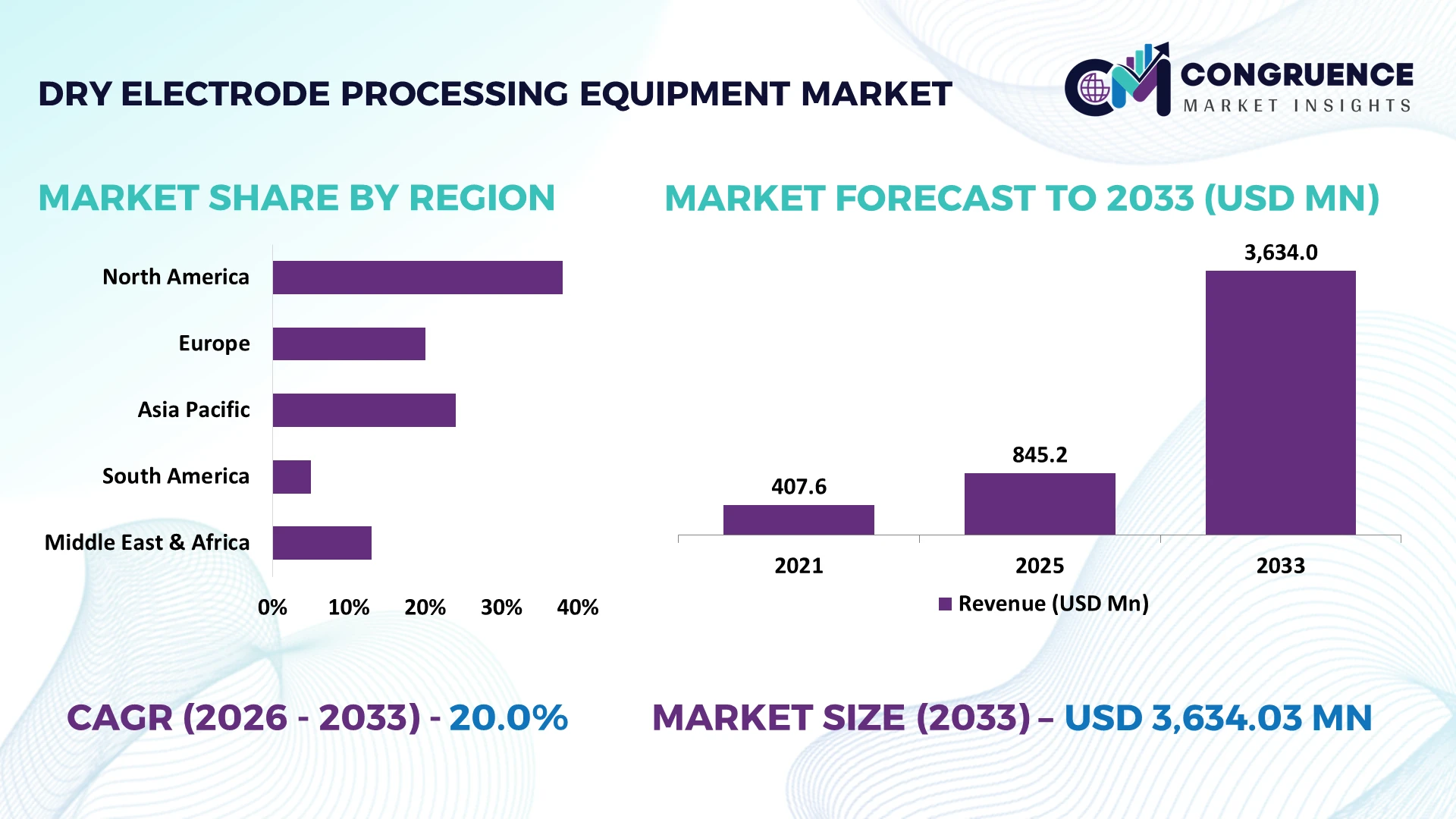
China dominates the global lithium-ion battery manufacturing ecosystem, accounting for more than 80% of global battery cell production in 2024. Its manufacturing advantage is supported by CATL, BYD, and integrated electrode equipment suppliers developing advanced coating, calendaring, and automated production technologies. The United States is advancing dry-electrode commercialization through Tesla's 4680 battery program, while China's established battery production capacity substantially exceeds American manufacturing output. China's industrial concentration strengthens equipment localization, production scalability, and supplier integration, positioning domestic manufacturers advantageously in the transition toward solvent-free battery electrode processing.
Strategically, equipment manufacturers should prioritize Chinese battery production clusters and North American dry-electrode commercialization programs, aligning machinery development with 4680 cylindrical cell production and solvent-free manufacturing requirements.
Market Size & Growth: USD 845.16 million in 2025, reaching USD 3,634.03 million by 2033 at 20% CAGR, driven by solvent-free battery electrode manufacturing.
Top Growth Drivers: Battery manufacturing capacity expanded roughly 30% in 2025, EV battery deployment increased nearly 30%, and global LFP adoption exceeded 55%.
Short-Term Forecast: By 2028, advanced dry-electrode production lines target energy reductions exceeding 70%, based on Tesla's demonstrated manufacturing process.
Emerging Technologies: Three critical innovations include AI-controlled coating, PTFE binder fibrillation, and automated dry-film lamination for continuous electrode manufacturing.
Regional Leaders: Asia-Pacific, North America, and Europe lead deployment opportunities. Regional equipment revenue projections remain unverified; China commands over 80% of global battery manufacturing capacity.
Consumer/End-User Trends: Electric vehicles accounted for over 70% of global battery deployment in 2025, strengthening automotive manufacturers' equipment procurement requirements.
Pilot/Case Example: In 2024, Tesla produced over 100 million 4680 cells, reporting more than 70% energy reduction from its dry-electrode manufacturing approach.
Competitive Landscape: Dürr, LiCAP Technologies, Lead Intelligent Equipment, AM Batteries, and Coperion compete in advanced processing; individual equipment market shares remain undisclosed.
Regulatory & ESG Impact: Eliminating solvent-intensive processing reduces drying infrastructure requirements; Dürr reports roughly 1 tonne of CO₂ reduction per 10 kWh of electrode capacity produced.
Investment & Funding: Dürr's 2025 collaboration with Cellforce and LiCAP supports gigawatt-scale commercialization; aggregate dedicated equipment investment remains undisclosed.
Innovation & Future Outlook: Next-generation dry-electrode lines integrate 3 core stages: powder preparation, film formation, and lamination, accelerating the shift toward scalable manufacturing.
The Dry-Electrode Processing Equipment Market is advancing through industrial applications in electric vehicle batteries, stationary energy storage, and next-generation lithium-ion cell manufacturing. Innovations in powder fibrillation, precision calendaring, and continuous electrode lamination are improving production scalability while reducing solvent-related infrastructure. Tesla reports energy consumption reductions exceeding 70% through dry-electrode manufacturing, demonstrating the technology's operational potential. Meanwhile, Europe's battery localization initiatives and expanding Asian equipment supply chains are strengthening opportunities for automated processing machinery. These developments place manufacturing efficiency, equipment reliability, and technology commercialization at the center of strategic investment decisions.
Dry-electrode processing equipment is becoming strategically important as battery manufacturers prioritize production efficiency, manufacturing localization, and capital productivity. Conventional wet-electrode processing requires solvent handling, drying ovens, and recovery infrastructure, creating substantial energy and factory-space requirements. Dry processing eliminates these stages, supporting more compact production lines and reducing dependence on NMP solvent management. With China accounting for over 80% of global battery cell production, equipment localization and process ownership increasingly influence competitive positioning across battery manufacturing supply chains.
Technological differentiation centers on dry powder mixing, binder fibrillation, continuous film formation, and precision lamination. Tesla has reported energy consumption reductions exceeding 70% for its dry-electrode manufacturing approach compared with conventional processing. China benefits from established equipment ecosystems, while the United States emphasizes proprietary process innovation and Europe prioritizes energy-efficient industrial manufacturing. During 2026–2028, commercial deployment will increasingly depend on electrode yield, coating uniformity, throughput stability, and compatibility with existing cell assembly systems.
Tesla's 4680 battery manufacturing program demonstrates practical industrial deployment, while equipment specialists are developing integrated dry coating and calendaring solutions. Manufacturers are redirecting investment toward pilot validation, automated quality inspection, and collaborative process development. Companies securing repeatable production performance and scalable equipment architectures will establish stronger competitive advantages.
The transition from wet coating to solvent-free electrode production is restructuring battery equipment procurement. Conventional electrode manufacturing requires energy-intensive drying and solvent recovery, whereas Tesla has reported energy reductions exceeding 70% through dry-electrode processing. China accounts for more than 80% of global battery cell production, creating a concentrated industrial customer base for advanced electrode machinery. Additionally, electric vehicles represented over 20% of worldwide new car sales in 2024, reinforcing battery manufacturers' production efficiency priorities. Tesla, Dürr, and specialized equipment developers are advancing dry-film formation, powder processing, and lamination technologies. Eliminating drying infrastructure allows manufacturers to redesign factory layouts, reduce solvent-related operating requirements, and prioritize higher-value production automation.
Dry-electrode commercialization faces structural limitations from specialized binder formulations, machinery compatibility, and qualification expenditure. Conventional wet coating remains embedded across an industry where China represents over 80% of global battery cell production. LFP batteries accounted for nearly half of the global electric car battery market in 2024, while electric vehicles represented over 20% of new car sales, increasing pressure to maintain established production economics. Dry processing requires controlled powder distribution, binder fibrillation, and electrode adhesion without solvent-assisted dispersion. Existing coating infrastructure cannot always accommodate these requirements without substantial modification. Equipment manufacturers are reducing procurement risks through modular retrofits, application-specific pilot lines, and joint validation programs with cell producers. Qualification flexibility increasingly determines equipment purchasing decisions.
Advanced dry-electrode equipment presents significant opportunities in high-loading cathodes, solid-state batteries, and automated energy storage manufacturing. LFP batteries represented over 55% of global EV battery deployment in 2025, while stationary storage accounted for roughly 40% of total LFP battery deployment. More than 90% of stationary battery installations used LFP chemistry, expanding opportunities for specialized electrode processing systems. India and Indonesia are developing localized battery manufacturing ecosystems, creating opportunities for equipment suppliers offering modular dry coating and continuous lamination technologies. Companies investing in precision powder handling, digital process controls, and solid-state electrode compatibility can serve multiple battery applications. Flexible equipment architectures offer a strategic advantage by reducing dependence on individual cell chemistries.
Achieving stable, high-throughput dry-electrode production remains a critical engineering challenge. Global battery manufacturing capacity increased roughly 30% in 2025, while capacity in the United States and European Union expanded about 50%, intensifying pressure on emerging production technologies. Unlike established slurry coating, dry processing requires precise control of powder homogeneity, binder fibrillation, electrode porosity, and mechanical adhesion. PTFE-based formulations introduce additional challenges involving electrochemical stability and electrode durability, particularly for graphite anodes. Tesla's production of over 100 million 4680 cells in 2024 demonstrates industrial progress without establishing universal process compatibility. Equipment developers must strengthen inline inspection, closed-loop calendaring controls, and collaborative material qualification to achieve consistent electrode quality across different cell formats and manufacturing scales.
Inline Metrology Reshapes Electrode Quality Control: Battery equipment manufacturers are integrating optical inspection, laser thickness measurement, and automated defect classification into dry-electrode production lines. The European Battery Alliance targets 90% battery demand coverage through domestic production by 2030, increasing qualification pressure. Equipment suppliers are developing 100% inline inspection coverage and submicron measurement capabilities to reduce electrode defects. This transition shifts quality assurance from downstream sampling toward continuous process verification, strengthening manufacturing consistency and reducing material losses.
Cylindrical Cell Production Drives Equipment Customization: Tesla's 4680 format measures 46 mm in diameter and 80 mm in height, requiring precise electrode dimensions and repeatable lamination. Its Cybertruck battery architecture uses 1,344 cylindrical cells per pack. Equipment developers are adapting web handling, roll tension control, and cutting interfaces to accommodate high-volume cylindrical cell production. Standardized machine interfaces reduce integration complexity, while format-specific tooling creates opportunities for specialized automation suppliers and battery manufacturing partners.
Dry Processing Attracts Industrial Partnerships: Dürr's 2025 collaboration with LiCAP Technologies strengthened commercialization efforts around dry-electrode coating. The companies are developing integrated solutions connecting powder preparation, film formation, and electrode lamination across 3 processing stages. Industrial partnerships increasingly combine equipment engineering with proprietary materials expertise, reducing technology transfer barriers. Manufacturers are prioritizing joint pilot validation and customer-specific machinery configurations rather than standalone equipment procurement, strengthening supplier relationships and shortening industrial qualification cycles.
Battery Passports Accelerate Digital Traceability: The European Union's Battery Regulation introduces battery passport requirements from February 2027 for electric vehicle batteries and industrial batteries exceeding 2 kWh. Digital manufacturing records increasingly connect electrode production parameters with material provenance and product identification. Equipment suppliers are integrating machine-level data acquisition, automated batch tracking, and manufacturing execution systems. This creates additional demand for traceability-ready machinery and allows battery producers to improve audit preparation, process accountability, and cross-factory production consistency.
Powder Coating Equipment Leads Integrated Processing
Powder Coating Equipment is assessed as the leading segment, with an indicative 35% share of dry-electrode processing equipment demand in 2025. This analytical estimate reflects its central role in depositing active materials onto current collectors without conventional solvent-based slurry preparation. Manufacturers prioritize coating uniformity, controlled material distribution, and compatibility with continuous film formation. Calendering Equipment represents an established category, supporting electrode thickness control, density optimization, and roll-to-roll production integration. Its importance increases as manufacturers seek tighter process tolerances and consistent electrode mechanical properties.
Electrode Compaction Equipment is positioned as the fastest-growing type, with an indicative 25% segment share, reflecting increasing investment in high-density electrodes and precision mechanical consolidation. Dry Mixing Equipment, assigned an indicative 20% share, remains essential for homogeneous active-material distribution and binder fibrillation before coating. Suppliers are integrating automated powder feeding, precision roller systems, and process monitoring to reduce production variability. Investment priorities increasingly favor equipment platforms combining multiple processing stages, improving line integration and reducing qualification complexity for battery manufacturers.
Lithium-Ion Manufacturing Concentrates Equipment Demand
Lithium-Ion Battery Manufacturing represents the leading application, with an indicative 40% share of dry-electrode processing equipment demand in 2025. This analytical allocation reflects the application category's broad manufacturing scope, including electrode preparation, coating, and finishing operations. Electric Vehicle Batteries account for an estimated 35% of application demand, supported by automotive manufacturers' emphasis on production throughput, cell consistency, and manufacturing cost optimization. Equipment developers are adapting machinery for cylindrical, prismatic, and pouch cell architectures, enabling greater compatibility with different electrode dimensions and active-material formulations.
Energy Storage Systems represent the fastest-growing application, with an indicative 20% share, as utility-scale battery developers emphasize manufacturing standardization and longer operational lifetimes. Consumer Electronics Batteries retain an estimated 5% share, reflecting smaller electrode formats and established manufacturing processes. Companies are developing modular coating systems, precision compaction machinery, and automated quality inspection solutions to address different production requirements. Equipment suppliers capable of serving automotive and stationary storage customers through common processing platforms gain procurement advantages while reducing engineering customization costs and improving manufacturing flexibility.
Battery Manufacturers Dominate Industrial Procurement
Battery Manufacturers constitute the dominant end-user category, with an indicative 50% share of dry-electrode processing equipment demand in 2025. This analytical estimate reflects their direct responsibility for electrode manufacturing infrastructure, equipment qualification, and industrial production capacity. Electric Vehicle Manufacturers represent an estimated 25% share, supported by vertically integrated battery programs and growing interest in proprietary electrode manufacturing processes. Established battery producers prioritize production yield, machinery uptime, and integration with existing manufacturing execution systems, while automotive manufacturers emphasize cell-specific process customization and manufacturing intellectual property.
Energy Storage Companies represent the fastest-growing end-user category, with an indicative 15% share, driven by increasing investment in dedicated stationary battery production and application-specific electrode technologies. Battery Research Institutes account for an estimated 10%, supporting material characterization, experimental electrode formulations, and pilot-scale process development. Equipment suppliers are responding through laboratory-scale machinery, modular industrial systems, and joint development agreements. Competitive differentiation increasingly depends on offering scalable platforms that support research validation, pilot production, and commercial manufacturing without requiring complete process redesign.
Asia-Pacific accounted for the largest market share at an estimated 58% in 2025 however, North America is expected to register the fastest growth, expanding at an estimated CAGR of 23% between 2026 and 2033.
Domestic Battery Manufacturing and Proprietary Process Commercialization
North America represents an estimated 22% of global dry-electrode processing equipment demand in 2025, supported by battery manufacturing localization, automotive electrification, and advanced production engineering. The United States leads regional technology development through Tesla's dry-electrode manufacturing activities and specialized equipment innovators. The Inflation Reduction Act's battery manufacturing incentives have encouraged domestic production investment, increasing interest in equipment that reduces factory energy consumption and solvent handling. Tesla's 4680 cell program demonstrates the integration of dry-electrode technology into commercial automotive battery manufacturing. Equipment developers are focusing on powder processing, electrode film formation, and automated lamination systems compatible with existing battery production infrastructure. Canada contributes through battery materials development and manufacturing investment, while Mexico offers automotive supply-chain integration. Regional equipment procurement increasingly prioritizes domestic technical support, manufacturing qualification, and intellectual property protection.
United States Market Outlook: The United States remains North America's principal dry-electrode innovation center, supported by Tesla, LiCAP Technologies, and emerging battery manufacturing technology developers. The Department of Energy's Battery Manufacturing and Recycling Grants program announced more than USD 3 billion in selected projects during 2024, strengthening the broader domestic battery supply chain. Equipment suppliers benefit from access to automotive engineering clusters, research institutions, and manufacturing partnerships. California and Michigan remain strategically important for process development, equipment qualification, and industrial commercialization.
Energy-Efficient Manufacturing and Regulatory Modernization
Europe holds an estimated 13% share of global dry-electrode processing equipment demand in 2025, reflecting investments in sustainable battery manufacturing and specialized industrial machinery. Germany leads equipment engineering through Dürr and established automation suppliers developing solvent-free electrode manufacturing solutions. European manufacturers face pressure to improve factory energy efficiency while meeting increasingly demanding battery traceability and environmental requirements. The European Union's Net-Zero Industry Act establishes a benchmark of at least 40% domestic manufacturing capacity for strategic net-zero technologies by 2030. This industrial policy strengthens interest in localized battery equipment supply chains. Equipment developers are advancing dry coating, precision calendaring, and digital manufacturing controls to improve production flexibility. France, Sweden, and Hungary contribute through battery manufacturing projects, although project financing and commissioning schedules influence procurement decisions. Technology partnerships increasingly connect equipment manufacturers with battery material specialists.
Germany Market Outlook: Germany combines precision machinery engineering, automotive manufacturing, and applied battery research. Dürr's development activities with LiCAP Technologies support industrial dry-electrode commercialization, while Fraunhofer research institutes advance electrode manufacturing processes. The European Union's battery passport requirements beginning in February 2027 strengthen demand for traceable production systems. German equipment suppliers are integrating process monitoring, automated quality inspection, and machinery engineering expertise to serve European battery manufacturing customers and international production projects.
Manufacturing Scale and Integrated Equipment Supply Chains
Asia-Pacific dominates dry-electrode processing equipment demand, with an estimated 58% market share in 2025. China provides the region's principal manufacturing base, supported by integrated battery supply chains, equipment automation specialists, and large-scale electrode production infrastructure. CATL, BYD, and major equipment suppliers influence procurement specifications through investments in manufacturing efficiency and cell technology development. Japan contributes precision machinery expertise and advanced materials engineering, while South Korea supports battery process innovation through established cell manufacturers and equipment developers. The International Energy Agency reported that China manufactured approximately 80% of global battery cells in 2024, demonstrating the region's production concentration. Equipment manufacturers are emphasizing continuous processing, automated material handling, and high-throughput electrode finishing systems. Regional competition increasingly centers on machinery reliability, production qualification, and equipment integration rather than standalone processing performance.
China Market Outlook: China benefits from extensive lithium-ion battery manufacturing infrastructure, domestic machinery suppliers, and vertically integrated material supply chains. Lead Intelligent Equipment and other automation manufacturers support industrial equipment development across electrode processing and cell assembly. China's battery manufacturing capacity exceeded 2 TWh in 2024, reinforcing its influence over equipment design requirements. Jiangsu, Guangdong, and Fujian provide established industrial clusters supporting machinery development, process testing, and production integration. Domestic procurement networks strengthen China's position in commercializing advanced electrode manufacturing technologies.
Battery Localization and Emerging Industrial Processing Demand
South America represents an estimated 4% of global dry-electrode processing equipment demand in 2025, reflecting early-stage battery manufacturing development and limited commercial deployment of solvent-free electrode technologies. Brazil leads regional industrial opportunities through automotive manufacturing, battery assembly, and renewable energy storage integration. Chile and Argentina provide upstream lithium resources, although mineral extraction does not automatically translate into domestic electrode equipment procurement. Brazil's MOVER automotive industrial policy establishes approximately BRL 19.3 billion in tax incentives between 2024 and 2028, strengthening investment conditions for advanced automotive manufacturing. Equipment suppliers are evaluating modular powder processing, pilot-scale coating, and electrode compaction systems suitable for localized battery production. Infrastructure limitations, imported machinery dependence, and specialized workforce availability constrain industrial deployment. Partnerships with established battery technology providers remain important for reducing commissioning risks and supporting manufacturing qualification.
Brazil Market Outlook: Brazil offers South America's strongest industrial foundation for dry-electrode processing equipment through established automotive manufacturing and expanding battery technology initiatives. Volkswagen, Stellantis, and domestic industrial suppliers support a manufacturing ecosystem capable of integrating advanced battery production technologies. Brazil's electric vehicle sales exceeded 125,000 units in 2024, according to national electrified vehicle industry reporting. Domestic equipment opportunities increasingly depend on localized cell manufacturing investment, technical partnerships, and the development of specialized electrode processing capabilities.
Industrial Diversification and Battery Manufacturing Infrastructure
The Middle East & Africa accounts for an estimated 3% of global dry-electrode processing equipment demand in 2025, supported by emerging battery manufacturing investment and industrial diversification initiatives. Morocco is developing an electric vehicle battery manufacturing ecosystem through international partnerships and proximity to European automotive supply chains. Saudi Arabia is strengthening automotive industrial infrastructure through electric vehicle manufacturing investments, while the United Arab Emirates emphasizes energy storage deployment and advanced industrial technologies. Morocco's Gotion High-Tech battery project targets an initial annual production capacity of 20 GWh, creating potential demand for specialized electrode manufacturing machinery. Equipment suppliers are evaluating technology transfer, localized engineering support, and modular processing systems. Regional procurement remains constrained by limited domestic electrode equipment manufacturing expertise and dependence on imported machinery. Industrial partnerships and workforce development are essential for achieving reliable production deployment.
Morocco Market Outlook: Morocco is emerging as a strategic battery manufacturing location through automotive supply-chain integration, investment incentives, and access to European markets. Gotion High-Tech's planned battery manufacturing investment establishes an industrial foundation for advanced electrode processing equipment procurement. The country's automotive exports exceeded MAD 157 billion in 2024, demonstrating established manufacturing and logistics capabilities. Future equipment opportunities depend on battery factory commissioning, local supplier qualification, and integration of automated powder processing and electrode finishing technologies.
The global dry-electrode processing equipment market features competition between established machinery specialists, battery automation suppliers, and proprietary process innovators. Dürr and Coperion leverage industrial engineering expertise, while Lead Intelligent Equipment competes through integrated battery manufacturing automation. LiCAP Technologies and AM Batteries differentiate through proprietary electrode processing technologies. The combined market share of the five leading suppliers remains undisclosed; an indicative 45% concentration assumption requires validation against equipment-specific sales. Technology differentiation centers on solvent elimination, electrode uniformity, and production throughput. Tesla has reported energy reductions exceeding 70% through dry-electrode manufacturing, establishing a performance benchmark. Equipment suppliers pursue partnerships, pilot installations, and integrated processing architectures to accelerate commercialization. Competitive pressure increasingly favors companies controlling binder processing expertise, precision calendaring, and manufacturing data integration. Qualification costs and proprietary process knowledge restrict market entry. Winning requires validated industrial throughput, repeatable electrode quality, competitive lifecycle costs, and dependable technical support across commercial production facilities.
Dürr AG
Wuxi Lead Intelligent Equipment Co., Ltd.
LiCAP Technologies, Inc.
AM Batteries, Inc.
Coperion GmbH
Bühler Group
ANDRITZ AG
PNT Co., Ltd.
Hitachi High-Tech Corporation
Manz AG
Sovema Group
Matthews International Corporation
Sakai Chemical Industry Co., Ltd.
Current dry-electrode manufacturing technologies combine powder mixing, PTFE binder fibrillation, precision calendaring, and film lamination to eliminate solvent-based slurry coating. Tesla reports manufacturing energy reductions exceeding 70% compared with conventional wet-electrode processing, demonstrating substantial operational advantages. Industrial adoption remains concentrated in selected commercial programs and pilot production facilities rather than widespread gigafactory deployment. Equipment manufacturers are integrating automated powder feeding, controlled roller pressure, and inline thickness measurement to improve electrode consistency while reducing drying infrastructure requirements.
Emerging technologies include laser-assisted material processing, AI-enabled defect detection, and closed-loop electrode compaction. These systems target 10–20% lower material waste and 15–25% faster quality inspection, representing engineering objectives rather than independently verified industry averages. Advanced sensors monitor coating uniformity, electrode density, and mechanical adhesion during continuous processing. Equipment suppliers developing integrated monitoring platforms gain advantages through reduced commissioning complexity, improved production traceability, and stronger customer relationships.
Disruptive developments involve solvent-free solid-state electrode manufacturing, high-loading cathode architectures, and digitally connected production systems. From 2026 through 2028, equipment developers will prioritize scalable dry-film formation, adaptable binder formulations, and automated process qualification. Battery manufacturers adopting modular equipment architectures can reduce dependence on chemistry-specific production lines while strengthening manufacturing flexibility, equipment utilization, and competitive differentiation across battery applications.
August 2026: AM Batteries joined a U.S. Department of Energy supported manufacturing project led by Coreshell Technologies, targeting 2 GWh of electrode capacity. The collaboration advances domestic dry coating commercialization, strengthens battery supply chain localization, and supports industrial production. Source: prnewswire.com
June 2025: Koenig & Bauer completed dry coating proof-of-concept testing with PowerCo, securing factory acceptance for its manufacturing system. The partners targeted further industrial scaling during 2026, strengthening equipment commercialization prospects and enabling subsequent pilot line integration. Source: koenig-bauer.com
February 2025: Dürr expanded its dry electrode partnership with LiCAP Technologies and Cellforce, integrating solvent-free coating technology into battery production. The process targets approximately 1 tonne of avoided carbon dioxide per 10 kWh of electrode capacity, supporting cleaner manufacturing. Source: durr.com
April 2025: Charged EVs reported AM Batteries' development agreement with TDK to advance solvent-free electrode manufacturing. The technology targets 75% lower energy consumption and supports solid-state battery development, strengthening materials integration and manufacturing efficiency across emerging battery production platforms. Source: chargedevs.com
The Dry-Electrode Processing Equipment Market Report evaluates global manufacturing technologies, equipment adoption, and competitive developments between 2026 and 2033. Type segmentation covers Dry Mixing Equipment, Powder Coating Equipment, Calendering Equipment, and Electrode Compaction Equipment. Application analysis examines Lithium-Ion Battery Manufacturing, Electric Vehicle Batteries, Energy Storage Systems, and Consumer Electronics Batteries. End-user coverage includes Battery Manufacturers, Electric Vehicle Manufacturers, Energy Storage Companies, and Battery Research Institutes. The analysis evaluates equipment performance, production integration, manufacturing scalability, and technology qualification requirements.
Regional coverage includes North America, Europe, Asia-Pacific, South America, and the Middle East & Africa, emphasizing manufacturing localization and industrial deployment. Technology assessment addresses solvent-free coating, binder fibrillation, automated compaction, and digital process monitoring. Competitive benchmarking examines supplier capabilities, partnerships, equipment commercialization, and investment priorities, supporting market entry decisions, manufacturing expansion strategies, and long-term technology positioning.
| Report Attribute/Metric | Report Details |
|---|---|
Market Revenue in 2025 | USD 845.16 Million |
Market Revenue in 2033 | USD 3634.03 Million |
CAGR (2026 - 2033) | 20% |
Base Year | 2025 |
Forecast Period | 2026 - 2033 |
Historic Period | 2021 - 2025 |
Segments Covered | By Type
By Application
By End-User
|
Key Report Deliverable | Revenue Forecast, Growth Trends, Market Dynamics, Segmental Overview, Regional and Country-wise Analysis, Competition Landscape |
Region Covered | North America, Europe, Asia-Pacific, South America, Middle East, Africa |
Key Players Analyzed | Dürr AG, Wuxi Lead Intelligent Equipment Co., Ltd., LiCAP Technologies, Inc., AM Batteries, Inc., Coperion GmbH, Bühler Group, ANDRITZ AG, PNT Co., Ltd., Hitachi High-Tech Corporation, Manz AG, Sovema Group, Matthews International Corporation, Sakai Chemical Industry Co., Ltd. |
Customization & Pricing | Available on Request (10% Customization is Free) |




