
Reports
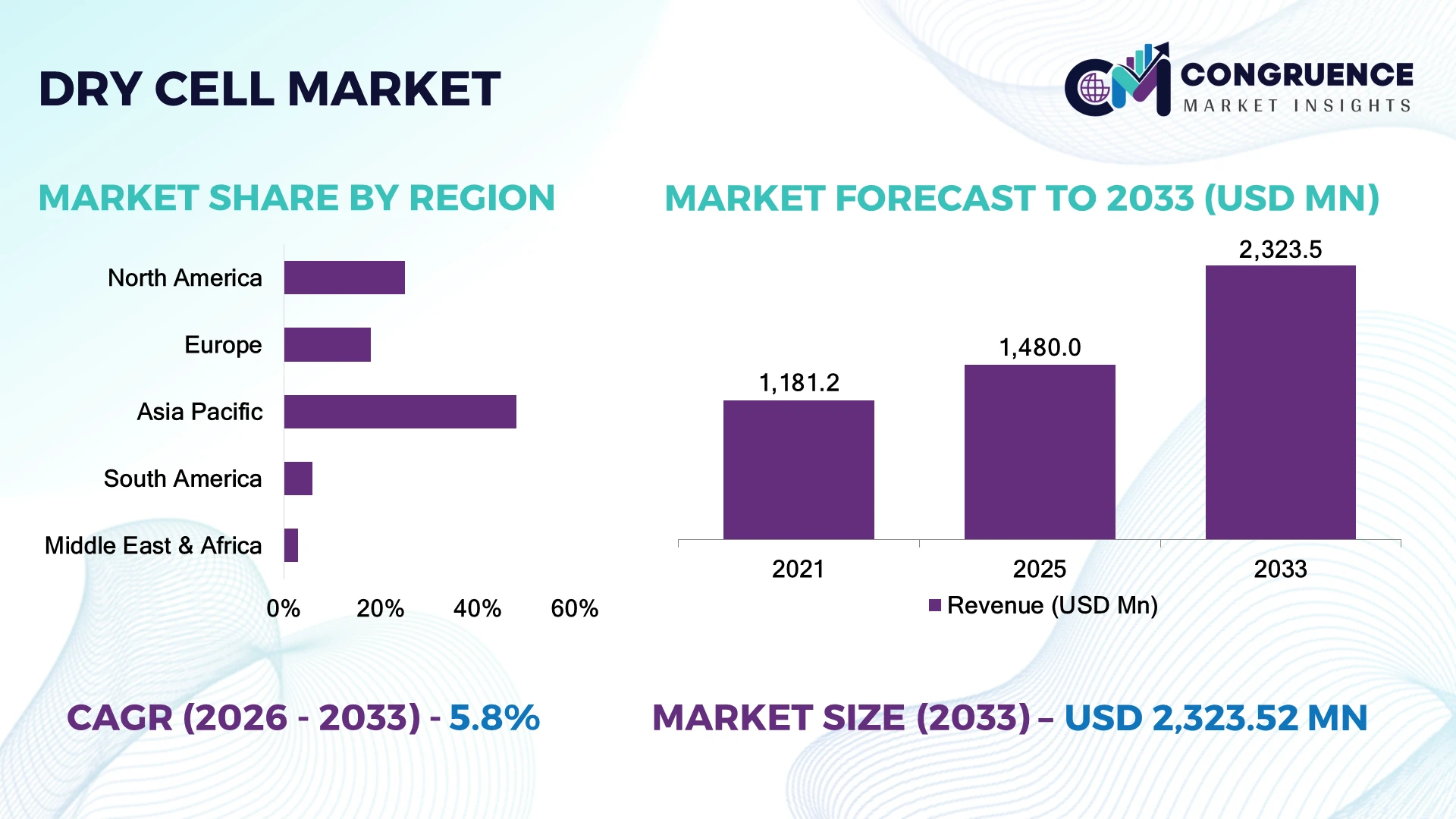
The Global Dry Cell Market was valued at USD 1,480.0 Million in 2025 and is anticipated to reach a value of USD 2,323.5 Million by 2033 expanding at a CAGR of 5.8% between 2026 and 2033. Growth is driven by rising adoption of alkaline and zinc-carbon batteries in portable electronics, smart home devices, industrial sensors, and emergency power systems.
China dominates dry cell production, accounting for nearly 35% of global battery manufacturing capacity, supported by large-scale alkaline battery plants, electronics exports, and supply-chain integration. The country’s investment in automated battery production has improved manufacturing efficiency by over 20%, while Japan focuses on premium battery technologies with approximately 15% global capacity contribution. Compared with India’s expanding consumer battery sector, China maintains stronger export infrastructure and material access.
Companies are prioritizing localized production networks and advanced battery chemistry investments to strengthen supply resilience.
Market Size & Growth: USD 1.48 Billion (2025) to USD 2.32 Billion (2033) at 5.8% CAGR, supported by rising adoption of alkaline batteries and portable power solutions.
Top Growth Drivers: Portable electronics (30%), industrial automation (25%), and smart devices (20%) are the leading demand contributors.
Short-Term Forecast: By 2028, automation in battery manufacturing improves production efficiency by 15% and reduces operational waste by 10%.
Emerging Technologies: Advanced alkaline formulations, automated manufacturing, and AI-enabled quality inspection are reshaping global dry cell production.
Regional Leaders: Asia-Pacific reaches USD 1.1 Billion with electronics expansion; North America reaches USD 650 Million with smart device adoption; Europe reaches USD 450 Million with sustainable battery initiatives.
Consumer/End-User Trends: Over 60% of household battery usage comes from remote controls, toys, clocks, and consumer electronics applications.
Pilot/Case Example: In 2024, automated battery inspection systems reduced manufacturing defects by 18% in large-scale production facilities.
Competitive Landscape: Duracell leads with approximately 15% market share, followed by Energizer, Panasonic, GP Batteries, and VARTA.
Regulatory & ESG Impact: Recycling programs improve battery recovery rates by more than 25%, supporting circular economy initiatives across major markets.
Investment & Funding: Over USD 500 Million invested in battery manufacturing upgrades and supply-chain expansion, driven by automation and localization strategies.
Innovation & Future Outlook: Next-generation dry cells focus on longer shelf life, improved energy density, and sustainable material integration for future applications.
Dry Cell Market development is increasingly influenced by demand from consumer electronics, industrial monitoring equipment, and low-maintenance power applications. Innovations in leakage prevention, extended shelf-life designs, and improved electrode materials are strengthening product performance, with premium battery adoption increasing by nearly 18%. Global manufacturers are restructuring supply chains following logistics disruptions and increasing investments in automated production facilities, creating a transition toward more efficient and reliable dry cell ecosystems.
The Dry Cell Market is becoming strategically important as industries require dependable, low-cost, and widely available energy sources for distributed electronics, monitoring systems, and consumer applications. Supply-chain restructuring after global disruptions has encouraged manufacturers to diversify production locations, strengthen material sourcing, and expand regional manufacturing capabilities.
Battery producers are shifting from traditional zinc-carbon designs toward advanced alkaline technologies that deliver approximately 25–40% longer operating life and improved leakage resistance compared with older formulations. While China maintains leadership through large-scale manufacturing and integrated supply networks, countries such as India and Vietnam are gaining importance through electronics assembly growth and localized battery production initiatives.
Operational deployments in smart meters, industrial sensors, and emergency devices are increasing, with manufacturers investing in automation, digital quality control, and strategic partnerships. Companies are also improving sustainability through recycling programs and reduced material waste. Over the next 2–3 years, competitive advantage will depend on manufacturing flexibility, cost-efficient production, and the ability to deliver reliable battery solutions across consumer and industrial ecosystems.
Increasing usage of portable electronics, industrial sensors, and connected devices is accelerating dry cell adoption globally. Consumer electronics represent nearly 40% of application demand, while industrial equipment usage is growing by more than 15% annually in several manufacturing markets. The expansion of smart monitoring systems and remote devices is creating consistent demand for reliable primary batteries. Companies such as Duracell, Energizer, and Panasonic are responding through improved alkaline formulations, automated production lines, and supply-chain expansion. China’s electronics manufacturing ecosystem and India’s growing device assembly sector are strengthening battery consumption. The strategic shift toward longer-lasting batteries is improving customer value while reducing replacement frequency.
Dry cell manufacturers face pressure from fluctuating zinc, manganese dioxide, and steel component costs, with raw material variations affecting production margins by nearly 10–15%. Dependence on concentrated mining and chemical supply networks creates vulnerability during geopolitical disruptions and transportation constraints. European manufacturers face additional compliance pressure due to stricter battery waste and chemical regulations. Companies are reducing exposure through supplier diversification, long-term procurement agreements, and localized sourcing strategies. The key operational challenge is maintaining affordable pricing while investing in sustainable production methods and meeting evolving environmental requirements.
Growing deployment of smart sensors, IoT devices, and low-power electronics creates new opportunities for advanced dry cell solutions. Industrial battery applications are expanding as factories increase automation adoption by more than 20% across major manufacturing hubs. Manufacturers are developing improved alkaline chemistries with higher energy retention, longer shelf life, and enhanced safety performance. India’s smart infrastructure programs and Southeast Asia’s electronics expansion are opening new demand channels. Companies are positioning through R&D partnerships, localized production, and product innovation focused on specialized applications such as medical devices, security systems, and remote monitoring equipment.
Long-term competitiveness depends on improving recycling systems, material recovery, and sustainable battery manufacturing practices. Currently, global household battery recycling rates remain below 50% in many markets, creating environmental pressure and increasing demand for circular economy solutions. Manufacturers face challenges in collection networks, consumer awareness, and regulatory alignment across countries. Companies must invest in recycling partnerships, eco-friendly materials, and improved lifecycle management. The transition toward sustainable dry cell production requires coordinated action between battery producers, governments, and waste management operators to maintain operational consistency and strengthen market positioning.
Automation-Driven Production Shift Dry cell manufacturers are accelerating factory automation, with automated inspection, robotic assembly, and digital quality monitoring reducing production defects by 15–20% and improving throughput by nearly 25%. Companies in China, Japan, and South Korea are expanding smart manufacturing lines to address labor shortages and improve consistency. This operational transition is enabling faster product customization, lower rejection rates, and stronger competitiveness in high-volume battery markets.
Supply Chain Localization Growth Battery producers are restructuring supply networks after global logistics disruptions, with regional sourcing initiatives increasing component localization by 20–30% across major manufacturing hubs. India and Southeast Asian countries are attracting new battery assembly investments as companies diversify beyond concentrated supply chains. Manufacturers are forming supplier partnerships for zinc, manganese materials, and packaging components to reduce lead times and improve production resilience.
Advanced Alkaline Innovation Adoption Companies are investing in enhanced alkaline formulations, improved separators, and leakage-resistant designs that extend battery performance by 20–35% compared with conventional dry cells. Premium consumer segments are adopting these technologies for cameras, gaming devices, and smart accessories. Leading manufacturers are focusing on material optimization and product differentiation as consumers increasingly prioritize longer operating life and reliability.
Sustainability Compliance Expansion Environmental regulations are reshaping dry cell manufacturing, with recycling initiatives improving collection efficiency by more than 25% in developed markets. European battery waste policies and corporate sustainability targets are driving investments in recovery systems and eco-friendly materials. Companies are partnering with recycling organizations and redesigning packaging processes to reduce environmental impact while maintaining cost efficiency.
Alkaline batteries represent the leading dry cell type, accounting for approximately 55% of the market, supported by superior energy density, longer shelf life, and broad compatibility across consumer electronics and industrial devices. Their ability to deliver 30–40% longer operational performance than traditional zinc-carbon batteries has strengthened adoption in premium household and commercial applications. Zinc-carbon batteries remain important in cost-sensitive markets due to affordability, while lithium primary dry cells are gaining attention for specialized applications requiring higher energy retention. Lithium dry cells are the fastest-growing segment, driven by demand from medical devices, smart sensors, and advanced electronic equipment requiring compact power solutions. Adoption is increasing by nearly 15–20% annually in niche applications as manufacturers improve safety and reduce costs. Companies are prioritizing advanced electrode materials, product diversification, and strategic partnerships to capture emerging high-performance battery opportunities.
Consumer electronics dominate dry cell applications, contributing approximately 45% market share due to widespread use in remote controls, toys, clocks, cameras, and personal devices. High replacement frequency and household dependence support steady demand, with battery-powered consumer products accounting for more than 60% of everyday dry cell usage. Industrial equipment applications are expanding as factories deploy wireless sensors, monitoring systems, and backup devices requiring reliable primary batteries. The fastest-growing application segment is smart and industrial monitoring, increasing adoption by nearly 20% as manufacturers integrate IoT-enabled equipment and automation systems. Healthcare devices, security systems, and emergency equipment are also creating new demand channels. Companies are adapting through specialized battery designs, longer-life products, and partnerships with device manufacturers to improve integration efficiency and reduce maintenance requirements.
The consumer electronics sector leads dry cell consumption with approximately 50% market share, driven by extensive household usage, retail availability, and replacement demand. Large consumer brands prioritize reliable battery performance for everyday devices, while industrial users increasingly adopt dry cells for sensors, control systems, and portable equipment. Consumer demand remains concentrated in developed markets, while emerging economies continue expanding battery usage through rising electronics ownership. Industrial and commercial users represent the fastest-growing end-user segment, with adoption increasing by nearly 18% due to automation, smart infrastructure, and remote monitoring requirements. Enterprises are shifting toward higher-quality batteries that reduce maintenance cycles and improve operational continuity. Manufacturers are responding with customized product portfolios, bulk supply agreements, and partnerships with equipment providers to strengthen industrial penetration.
Asia-Pacific accounted for the largest market share at 48% in 2025 however, North America is expected to register the fastest growth, expanding at a CAGR of 6.4% between 2026 and 2033.
North America held approximately 25% of the global dry cell market in 2025, supported by strong consumer electronics usage, industrial automation deployment, and demand for reliable portable power solutions. The United States represents the largest regional contributor due to advanced retail networks, defense applications, and smart device penetration. Industrial facilities are increasingly deploying wireless sensors and monitoring systems, with automation adoption rising by more than 20% across manufacturing sectors. Battery producers are expanding domestic supply partnerships and improving automated quality-control systems to strengthen operational resilience. Recycling infrastructure investments are also increasing as companies align with sustainability requirements and circular battery initiatives.
United States Market Outlook: The United States remains the strategic hub for dry cell consumption due to high electronics ownership and industrial equipment deployment. More than 80% of households use battery-powered devices regularly, supporting consistent replacement demand. Companies are focusing on advanced alkaline products, domestic distribution expansion, and partnerships with electronics manufacturers to improve market reach.
Europe accounted for nearly 18% of the global dry cell market in 2025, with demand shaped by consumer electronics, industrial equipment, and strict environmental compliance frameworks. Countries such as Germany, France, and the United Kingdom are strengthening battery recycling systems and encouraging sustainable manufacturing practices. European manufacturers are increasing investments in material recovery technologies, with recycling efficiency improvements exceeding 25% in several advanced markets. The region is experiencing stronger adoption of premium batteries with improved safety and extended shelf life. Companies are restructuring supply chains and developing eco-conscious product portfolios to comply with evolving battery waste regulations while maintaining competitive pricing.
Germany Market Outlook: Germany leads Europe’s industrial battery demand due to its advanced manufacturing base and automation ecosystem. Over 30% of European industrial automation installations are concentrated in Germany, creating opportunities for dry cell applications in sensors, control devices, and monitoring equipment. Manufacturers are emphasizing sustainable production and strategic supplier partnerships.
Asia-Pacific dominated the global dry cell market with approximately 48% share in 2025, driven by large-scale production capacity, electronics manufacturing, and expanding consumer markets. China, Japan, South Korea, and India represent major contributors through integrated supply chains and high-volume battery production. China accounts for nearly 35% of global dry cell manufacturing capacity, supported by automated factories and strong material availability. India is experiencing rising demand from consumer electronics and infrastructure applications, with battery consumption increasing alongside device ownership growth. Companies are expanding production facilities, improving automation, and establishing regional supply networks to reduce logistics risks and support growing domestic demand.
China Market Outlook: China remains the largest manufacturing center for dry cells, supported by extensive electronics production and export capabilities. The country’s automated battery facilities have improved production efficiency by more than 20%, enabling competitive pricing and high-volume output. Manufacturers continue investing in advanced materials, quality control systems, and supply-chain integration.
South America represents an emerging dry cell market supported by increasing electronics penetration, retail expansion, and demand from household applications. Brazil and Argentina account for major regional consumption due to larger populations and growing device ownership. The region contributes approximately 6% of global dry cell demand, with household applications representing more than 60% of usage. Infrastructure limitations and dependence on imported battery products influence supply consistency and pricing. Companies are strengthening distribution partnerships, improving inventory management, and expanding local sales networks to address demand across urban and semi-urban markets.
Brazil Market Outlook: Brazil is the largest dry cell market in South America due to its consumer electronics base and extensive retail ecosystem. Battery-powered household devices account for a significant share of local consumption, while companies are improving logistics networks and partnerships with regional distributors to enhance product availability.
The Middle East & Africa dry cell market is expanding through infrastructure development, telecommunications growth, and increasing demand for portable power solutions. The region contributes nearly 3% of global dry cell consumption, with demand concentrated in household devices, security systems, and remote equipment. Countries investing in smart infrastructure and digital services are increasing adoption of reliable battery-powered technologies. The United Arab Emirates and Saudi Arabia are improving technology infrastructure, while African markets are experiencing growth through expanding consumer electronics access. Companies are strengthening distribution channels, forming regional partnerships, and adapting product offerings for diverse operating environments.
Saudi Arabia Market Outlook: Saudi Arabia is emerging as a key regional market due to infrastructure modernization programs and increasing technology deployment. Smart city initiatives are expanding demand for sensors, security systems, and portable devices. Companies are targeting the market through strategic partnerships, improved supply networks, and customized battery solutions.
The dry cell market features competition between global battery leaders such as Duracell, Energizer, Panasonic, and VARTA against regional manufacturers and cost-focused suppliers including GP Batteries and Chinese producers. The top five players collectively control approximately 45% of the market, creating a moderately consolidated structure. Competition is based on product reliability, pricing efficiency, manufacturing scale, and distribution strength. Premium alkaline producers achieve 20–30% longer operational life than conventional alternatives, while cost leaders compete through high-volume production and supply-chain optimization. Companies are expanding automated facilities, forming retail partnerships, and improving battery chemistries to strengthen positioning. The market is shifting toward advanced materials, sustainability compliance, and localized production following supply-chain disruptions. High capital requirements, material sourcing networks, and brand trust create entry barriers. Winning players require scalable manufacturing, innovation capability, and resilient supply ecosystems to outperform established competitors.
Energizer Holdings, Inc.
Panasonic Energy Co., Ltd.
VARTA AG
GP Batteries International Limited
Sony Corporation
Maxell, Ltd.
Toshiba Corporation
Nippon Denchi Co., Ltd.
Camelion Battery Co., Ltd.
Fujitsu Limited
Spectrum Brands Holdings, Inc.
Dry cell technology is advancing through improved alkaline chemistry, zinc materials, and automated manufacturing systems. Modern alkaline batteries provide approximately 30–40% longer operating performance compared with traditional zinc-carbon cells, improving reliability across consumer and industrial devices. Automated inspection and production technologies are reducing manufacturing defects by 15–20%, giving large-scale producers stronger quality control advantages.
Emerging innovations include leakage-resistant designs, advanced separators, and digital manufacturing integration. Smart production platforms improve operational efficiency by nearly 20% through real-time monitoring and predictive maintenance. Lithium primary dry cells are gaining adoption in specialized applications, delivering higher energy retention and benefiting medical devices, sensors, and premium electronics manufacturers requiring compact power solutions.
Between 2026 and 2028, competitive advantage will depend on material innovation, manufacturing automation, and sustainable battery processes. Companies investing in recyclable materials, localized production, and advanced quality systems will improve cost efficiency and supply resilience. The transition from conventional battery manufacturing toward intelligent production ecosystems will reshape supplier competitiveness and accelerate premium product adoption.
July 2024 Duracell Inc. entered the Japan market through a distribution agreement with ITOCHU Corporation, expanding access to Duracell dry cell products. The partnership supports regional market penetration and strengthens retail availability in Japan. Source: www.itochu.co.jp
June 2025 Duracell Inc. introduced Duracell Plus Power with PowerBoost Actives, featuring a new alkaline formulation designed to deliver up to 150% extra life compared with previous product generations. The innovation strengthens premium battery positioning through improved consumer performance. Source: www.supreme.co.uk
May 2025 Energizer Holdings, Inc. reported fiscal 2025 second-quarter results and highlighted continued organic growth of 1.4% alongside improvements in operating performance. The company continues focusing on battery portfolio strength, operational efficiency, and brand expansion. Source: www.investors.energizerholdings.com
July 2025 Panasonic Energy Co., Ltd.began mass production at its new Kansas battery manufacturing facility with targeted annual capacity of 32 GWh, demonstrating continued investment in localized battery manufacturing and advanced production infrastructure.
The Dry Cell Market Report covers comprehensive analysis across battery types including alkaline, zinc-carbon, and lithium dry cells, along with applications spanning consumer electronics, industrial equipment, healthcare devices, security systems, and portable power solutions. The report evaluates end-users such as residential consumers, commercial organizations, industrial operators, and technology manufacturers across North America, Europe, Asia-Pacific, South America, and Middle East & Africa.
The study examines manufacturing trends, advanced battery technologies, automation adoption, sustainability initiatives, and competitive strategies shaping the industry. With analysis of more than 10 major market participants and multiple application segments, the report supports investment planning, market expansion decisions, supplier evaluation, and competitive positioning. It highlights emerging opportunities in smart devices, industrial monitoring, and next-generation battery innovations through 2026–2033.
| Report Attribute / Metric | Details |
|---|---|
| Market Revenue (2025) | USD 1,480.0 Million |
| Market Revenue (2033) | USD 2,323.5 Million |
| CAGR (2026–2033) | 5.8% |
| Base Year | 2025 |
| Forecast Period | 2026–2033 |
| Historic Period | 2021–2025 |
| Segments Covered |
By Type
By Application
By End-User
|
| Key Deliverables | Revenue Forecast; Market Trends; Growth Drivers & Restraints; Technology Insights; Segmentation Analysis; Regional Insights; Competitive Landscape; Regulatory & ESG Overview; Recent Developments |
| Regions Covered | North America; Europe; Asia-Pacific; South America; Middle East & Africa |
| Companies Profiled | Duracell Inc.; Energizer Holdings, Inc.; Panasonic Energy Co., Ltd.; VARTA AG; GP Batteries International Limited; Sony Corporation; Maxell, Ltd.; Toshiba Corporation; Nippon Denchi Co., Ltd.; Camelion Battery Co., Ltd.; Fujitsu Limited; Spectrum Brands Holdings, Inc. |
| Customization & Pricing | Available on Request (10% Customization Free) |




