
Reports
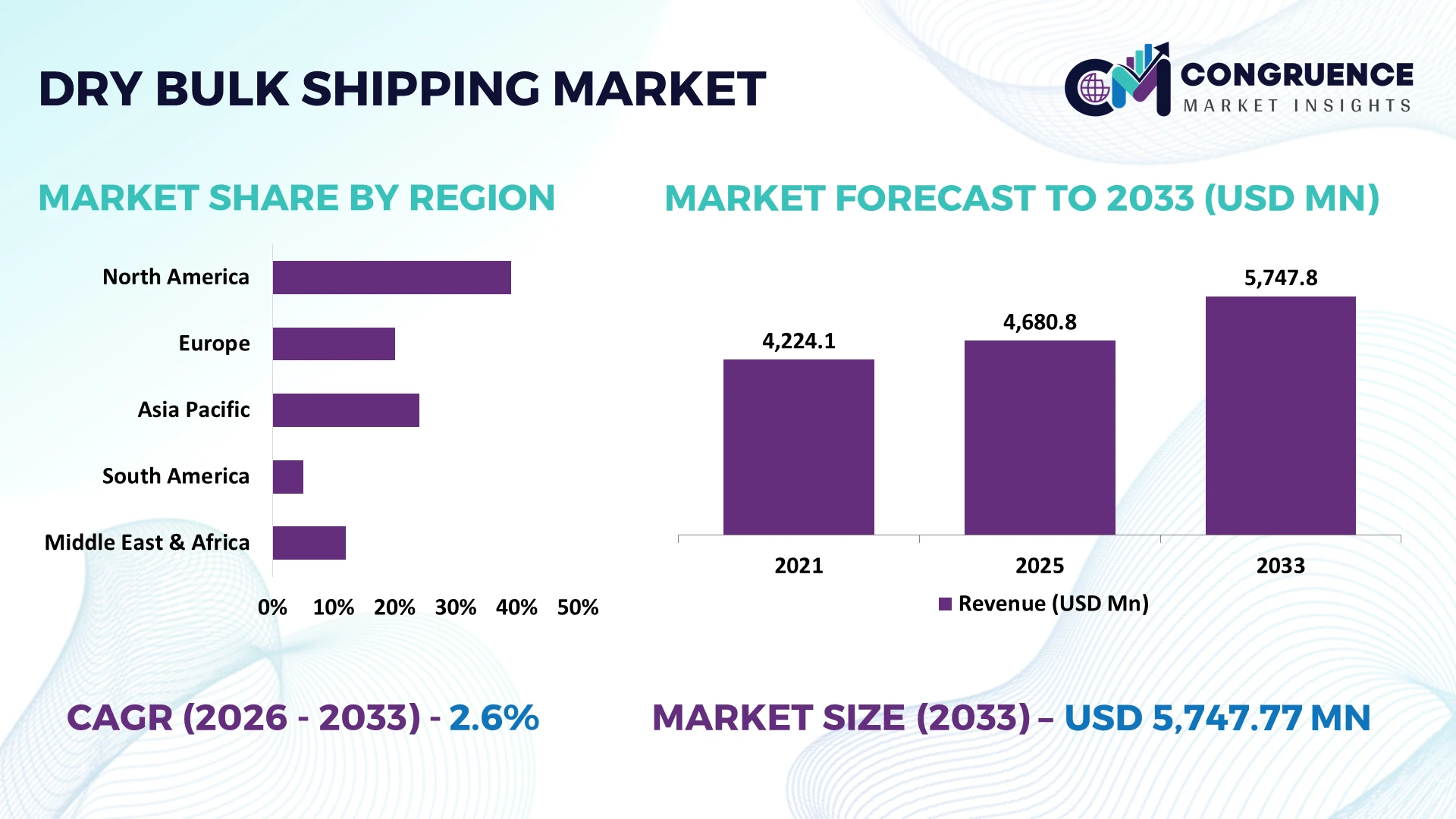
The Global Dry Bulk Shipping Market was valued at USD 4680.8 Million in 2025 and is anticipated to reach a value of USD 5747.77 Million by 2033 expanding at a CAGR of 2.6% between 2026 and 2033. Growth is driven by sustained iron-ore, grain, fertilizer and critical-mineral movements, longer ton-mile routes created by geopolitical diversions, and fleet-efficiency upgrades required by tightening maritime emissions standards.
China remains the pivotal demand center for global dry bulk shipping: it discharged nearly 3.0 billion tonnes of seaborne cargo in 2024, representing about 25% of worldwide discharged volume, while Chinese-controlled shipping capacity reached approximately 325 million DWT. Its steel industry produced about 1.01 billion tonnes in 2024, sustaining iron-ore requirements substantially above Japan’s 84 million-tonne steel base. Digital voyage optimization is also expanding; Cargill applied ZeroNorth technology across 100% of its time-chartered voyages in 2024. The Red Sea disruption reinforces route economics: vessel diversions lifted global dry-bulk ton-mile demand approximately 1.2% in 2024, increasing effective vessel utilization despite moderate cargo-volume growth.
Strategically, operators with efficient Capesize/Panamax fleets, digital voyage control and fuel-saving retrofits are positioned to capture higher utilization while limiting exposure to fuel, carbon-compliance and geopolitical route costs.
Market Size & Growth: USD 4,680.8 million in 2025 advances toward USD 5,747.77 million by 2033 at 2.6%, supported by mineral, grain and fertilizer ton-mile activity.
Top Growth Drivers: Red Sea rerouting lifted dry-bulk ton-miles 1.2%; global dry-bulk fleet capacity represents roughly 43% of total merchant-fleet DWT; dry bulk reached 36% of seaborne cargo in 2023.
Short-Term Forecast: Through 2026–2028, fleet economics remain disciplined after dry-bulk capacity expanded around 3% during 2025, sharpening the emphasis on utilization and fuel efficiency.
Emerging Technologies: AI voyage optimization, automated wind-assisted propulsion and alternative-fuel-ready engines are redefining vessel efficiency; Cargill already applies digital optimization across 100% of time-chartered voyages.
Regional Leaders: Asia remains the strongest demand center, with China alone accounting for approximately 25% of global seaborne cargo discharged; independently auditable regional dry-bulk revenue splits are unavailable, so unsupported USD allocations are excluded.
End-User Trends: China produced about 1.01 billion tonnes of crude steel in 2024 versus India's 149 million tonnes, concentrating iron-ore shipping exposure around Asian steelmaking corridors.
Pilot/Case Example: In 2024, Cargill's Pyxis Ocean WindWings trial delivered approximately 14% average fuel savings, equal to about 3 tonnes of fuel per day.
Competitive Landscape: Large global charterers and owners compete through scale, vessel efficiency and network access; Cargill alone charters around 650 vessels while technology differentiation increasingly determines operating economics.
Regulatory & ESG Impact: Alternative-fuel capability remains limited—only about 8% of global fleet tonnage was equipped for alternative fuels in 2025—raising the strategic value of retrofit-ready vessels.
Investment & Fleet Renewal: The bulker orderbook has stood near 8.5% of the active fleet, below the roughly 15–20% level associated with balanced replacement requirements as older vessels retire.
Innovation & Future Outlook: Wind propulsion is moving beyond pilots: 24 WAPS-equipped vessels were delivered during 2025 with 63 sails installed, establishing efficiency technology as a direct competitive lever.
Dry bulk shipping demand is increasingly shaped by iron ore, grain, fertilizers and critical minerals rather than simple cargo-volume expansion. Route disruption is equally important: Red Sea diversions increased dry-bulk ton-mile demand about 1.2%, tightening effective capacity even without equivalent volume growth. Meanwhile, AI voyage optimization, wind-assisted propulsion and alternative-fuel readiness are shifting competition toward measurable vessel efficiency, setting up a more technology-intensive strategic landscape.
Dry bulk shipping is becoming strategically important because commodity security, vessel availability, and route resilience increasingly determine delivered raw-material costs for steelmakers, utilities, and agricultural processors. Red Sea disruption has accelerated supply-chain restructuring, with dry-bulk rerouting adding about 1.2% to ton-mile demand and tightening effective vessel capacity. At the same time, emissions regulation is pushing owners toward digitally optimized, fuel-efficient fleets rather than capacity expansion alone.
Technology now directly influences vessel economics. Modern wind-assisted propulsion systems have demonstrated fuel savings of 4.5–9% versus conventional engine-only operation, with optimized retrofit configurations offering substantially higher technical potential. China remains the dominant cargo-demand hub, while European operators face stronger carbon-cost pressure through emissions regulation, accelerating efficiency retrofits. Cargill’s deployment of wind-assisted propulsion on Pyxis Ocean illustrates how charterers are combining route optimization, propulsion upgrades, and operational data to lower voyage fuel intensity.
Over the next two to three years, competitive advantage will shift toward operators controlling efficient tonnage rather than simply larger fleets. Bulker contracting capacity fell 54% year-on-year during January–November 2025, while the orderbook represented about 11% of the active fleet, encouraging owners to prioritize selective newbuilds, retrofits, charter partnerships, and digital fleet management. Companies aligning vessel efficiency, route flexibility, and cargo relationships will secure stronger utilization and resilience across increasingly fragmented commodity corridors.
Commodity rerouting is increasing transport work even when underlying cargo volumes remain moderate. Red Sea diversions lifted dry-bulk ton-mile demand approximately 1.2%, while total maritime ton-miles increased 5.9% in 2024 as vessels sailed longer routes around the Cape of Good Hope. Capesize charter rates averaged USD 22,953 per day in 2024, roughly 40% above 2023 levels, demonstrating how route length directly affects effective capacity and earnings. China, India, and Southeast Asian economies continue absorbing substantial iron ore and coal volumes, sustaining longer-haul vessel deployment. Shipowners are responding by securing efficient Capesize and Kamsarmax tonnage, extending charter coverage, and investing in voyage optimization. The strategic insight is that distance—not simply cargo volume—is increasingly determining fleet utilization and asset productivity.
Dry bulk operators remain exposed to abrupt earnings swings caused by commodity cycles, fleet additions, and geopolitical disruptions. Average dry-bulk daily earnings fell to approximately USD 10,750 during the first half of 2025, nearly 30% below the comparable 2024 period, while fleet capacity was projected to increase about 3%. The imbalance is particularly important for Chinese iron-ore and coal trades, where weaker industrial activity rapidly reduces Capesize utilization. Meanwhile, prolonged rerouting raises bunker consumption and voyage duration, increasing exposure to fuel costs even when freight rates soften. Owners are reducing risk through diversified cargo contracts, period charters, fuel-efficiency retrofits, and broader geographic deployment. The operational constraint is utilization sensitivity: even modest excess fleet capacity can sharply compress returns when commodity demand weakens.
Fuel-saving technologies are opening an underexploited profitability opportunity for dry-bulk fleets operating long-distance commodity routes. Wind-assisted propulsion systems have already delivered approximately 4.5–9% fuel savings in commercial operation, while technically optimized retrofit configurations can achieve materially higher reductions under favorable conditions. This matters as only around 8% of global fleet tonnage was capable of using alternative fuels in 2025, leaving efficiency retrofits as a faster near-term decarbonization pathway. Japan, China, and European shipowners are increasingly evaluating rotor sails, automated weather routing, and energy-management software alongside alternative-fuel newbuilds. Companies are positioning through shipyard partnerships, class-certified retrofits, and digital optimization platforms. The non-obvious opportunity lies in combining propulsion technology with route intelligence, allowing existing vessels to improve economics without waiting for full fleet replacement.
The central long-term challenge is coordinating fleet renewal with uncertain fuel, regulation, and technology pathways. More than 90% of the active global fleet still operates on conventional fuels, while alternative-fuel vessels account for over half of new-order tonnage, creating a widening technology gap between existing and incoming ships. At the same time, bulker contracting capacity fell 54% year-on-year through November 2025, and the orderbook stood near 11% of the active fleet. Owners therefore face difficult choices between retrofitting older tonnage, ordering dual-fuel ships, or delaying investment until fuel infrastructure matures. China, Japan, and Greece control a significant portion of global shipping capacity, making their fleet-renewal strategies particularly influential. Successful operators must integrate propulsion, fuel availability, cybersecurity, crew capability, and regulatory compliance into a single asset strategy rather than treating decarbonization as an isolated technology decision.
Fleet Ordering Turns More Selective: Bulker newbuilding contracting capacity dropped 54% year-on-year to about 25 million DWT during January–November 2025, while the orderbook represented roughly 11% of the operating fleet. Uncertain decarbonization rules, elevated shipyard prices, and fuel-technology choices are slowing speculative ordering. Owners are concentrating capital on younger, fuel-efficient tonnage, selective secondhand purchases, and retrofit programs rather than indiscriminate fleet expansion.
Chinese Shipyards Consolidate Bulker Supply: China captured approximately 77% of global bulker orderbook capacity by end-2025, versus roughly 19% for Japan, as South Korea retained minimal bulker exposure. This concentration is changing procurement workflows and yard-slot negotiations. Owners are strengthening Chinese shipyard partnerships while diversifying equipment suppliers and financing arrangements to reduce delivery and geopolitical exposure.
Digital Chartering Becomes Operational Infrastructure: Large charterers are embedding AI-supported routing, weather analytics, and fuel optimization directly into voyage execution. Cargill applied digital optimization across 100% of its time-chartered voyages, while modern systems increasingly evaluate speed, bunker consumption, currents, and port congestion simultaneously. The non-obvious shift is organizational: commercial and technical teams are converging around common voyage data, shortening decisions and improving fleet utilization.
Commodity Mix Shifts Toward Agriculture: International grain trade was projected at approximately 428 million tonnes in 2025/26, up 2%, while Chinese crude-steel production declined 4.4% during 2025. This divergence is increasing relative exposure to grain corridors linking the United States, Brazil, Argentina, and Asian importers. Operators are adjusting Panamax deployment, seasonal positioning, charter coverage, and cargo diversification to reduce dependence on iron-ore and coal cycles.
Capesize represents the leading vessel type, accounting for approximately 39% of global dry-bulk fleet deadweight capacity. Its dominance reflects vessel sizes above 100,000 DWT and superior unit economics on high-volume iron-ore and coal corridors connecting Australia and Brazil with China. Panamax holds roughly 25% of fleet capacity and is emerging as the strongest expansion-focused segment, supported by broader cargo flexibility and an orderbook equivalent to approximately 15% of its existing fleet. Its ability to serve coal, grain, and fertilizer routes limits dependence on a single commodity cycle.
Handysize accounts for approximately 12% of fleet DWT but remains strategically important where shallow drafts, smaller terminals, and fragmented cargo parcels restrict larger vessels. Within the supplied taxonomy, Dry Bulk Carriers and Bulk Carriers cover broader conventional vessel configurations supporting diversified commodity movements. Companies are therefore balancing Capesize scale economics with Panamax flexibility and smaller-vessel port access. Investment priorities increasingly favor fuel-efficient Panamax tonnage alongside selective Capesize renewal rather than uniform capacity additions.
Iron Ore Transportation is the leading application, representing approximately 29% of global dry-bulk commodity trade and remaining structurally tied to large-scale steelmaking in China, India, Japan, and South Korea. Capesize vessels dominate these long-haul flows because their high payload reduces transportation cost per tonne. Coal Transportation accounts for roughly 17% of dry-bulk trade, although structural decarbonization policies are gradually altering its long-term cargo profile. Grain Transportation represents approximately 11% and is showing the strongest near-term expansion within the supplied applications.
Global grain trade reached an estimated 428 million tonnes for 2025/26, approximately 2% higher year-on-year, supported by stronger wheat shipments and agricultural output from the United States, Argentina, and South America. Grain growth is increasing Panamax deployment and seasonal fleet repositioning. Cement Transportation remains important for construction-linked coastal and emerging-economy flows, while Fertilizer Transportation supports agricultural supply chains with more fragmented parcel sizes. Shipowners and charterers are responding through diversified cargo books, flexible vessel deployment, automated scheduling, and tighter integration with commodity-trading logistics.
Steel Producers form the dominant end-user group, representing an estimated 40% of addressable dry-bulk transportation activity when iron ore and metallurgical-coal requirements are considered together. Their concentration reflects continuous high-volume raw-material intake and dependency on deepwater terminals capable of handling Capesize cargoes. China alone produced approximately 961 million tonnes of crude steel in 2025, explaining its outsized influence on vessel deployment, freight rates, and iron-ore positioning. Mining Companies remain equally critical upstream, particularly Australian and Brazilian exporters coordinating long-term ore shipment programs.
Commodity Trading Companies are becoming the fastest-evolving buyer group as asset-light chartering, digital freight procurement, and portfolio-based cargo optimization expand. Grain Traders also command growing Panamax capacity as agricultural trade diversifies toward Brazil, Argentina, and the United States, while Cement Manufacturers depend more heavily on Handysize and smaller bulk-carrier flexibility. Operators are targeting these buyers through contract-of-affreightment structures, customized chartering, digital voyage visibility, and integrated commodity-logistics partnerships. Future competitive differentiation increasingly depends on controlling cargo relationships rather than owning vessels alone.
Asia-Pacific accounted for the largest market share at 48% in 2025 however, South America is expected to register the fastest growth, expanding at a CAGR of 3.4% between 2026 and 2033.

Export Corridors Reshape Vessel Deployment
North America accounted for approximately 12% of dry bulk shipping activity in 2025, anchored by U.S. grain, metallurgical coal, fertilizer, and construction-material movements through Gulf, Atlantic, Great Lakes, and Pacific terminals. U.S. coal exports totaled 93 million short tons in 2025, with 62% of shipments over the preceding five years departing East Coast ports and another 25% through Gulf Coast gateways. The concentration favors operators capable of matching Panamax and smaller bulk tonnage with specialized export terminals. Agricultural flows add seasonal vessel demand through Mississippi River and Gulf infrastructure, while Panama Canal conditions remain important for voyage economics. Operators are strengthening terminal coordination, cargo scheduling, and fleet repositioning rather than relying solely on capacity expansion, making inland-to-port integration increasingly important for competitiveness.
United States Market Outlook: The United States combines deepwater export terminals with large grain and metallurgical-coal supply chains. Lambert Point in Norfolk alone handled approximately 58% of U.S. metallurgical-coal exports over the referenced five-year period. However, 2025 coal exports declined 15% from 108 million to 93 million short tons, reinforcing the value of diversified grain, fertilizer, and minor-bulk cargo portfolios for vessel operators.
Carbon Regulation Reprices Fleet Efficiency
Europe represented approximately 16% of dry bulk shipping activity in 2025, supported by iron ore, grain, fertilizer, coal, aggregates, and industrial raw-material movements through Rotterdam, Hamburg, Antwerp-Bruges, and Mediterranean gateways. The structural change is regulatory: maritime transport entered the EU Emissions Trading System in 2024, while the compliance phase progressively increases the share of covered emissions that operators must surrender allowances against. FuelEU Maritime adds further pressure on vessel energy intensity. These mechanisms make bunker consumption, voyage optimization, and vessel specification commercially relevant to charter selection. European companies already own about 35% of global ship carrying capacity, giving the region substantial influence over fleet-renewal decisions. Owners are accelerating energy-management systems, propulsion retrofits, alternative-fuel readiness, and contractual carbon-cost allocation between owners and charterers.
Greece Market Outlook: Greece remains Europe’s most strategically important shipowning center, with Greek companies controlling approximately 398 million DWT of carrying capacity. This ownership scale gives Greek operators substantial purchasing and chartering influence despite domestic cargo demand being comparatively limited. Fleet renewal, secondhand asset transactions, technical management expertise, and compliance-oriented vessel investment position Greece as a capital-allocation center for global dry-bulk shipping.
Commodity Scale Anchors Global Deployment
Asia-Pacific commanded approximately 48% of the market in 2025, reflecting unmatched concentration of iron-ore, coal, grain, and minor-bulk consumption alongside extensive shipbuilding and fleet ownership. China remains the pivotal demand center, while India’s expanding steel industry strengthens raw-material import requirements and Australia supplies long-haul iron ore and coal cargoes. Asian companies control more than half of worldwide ship tonnage; Chinese owners alone controlled approximately 347 million DWT and Japanese owners 241 million DWT in 2025. China also dominates new vessel construction, creating procurement advantages for operators renewing Capesize, Panamax, and Ultramax fleets. The result is a tightly connected cargo-shipyard-financing ecosystem. Carriers are strengthening Chinese shipyard relationships, expanding digitally optimized fleets, and repositioning vessels around Australia-China, Brazil-China, and agricultural routes into Southeast Asia.
China Market Outlook: China combines extraordinary cargo absorption with growing fleet control and shipbuilding capacity. COSCO SHIPPING alone operated 477 dry-bulk vessels totaling 51.2 million DWT at year-end 2025. This scale supports integrated shipping, port, logistics, finance, and digital-service capabilities, giving Chinese operators structural advantages in cargo visibility, fleet deployment, and long-term industrial relationships across major commodity corridors.
Export Scale Extends Long-Haul Demand
South America accounted for approximately 14% of dry bulk shipping activity in 2025, with Brazil anchoring iron ore, soybeans, corn, and other agricultural exports and Argentina strengthening grain flows. Brazil’s long sailing distance to China makes its commodity exports particularly valuable for ton-mile demand and Capesize utilization. Brazilian iron-ore exports reached 416.3 million tonnes in 2025, increasing 7.1% year-on-year, while December shipments reached 40 million tonnes. This expanding physical volume supports terminals, rail-port integration, and large-vessel deployment even when commodity prices weaken. Port congestion, inland logistics, and seasonal agricultural peaks remain operational constraints. Mining groups, grain traders, and shipowners are responding through long-term freight arrangements, terminal modernization, optimized vessel arrival schedules, and deeper integration between inland logistics and export-port capacity.
Brazil Market Outlook: Brazil is the region’s decisive dry-bulk export hub. Iron-ore shipments reached 227 million tonnes during January–July 2026, up 0.6% year-on-year, after the 2025 record expansion. The combination of Vale-linked mining corridors, northern agricultural export routes, and deepwater terminals sustains demand for both Capesize and Panamax tonnage while making port productivity a critical freight-cost variable.
Mineral Corridors Drive Port Modernization
Middle East & Africa represented approximately 10% of dry bulk shipping activity in 2025, supported by South African minerals and coal, West African bauxite, Middle Eastern fertilizers, and expanding industrial-material flows. Africa’s export structure remains strongly extra-regional, making maritime connectivity central to mineral commercialization and long-distance vessel utilization. Gulf economies add phosphate, fertilizer, clinker, and construction-material movements alongside large port-modernization programs. South Africa remains an established bulk-export gateway, while Guinea’s bauxite and emerging iron-ore corridors are changing the future cargo mix. Operators increasingly require transshipment capability, shallow-port flexibility, and integrated mine-to-port logistics. Investment is concentrating on rail links, loading terminals, stockyard automation, and higher-capacity export corridors because inland infrastructure—not vessel availability alone—often determines achievable shipment volumes and fleet productivity.
South Africa Market Outlook: South Africa retains a strategic position through established coal and mineral export corridors linking inland production with Richards Bay and other deepwater gateways. The country’s advantage is mature heavy-haul logistics and direct access to Indian Ocean trade routes. Operators increasingly focus on terminal reliability and rail availability because landside throughput constraints directly determine vessel waiting time, cargo consistency, and charter economics.
COSCO Shipping Bulk, Oldendorff Carriers, Star Bulk Carriers, Pacific Basin Shipping and NORDEN compete across commodity corridors, while specialized Handysize operators challenge larger fleets in minor-bulk trades. The top five operators account for an estimated 12% of dry-bulk shipping activity, reflecting a fragmented market. Competition centers on fleet scale, chartering flexibility, fuel efficiency and cargo access. Oldendorff’s eco-designed vessels represent about 90% of its owned capacity, while Star Bulk has exhaust-gas cleaning systems on 136 of 141 vessels. Pacific Basin operates roughly 250 Handysize and Supramax ships, reinforcing specialization advantages. Operators are expanding through efficient newbuildings, lease structures, digital voyage optimization and long-term contracts with miners and commodity traders. The competitive shift favors asset-light flexibility combined with fleet control rather than ownership scale alone. High vessel capital requirements, customer relationships and regulatory compliance constrain entry. Winning requires efficient tonnage, chartering, cargo access and technology-enabled operating performance across volatile trade routes.
COSCO Shipping Bulk Co., Ltd.
Oldendorff Carriers GmbH & Co. KG
Star Bulk Carriers Corp.
Pacific Basin Shipping Limited
Dampskibsselskabet NORDEN A/S
Mitsui O.S.K. Lines, Ltd.
Nippon Yusen Kabushiki Kaisha (NYK Line)
Kawasaki Kisen Kaisha, Ltd. (K Line)
Pan Ocean Co., Ltd.
Berge Bulk Limited
Ultrabulk A/S
Genco Shipping & Trading Limited
Safe Bulkers, Inc.
Diana Shipping Inc.
Digital voyage optimization, remote monitoring, weather routing and propulsion-efficiency systems are becoming core dry-bulk technologies. Pacific Basin reports strategic power weather routing delivers 3–4% fuel savings, while silicone hull coatings achieve around 8% savings today. Compared with legacy manual routing, data-led optimization continuously adjusts speed, RPM and weather exposure. Large operators benefit most because fleetwide data converts efficiency gains into lower bunker consumption and stronger global charter competitiveness.
Emerging technologies combine graphene coatings, wind-assisted propulsion and alternative-fuel readiness. Graphene propeller coatings offer up to 4% performance improvement, while the Pyxis Ocean WindWings trial indicated roughly 14% average fuel savings. Adoption is moving beyond pilots: Pacific Basin initiated graphene coating deployment across 40 vessels and has dual-fuel methanol Ultramax vessels scheduled for delivery from 2028. These technologies reduce exposure to bunker costs and tightening carbon-intensity requirements.
The disruptive layer is integrated AI linking port optimization, cargo forecasting, voyage planning and energy management. Cargill deployed ZeroNorth optimization across all time-chartered voyages in 2025, demonstrating fleet-scale adoption. Between 2026 and 2028, differentiation will increasingly depend on combining AI routing, low-friction surfaces, wind propulsion and fuel-flexible newbuildings. Operators acting now gain operational data, retrofit experience and compliance readiness before these capabilities become charter-selection criteria.
March 2024 Cargill reported six-month Pyxis Ocean WindWings results, with average fuel savings projected near 14% and optimal-condition emissions reductions reaching 37%. The Kamsarmax trial strengthened the commercial case for wind-assisted propulsion retrofits across bulk fleets worldwide. Source: Maritime Executive.
November 2024 Pacific Basin ordered four 64,000-DWT dual-fuel methanol Ultramax vessels from Nihon Shipyard, targeting 2028–2029 delivery. The fleet-renewal move introduced scalable methanol capability while positioning the operator for tightening emissions requirements and future green-fuel availability globally. Source: Pacific Basin.
February 2025 Pacific Basin disclosed that super-low-friction silicone hull coating covered over one-third of its owned fleet, delivering about 8% fuel savings in good weather. The deployment improves existing-vessel efficiency while dual-fuel newbuildings remain under development worldwide. Source: HKEX.
March 2026 Star Bulk agreed to acquire 16 dry-bulk vessels from Diana Shipping, conditional on its Genco transaction, expanding consolidation potential around a fleet already exceeding 14 million DWT. The transaction targets greater operating scale and fleet flexibility. Source: StarBulk.
The report evaluates Dry Bulk Carriers, Bulk Carriers, Handysize, Panamax and Capesize vessels across coal, grain, iron ore, cement and fertilizer transportation. It examines Mining Companies, Grain Traders, Steel Producers, Cement Manufacturers and Commodity Trading Companies, alongside North America, Europe, Asia-Pacific, South America, and Middle East & Africa. Capesize vessels command approximately 39% of dry-bulk fleet capacity, highlighting scale concentration in major-bulk transportation.
Strategic coverage extends to AI voyage optimization, weather routing, remote vessel monitoring, wind-assisted propulsion, advanced hull and propeller coatings, alternative-fuel readiness and fleet digitalization. The report evaluates technology deployment, cargo-flow restructuring, fleet renewal, port infrastructure, regulatory exposure and competitive positioning through 2026–2033. It supports investment planning, vessel-class selection, geographic expansion, partnership development and asset-allocation decisions while identifying emerging opportunities around green methanol, retrofit technologies, digital chartering and increasingly technology-driven freight operations.
| Report Attribute/Metric | Report Details |
|---|---|
Market Revenue in 2025 | USD 4680.8 Million |
Market Revenue in 2033 | USD 5747.77 Million |
CAGR (2026 - 2033) | 2.6% |
Base Year | 2025 |
Forecast Period | 2026 - 2033 |
Historic Period | 2021 - 2025 |
Segments Covered | By Type
By Application
By End-User
|
Key Report Deliverable | Revenue Forecast, Growth Trends, Market Dynamics, Segmental Overview, Regional and Country-wise Analysis, Competition Landscape |
Region Covered | North America, Europe, Asia-Pacific, South America, Middle East, Africa |
Key Players Analyzed | COSCO Shipping Bulk Co., Ltd., Oldendorff Carriers GmbH & Co. KG, Star Bulk Carriers Corp., Pacific Basin Shipping Limited, Dampskibsselskabet NORDEN A/S, Mitsui O.S.K. Lines, Ltd., Nippon Yusen Kabushiki Kaisha (NYK Line), Kawasaki Kisen Kaisha, Ltd. (K Line), Pan Ocean Co., Ltd., Berge Bulk Limited, Ultrabulk A/S, Genco Shipping & Trading Limited, Safe Bulkers, Inc., Diana Shipping Inc. |
Customization & Pricing | Available on Request (10% Customization is Free) |




