
Reports
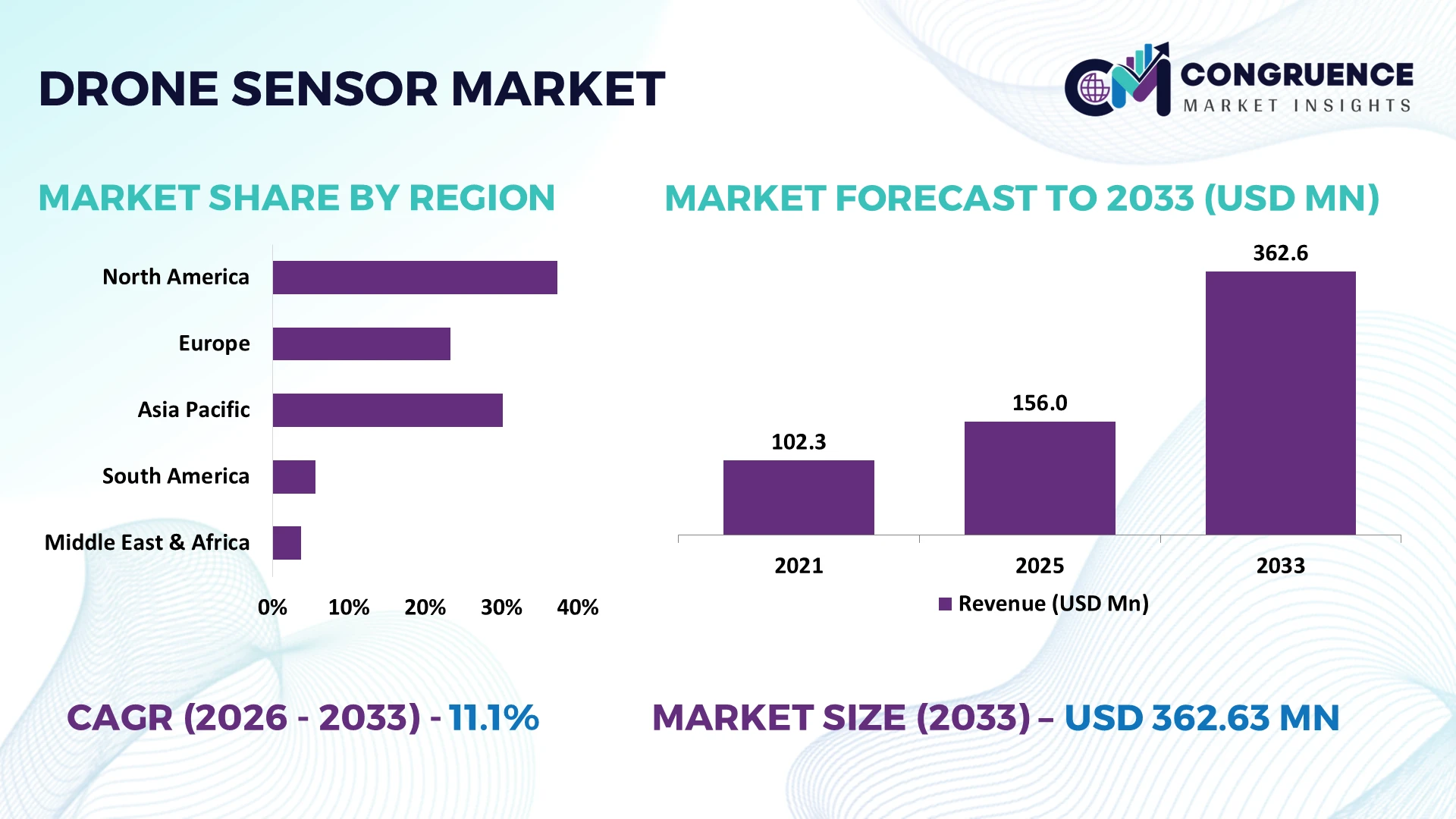
The Global Drone Sensor Market was valued at USD 156.0 Million in 2025 and is anticipated to reach a value of USD 362.6 Million by 2033 expanding at a CAGR of 11.12% between 2026 and 2033. Growth is driven by the integration of LiDAR, thermal imaging, multispectral, and AI-enabled sensors into autonomous navigation, precision agriculture, industrial inspection, and defense surveillance platforms.
The United States maintains a leading position in advanced drone sensor adoption, supported by defense modernization, aerospace manufacturing, and commercial UAV deployment. Federal investment in unmanned systems and the expansion of domestic semiconductor capabilities strengthen sensor innovation. Compared with China, which benefits from large-scale drone manufacturing and component integration, the U.S. emphasizes high-performance sensing, secure navigation, and defense-grade technologies. FAA regulatory developments further influence commercial deployment priorities.
Strategically, manufacturers prioritizing sensor miniaturization, secure components, and multi-sensor integration will strengthen their competitive positioning across commercial and defense applications.
Market Size & Growth: The market advances from USD 156.0 million in 2025 to USD 362.6 million by 2033, at an 11.12% CAGR, supported by LiDAR integration and autonomous flight capabilities.
Top Growth Drivers: Autonomous navigation contributes to approximately 35% of technology-driven adoption, precision agriculture accounts for 30%, and defense surveillance represents 25% of major application-driven demand.
Short-Term Forecast: By 2028, wider sensor integration is expected to reduce selected inspection costs by 15% and improve automated data collection efficiency by 20%.
Emerging Technologies: AI-powered sensor fusion, solid-state LiDAR, and compact multispectral imaging are transforming obstacle detection, terrain mapping, and real-time analytics.
Regional Leaders: North America is projected to reach USD 145 million, Asia-Pacific USD 125 million, and Europe USD 75 million by 2033, reflecting defense modernization, manufacturing expansion, and industrial automation.
Consumer/End-User Trends: More than 40% of advanced commercial UAV deployments increasingly prioritize integrated imaging, positioning, and environmental sensing capabilities.
Pilot/Case Example: In 2023, industrial drone inspection programs demonstrated approximately 30% reductions in selected inspection turnaround times through automated imaging and sensor-based monitoring.
Competitive Landscape: The market remains fragmented, with no single supplier controlling a dominant global share. Honeywell, Teledyne FLIR, Bosch Sensortec, Sony, and Trimble compete through sensing accuracy, miniaturization, and integration capabilities.
Regulatory & ESG Impact: FAA Remote ID requirements in the United States strengthen identification and tracking capabilities, while precision monitoring supports reductions in unnecessary agricultural input applications.
Investment & Funding: Global investment in drone and autonomous sensing ecosystems exceeds USD 1 billion annually across selected venture, corporate, and defense-backed initiatives, emphasizing AI, navigation, and secure components.
Innovation & Future Outlook: Next-generation sensor fusion, edge computing, and low-power imaging are shifting competition toward integrated intelligence rather than individual sensor specifications.
The drone sensor market is witnessing stronger demand across defense surveillance, precision agriculture, infrastructure inspection, mining, and logistics. Recent innovation in MEMS-based inertial measurement units, thermal imaging, compact LiDAR, and multispectral cameras is improving navigation accuracy and environmental monitoring. In 2025, inertial sensors accounted for approximately 31.75% of the market, highlighting their importance in flight stabilization and positioning. Supply-chain localization and secure component procurement are increasingly influencing manufacturer partnerships and product development priorities.
Drone sensors are becoming strategically important because they determine flight reliability, autonomous decision-making, mission accuracy, and the quality of aerial intelligence. Their role extends beyond hardware procurement, positioning sensor integration as a competitive differentiator across defense, agriculture, energy, and infrastructure industries. North America accounted for approximately 37.25% of global market share in 2025, supported by defense procurement and established aerospace capabilities.
A significant market shift involves the transition from standalone sensing components toward integrated sensor-fusion architectures. Modern MEMS-based inertial sensors combined with GNSS, LiDAR, and computer vision improve navigation reliability, particularly when satellite signals weaken. LiDAR technology is gaining importance in applications requiring detailed three-dimensional mapping, while thermal and multispectral imaging support specialized monitoring. China's manufacturing scale contrasts with the United States' emphasis on defense-grade sensing and secure autonomous platforms.
Over the next 2–3 years, manufacturers will prioritize lightweight sensor modules, onboard AI processing, and improved power efficiency. For example, infrastructure operators increasingly deploy thermal and optical sensors for power-line and pipeline inspections, reducing dependence on manual monitoring. Companies are strengthening semiconductor partnerships, expanding domestic component sourcing, and investing in integrated payload development. Competitive advantage will increasingly depend on sensor accuracy, interoperability, cybersecurity, and reliable performance under demanding operating conditions.
Growing deployment of autonomous UAVs is accelerating demand for integrated inertial, positioning, and environmental sensors. In 2025, inertial sensors represented 31.75% of the market, while navigation applications accounted for 35.10%, demonstrating the importance of accurate flight control and positioning. Defense modernization and commercial BVLOS operations are reinforcing this transition. In the United States, evolving FAA operating frameworks are encouraging investment in reliable navigation and identification technologies. Manufacturers are responding through MEMS miniaturization, AI-enabled sensor fusion, and partnerships with drone OEMs. The strategic advantage lies in combining multiple sensing inputs to maintain operational reliability when individual navigation signals become unavailable.
High-precision LiDAR, thermal imaging, and inertial measurement systems increase procurement costs, particularly for small and mid-sized UAV manufacturers. Dependence on specialized semiconductor fabrication, optical components, and imported electronic materials exposes suppliers to pricing volatility and geopolitical trade restrictions. The concentration of North American demand at approximately 37.25% also highlights the importance of maintaining reliable access to established technology ecosystems. Component qualification and replacement compatibility further increase integration expenses. Manufacturers are addressing these constraints through supplier diversification, modular sensor architectures, long-term procurement agreements, and localized assembly. Cost optimization without compromising measurement accuracy remains essential for expanding commercial drone adoption.
AI-powered sensor fusion presents a significant opportunity for manufacturers developing next-generation UAV platforms. LiDAR sensors are projected to expand at a 12.35% CAGR through 2031, while collision-avoidance applications are advancing at 12.95%, creating opportunities for advanced optical and proximity sensing technologies. India's expanding agricultural drone ecosystem and China's large-scale UAV manufacturing base provide attractive deployment opportunities. Integration of multispectral imaging, edge AI, and compact environmental sensors enables predictive crop monitoring and automated infrastructure assessment. Companies are increasing R&D expenditure, developing application-specific sensor modules, and establishing partnerships with analytics providers. The strongest opportunity lies in offering integrated sensing solutions that reduce payload complexity while improving mission-level intelligence.
Maintaining consistent sensor performance across different UAV platforms remains a significant execution challenge. Variations in calibration, communication protocols, electromagnetic interference, and operating environments complicate integration. With navigation applications representing 35.10% of market demand, even minor positioning inaccuracies can affect mission reliability and autonomous flight decisions. Increasing BVLOS deployment also raises cybersecurity and operational validation requirements. Manufacturers must address these issues through standardized interfaces, redundant navigation architectures, rigorous sensor calibration, and secure onboard data processing. Companies operating in the United States and Europe must also accommodate evolving aviation safety requirements. Long-term competitiveness will depend on delivering interoperable sensor ecosystems that maintain accuracy, reliability, and cybersecurity across diverse operating conditions.
AI-Powered Sensor Integration: Drone manufacturers are increasingly combining optical cameras, LiDAR, thermal imaging, and inertial measurement units into unified sensing architectures. AI-based processing is improving object classification and flight decisions, with integrated systems targeting 15–20% improvements in selected data-processing workflows. U.S. defense and industrial UAV operators are prioritizing onboard analytics to reduce dependence on continuous ground-station intervention. Suppliers are responding with compact sensor-fusion modules and embedded computing partnerships.
Miniaturization Reshapes Payload Design: MEMS technology is changing drone payload economics through smaller, lighter, and lower-power sensing components. Advanced inertial modules increasingly target 20–30% reductions in size and power consumption compared with selected legacy systems. This shift allows manufacturers to allocate more payload capacity to imaging equipment and batteries. Chinese component manufacturers are expanding integrated module production, while U.S. suppliers emphasize precision, reliability, and defense-grade specifications.
Multispectral Imaging Gains Traction: Precision agriculture is accelerating the use of multispectral payloads for crop-health assessment, irrigation planning, and variable-rate spraying. U.S. agricultural drone-treated acreage reached 16.4 million acres in 2025, increasing 59% year over year. This operational shift is encouraging sensor suppliers to develop ruggedized imaging modules and automated analytics packages. Manufacturers are focusing on spectral accuracy and faster image processing to support large-scale farm operations.
BVLOS Operations Change Sensor Requirements: Regulatory movement toward routine beyond-visual-line-of-sight operations is increasing the importance of redundant positioning, collision detection, and environmental sensing. The United States recorded 86,181 operational BVLOS flights in 2024, including 80,955 package-delivery flights. This transition is shifting procurement toward dependable navigation and obstacle-detection systems. Companies are strengthening sensor redundancy, system validation, and integration with automated flight-management platforms.
Inertial sensors dominated the global drone sensor market with approximately 31.75% share in 2025, supported by their essential role in flight stabilization, orientation measurement, and navigation accuracy. MEMS-based accelerometers and gyroscopes offer compact dimensions, low power consumption, and compatibility with multiple UAV configurations. Their established integration into commercial and defense platforms reinforces demand. LiDAR sensors represent a rapidly advancing category as operators increasingly require high-resolution 3D mapping, terrain modeling, and obstacle detection. Manufacturers are prioritizing compact LiDAR modules and improved point-cloud processing to address payload limitations.
Thermal imaging, multispectral sensors, optical/computer vision, and environmental/proximity sensors serve specialized operational requirements. Thermal systems support surveillance and equipment monitoring, while multispectral imaging strengthens agricultural analysis. Optical sensors improve visual recognition, whereas environmental and proximity sensors support situational awareness. LiDAR development is attracting greater innovation investment, while inertial sensor manufacturers are emphasizing accuracy and cost optimization. This creates a market distinction between established flight-control components and emerging perception technologies.
Autonomous navigation represented approximately 35.10% of the global drone sensor market in 2025, supported by extensive requirements for positioning, flight stabilization, and route execution. Commercial mapping, defense operations, and industrial UAV deployments depend on reliable navigation systems combining inertial measurement units, GNSS, and optical sensing. Navigation remains an established application because accurate positioning is essential across virtually every drone mission. Collision avoidance is gaining momentum as autonomous flight and complex operating environments increase requirements for proximity detection and real-time environmental interpretation.
Defense surveillance, precision agriculture, infrastructure and industrial inspection, mining, and logistics represent additional application areas. Defense operators prioritize detection accuracy and mission reliability, while agricultural users increasingly integrate imaging sensors into crop-monitoring workflows. Infrastructure inspection benefits from thermal and LiDAR payloads, whereas mining applications require terrain and volumetric measurements. Logistics is strengthening demand for dependable positioning and obstacle detection. Manufacturers are consequently developing application-specific sensor packages rather than relying exclusively on standardized payload configurations.
The defense and security segment accounted for approximately 30.95% of the global drone sensor market in 2025, supported by persistent surveillance requirements, border monitoring, tactical reconnaissance, and unmanned combat-system development. Defense procurement emphasizes high-precision inertial sensors, thermal imaging, secure positioning, and advanced optical detection. Compared with commercial buyers, defense organizations prioritize mission reliability, environmental resilience, and secure component integration. Manufacturers are responding through defense-specific product development, long-term procurement agreements, and partnerships with aerospace and unmanned-system integrators.
Agriculture, infrastructure and energy, industrial, mining, and logistics represent important additional end-user groups. Logistics and warehousing are emerging as the fastest-expanding end-user category as automated delivery and inventory-monitoring operations require dependable navigation and collision detection. Agriculture increasingly favors multispectral imaging, while energy and infrastructure operators prioritize thermal and LiDAR systems. Industrial and mining buyers emphasize operational accuracy and equipment monitoring. Companies are adapting through modular payload offerings, application-specific calibration, and partnerships with commercial UAV manufacturers. Future purchasing priorities are shifting toward integrated sensing platforms that combine operational reliability with lower payload complexity.
North America accounted for the largest market share at 37.3% in 2025 however, Asia-Pacific is expected to register the fastest growth, expanding at a CAGR of 8.24% between 2026 and 2033.
North America accounted for 37.3% of the global drone sensor market in 2025, maintaining its leading regional position. Demand is supported by defense modernization, infrastructure inspection, precision agriculture, public safety, and commercial drone operations. The region benefits from established aerospace manufacturers, sensor technology developers, defense procurement networks, and a growing base of enterprise drone operators. The United States represents approximately 87.4% of the North American market, reflecting its concentration of technology providers and commercial deployment activity. Demand is particularly strong for inertial measurement units, thermal imaging, high-resolution cameras, positioning systems, and collision-detection sensors. The FAA reported more than 782,000 registered drones in the United States as of July 2024, including nearly 383,000 registered for commercial purposes, demonstrating the scale of the operational ecosystem.
United States Market Outlook: The United States benefits from a large commercial drone base, advanced aerospace capabilities, and substantial defense-sector demand. Applications across energy infrastructure, agriculture, emergency response, and industrial inspection create opportunities for precision inertial sensors, thermal cameras, multispectral imaging, and secure positioning systems. The country's technology ecosystem also supports domestic development of flight-control and navigation components. The FAA's ongoing work toward enabling more scalable beyond-visual-line-of-sight operations could expand commercial drone activity and increase requirements for detect-and-avoid systems, airspace awareness, and reliable onboard sensing technologies.
Europe accounted for an estimated 23.3% of the global drone sensor market in 2025, supported by industrial modernization, infrastructure monitoring, environmental applications, and expanding commercial drone operations. Germany represents approximately 22.3% of the European regional market, reflecting its established engineering and industrial technology base. Demand across the region is concentrated in manufacturing, utilities, construction, agriculture, and public safety, where drones equipped with imaging, positioning, thermal, and obstacle-detection sensors improve inspection and monitoring efficiency. Regulatory harmonization is also influencing technology requirements, particularly for safe operations in shared airspace. The European Union's U-space framework is encouraging the development of digital traffic-management services, increasing the importance of interoperable identification, navigation, and situational-awareness systems for commercial drone fleets.
Germany Market Outlook: Germany's market position is supported by its aerospace suppliers, engineering expertise, and strong industrial customer base. Manufacturing facilities, energy operators, and infrastructure companies increasingly use drones for asset inspection, surveying, and operational monitoring. These applications create demand for high-accuracy positioning, optical imaging, thermal detection, and environmental sensors. Germany's drone ecosystem also attracted approximately EUR 86 million in investment in 2022, supporting the development of domestic technology companies and commercial solutions. Its industrial research capabilities and established supplier networks provide a foundation for developing specialized sensor systems for demanding enterprise applications.
Asia-Pacific accounted for an estimated 30.1% of the global drone sensor market in 2025 and is positioned as the fastest-growing regional market. China represents approximately 44.8% of the Asia-Pacific market, supported by its domestic drone manufacturing ecosystem, electronics supply chains, and extensive industrial deployment. Regional demand is expanding across agriculture, infrastructure inspection, surveying, logistics, mining, and public safety. These applications are increasing requirements for compact inertial sensors, high-resolution imaging modules, positioning systems, altitude sensors, and obstacle-detection technologies. Government-backed initiatives and the development of low-altitude aviation infrastructure are further encouraging commercial adoption. China had approximately 3.287 million registered drones by the end of 2025, while annual drone flight hours reached 45.3 million, illustrating the scale of its expanding operational ecosystem.
China Market Outlook: China's competitive advantage combines large-scale drone manufacturing, domestic electronics production, and a broad industrial customer base. Local manufacturers benefit from established component supply chains for navigation, imaging, flight control, and obstacle sensing. Agricultural monitoring, infrastructure inspection, surveying, and logistics are creating demand for sensors designed for different payload capacities and operating environments. Civilian drone output increased 37.3% in 2025 compared with the previous year, highlighting the strength of domestic production. Continued development of the country's low-altitude economy and evolving aviation regulations is expected to encourage further integration of onboard sensing, positioning, and traffic-awareness technologies.
South America accounted for an estimated 5.6% of the global drone sensor market in 2025, with demand concentrated in agriculture, mining, energy infrastructure, surveying, and environmental monitoring. Brazil is the region's most strategically significant market, supported by its extensive agricultural operations and growing use of precision-farming technologies. Drone-based crop monitoring and field mapping are creating demand for multispectral cameras, optical sensors, positioning systems, and altitude measurement components. Mining and energy companies also represent important users of thermal imaging and inspection sensors. However, limited domestic component manufacturing, uneven connectivity, and differences in operator capabilities can restrict wider deployment. Adoption is therefore strongest among large agricultural enterprises, commercial drone service providers, and industrial operators with established technical resources and investment capacity.
Brazil Market Outlook: Brazil's extensive agricultural sector provides a strong foundation for drone sensor adoption. Large farms and commercial service providers use aerial data to monitor crop health, assess field conditions, and improve the precision of agricultural operations. These applications support demand for multispectral imaging, GNSS positioning, terrain awareness, and environmental sensing technologies. The country's agricultural drone framework requires operators to comply with applicable aviation and Ministry of Agriculture registration requirements, including SIPEAGRO registration where relevant. This regulatory structure supports formal commercial operations, while demand from large agricultural producers creates opportunities for specialized sensor suppliers and drone service companies.
The Middle East & Africa region accounted for an estimated 3.7% of the global drone sensor market in 2025. Demand is supported by infrastructure development, oil and gas inspection, security operations, construction, logistics, and government-led smart mobility initiatives. The UAE represents approximately 38.4% of the regional market, reflecting its active commercial drone ecosystem and investment in technology-led infrastructure. Regional operators increasingly require thermal imaging, optical cameras, positioning systems, and obstacle-detection sensors for monitoring large industrial assets and complex urban environments. The UAE had approximately 23,960 registered drones by January 2025, alongside 93 registered companies on its unified drone platform. Dubai's drone delivery program, which targets coverage of 33% of the emirate by 2030, further supports demand for integrated sensing and airspace-awareness technologies.
United Arab Emirates Market Outlook: The UAE benefits from coordinated aviation regulation, investment in smart-city infrastructure, and government support for commercial drone applications. Dubai's initiatives across delivery services, infrastructure monitoring, and autonomous mobility create opportunities for suppliers of positioning, collision-detection, communication, and environmental sensors. The country's registered drone fleet and established service-provider ecosystem provide a base for commercial deployment. Development of designated flight zones and delivery corridors is also increasing the importance of dependable navigation and situational-awareness technologies. These capabilities position the UAE as an important regional market for integrated drone sensing solutions.
The market is shaped by sensor-component leaders, specialist navigation suppliers, imaging companies, and LiDAR developers. Bosch Sensortec, TDK InvenSense, and TE Connectivity compete in MEMS, inertial, pressure, and environmental sensing, while Trimble and SBG Systems target precision positioning and navigation. Teledyne FLIR and Sony compete in thermal and imaging payloads; Ouster and LeddarTech address LiDAR-based perception. The top-five combined market share is not reliably disclosed in publicly available, comparable market data, so assigning a percentage would be misleading. Competition centers on size, weight, power consumption, accuracy, integration, and supply reliability. Integrated sensor-fusion solutions can reduce payload complexity, while specialized suppliers differentiate through precision and application-specific performance. OEM partnerships, embedded software, and vertically integrated payloads are shifting value away from standalone components. Qualification requirements, flight-safety validation, and established OEM relationships create entry barriers. Winners must deliver compact, reliable, interoperable sensing at competitive lifecycle cost across commercial, industrial and defense drone platforms.
Bosch Sensortec GmbH
TDK InvenSense
TE Connectivity Ltd.
Sony Semiconductor Solutions Corporation
Trimble Inc.
Teledyne FLIR LLC
Ouster, Inc.
KVH Industries, Inc.
SBG Systems
ams-OSRAM AG
RTX Corporation
Sentera, Inc.
Sparton Corporation
Drone sensing is shifting from standalone cameras and GNSS receivers toward fused payloads combining RGB, multispectral, thermal, LiDAR, radar, and IMUs. An agricultural research survey found 80.3% of respondents used multispectral sensors and 45.9% used thermal imaging. Sensor fusion links camera features with LiDAR depth and IMU motion data, supporting navigation when satellite signals weaken. A 2025 simulated LiDAR-visual-inertial architecture reported position-estimation error below 0.9% of traveled distance.
Miniaturized MEMS accelerometers and ultrasonic time-of-flight sensors reduce payload size and add proximity awareness. Bosch reported a 76% smaller footprint for its accelerometers versus its previous generation, while TDK's ultrasonic sensor measures distances up to 9.5 meters. These advances improve integration flexibility and obstacle detection, although gains depend on calibration and conditions. Digital LiDAR adds 3D perception for mapping, inspection, and autonomous flight.
From 2026 to 2028, advantage will move toward sensor-fusion stacks, edge processing, and component provenance. Suppliers combining IMUs, imaging, ranging, and software can win OEM design slots; payload integrators gain faster deployment and lower integration burden. Legacy single-sensor systems remain economical for basic missions, but fused systems offer greater resilience in complex, GPS-challenged operations. Investment now helps manufacturers qualify components, validate safety, and supply before autonomy requirements scale globally.
January 2025 — TDK InvenSense began full-scale production of its ICU-30201 ultrasonic time-of-flight sensor, designed for obstacle avoidance in drones and robotics. It measures distances up to 9.5 meters, extending proximity sensing aboard UAV platforms across varied surfaces and lighting. Source: invensense.tdk.com
September 2024 — Trimble launched its APX RTX direct-georeferencing portfolio for UAV mapping payloads, pairing positioning services with sensor workflows. The offering targets high-accuracy mapping with simplified operation, helping OEMs and payload integrators reduce field processing and accelerate survey delivery. Source: trimble.com
June 2025 — Ouster announced its OS1 digital LiDAR had been approved for the U.S. Department of Defense Blue UAS Framework following cybersecurity testing. It became the framework’s first high-resolution 3D LiDAR, strengthening compliant perception options for defense drone integrators. Source: ouster.com
January 2024 — Bosch Sensortec introduced BMA530 and BMA580 MEMS accelerometers, each measuring 1.2 × 0.8 × 0.55 mm. Their footprint is 76% smaller than the prior generation, supporting compact embedded sensing designs and giving drone manufacturers additional miniaturization options. Source: bosch-presse.de
The report evaluates the global drone sensor market across sensor types, including inertial, image, position, speed and distance, pressure, light, ultrasonic, and altitude sensors. It examines applications such as navigation, data acquisition, collision detection, mapping, motion detection, and air-pressure measurement, alongside end users in defense, agriculture, construction, media, transportation, security, law enforcement, and commercial services. Coverage also considers fixed-wing, rotary-wing, and hybrid platforms, with attention to integrated payloads and emerging multisensor configurations.
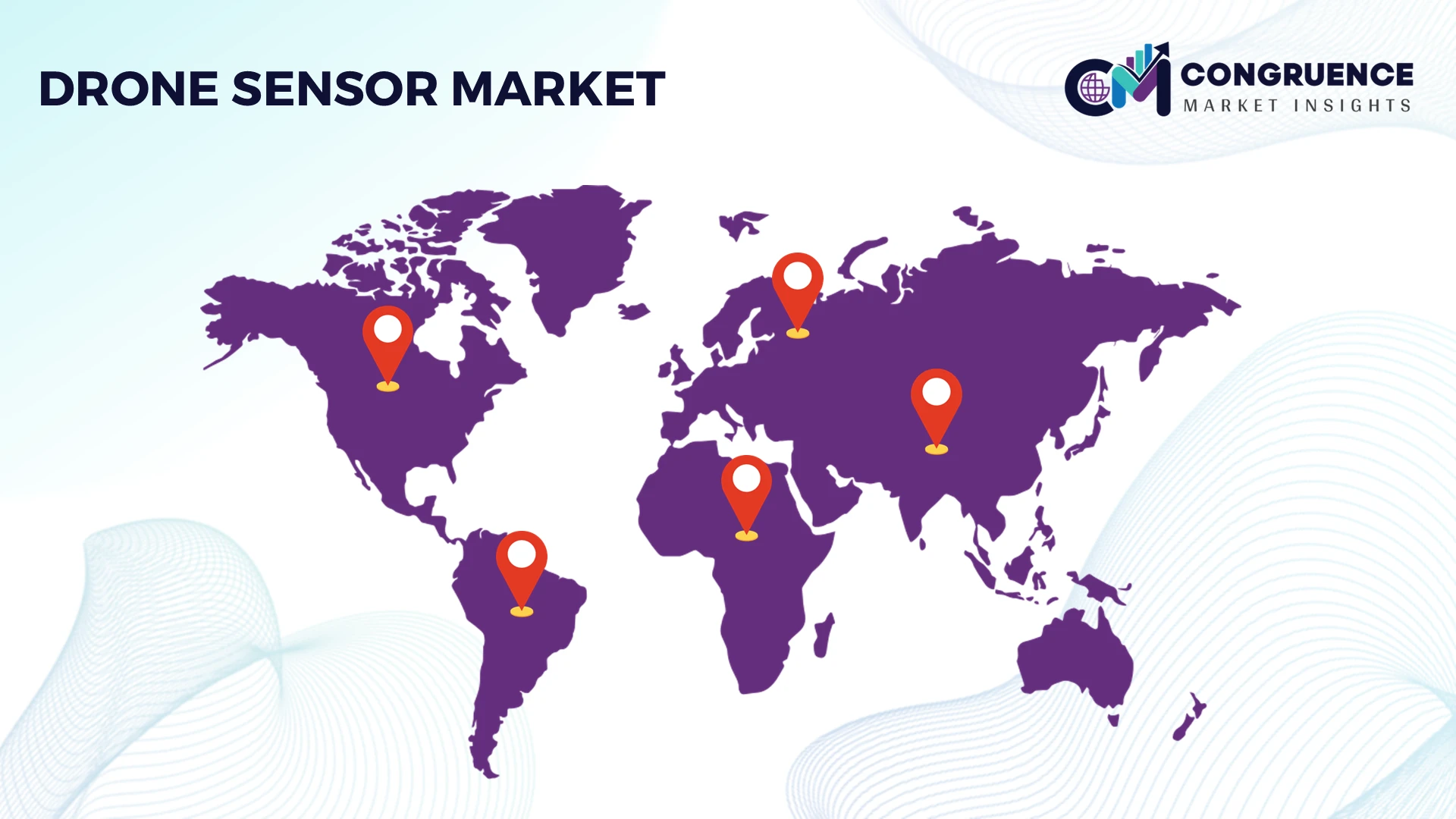
Regional analysis spans North America, Europe, Asia-Pacific, South America, and the Middle East & Africa, highlighting deployment concentration, manufacturing capabilities, regulatory conditions, and infrastructure readiness. Technology coverage includes MEMS, GNSS, LiDAR, thermal, multispectral, radar, and sensor-fusion systems. Competitive profiles and adoption indicators help decision-makers assess supplier positioning, identify underserved applications, compare expansion opportunities, and prioritize investment, partnerships, and product development through 2033.
| Report Attribute / Metric | Details |
|---|---|
| Market Revenue (2025) | USD 156.0 Million |
| Market Revenue (2033) | USD 326.6 Million |
| CAGR (2026–2033) | 11.12% |
| Base Year | 2025 |
| Forecast Period | 2026–2033 |
| Historic Period | 2021–2025 |
| Segments Covered |
By Type
By Application
By End-User
|
| Key Deliverables | Revenue Forecast; Market Trends; Growth Drivers & Restraints; Technology Insights; Segmentation Analysis; Regional Insights; Competitive Landscape; Regulatory & ESG Overview; Recent Developments |
| Regions Covered | North America; Europe; Asia-Pacific; South America; Middle East & Africa |
| Companies Profiled | Bosch Sensortec GmbH; TDK InvenSense; TE Connectivity Ltd.; Sony Semiconductor Solutions Corporation; Trimble Inc.; Teledyne FLIR LLC; Ouster, Inc.; KVH Industries, Inc.; SBG Systems; ams-OSRAM AG; RTX Corporation; Sentera, Inc.; Sparton Corporation |
| Customization & Pricing | Available on Request (10% Customization Free) |




