
Reports
The Global Drone-Powered Business Solutions Market was valued at USD 953.45 Million in 2025 and is anticipated to reach a value of USD 2978.05 Million by 2033 expanding at a CAGR of 15.3% between 2026 and 2033. This growth is driven by increased enterprise adoption of autonomous aerial systems for operational efficiencies and data-driven insights.
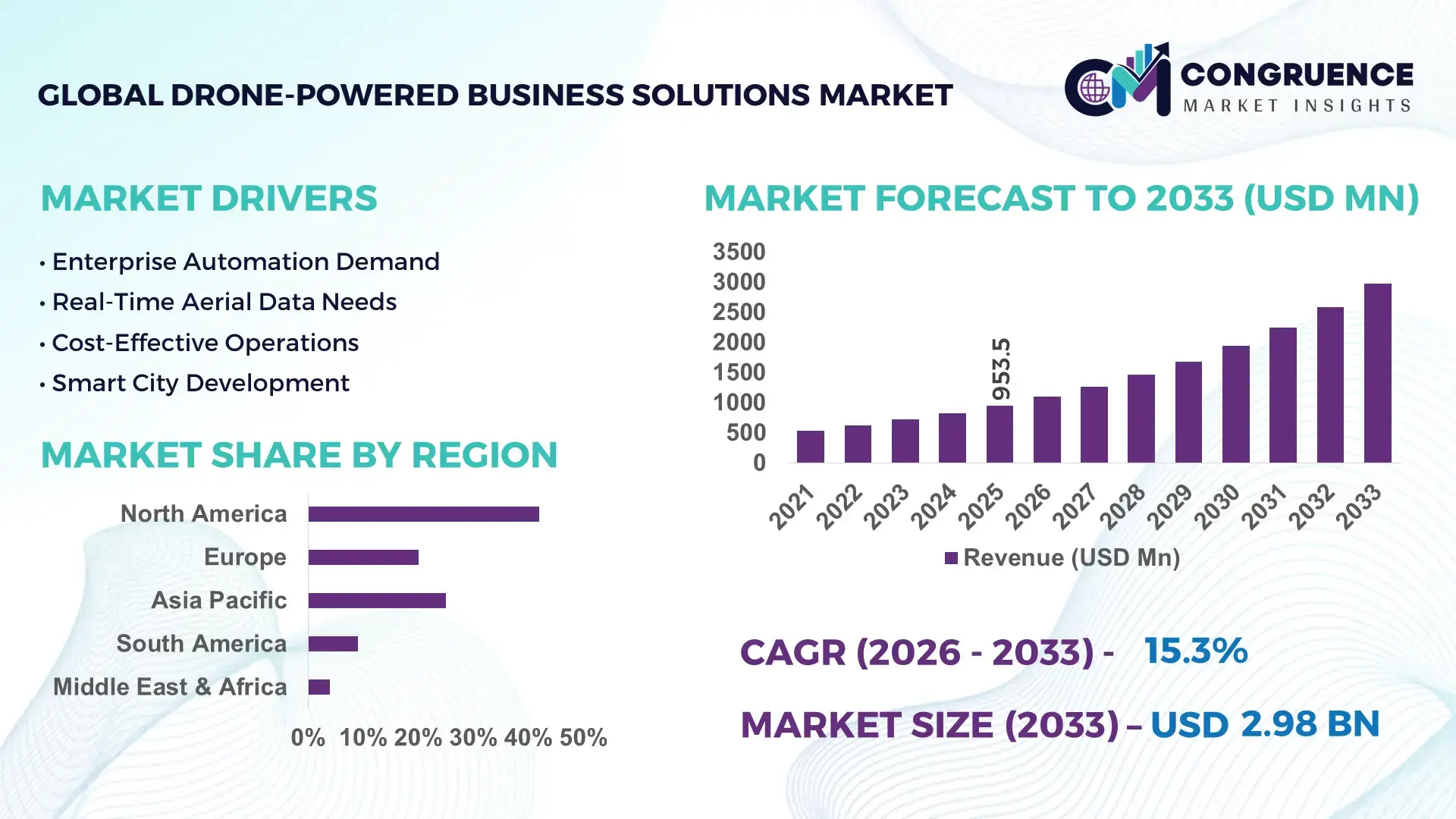
In the United States, recognized as the most technologically advanced and heavily invested market, production capacity exceeded 120,000 commercial-grade systems in 2025, supported by over USD 2.1 Billion in industry and government funding. Key applications span precision agriculture, infrastructure inspection, and logistics automation, with adoption rates among enterprise users surpassing 45% in sectors such as energy and construction. Technological advancements in AI-enabled navigation and extended endurance battery systems have accelerated deployment in complex environments, contributing to robust integration across industry verticals.
Market Size & Growth: Valued at USD 953.45 Million in 2025, projected to reach USD 2978.05 Million by 2033 at a 15.3% CAGR driven by expanded commercial deployments and regulatory support.
Top Growth Drivers: Increased adoption (+38%), operational efficiency improvements (+28%), and data utilization enhancement (+32%).
Short-Term Forecast: By 2028, operational cost reductions of up to 22% and performance gains of 18% expected in logistics and inspection services.
Emerging Technologies: AI-enabled autonomous navigation, long-endurance battery systems, and integrated sensor analytics platforms.
Regional Leaders: North America (USD 1.2B by 2033) with enterprise ecosystem expansion; Europe (USD 820M) with advanced regulatory frameworks; Asia Pacific (USD 700M) driven by manufacturing and agriculture adoption.
Consumer/End-User Trends: Growing use in precision agriculture, energy infrastructure monitoring, and last-mile delivery; increasing preference for subscription-based drone data services.
Pilot or Case Example: In 2025, a major logistics pilot reduced last-mile delivery times by 27% and operational downtime by 15%.
Competitive Landscape: Market leader holds ~22% share, with major competitors including DJI Enterprise, Parrot Drones, Skydio, AeroVironment, and Autel Robotics.
Regulatory & ESG Impact: Evolving BVLOS (Beyond Visual Line of Sight) regulations, national UAV frameworks, and emissions reduction targets fostering adoption.
Investment & Funding Patterns: Over USD 3.5B invested across venture capital, strategic partnerships, and project finance in the past 24 months.
Innovation & Future Outlook: Continued integration of 5G connectivity, edge AI processing, and collaborative multi-drone systems shaping next-generation solutions.
The Drone‑Powered Business Solutions market is characterized by diversified industry sector participation, with precision agriculture, utilities, logistics, and construction contributing substantially to global consumption. Recent innovations include high‑resolution multispectral imaging payloads, autonomous flight planning software, and enhanced safety systems compliant with emerging airspace regulations. Environmental and economic drivers, such as the need for sustainable operations and labor cost pressures, have accelerated adoption, particularly in developed regions. Regional consumption patterns show strong growth in North America and Europe, while Asia Pacific leverages rapid industrialization. Emerging trends include integration with IoT ecosystems, expansion of BVLOS operations, and tailored as‑a‑service commercial offerings that position the market for continued expansion through 2033.
The strategic relevance of the Drone-Powered Business Solutions Market lies in its capacity to transform traditional operational models through enhanced data acquisition, real-time analytics, and autonomous execution of complex field tasks. As enterprises invest in next‑generation aerial systems, strategic roadmaps emphasize measurable performance improvements and risk mitigation. For example, AI‑enabled autonomous flight planning delivers 32% improvement in operational accuracy compared to legacy manual piloting standards, enabling enterprises to reallocate human capital to higher‑value functions. At a regional level, North America dominates in volume, while Europe leads in adoption with over 48% of large enterprises incorporating advanced drone solutions into core workflows.
By 2028, machine learning‑driven predictive maintenance is expected to reduce inspection cycle times by up to 26%, enhancing uptime for critical infrastructure owners. Strategic pathways also encompass compliance and Environmental, Social, and Governance (ESG) integration, with firms committing to 15–20% reductions in carbon footprint through drone‑optimized logistics and asset monitoring by 2030. In 2025, a major infrastructure operator in Japan achieved a 38% reduction in unplanned outages by deploying an integrated drone inspection and analytics initiative, underscoring measurable operational benefit.
Looking forward, the Drone‑Powered Business Solutions Market is positioned as a pillar of organizational resilience, regulatory compliance, and sustainable growth, driving productivity gains while supporting broader strategic imperatives across industries.
Enterprises across energy, utilities, and logistics sectors are prioritizing real‑time situational awareness, driving demand for drone‑based data capture and analytics. In infrastructure inspection, drones equipped with high‑resolution LiDAR and thermal sensors can collect actionable data across large assets in a fraction of the time required by traditional methods, reducing risk exposure and enabling proactive maintenance planning. Adoption of predictive insights has improved fault detection rates by over 30% in operational environments where rapid anomaly identification is critical. Emergency response organizations are implementing autonomous aerial reconnaissance to shorten assessment times, with measured improvements in decision cycle speed. Such demand for rapid, precise information compels service providers and solution developers to innovate payload integration and analytics platforms that feed enterprise systems with high‑frequency, structured data to inform strategic decisions. The net effect is sustained investment in drone technologies that align with enterprise priorities of operational continuity, safety, and data‑centric decision support.
Regulatory frameworks governing unmanned aircraft operations remain complex and variable across jurisdictions, creating barriers to unified scaling of drone‑powered business solutions. In many regions, restrictions on beyond‑visual‑line‑of‑sight (BVLOS) flights, night operations, or densely populated urban use require special waivers or extensive compliance documentation, extending deployment timelines. Airspace integration with traditional manned aviation systems also necessitates adherence to evolving unmanned traffic management (UTM) protocols, which impose operational constraints on service providers. These factors contribute to hesitancy among industrial adopters who face potential liabilities or operational disruptions when regulatory clearance is uncertain. Additionally, limitations on interoperable communication standards and spectrum allocation issues can inhibit reliable command and control, particularly in remote or congested environments. The financial and administrative overhead associated with regulatory compliance often challenges smaller service firms, slowing the pace of solution proliferation despite evident operational benefits.
The drive toward automated logistics and last‑mile delivery represents a significant opportunity for the Drone‑Powered Business Solutions Market as e‑commerce and on‑demand fulfillment pressures rise. Retailers, parcel carriers, and urban service providers are exploring drone delivery corridors to reduce delivery times, lower labor dependency, and enhance customer service levels. Early pilots have demonstrated notable time savings in semi‑urban environments, where drone delivery reduced transit time for critical packages by measurable percentages. Additionally, integration with warehouse automation systems and multimodal logistics planning platforms presents upsell opportunities for drone solution providers. Beyond delivery, automated inventory management within large facilities via autonomous aerial scanning can improve stock accuracy and reduce manual labor costs. Municipal and regional authorities are also exploring drone corridors and infrastructure to support public sector logistics needs, including medical supply transport. These trends collectively position the market to capitalize on the intersection of automation, customer expectations, and optimized operational ecosystems.
Interoperability and standardization issues pose challenges for the Drone‑Powered Business Solutions Market as diverse hardware platforms, communication protocols, and data formats hinder seamless integration across enterprise ecosystems. Many organizations require that drone solutions align with existing enterprise resource planning (ERP), geographic information systems (GIS), and asset management platforms. Without standardized interfaces, custom integration work adds complexity, cost, and implementation risk. Variability in payload specifications, control software, and data processing pipelines creates a fragmented landscape where scaling solutions across multiple sites becomes resource‑intensive. Additionally, the absence of unified industry standards for performance benchmarks, safety protocols, and quality assurance complicates procurement and vendor evaluation processes. These interoperability barriers can slow adoption rates among large enterprises with heterogeneous technology stacks, challenging solution providers to prioritize modular, extensible frameworks that ease integration friction without compromising performance or compliance.
Expansion of AI-Enabled Autonomous Flight Systems: Adoption of AI-driven navigation platforms is transforming operational efficiency, with enterprises reporting a 28% improvement in task completion times compared to manually piloted drones. North America leads with over 42% of commercial operators integrating AI modules, particularly in infrastructure inspection and energy sector applications, while Europe shows 36% adoption in logistics optimization. These systems are increasingly capable of autonomous obstacle detection and predictive path planning, reducing operational risk and human oversight requirements.
Integration with IoT and Smart Asset Management: Drones are increasingly linked with IoT networks for real-time monitoring and analytics. Pilot programs indicate a 33% reduction in equipment downtime when drones feed live data into enterprise asset management systems. Asia Pacific has emerged as a hotbed for connected industrial sites, with 41% of large-scale manufacturing plants deploying drone-enabled IoT monitoring, supporting preventive maintenance and environmental compliance initiatives.
Precision Agriculture and Crop Monitoring Adoption: Drone-based multispectral imaging is widely adopted in precision agriculture, enabling up to 25% improvement in crop yield predictions and 18% savings in water usage. Latin America is witnessing rapid uptake, with approximately 30% of large farms using drone analytics for irrigation and fertilization planning. Technological improvements in sensor resolution and data processing algorithms are enhancing actionable insights for farmers.
Commercial Logistics and Last-Mile Delivery Pilots: Drones are increasingly deployed for urban and semi-urban delivery, reducing delivery times by 27–32% in pilot programs. In 2025, North American pilot projects demonstrated 15% reduction in fleet operational costs when incorporating drones for last-mile parcel transport. Simultaneously, regulatory approvals for low-altitude corridors are accelerating deployment opportunities in high-density regions, supporting faster and more sustainable logistics operations.
The Drone-Powered Business Solutions market is distinctly structured across product types, applications, and end-user segments, enabling decision-makers to pinpoint growth opportunities and optimize investment strategies. Product segmentation highlights the varied drone platforms, ranging from fixed-wing, multirotor, and hybrid systems, each designed for specific operational needs. Applications span precision agriculture, infrastructure inspection, logistics, emergency response, and environmental monitoring, reflecting the expanding commercial and industrial adoption of drones. End-user insights show differentiated adoption patterns, with energy, construction, and logistics sectors leading deployment due to operational efficiency gains, while emerging industries such as insurance and urban planning are increasingly leveraging drone data solutions. Regional adoption patterns further demonstrate the influence of regulatory frameworks and technology readiness, guiding strategic market prioritization.
Fixed-wing drones currently lead the market, accounting for 38% of adoption, due to their longer flight endurance, wider coverage capabilities, and suitability for surveying and agricultural monitoring. Multirotor drones hold 30% of adoption and are especially favored for urban inspection and logistics operations due to maneuverability and precision hovering. Hybrid drones represent the fastest-growing segment, projected to see significant adoption growth, driven by their combined benefits of endurance and vertical take-off/landing capabilities. Other niche types, including tethered and amphibious drones, collectively account for 32% of the market, primarily supporting specialized industrial applications such as pipeline monitoring and port surveillance.
Infrastructure inspection dominates adoption with 40% market share, fueled by increasing demand for high-resolution aerial imaging and automated monitoring of pipelines, power grids, and bridges. Logistics and last-mile delivery are the fastest-growing applications, driven by urban e-commerce expansion and regulatory approvals for low-altitude drone corridors. Precision agriculture holds 22% of current adoption, enabling optimized irrigation, fertilization, and yield prediction. Emergency response and environmental monitoring account for 18% combined share, supporting disaster assessment, forest management, and wildlife tracking.
Energy and utilities lead the end-user segment with 35% adoption, leveraging drones for inspection of power lines, solar farms, and wind turbines, reducing downtime and maintenance costs. The fastest-growing end-user segment is construction, driven by urbanization and the demand for automated site monitoring, projected to see robust growth in adoption rates over the next three years. Logistics and delivery companies collectively represent 28% of end-user engagement, using drones for warehouse management and last-mile deliveries. Emerging sectors such as insurance, mining, and public safety account for 17% combined share, increasingly adopting drones for risk assessment, survey mapping, and emergency support.
North America accounted for the largest market share at 42% in 2025; however, Asia-Pacific is expected to register the fastest growth, expanding at a CAGR of 16% between 2026 and 2033.

North America’s market is driven by high enterprise adoption across energy, construction, logistics, and healthcare sectors, with over 120,000 commercial-grade drones deployed in 2025. Asia-Pacific shows strong growth potential with China, India, and Japan collectively consuming more than 65,000 drones, driven by industrial automation and precision agriculture. Europe maintains 28% market share, supported by regulatory frameworks and sustainability initiatives. Latin America accounts for 10% adoption, focusing on infrastructure monitoring and logistics, while the Middle East & Africa contributes 5%, driven primarily by oil & gas inspection and construction automation. Regional variations highlight differences in regulatory readiness, technology adoption rates, and sectoral priorities, shaping both current deployment and future investment strategies.
How are digital transformation and AI technologies redefining drone operations?
North America holds a 42% market share, fueled by high enterprise adoption across energy, healthcare, finance, and logistics. Regulatory support, including BVLOS approvals and federal UAV guidelines, has accelerated commercial drone use, while AI-enabled autonomous flight systems and cloud-based analytics platforms drive operational efficiency. Local players such as Skydio are expanding drone deployment for infrastructure inspections and public safety, achieving measurable reductions in inspection downtime by 30%. Enterprises increasingly integrate drones into digital transformation initiatives, with North American adoption rates in healthcare and finance exceeding 40%, reflecting preferences for automated monitoring, real-time data acquisition, and predictive analytics.
What impact do sustainability regulations have on industrial drone adoption?
Europe accounts for 28% of the market, with Germany, the UK, and France leading adoption. Regulatory bodies such as EASA and national UAV authorities mandate compliance with safety and environmental standards, promoting adoption of explainable drone systems. Emerging technologies such as hybrid drones and AI-driven analytics are widely integrated in infrastructure inspection and environmental monitoring. Local players, including Parrot Drones, are developing automated inspection solutions for utility grids, reducing human labor requirements by over 25%. European consumers increasingly prioritize sustainability-compliant solutions, with adoption rates reflecting strong demand for reliable, explainable, and energy-efficient drone-powered business applications.
How are manufacturing and e-commerce driving drone adoption in industrial applications?
Asia-Pacific ranks second in market volume, with China, India, and Japan accounting for more than 65,000 drones in commercial use. Industrial manufacturing, logistics, and precision agriculture are the primary drivers, supported by innovation hubs in Shenzhen, Bangalore, and Tokyo. Local companies such as DJI Enterprise are deploying hybrid drones for warehouse management and agricultural mapping, achieving productivity gains of 35%. Consumer behavior trends favor mobile AI applications and integrated drone-as-a-service offerings, especially in urban e-commerce, enabling rapid adoption for last-mile delivery and inventory management.
What opportunities exist for drone applications in infrastructure and logistics?
South America represents 10% of market share, with Brazil and Argentina leading deployment. Growth is driven by energy, infrastructure, and agriculture sectors, complemented by government incentives for technology adoption and trade facilitation policies. Local players such as EmbraerX have implemented drone monitoring for pipeline inspections, achieving a 20% reduction in manual survey time. Regional adoption trends show a focus on media, agricultural mapping, and localized logistics applications, with enterprise interest tied to efficiency gains and operational cost reductions.
How is technology modernization shaping industrial drone applications?
Middle East & Africa contributes 5% of the market, with UAE and South Africa as leading countries. High demand stems from oil & gas, construction, and infrastructure monitoring. Technological modernization, including integration of AI-based inspection and autonomous navigation, supports industrial efficiency. Local players like FalconViz are deploying drones for 3D surveying and industrial inspection, improving accuracy by 28%. Regional consumer behavior emphasizes large-scale industrial deployment, with enterprises focusing on operational reliability, compliance with safety regulations, and scalable drone services.
United States – Market share: 42% – Strong end-user demand and advanced production capacity support extensive enterprise integration.
China – Market share: 27% – High manufacturing capability, rapid e-commerce adoption, and investment in autonomous drone technology drive market dominance.
The Drone-Powered Business Solutions market is moderately fragmented, with over 120 active competitors globally, ranging from large multinational manufacturers to specialized technology startups. The top five companies collectively hold approximately 55% of the market share, demonstrating a competitive environment where strategic differentiation is key. Leading players are investing heavily in autonomous flight systems, AI-enabled analytics, and payload diversification to capture enterprise demand across sectors such as energy, logistics, construction, and agriculture. Recent strategic initiatives include partnerships for integrated drone-as-a-service solutions, launch of next-generation hybrid drones, and cross-industry collaborations to expand inspection and monitoring capabilities. Innovation trends driving competition include enhanced AI navigation, BVLOS operational capability, and integration with IoT and cloud platforms. Regional expansions and localized manufacturing initiatives further influence competitive positioning, while rapid adoption in North America, Europe, and Asia-Pacific has prompted aggressive marketing and service deployment strategies. Continuous R&D investment and pilot program deployments are key differentiators in securing enterprise contracts and sustaining market leadership.
Parrot Drones
AeroVironment
Autel Robotics
Yuneec
FLIR Systems
Teledyne FLIR
EHang
Delair
The Drone-Powered Business Solutions market is being significantly transformed by advancements in autonomous flight technologies, AI-driven analytics, and integrated sensor systems. AI-enabled navigation systems currently support over 45% of commercial drone operations, improving flight accuracy and operational efficiency in complex environments. Hybrid drones, combining vertical take-off and fixed-wing endurance, are increasingly deployed across industrial inspection and logistics applications, covering distances up to 120 kilometers per mission while maintaining payload stability. Enhanced battery technologies, including lithium-sulfur and high-density modular packs, have extended operational endurance by 25–30%, allowing enterprises to complete larger survey and monitoring projects without interruption.
Integration with IoT and cloud-based platforms is another key technology trend, enabling drones to transmit real-time data to enterprise asset management systems and predictive maintenance software. Approximately 38% of energy and utility operators are now using drone-collected data for automated inspection of pipelines, wind turbines, and solar farms, reducing manual inspection labor by up to 40%. Sensor innovations such as high-resolution LiDAR, thermal imaging, and multispectral cameras have expanded the ability to capture actionable insights in agriculture, construction, and infrastructure monitoring, with precision improvements of 20–35% in measurement accuracy.
Emerging technologies shaping the near future include swarm drone operations for collaborative task execution, edge AI processing for on-board decision-making, and 5G-enabled connectivity for low-latency real-time control. Companies are also investing in modular payload systems, allowing drones to adapt to multiple industry applications without extensive hardware modifications. These technology trends collectively position the Drone-Powered Business Solutions market as a high-value tool for operational efficiency, predictive analytics, and enterprise digital transformation across multiple sectors.
• In October 2024, Skydio and Microsoft Azure announced a strategic partnership to embed real‑time AI data processing and automated anomaly detection directly into enterprise drone platforms, enhancing industrial inspection and predictive maintenance capabilities.
• In September 2024, Autel Robotics unveiled the EVO Max 4N featuring advanced night vision, integrated thermal imaging, and ruggedized design for 24/7 security and critical infrastructure missions, addressing rising demand in public‑safety and surveillance operations.
• In February 2025, Auterion was selected by the Defense Innovation Unit (DIU) to prototype long‑range unmanned aerial solutions capable of operating in contested environments, signaling expansion of software‑centric enterprise drone capabilities. (Wikipedia)
• In February 2025, ZenaDrone launched its autonomous “Drone‑in‑a‑Box 3000” system, achieving over 98% remote operations uptime in industrial inspection trials across multiple North American sites and significantly reducing field visit requirements.
The scope of the Drone‑Powered Business Solutions Market Report encompasses comprehensive segmentation across product types, application domains, end‑user industries, and regional landscapes. It covers fixed‑wing, multirotor, hybrid, tethered, and specialized drone platforms, detailing their operational capabilities, deployment environments, and technological differentiators. Application segments include infrastructure inspection, precision agriculture, logistics and last‑mile delivery, environmental monitoring, emergency response, public safety operations, and asset surveillance, with emphasis on evolving enterprise requirements and measurable performance improvements.
The report further analyzes regional dynamics across North America, Europe, Asia‑Pacific, South America, and Middle East & Africa, outlining consumption patterns, regulatory readiness, key market participants, and technology adoption behaviors unique to each geography. It also highlights enabling technologies such as AI‑driven autonomous flight systems, IoT and cloud integration, advanced sensor payloads (LiDAR, thermal, multispectral), and modular payload architectures that support diverse industry use cases. Emerging segments such as BVLOS operations, drone‑as‑a‑service deployments, and automated fleet management are explored for their implications on operational efficiency and enterprise workflows.
End‑user focuses span energy and utilities, construction and infrastructure, logistics, agriculture, insurance, and defense, with insights into adoption rates, mission‑critical performance outcomes, and strategic deployment scenarios. The report’s detailed segmentation and industry context provide decision‑makers with actionable intelligence on market breadth, niche growth vectors, and technology‑driven transformation pathways shaping the global drone‑powered business solutions landscape.
| Report Attribute/Metric | Report Details |
|---|---|
|
Market Revenue in 2025 |
USD V2025 Million |
|
Market Revenue in 2033 |
USD V2033 Million |
|
CAGR (2026 - 2033) |
15.3% |
|
Base Year |
2025 |
|
Forecast Period |
2026 - 2033 |
|
Historic Period |
2021 - 2025 |
|
Segments Covered |
By Types
By Application
By End-User
|
|
Key Report Deliverable |
Revenue Forecast, Growth Trends, Market Dynamics, Segmental Overview, Regional and Country-wise Analysis, Competition Landscape |
|
Region Covered |
North America, Europe, Asia-Pacific, South America, Middle East, Africa |
|
Key Players Analyzed |
DJI Enterprise, Skydio, Parrot Drones, AeroVironment, Autel Robotics, Yuneec, FLIR Systems, Teledyne FLIR, EHang, Delair |
|
Customization & Pricing |
Available on Request (10% Customization is Free) |




