
Reports
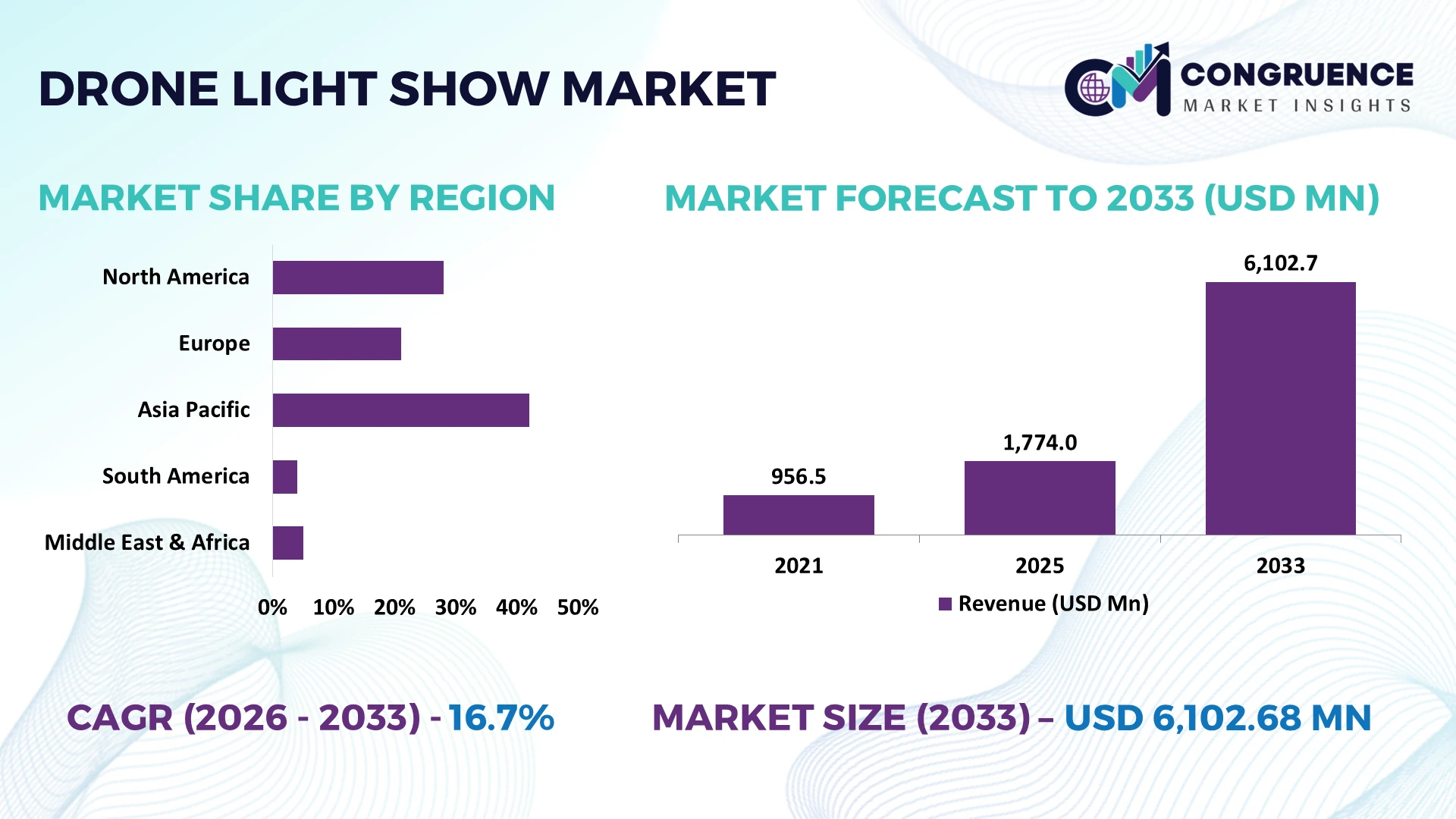
The Global Drone Light Show Market was valued at USD 1,774.0 Million in 2025 and is anticipated to reach a value of USD 6,102.7 Million by 2033 expanding at a CAGR of 16.7% between 2026 and 2033. Growth is driven by the replacement of conventional fireworks with programmable LED drone fleets, increasing investment in synchronized aerial entertainment, and the integration of AI-based flight coordination, 3D animation, and real-time fleet management.
China holds a strategically important position in drone light show manufacturing and large-scale deployment, supported by domestic drone producers, electronics supply chains, and government-backed low-altitude economy initiatives. In June 2025, a Chongqing display deployed 11,787 drones, demonstrating the country's capacity for coordinated mass-fleet operations. India is also strengthening its position, with a 5,500-drone deployment at the 2024 Amaravati Drone Summit. China's manufacturing scale and India's expanding event ecosystem reinforce Asia's competitive importance.
Companies prioritizing fleet reliability, proprietary choreography software, regulatory readiness, and localized manufacturing partnerships will secure stronger positions in the global drone entertainment ecosystem.
Market Size & Growth: The market progresses from USD 1,774.0 million in 2025 to USD 6,102.7 million by 2033, supported by 16.7% growth and the shift toward programmable aerial entertainment.
Top Growth Drivers: Sustainable alternatives to fireworks, AI-enabled fleet synchronization, and increasing corporate event adoption are the three principal demand catalysts.
Short-Term Forecast: By 2028, operators will prioritize larger reusable fleets, automated pre-flight validation, and improved deployment efficiency to increase show frequency and fleet utilization.
Emerging Technologies: AI-assisted choreography, RTK-GNSS positioning, and advanced LED payloads are improving animation accuracy, formation stability, and visual resolution.
Regional Leaders: North America is projected to reach USD 2,096.7 million by 2033, while Asia Pacific is projected to reach USD 1,777.2 million; Europe remains an established market for premium cultural and commercial productions.
Consumer/End-User Trends: Public events accounted for more than 23% of the 2024 market, reflecting the importance of festivals, municipal celebrations, tourism campaigns, and destination marketing.
Pilot/Case Example: In 2025, Chongqing's record-setting aerial display deployed 11,787 drones, demonstrating the operational potential of synchronized mass-fleet entertainment.
Competitive Landscape: The market features Intel, Sky Elements, Verge Aero, Dronisos, and SKYMAGIC, competing through fleet capacity, software, creative execution, and international event delivery.
Regulatory & ESG Impact: Drone displays provide a reusable alternative to conventional fireworks, while aviation permissions, flight separation, and operational safety requirements influence deployment planning.
Investment & Funding: Capital allocation is increasingly directed toward fleet expansion, software development, specialized LED hardware, and partnerships with event producers; a consolidated global investment total is not consistently disclosed.
Innovation & Future Outlook: Autonomous fleet coordination, interactive aerial storytelling, drone-launched special effects, and integrated laser projection are shifting competition toward complete immersive-entertainment platforms.
The drone light show industry is expanding across public celebrations, sports events, tourism destinations, corporate advertising, and entertainment productions. AI-powered choreography, high-brightness LED payloads, swarm navigation, and drone-launched pyrotechnics are enhancing creative flexibility. Drone formations accounted for over 49% of the market in 2024, highlighting the commercial importance of synchronized aerial displays. Reusable fleets and software-led production are increasingly influencing event procurement and operational planning.
Drone light shows are becoming strategically important because they combine aerospace engineering, digital entertainment, advertising, and event production into a scalable commercial service. Operators with proprietary choreography software, reliable fleet management, and aviation compliance capabilities gain an advantage over conventional event-production providers. The shift toward reusable aerial displays also creates opportunities for recurring contracts with tourism authorities, municipalities, sports organizations, and global brands.
Technology differentiation is increasingly measurable through fleet capacity and operational precision. Unlike conventional fireworks, which are consumed during a single performance, programmable drones can be reused across multiple events, with animations redesigned through software rather than rebuilding the physical display. Intel's Shooting Star platform illustrates this integrated model by combining specialized aircraft, animation design, site surveys, calibration, and flight execution.
Regional strategies differ considerably. The United States leads through established commercial operators and premium event contracts, while China benefits from manufacturing scale and record-setting mass deployments. India is emerging through domestic drone development and government-supported events. During 2026–2028, operators will prioritize larger reusable fleets, automated safety validation, local aviation partnerships, and multi-event service agreements. Companies that integrate hardware, software, creative production, and regulatory expertise will establish more defensible competitive positions.
The transition from conventional fireworks toward reusable aerial entertainment is a major structural growth driver. Drone formations held more than 49% of the market's 2024 revenue, while public events represented over 23%, demonstrating strong commercial relevance across municipal celebrations and tourism programming. Restrictions on noise, particulate emissions, and fire hazards are encouraging event organizers to consider programmable LED fleets. China's expanding low-altitude economy and record-setting 11,787-drone Chongqing performance demonstrate how government-backed cultural tourism initiatives accelerate adoption. Companies are responding through fleet expansion, advanced choreography platforms, and partnerships with destination-management organizations. The strategic advantage lies in converting one-time performances into reusable, repeatable event-service contracts.
Specialized aircraft, batteries, positioning equipment, control software, trained pilots, and transportation requirements create substantial upfront investment for drone show operators. Fleet reliability also depends on battery replacement cycles, maintenance infrastructure, and spare-aircraft availability, increasing operating expenditure during large productions. In the United States, FAA requirements governing multiple-aircraft operations, operations over people, and airspace permissions introduce additional compliance responsibilities. Multiple-drone operations can require specific waivers, with safety assessments covering software, geofencing, and aircraft-failure procedures. These requirements increase preparation time and restrict smaller operators' ability to compete for complex contracts. Companies are reducing exposure through standardized fleets, equipment leasing, preventive maintenance, and long-term supplier agreements.
AI-assisted choreography, automated formation planning, high-efficiency LED systems, and integrated laser projection are creating opportunities beyond conventional drone formations. The more than 49% share held by drone formations in 2024 provides an established commercial foundation for higher-value animation and immersive entertainment services. China's 11,787-drone Chongqing performance also demonstrates the potential for large-scale cultural tourism projects and destination branding. Emerging opportunities include synchronized displays for stadiums, smart-city celebrations, product launches, and recurring tourism festivals. Operators are investing in proprietary software, modular payloads, and partnerships with event-production agencies. A particularly attractive opportunity is licensing reusable choreography libraries, allowing providers to generate recurring software and customization income beyond individual flight contracts.
Scaling drone light shows requires precise positioning, reliable communication links, synchronized flight paths, and coordinated emergency procedures across hundreds or thousands of aircraft. China's 11,787-drone Chongqing deployment illustrates the technical complexity of maintaining synchronized formations at exceptional fleet scale. In the United States, FAA-issued drone light show provisions specify operational requirements that include redundant flight-control and transmission systems, additional certified personnel, and visual observers scaled to fleet size. One provision specifies one visual observer per 125 aircraft. These requirements increase coordination complexity and workforce requirements as fleets expand. Companies must strengthen cybersecurity, navigation redundancy, weather monitoring, battery diagnostics, and operator training to maintain consistent performance and protect long-term customer confidence.
High-Density Fleet Deployment: Large-scale synchronized performances are increasing operational complexity, with Chongqing's 2025 record deployment involving 11,787 drones. Fleet capacity is becoming an important procurement differentiator as operators move beyond conventional formations toward complex 3D aerial storytelling. Companies are investing in centralized fleet management, positioning accuracy, and redundant communication systems to improve show reliability and reduce setup delays.
Animation-Led Content Production: Drone animation shows are gaining commercial importance, with the segment projected to expand at 19.6% CAGR through 2033. AI-assisted choreography, motion sequencing, and reusable animation libraries are changing production workflows. Operators are shifting investment toward creative software and digital design teams, reducing dependence on manually developed show sequences and improving customization for brand campaigns.
Autonomous Flight Management: Remotely operated systems accounted for more than 55% of the 2024 market, while semi-autonomous and fully autonomous platforms are advancing through improved navigation and flight-control software. Companies are integrating automated diagnostics, geofencing, and real-time positioning to reduce manual coordination. This shift is particularly relevant to operators managing recurring performances across multiple venues.
Safety-Driven Operational Standardization: Aviation compliance is increasingly shaping fleet deployment, particularly in the United States, where complex multi-aircraft operations require specific regulatory approvals. FAA provisions include visual-observer requirements that can reach one observer per 125 aircraft under specified operating conditions. Operators are responding with standardized safety procedures, trained ground teams, and stronger pre-flight validation, making regulatory readiness a competitive differentiator.
Drone formations represented the leading type, accounting for approximately 49.15% of the global market in 2024. Their dominance reflects their ability to create recognizable logos, geometric patterns, animated symbols, and large-scale visual compositions using synchronized aircraft. Standardized flight paths, modular fleet configurations, and reusable choreography improve deployment efficiency across festivals, national celebrations, and corporate events. Drone animation shows are the fastest-growing type, with a projected 19.6% CAGR, driven by demand for moving characters, sequential storytelling, and increasingly sophisticated aerial content.
Drone-launched fireworks provide additional visual effects and strengthen premium entertainment offerings, while other types serve specialized creative and operational requirements. The difference between established formations and emerging animation shows is shifting investment toward software capabilities, motion programming, and advanced payload integration. Operators are expanding animation libraries and combining conventional formations with dynamic sequences to improve customization and contract value. The strategic implication is that fleet size alone is becoming insufficient; creative execution and repeatable software-driven production increasingly determine differentiation.
Public events represent the largest established application category, supported by national celebrations, municipal festivals, cultural programs, and major public gatherings. Grand View Research reported that public events accounted for more than 23% of global end-use demand in 2024. Tourism, corporate events, sports, and music concerts provide additional application opportunities, with demand shaped by destination promotion, brand visibility, stadium entertainment, and live-event programming.
Tourism applications are gaining strategic importance as destination authorities and hospitality operators incorporate recurring aerial performances into visitor experiences. Corporate applications prioritize branded formations and product storytelling, while sports and music events favor synchronized displays integrated with live programming. Drone-launched visual effects also support differentiated entertainment packages. Operators are responding through venue partnerships, customized choreography, and multi-event service agreements. Compared with occasional public celebrations, tourism and corporate deployments offer opportunities for recurring schedules and longer-term commercial relationships. This shift encourages companies to prioritize venue-specific show libraries, reusable equipment, and integrated event-production capabilities.
Event management companies represent a central buyer group because they coordinate large-scale public celebrations, festivals, concerts, and commercial productions requiring specialized drone fleets. Other important end-user categories include advertising agencies, corporations, entertainment studios, governments and municipalities, private individuals, sports organizers, and theme parks and resorts. Government and municipal buyers prioritize public celebrations and destination branding, while corporations and advertising agencies focus on customized promotional campaigns and branded aerial storytelling.
Event management companies and tourism-oriented venues are increasingly attractive growth opportunities because recurring event schedules support higher fleet utilization. Advertising agencies are strengthening demand for customized brand experiences, while sports organizers and entertainment studios are integrating aerial displays into live programming. Operators are responding with flexible fleet packages, creative partnerships, and venue-specific pricing. The competitive priority is shifting toward long-term service agreements rather than isolated performances, improving equipment utilization and customer retention. Public-sector procurement remains important, but commercial buyers offer opportunities for repeat bookings and customized premium services.
Asia Pacific accounted for the largest market share at 42.0% in 2025 however, Middle East & Africa is expected to register the fastest growth, expanding at a CAGR of 15.3% between 2026 and 2033.

North America accounted for 28.0% of the global market in 2025, supported by established event-production companies, commercial drone operators, sports organizations, and technology developers. The United States represents the principal demand center, benefiting from premium corporate events, professional sports entertainment, municipal celebrations, and established aerial advertising capabilities. Canada contributes through tourism festivals and government-supported public events. FAA operational approvals and airspace coordination remain important deployment considerations, encouraging investment in flight-control software, safety systems, and certified operating teams. The region's competitive advantage lies in combining creative production with established commercial distribution networks. Operators are increasingly pursuing recurring venue contracts and integrated entertainment partnerships rather than relying exclusively on individual performances, improving fleet utilization and commercial predictability.
United States Market Outlook: The United States dominates North American commercial deployment through its concentration of specialist operators, event agencies, and aerospace technology companies. The country accounted for approximately 85.5% of North America's market in 2024, reflecting its substantial commercial event ecosystem. Companies including Sky Elements, Intel, and Verge Aero strengthen the domestic competitive landscape through fleet engineering, choreography software, and large-scale production capabilities.
Europe accounted for 21.0% of the global market in 2025, supported by established cultural festivals, tourism destinations, corporate exhibitions, and premium entertainment productions. Germany, France, and the United Kingdom provide important commercial markets through advanced event infrastructure and established audiovisual production industries. European Union drone regulations, particularly the risk-based operational framework, influence fleet certification, operator responsibilities, and deployment planning. These requirements encourage providers to strengthen technical documentation, operational risk assessments, and pilot training. Compared with North America's commercial event concentration, European demand is more closely associated with cultural programming, destination marketing, and cross-border entertainment production. Companies are responding through local operating partnerships, standardized equipment platforms, and reusable show formats that accommodate different national aviation requirements.
Germany Market Outlook: Germany benefits from its advanced engineering ecosystem, industrial automation capabilities, and established audiovisual production infrastructure. Its position in the European market is supported by corporate events, public festivals, and technology-led entertainment services. Local suppliers can leverage precision engineering, battery technology, and software integration expertise to strengthen drone reliability. Germany's implementation of EU-wide aviation requirements also creates opportunities for operators with strong compliance capabilities and standardized fleet-management systems.
Asia Pacific held the largest regional share at 42.0% in 2025, driven by China's drone manufacturing ecosystem, large-scale public celebrations, and expanding commercial entertainment infrastructure. China leads regional production and deployment through specialized drone manufacturers, fleet-management technology, and large-format aerial performances. India, Japan, and South Korea are strengthening demand through tourism promotion, national celebrations, corporate advertising, and entertainment applications. A major operational milestone occurred in Chongqing in June 2025, when 11,787 drones participated in a synchronized aerial display, demonstrating the region's mass-deployment capabilities.
Companies are strengthening manufacturing capacity, developing proprietary flight-control systems, and expanding partnerships with event organizers. The regional advantage increasingly comes from integrating hardware production with creative software and large-scale deployment expertise.
China Market Outlook: China maintains a strong competitive advantage through domestic drone manufacturing, electronics supply chains, and extensive experience in coordinated aerial displays. The country's 11,787-drone Chongqing performance in 2025 demonstrated the operational maturity of its large-fleet ecosystem. Domestic companies are investing in high-density positioning systems, battery optimization, LED payloads, and automated choreography platforms. Government initiatives supporting the low-altitude economy further strengthen opportunities for commercial drone applications and entertainment services.
South America accounted for 4.0% of the global market in 2025, with Brazil serving as an important demand center through festivals, tourism events, sporting celebrations, and corporate activations. Argentina, Chile, and Colombia offer additional opportunities through cultural programming and destination marketing. Compared with established North American and European markets, the region has a smaller specialist operator base and greater dependence on imported drone hardware, batteries, and positioning equipment. Currency volatility, transportation costs, and inconsistent aviation approval processes influence deployment economics. Brazil's extensive festival calendar creates opportunities for recurring entertainment contracts, while tourism authorities increasingly prioritize distinctive visitor experiences. Companies are responding through partnerships with local event producers, equipment distributors, and tourism organizations, enabling market entry without immediately establishing extensive domestic manufacturing operations.
Brazil Market Outlook: Brazil offers the strongest commercial opportunity in South America because of its large entertainment industry, tourism infrastructure, and internationally recognized cultural events. Its estimated 49% share of the Latin American market in a separate industry forecast highlights its importance as a regional commercial hub. Operators are targeting carnival celebrations, destination promotions, sporting events, and branded productions. Local event partnerships, equipment servicing capabilities, and aviation-compliant deployment models will remain important competitive factors.
Middle East & Africa represented 5.0% of the global market in 2025 and is positioned as the fastest-growing regional market in the selected regional forecast. The United Arab Emirates and Saudi Arabia are important demand centers, supported by destination development, large-scale festivals, luxury hospitality, and landmark entertainment projects. Saudi Arabia's Vision 2030 tourism and entertainment investments are expanding opportunities for specialized aerial productions, while Dubai and Abu Dhabi continue attracting international event operators. Across Africa, adoption is concentrated in tourism destinations, major celebrations, and premium corporate events. Compared with mature markets, the region offers opportunities for new venue partnerships and large-format installations. Companies are prioritizing local operating relationships, imported fleet availability, and customized entertainment packages to address differing aviation frameworks and deployment conditions.
United Arab Emirates Market Outlook: The UAE benefits from premium tourism infrastructure, international event connectivity, and substantial investment in destination entertainment. Dubai and Abu Dhabi provide established commercial platforms for synchronized aerial displays across national celebrations, hospitality developments, and major public events. The country's experience hosting large international gatherings strengthens demand for sophisticated visual productions. Companies are positioning through partnerships with tourism authorities, hospitality operators, and international event-production agencies, while investing in advanced fleet coordination and operational safety capabilities.
The market pits vertically integrated manufacturers such as DAMODA, HIGH GREAT, Geoscan and EHang against service-led specialists including Sky Elements, Verge Aero, Dronisos, SKYMAGIC and BotLab Dynamics. Manufacturers compete on fleet cost, reliability and supply availability; show producers compete on choreography, approvals, customization and delivery speed. The five largest suppliers held an estimated 45.23% market share in 2023, indicating concentration but room for regional and specialist operators. Competition rewards scale: drone formations represented over 49% in 2024, while remotely operated systems accounted for more than 55%. Chinese OEMs leverage manufacturing depth and pricing, while Western specialists differentiate through proprietary software, branded-event relationships and safety execution. Players are expanding partner networks, integrating pyrotechnics and laser payloads, and developing hardware-software platforms. Entry barriers include capital-intensive fleets, aviation permissions, trained crews and proven reliability. The competitive shift favors operators controlling technology, supply, compliance and creative delivery—not simply the lowest-cost aircraft alone.
Sky Elements, LLC
Verge Aero, Inc.
Dronisos
Great Lakes Drone Company, LLC
SKYMAGIC LIVE PTE. Ltd.
CollMot Robotics
Firefly Drone Shows
Nova Sky Stories
CYBERDRONE
Celestial
BotLab Dynamics
DAMODA Intelligent Control Technology
HIGH GREAT
Geoscan Group
Drone light show technology is shifting from manually coordinated LED fleets toward integrated platforms combining RTK-GNSS positioning, autonomous flight planning, redundant sensors, AI-assisted choreography, and special-effects payloads. Remotely operated systems represented more than 55% of the market in 2024, while drone formations exceeded 49%, confirming that reliable control and synchronized geometry remain the commercial foundation. RTK correction and geofencing improve repeatability; Firefly’s Gen2 combines centimeter-level positioning, triple-redundant IMUs, and 360-degree LEDs.
The next layer integrates lasers, pyrotechnics, and timecode synchronization. SKYMAGIC’s 2025 Ras Al Khaimah production combined 47 laser drones with 1,400 LED aircraft, extending displays beyond pixel-based imagery. Verge Aero’s PGI fleet increased from 1,800 drones in 2024 to 2,500 in 2025, a 38.9% rise in demonstrated capacity—not a controlled efficiency gain. Unlike conventional fireworks, reusable aircraft allow sequences to be reprogrammed rather than rebuilt for each event.
During 2026–2028, investment in simulation, diagnostics, secure communications, and modular payloads will improve repeatability and creative range. Hardware manufacturers benefit from scale, while software-led providers differentiate through faster revisions, safer validation, and multi-venue content reuse. Comparable industry-wide percentage gains in cost or efficiency are not established; buyers should prioritize verified uptime, positioning accuracy, setup time, and aircraft reuse before fleet procurement.
February 2026 — EHang Egret deployed 22,580 GHOSTDRONE 4.0 UAVs at China’s Spring Festival Gala in Hefei, setting a Guinness record for drones airborne simultaneously from one computer. The milestone validates mass-swarm control and strengthens EHang’s cultural-event positioning. Source: ehang.com
June 2025 — DAMODA reported an 11,787-drone aerial image record and an 11,198-aircraft simultaneous flight during a seven-day Heyuan event in Guangdong Province. These deployments demonstrate manufacturing scale and reinforce its export proposition for operators seeking high-capacity fleets. Source: damoda.com
August 2025 — Verge Aero partnered with Rozzi Fireworks and its provider network on a hybrid production using 2,300 LED drones and 200 pyro-drones in Iowa. The integration expands premium formats and cross-selling opportunities with established pyrotechnics producers. Source: verge.aero
August 2024 — Dronisos staged a Tour de France arrival display in Nice using 1,500 drones for more than 60,000 spectators. The citywide production strengthened its credentials for major sporting events and destination-marketing contracts across France premium productions. Source: dronisos.com
The report evaluates the global drone light show industry across product formats, deployment settings, buyer groups, operating models, and geographic markets. Type coverage includes drone formations, drone-launched fireworks, drone animation shows, and other formats. Application and end-use analysis examines public events, corporate events, tourism, sports, music concerts, and related entertainment deployments, while buyer assessment considers event producers, municipalities, brands, and venue operators. Operating models span remotely operated, semi-autonomous, and fully autonomous fleets.
Regional coverage includes North America, Europe, Asia Pacific, South America, and the Middle East & Africa, with country-level emphasis on the United States, China, India, Germany, Brazil, Saudi Arabia, and the UAE. Technology assessment covers RTK positioning, swarm-control software, AI choreography, LED and laser payloads, safety systems, and hybrid effects. The analysis supports investment screening, market entry, fleet expansion, partnership selection, and competitive positioning through 2033.
| Report Attribute / Metric | Details |
|---|---|
| Market Revenue (2025) | USD 1,774.0 Million |
| Market Revenue (2033) | USD 6,102.7 Million |
| CAGR (2026–2033) | 16.7% |
| Base Year | 2025 |
| Forecast Period | 2026–2033 |
| Historic Period | 2021–2025 |
| Segments Covered |
By Type
By Application
By End-User
|
| Key Report Deliverables | Revenue Forecast; Market Trends; Growth Drivers & Restraints; Technology Insights; Segmentation Analysis; Regional Insights; Competitive Landscape; Regulatory & ESG Overview; Recent Developments |
| Regions Covered | North America; Europe; Asia-Pacific; South America; Middle East & Africa |
| Key Players Analyzed | Sky Elements, LLC; Verge Aero, Inc.; Dronisos; Great Lakes Drone Company, LLC; SKYMAGIC LIVE PTE. Ltd.; CollMot Robotics; Firefly Drone Shows; Nova Sky Stories; CYBERDRONE; Celestial; BotLab Dynamics; DAMODA Intelligent Control Technology; HIGH GREAT; Geoscan Group |
| Customization & Pricing | Available on Request (10% Customization Free) |




