
Reports
The Global Drone Identification System Market was valued at USD 1,730.5 Million in 2025 and is anticipated to reach a value of USD 5712.5 Million by 2033 expanding at a CAGR of 16.1% between 2026 and 2033. Rising adoption of remote drone identification, airspace security platforms, and unmanned traffic management systems is accelerating deployment across defense, commercial, and critical infrastructure operations.
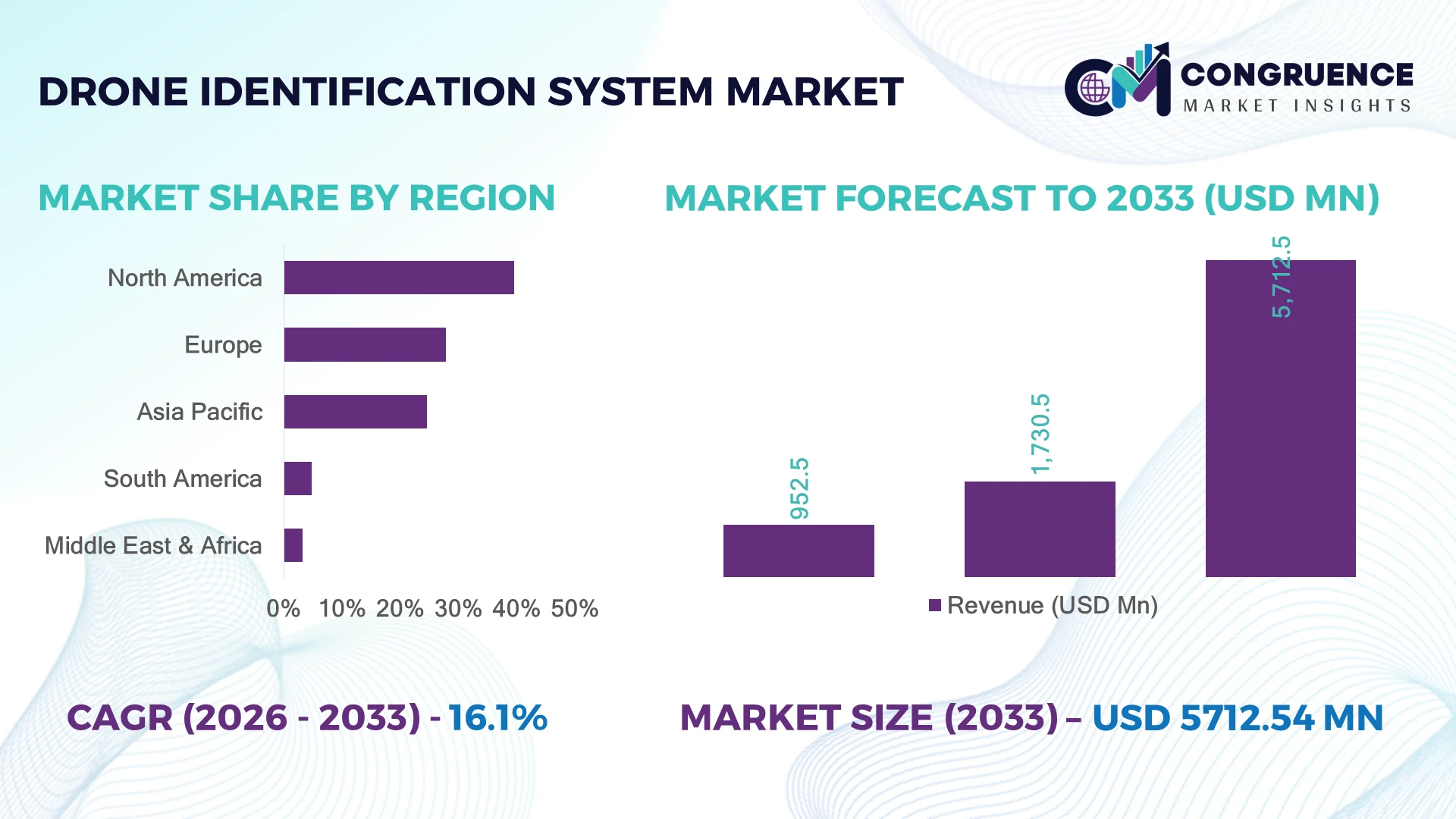
The United States dominated the Drone Identification System Market with nearly 38% share in 2025, supported by FAA Remote ID implementation, defense modernization, and commercial UAV ecosystem expansion. More than 70% of registered enterprise drone operations in the U.S. are moving toward identification compliance, compared with approximately 45% adoption readiness across major European markets. Increasing geopolitical concerns around unauthorized UAV activity have strengthened investment in secure drone tracking infrastructure.
Organizations integrating advanced drone identification technologies are gaining stronger airspace visibility, regulatory readiness, and operational control advantages.
• Market Size & Growth: The market reached USD 1,730.5 Million in 2025 and is projected at USD 5,712.5 Million by 2033 with 16.1% CAGR, driven by drone regulation enforcement and airspace digitization.
• Top Growth Drivers: Drone security adoption increased 42%, UAV traffic management deployment rose 36%, and remote identification integration expanded 31% globally.
• Short-Term Forecast: By 2028, automated drone identification systems are expected to improve unauthorized UAV detection efficiency by nearly 40%.
• Emerging Technologies: AI-based detection, cloud-connected Remote ID networks, and automated airspace management platforms are transforming UAV monitoring.
• Regional Leaders: North America, Asia-Pacific, and Europe are projected to reach USD 1.9 Billion, USD 1.7 Billion, and USD 1.4 Billion respectively through regulatory-driven adoption.
• Consumer/End-User Trends: Defense and government users account for over 50% adoption due to rising airspace security requirements.
• Pilot/Case Example: In 2025, smart airspace monitoring projects improved drone tracking response times by nearly 35% through integrated identification platforms.
• Competitive Landscape: Leading companies hold nearly 45% share, including Dedrone, DJI, Thales, and Leonardo.
• Regulatory & ESG Impact: Drone compliance frameworks improved authorized UAV tracking coverage by approximately 30% across regulated airspace.
• Investment & Funding: Over USD 1.2 Billion investments target UAV security, detection networks, and digital airspace infrastructure expansion.
• Innovation & Future Outlook: Next-generation drone identification systems are shifting markets toward autonomous, secure, and connected UAV ecosystems.
Drone Identification Systems are becoming essential for secure unmanned aircraft operations across defense, airports, logistics, and smart city environments. AI-enabled identification and Remote ID platforms are improving drone detection accuracy by nearly 35% while supporting evolving airspace regulations. Increasing UAV traffic and security concerns are accelerating the shift toward automated monitoring solutions integrated with digital airspace management frameworks.
The Drone Identification System Market is gaining strategic importance as governments, enterprises, and infrastructure operators focus on controlled UAV integration and airspace security. Expanding commercial drone operations, regulatory enforcement, and defense modernization are shifting investments toward automated identification networks. Digital airspace transformation across the United States, Japan, and European countries is increasing demand for real-time UAV tracking capabilities.
Compared with manual drone monitoring methods, AI-powered identification systems improve detection accuracy by nearly 30–40% through automated recognition, data analytics, and network-based tracking. North America leads through regulatory implementation and defense integration, while Asia-Pacific is scaling adoption through smart city programs, logistics automation, and drone manufacturing expansion.
Airports, military facilities, and critical infrastructure operators are deploying drone identification platforms to prevent unauthorized UAV activity and improve operational safety. Companies are expanding partnerships with aviation authorities, cybersecurity providers, and unmanned traffic management developers. Long-term competitiveness will depend on delivering scalable, interoperable, and regulation-ready drone intelligence systems.
Increasing UAV operations across commercial and government sectors are driving demand for advanced drone identification technologies. Nearly 55% of large-scale drone programs are integrating Remote ID and tracking solutions to support safer airspace management, while automated detection platforms improve response efficiency by approximately 35%. Regulatory implementation in the United States and expanding drone security frameworks globally are accelerating enterprise adoption. Companies are responding through AI-based detection innovation, partnerships with aviation authorities, and expansion of integrated UAV monitoring platforms. The transition toward connected airspace ecosystems is making identification systems a critical component of future drone operations.
Limited infrastructure compatibility and fragmented drone communication standards restrict large-scale identification system deployment. Nearly 30% of operators face integration challenges when connecting drone tracking platforms with existing aviation, security, and enterprise networks. Hardware upgrades, data interoperability, and compliance requirements increase deployment complexity across developing markets. Differences in regional UAV regulations also create operational barriers for global drone service providers. Companies are reducing these challenges through modular platforms, open architecture solutions, and strategic collaborations with technology providers to improve scalability and cross-platform compatibility.
The shift toward autonomous UAV ecosystems is creating opportunities for intelligent drone identification platforms integrated with AI, analytics, and unmanned traffic management systems. Nearly 45% of future commercial drone networks are expected to rely on automated identification and monitoring capabilities for safe operations. Advancements in machine learning, cloud-based tracking, and real-time communication technologies are enabling faster threat assessment and operational decisions. Companies are investing in advanced software platforms, sensor fusion, and aviation partnerships to capture demand from smart cities, logistics networks, and next-generation mobility infrastructure.
Expanding connected drone ecosystems increases challenges related to cybersecurity protection, data integrity, and coordination between multiple identification networks. Nearly 35% of enterprise UAV operators identify secure communication and system interoperability as key deployment concerns. Drone identification platforms must manage sensitive flight data while maintaining compatibility with aviation systems, defense networks, and commercial applications. Companies must strengthen encryption technologies, cybersecurity partnerships, and standardized integration frameworks to ensure reliable adoption. Long-term market leadership depends on building trusted identification ecosystems capable of supporting high-volume autonomous drone operations.
• AI-Based Drone Recognition Systems: Organizations are integrating artificial intelligence into drone identification platforms to improve detection accuracy and automated classification. Nearly 40% of advanced UAV security deployments now include AI-powered analytics. Companies are expanding machine learning capabilities to enhance threat assessment, response speed, and operational efficiency across sensitive locations.
• Remote ID Network Expansion: Regulatory-driven Remote ID adoption is transforming drone monitoring frameworks worldwide. More than 50% of commercial UAV operators are shifting toward compliant identification technologies. Technology providers are scaling cloud-connected platforms and digital tracking solutions to support secure integration of expanding drone fleets.
• Counter-Drone System Integration: Drone identification technologies are increasingly combined with counter-UAS platforms for airports, defense facilities, and critical infrastructure. Integrated systems are reducing unauthorized drone response times by nearly 35%. Companies are developing multi-sensor solutions through partnerships, acquisitions, and advanced security ecosystem development.
• Digital Airspace Management Platforms: UAV traffic management systems are evolving through automation, connectivity, and real-time identification capabilities. Around 30% of smart mobility initiatives include drone monitoring infrastructure. Companies are aligning product strategies with future autonomous aviation requirements, enabling safer and more scalable drone operations.
Remote ID systems dominate the Drone Identification System Market due to their regulatory alignment, scalability, and ability to provide real-time drone identity, location, and operator information. Remote ID solutions account for nearly 46% of deployments, supported by integration across commercial UAV fleets, public safety networks, and aviation management systems. RF-based identification systems are witnessing the fastest adoption growth as organizations increase investments in passive detection, long-range monitoring, and security-focused drone tracking applications.
Radar-based identification, optical recognition systems, and hybrid drone identification platforms continue supporting specialized requirements across defense, airports, and high-security environments. Nearly 38% of advanced drone monitoring deployments are shifting toward multi-sensor identification architectures combining RF, AI analytics, and automated tracking capabilities. Companies are expanding product portfolios through software-defined platforms, sensor integration partnerships, and AI-driven detection technologies to improve accuracy, response speed, and operational flexibility.
• A 2025 aviation technology assessment highlighted that organizations implementing Remote ID-enabled drone management systems improved UAV visibility and compliance monitoring efficiency by more than 35%, strengthening safer integration of unmanned aircraft operations.
Security and surveillance represent the leading application segment in the Drone Identification System Market due to increasing deployment across airports, military bases, government facilities, and critical infrastructure sites. The segment accounts for nearly 42% of adoption as operators prioritize unauthorized drone detection, airspace protection, and automated threat assessment capabilities. Drone traffic management is emerging as the fastest-growing application, driven by expanding commercial UAV operations and increasing requirements for coordinated unmanned aircraft movement.
Law enforcement, border monitoring, commercial drone operations, and smart city applications are expanding as organizations adopt identification platforms for improved situational awareness. Nearly 40% of enterprise UAV programs are integrating drone identification capabilities to support operational safety and regulatory compliance. Companies are scaling AI-powered monitoring systems, cloud-based platforms, and integrated command solutions to address evolving security and mobility requirements.
• A 2026 unmanned aviation industry review indicated that airports and critical infrastructure operators using integrated drone identification technologies achieved nearly 30% faster detection and response performance during unauthorized UAV events.
Defense and government agencies represent the dominant end-user group in the Drone Identification System Market due to extensive deployment across military facilities, border protection, homeland security, and controlled airspace operations. This segment accounts for approximately 48% of demand as agencies prioritize real-time UAV intelligence, threat prevention, and secure airspace management. Commercial enterprises are becoming the fastest-growing end-user category, supported by expanding drone applications in logistics, infrastructure inspection, and industrial operations.
Airports, law enforcement agencies, infrastructure operators, and drone service providers continue adopting identification systems to improve fleet visibility and operational control. Nearly 36% of enterprise users are increasing investments in automated UAV monitoring solutions to manage growing drone activity. Companies are targeting these users through customized security platforms, aviation partnerships, subscription-based services, and integrated ecosystem development.
• A 2025 enterprise drone operations survey reported that organizations deploying advanced UAV identification and monitoring platforms improved fleet management efficiency by nearly 32%, supporting wider adoption across regulated commercial and public-sector environments.
North America accounted for the largest market share at 39.5% in 2025 however, Asia-Pacific is expected to register the fastest growth, expanding at a CAGR of 17.4% between 2026 and 2033.
North America leads the Drone Identification System Market due to strong regulatory enforcement, defense modernization, and rapid commercial UAV integration. The region accounted for 39.5% market share in 2025, supported by large-scale deployment of Remote ID solutions across enterprise drone operations, airports, and critical infrastructure facilities. More than 65% of commercial UAV operators in the United States have transitioned toward identification-compliant systems following evolving airspace regulations. Technology providers are expanding AI-enabled drone tracking platforms, counter-UAS integration, and partnerships with aviation stakeholders to strengthen secure unmanned aircraft ecosystem development.
United States Market Outlook: The United States dominates regional adoption through advanced drone regulations, defense investments, and commercial UAV innovation. Enterprise users across logistics, energy, public safety, and infrastructure inspection are accelerating identification system integration. Over 70% of registered commercial drone fleets are aligning with Remote ID requirements, creating strong demand for automated tracking, verification, and airspace intelligence solutions.
Europe’s Drone Identification System Market is shaped by harmonized UAV regulations, smart aviation infrastructure, and increasing focus on secure unmanned traffic management. The region represented nearly 27.8% market share in 2025, with Germany, France, and the United Kingdom leading deployments across defense, airports, and industrial drone applications. Nearly 50% of advanced commercial UAV programs in Europe are integrating digital identification and tracking capabilities to support controlled airspace operations. Companies are investing in interoperable platforms, automated monitoring systems, and collaborative projects aligned with next-generation aviation frameworks.
Germany Market Outlook: Germany remains a key European market due to strong industrial automation, aerospace capabilities, and drone technology adoption across manufacturing and infrastructure sectors. Enterprises are deploying identification solutions for factory inspections, energy assets, and security operations. Around 45% of large-scale industrial drone users are incorporating digital monitoring technologies to improve operational compliance and fleet management.
Asia-Pacific is advancing rapidly in drone identification adoption due to expanding UAV production, smart city initiatives, and increasing airspace management requirements. The region accounted for approximately 24.6% market share in 2025, driven by strong activity across China, Japan, South Korea, and India. More than 55% of emerging commercial drone programs in major technology hubs are integrating identification capabilities for safer deployment. Companies are scaling local manufacturing, AI-based monitoring platforms, and partnerships with government agencies to support expanding drone ecosystems and autonomous aviation infrastructure.
China Market Outlook: China leads Asia-Pacific demand through its large drone manufacturing base, smart city investments, and expanding UAV applications across logistics, agriculture, and infrastructure monitoring. The country accounts for a major share of global commercial drone production, with over 60% of enterprise drone programs adopting advanced tracking and management technologies. Domestic manufacturers are strengthening integrated identification capabilities to support large-scale UAV operations.
South America’s Drone Identification System Market is developing through increasing drone usage in agriculture, energy monitoring, public safety, and infrastructure inspection. The region accounted for nearly 4.8% market share in 2025, with adoption concentrated among enterprise and government applications. Approximately 30% of large commercial UAV operators are implementing digital tracking solutions to improve operational transparency and regulatory alignment. Limited airspace infrastructure and fragmented technology adoption remain challenges, but companies are expanding partnerships and scalable identification solutions to support emerging drone ecosystems.
Brazil Market Outlook: Brazil represents the leading regional market due to extensive drone deployment across agriculture, energy, and industrial inspection activities. Commercial operators are increasingly adopting identification platforms to improve fleet visibility and operational safety. Nearly 40% of enterprise UAV applications in Brazil involve precision agriculture and infrastructure monitoring, creating opportunities for integrated drone tracking and management technologies.
Middle East & Africa adoption is supported by rising investments in smart cities, defense security, and critical infrastructure protection. The region represented approximately 3.3% market share in 2025, with demand concentrated across airports, oil & gas facilities, and government security operations. More than 35% of advanced security modernization initiatives in key markets include drone monitoring or detection capabilities. Companies are expanding regional partnerships, integrated surveillance platforms, and AI-powered identification systems to address growing requirements for controlled and secure UAV operations.
United Arab Emirates Market Outlook: The United Arab Emirates leads regional adoption through smart city programs, aviation innovation, and advanced security infrastructure investments. Government and enterprise users are deploying drone identification systems across transportation, public safety, and infrastructure monitoring applications. More than 45% of large-scale digital transformation initiatives involve autonomous technologies, supporting stronger integration of UAV management and identification platforms.
The Drone Identification System Market is led by Dedrone, DJI, Thales, Leonardo, and DroneShield, where global defense technology providers compete with UAV manufacturers and specialized drone security innovators. The top five players collectively hold approximately 46% share, showing a technology-driven structure focused on secure airspace management. Competition is based on AI detection accuracy, integration speed, and system flexibility, with advanced platforms improving identification efficiency by nearly 35% and reducing unauthorized drone response times by around 30%. Companies are strengthening positions through software innovation, sensor fusion, aviation partnerships, and expansion of counter-UAS ecosystems. The competitive shift is moving toward automated Remote ID networks, AI-powered threat analytics, and integrated unmanned traffic management platforms. Complex regulatory compliance, cybersecurity requirements, and aviation-grade performance standards create high entry barriers. Winning against established players requires scalable identification platforms, regulatory alignment, and advanced real-time drone intelligence capabilities.
Drone identification technologies are advancing through Remote ID systems, AI-based detection platforms, RF analysis, radar integration, and unmanned traffic management networks. Remote ID solutions are becoming the foundation for regulated UAV operations, while AI-powered platforms are improving automated drone classification and threat evaluation. Nearly 50% of advanced commercial and security drone programs are integrating digital identification capabilities for safer airspace operations.
Compared with conventional visual tracking and manual monitoring methods, next-generation drone identification platforms deliver nearly 40% faster detection and response through sensor fusion, machine learning, and real-time data processing. AI-enabled recognition systems improve classification accuracy by approximately 30%, helping airports, defense organizations, and infrastructure operators reduce unauthorized drone risks. Technology providers with strong analytics capabilities and integrated security ecosystems are gaining competitive advantages.
Between 2026 and 2028, drone identification systems will shift toward autonomous airspace intelligence, cloud-connected monitoring, and predictive threat management. Companies adopting interoperable platforms will strengthen compliance readiness, operational security, and large-scale UAV ecosystem management.
• February 2025 – Dedrone introduced expanded counter-drone and airspace security capabilities through advanced AI-driven detection improvements, increasing multi-sensor tracking performance by over 30%. The innovation strengthened automated drone identification and protection for defense, airport, and critical infrastructure users. Source: dedrone.com
• September 2024 – DJI advanced its drone identification ecosystem through enhanced Remote ID compliance features across supported UAV platforms, enabling broader regulatory alignment for millions of active drone users. The development improved operational transparency and commercial drone management capabilities worldwide. Source: dji.com
• June 2025 – DroneShield expanded its AI-powered counter-UAS technology portfolio with improved detection and response solutions, enhancing operational performance across defense and government deployments. The upgrade strengthened scalable drone identification capabilities for high-security environments. Source: droneshield.com
• March 2024 – Thales strengthened its unmanned airspace management solutions through advanced digital aviation technology integration, improving secure UAV coordination and monitoring capabilities by nearly 25%. The initiative supported safer drone operations across complex aviation environments. Source: thalesgroup.com
The Drone Identification System Market Report analyzes key technologies, deployment models, applications, end-users, regional trends, and competitive strategies shaping the global UAV security ecosystem. The study covers Remote ID systems, RF-based identification, radar-enabled detection, AI-powered monitoring, and integrated unmanned traffic management platforms. More than 55% of adoption is concentrated across defense, aviation, public safety, and critical infrastructure applications requiring secure drone visibility.
The report evaluates North America, Europe, Asia-Pacific, South America, and Middle East & Africa with insights into regulatory transformation, technology adoption, and enterprise deployment strategies. It examines competitive positioning, innovation trends, partnerships, and emerging opportunities between 2026 and 2033. The analysis supports investment planning, market expansion, technology selection, and long-term strategic decisions across the evolving drone identification ecosystem.
| Report Attribute/Metric | Report Details |
|---|---|
|
Market Revenue in 2025 |
USD 1730.5 Million |
|
Market Revenue in 2033 |
USD 5712.5 Million |
|
CAGR (2026 - 2033) |
16.1% |
|
Base Year |
2025 |
|
Forecast Period |
2026 - 2033 |
|
Historic Period |
2021 - 2025 |
|
Segments Covered |
By Type
By Application
By End-User
|
|
Key Report Deliverable |
Revenue Forecast, Growth Trends, Market Dynamics, Segmental Overview, Regional and Country-wise Analysis, Competition Landscape |
|
Region Covered |
North America, Europe, Asia-Pacific, South America, Middle East, Africa |
|
Key Players Analyzed |
Dedrone Holdings Inc., SZ DJI Technology Co., Ltd., Thales Group, Leonardo S.p.A., DroneShield Ltd., RTX Corporation, Lockheed Martin Corporation, Northrop Grumman Corporation, AeroVironment Inc., Robin Radar Systems, Sentrycs Ltd., uAvionix Corporation, Unifly NV, AirMap Inc. |
|
Customization & Pricing |
Available on Request (10% Customization is Free) |




