
Reports
The Global Drilling and Completion Fluids Market was valued at USD 1,037.0 Million in 2025 and is anticipated to reach a value of USD 1,631.7 Million by 2033 expanding at a CAGR of 5.83% between 2026 and 2033. Growth is being driven by rising horizontal drilling activity, expanding unconventional shale development, and increased deployment of high-performance water-based and synthetic fluid systems in complex well environments.
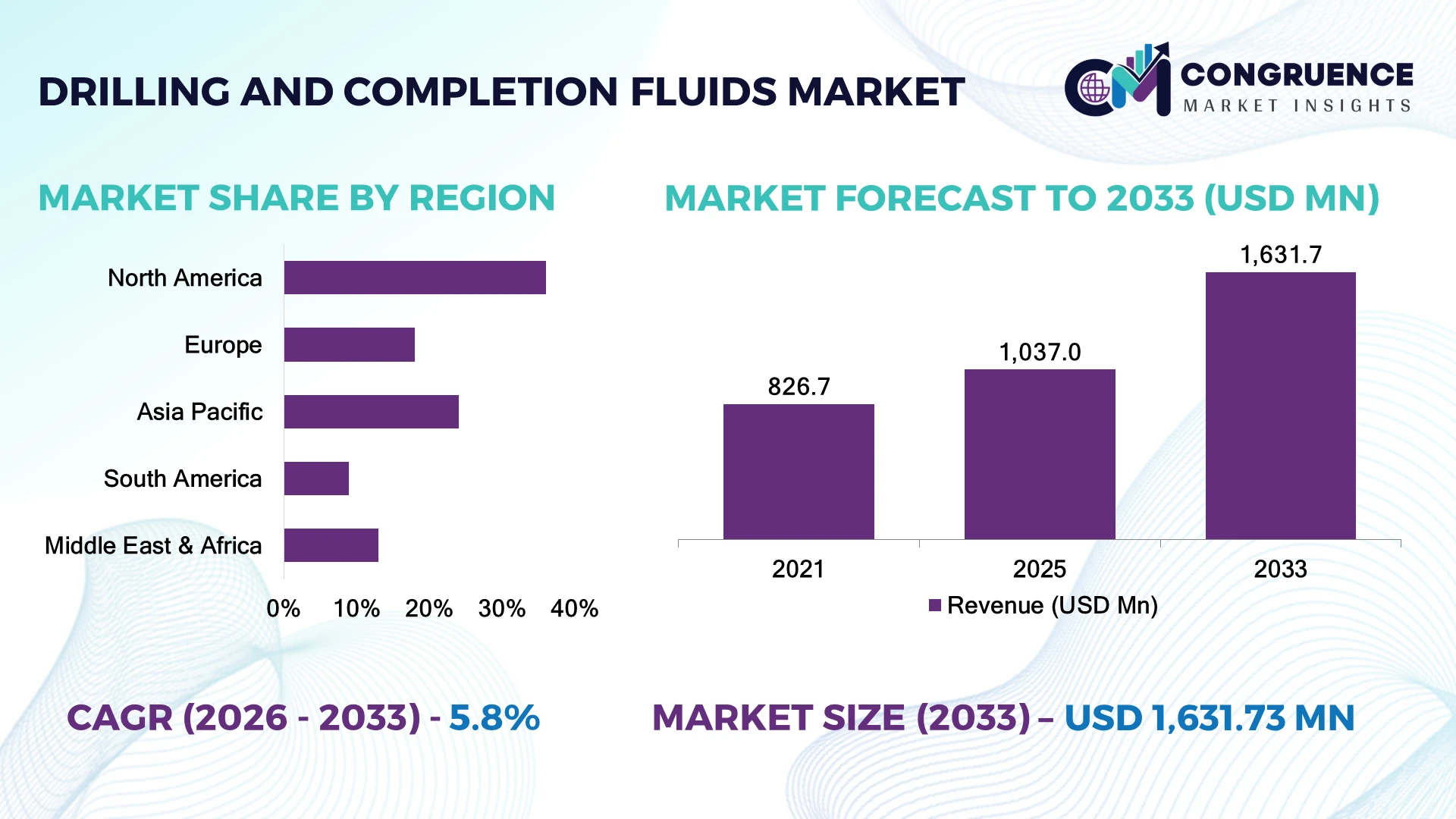
The United States dominates the market with approximately 34% of global drilling fluid consumption, supported by more than 900 active land rigs, sustained shale investments, and advanced completion technologies across the Permian Basin. In comparison, Saudi Arabia accounts for nearly 11% of global demand, driven by large-scale upstream capacity expansion and enhanced oil recovery programs. U.S. operators report over 20% higher utilization of automated fluid monitoring systems than Middle Eastern counterparts, reflecting faster digital integration. Ongoing energy security priorities following global supply disruptions continue to reinforce drilling activity.
Companies prioritizing advanced fluid chemistry, supply-chain resilience, and digital wellsite optimization are positioned to secure stronger operational and competitive advantages.
Market Size & Growth: Valued at USD 1,037.0 Million in 2025 and projected to reach USD 1,631.7 Million by 2033, supported by increasing shale drilling intensity, deeper well development, and advanced fluid engineering adoption.
Top Growth Drivers: Horizontal well activity contributes over 40% of fluid demand growth, unconventional resource development exceeds 35%, and high-temperature high-pressure drilling projects account for nearly 18% of incremental consumption.
Short-Term Forecast: By 2028, drilling fluid recycling rates are expected to improve by 22%, while non-productive drilling time is projected to decline by approximately 15% through digital monitoring systems.
Emerging Technologies: AI-driven fluid analytics, automated mud management platforms, and next-generation synthetic-based formulations are improving wellbore stability by up to 25%.
Regional Leaders: North America is projected to exceed USD 560 Million, the Middle East USD 310 Million, and Asia Pacific USD 280 Million, supported by shale expansion, capacity additions, and offshore development programs.
Consumer/End-User Trends: More than 60% of new unconventional wells now utilize advanced water-based systems due to lower environmental impact and improved operational performance.
Pilot/Case Example: In 2024, a Permian Basin drilling program reduced fluid-related downtime by 17% and improved drilling efficiency by 13% through real-time fluid optimization.
Competitive Landscape: The leading supplier holds approximately 14% market share, while Halliburton, SLB, Baker Hughes, Newpark Resources, and CES Energy Solutions continue expanding technology portfolios.
Regulatory & ESG Impact: Closed-loop fluid systems have reduced drilling waste volumes by nearly 30%, supporting stricter environmental compliance requirements across major producing countries.
Investment & Funding: Industry investments surpassed USD 2.1 Billion in fluid technologies, recycling infrastructure, and strategic partnerships aimed at improving operational efficiency.
Innovation & Future Outlook: High-performance biodegradable additives, predictive fluid management, and automated drilling ecosystems are reshaping competitive differentiation across global energy markets.
Drilling and completion fluids play a critical role in unconventional shale wells, offshore developments, and high-pressure drilling operations where wellbore stability and formation protection remain essential. Recent innovations include advanced synthetic formulations, digital fluid monitoring platforms, and recycling technologies that reduce waste generation by nearly 25%. Growing emphasis on localized sourcing and environmentally compliant fluid systems is creating new opportunities across emerging energy-producing nations, setting the stage for broader strategic developments.
The drilling and completion fluids market has become strategically important as operators focus on maximizing well productivity, reducing drilling risks, and improving capital efficiency across increasingly complex reservoirs. Supply-chain restructuring following recent geopolitical disruptions has accelerated investment in regional manufacturing capacity and localized chemical sourcing. Operators are also prioritizing fluid performance as longer lateral wells and deeper formations place greater demands on drilling systems.
Advanced fluid monitoring platforms now deliver up to 18% faster drilling response times compared with conventional manual monitoring methods while reducing fluid-related downtime by nearly 15%. The United States leads in large-scale deployment of automated fluid technologies, whereas Saudi Arabia and the UAE are emphasizing customized formulations designed for high-temperature reservoirs and enhanced recovery projects. This contrast reflects differences in resource profiles, operational objectives, and technology integration strategies.
Recent deployments across major shale basins demonstrate how integrated fluid management programs improve well consistency while lowering disposal requirements. Companies are expanding partnerships with specialty chemical providers, investing in recycling infrastructure, and strengthening regional supply networks. Over the next two to three years, increasing adoption of digital optimization tools and advanced fluid chemistries will strengthen competitive positioning, improve operational reliability, and support long-term resource development objectives.
Unconventional oil and gas development continues to reshape drilling fluid requirements globally. More than 70% of newly drilled shale wells utilize specialized fluid systems designed for extended-reach drilling and complex reservoir conditions. Horizontal well lengths have increased by over 25% during the past five years, creating stronger demand for advanced lubricity and wellbore stability solutions. In the United States, sustained activity across the Permian Basin and Eagle Ford formations has accelerated adoption of high-performance fluid technologies. This operational shift improves drilling efficiency and reduces formation damage, directly enhancing well economics. Leading suppliers are responding through expanded production capacity, strategic chemical partnerships, and investment in real-time fluid monitoring platforms. A key strategic insight is that fluid performance increasingly influences total well productivity rather than serving solely as a drilling support function.
Volatility in specialty chemical inputs remains a significant structural limitation for drilling fluid suppliers. Certain fluid additives experienced price fluctuations exceeding 20% during recent supply disruptions, while transportation and logistics expenses increased by approximately 15% in key export corridors. Dependence on globally sourced polymers, surfactants, and performance additives creates exposure to geopolitical uncertainty and trade constraints. For operators, these fluctuations can compress project margins and complicate procurement planning. Companies are mitigating risks through localized manufacturing, long-term supply agreements, and supplier diversification strategies. Several providers are also reformulating products to reduce dependence on constrained materials. A critical operational insight is that supply-chain resilience is becoming as important as product performance in securing long-term customer contracts.
Digital transformation is creating substantial opportunities for next-generation fluid management solutions. Automated monitoring systems can improve fluid utilization efficiency by nearly 18%, while predictive analytics reduce drilling interruptions by approximately 12%. In Norway and the United States, operators are increasingly integrating cloud-based drilling platforms with real-time fluid performance data. Simultaneously, environmentally optimized formulations are gaining traction as regulatory requirements become more stringent. Biodegradable additives and advanced recycling systems have reduced waste handling requirements by more than 20% in selected operations. Companies are expanding R&D investments, developing intelligent fluid ecosystems, and pursuing technology partnerships with digital service providers. A notable strategic opportunity lies in combining sustainability objectives with operational optimization to create differentiated value propositions.
The increasing sophistication of drilling fluid technologies introduces new execution challenges across the industry. More than 35% of operators report difficulties sourcing personnel with expertise in advanced fluid analytics and automated drilling environments. Integration of digital monitoring platforms with existing wellsite systems often extends deployment timelines by 10% to 15%, particularly in mature operating regions. In countries with limited technical infrastructure, inconsistent data quality and fragmented operational processes further complicate implementation. These challenges affect deployment consistency, operational scalability, and long-term technology utilization. Companies are addressing the issue through workforce development programs, digital training initiatives, and collaborations with technology specialists. A critical strategic insight is that successful adoption depends not only on fluid innovation but also on the industry's ability to build technical capabilities and integrated operational ecosystems.
Automated Fluid Management Expansion Real-time fluid monitoring platforms are being deployed across more than 45% of newly drilled unconventional wells, reducing fluid-related downtime by nearly 15% and improving drilling consistency by 12%. U.S. operators are integrating sensor-based mud systems into centralized drilling workflows to address skilled labor shortages. Service providers are expanding automation partnerships and scaling digital wellsite platforms to improve operational visibility and accelerate decision-making.
Shift Toward Synthetic Formulations Synthetic-based fluid adoption has increased by approximately 18% over the past two years in offshore developments, while disposal-related costs have declined by nearly 20% through improved fluid recovery practices. Stricter environmental compliance requirements in Norway and the Gulf of Mexico are accelerating deployment. Suppliers are restructuring product portfolios and investing in lower-toxicity formulations that maintain lubricity and thermal stability under challenging drilling conditions.
Localized Chemical Supply Networks More than 30% of major fluid suppliers have expanded regional sourcing programs following recent supply-chain disruptions, reducing procurement lead times by roughly 25%. Chemical inventory localization has improved project continuity and minimized exposure to international shipping volatility. Companies are strengthening domestic manufacturing capabilities, forming procurement alliances, and diversifying additive suppliers to improve operational resilience and contract performance.
High-Performance Reservoir Protection Focus Advanced completion fluid systems are delivering formation damage reductions of up to 22% while improving production startup efficiency by nearly 14% in complex reservoirs. Operators in Saudi Arabia and the United States are increasingly selecting customized fluid chemistries for extended-reach and high-temperature wells. A notable industry shift is the growing use of reservoir-specific fluid engineering, prompting suppliers to expand laboratory testing capabilities and collaborative development programs with exploration companies.
Water-based systems lead the drilling and completion fluids market with an estimated 47–50% share, supported by lower disposal costs, regulatory compatibility, and widespread use across conventional and shale drilling programs. Operators in the United States, India, and Saudi Arabia continue to prioritize these systems for large-volume onshore projects where cost control and operational flexibility remain critical. Oil-based systems account for nearly 25% of demand and retain importance in challenging formations requiring enhanced lubricity and wellbore stability.
Synthetic-based systems are the fastest-growing segment, benefiting from increasing offshore activity and stricter environmental performance requirements. Adoption of synthetic formulations has increased by approximately 18% over the past two years in deepwater projects due to improved thermal stability and lower environmental impact. Companies are expanding advanced additive portfolios, strengthening fluid engineering capabilities, and investing in specialized formulations tailored for high-temperature reservoirs. This shift reflects growing investment toward performance-driven fluid systems capable of supporting increasingly complex well architectures.
Onshore drilling remains the leading application segment, representing approximately 61% of global demand due to extensive shale development, conventional field expansion, and lower operational costs compared with offshore projects. High drilling activity across the United States, China, Argentina, and Saudi Arabia continues to generate substantial fluid consumption. The concentration of land-based drilling programs supports continuous demand for drilling, completion, and maintenance fluid systems throughout the well lifecycle.
Offshore drilling is the fastest-growing application segment as operators accelerate investments in deepwater and ultra-deepwater projects. Fluid requirements in offshore environments have increased by nearly 15% due to more complex well designs and stricter operational standards. Companies are responding by deploying specialized fluid systems, enhancing logistics capabilities, and expanding technical service support near offshore production hubs. While onshore operations continue to dominate volume demand, offshore projects are driving higher-value fluid innovation and creating opportunities for advanced fluid performance solutions.
Oilfield operators represent the largest end-user segment, accounting for approximately 58% of total market demand due to their direct responsibility for exploration, drilling, completion, and production activities. Large national and independent energy companies continue investing in fluid optimization programs to improve well productivity and reduce non-productive time. Their purchasing decisions increasingly prioritize fluid performance, operational reliability, and environmental compliance across diverse reservoir conditions.
Service companies are emerging as the fastest-growing end-user group as operators outsource fluid management, monitoring, testing, and optimization functions. Demand for integrated fluid services has increased by nearly 16% as digital drilling operations become more common. Drilling contractors maintain strategic importance through equipment deployment and field execution support, particularly in large-scale drilling campaigns. Suppliers are targeting these customer groups through customized formulations, long-term service agreements, and technology partnerships that improve field performance. Competitive positioning is increasingly influenced by the ability to deliver integrated fluid solutions rather than standalone chemical products.
North America accounted for the largest market share at 36% in 2025 however, Asia-Pacific is expected to register the fastest growth, expanding at a CAGR of 6.8% between 2026 and 2033.
North America represents approximately 36% of the global market, supported by extensive shale drilling activity, advanced completion techniques, and high adoption of automated fluid management systems. The United States and Canada continue to lead deployment of high-performance drilling fluids for horizontal and extended-reach wells. More than 70% of active unconventional wells in the region utilize engineered fluid systems designed to improve wellbore stability and drilling efficiency. Operators are increasingly integrating digital monitoring platforms to optimize fluid properties in real time. Recent investments in regional chemical production and recycling infrastructure have reduced fluid logistics costs by nearly 12% in key shale basins. The region’s strong service ecosystem, established oilfield infrastructure, and continuous drilling activity reinforce its leadership position in fluid technology deployment and operational optimization.
United States Market Outlook: The United States remains the dominant country market due to its large-scale shale operations, extensive drilling infrastructure, and leadership in oilfield technology adoption. The Permian Basin alone accounts for a substantial share of drilling activity, creating consistent demand for advanced fluid systems. More than 900 active land rigs operate across major producing regions, while digital fluid monitoring adoption exceeds 20% above the global average. Energy companies continue investing in localized chemical supply chains and specialized fluid formulations to support increasingly complex horizontal well designs and improve operational efficiency.
Europe accounts for approximately 18% of global demand, supported by offshore operations, mature hydrocarbon fields, and strict environmental performance standards. Operators are increasingly transitioning toward lower-toxicity and environmentally optimized fluid systems to comply with evolving regulatory frameworks. Offshore developments in the North Sea continue to drive demand for high-performance completion fluids capable of operating under challenging conditions. Nearly 40% of newly specified offshore fluid systems now incorporate enhanced environmental performance characteristics. Companies are expanding laboratory testing capabilities and investing in advanced fluid recycling technologies to reduce waste volumes and improve operational sustainability. Strategic collaborations between energy operators and specialty chemical suppliers are accelerating the deployment of customized fluid solutions across offshore projects.
Norway Market Outlook: Norway remains the most strategically significant market within Europe due to its advanced offshore sector, strong regulatory framework, and continuous investment in field optimization. The country maintains one of the highest rates of environmentally compliant fluid adoption globally, with offshore operators increasingly deploying synthetic and low-toxicity systems. More than 80% of active offshore developments incorporate advanced fluid management practices designed to enhance operational efficiency while meeting strict environmental requirements. Ongoing investment in offshore infrastructure continues to support specialized fluid demand.
Asia-Pacific holds approximately 24% of the global market and represents the fastest-expanding regional opportunity due to increasing exploration activity, energy security initiatives, and upstream infrastructure investments. China, India, Australia, and Indonesia continue expanding drilling programs to support domestic energy production objectives. National oil companies are increasing deployment of advanced fluid systems to improve drilling performance in complex geological formations. Infrastructure investments linked to upstream development projects have increased by nearly 18% across major producing countries. Companies are strengthening regional manufacturing capacity, expanding distribution networks, and localizing chemical supply chains to improve responsiveness and reduce operational delays. The region's growing focus on unconventional resources is further supporting adoption of advanced drilling and completion fluid technologies.
China Market Outlook: China leads the Asia-Pacific market through extensive shale development, large-scale exploration programs, and strong government support for domestic energy production. The country continues investing in advanced drilling technologies to improve recovery rates and reduce dependence on imported hydrocarbons. Unconventional drilling activity has expanded significantly across major resource basins, while domestic chemical manufacturers are increasing production of drilling-fluid additives. More than 60% of newly developed unconventional projects incorporate customized fluid systems designed for local reservoir conditions, supporting long-term operational efficiency and resource optimization.
South America accounts for approximately 9% of global market demand and is increasingly influenced by offshore oil and gas developments, particularly in deepwater environments. Brazil remains the primary demand center, supported by ongoing investment in offshore production infrastructure and field development programs. Advanced drilling campaigns require specialized fluid systems capable of managing high-pressure and high-temperature conditions. Offshore deployment activity has increased by approximately 15% over recent years, supporting greater demand for premium fluid formulations. While infrastructure limitations and logistical complexity remain operational considerations, companies continue expanding local service capabilities and strengthening regional partnerships to improve project execution and supply reliability.
Brazil Market Outlook: Brazil dominates the regional landscape through its extensive offshore resource base and continuous investment in deepwater exploration. The country's pre-salt developments require sophisticated drilling and completion fluid technologies capable of supporting technically demanding operations. Offshore drilling programs continue to attract substantial industry investment, while specialized fluid service providers are expanding local operational capacity. Advanced fluid engineering has become increasingly important as operators pursue greater efficiency and reliability across complex offshore production environments.
The Middle East & Africa region represents approximately 13% of global demand, supported by large-scale upstream investments, production capacity expansion, and enhanced oil recovery programs. Major producing countries continue increasing drilling activity to strengthen long-term energy output and infrastructure resilience. High-temperature reservoir environments require specialized fluid systems with superior thermal stability and performance characteristics. Deployment of advanced drilling technologies has increased by nearly 20% across several national development programs. Service providers are expanding regional manufacturing, technical support centers, and fluid engineering capabilities to meet growing operational requirements. Large-scale field modernization initiatives continue to create opportunities for advanced completion and drilling fluid solutions.
Saudi Arabia Market Outlook: Saudi Arabia remains the leading country market within the region due to its substantial hydrocarbon reserves, extensive drilling programs, and long-term upstream investment strategy. National operators continue expanding production infrastructure while deploying advanced technologies to improve reservoir performance. Large-scale field development projects require high-performance fluid systems capable of supporting complex drilling environments. The country accounts for a significant share of regional drilling activity, and increasing adoption of digital wellsite technologies is enhancing fluid monitoring, operational efficiency, and long-term resource management capabilities.
The competitive landscape is led by SLB, Halliburton, Baker Hughes, Newpark Fluids Systems, and CES Energy Solutions, with global integrated service providers competing directly against regional fluid specialists and independent chemical suppliers. The top five players collectively control approximately 58% of market activity through extensive service networks, proprietary fluid technologies, and established customer relationships. Competition is centered on fluid performance, operational reliability, customization capability, and supply-chain responsiveness rather than price alone. Advanced fluid systems can reduce drilling-related downtime by 12–18%, while digital monitoring platforms improve fluid optimization efficiency by nearly 15%, creating a strong technology-based competitive advantage. Companies are expanding regional manufacturing capacity, forming digital technology partnerships, and integrating chemical supply operations to strengthen customer retention. The market is shifting toward data-driven fluid management and localized supply models, increasing pressure on providers lacking technical differentiation. High certification requirements, field-performance validation, and specialized formulation expertise remain major entry barriers. Winning requires superior fluid engineering, localized execution capability, and integrated digital service delivery.
Halliburton
Baker Hughes
Newpark Fluids Systems
CES Energy Solutions Corp.
Weatherford International plc
China Oilfield Services Limited (COSL)
Scomi Group Berhad
Tetra Technologies, Inc.
Secure Energy Services Inc.
National Energy Services Reunited Corp. (NESR)
Anchor Drilling Fluids USA, LLC
Gumpro Drilling Fluids Pvt. Ltd.
Global Drilling Fluids & Chemicals Limited
Digital fluid intelligence platforms are becoming a core technology differentiator across drilling operations. Real-time monitoring systems are now deployed in nearly 40% of advanced drilling projects, enabling continuous tracking of rheology, density, and wellbore conditions. These systems improve drilling efficiency by approximately 15% while reducing fluid-related non-productive time by up to 12%. Operators benefit from faster decision-making and improved well consistency, particularly in extended-reach and unconventional wells.
Advanced synthetic-based and reservoir-specific fluid formulations are replacing traditional one-size-fits-all systems in complex drilling environments. Compared with conventional fluid programs, customized formulations improve wellbore stability by nearly 20% and reduce formation damage by up to 22%. Adoption is strongest among offshore operators and technically challenging shale developments. Companies with proprietary formulation capabilities gain stronger customer retention, higher-value contracts, and greater differentiation in performance-sensitive projects.
Between 2026 and 2028, AI-enabled fluid optimization, automated additive dosing, and predictive drilling analytics are expected to reshape operational workflows. More than 50% of large-scale drilling programs are projected to integrate at least one automated fluid management function. Companies that combine digital platforms, advanced chemistry, and localized technical support will achieve stronger operational outcomes, lower intervention costs, and superior competitive positioning as drilling complexity continues to increase.
June 2025 – Newpark Fluids Systems announced a strategic collaboration with Intelligent Mud Solutions (IMS) to deploy real-time drilling fluids measurement technology globally. The agreement grants exclusive North American rights and enables continuous fluid analysis for faster operational decisions and improved drilling performance. Source: newpark.com
November 2024 – Baker Hughes opened Namibia’s largest liquid mud plant and integrated support facility to strengthen local drilling and completion fluid supply capabilities. The new infrastructure expands in-country capacity and improves offshore logistics efficiency for exploration and development programs. Source: bakerhughes.com
June 2025 – SLB entered a digital collaboration with Cactus Drilling to scale automated and autonomous drilling solutions. The deployment expands use of automated drilling controls and real-time operational analytics, improving equipment utilization and drilling execution consistency. Source: slb.com
June 2024 – Baker Hughes secured a major integrated offshore contract with Petrobras covering workover, intervention, completion fluids, and production chemical services across offshore fields. The multi-year agreement strengthens localization efforts and expands integrated service deployment across Brazil’s offshore operations. Source: bakerhughes.com
The report provides comprehensive coverage of drilling and completion fluid technologies, applications, operational deployment patterns, and competitive developments across the global energy sector. Analysis includes key fluid categories such as water-based, oil-based, and synthetic-based systems, along with detailed assessment of onshore and offshore applications. The study evaluates demand patterns across oilfield operators, drilling contractors, and specialized service providers while examining evolving technology adoption trends, including digital fluid monitoring and advanced formulation development.
Regional analysis covers North America, Europe, Asia-Pacific, South America, and the Middle East & Africa, representing more than 95% of global drilling activity. The report assesses deployment intensity, operational trends, supply-chain developments, and investment priorities across major producing countries. Strategic insights include technology positioning, competitive benchmarking, procurement trends, localization strategies, and emerging opportunities in unconventional drilling, deepwater projects, and environmentally optimized fluid systems. The findings support expansion planning, partnership evaluation, competitive positioning, and long-term business decision-making between 2026 and 2033.
| Report Attribute / Metric | Details |
|---|---|
| Market Revenue (2025) | USD 1,037.0 Million |
| Market Revenue (2033) | USD 1,631.7 Million |
| CAGR (2026–2033) | 5.83% |
| Base Year | 2025 |
| Forecast Period | 2026–2033 |
| Historic Period | 2021–2025 |
| Segments Covered |
By Type
By Application
By End-User
|
| Key Deliverables | Revenue Forecast; Market Trends; Growth Drivers & Restraints; Technology Insights; Segmentation Analysis; Regional Insights; Competitive Landscape; Regulatory & ESG Overview; Recent Developments |
| Regions Covered | North America; Europe; Asia-Pacific; South America; Middle East & Africa |
| Companies Profiled | SLB; Halliburton; Baker Hughes; Newpark Fluids Systems; CES Energy Solutions Corp.; Weatherford International plc; China Oilfield Services Limited (COSL); Scomi Group Berhad; Tetra Technologies, Inc.; Secure Energy Services Inc.; National Energy Services Reunited Corp. (NESR); Anchor Drilling Fluids USA, LLC; Gumpro Drilling Fluids Pvt. Ltd.; Global Drilling Fluids & Chemicals Limited |
| Customization & Pricing | Available on Request (10% Customization Free) |




