
Reports
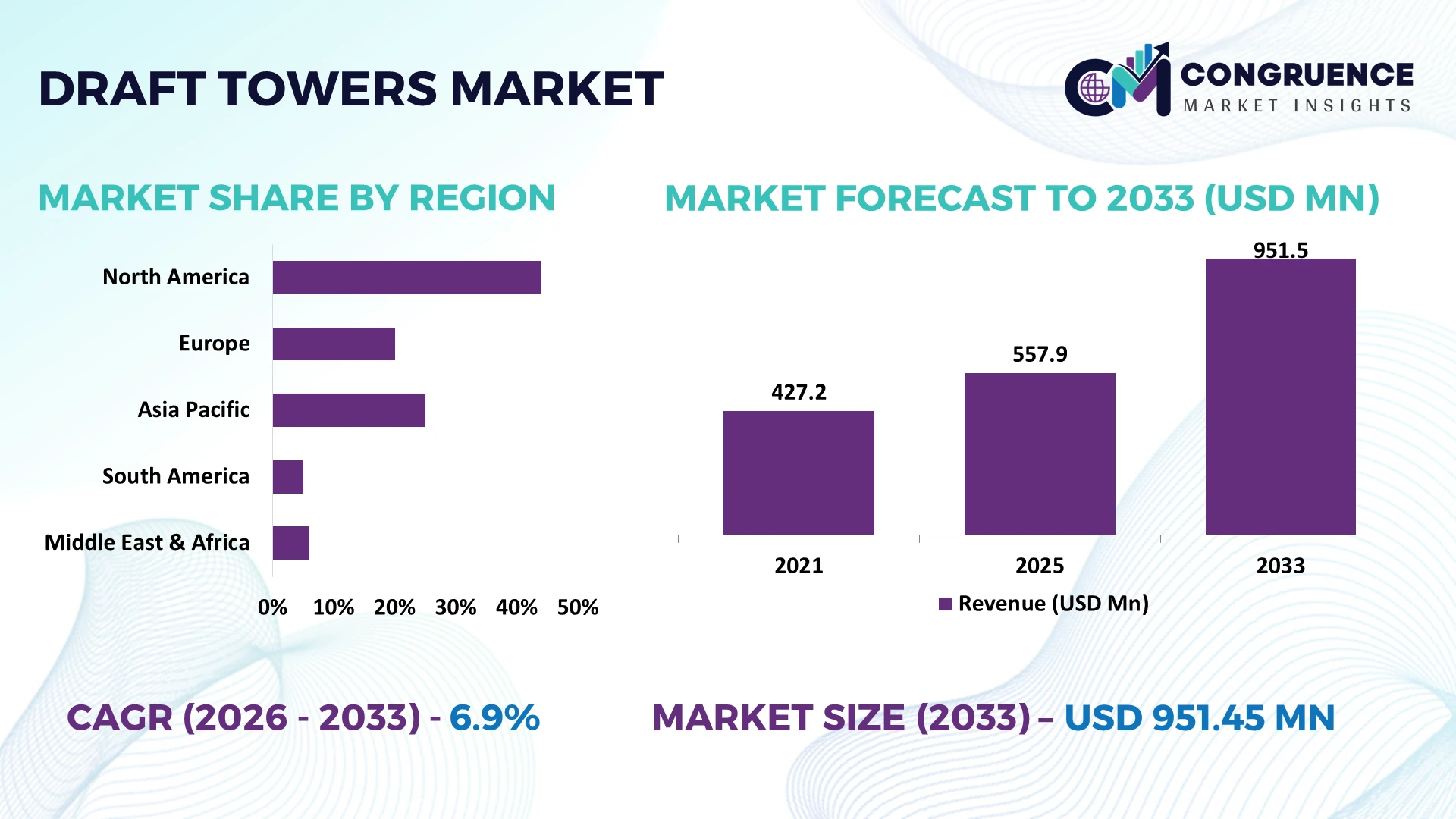
The Global Draft Towers Market was valued at USD 557.91 Million in 2025 and is anticipated to reach a value of USD 951.45 Million by 2033 expanding at a CAGR of 6.9% between 2026 and 2033. Growth is driven by natural-draft cooling infrastructure upgrades, thermal power plant modernization, industrial heat-rejection requirements, and increasing adoption of high-efficiency cooling tower internals.
China represents a major demand center for industrial draft towers, supported by its extensive coal-fired power generation infrastructure and concentrated heavy industries. The country's installed coal-fired generating capacity exceeded 1,200 GW in 2024, compared with approximately 210 GW in the United States. China's thermal power infrastructure supports demand for large natural-draft cooling towers, particularly where continuous heat rejection is essential. Industrial water conservation policies and power plant efficiency upgrades are encouraging improved fill media, drift eliminators, and cooling water distribution systems.
Manufacturers prioritizing large-capacity cooling structures, water-efficient internals, and retrofit engineering are positioned to secure utility modernization and industrial cooling infrastructure contracts.
Market Size & Growth: USD 557.91 million in 2025, reaching USD 951.45 million by 2033 at 6.9% CAGR, supported by thermal cooling infrastructure modernization.
Top Growth Drivers: Approximately 35% of global electricity generation remains coal-based; industrial cooling represents substantial freshwater withdrawals; cooling upgrades target measurable energy efficiency improvements.
Short-Term Forecast: By 2028, optimized cooling tower retrofits target 10–20% reductions in circulating-water pumping energy through hydraulic improvements.
Emerging Technologies: AI-enabled thermal monitoring, high-efficiency fill media, and automated water treatment support 3 operational improvements: heat transfer, reliability, and water conservation.
Regional Leaders: Asia-Pacific leads thermal infrastructure deployment; North America emphasizes modernization; Europe prioritizes water-efficient cooling across 3 industrial operating environments.
Consumer/End-User Trends: Power generation facilities account for substantial natural-draft tower installations, with individual cooling structures exceeding 150 meters in height.
Pilot/Case Example: India's 2024 thermal power infrastructure development included 660 MW supercritical generating units requiring integrated industrial cooling systems.
Competitive Landscape: SPX Cooling Technologies, ENEXIO, Hamon, Paharpur Cooling Towers, and Babcock & Wilcox compete through engineering scale and cooling performance.
Regulatory & ESG Impact: Modern drift eliminators can limit water drift to approximately 0.001% of circulating flow, improving water conservation and environmental performance.
Investment & Funding: Global energy investment exceeded USD 3 trillion in 2024, supporting electricity infrastructure and industrial equipment modernization.
Innovation & Future Outlook: Hybrid cooling, modular fill assemblies, and predictive maintenance are reshaping 2030-era industrial heat-rejection infrastructure.
The Draft Towers Market serves thermal power stations, petrochemical complexes, steel manufacturing facilities, and industrial process cooling networks requiring continuous heat rejection. Natural-draft cooling towers use buoyancy-driven airflow, eliminating the large mechanical fans required by conventional induced-draft systems. Advanced fill media, low-drift eliminators, and automated water chemistry controls improve thermal performance while limiting operational losses. Modern drift eliminator configurations can restrict droplet carryover to approximately 0.001% of circulating water flow under specified conditions. Water scarcity regulations and aging thermal infrastructure are accelerating interest in hybrid cooling designs, specialized retrofit services, and lifecycle performance optimization, establishing the foundation for strategic market evaluation.
Draft towers are becoming strategically important as thermal power operators and industrial facilities prioritize cooling efficiency, water conservation, and infrastructure reliability. China's coal-fired generating capacity exceeds 1,200 GW, sustaining requirements for large natural-draft cooling installations. India's thermal generation expansion reinforces demand for cooling infrastructure capable of supporting continuous high-temperature operations. Meanwhile, stricter industrial water management requirements are shifting procurement toward high-efficiency fill media, improved drift elimination, and automated cooling-water treatment. Manufacturers are strengthening retrofit engineering capabilities to address aging installations without requiring complete structural replacement.
Technology modernization is improving cooling performance and operating economics. Advanced drift eliminators restrict droplet carryover to approximately 0.001% of circulating water flow, compared with 0.01% for older designs, representing a 90% reduction under comparable operating conditions. Natural-draft configurations eliminate mechanical fan electricity consumption, although performance remains dependent on ambient temperature and humidity. China emphasizes large-capacity installations, while European operators prioritize refurbishment and water-efficient operation. This distinction encourages suppliers to develop application-specific thermal engineering and maintenance solutions.
Between 2026 and 2028, industrial operators will prioritize modular fill replacement, predictive condition monitoring, and optimized water distribution. Retrofitting cooling tower internals during scheduled power plant outages offers an operational pathway to improve performance without major civil reconstruction. Competitive positioning will depend on verified thermal efficiency, reliable installation execution, and lifecycle service capabilities.
Thermal generation infrastructure modernization remains a principal driver of draft tower equipment procurement. Coal accounted for approximately 35% of global electricity generation in 2024, maintaining substantial requirements for large-scale heat rejection systems. India's electricity generation from coal remained above 70%, reinforcing the operational importance of dependable cooling infrastructure. Modern drift eliminators reduce water carryover by up to 90% compared with older configurations under comparable conditions, strengthening water management performance. Utilities are replacing deteriorated fill media, upgrading water distribution systems, and improving cooling tower inspection procedures. Engineering suppliers are expanding retrofit services and partnering with power plant operators to coordinate installation during scheduled maintenance outages. This approach improves asset performance while avoiding costly structural replacement.
Draft tower installations face structural limitations from freshwater availability, civil construction requirements, and material-intensive engineering. Evaporative cooling typically consumes approximately 1–2% of circulating water flow through evaporation, depending on operating conditions. At three cycles of concentration, blowdown approaches 50% of evaporation volume, increasing makeup-water requirements and treatment expenses. In India, industrial facilities operating in water-stressed regions face additional constraints on freshwater withdrawals and wastewater discharge. Large natural-draft structures also require substantial concrete, reinforcement steel, and specialized construction expertise, limiting procurement flexibility. Manufacturers are reducing exposure through modular internal components, alternative water treatment systems, and local construction partnerships. Securing dependable water supplies and predictable civil engineering costs remains essential for project viability.
Hybrid cooling configurations create opportunities for draft tower manufacturers serving water-constrained industrial facilities. Dry cooling sections can reduce evaporative water consumption by approximately 30–50% under suitable operating conditions, while optimized drift eliminators restrict liquid carryover to around 0.001% of circulating flow. These technologies strengthen cooling reliability where freshwater availability limits conventional wet cooling expansion. Saudi Arabia's industrial diversification and water conservation priorities create potential applications for hybrid thermal management systems. Manufacturers are developing modular heat exchange assemblies, automated water chemistry controls, and digital performance monitoring packages. Integrating cooling tower modernization with long-term maintenance contracts creates an additional service opportunity, allowing suppliers to compete through measurable operating savings rather than equipment installation alone.
Maintaining consistent draft tower performance across changing climatic conditions and aging infrastructure presents significant engineering challenges. Natural-draft airflow depends on temperature differences between ambient air and the internal tower environment, making cooling performance sensitive to seasonal conditions. A 1°C increase in cooling-water temperature can affect steam turbine condenser performance and overall plant efficiency. Modern drift eliminators target approximately 0.001% carryover, but maintaining this performance requires correct installation and sustained maintenance. India's high-temperature operating environments increase the importance of reliable thermal design and water distribution. Manufacturers must improve computational fluid dynamics modeling, structural inspections, and installation quality assurance. Long-term competitiveness depends on delivering predictable cooling performance while minimizing shutdown duration and maintenance-related operating disruptions.
High-Strength Steel Reshapes Tower Fabrication: Transmission tower manufacturers are increasing the use of galvanized high-strength steel to improve structural efficiency and installation logistics. S355 steel provides approximately 50% higher nominal yield strength than S235, while hot-dip zinc coatings commonly range from 55 to 85 micrometers. Indian fabricators are optimizing lattice member dimensions, automated cutting, and bolt-hole accuracy to reduce assembly errors and transportation weight. These improvements strengthen competitiveness in long-distance electricity transmission projects requiring standardized structural components.
Telecom Infrastructure Favors Compact Tower Designs: Telecommunications operators are increasingly selecting monopole and tubular steel structures for urban network densification. Global 5G subscriptions exceeded 2 billion in 2024, while network infrastructure increasingly supports multiple frequency bands and antenna configurations. Urban site restrictions favor smaller tower footprints and integrated equipment mounting. Manufacturers are developing modular monopole sections, concealed antenna supports, and standardized foundation interfaces, helping operators accelerate installation approvals and improve utilization of constrained deployment locations.
Digital Structural Monitoring Enters Maintenance Workflows: Tower asset managers are incorporating drone inspections, photogrammetry, and digital structural models into maintenance planning. Inspection platforms increasingly combine 3 capabilities: corrosion identification, geometric measurement, and defect documentation. High-resolution aerial imaging supports assessment of structures exceeding 100 meters without requiring continuous manual climbing. Engineering contractors are integrating digital inspection records with asset management systems, improving maintenance prioritization and reducing exposure to hazardous inspection activities.
Prefabricated Tower Components Improve Installation: Manufacturers are expanding factory-fabricated tower sections to reduce field assembly complexity and improve dimensional consistency. Standardized bolted connections, modular steel sections, and automated welding support repeatable fabrication across multiple project locations. Transmission structures operating at 400 kV and 765 kV require precise conductor clearances and structural tolerances. Indian infrastructure contractors are strengthening fabrication partnerships and preassembly inspections, improving construction coordination where difficult terrain and limited installation windows constrain deployment schedules.
Lattice Towers represent the established structural configuration for high-voltage transmission networks because triangulated steel frameworks provide favorable strength-to-weight performance and flexibility across different span lengths. Their widespread deployment in 220 kV, 400 kV, and 765 kV transmission systems reflects standardized engineering practices and established fabrication supply chains. Self-Supporting Towers remain important where independent structural stability is essential, particularly for high-capacity electrical and communication installations. Guyed Towers offer material-efficient configurations for locations with sufficient land availability, although their anchoring requirements restrict deployment in congested environments. Manufacturers are improving galvanization, connection design, and automated steel fabrication to strengthen structural durability and installation consistency.
Monopole Towers represent an increasingly important configuration for space-constrained infrastructure, particularly in urban telecommunications networks. Tubular Steel Towers also support compact installation and controlled structural geometry where conventional lattice arrangements are less practical. S355 structural steel provides approximately 50% higher nominal yield strength than S235, supporting design optimization where permitted by engineering requirements. Suppliers are expanding modular fabrication capabilities and standardized foundation solutions to address changing installation priorities.
Power Transmission represents the principal infrastructure application for draft towers, supported by extensive electricity networks and the need to connect generation assets with industrial and urban demand centers. Transmission structures accommodate voltage classes including 132 kV, 220 kV, 400 kV, and 765 kV, creating differentiated requirements for structural loading, conductor clearance, and foundation engineering. Telecommunications represents another important application, particularly where tower sharing and antenna installation influence structural design. Broadcasting infrastructure requires dependable elevated installations for wide-area signal coverage, while Microwave Communication relies on precisely aligned antenna systems and unobstructed transmission paths. Manufacturers are adapting tower configurations, steel fabrication processes, and structural analysis capabilities to accommodate these operational requirements.
Wind Energy represents an increasingly important application as renewable electricity infrastructure expands. Global wind power installations reached approximately 117 GW in 2024, strengthening requirements for supporting electricity transmission infrastructure. Railway Electrification also contributes demand through overhead electrical supply networks and associated support structures. Suppliers are developing specialized foundations, corrosion-resistant materials, and modular installation systems to improve project execution across geographically diverse infrastructure environments.
Electric Utilities represent the principal end-user group for draft towers because transmission network development requires extensive structural infrastructure, standardized engineering specifications, and long-term maintenance commitments. Utilities operating 400 kV and 765 kV networks procure lattice and self-supporting structures designed for demanding conductor loads and environmental conditions. Telecom Operators represent another significant customer category, particularly through mobile network expansion and infrastructure sharing arrangements. Broadcasting Companies maintain specialized tower requirements for transmission coverage, while Railway Authorities procure structures supporting electrification infrastructure and related communication systems. Manufacturers are strengthening utility qualification capabilities, project-specific structural engineering, and long-term supply agreements to improve procurement competitiveness.
Renewable Energy Developers represent an expanding customer group as wind generation and grid interconnection projects require additional transmission infrastructure. Government Agencies influence procurement through public infrastructure programs, regulatory specifications, and national connectivity initiatives. India's transmission network expansion creates opportunities for suppliers capable of delivering standardized tower structures at industrial scale. Manufacturers are investing in automated fabrication, corrosion protection, and installation partnerships to serve both established utility customers and emerging infrastructure developers.
Asia-Pacific accounted for the largest market share at an estimated 42% in 2025 however, Middle East & Africa is expected to register the fastest growth, expanding at a CAGR of an estimated 8.1% between 2026 and 2033.

Grid Hardening and Telecom Infrastructure Modernization
North America's draft towers market is shaped by electricity transmission reinforcement, wireless network modernization, and infrastructure resilience requirements. The United States dominates regional demand through extensive high-voltage networks, established tower fabrication facilities, and telecommunications infrastructure. Canada contributes through long-distance transmission projects, hydropower connections, and communication towers serving remote communities. The US Department of Energy estimates that transmission infrastructure must expand substantially to accommodate changing electricity generation patterns and increasing electrical loads. Federal grid modernization initiatives support replacement of aging lattice structures, installation of higher-capacity transmission towers, and structural reinforcement in severe-weather regions. Telecom operators are also upgrading existing tower sites for advanced wireless equipment, favoring modular steel structures and efficient foundation designs. Manufacturers are strengthening automated fabrication, corrosion-resistant coatings, and structural engineering capabilities to improve installation speed and lifecycle reliability.
United States Market Outlook: The United States leads regional deployment through utility transmission projects and extensive telecommunications infrastructure. The Federal Communications Commission reported more than 400,000 registered antenna structures and associated infrastructure records historically, reflecting the scale of tower-related regulatory oversight. Domestic suppliers are expanding structural testing, prefabrication, and grid-hardening capabilities to address utility reliability requirements and changing wireless network configurations.
Cross-Border Transmission Expansion and Structural Efficiency
Europe's draft towers market is influenced by electricity interconnection projects, renewable energy integration, and stringent structural engineering requirements. Germany, France, the United Kingdom, and Spain represent important infrastructure markets, supported by established transmission operators and telecommunications networks. The European Commission estimates that approximately EUR 584 billion in electricity grid investment is required by 2030, reinforcing demand for transmission structures and associated engineering services. European tower manufacturers emphasize high-strength steel, optimized lattice geometries, and corrosion protection to improve lifecycle performance. Cross-border electricity infrastructure requires structural designs capable of accommodating varying terrain, conductor configurations, and environmental conditions. Telecommunications infrastructure providers increasingly prioritize tower sharing and site consolidation to reduce deployment costs. Manufacturers are responding through automated steel processing, modular fabrication, and partnerships with transmission system operators and engineering contractors.
Germany Market Outlook: Germany maintains a strategic position through its electricity transmission expansion and advanced structural engineering industry. The country's major transmission operators are developing high-voltage direct-current corridors to connect northern renewable generation with southern industrial demand. These projects strengthen demand for specialized support structures, foundation engineering, and transmission infrastructure components. German manufacturers benefit from established fabrication standards and sophisticated structural design capabilities.
Transmission Network Scale and Manufacturing Concentration
Asia-Pacific dominates the draft towers market through extensive electricity transmission construction, concentrated steel fabrication capacity, and expanding telecommunications infrastructure. China and India represent the largest regional deployment centers, while Japan and South Korea contribute advanced structural engineering and specialized communication tower technologies. China's ultra-high-voltage electricity transmission network includes operating systems at 1,000 kV AC and ±800 kV DC, requiring sophisticated tower configurations and structural load management. India is expanding high-voltage transmission infrastructure to support renewable electricity integration and industrial electrification. Regional manufacturers benefit from established steel processing ecosystems, competitive fabrication costs, and large-scale infrastructure procurement. Companies are investing in automated cutting, robotic welding, galvanization facilities, and standardized tower designs. Competitive advantage increasingly depends on manufacturing capacity, installation logistics, and compliance with demanding utility engineering specifications.
China Market Outlook: China anchors regional demand through State Grid's extensive electricity transmission development and large-scale steel tower manufacturing infrastructure. The country's high-voltage transmission programs connect renewable generation centers in western provinces with major eastern electricity consumption hubs. Domestic manufacturers leverage automated fabrication and integrated steel supply chains to deliver specialized tower structures. Export-oriented production capabilities strengthen participation in international transmission and telecommunications infrastructure projects.
Renewable Transmission Connectivity and Telecom Network Expansion
South America's draft towers market is supported by renewable electricity development, transmission network expansion, and mobile communication infrastructure investment. Brazil represents the largest regional demand center through its extensive interconnected electricity system and established tower manufacturing capabilities. Chile contributes demand through long-distance transmission infrastructure connecting northern renewable generation with central electricity consumption centers. Argentina requires reinforcement of aging electricity networks and communication infrastructure serving industrial regions. Brazil's electricity generation mix exceeded 88% renewable sources in 2024, highlighting the importance of reliable transmission connectivity between geographically dispersed generation facilities. Regional suppliers are developing galvanized lattice towers, modular monopoles, and site-specific foundation solutions. Difficult terrain, permitting procedures, and transportation constraints influence project economics. Manufacturers increasingly prioritize local fabrication partnerships and coordinated installation services to improve infrastructure delivery reliability.
Brazil Market Outlook: Brazil leads regional tower deployment through electricity transmission auctions, telecommunications network expansion, and industrial infrastructure development. The country's electricity regulator, ANEEL, oversees transmission concession programs supporting new network corridors and substations. Domestic fabrication capabilities enable suppliers to address project-specific structural requirements and logistics challenges. Telecom infrastructure operators also favor tower-sharing arrangements to improve asset utilization and reduce duplicated construction.
Utility Network Investment and Digital Connectivity Expansion
The Middle East & Africa draft towers market is developing through electricity transmission investment, telecommunications expansion, and infrastructure modernization. Saudi Arabia and the United Arab Emirates are strengthening high-voltage networks to support industrial diversification and renewable electricity projects. Egypt contributes demand through electricity interconnection initiatives, while South Africa requires transmission reinforcement to address grid constraints. Saudi Arabia targets approximately 50% renewable electricity generation by 2030, supporting investment in transmission structures and related infrastructure. Telecommunications operators are expanding wireless coverage and upgrading existing tower installations to accommodate advanced network equipment. Regional manufacturers are prioritizing corrosion-resistant materials, wind-load engineering, and modular structures suitable for desert and coastal environments. Local manufacturing partnerships and installation capabilities are becoming important procurement considerations as infrastructure development accelerates.
Saudi Arabia Market Outlook: Saudi Arabia represents a strategically important tower infrastructure market through electricity network expansion and telecommunications modernization. The Kingdom's renewable energy strategy targets approximately 130 GW of installed renewable capacity by 2030. Transmission projects associated with industrial zones, new urban developments, and renewable generation create demand for high-strength lattice structures. Local fabrication and engineering partnerships support project delivery and industrial localization objectives.
The global draft towers market features competition between transmission infrastructure specialists KEC International, Kalpataru Projects International, and Skipper Limited and telecommunications tower suppliers Valmont Industries, Sabre Industries, and ROHN Products. Leading suppliers compete through engineering qualifications, fabrication capacity, delivery schedules, and structural customization. The combined market share of the five largest participants is estimated at approximately 35%, reflecting fragmented procurement across electricity and communication infrastructure. High-strength S355 steel offers approximately 50% greater nominal yield strength than S235, enabling structural optimization, while hot-dip galvanization improves corrosion resistance and asset durability. Manufacturers are expanding automated fabrication, modular assembly, and localized installation partnerships. Increasing demand for transmission reliability and compact telecommunications structures is shifting competition toward specialized engineering and integrated project execution. Certification requirements, capital-intensive galvanization facilities, and utility vendor approvals restrict market entry. Competitive leadership requires reliable fabrication quality, optimized structural designs, and dependable infrastructure delivery.
KEC International Limited
Kalpataru Projects International Limited
Skipper Limited
Valmont Industries, Inc.
Sabre Industries, Inc.
ROHN Products LLC
SAE Towers
Al-Babtain Power & Telecommunication Co.
Jyoti Structures Limited
Salasar Techno Engineering Limited
Triveni Structures Limited
V K Industries
Current draft tower technologies emphasize galvanized lattice structures, tubular steel sections, automated fabrication, and optimized foundation engineering. S355 structural steel provides approximately 50% higher nominal yield strength than S235, enabling designers to optimize member dimensions while meeting specified load requirements. Hot dip galvanizing protects exposed steel against corrosion, while computer numerical control cutting and drilling improve connection accuracy. These technologies are established across high voltage transmission projects, where standardized fabrication supports repeatable installation and dependable structural performance.
Emerging technologies include building information modeling, drone based inspection, digital structural analysis, and robotic welding. Compared with conventional manual surveying, drone inspections reduce work at height and accelerate documentation, although actual time savings depend on tower geometry and access conditions. Digital models integrate wind loading, foundation conditions, and component specifications before construction. Manufacturers with integrated engineering and fabrication capabilities benefit from fewer interface errors, stronger utility qualification, and improved project coordination.
Between 2026 and 2028, advanced tower engineering will increasingly combine sensor based condition monitoring, modular components, and automated quality verification. High voltage transmission expansion and telecommunications densification strengthen demand for application specific designs. Suppliers investing in traceable fabrication records, interoperable engineering software, and corrosion monitoring will improve maintenance planning and differentiate themselves through reliable structural performance.
April 2025: Skipper Limited inaugurated its second full-scale transmission tower test bed in India, enabling simultaneous testing of lattice towers and monopoles. The dual-facility arrangement strengthens structural validation capacity and supports faster qualification of complex utility infrastructure projects. Source: skipperlimited.com.
July 2025: Valmont Industries reported progress expanding utility structure manufacturing capacity and improving factory throughput across North America. Its utility expansion program targeted approximately $100 million in annual growth capital expenditure, addressing production constraints and strengthening infrastructure delivery capabilities. Source: valmont.com.
September 2025: KEC International secured transmission and distribution orders worth ₹3,243 crore, including 400 kV transmission lines in the UAE and tower supplies across the Americas. The contracts expanded its international project portfolio and reinforced cross-border infrastructure execution. Source: business-standard.com.
March 2025: Kalpataru Projects International secured approximately ₹2,366 crore in new orders, including transmission and distribution contracts in India and overseas. Its HVDC project wins strengthened participation in grid modernization and renewable electricity evacuation infrastructure development programs. Source: pv-magazine-india.com.
The Draft Towers Market Report evaluates structural tower technologies, manufacturing capabilities, and infrastructure deployment patterns from 2026 through 2033. Type segmentation covers Lattice Towers, Tubular Steel Towers, Guyed Towers, Self-Supporting Towers, and Monopole Towers. Application coverage includes Power Transmission, Telecommunications, Broadcasting, Wind Energy, Railway Electrification, and Microwave Communication. End-user analysis examines Electric Utilities, Telecom Operators, Renewable Energy Developers, Broadcasting Companies, Railway Authorities, and Government Agencies.
Regional assessment covers North America, Europe, Asia-Pacific, South America, and Middle East & Africa, identifying manufacturing concentration, procurement requirements, and infrastructure expansion priorities. Technology coverage includes high-strength structural steel, automated fabrication, corrosion protection, modular construction, and digital inspection. Analysis of 400 kV, 765 kV, and ultra-high-voltage transmission deployments supports capacity planning, supplier evaluation, geographic expansion, and competitive positioning across established and emerging infrastructure markets.
| Report Attribute/Metric | Report Details |
|---|---|
Market Revenue in 2025 | USD 557.91 Million |
Market Revenue in 2033 | USD 951.45 Million |
CAGR (2026 - 2033) | 6.9% |
Base Year | 2025 |
Forecast Period | 2026 - 2033 |
Historic Period | 2021 - 2025 |
Segments Covered | By Type
By Application
By End-User
|
Key Report Deliverable | Revenue Forecast, Growth Trends, Market Dynamics, Segmental Overview, Regional and Country-wise Analysis, Competition Landscape |
Region Covered | North America, Europe, Asia-Pacific, South America, Middle East, Africa |
Key Players Analyzed | KEC International Limited, Kalpataru Projects International Limited, Skipper Limited, Valmont Industries, Inc., Sabre Industries, Inc., ROHN Products LLC, SAE Towers, Al-Babtain Power & Telecommunication Co., Jyoti Structures Limited, Salasar Techno Engineering Limited, Triveni Structures Limited, V K Industries |
Customization & Pricing | Available on Request (10% Customization is Free) |




