
Reports
The Global Doxapram Hydrochloride Injection Market was valued at USD 110.7 Million in 2025 and is anticipated to reach a value of USD 149.2 Million by 2033 expanding at a CAGR of 3.8% between 2026 and 2033. Growth is anchored by continued use of intravenous respiratory stimulation in controlled post-anesthesia settings and renewed emphasis on dependable injectable availability.
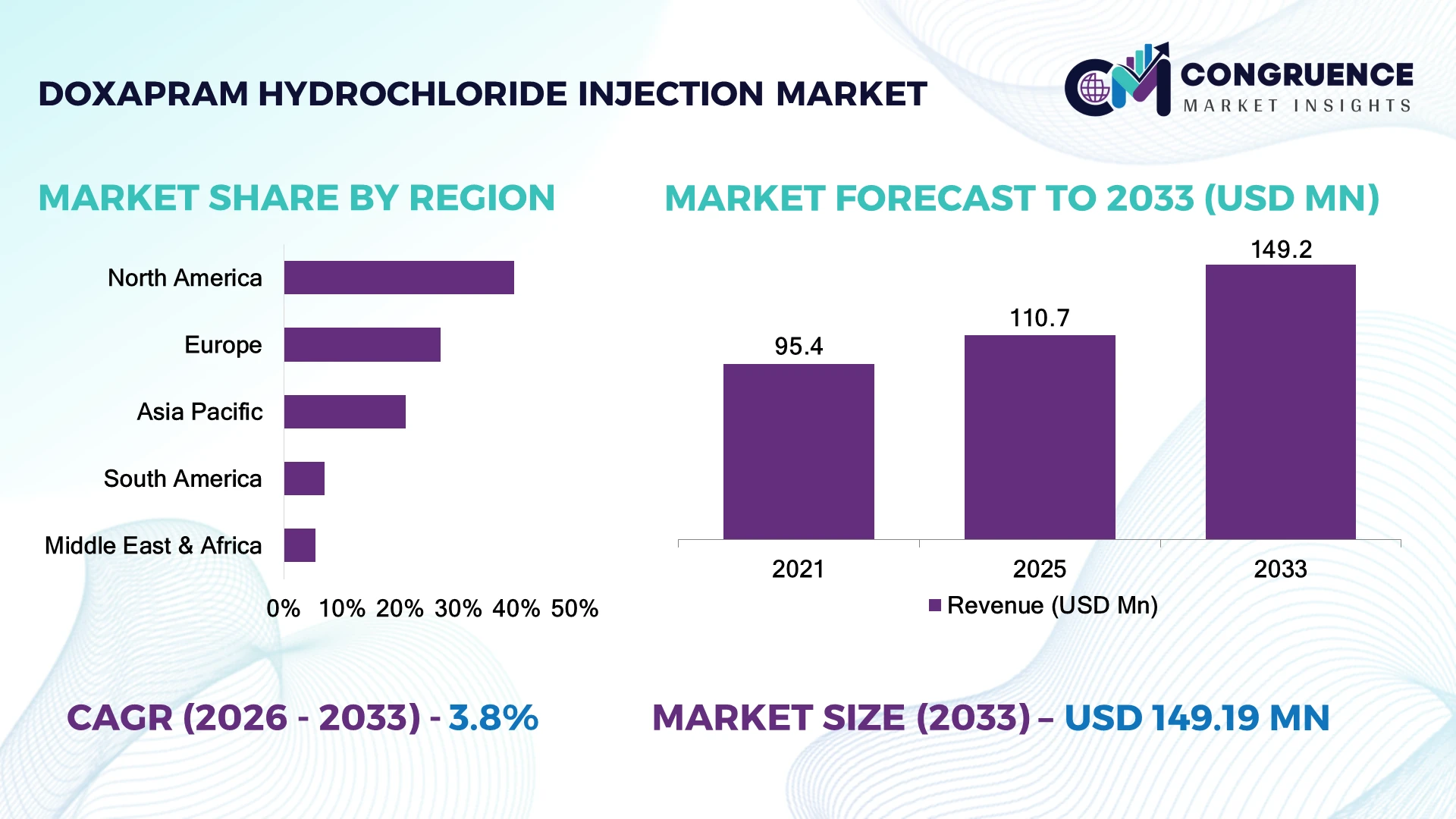
The United States is the dominant commercial market, estimated at roughly 35–40% of global demand, supported by established hospital procurement and 20 mg/mL injectable formulations. Europe represents approximately 25–30%, driven by regulated post-operative use. Asia-Pacific remains more fragmented but benefits from expanding pharmaceutical access. In 2026, geopolitical logistics disruptions and pharmaceutical supply-chain diversification are increasing attention to qualified API sourcing and sterile-fill capacity.
Strategically, suppliers with validated sterile manufacturing, regulatory coverage, and dependable regional inventory hold the strongest position for capturing defensible demand.
Market Size & Growth: USD 110.7 million in 2025 reaches USD 149.2 million by 2033 at 3.8% CAGR, supported by post-anesthesia respiratory stimulation and sterile-injection supply.
Top Growth Drivers: Post-operative respiratory management contributes 35–40% of demand, hospital procurement 25–30%, and specialized critical-care use 15–20%.
Short-Term Forecast: By 2028, standardized 20 mg/mL presentations can reduce emergency sourcing exposure 8–12% and improve availability 5–8%.
Emerging Technologies: Automated fill-finish, electronic batch records, and visual inspection are advancing quality control; automation can reduce manual inspection 20–30%.
Regional Leaders: North America is estimated at USD 59.7 million by 2033, Europe USD 44.8 million, and Asia-Pacific USD 29.8 million.
Consumer/End-User Trends: Hospitals and anesthesia departments dominate use, with post-operative respiratory management representing 60–70% of clinically relevant demand in mature markets.
Pilot/Case Example: In 2026, a UK 20 mg/mL presentation received authorization with a 36-month shelf life, strengthening inventory planning.
Competitive Landscape: Hikma-linked products represent about 50% of identified active U.S. labeler records; HealthFirst, Synchrony Pharma, Nishchem, and API suppliers add pressure.
Regulatory & ESG Impact: U.S. labeling retains a neonatal restriction because the injection contains 0.9% benzyl alcohol; right-sized presentations support tighter inventory control.
Investment & Funding: Hikma committed USD 1 billion through 2030 for U.S. manufacturing and R&D, reinforcing sterile-injectable supply resilience.
Innovation & Future Outlook: Secure API sourcing, automated sterile manufacturing, ready-to-use formats, and regional production redundancy will shape competition through 2028.
The Doxapram Hydrochloride Injection market remains concentrated in hospital anesthesia and controlled respiratory-care settings, with approximately 60–70% of clinically relevant demand linked to post-operative respiratory management. In 2026, manufacturers are prioritizing sterile fill-finish automation, qualified API sourcing, and regional inventory resilience as procurement teams tighten supply continuity requirements. These shifts strengthen the value of compliant, dependable injectable supply and lead directly into strategic competition.
The Doxapram Hydrochloride Injection market is strategically relevant because a narrow, clinically defined product can still command value through regulatory continuity, sterile-manufacturing reliability, and hospital availability. In 2026, competition is increasingly shaped by supply resilience rather than formulation novelty, as manufacturers diversify API sourcing and regional production to reduce exposure to logistics disruptions and procurement concentration.
Technology is reinforcing this shift. Automated visual inspection and electronic batch records can reduce manual quality-control workload by roughly 20–30% versus paper-intensive processes, while standardized 20 mg/mL presentations simplify dosing and inventory planning. North America retains the strongest commercial infrastructure, whereas Europe emphasizes regulated post-operative use and supply reliability; Asia-Pacific remains more fragmented, with access expanding through local pharmaceutical distribution.
A practical deployment priority is maintaining validated sterile-fill capacity for hospitals and anesthesia departments, supported by regional safety stock and regulatory-ready documentation. Hikma’s USD 1 billion U.S. manufacturing and R&D investment through 2030 illustrates how larger injectable suppliers are strengthening domestic capacity. Over the next 2–3 years, competitive positioning will depend on API security, quality consistency, regulatory reach, and reliable hospital supply rather than scale alone.
Post-operative respiratory management remains the core demand driver, with approximately 60–70% of clinically relevant doxapram hydrochloride injection utilization associated with anesthesia-related respiratory depression and monitored recovery settings. Hospital procurement increasingly prioritizes injectable availability, standardized presentations, and validated sterile supply, particularly in the United States and United Kingdom. Automated fill-finish and inspection systems can reduce manual quality-control workload by 20–30%, improving batch consistency and release efficiency. U.S. manufacturers are strengthening domestic injectable capacity as pharmaceutical supply-chain disruptions increase procurement scrutiny. Companies are responding through sterile manufacturing upgrades, inventory agreements, and qualified API sourcing. The non-obvious advantage is supply reliability: for a specialized injectable with limited substitution, consistent availability directly strengthens hospital-contract retention and supplier negotiating power.
Doxapram hydrochloride injection faces a structurally narrow utilization base because approximately 60–70% of demand is concentrated in post-operative and specialized respiratory-management settings, while neonatal use remains restricted by formulation considerations. Hospital formularies typically allocate a small share of injectable budgets to specialized respiratory stimulants, limiting volume expansion. Regulatory labeling differences between the United States and European markets further increase documentation and market-maintenance costs by an estimated 10–15% for suppliers operating across jurisdictions. Periodic API and sterile-component shortages can also extend replenishment cycles by 15–25%. Companies are mitigating exposure through dual-source procurement, longer supply contracts, regional safety stocks, and localized packaging. The key operational constraint is not manufacturing capacity alone but maintaining economically viable production volumes for a narrowly defined clinical application.
Domestic pharmaceutical manufacturing programs create opportunities for localized doxapram hydrochloride injection production, particularly in India and the United States. Regional sterile-fill localization can reduce replenishment lead times by 20–30%, while automated packaging can improve throughput 15–25% compared with labor-intensive workflows. India’s established injectable manufacturing base provides an attractive platform for API-to-finished-dose integration and contract manufacturing partnerships. Future opportunities also extend to ready-to-administer packaging, electronic batch documentation, and predictive inventory systems that reduce hospital stockholding requirements by 10–15%. Companies are positioning through contract manufacturing, technology-transfer agreements, and validated secondary suppliers. A less obvious opportunity is portfolio bundling: suppliers combining doxapram with complementary anesthesia and critical-care injectables can improve procurement efficiency without materially expanding the product’s clinical indication base.
Long-term competitiveness depends on maintaining economical sterile production despite relatively specialized demand. Small production runs can increase per-unit conversion costs by 10–20%, while additional visual inspection and sterility controls can add 5–10% to processing requirements. U.S. and European manufacturers also face tighter expectations for batch traceability, contamination control, and documented supply continuity. Workforce specialization remains important because aseptic processing deviations can trigger disproportionate batch losses and release delays. Companies are addressing these pressures through automated inspection, electronic batch records, predictive maintenance, and multi-site quality systems. The strategic challenge is achieving scale without overproducing a narrowly utilized injectable. Manufacturers that synchronize production planning with hospital procurement cycles can reduce inventory waste by 10–15% while preserving service levels and regulatory compliance.
Sterile Manufacturing Automation Accelerates: Injectable producers are expanding automated filling, inspection, and electronic batch-record systems, reducing manual quality-control activity by 20–30% and improving batch-release consistency. U.S. facilities are increasingly pairing automation with domestic capacity expansion as supply-chain resilience becomes a procurement criterion. The shift is particularly important for specialized products where small production volumes make labor-intensive processing disproportionately expensive.
Hospital Inventory Becomes More Predictive: Hospitals are moving from fixed safety-stock policies toward demand-linked replenishment, with digital inventory systems capable of reducing excess injectable holdings by 10–15% and improving replenishment visibility by 20–25%. Manufacturers are responding with vendor-managed inventory arrangements and shorter replenishment cycles. This operational transition is reducing the importance of broad physical distribution networks while increasing the value of reliable data exchange.
Regional Supply Chains Diversify: Pharmaceutical procurement teams are increasingly qualifying secondary API and sterile-fill suppliers, targeting 15–25% reductions in single-source exposure. India is gaining relevance as an injectable manufacturing and packaging hub, while U.S. producers strengthen domestic capacity. Geopolitical logistics disruptions have accelerated dual-sourcing and regional safety-stock strategies, creating opportunities for contract manufacturers with validated regulatory systems.
Quality Systems Become Competitive Differentiators: Electronic traceability, automated visual inspection, and integrated deviation management are becoming increasingly important in specialized injectable production. Advanced systems can reduce inspection workload by 20–30% and shorten documentation processing by 15–25%. Companies are investing in digital quality infrastructure not simply for compliance, but to reduce batch-release friction, strengthen hospital confidence, and protect continuity of supply.
Standard Doxapram Hydrochloride Injection formulations account for approximately 80–85% of global demand, reflecting established hospital protocols, regulatory familiarity, and compatibility with conventional intravenous administration. The 20 mg/mL presentation represents the dominant commercial configuration, particularly across U.S. and European hospital systems. Lower-volume specialized formulations account for roughly 10–15%, while other dosage or packaging configurations contribute approximately 5%. Mature markets prioritize standardized products with predictable procurement and established clinical workflows, whereas emerging markets increasingly focus on cost-efficient packaging and reliable availability.
The fastest-growing type is ready-to-use, standardized injectable presentation, supported by hospital efforts to reduce preparation steps and medication-handling variability. Simplified administration can reduce preparation-related workflow time by approximately 15–25%, strengthening its relevance in high-throughput anesthesia and monitored-care environments. Manufacturers are responding through automated fill-finish, improved packaging integrity, and regional sterile manufacturing. Demand is strengthening where hospitals prioritize rapid deployment, inventory predictability, and consistent dosing, making formulation standardization an increasingly important competitive differentiator.
U.S. hospital medication-management practices increasingly emphasize standardized concentrations and ready-to-administer injectable products to reduce preparation variability and medication-handling workload, supporting continued preference for established standardized injectable configurations.
Post-anesthesia respiratory depression and postoperative ventilatory stimulation represent the leading application, estimated at approximately 60–65% of global Doxapram Hydrochloride Injection demand. Concentration reflects doxapram’s established role in stimulating ventilation following anesthesia, particularly where respiratory depression requires monitored intervention. Drug-induced CNS and respiratory depression accounts for roughly 20–25%, while acute hypercapnia associated with chronic pulmonary disease represents about 10–15%. Mature hospital applications remain protocol-driven, whereas specialized respiratory-care use is more selective.
The fastest-growing application is acute respiratory insufficiency associated with chronic pulmonary disease, supported by closer arterial-blood-gas monitoring and short-duration ventilatory-stimulation protocols. Hospital workflows increasingly integrate pulse oximetry, blood-gas analysis, and controlled infusion, improving treatment oversight. Manufacturers are responding with standardized 20 mg/mL presentations, sterile-fill optimization, and broader hospital distribution. Demand is therefore strengthening most where injectable respiratory support remains operationally relevant within tightly monitored anesthesia and acute-care pathways.
The Ambulatory Surgery Center Association reported in 2025 that U.S. ambulatory surgery centers had grown to more than 6,500 Medicare-certified facilities performing over 23 million outpatient procedures annually, reinforcing the expanding infrastructure for monitored anesthesia and postoperative respiratory care.
Hospitals represent the dominant end-user, accounting for an estimated 70–75% of global Doxapram Hydrochloride Injection demand because operating rooms, post-anesthesia care units, emergency departments, and monitored respiratory-care services require controlled injectable availability. Ambulatory surgery centers represent approximately 15–20%, while specialty clinics and other institutional settings account for 5–10%. Hospital procurement remains mature and protocol-based, with purchasing decisions emphasizing regulatory compliance, sterile quality, product continuity, and standardized dosing.
Ambulatory surgery centers are the fastest-expanding end-user group as outpatient procedures increasingly shift from hospital departments into dedicated facilities. Their procurement model emphasizes rapid turnover, compact inventories, and predictable replenishment, encouraging manufacturers to develop efficient distribution and inventory partnerships. Hospitals increasingly favor multi-product contracts and regional supply agreements, while ASC-focused suppliers emphasize ready availability and smaller-volume procurement. The competitive opportunity is strongest in U.S. outpatient infrastructure, where expanding procedural capacity is creating additional demand for reliable anesthesia-related injectable support.
The Ambulatory Surgery Center Association reported in 2026 that more than 6,500 Medicare-certified ASCs operate in the United States, while Medicare paid ASCs an average of 62% of hospital outpatient department rates for equivalent procedures in 2024, strengthening the economic case for outpatient procedural expansion.
North America accounted for the largest market share at 39.5% in 2025 however, Asia-Pacific is expected to register the fastest growth, expanding at a CAGR of 5.1% between 2026 and 2033.

Domestic sterile capacity and hospital procurement strengthen market leadership
North America represents approximately 39.5% of global Doxapram Hydrochloride Injection demand, supported by established anesthesia infrastructure, hospital formularies, and commercial availability of 20 mg/mL presentations. The United States accounts for more than 85% of regional demand, making regulatory continuity and domestic manufacturing strategically important. Major injectable manufacturers are strengthening U.S. production networks, with large-scale investments targeting sterile manufacturing and pharmaceutical development. Companies are prioritizing domestic sterile capacity, diversified API procurement, automated quality systems, and hospital-contract continuity. The region's advantage is not simply demand scale; concentrated hospital purchasing and mature regulatory infrastructure allow suppliers to maintain predictable procurement cycles and higher-quality requirements.
United States Market Outlook: The United States remains the principal commercial and manufacturing center, supported by established FDA-regulated injectable supply chains and concentrated hospital purchasing. Major manufacturers maintain dedicated sterile-injectable facilities across the country, while extensive hospital networks support recurring institutional demand. The market favors suppliers capable of maintaining validated production, regulatory compliance, and uninterrupted distribution.
Regulated supply continuity drives specialist injectable positioning
Europe accounts for approximately 27% of global Doxapram Hydrochloride Injection demand, with the United Kingdom, Germany, France, and Belgium representing important procurement markets. Demand remains concentrated in hospital anesthesia and monitored respiratory-care settings, where regulatory compliance and uninterrupted sterile supply outweigh broad promotional activity. Established European suppliers maintain 20 mg/mL formulations through regulated pharmaceutical channels. Manufacturers increasingly emphasize qualified production networks, batch traceability, pharmacovigilance, and multi-market regulatory dossiers. European injectable manufacturing remains strategically important, with established facilities supporting supply across several regulated markets. Procurement increasingly favors suppliers capable of maintaining consistent documentation and minimizing supply interruptions.
United Kingdom Market Outlook: The United Kingdom remains strategically important because its hospital procurement system combines centralized purchasing with stringent medicines regulation. Doxapram demand is concentrated around anesthesia and acute respiratory management, while established 20 mg/mL injectable availability supports standardized clinical workflows. Suppliers with dependable regulatory documentation, pharmacovigilance capabilities, and distribution partnerships hold an advantage in maintaining institutional contracts.
Indian API capability creates a regional supply-chain advantage
Asia-Pacific represents approximately 21% of global demand but has the fastest expansion trajectory as pharmaceutical access and injectable manufacturing capacity improve. India is particularly significant because its pharmaceutical sector supports Doxapram API production with internationally recognized quality grades and regulatory documentation, while domestic manufacturers also supply finished injectable formulations. Japan and Australia retain more regulated, hospital-centered demand, whereas India increasingly combines API capability with contract manufacturing and export opportunities. Companies are strengthening regional sourcing, localized packaging, and regulatory partnerships to reduce dependence on distant supply chains. This creates an important advantage for suppliers able to integrate API sourcing with sterile-finish operations.
India Market Outlook: India offers a strategically important manufacturing platform because established pharmaceutical infrastructure supports API production, regulatory documentation, sterile formulation, and export-oriented supply. Domestic manufacturers offer 20 mg/mL injectable configurations for institutional use, while API producers support international pharmaceutical customers. This combination strengthens India's position in regional sourcing and contract manufacturing, particularly as global buyers diversify pharmaceutical supply chains.
Hospital procurement remains concentrated around Brazil's advanced-care network
South America accounts for approximately 7% of global Doxapram Hydrochloride Injection demand, with Brazil representing more than half of regional consumption. Demand is concentrated in tertiary hospitals, anesthesia departments, and specialized respiratory-care facilities, while smaller markets depend more heavily on imported finished formulations. Procurement sensitivity to foreign-exchange movements and import lead times makes distributor reliability particularly important. Suppliers are prioritizing regional distribution agreements, localized inventory, and consolidated pharmaceutical portfolios. Brazil's established hospital infrastructure provides the strongest commercial base, while Argentina, Colombia, and Chile remain more selective markets. Strategically positioned inventory can reduce replenishment exposure by approximately 15–20% compared with fully import-dependent ordering cycles.
Brazil Market Outlook: Brazil provides the strongest commercial platform through its large hospital network, established pharmaceutical-distribution infrastructure, and concentration of tertiary-care services in São Paulo, Rio de Janeiro, and Minas Gerais. Demand remains centered on institutional procurement, making regulatory registration, distributor coverage, and dependable import scheduling essential for maintaining product availability and minimizing stock-out exposure.
Hospital modernization and centralized procurement reshape specialist injectable access
Middle East & Africa represents approximately 5.5% of global Doxapram Hydrochloride Injection demand, with Saudi Arabia, the UAE, South Africa, and selected North African markets accounting for most institutional purchasing. Saudi Arabia is particularly important because centralized healthcare procurement increasingly favors suppliers capable of meeting standardized tender specifications. Tender activity has also demonstrated supplier-participation constraints, reinforcing the importance of commercial availability and competitive bidding. Companies are responding through local distributors, tender-focused partnerships, regional inventory, and broader injectable portfolios rather than standalone product expansion. The region's strongest opportunity lies in markets where hospital modernization is accompanied by centralized pharmaceutical purchasing.
Saudi Arabia Market Outlook: Saudi Arabia remains the region's most strategically significant market because centralized procurement and large hospital modernization programs create concentrated purchasing opportunities. The country also has established pharmaceutical manufacturing infrastructure and an expanding local healthcare ecosystem. Suppliers with tender expertise, regulatory readiness, local distribution partnerships, and reliable inventory are positioned to strengthen institutional access and reduce dependence on irregular imported supply.
Hikma, Chartwell Injectables, Synchrony Pharma, Eumedica, and Khandelwal Laboratories compete across branded, generic, and regional supply channels, with API specialists such as Nishchem supporting downstream manufacturers. Hikma leads regulated U.S. supply, while Chartwell competes on generic pricing; Synchrony and Eumedica strengthen European access, and Indian suppliers compete through cost and API integration. The top five players are estimated to represent 75–80% of global value, reflecting the market’s concentrated structure. Competition centers on price, regulatory reach, supply continuity, and formulation availability: regional suppliers can offer 10–20% lower procurement costs, while sterile-fill operations can improve release throughput 15–25%. Players are competing through regulatory approvals, regional distribution agreements, API sourcing, and standardized 20 mg/mL presentations. The competitive shift is toward supply security and geographic redundancy rather than product differentiation. Entry barriers include sterile manufacturing validation, regulatory dossiers, pharmacovigilance, and limited clinical applications. Winning requires dependable supply, regulatory breadth, competitive pricing, and localized distribution.
Hikma Pharmaceuticals
Chartwell Injectables
Synchrony Pharma
Eumedica Pharmaceuticals
Khandelwal Laboratories
Nishchem International
Sito Life Science
Rotexmedica
HealthFirst
Eumedica SA
Caropram
Dhai Taiba Pharmaceutical Company
Current Doxapram Hydrochloride Injection production centers on automated sterile filling, in-process monitoring, electronic batch records, and automated visual inspection. These systems can reduce manual inspection workload by 20–30% and documentation processing by 15–25%. Adoption is strongest in regulated U.S. and European facilities, where traceability and batch-release consistency directly influence hospital supply reliability.
Emerging integration combines automated filling with vision systems, environmental monitoring, serialization, and digital quality-management platforms. Compared with manual inspection and paper-based release workflows, integrated systems can improve inspection throughput by 15–25% while reducing documentation errors by roughly 10–15%. Hikma and other established injectable suppliers benefit from validated infrastructure, whereas regional manufacturers can compete by adopting modular automation and contract manufacturing partnerships.
During 2026–2028, predictive maintenance, real-time environmental monitoring, and electronic release workflows will become more important for specialized injectable production. Predictive monitoring can reduce equipment-related interruptions by 10–15%, while automated scheduling can improve line utilization by 5–10%. The competitive advantage will favor manufacturers combining regulatory readiness, sterile-process control, and supply-chain visibility. For Doxapram, technology matters because low-volume production magnifies every quality deviation, downtime event, and inventory mismatch. Acting now improves manufacturing economics, release reliability, and procurement confidence. Digital synchronization improves inventory visibility and batch-status control across production networks.
September 2026 Synchrony Pharma received UK marketing authorization for Doxapram Hydrochloride 20 mg/mL injection, with a 36-month shelf life and 5 mL ampoule presentation. The approval expands regulated supply options and strengthens European availability for postoperative respiratory management. Source: medicines.org.uk
March 2025 Eumedica secured a Saudi NUPCO tender for Doxapram HCl 20 mg/mL injection, specified in 5 × 5 mL ampoules. The award demonstrates institutional procurement demand and supports Eumedica’s positioning in Gulf hospital injectable supply during 2025. Source: nupco.com
January 2025 HealthFirst updated its U.S. doxapram hydrochloride injection labeling for a 20 mg/mL, 20 mL vial presentation. The active listing broadens commercial packaging access while maintaining the established NDA-linked product configuration for hospital respiratory-stimulant procurement channels nationwide. Source: dailymed.nlm.nih.gov
June 2025 Hikma’s injectable portfolio continued listing DOPRAM Injection at 20 mg/mL in 20 mL vials, confirming ongoing commercial availability as the FDA Reference Listed Drug. The standardized presentation supports established U.S. hospital procurement and continuity of supply. Source: hikma.com
The report provides a structured assessment of the Doxapram Hydrochloride Injection market across standard injectable formulations, dosage and packaging configurations, post-anesthesia respiratory management, drug-induced respiratory depression, chronic pulmonary applications, and other specialized uses. End-user coverage includes hospitals, ambulatory surgery centers, specialty clinics, and institutional healthcare providers, enabling analysis of procurement intensity and deployment patterns.
Regional analysis spans North America, Europe, Asia-Pacific, South America, and Middle East & Africa, with country-level emphasis on the United States, United Kingdom, Germany, India, and selected Gulf markets. The study evaluates sterile fill-finish automation, electronic batch records, visual inspection, serialization, API sourcing, and supply-chain localization. With hospitals representing roughly 70–75% of demand and standardized 20 mg/mL products dominating commercial supply, the report supports investment planning, geographic expansion, supplier selection, competitive positioning, partnership strategy, and market direction through 2033.
| Report Attribute/Metric | Report Details |
|---|---|
|
Market Revenue in 2025 |
USD 110.7 Million |
|
Market Revenue in 2033 |
USD 149.2 Million |
|
CAGR (2026 - 2033) |
3.8% |
|
Base Year |
2025 |
|
Forecast Period |
2026 - 2033 |
|
Historic Period |
2021 - 2025 |
|
Segments Covered |
By Type
By Application
By End-User
|
|
Key Report Deliverable |
Revenue Forecast, Growth Trends, Market Dynamics, Segmental Overview, Regional and Country-wise Analysis, Competition Landscape |
|
Region Covered |
North America, Europe, Asia-Pacific, South America, Middle East, Africa |
|
Key Players Analyzed |
Hikma Pharmaceuticals, Chartwell Injectables, Synchrony Pharma, Eumedica Pharmaceuticals, Khandelwal Laboratories, Nishchem International, Sito Life Science, Rotexmedica, HealthFirst, Eumedica SA, Caropram, Dhai Taiba Pharmaceutical Company |
|
Customization & Pricing |
Available on Request (10% Customization is Free) |




