
Reports
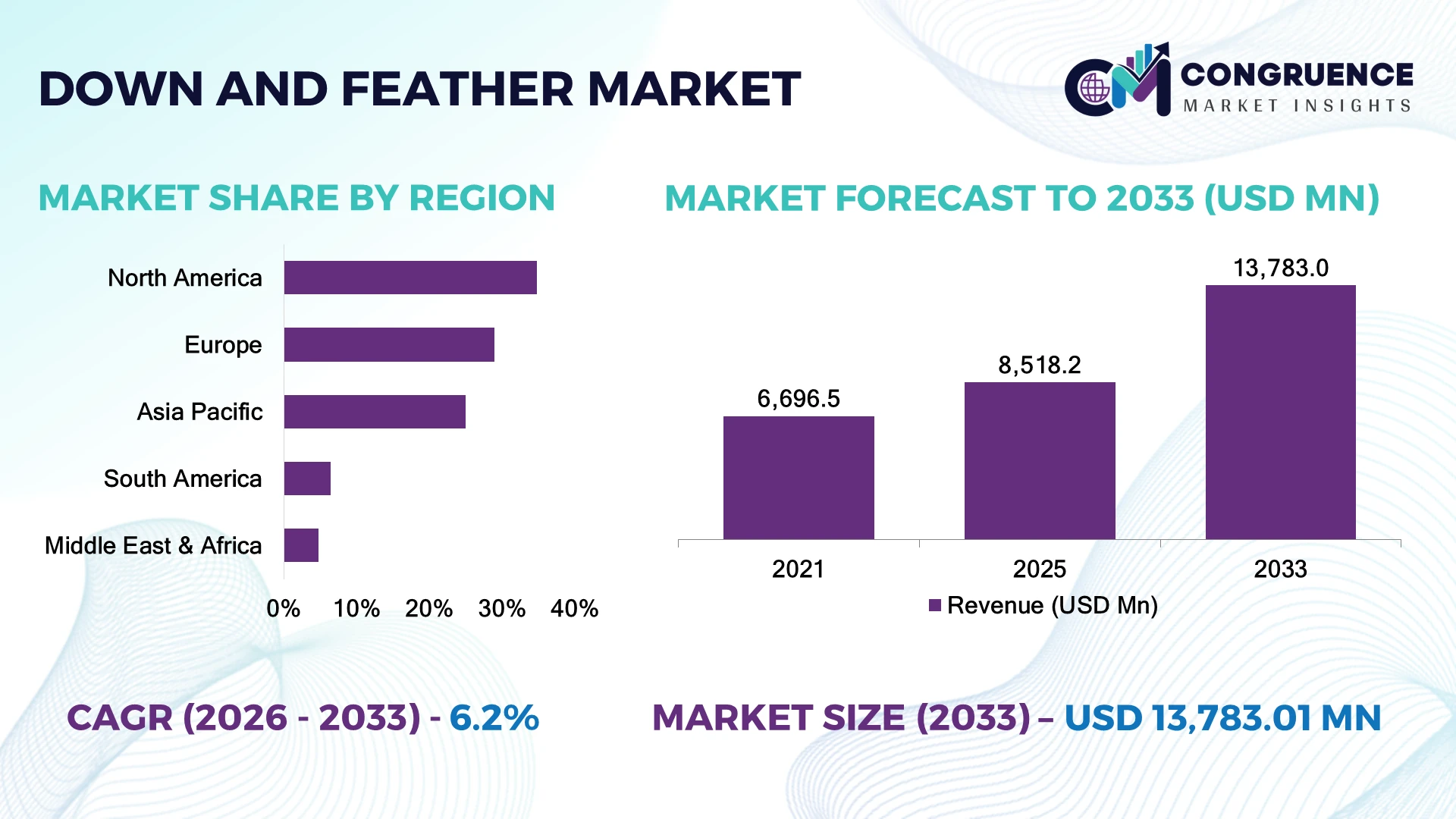
The Global Down and Feather Market was valued at USD 8,518.2 Million in 2025 and is anticipated to reach a value of USD 13,783.0 Million by 2033 expanding at a CAGR of 6.2% between 2026 and 2033. Growth is driven by premium insulation demand in technical outerwear, high-loft bedding, and sleeping bags, alongside greater use of traceable down and improved feather-processing systems.
China anchors global down and feather production, processing, and exports, accounting for an estimated 70–80% of global activity across these supply-chain functions. Global virgin down production reached approximately 659,073 tonnes in 2024, while RDS-certified production was about 19,595 tonnes, highlighting the substantial gap between total output and certified supply. Compared with China’s scale, European and North American businesses place stronger emphasis on premium product specifications, traceability, and documented animal-welfare controls. Trade-policy changes and supply-chain scrutiny are encouraging buyers to qualify suppliers beyond price alone.
Buyers and manufacturers should secure reliable Chinese processing capacity while diversifying qualified suppliers and strengthening traceability for premium markets.
Market Size & Growth: The market is projected to expand from USD 8,518.2 million in 2025 to USD 13,783.0 million by 2033, with premium insulation, bedding upgrades, and technical outdoor products supporting demand.
Top Growth Drivers: China’s estimated 70–80% share of global down production, export, and consumption activity reinforces manufacturing scale; premium bedding and technical apparel strengthen demand for higher-fill-power materials.
Short-Term Forecast: Through 2028, processors prioritizing batch traceability, automated sorting, and moisture control are positioned to target lower rework and more consistent fill performance; savings depend on plant-level baselines.
Emerging Technologies: Optical sorting, automated filling, and digital lot tracking are improving grading consistency and material accountability, while recycled-down cleaning systems support circular product lines.
Regional Leaders: Asia Pacific leads on processing scale, Europe emphasizes animal-welfare documentation and premium textile standards, and North America supports technical outerwear and high-performance bedding demand.
Consumer/End-User Trends: Brands increasingly distinguish down products by fill power, warmth-to-weight performance, responsible sourcing, and durability rather than relying only on fill weight or price.
Pilot/Case Example: Global virgin down production reached approximately 659,073 tonnes in 2024, while RDS-certified production was about 19,595 tonnes, underscoring the opportunity to expand verified sourcing and chain-of-custody coverage.
Competitive Landscape: China-based processors benefit from manufacturing scale, while international suppliers and brands differentiate through grading, blending, testing, and certified sourcing; market-share rankings vary by product and supply-chain stage.
Regulatory & ESG Impact: Responsible Down Standard requirements prohibit live-plucking and force-feeding and use third-party audits and chain-of-custody controls, increasing documentation requirements for participating suppliers.
Investment & Funding: Investment priorities include automated cleaning and sorting, wastewater treatment, quality laboratories, and traceability systems; capital allocation increasingly favors consistent yield and verifiable sourcing.
Innovation & Future Outlook: Recycled down, blended insulation systems, and digital sourcing records are reshaping product development, encouraging companies to compete on verified performance and material accountability alongside cost.
The global down and feather market is shaped by premium bedding, cold-weather apparel, and outdoor equipment, where insulation performance and durability influence material selection. Manufacturers are refining washing, sterilization, sorting, and filling processes to improve consistency; automated grading also helps separate down clusters from feathers and lower-value material. With China central to processing and exports, buyers are increasingly balancing supply concentration against traceability and supplier qualification. Responsible sourcing is becoming a commercial requirement for brands serving customers who expect documented animal-welfare practices, making product performance and supply-chain evidence increasingly connected purchasing criteria.
The down and feather market is becoming strategically important because insulation performance, raw-material traceability, and dependable sourcing increasingly influence brand positioning across outdoor apparel, bedding, and travel products. Manufacturers compete not only on fill power and warmth-to-weight ratio but also on their ability to document origin and maintain consistent quality across processing stages. China’s manufacturing concentration provides scale, while buyers in Europe and North America place particular emphasis on product specifications and sourcing assurance.
Processing technology creates a practical point of differentiation. Automated optical sorting and controlled washing help standardize grading and reduce manual handling, although actual efficiency gains depend on input quality and equipment configuration. Certified supply chains require more than a supplier declaration: the Responsible Down Standard uses third-party audits and chain-of-custody controls, while prohibiting live-plucking and force-feeding. This raises documentation requirements but helps brands substantiate sourcing claims.
Over the next two to three years, processors are likely to prioritize traceable lots, recycled-down recovery, improved sorting, and more consistent filling operations. For example, a bedding manufacturer can qualify separate lots by fill power and cleanliness, then link those batches to purchase and production records. Companies that combine reliable supply with verifiable sourcing and repeatable product performance will be better positioned to protect margins and win long-term contracts.
Demand for high-performance insulation is supported by the strong warmth-to-weight ratio of down, particularly in premium jackets, sleeping bags, and lightweight bedding. China’s estimated 70–80% share of global down production, export, and consumption activity supports processing scale, while global virgin down production reached approximately 659,073 tonnes in 2024. Brands use fill power, cluster content, cleanliness, and traceability to differentiate products rather than competing on fill weight alone. As technical product specifications become more demanding, processors are investing in sorting, washing, and quality-control systems. The strategic advantage lies in converting variable raw material into repeatable grades that meet brand requirements and reduce inconsistency between production batches.
Dependence on a concentrated processing base exposes buyers to sourcing disruption, freight volatility, and differences in raw-material quality. China’s estimated 70–80% share of global down production, export, and consumption activity makes supplier qualification and contingency planning commercially important. Down quality also varies by species, origin, cluster content, moisture, and contamination, affecting usable yield after cleaning and sorting. These differences can create inconsistent fill performance and increase rejection or reprocessing costs. Buyers are responding by qualifying multiple suppliers, specifying measurable acceptance criteria, and securing supply through longer-term agreements. The non-obvious risk is that nominally lower-cost material can become more expensive when inconsistent quality reduces usable yield or delays finished-product production.
Recycled down creates an opportunity to recover usable insulation from discarded bedding, apparel, and production offcuts while supporting circular-product strategies. The commercial opportunity depends on sorting, cleaning, sterilization, and grading recovered material to meet defined performance requirements; recycled content alone does not guarantee equivalent fill power or cleanliness. Manufacturers can begin with controlled recovery streams from known production sources, where material composition and handling history are easier to document. Investments in cleaning lines, automated separation, and batch testing can help establish repeatable grades. Brands can then use recycled down in selected jackets, sleeping bags, cushions, or bedding ranges, reserving higher-specification virgin material for products with stricter performance requirements.
Maintaining consistent traceability remains difficult because down and feathers can pass through farms, slaughter facilities, collectors, processors, traders, and finished-product factories. Each transfer creates a documentation and reconciliation requirement, especially when batches are blended or reprocessed. Responsible Down Standard certification uses third-party audits and chain-of-custody controls, but companies still need reliable internal records to connect incoming material, processing batches, and finished goods. Inconsistent supplier data can undermine sourcing claims and complicate customer audits. Companies must standardize lot identification, retain transaction records, and reconcile certified and non-certified inventory. The operational challenge is to make traceability part of production control rather than treating it as a separate compliance exercise.
Certified Sourcing Gains Importance: Buyers increasingly require documented animal-welfare controls and chain-of-custody evidence. The Responsible Down Standard prohibits live-plucking and force-feeding and relies on third-party audits across the supply chain. With RDS-certified down production at approximately 19,595 tonnes in 2024 against total virgin down production of about 659,073 tonnes, the gap highlights room for broader verified sourcing. Brands are tightening supplier onboarding and retaining transaction records to support product claims.
Automated Grading Improves Consistency: Optical sorting, controlled washing, and digital quality records are helping processors separate down clusters from feathers and contaminants more consistently. Even small improvements in usable yield can matter in high-volume plants, although performance gains depend on incoming material and equipment settings. Chinese processors are well placed to deploy these systems at scale, while buyers increasingly specify fill power, cleanliness, and composition tolerances in purchase contracts.
Recycled Down Enters More Product Lines: Recovered insulation from used bedding, apparel, and manufacturing offcuts is attracting attention as brands pursue circular-material strategies. Recycled material requires cleaning, sterilization, grading, and performance checks before reuse. Producers are starting with controlled feedstocks and narrower product applications to manage quality variability. The key commercial distinction is verified performance: recycled content adds value only when the recovered material meets the required durability, cleanliness, and insulation specifications.
Supply Chains Emphasize Risk Diversification: Concentration in China—estimated at 70–80% of global production, export, and consumption activity—makes supplier resilience a strategic priority. Buyers are qualifying additional processors, clarifying origin documentation, and separating sourcing decisions by quality grade and application. The aim is not to replace China’s scale but to reduce exposure to disruptions and quality bottlenecks. Companies that maintain comparable specifications across approved suppliers can improve procurement flexibility without compromising finished-product performance.
Down is the premium-value segment of the global down and feather market, supported by its superior warmth-to-weight ratio, compressibility, and suitability for high-end comforters, insulated jackets, and sleeping bags. Down is estimated to account for approximately 55–60% of market value, although the precise share varies with product mix and market measurement. Goose down generally occupies the premium tier, while duck down offers a balance of insulation performance and raw-material cost. Feathers remain important in pillows, cushions, and entry-level bedding because they provide structure at lower cost. These established materials benefit from mature processing infrastructure, but profitability depends on cleanliness, cluster content, sorting accuracy, and usable yield.
Recycled down and feather fillings represent an emerging product direction as manufacturers recover insulation from used textiles and production offcuts. Although smaller than conventional material categories, recycled filling offers differentiation for brands pursuing circular-material strategies. Processors are improving separation, washing, sterilization, and grading to increase consistency; even a 2–3% improvement in usable yield can reduce material losses in high-throughput facilities. Investment is shifting toward quality control and traceable feedstock alongside conventional capacity expansion. Suppliers that demonstrate repeatable specifications can compete for premium contracts, while standard feather products remain relevant to price-sensitive applications.
Bedding and home textiles represent the largest application category, estimated to account for approximately 55–60% of global down and feather demand. Comforters, duvets, pillows, and cushions benefit from established manufacturing processes, repeat replacement purchases, and the flexibility to use down, feathers, or blended fillings. Bedding producers prioritize fill consistency, cleanliness, durability, and cost per finished unit. Apparel is a strategically important application because premium jackets and insulated garments depend on warmth-to-weight performance, compressibility, and fill-power specifications. Outdoor equipment, including sleeping bags, serves a specialized market where thermal performance and packability influence purchasing decisions. These differences require suppliers to match material grades to product requirements rather than apply one specification across all applications.
Technical apparel and outdoor equipment are emerging innovation priorities as brands refine lightweight insulation, baffle construction, and performance testing. Selected premium product categories are estimated to expand by approximately 6–8% annually, an indicative analyst estimate rather than a verified growth rate for the entire application segment. Bedding manufacturers are emphasizing automated filling, standardized grading, and recovered-material trials to improve production consistency. A 2–3% reduction in filling waste can create meaningful savings for high-volume factories. Suppliers are balancing scale-oriented investments for bedding with specialized product development for technical applications, where reliable performance documentation supports premium positioning and longer-term customer relationships.
Bedding and home-textile manufacturers are estimated to represent approximately 45–50% of global down and feather demand, reflecting their large-volume use in pillows, duvets, comforters, and cushions. Their purchasing priorities include consistent fill composition, dependable delivery, processing yield, and competitive material costs. Apparel and outdoor-equipment manufacturers represent a more specification-intensive buyer group, requiring defined fill power, cleanliness, warmth-to-weight performance, and durability. Hospitality and institutional buyers generally procure through bedding manufacturers and distributors, prioritizing product lifespan, laundering performance, and replacement consistency. This creates distinct supplier strategies: high-volume bedding accounts reward scale and stable quality, whereas technical brands place greater value on material differentiation, application testing, and sourcing documentation.
Apparel and outdoor-equipment brands are an important growth-oriented customer group as premium insulation and circular-material development influence product design. Selected premium product categories are estimated to expand by approximately 6–8% annually, although this is not a measured growth rate for the full end-user segment. Bedding suppliers are responding through automated filling and tighter input specifications, while performance brands increasingly seek traceable sourcing and application-specific testing. Hospitality buyers continue to emphasize contract pricing and reliable replenishment. Suppliers can strengthen competitiveness through tailored grades, flexible order volumes, and documented chain of custody, while partnerships with garment factories and home-textile manufacturers help secure repeat business across distinct procurement models.
North America accounted for the largest market share at approximately 34.8% in 2025; however, Asia-Pacific is expected to register the fastest growth, expanding at a CAGR of approximately 8.4% between 2026 and 2033.

Premium Bedding and Technical Insulation Strengthen Regional Value
North America represents the leading demand center for down and feather products, supported by premium bedding purchases, established outdoor-apparel brands, and a mature retail and hospitality ecosystem. The United States accounts for approximately 78.6% of regional market demand, making it the primary destination for premium comforters, pillows, insulated jackets, and sleeping bags. The region relies substantially on imported raw materials and processed fills, while specialized domestic processors differentiate through cleaning, grading, blending, and traceable sourcing. Investment is increasingly directed toward material recovery, quality control, and differentiated insulation products. The strategic priority is to balance premium product specifications with sourcing resilience as tariffs, animal-disease disruptions, and freight variability influence procurement decisions.
United States Market Outlook: The United States anchors North American demand through its large home-textile retail base, outdoor recreation industry, and premium consumer-goods market. Brands such as Patagonia and The North Face support demand for technical insulation, while bedding manufacturers prioritize repeatable fill quality and dependable delivery. With the United States representing nearly four-fifths of regional demand, supplier qualification and product-level traceability offer meaningful competitive advantages. Companies that combine reliable imports with domestic finishing, quality assurance, and diversified sourcing can respond more effectively to changing trade conditions and customer specifications.
Traceability and Product Quality Shape Premium Procurement
Europe remains an important market for premium bedding, duvets, pillows, and insulated apparel, with Germany, France, Italy, and the United Kingdom supporting established retail and textile-manufacturing demand. The region accounted for an estimated 28.9% of the global market in 2025 under selected market estimates, although its share varies by market definition. European buyers place considerable emphasis on labeling accuracy, product durability, animal-welfare assurance, and documented material origin. EU textile-composition rules require accurate disclosure of down and feather content, reinforcing the need for consistent grading and product documentation. Processors and brands are responding through certified sourcing, supplier audits, and improved batch-level traceability rather than relying exclusively on lower-cost imports.
Germany Market Outlook: Germany combines a strong home-textile market with specialist feather-processing capabilities and established distribution networks. Manufacturers serving premium bedding customers compete through consistent fill composition, cleanliness, and product durability. EU textile-labeling requirements reinforce the commercial value of accurate material specifications, while documented sourcing helps suppliers meet the expectations of retailers and institutional buyers. German companies can strengthen their position by investing in processing efficiency, quality testing, and traceability systems that support both domestic sales and cross-border distribution.
China’s Processing Scale Supports Regional Supply Leadership
Asia-Pacific combines raw-material access, large-scale processing, and extensive bedding and apparel manufacturing. China is the principal industry hub, accounting for an estimated 70–80% of global down production, export, and consumption activity across the supply chain. Vietnam, Japan, South Korea, and India contribute through garment manufacturing, specialized textiles, and expanding consumer markets. Regional processors benefit from established supplier networks and proximity to downstream factories, helping manage lead times and production costs. However, export-oriented businesses face increasing requirements for documented sourcing and consistent quality. Investment in automated sorting, washing, and batch traceability is strengthening the ability of manufacturers to supply differentiated products to international brands while retaining cost competitiveness.
China Market Outlook: China remains the strategic center of the global down and feather supply chain because of its extensive collection, processing, bedding, and garment-manufacturing infrastructure. Its estimated 70–80% contribution to global down production, export, and consumption activity gives processors considerable influence over availability and sourcing economics. Companies are improving washing, sterilization, sorting, and grading processes to meet international specifications. Continued competitiveness will depend on reliable export execution, quality consistency, environmental controls, and the ability to document material origin for international customers.
Poultry Processing Creates a Foundation for Material Recovery
South America represents a smaller down and feather market, with demand concentrated in bedding, pillows, cushions, and selected apparel applications. Brazil is strategically important because its large poultry-processing industry creates an extensive feather by-product stream, although poultry feather availability does not directly translate into usable down supply. Specialized cleaning, separation, and sterilization are necessary to convert suitable material into commercial filling. Regional manufacturers can strengthen value recovery by improving collection systems and processing quality, while retailers benefit from cost-effective products for price-sensitive consumers. Infrastructure investment and access to specialized processing technology remain important constraints. The strongest opportunity lies in improving the quality and commercial utilization of existing by-products rather than assuming rapid expansion in premium down production.
Brazil Market Outlook: Brazil offers a substantial industrial base for feather collection and processing through its poultry supply chain, supported by established meat-processing and export infrastructure. The country produced approximately 14.9 million tonnes of chicken meat in 2024, illustrating the scale of its poultry industry and associated by-product streams. However, feather recovery requires dedicated cleaning, sterilization, sorting, and quality-control capacity. Companies investing in efficient by-product handling and partnerships with poultry processors can improve material utilization and serve regional bedding manufacturers, while specialized down products will continue to depend on suitable raw-material availability and processing capability.
Hospitality Investment Supports Premium Bedding Procurement
The Middle East and Africa market is smaller than the established demand centers but offers opportunities through hotel development, luxury accommodation, premium residential projects, and expanding modern retail. The United Arab Emirates and Saudi Arabia are important demand centers for hospitality-grade bedding, where durability, comfort, and consistent replacement supply influence purchasing decisions. South Africa provides an established retail and distribution base for selected home-textile products. The region depends heavily on imported down and feather fillings and finished goods, making lead times, distributor coverage, and supplier reliability commercially important. Hospitality procurement can involve large, standardized orders, encouraging suppliers to offer contract specifications, consistent fill grades, and dependable replenishment rather than relying only on seasonal consumer sales.
United Arab Emirates Market Outlook: The UAE serves as a regional distribution and hospitality procurement hub, supported by international hotel operators, premium residential developments, and established import channels. Its hotel sector creates demand for pillows, duvets, and bedding that meet consistent comfort and durability specifications across multiple properties. Large hotel projects can involve coordinated room fit-outs and repeat replenishment, favoring suppliers capable of maintaining uniform product standards and delivery schedules. Companies that work with hospitality distributors and contract-textile providers can strengthen market access, while transparent sourcing and reliable product documentation help differentiate premium offerings.
The market pits premium processors such as ALLIED Feather + Down and Downlite against bulk suppliers in China, Europe, and Türkiye, while recyclers challenge virgin-fill producers on circularity and traceability. The top five players are estimated to hold roughly 30–35% of the market; this is indicative because audited global shares are not consistently disclosed. Competition turns on raw-material access, fill-power consistency, processing yield, price, and sourcing documentation. A 2–3% improvement in usable yield can strengthen margins in high-volume operations, while premium grades differentiate through cleanliness and insulation performance. Suppliers invest in automated sorting, recycled-fill recovery, water-resistant treatments, and batch traceability. ALLIED’s recycled-down programs challenge conventional suppliers, while Downlite strengthens domestic manufacturing and hospitality supply. Chinese processors retain scale and cost advantages, but exporters face scrutiny over origin and animal welfare. Certification, reliable capacity, and custom grades create entry barriers. Winning requires cost discipline, verified performance, traceable sourcing, and dependable delivery.
Down and feather processing is shifting from manual grading toward optical sorting, automated washing, drying, and digital batch records. Machine-assisted separation improves cluster-content consistency; a 1–3% improvement in usable yield is a realistic plant-level target, not a universal result. Conventional water-resistant treatments remain relevant, while ALLIED’s ExpeDRY uses particle-based technology to manage moisture without conventional hydrophobic-treatment chemistry. These systems matter in technical apparel, where loft retention and drying behavior affect performance.
Recycled-down recovery is another shift. Opening, separation, washing, sterilization, and grading lines convert post-consumer bedding and apparel into reusable fill. ALLIED reports recycled down at 700-plus fill power, demonstrating potential for performance applications. Digital traceability connects sourcing records with product batches; ALLIED’s TrackMyDown platform has reached 100 partner brands, indicating that traceability is becoming a tool as well as a compliance record.
During 2026–2028, processors are likely to integrate quality-control data with procurement and production planning. A 1–2% reduction in rework or material loss is a reasonable target where controls are weak. Premium innovators benefit from differentiated performance, while scale-led processors gain from automation. An industry life-cycle assessment update announced in 2026 will include recycled down, improving evidence for comparisons. Investment should prioritize yield, verified claims, and process consistency.
April 2026: The American Down and Feather Council backed an expanded International Down and Feather Bureau life-cycle assessment that will include recycled down for the first time; the original study found 85–97% lower impacts than synthetic alternatives across key categories. Source: downandfeathercouncil.com
October 2025: ALLIED Feather + Down secured both OEKO-TEX Standard 100 certification and bluesign approval for ExpeDRY Ultra Dry Down, strengthening third-party validation for its moisture-management technology and supporting brand qualification for performance insulation products across brands. Source: wtin.com
September 2025: Downlite highlighted U.S.-made collections and plans to add mattress-pad sewing lines at its North Carolina facility, reinforcing domestic manufacturing capacity as bedding suppliers respond to supply-chain uncertainty and customer interest in U.S.-produced products to improve local manufacturing resilience. Source: hometextilestoday.com
January 2026: China’s down and feather industry exports totaled approximately USD 2.18 billion in 2025, down 2.6% year over year; raw-down export value rose 18.6%, while apparel export volume fell 22.2%, indicating divergent product-category performance for export-oriented suppliers and manufacturers. Source: yongjinbiotech.com
The Down and Feather Market Report evaluates natural insulation materials across down, feathers, and recovered or recycled fillings, covering bedding and home textiles, apparel, and outdoor equipment. End-user coverage includes bedding manufacturers, apparel and outdoor brands, hospitality buyers, and institutional procurement channels. Regional analysis spans North America, Europe, Asia-Pacific, South America, and the Middle East and Africa, with country-level emphasis on the United States, Germany, China, Brazil, and the United Arab Emirates.
The report examines washing, sterilization, optical sorting, grading, water-resistant treatments, recycled-fill recovery, and digital traceability. Competitive analysis compares global processors, regional suppliers, and specialist recyclers, while market dynamics address sourcing concentration, quality variation, animal-welfare assurance, and material recovery. Findings support supplier qualification, investment prioritization, product positioning, regional expansion, and competitive planning for 2026–2033.
| Report Attribute/Metric | Report Details |
|---|---|
|
Market Revenue in 2025 |
USD 8,518.2 Million |
|
Market Revenue in 2033 |
USD 13,783.0 Million |
|
CAGR (2026 - 2033) |
6.2% |
|
Base Year |
2025 |
|
Forecast Period |
2026 - 2033 |
|
Historic Period |
2021 - 2025 |
|
Segments Covered |
By Type
By Application
By End-User
|
|
Key Report Deliverable |
Revenue Forecast, Growth Trends, Market Dynamics, Segmental Overview, Regional and Country-wise Analysis, Competition Landscape |
|
Region Covered |
North America, Europe, Asia-Pacific, South America, Middle East, Africa |
|
Key Players Analyzed |
ALLIED Feather + Down, Downlite International, Inc., United Feather & Down, Feather Industries, ROHDEX Bettfedern GmbH & Co. KG, Heinrich Häussling GmbH & Co. KG, Peter Kohl KG, Norfolk Feather Company, Hanskruchen GmbH, KL Down, Anhui Yahua Feather Down Co., Ltd., Hangzhou Xiaoshan Xintang |
|
Customization & Pricing |
Available on Request (10% Customization is Free) |




