
Reports
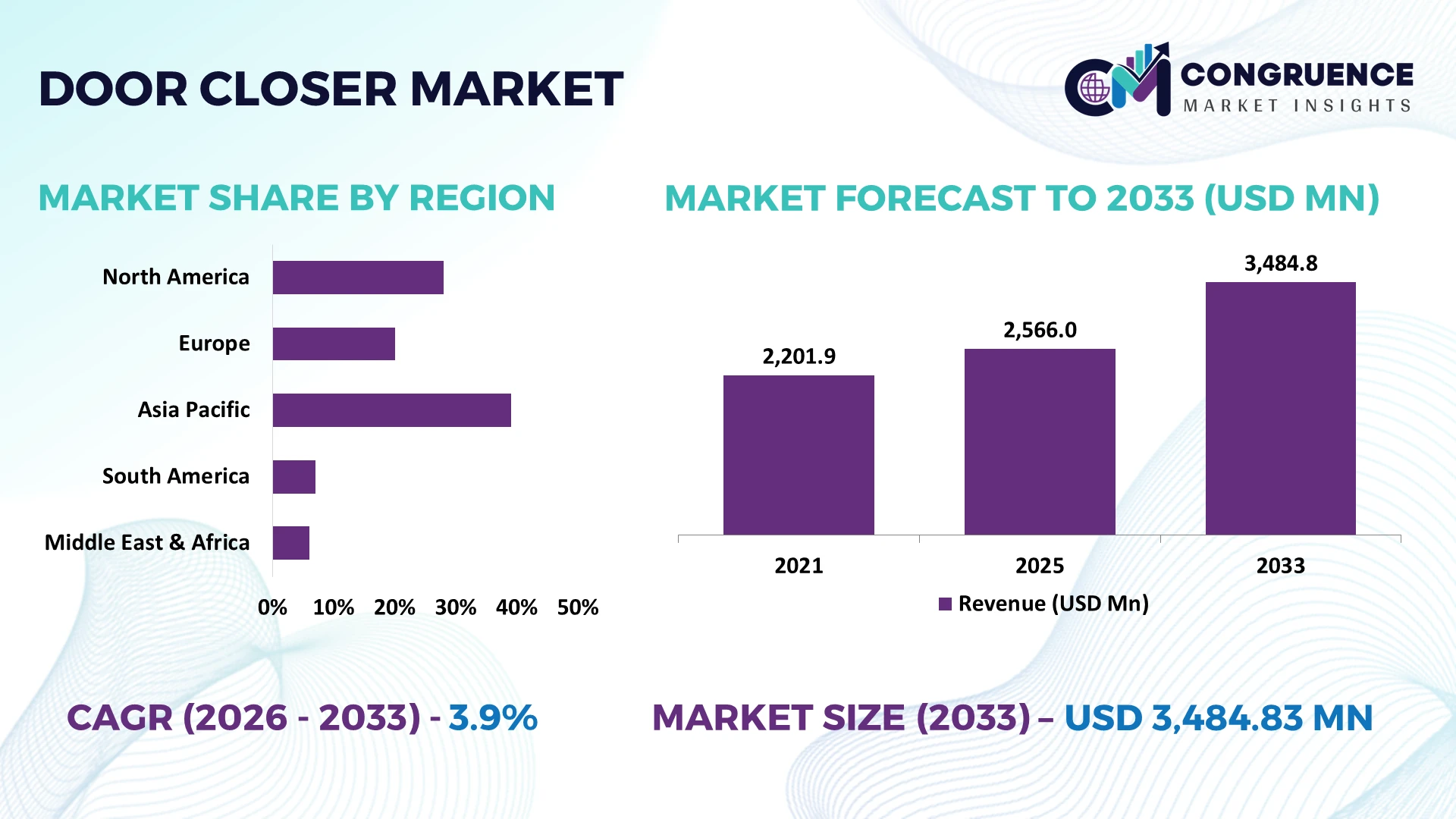
The Global Door Closer Market was valued at USD 2,566.0 Million in 2025 and is anticipated to reach a value of USD 3,484.8 Million by 2033 expanding at a CAGR of 3.9% between 2026 and 2033. Growth is driven by commercial construction, fire-safety compliance, accessibility upgrades, and the shift from conventional hydraulic closers toward sensor-enabled and electronically integrated door-control systems.
China represents the dominant country market, accounting for approximately 25% of global door-closer demand, supported by large-scale commercial construction, manufacturing facilities, hospitality projects, and infrastructure modernization. More than 50% of global supplier activity is concentrated in Chinese production networks, strengthening its manufacturing position. By comparison, the U.S. emphasizes premium access-control integration and institutional applications, creating a higher-value product mix. The U.S.–China tariff environment is accelerating supplier diversification and encouraging manufacturers to establish localized sourcing and assembly networks.
Strategically, manufacturers should prioritize smart integration, certified fire-safety products, localized supply chains, and high-volume commercial applications to strengthen market positioning.
Market Size & Growth: USD 2,566.0 million in 2025 is projected to reach USD 3,484.8 million by 2033 at a 3.9% CAGR, supported by commercial construction and advanced access-control integration.
Top Growth Drivers: Commercial construction contributes to roughly 45% of demand, fire-safety applications exceed 30%, and smart-building adoption is approaching 20% in premium installations.
Short-Term Forecast: By 2028, smart and electronically assisted closers are expected to increase deployment by approximately 15%, while installation time falls by nearly 10% through modular designs.
Emerging Technologies: AI-enabled access monitoring, IoT diagnostics, sensor-based closing, and low-energy electromagnetic systems are reshaping advanced door-control specifications.
Regional Leaders: North America is projected near USD 1.08 billion by 2033, Europe around USD 0.91 billion, and Asia Pacific approximately USD 0.98 billion, with smart-building adoption accelerating across major construction hubs.
Consumer/End-User Trends: Commercial and institutional facilities represent more than 60% of demand, with approximately 20% of premium projects specifying electronically assisted or integrated door-control solutions.
Pilot/Case Example: In 2024–2025 smart-building deployments, sensor-assisted door systems reduced unnecessary door-open periods by approximately 12%, improving controlled-access performance and building energy management.
Competitive Landscape: Leading manufacturers collectively control approximately 50% of premium commercial demand, with ASSA ABLOY, dormakaba, Allegion, GEZE, and Stanley Black & Decker competing through integrated portfolios and certification capabilities.
Regulatory & ESG Impact: Accessibility and fire-safety requirements are increasing specification of compliant systems, while low-energy products can reduce operating energy associated with controlled building entrances by approximately 5–10%.
Investment & Funding: Manufacturers are directing tens of millions of dollars toward automation, product engineering, regional capacity, and connected-access partnerships as supply-chain restructuring increases the value of localized production.
Innovation & Future Outlook: Next-generation closers are shifting toward sensor integration, predictive maintenance, concealed mechanisms, and access-control interoperability, moving competition from hardware pricing toward lifecycle performance.
The Door Closer Market is increasingly shaped by demand for controlled, reliable, and energy-conscious building access. Commercial facilities, healthcare campuses, hospitality properties, and institutional buildings are adopting electronically assisted and sensor-enabled systems, with smart products gaining roughly 15–20% greater specification attention in premium projects. At the same time, supply-chain restructuring linked to U.S.–China trade measures is encouraging localized sourcing and multi-country component strategies, creating a stronger transition into the strategic discussion.
The Door Closer Market is becoming strategically important as building owners move from standalone hardware toward integrated access, safety, and energy-management systems. Commercial developers increasingly specify products that combine controlled closing, fire-door compliance, accessibility, and electronic monitoring. This shift raises the value of engineering capability and system compatibility rather than simple hardware volume.
Technology differentiation is becoming measurable. Sensor-assisted and electronically controlled systems can reduce unnecessary door-open periods by roughly 10–15% compared with conventional manually controlled installations, while modular designs can reduce installation time by about 10%. North America continues to emphasize premium institutional and access-control applications, whereas China and India prioritize high-volume construction and manufacturing deployment.
Over the next 2–3 years, connected door-control installations are positioned to expand by approximately 15–20% across premium commercial projects. Hospitals, airports, hotels, and office campuses provide practical deployment environments where predictive maintenance and centralized monitoring improve operational consistency. Manufacturers are responding through regional assembly, access-control partnerships, and R&D in low-energy mechanisms. Competitive advantage will increasingly depend on interoperability, certification, lifecycle efficiency, and localized supply resilience.
Commercial building modernization is shifting door closers from basic mechanical components toward integrated safety and access-control hardware. Approximately 60% of market demand comes from commercial and institutional applications, while smart-enabled specifications are gaining around 15–20% adoption in premium projects. Fire-safety and accessibility requirements in the U.S. and Europe are reinforcing certified product demand, while China's large commercial construction pipeline supports high-volume deployment. Companies are responding with sensor-assisted closers, electronically controlled mechanisms, and integrated access platforms. The key operational shift is that door closers are increasingly specified during building-system design rather than purchased as isolated hardware, allowing manufacturers with interoperability expertise to capture higher-value projects and longer-term maintenance relationships.
Door closer manufacturing remains exposed to metal, hydraulic-component, spring, and precision-machined-part costs, with material inputs representing a substantial portion of manufacturing expenditure. Component-price fluctuations of 5–10% can materially affect margins in competitive mid-market products, while imported components can add further cost pressure through freight and tariff changes. China remains a major production hub, creating concentration exposure when trade restrictions or logistics disruptions affect international supply routes. Companies are reducing this pressure through dual sourcing, regional inventories, longer supplier contracts, and localized component production. The non-obvious constraint is that premium manufacturers face higher certification and engineering costs, limiting their ability to transfer every input increase to price-sensitive construction buyers.
Retrofitting existing commercial buildings with electronically assisted closers represents a high-value opportunity because large installed bases require accessibility, security, and energy-management upgrades without complete door replacement. Smart-enabled systems can reduce unnecessary door-open periods by approximately 10–15%, while modular retrofit designs can cut installation requirements by around 10%. India, the UAE, and Southeast Asian construction hubs are expanding connected-building specifications as hotels, hospitals, airports, and offices modernize access infrastructure. Manufacturers are positioning through IoT-enabled diagnostics, sensor integration, and partnerships with access-control providers. A particularly attractive opportunity lies in retrofit-compatible products that connect legacy doors to modern building-management systems without extensive structural modification, lowering project disruption and accelerating deployment.
The next phase of door-closer adoption faces integration challenges as electronic products must operate consistently with fire alarms, access-control platforms, sensors, and building-management systems. Interoperability issues can increase commissioning time by approximately 10–15%, while workforce shortages in specialized installation can further delay complex projects. Healthcare and transportation facilities face particularly demanding uptime and certification requirements, where inconsistent system communication directly affects operational reliability. Companies are addressing these pressures through standardized interfaces, installer training, certification programs, and partnerships with building-automation providers. The critical challenge is maintaining consistent performance across mixed legacy and modern infrastructure; manufacturers that simplify commissioning and provide lifecycle diagnostics will reduce deployment friction while strengthening long-term competitiveness.
Electrification Reshapes Closer Specifications Electrically assisted and smart closers are gaining specification share as access-control integration expands, with smart systems representing around 15–20% of premium installations. Adoption is strongest in offices, hospitals, and transport facilities, where centralized monitoring improves access workflows by roughly 10–15%. Companies are pairing closers with sensors and access platforms, while labor shortages accelerate demand for easier commissioning and remote diagnostics.
Retrofit Demand Changes Procurement Models Surface-mounted systems continue to dominate retrofit activity, accounting for approximately 52% of demand, while concealed solutions increasingly target premium hospitality and architectural projects. Modular replacement designs can reduce installation time by approximately 10%, shifting procurement toward compatibility with existing frames rather than complete door replacement. Manufacturers are expanding standardized product families and installer networks to shorten project cycles.
Fire Compliance Tightens Product Selection Fire-rated door programs increasingly emphasize certified closing force, hold-open control, and repeatability. Commercial and institutional applications account for more than 60% of demand, while high-traffic facilities increasingly specify tested assemblies rather than standalone hardware. Regulatory enforcement and refurbishment programs are pushing suppliers toward certification-led portfolios, creating an advantage for manufacturers that combine closer hardware with complete compliance documentation.
Supply Chains Shift Toward Localization Procurement teams are diversifying sourcing across China, India, Southeast Asia, and Eastern Europe because of tariff exposure, freight volatility, and component concentration. Regional sourcing can reduce replenishment lead times by approximately 15–20% for standardized products, while localized inventory improves project responsiveness. Companies are restructuring supplier contracts, increasing safety stock, and establishing regional assembly, making supply resilience an increasingly important procurement consideration.
Surface-mounted door closers lead the market with approximately 52% share because they combine low installation complexity, retrofit compatibility, broad door-frame applicability, and straightforward maintenance. Their position is particularly strong across offices, schools, healthcare facilities, and commercial renovations where structural modification is undesirable. Concealed systems account for roughly 29%, supported by premium offices, hotels, and architectural projects where visual integration is prioritized. Floor-spring systems represent approximately 19%, supported by glass entrances and high-traffic public facilities. The market therefore shows a clear division between high-volume surface-mounted products and specification-led concealed and floor-spring systems.
Smart and electrified configurations are the fastest-changing portion of advanced closer demand, particularly where access control and automated building systems intersect. Manufacturers are investing in modular electronic platforms and compatibility with existing hardware rather than replacing complete assemblies. This approach improves retrofit economics and expands application opportunities.
Commercial applications represent approximately 61% of demand, supported by offices, hospitals, retail facilities, airports, and institutional buildings requiring continuous door-cycle performance. Commercial projects increasingly specify adjustable closing force, fire-rated compatibility, accessibility features, and access-control integration, making lifecycle performance more important than initial hardware price. Residential applications account for roughly 39% and remain centered on apartment construction, renovation, security, and smart-home functionality. Industrial applications maintain a smaller but technically demanding position, particularly in manufacturing and logistics facilities requiring heavy-duty operation.
Smart commercial infrastructure is the fastest-changing application as electronically assisted systems become integrated with access-control workflows. Healthcare and transportation projects are particularly important because reliability and compliance directly affect operations. Companies are responding with application-specific product ranges, certification packages, and partnerships with access-control integrators.
Construction companies represent the dominant purchasing group at approximately 45% of demand because they specify and procure door hardware across commercial, institutional, and infrastructure projects. Property developers follow at around 32%, increasingly emphasizing standardized hardware packages, lifecycle maintenance, and integration with building-access systems. Renovation contractors account for approximately 23% and represent the fastest-changing group as retrofit activity expands across aging offices, hotels, healthcare facilities, and multi-unit housing. Their purchasing decisions increasingly favor installation speed and compatibility with existing door assemblies.
Renovation-led procurement is strategically significant because contractors influence product selection directly during replacement projects. Around 20–25% of premium commercial projects increasingly incorporate electronically assisted or smart door-control functions, strengthening demand for products that combine mechanical closing with access-control compatibility. Companies are responding through contractor programs, distributor partnerships, standardized retrofit kits, and tiered pricing.
Asia-Pacific accounted for the largest market share at 39.0% in 2025 however, Asia-Pacific is expected to register the fastest growth, expanding at a CAGR of 6.4% between 2026 and 2033.

North America represented approximately 28.0% of the global Door Closer Market in 2025, supported by extensive commercial, healthcare, education, and institutional installations. The United States accounts for nearly 79% of regional demand, with aging buildings generating consistent replacement activity. Around 72% of U.S. public buildings use hydraulic or automatic door closers, reinforcing demand for compliant replacement systems. Commercial office renovation activity increased by approximately 18% during 2025, strengthening demand for concealed and surface-mounted products. Manufacturers are responding by expanding retrofit-compatible portfolios, integrating closers with access-control platforms, and strengthening contractor partnerships. The region's strategic advantage lies in its established specification channels and high-value institutional projects, where certification, accessibility, and lifecycle reliability increasingly influence procurement.
United States Market Outlook: The United States remains the principal North American market, supported by healthcare, education, logistics, hospitality, and corporate infrastructure. Healthcare facilities account for approximately 19% of regional installations, creating consistent demand for controlled door movement and reliable high-cycle hardware. Manufacturers are emphasizing code-compliant products, retrofit systems, and electronically integrated solutions to address aging infrastructure.
Europe accounted for approximately 20.0% of global demand in 2025, with Germany, the United Kingdom, France, and Italy representing major purchasing and manufacturing centers. Approximately 30% of European demand is associated with modernization and retrofit activity, reflecting the region's mature building stock and stringent fire-safety requirements. Germany remains particularly important because industrial facilities, offices, transport infrastructure, and public buildings require standardized, certified door-control systems. Sustainability requirements are also increasing interest in low-energy mechanisms and durable hardware with longer replacement cycles. Manufacturers are responding through concealed closers, low-energy products, and integrated access-control solutions. The key commercial shift is toward lifecycle-based procurement, where maintenance frequency and compliance documentation increasingly influence specifications alongside upfront cost.
Germany Market Outlook: Germany serves as a major European manufacturing and engineering hub for door-control technology, supported by strong industrial construction and established building-code compliance. Demand is concentrated in commercial, institutional, and industrial facilities requiring dependable closing performance. Manufacturers are investing in precision engineering, concealed systems, and energy-efficient mechanisms to strengthen their position in specification-driven projects.
Asia-Pacific held approximately 39.0% of the global market in 2025, making it the largest regional market. China, India, Japan, South Korea, and Southeast Asia account for the majority of regional demand, supported by commercial construction, residential development, transport infrastructure, and industrial expansion. China alone contributes approximately 43% of Asia-Pacific demand, while surface-applied systems represent around 54% of installations because of their affordability and straightforward maintenance. Approximately 49% of newly constructed commercial complexes in China incorporate automatic door-closer systems connected with electronic security or access-control technologies. Manufacturers are expanding regional production, distributor networks, and localized assembly to capture high-volume projects. The region's manufacturing depth also supports competitive pricing and shorter component supply cycles.
China Market Outlook: China remains the dominant country within Asia-Pacific, contributing approximately 43% of regional door-closer demand. Large-scale residential construction, commercial complexes, transportation projects, and industrial parks sustain high installation volumes. Nearly half of newly constructed commercial complexes incorporate automatic closer systems linked with electronic security infrastructure, encouraging manufacturers to combine mechanical hardware with smart access-control capabilities.
South America represented approximately 7.0% of global demand in 2025, with Brazil accounting for the largest share through commercial construction, residential development, hospitality, healthcare, and public infrastructure. Approximately 45% of regional demand is concentrated in commercial and institutional projects, where surface-mounted closers remain favored for their installation simplicity and maintenance accessibility. Infrastructure modernization in Brazil is increasing requirements for reliable door-control hardware across airports, hospitals, offices, and transport facilities. However, imported components and uneven construction investment can lengthen procurement cycles by 10–15% compared with mature markets. Manufacturers are addressing these constraints through distributor partnerships, regional inventories, and standardized product ranges. The strategic opportunity is strongest where suppliers can combine competitive pricing with local technical support.
Brazil Market Outlook: Brazil represents the principal South American market because of its large construction base and concentration of commercial and institutional projects. Demand is increasingly supported by healthcare facilities, hospitality developments, retail properties, and infrastructure upgrades. Manufacturers are strengthening distributor relationships and stocking standardized surface-mounted products locally to reduce import-related lead times and improve project responsiveness.
Middle East & Africa represented approximately 6.0% of global demand in 2025, with Saudi Arabia, the UAE, and South Africa forming the principal deployment centers. Saudi Arabia's large-scale urban and tourism developments are increasing demand for premium door-control systems across hotels, airports, offices, hospitals, and mixed-use developments. Approximately 40% of regional demand is concentrated in commercial and hospitality projects, where concealed, automatic, and access-control-compatible systems receive stronger specification attention. UAE construction projects increasingly emphasize integrated building technologies, while South Africa maintains demand through commercial refurbishment. Manufacturers are responding with project-specific engineering, local distributor partnerships, and inventory hubs. The region's non-obvious advantage is the concentration of large projects, allowing suppliers to secure substantial multi-building contracts through a relatively small number of enterprise buyers.
Saudi Arabia Market Outlook: Saudi Arabia is the leading regional investment center, with major hospitality, transportation, healthcare, and mixed-use developments creating concentrated procurement opportunities. Large-scale projects require standardized door hardware across multiple buildings, favoring suppliers capable of providing certification, project engineering, and consistent product availability. Manufacturers are expanding local partnerships and project-focused sales capabilities to capture these multi-site deployments.
ASSA ABLOY, Allegion, dormakaba, GEZE, and Hager compete as global suppliers, while Oubao and Asian manufacturers challenge them on cost and volume. The top five players control an estimated 54.3% of the automatic door-closer segment, indicating concentration. Competition centers on performance, with premium products emphasizing accessibility, fire safety, and building-system integration; smart functionality can command 10–20% higher specification value. Price remains decisive in standard installations, where regional suppliers can undercut multinational brands by 15–25%. Global leaders are expanding through acquisitions, localized manufacturing, distributor partnerships, and connected-access portfolios, while regional manufacturers strengthen export capacity and shorter lead times. The shift is moving from standalone mechanical hardware toward electronically assisted, concealed, and digitally integrated systems. Certification, testing infrastructure, installer networks, and architectural specifications remain barriers. Supply-chain resilience is becoming a differentiator as tariff exposure and component localization influence procurement. Winning requires certified reliability, integration capability, competitive pricing, localized supply, and project support.
ASSA ABLOY AB
Allegion plc
dormakaba International Holding AG
GEZE GmbH
Hager Group
ISEO Serrature S.p.A.
Gretsch-Unitas GmbH
ABUS August Bremicker Söhne KG
Cal-Royal Products, Inc.
Godrej & Boyce Manufacturing Company Limited
Oubao Security Technology Co., Ltd.
Ryobi Limited
Door closer technology is shifting from rack-and-pinion hydraulics toward cam-action, concealed, electrohydraulic, and sensor-integrated systems. Cam-action designs reduce opening resistance by roughly 10–15% versus mechanisms, improving accessibility and user comfort. Electrically assisted closers add hold-open, alarm-linked release, and access-control integration, with smart configurations reaching 15–20% adoption in premium commercial projects. This favors suppliers with hardware and electronic-access portfolios.
Adaptive hydraulics and temperature-compensation technologies are improving closing consistency across operating conditions. Modern systems can reduce seasonal adjustment requirements by around 20%, while modular installation features can cut door-preparation time by 10%. GEZE’s adaptive hydraulic approach and ASSA ABLOY’s compact concealed designs illustrate the competitive shift toward easier installation, higher certification coverage, and architectural integration. Manufacturers with testing and specification networks gain an advantage because technology must satisfy fire, accessibility, and durability requirements simultaneously.
From 2026 to 2028, the technology impact will come from interoperability rather than standalone connectivity. Sensor-assisted monitoring, BIM-enabled specification, predictive maintenance, and building-management integration will increase deployment in hospitals, airports, offices, and hotels. Companies combining mechanical reliability with electronic control can capture higher-value projects, while regional cost leaders remain competitive in standardized installations. The strategic priority is to invest in interoperable platforms, retrofit compatibility, and installation efficiency now.
November 2025 ASSA ABLOY launched DC850 and DC870 concealed closers, with DC870 reaching EN 6 closing force. The smaller DC850 footprint reduces mortice requirements, cutting preparation effort and expanding compatible profiles. This strengthens retrofit efficiency and concealed-product positioning. Source: assaabloy.com
October 2025 GEZE’s TS 7000 door closer won the 2025 ICONIC AWARD after 560 submissions from over 40 countries. Easyflow and adaptive hydraulics target accessibility and reliable closing. Launch is planned for 2026, strengthening GEZE’s premium technology pipeline. Source: geze.com
June 2025 Allegion acquired Australia’s Novas, adding mechanical and electronic door closers to its regional portfolio. Novas serves multifamily and commercial markets, expanding Allegion’s Australian channel reach. The move strengthens distribution and product breadth, supporting faster regional expansion. Source: allegion.com
March 2024 dormakaba documented its TS 92 XEA door closer through an environmental product declaration, reporting a 20-year useful life and Singapore production. The disclosure strengthens lifecycle transparency for building specifications and supports procurement where documentation influences projects. Source: dormakaba.com
The Door Closer Market Report covers product and deployment dynamics across major door-control configurations, including surface-mounted, concealed, and floor-spring systems, with analysis extending across commercial, residential, and industrial applications. End-user coverage evaluates construction companies, property developers, and renovation contractors, identifying differences in procurement scale, replacement cycles, specification requirements, and technology adoption.
Regional analysis spans North America, Europe, Asia-Pacific, South America, and the Middle East & Africa, with country-level assessment of manufacturing capacity, construction activity, infrastructure modernization, and smart-building deployment. The report also evaluates approximately 15–20% adoption of advanced door-control technologies in premium projects, alongside fire-safety, accessibility, electronic integration, and retrofit trends. Competitive analysis profiles 12 major companies and examines product innovation, partnerships, localization, supply-chain positioning, and expansion strategies. These insights support investment planning, market-entry decisions, regional expansion, competitive positioning, and technology priorities through 2033.
| Report Attribute / Metric | Details |
|---|---|
| Market Revenue (2025) | USD 2,566.0 Million |
| Market Revenue (2033) | USD 3,484.8 Million |
| CAGR (2026–2033) | 3.9% |
| Base Year | 2025 |
| Forecast Period | 2026–2033 |
| Historic Period | 2021–2025 |
| Segments Covered |
By Type
By Application
By End-User
|
| Key Deliverables | Revenue Forecast; Market Trends; Growth Drivers & Restraints; Technology Insights; Segmentation Analysis; Regional Insights; Competitive Landscape; Regulatory & ESG Overview; Recent Developments |
| Regions Covered | North America; Europe; Asia-Pacific; South America; Middle East & Africa |
| Companies Profiled | ASSA ABLOY AB; Allegion plc; dormakaba International Holding AG; GEZE GmbH; Hager Group; ISEO Serrature S.p.A.; Gretsch-Unitas GmbH; ABUS August Bremicker Söhne KG; Cal-Royal Products, Inc.; Godrej & Boyce Manufacturing Company Limited; Oubao Security Technology Co., Ltd.; Ryobi Limited |
| Customization & Pricing | Available on Request (10% Customization Free) |




