
Reports
The Global DIY Furniture Market was valued at USD 36760 Million in 2025 and is anticipated to reach a value of USD 87816.15 Million by 2033 expanding at a CAGR of 11.5% between 2026 and 2033. Growth is driven by expanding e-commerce furniture platforms, modular flat-pack product innovation, AI-enabled room planning tools, and increasing consumer preference for customizable, cost-efficient home furnishing solutions.
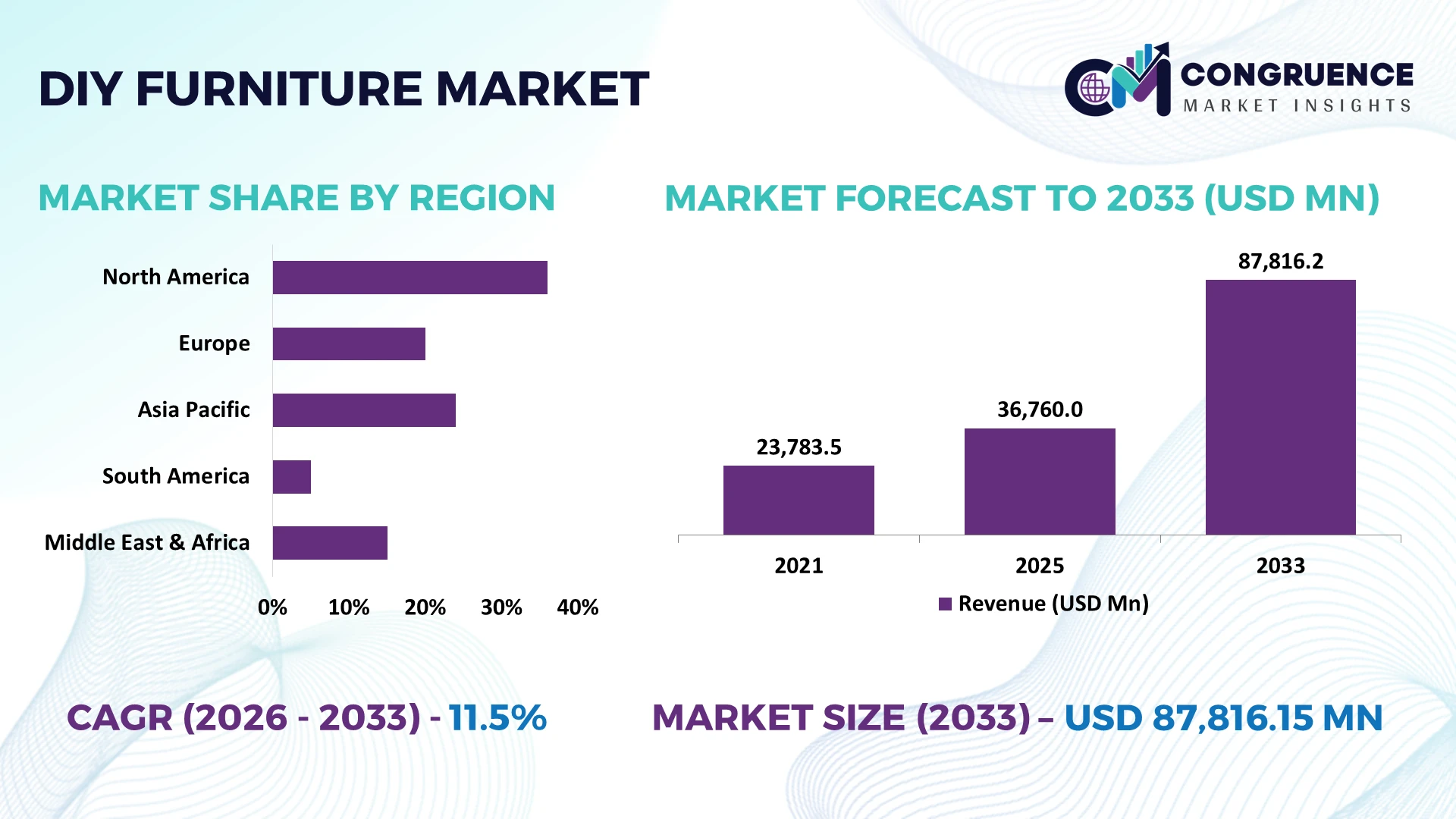
The United States remains the dominant market, accounting for approximately 31% of global demand, supported by high online furniture penetration, advanced logistics networks, and sustained residential renovation activity. More than 65% of furniture shoppers research products digitally before purchase, while Germany leads Europe through strong manufacturing capabilities and precision-engineered modular systems. Ongoing global supply-chain diversification following Red Sea shipping disruptions has accelerated regional sourcing and inventory optimization across leading manufacturers.
Strategic focus on localized production, digital customization, and resilient sourcing networks will strengthen competitive positioning across the global DIY furniture market.
Market Size & Growth: USD 36,760 Million (2025) to USD 87,816.15 Million (2033) at 11.5% CAGR, supported by AI-powered furniture visualization and expanding direct-to-consumer distribution.
Top Growth Drivers: Online furniture sales +18%, modular furniture adoption +24%, home renovation spending +12% accelerate global market expansion.
Short-Term Forecast: By 2028, automated packaging and optimized assembly processes reduce fulfillment costs by nearly 15% while improving order efficiency by approximately 20%.
Emerging Technologies: AI room planners, automated manufacturing, and lightweight engineered wood composites improve customization, production speed, and material utilization.
Regional Leaders: North America exceeds USD 28 Billion, Europe approaches USD 24 Billion, and Asia Pacific surpasses USD 22 Billion through digital retail expansion and localized production.
Consumer Trends: Around 58% of urban consumers prefer customizable DIY furniture with tool-free assembly and sustainable materials for faster home improvement projects.
Pilot Case: In 2026, AI-driven warehouse optimization improved order accuracy by approximately 22% while reducing delivery lead times by 16%.
Competitive Landscape: Leading brands collectively hold nearly 38% market share, with IKEA, Sauder, Bush Industries, HOMAG, and Inter IKEA driving innovation.
Regulatory & ESG Impact: Sustainable material adoption increased about 27% as manufacturers aligned with stricter circular economy and product traceability requirements.
Investment & Funding: More than USD 2.4 Billion supports manufacturing expansion, automation, regional sourcing, and digital commerce infrastructure amid global supply-chain realignment.
Innovation & Future Outlook: Smart modular systems, recyclable materials, and AI-driven product configuration strengthen next-generation manufacturing and customer-centric furniture ecosystems.
The DIY Furniture Market continues to advance through demand for modular home furnishing, digital customization platforms, and sustainable engineered materials. Nearly 45% of new product launches emphasize tool-free assembly and recyclable components, while manufacturers increasingly regionalize sourcing to improve operational resilience amid evolving global trade and logistics conditions. These developments establish a strong foundation for the strategic market assessment that follows.
The DIY Furniture Market has become strategically important as manufacturers, retailers, and material suppliers reshape operating models around digital commerce, localized production, and modular product design. Supply-chain restructuring following global shipping disruptions has accelerated nearshoring initiatives and inventory optimization, reducing dependence on long-distance sourcing while improving fulfillment reliability. Companies are increasingly integrating digital product configuration with omnichannel retail to strengthen customer engagement and shorten purchasing cycles.
AI-enabled room visualization and automated panel-cutting systems now deliver approximately 25% faster design-to-production workflows than conventional manual planning while reducing material waste by nearly 15%. The United States leads in digital retail integration and large-scale fulfillment infrastructure, whereas Germany differentiates through precision manufacturing and engineered modular furniture systems with higher automation intensity. Over the next two to three years, digital product customization is expected to exceed 60% of online DIY furniture transactions, supported by expanding smart manufacturing capabilities and localized distribution networks.
A practical example is the deployment of automated warehouse management combined with flat-pack packaging optimization, enabling faster order processing and lower transportation costs. Leading companies are expanding regional manufacturing, investing in digital design platforms, and forming logistics partnerships to improve operational resilience. Organizations that combine advanced manufacturing, agile sourcing, and customer-centric customization will secure stronger competitive positioning and long-term market relevance.
Digital product personalization and modular construction have become the primary structural drivers transforming the DIY furniture industry. Around 62% of consumers now evaluate furniture through online visualization tools before purchasing, while automated manufacturing improves production efficiency by nearly 20% and reduces material waste by approximately 14%. In the United States, manufacturers are expanding regional assembly operations to strengthen supply continuity following logistics disruptions affecting international freight. Companies are responding through investments in AI-powered design platforms, modular product portfolios, and localized production partnerships. A key strategic advantage lies in combining digital configuration with standardized manufacturing, enabling faster product launches while maintaining cost competitiveness across multiple customer segments.
Price fluctuations in engineered wood, metal hardware, and fastening components continue to pressure operational margins and procurement planning. Material costs have experienced periodic swings exceeding 18%, while container logistics expenses remain roughly 12% above pre-disruption benchmarks for several sourcing corridors. Manufacturers in Germany and other production hubs increasingly face procurement complexity for certified sustainable timber alongside stricter compliance requirements. These conditions reduce production flexibility and complicate inventory forecasting for high-volume product lines. To reduce operational exposure, companies are diversifying supplier networks, increasing regional sourcing, negotiating long-term procurement agreements, and incorporating alternative engineered materials that stabilize manufacturing costs without compromising product quality.
Advanced manufacturing technologies are creating significant opportunities beyond conventional furniture production. AI-driven production planning improves factory utilization by nearly 18%, while automated cutting systems reduce material scrap by approximately 15%. Japan and South Korea are accelerating adoption of intelligent manufacturing technologies integrated with digital product development and precision fabrication. Manufacturers are expanding R&D investments in recyclable composite materials, modular replacement components, and digital assembly ecosystems that extend product life cycles. An emerging strategic opportunity lies in subscription-based furniture upgrades supported by interchangeable modules, enabling recurring customer engagement while strengthening circular manufacturing practices and improving long-term operational efficiency.
Maintaining consistent product quality and customer experience across expanding international operations remains a complex execution challenge. Nearly 28% of customer service issues originate from assembly complexity, while product return rates for incorrectly assembled furniture remain close to 10% in several mature e-commerce markets. Manufacturers also face increasing pressure to integrate digital design platforms with production scheduling, warehouse management, and last-mile delivery systems without disrupting operations. Companies are addressing these challenges through standardized assembly engineering, digital instruction platforms, workforce training, and integrated enterprise software. Organizations that successfully synchronize manufacturing, logistics, and digital customer support will achieve stronger operational consistency and durable competitive differentiation.
AI-Driven Design Personalization AI-based room planning and product visualization have become standard across leading furniture retailers, with digital configuration usage exceeding 55% and customer engagement improving by nearly 30%. Following accelerated digital transformation, companies are integrating generative design platforms with e-commerce ecosystems, reducing design revisions by approximately 20% while expanding technology partnerships to improve purchasing accuracy and lower product returns.
Regionalized Manufacturing Networks Global supply-chain restructuring continues to shift production closer to end markets, with regional sourcing increasing by about 22% and average delivery times declining nearly 18%. Red Sea shipping disruptions and evolving trade policies have encouraged manufacturers in the United States and Poland to expand localized assembly operations, strengthen supplier diversification, and optimize inventory planning for greater operational resilience.
Sustainable Material Integration Manufacturers are accelerating adoption of recycled wood composites and certified timber, with sustainable material utilization rising approximately 27% and production waste declining by nearly 15%. Compliance with stricter environmental standards is reshaping procurement strategies, prompting companies to establish long-term supplier agreements, redesign packaging, and improve material traceability across manufacturing operations.
Automation Across Fulfillment Operations Automated warehouse systems and robotic packaging solutions now support nearly 40% of high-volume fulfillment facilities, improving order accuracy by around 24% while reducing processing time by 17%. Labor availability constraints are driving investment in intelligent logistics infrastructure, with manufacturers expanding automation partnerships to strengthen scalability, improve customer service performance, and stabilize operating costs.
Ready-to-Assemble (RTA) furniture leads the DIY Furniture Market with an estimated 39% market share, supported by lower transportation costs, standardized manufacturing, and efficient flat-pack logistics. Its compatibility with automated production and online retail channels enables faster inventory turnover and improved fulfillment performance. Modular furniture represents the fastest-growing segment as demand for adaptable living spaces and flexible interior layouts expands, with adoption increasing by approximately 20% across urban residential developments. Manufacturers are strengthening modular product portfolios through interchangeable components and digital configuration tools to address changing consumer requirements.
Flat-Pack products continue to support large-scale e-commerce distribution because of packaging efficiency, while Customizable furniture gains momentum through digital visualization and personalized design platforms. Foldable furniture remains strategically important for compact apartments and temporary workspaces, particularly in densely populated countries such as Japan. Companies are expanding production capacity, investing in modular engineering, and introducing recyclable materials to differentiate product offerings while improving manufacturing flexibility and supply-chain efficiency.
Living Room applications account for approximately 35% of total DIY furniture demand, reflecting high replacement frequency, greater product variety, and continuous home improvement activity. Consumers increasingly prioritize modular entertainment units, shelving systems, and multifunctional furniture, while digital planning tools have improved purchasing confidence by nearly 25%. Kitchen applications are the fastest-growing segment as compact housing and renovation projects accelerate demand for customizable storage systems and space-efficient furniture solutions. Manufacturers are expanding product compatibility with modular cabinetry and integrated storage concepts.
Bedroom furniture remains a mature category supported by wardrobe and storage optimization, while Office furniture continues expanding due to hybrid work adoption and ergonomic workstation upgrades. Outdoor furniture benefits from increasing residential landscaping investments and weather-resistant material innovations. Companies are strengthening production capabilities, optimizing digital merchandising, and developing multifunctional collections that improve assembly simplicity while addressing evolving residential and commercial usage patterns.
Households remain the dominant end-user group with an estimated 68% share, driven by residential renovation, first-home purchases, and expanding online furniture retail. Digital product customization and self-assembly solutions have increased household adoption by approximately 23%, encouraging manufacturers to broaden product ranges across multiple price points. Offices represent the fastest-growing end-user segment as organizations redesign workplaces with flexible layouts, collaborative furniture, and modular workstation systems that improve space utilization and operational adaptability.
Hospitality businesses continue investing in modular furniture to simplify refurbishment cycles and reduce installation downtime, while Educational Institutions increasingly adopt durable, configurable furniture for classrooms and collaborative learning environments. Companies are responding through enterprise partnerships, volume-based pricing strategies, and customizable commercial product lines tailored to institutional procurement requirements. These investments strengthen long-term customer relationships while expanding recurring business opportunities beyond traditional residential sales.
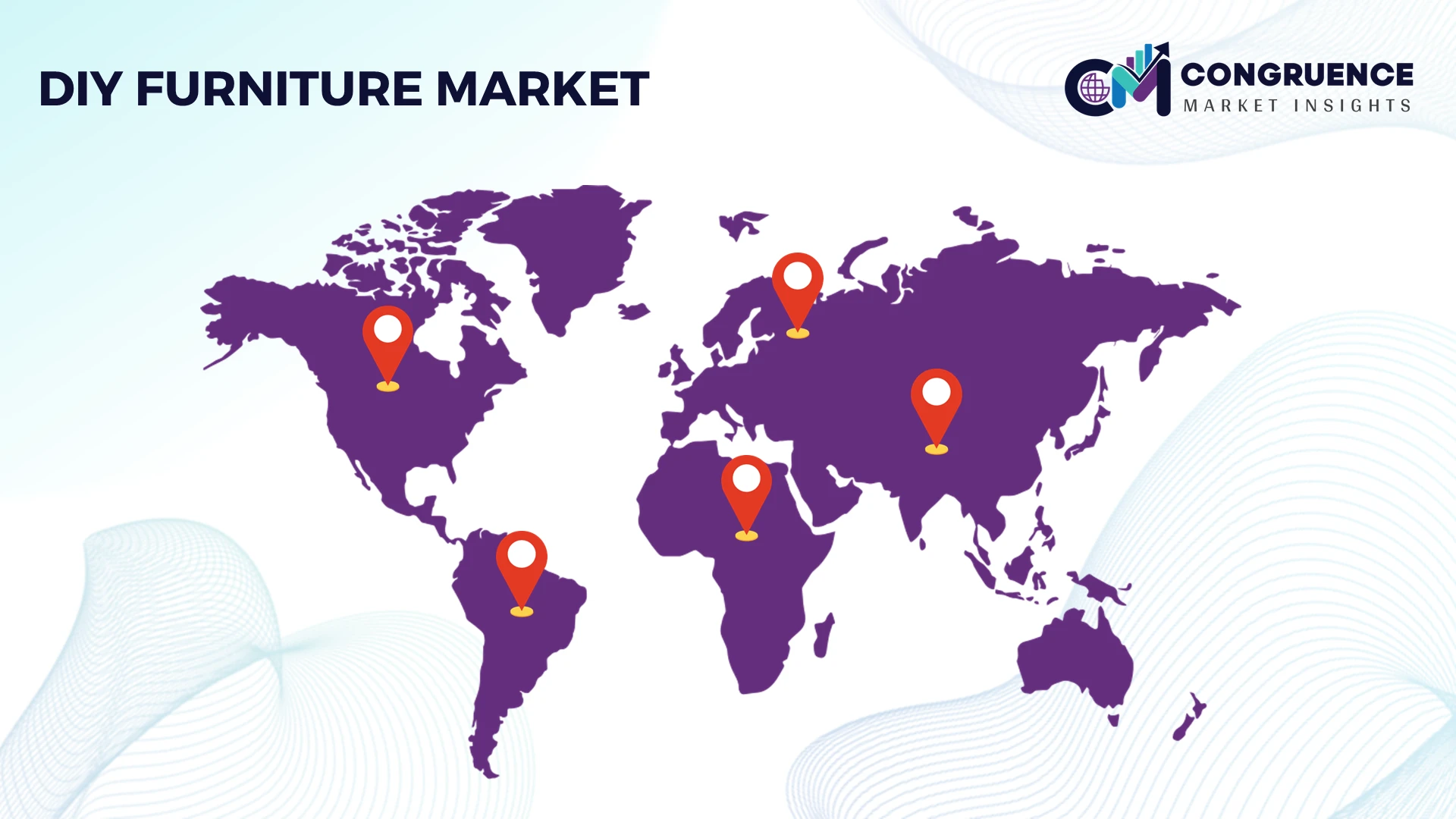
North America accounted for the largest market share at 34.8% in 2025 however, Asia-Pacific is expected to register the fastest growth, expanding at a 13.2% CAGR between 2026 and 2033.
Digital Retail and Localized Manufacturing Leadership
North America maintains the highest market concentration through mature e-commerce infrastructure, advanced furniture manufacturing, and widespread adoption of modular home improvement products. The region contributes approximately 35% of global DIY furniture deployment, supported by integrated fulfillment networks and strong residential remodeling activity. More than 60% of online furniture purchases now include digital visualization or configuration tools before ordering, improving purchasing accuracy and reducing return rates. Manufacturers continue expanding regional assembly operations and warehouse automation while strengthening supplier diversification to improve delivery performance and inventory resilience. Enterprise investment increasingly targets AI-enabled product planning, recyclable materials, and localized production to enhance operational flexibility and customer responsiveness.
United States Market Outlook: The United States leads the regional market through its large consumer base, sophisticated logistics infrastructure, and established home improvement ecosystem. Nearly 65% of furniture buyers begin their purchasing journey through digital channels, encouraging manufacturers to expand omnichannel distribution and AI-supported customization platforms. Companies continue investing in automated fulfillment centers, regional manufacturing, and modular product development to improve delivery speed, production flexibility, and long-term supply-chain resilience.
Sustainable Manufacturing and Modular Innovation
Europe remains a strategically important production and innovation hub, accounting for approximately 28% of global market activity through advanced furniture engineering and strong environmental compliance. Manufacturers increasingly integrate certified timber, recyclable materials, and modular product architecture into production, while automated manufacturing has improved factory efficiency by nearly 18%. Regulatory emphasis on circular economy principles continues influencing material sourcing, packaging optimization, and product lifecycle management. Companies are strengthening regional supplier partnerships and expanding precision manufacturing capabilities to improve operational consistency and reduce procurement risks.
Germany Market Outlook: Germany serves as Europe's manufacturing center for modular and ready-to-assemble furniture, supported by advanced automation, precision engineering, and established export capabilities. More than 40% of large furniture manufacturers have expanded investment in intelligent manufacturing technologies, improving production consistency and reducing material waste. Strong industrial collaboration and engineering expertise continue reinforcing Germany's competitive position across premium and mass-market DIY furniture segments.
Manufacturing Scale and Digital Expansion
Asia-Pacific represents the fastest-expanding regional market due to extensive manufacturing capacity, urban housing development, and accelerating digital commerce adoption. The region contributes approximately 42% of global furniture production, supported by integrated industrial clusters and efficient export infrastructure. Automated manufacturing deployment has increased by nearly 21% across leading production facilities, improving productivity and reducing processing times. Manufacturers are expanding smart factories, strengthening regional supplier ecosystems, and investing in localized distribution centers to support growing domestic and international demand while improving operational resilience.
China Market Outlook: China remains the region's manufacturing leader with comprehensive production ecosystems, integrated supply chains, and advanced export infrastructure. Approximately 45% of large furniture production facilities have implemented intelligent manufacturing technologies that improve throughput and production quality. Companies continue expanding automated panel processing, digital production management, and environmentally efficient manufacturing to strengthen competitiveness in both domestic and international DIY furniture markets.
Urban Housing Supports Market Expansion
South America is experiencing steady market development as residential construction, organized furniture retail, and digital commerce continue expanding. The region accounts for approximately 8% of global DIY furniture demand, with urban housing projects increasing deployment of modular residential furniture. Online furniture transactions have risen by nearly 19%, encouraging manufacturers to strengthen localized distribution and inventory planning. Infrastructure limitations and logistics costs remain operational constraints, prompting companies to establish regional partnerships, optimize warehouse networks, and increase domestic sourcing to improve delivery performance and cost efficiency.
Brazil Market Outlook: Brazil dominates the regional market through its extensive furniture manufacturing base, growing e-commerce sector, and expanding residential renovation activity. Around 55% of organized furniture retailers have strengthened digital sales capabilities and localized logistics operations to improve customer fulfillment. Manufacturers continue investing in modular product lines and regional production facilities that reduce transportation complexity while improving responsiveness to domestic demand.
Infrastructure Modernization and Retail Transformation
The Middle East & Africa market is benefiting from large-scale urban development, organized retail expansion, and modernization of logistics infrastructure. The region contributes approximately 6% of global market demand, while increasing residential developments and commercial projects stimulate adoption of modular furniture systems. Warehouse modernization and regional distribution investments have improved fulfillment efficiency by nearly 16%, supporting faster product availability. Companies are expanding partnerships with regional distributors, investing in localized assembly operations, and strengthening digital retail capabilities to support evolving consumer preferences and infrastructure-led demand.
Saudi Arabia Market Outlook: Saudi Arabia has emerged as the region's most strategically significant market through large residential development programs, retail modernization, and industrial diversification initiatives. More than 30% of major furniture distributors have expanded localized warehousing and assembly capabilities to support faster order fulfillment. Investment in smart logistics infrastructure and modern retail formats continues strengthening the country's position as a key regional hub for DIY furniture deployment.
The DIY Furniture Market is led by global brands including IKEA, Sauder Woodworking, Bush Industries, HOMAG Group, and Dorel Industries, competing directly against regional manufacturers specializing in low-cost production and rapid delivery. The top five players collectively control approximately 42% of the market, while regional firms differentiate through localized sourcing and shorter fulfillment cycles. Competition centers on digital customization, automated manufacturing, pricing efficiency, and resilient supply chains. AI-enabled design platforms improve order conversion by nearly 22%, while automated production reduces manufacturing costs by approximately 15% compared with conventional workflows. Companies are expanding regional assembly facilities, forming logistics partnerships, integrating sustainable materials, and vertically coordinating procurement to stabilize component availability. The competitive landscape is shifting toward technology-enabled differentiation rather than scale alone, with digital commerce and modular engineering reshaping customer expectations. High capital investment in automation, fulfillment infrastructure, and integrated supply networks creates a significant entry barrier. Winning requires agile manufacturing, advanced digital engagement, localized sourcing, and consistently reliable product delivery.
IKEA
Sauder Woodworking Co.
Bush Industries
Dorel Industries
HOMAG Group
Tvilum A/S
Prepac Manufacturing Ltd.
Whalen Furniture
Furinno
Walker Edison Furniture Company
Hettich Holding GmbH
Häfele GmbH & Co KG
Richelieu Hardware Ltd.
Hülsta-Werke Hüls GmbH & Co. KG
Artificial intelligence, digital product configuration, and advanced manufacturing platforms are redefining DIY furniture production and retail operations. More than 58% of leading manufacturers now deploy AI-supported product visualization or demand forecasting, improving inventory accuracy by approximately 20%. Cloud-connected design platforms enable real-time customization, reducing engineering revisions while accelerating product launch cycles. These technologies strengthen customer engagement and improve operational planning across manufacturing and distribution networks.
Emerging technologies include robotic panel processing, automated packaging, and digital twin production management. Compared with conventional manufacturing, intelligent production systems improve throughput by nearly 25% while reducing material waste by approximately 15%. Around 40% of high-volume manufacturing facilities have implemented automated material handling systems, enabling shorter production cycles and greater consistency. Global manufacturers with integrated digital factories gain measurable advantages over smaller competitors that continue relying on manual planning and fragmented workflows.
Between 2026 and 2028, modular digital ecosystems, AI-assisted furniture design, recyclable composite materials, and predictive supply-chain analytics will become core competitive differentiators. Manufacturers are integrating production software with logistics and customer platforms to improve responsiveness and operational visibility. Early adopters benefit from faster fulfillment, lower operating costs, and stronger customization capabilities, positioning them to secure premium customers, improve supply resilience, and respond rapidly to evolving consumer preferences and market conditions.
November 2025 IKEA launched its first Plan & Order Point in Bengaluru, India, introducing personalized home-planning services with access to more than 7,000 home furnishing products, strengthening omnichannel engagement and expanding localized customer reach.
May 2026 IKEA introduced the IKEA PS 2026 collection featuring 44 new multifunctional designs emphasizing playful functionality, flat-pack engineering, and material innovation, reinforcing its premium position in modular DIY furniture and next-generation product development. Source: (IKEA)
June 2026 IKEA established its fourth global product development center in India, expanding beyond sourcing into product engineering and innovation, positioning India as a strategic design hub supporting both domestic and international furniture portfolios.
July 2026 IKEA unveiled the KOMPISHÄNG collection with 13 portable furniture and home products designed for frequent movers, advancing modular, lightweight DIY living solutions while addressing changing urban mobility and rental housing lifestyles.
The report delivers a comprehensive assessment of the global DIY Furniture Market across product categories, end-use industries, competitive positioning, technology evolution, and regional deployment patterns between 2026 and 2033. It evaluates Ready-to-Assemble, Modular, Foldable, Customizable, and Flat-Pack furniture across Living Room, Bedroom, Kitchen, Office, and Outdoor applications while covering Households, Offices, Hospitality, and Educational Institutions. More than 40% of segment analysis focuses on operational adoption, product differentiation, and manufacturing competitiveness.
The study examines demand across North America, Europe, Asia-Pacific, South America, and the Middle East & Africa, highlighting digital furniture configuration, automation, smart manufacturing, and sustainable material integration. It analyzes deployment trends, enterprise strategies, competitive benchmarking, supply-chain transformation, and emerging niche opportunities, enabling stakeholders to evaluate investment priorities, expansion planning, technology adoption, product portfolio optimization, and long-term competitive positioning through detailed strategic and operational intelligence.
| Report Attribute/Metric | Report Details |
|---|---|
Market Revenue in 2025 | USD 36760 Million |
Market Revenue in 2033 | USD 87816.15 Million |
CAGR (2026 - 2033) | 11.5% |
Base Year | 2025 |
Forecast Period | 2026 - 2033 |
Historic Period | 2021 - 2025 |
Segments Covered | By Type
By Application
By End-User
|
Key Report Deliverable | Revenue Forecast, Growth Trends, Market Dynamics, Segmental Overview, Regional and Country-wise Analysis, Competition Landscape |
Region Covered | North America, Europe, Asia-Pacific, South America, Middle East, Africa |
Key Players Analyzed | IKEA, Sauder Woodworking Co., Bush Industries, Dorel Industries, HOMAG Group, Tvilum A/S, Prepac Manufacturing Ltd., Whalen Furniture, Furinno, Walker Edison Furniture Company, Hettich Holding GmbH, Häfele GmbH & Co KG, Richelieu Hardware Ltd., Hülsta-Werke Hüls GmbH & Co. KG |
Customization & Pricing | Available on Request (10% Customization is Free) |




