
Reports
The Global Distributed Antenna System (DAS) Market was valued at USD 4088.39 Million in 2025 and is anticipated to reach a value of USD 9421.86 Million by 2033 expanding at a CAGR of 11% between 2026 and 2033. Market expansion is being driven by accelerating 5G indoor coverage deployments, high-capacity enterprise connectivity requirements, and large-scale modernization of airports, hospitals, industrial facilities, and smart commercial infrastructure.
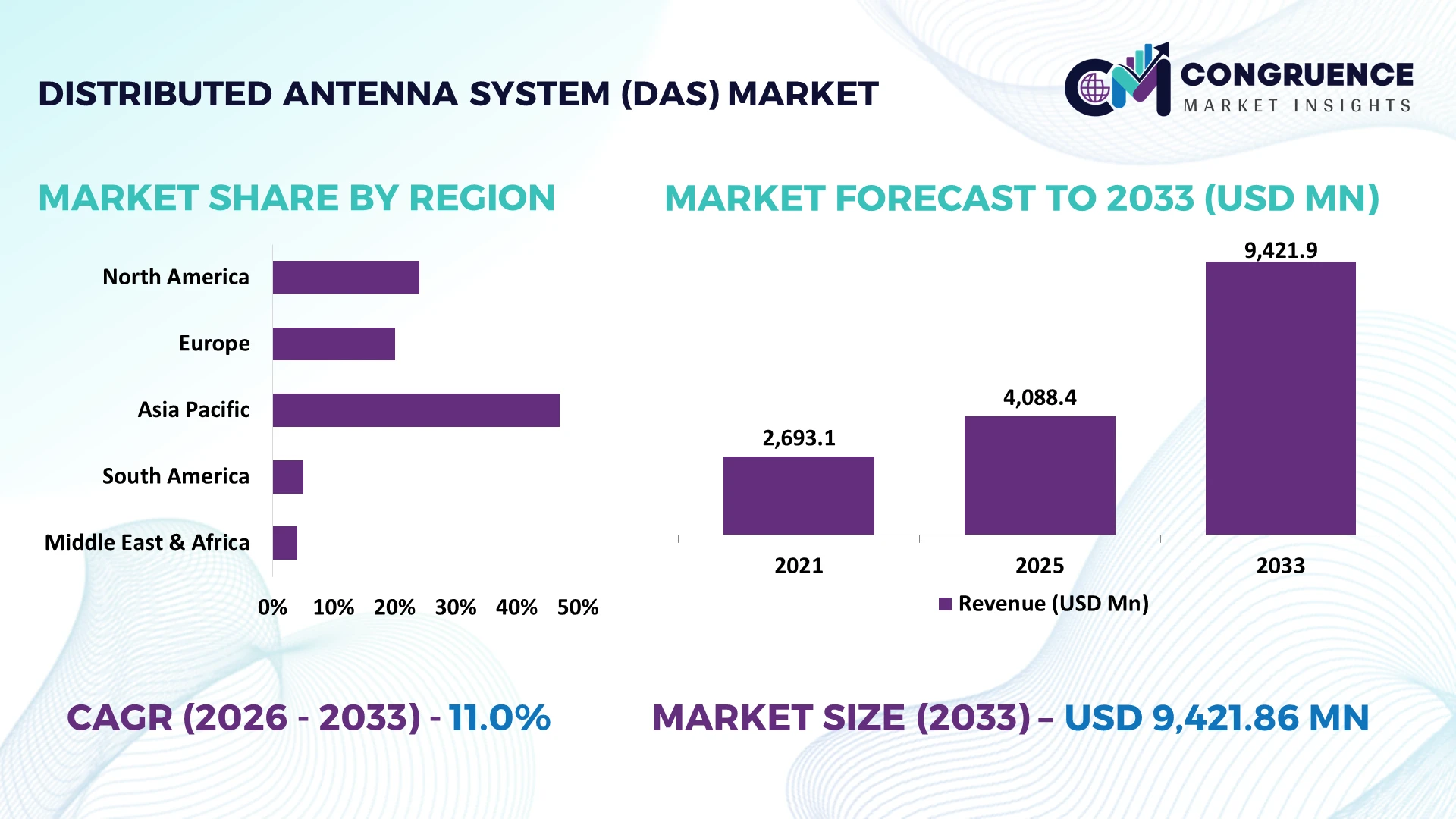
The United States remains the dominant country, accounting for approximately 34% of global DAS deployments, supported by multi-billion-dollar investments in 5G infrastructure across transportation, healthcare, manufacturing, and large public venues. More than 78% of newly developed premium commercial buildings integrate advanced in-building wireless systems, while China records faster deployment volumes through nationwide digital infrastructure programs and high-density industrial parks. Continued network resilience initiatives gained further importance following global telecom supply-chain diversification efforts in 2026.
Organizations investing in scalable DAS platforms with multi-operator compatibility and future-ready network architectures are positioned to strengthen long-term digital infrastructure competitiveness.
Market Size & Growth: USD 4,088.39 million in 2025 to USD 9,421.86 million by 2033 at 11% CAGR, driven by enterprise 5G indoor network expansion.
Top Growth Drivers: 5G deployment contributes 42%, smart buildings 31%, and industrial digitalization 27% to new installation momentum.
Short-Term Forecast: By 2028, deployment efficiency improves by 24% while installation timelines decline by nearly 18% through modular architectures.
Emerging Technologies: AI-based network optimization, Open RAN integration, and cloud-managed DAS increase operational efficiency by approximately 22%.
Regional Leaders: North America exceeds USD 3.2 billion, Asia-Pacific reaches USD 2.9 billion, and Europe surpasses USD 1.8 billion, supported by expanding indoor connectivity programs.
Consumer/End-User Trends: Over 71% of enterprise facility upgrades prioritize uninterrupted indoor mobile coverage for mission-critical operations.
Pilot/Case Example: A 2026 large transportation hub deployment improved indoor signal availability by 35% while reducing communication interruptions by 28%.
Competitive Landscape: Leading suppliers collectively control about 46% of the market, with competition centered on multi-operator and neutral-host solutions.
Regulatory & ESG Impact: Energy-efficient network designs reduce power consumption by nearly 20%, aligning with stricter digital infrastructure sustainability targets.
Investment & Funding: More than USD 5 billion in infrastructure investments support regional expansion, strategic partnerships, and localized manufacturing amid supply-chain diversification.
Innovation & Future Outlook: Software-defined DAS, edge intelligence, and private wireless convergence accelerate high-growth enterprise connectivity strategies across global industries.
The Distributed Antenna System (DAS) Market continues to gain momentum across transportation hubs, healthcare campuses, commercial real estate, manufacturing facilities, and smart venues requiring uninterrupted indoor wireless performance. AI-enabled network optimization, cloud-based monitoring, and neutral-host architectures improve operational efficiency by nearly 25%, while stricter digital infrastructure standards and diversified telecom supply chains accelerate modernization. These developments establish a strong foundation for the strategic market assessment that follows.
The Distributed Antenna System (DAS) Market has become strategically important as enterprises prioritize resilient indoor connectivity for digital operations, private wireless networks, and mission-critical communications. Infrastructure modernization across transportation, healthcare, manufacturing, and commercial real estate is accelerating investment decisions, while telecom supply-chain restructuring and stricter public-safety communication requirements are reshaping procurement priorities. Organizations increasingly evaluate DAS as a long-term infrastructure asset rather than a standalone connectivity upgrade.
Modern software-managed DAS platforms deliver approximately 25% higher spectrum utilization and reduce maintenance requirements by nearly 18% compared with conventional passive architectures, improving operational efficiency in high-density environments. The United States leads large-scale enterprise deployments through mature neutral-host ecosystems, whereas South Korea advances innovation with dense 5G indoor infrastructure supporting smart factories and digital campuses. During the next two to three years, more than 60% of newly constructed premium commercial facilities are expected to integrate converged wireless infrastructure during initial building design, reducing retrofit complexity and lifecycle costs.
Large airport modernization projects illustrate how integrated DAS platforms enhance uninterrupted connectivity for passengers, emergency responders, and operational teams through centralized network management. Equipment vendors are expanding technology partnerships, strengthening local integration capabilities, and increasing software investment to deliver scalable multi-operator solutions. Companies establishing interoperable, upgrade-ready infrastructure today will secure stronger competitive positioning as enterprise wireless ecosystems become increasingly software-defined.
Enterprise digital transformation is accelerating demand for advanced DAS deployments as organizations require uninterrupted indoor connectivity across mission-critical facilities. Around 72% of large enterprise campuses now prioritize dedicated in-building wireless upgrades, while integrated 5G architectures improve network capacity by nearly 30% in high-density environments. Public-safety communication regulations in the United States and large infrastructure modernization programs are further strengthening deployment activity across airports, hospitals, and industrial complexes. This structural shift increases demand for neutral-host and multi-operator platforms, prompting technology providers to expand system integration partnerships, invest in intelligent network management software, and localize technical support. Companies delivering scalable, standards-based solutions gain stronger positioning in complex enterprise infrastructure projects.
High implementation costs and integration complexity continue to limit deployment across existing commercial properties and legacy facilities. Retrofitting mature buildings can increase project costs by approximately 20%, while interoperability challenges account for nearly 15% of deployment delays where multiple network technologies coexist. Component sourcing remains sensitive to global semiconductor availability and specialized RF equipment supply, affecting installation schedules in several developed markets. These constraints reduce deployment scalability and extend customer decision cycles for large infrastructure projects. To mitigate operational risks, leading vendors are diversifying component suppliers, expanding localized manufacturing partnerships, and offering modular deployment models that simplify upgrades without requiring complete infrastructure replacement.
AI-driven network optimization and neutral-host infrastructure create significant opportunities beyond traditional commercial buildings. Intelligent traffic management improves spectrum efficiency by approximately 22%, while predictive maintenance reduces network downtime by nearly 18%. Japan and Singapore are expanding smart infrastructure policies supporting integrated wireless systems across transportation hubs, healthcare campuses, and mixed-use developments. Equipment manufacturers are strengthening R&D investments in cloud-managed DAS, Open RAN compatibility, and edge computing integration to improve operational flexibility. A notable strategic opportunity lies in converged private wireless ecosystems, where enterprises deploy a single infrastructure supporting multiple operators and business applications, reducing long-term ownership costs while enhancing network resilience.
Maintaining consistent performance across expanding multi-operator wireless environments remains a major execution challenge. More than 40% of large deployments require integration with existing IT, security, and building management platforms, increasing engineering complexity. Cybersecurity requirements for connected infrastructure have intensified, with software-managed network environments requiring frequent updates and continuous monitoring to protect operational continuity. Skilled RF engineering shortages in several developed economies also lengthen commissioning timelines by approximately 15%. Companies must address these challenges through workforce development, automated network management tools, cybersecurity investment, and strategic partnerships with system integrators capable of delivering standardized deployment methodologies across complex enterprise environments.
Active DAS remains the leading segment, accounting for approximately 43% of total deployments because of its superior scalability, signal quality, and ability to support high-density environments across airports, hospitals, stadiums, and enterprise campuses. Its centralized architecture enables efficient multi-operator integration while reducing signal degradation over extended coverage areas. Passive DAS continues to retain strong demand in smaller commercial buildings where installation simplicity and lower infrastructure costs remain attractive. Hybrid DAS solutions are gaining wider acceptance by combining the cost efficiency of passive systems with the operational flexibility of active architectures.
Digital DAS represents the fastest-growing segment as enterprises transition toward software-controlled network environments supporting private wireless, 5G, and cloud-managed operations. Adoption has increased by nearly 29% in newly developed smart buildings, while hybrid deployments have expanded by approximately 18% across industrial facilities requiring phased modernization. Technology providers are prioritizing digital product development, expanding system integration partnerships, and investing in programmable network platforms. These shifts indicate growing investment preference toward flexible, upgrade-ready architectures capable of supporting evolving enterprise connectivity requirements.
Indoor Coverage remains the dominant application, representing approximately 48% of total demand as enterprises seek uninterrupted connectivity across offices, hospitals, retail complexes, and educational campuses. Reliable indoor wireless performance has become operationally essential for digital workflows, cloud applications, and real-time communications. Public Safety applications continue expanding through stricter emergency communication compliance requirements, while Transportation deployments support increasingly connected airports, railway stations, and urban transit facilities.
Industrial Facilities represent the fastest-growing application segment as smart manufacturing and private wireless deployments accelerate. Industrial DAS adoption has increased by approximately 26%, while connected facility investments have improved wireless operational efficiency by nearly 21%. Transportation infrastructure continues integrating multi-operator systems to improve passenger experience and operational coordination. Vendors are expanding deployment partnerships with infrastructure developers, integrating AI-enabled monitoring capabilities, and standardizing modular deployment processes. Investment priorities increasingly favor environments where uninterrupted wireless connectivity directly influences operational continuity, automation performance, and workforce productivity.
Telecommunications remains the largest end-user segment, accounting for approximately 39% of deployments as mobile operators continue expanding indoor network quality, spectrum efficiency, and subscriber experience. Large-scale infrastructure modernization and multi-operator network strategies sustain investment across commercial buildings and public venues. Commercial Buildings continue representing a mature demand base, while Government organizations strengthen deployments supporting emergency communications and secure public infrastructure.
Healthcare is the fastest-growing end-user segment as hospitals expand connected medical devices, digital patient services, and mission-critical communications. Healthcare deployments have increased by nearly 24%, while integrated wireless infrastructure improves operational coordination by approximately 20%. Transportation operators continue investing in resilient passenger connectivity, and commercial property owners increasingly differentiate premium assets through advanced wireless infrastructure. Equipment manufacturers are introducing sector-specific deployment models, strengthening channel partnerships, and offering flexible lifecycle support programs. Competitive positioning increasingly depends on customized solutions aligned with operational requirements rather than standardized infrastructure offerings.
North America accounted for the largest market share at 38% in 2025 however, Asia-Pacific is expected to register the fastest growth, expanding at a 13.2% between 2026 and 2033.
Enterprise 5G Infrastructure Drives Market Leadership
North America maintains the strongest position in the Distributed Antenna System (DAS) Market through extensive enterprise digital infrastructure, large-scale 5G deployment, and stringent public safety communication requirements. The region contributes approximately 38% of global demand, supported by high deployment concentration across airports, healthcare facilities, stadiums, manufacturing campuses, and commercial buildings. More than 70% of newly constructed premium office developments incorporate advanced indoor wireless infrastructure during project planning. Neutral-host deployment models continue expanding as enterprises seek cost-efficient multi-operator connectivity. Strategic partnerships between telecom operators, infrastructure providers, and system integrators are accelerating deployment timelines while improving network scalability. Software-managed DAS platforms and AI-driven optimization are becoming standard features across mission-critical environments, enabling stronger operational resilience and lower lifecycle maintenance requirements.
United States Market Outlook: The United States leads regional deployment through nationwide 5G expansion, advanced commercial real estate development, and large enterprise modernization programs. Nearly 78% of premium commercial buildings in major metropolitan areas integrate advanced indoor wireless infrastructure. Public safety regulations, smart airport projects, and industrial digitalization continue driving demand, while technology providers expand local engineering capabilities, neutral-host partnerships, and cloud-managed DAS platforms to strengthen long-term enterprise connectivity.
Smart Infrastructure Modernization Reshapes Deployment Strategy
Europe continues strengthening its position through smart infrastructure modernization, sustainable building upgrades, and expanding enterprise digitalization initiatives. The region represents approximately 27% of global deployments, with increasing integration of DAS into transportation hubs, healthcare facilities, commercial complexes, and industrial campuses. More than 58% of new smart-building projects incorporate converged indoor connectivity planning during design stages. Regulatory emphasis on reliable emergency communication and energy-efficient infrastructure encourages investment in software-managed, multi-operator wireless systems. Vendors increasingly focus on interoperable platforms that simplify integration with intelligent building management systems while reducing operational complexity through centralized monitoring and predictive maintenance.
Germany Market Outlook: Germany remains the region's strategic leader because of its industrial automation strength, advanced manufacturing ecosystem, and extensive smart factory investments. Enterprise wireless deployments across automotive production facilities and logistics hubs continue expanding, with industrial digitalization initiatives increasing indoor network modernization by approximately 24%. Technology providers are strengthening engineering partnerships and localized deployment capabilities to support long-term industrial connectivity requirements.
Large-Scale Digital Infrastructure Accelerates Adoption
Asia-Pacific is the fastest-expanding market due to extensive urban infrastructure development, large-scale commercial construction, and accelerated 5G deployment. The region accounts for approximately 31% of global installations, supported by widespread enterprise connectivity projects across manufacturing, transportation, healthcare, and mixed-use developments. Smart city investments and industrial modernization programs continue increasing indoor wireless deployment intensity, while deployment activity across newly developed business districts has grown by nearly 30%. Equipment manufacturers are expanding production capacity, strengthening regional supply chains, and investing in programmable DAS platforms supporting multi-operator and private wireless environments.
China Market Outlook: China dominates regional deployment through extensive telecommunications infrastructure, large industrial parks, and continuous smart city development. More than 65% of newly constructed high-density commercial complexes integrate advanced indoor wireless systems during construction. Domestic manufacturers continue expanding production capacity and software capabilities while strengthening ecosystem partnerships supporting enterprise digital transformation and high-capacity wireless infrastructure.
Commercial Connectivity Investments Strengthen Demand
South America continues expanding DAS deployment through improving telecommunications infrastructure and increasing enterprise connectivity investments. The region contributes approximately 7% of global installations, with demand concentrated in commercial buildings, transportation facilities, healthcare institutions, and sports venues. Indoor wireless modernization projects have increased by nearly 19% across major metropolitan areas, reflecting stronger enterprise digital adoption. Infrastructure execution remains uneven because of investment constraints and varying regulatory frameworks, encouraging phased deployment strategies. System integrators increasingly collaborate with telecom operators to deliver modular, cost-efficient DAS implementations that balance performance with capital expenditure requirements.
Brazil Market Outlook: Brazil leads regional demand through expanding mobile infrastructure, large commercial developments, and modernization of airports and urban transportation systems. Enterprise wireless projects continue accelerating across financial districts and healthcare facilities, with indoor connectivity upgrades increasing by approximately 22%. Technology vendors are expanding local partnerships and technical service capabilities to improve deployment efficiency and support large multi-site enterprise projects.
Smart City Investments Expand Indoor Connectivity
The Middle East & Africa market is benefiting from large-scale smart city initiatives, digital infrastructure modernization, and premium commercial development. The region represents approximately 6% of global deployment activity, with increasing adoption across airports, hospitality complexes, government facilities, and healthcare infrastructure. More than 25% of recently announced mixed-use developments include integrated indoor wireless planning from initial construction stages. High-profile infrastructure investments and digital transformation programs continue supporting advanced multi-operator deployments. Vendors are expanding regional partnerships, strengthening technical support networks, and introducing scalable solutions tailored to rapidly developing urban infrastructure.
Saudi Arabia Market Outlook: Saudi Arabia leads regional investment through ambitious digital transformation programs, smart city developments, and advanced telecommunications infrastructure expansion. Large commercial projects increasingly integrate enterprise-grade indoor wireless systems, while deployment activity across transportation and hospitality facilities has expanded by approximately 27%. Technology providers continue establishing strategic partnerships and localized implementation capabilities to support complex infrastructure modernization initiatives.
The market is led by CommScope, Corning Incorporated, SOLiD, Comba Telecom, and Huawei, competing directly with specialized DAS integrators and regional infrastructure providers. The top five players collectively control approximately 52% of the market through advanced RF technologies, broad product portfolios, and global deployment capabilities. Competition centers on software-defined architectures, neutral-host platforms, deployment speed, and lifecycle support rather than price alone. AI-enabled network management improves operational efficiency by nearly 20%, while modular deployment reduces installation time by approximately 18%, creating measurable competitive differentiation. Leading companies are expanding through strategic partnerships with telecom operators, system integrators, and commercial real estate developers while strengthening localized manufacturing and technical support. Market dynamics increasingly favor vendors offering interoperable, cloud-managed platforms over standalone hardware suppliers. High certification requirements, complex RF engineering, and enterprise integration expertise create significant entry barriers. Sustained success depends on scalable technology, multi-operator compatibility, rapid implementation, and long-term service excellence.
CommScope
Corning Incorporated
SOLiD Inc.
Comba Telecom Systems Holdings Ltd.
Huawei Technologies Co., Ltd.
Ericsson
Nokia
Zinwave
Advanced RF Technologies (ADRF)
PBE Group
JMA Wireless
Boingo Wireless
Westell Technologies
Dali Wireless
Active Digital DAS, fiber-based fronthaul, and centralized network management remain the dominant technologies supporting enterprise indoor connectivity. Around 68% of new large-scale deployments now incorporate digital DAS architectures because they improve signal quality by approximately 26% while reducing maintenance effort by nearly 18%. AI-assisted network monitoring is increasingly integrated with building management systems, enabling automated fault detection and traffic balancing. Compared with legacy passive-only systems, software-managed digital platforms shorten configuration time by roughly 30%, giving operators greater flexibility across multi-operator and high-density environments.
Emerging technologies are reshaping deployment strategies through Open RAN compatibility, edge computing, cloud-native orchestration, and neutral-host architectures. More than 42% of enterprise infrastructure projects now evaluate Open RAN-ready DAS to simplify interoperability and accelerate future upgrades. AI-powered spectrum optimization improves network utilization by nearly 21%, while predictive maintenance lowers operational disruptions by approximately 17%. Equipment manufacturers are expanding partnerships with cloud providers and system integrators to deliver programmable wireless infrastructure that supports private 5G, industrial automation, and smart-building ecosystems through a single converged platform.
Between 2026 and 2028, intelligent DAS platforms integrated with AI-driven automation, digital twins, and software-defined networking will become the primary competitive differentiator. Early adopters are expected to reduce lifecycle operating costs by approximately 20% while improving deployment scalability by nearly 25%. Vendors investing in cloud-native architectures, cybersecurity integration, and multi-operator interoperability will outperform hardware-focused competitors, making technology modernization an immediate strategic priority rather than a future infrastructure upgrade.
March 2025 Comba Telecom introduced its ComFlex MAX OPEN DAS platform with Open RAN interoperability and DAS slicing, supporting multi-band 3G, 4G, and 5G connectivity through a scalable architecture that strengthens enterprise deployment flexibility and multi-vendor integration. Source: https://www.comba-ctnsl.com
July 2024 CommScope announced the sale of its Outdoor Wireless Networks and Distributed Antenna Systems business to Amphenol in a transaction valued at approximately USD 2.1 billion, sharpening strategic focus while reshaping competition across wireless infrastructure markets. Source: https://ir.commscope.com
August 2024 Corning partnered with a major U.S. telecom operator to deploy fiber-deep Distributed Antenna System architecture across multiple airport terminals, improving high-density 5G performance and operational reliability for large transportation environments.
October 2024 SOLiD expanded its public safety DAS portfolio by launching a FirstNet-certified Fiber Remote Unit that enhances uplink coverage for hospitals, stadiums, and government facilities, strengthening mission-critical communications and enterprise public safety deployments.
This report provides a comprehensive assessment of the Distributed Antenna System (DAS) Market across Active DAS, Passive DAS, Hybrid DAS, and Digital DAS while evaluating deployment trends in Indoor Coverage, Public Safety, Transportation, and Industrial Facilities. It examines demand across Telecommunications, Healthcare, Commercial Buildings, Government, and Transportation, with regional coverage spanning North America, Europe, Asia-Pacific, South America, and the Middle East & Africa. More than 50% of the analysis emphasizes enterprise deployment strategies, technology adoption, and infrastructure modernization.
The study evaluates competitive positioning, deployment patterns, technology integration, and operational developments expected to influence the market between 2026 and 2033. It covers AI-enabled network management, Open RAN compatibility, cloud-managed architectures, and neutral-host deployment models while assessing adoption intensity, investment priorities, and evolving enterprise requirements. Strategic insights support expansion planning, product positioning, partnership evaluation, risk assessment, and long-term infrastructure investment decisions across both established and emerging deployment environments.
| Report Attribute/Metric | Report Details |
|---|---|
Market Revenue in 2025 | USD 4088.39 Million |
Market Revenue in 2033 | USD 9421.86 Million |
CAGR (2026 - 2033) | 11% |
Base Year | 2025 |
Forecast Period | 2026 - 2033 |
Historic Period | 2021 - 2025 |
Segments Covered | By Type
By Application
By End-User
|
Key Report Deliverable | Revenue Forecast, Growth Trends, Market Dynamics, Segmental Overview, Regional and Country-wise Analysis, Competition Landscape |
Region Covered | North America, Europe, Asia-Pacific, South America, Middle East, Africa |
Key Players Analyzed | CommScope, Corning Incorporated, SOLiD Inc., Comba Telecom Systems Holdings Ltd., Huawei Technologies Co., Ltd., Ericsson, Nokia, Zinwave, Advanced RF Technologies (ADRF), PBE Group, JMA Wireless, Boingo Wireless, Westell Technologies, Dali Wireless |
Customization & Pricing | Available on Request (10% Customization is Free) |




