Global Direct-to-Consumer (D2C) Logistics Market Report Overview
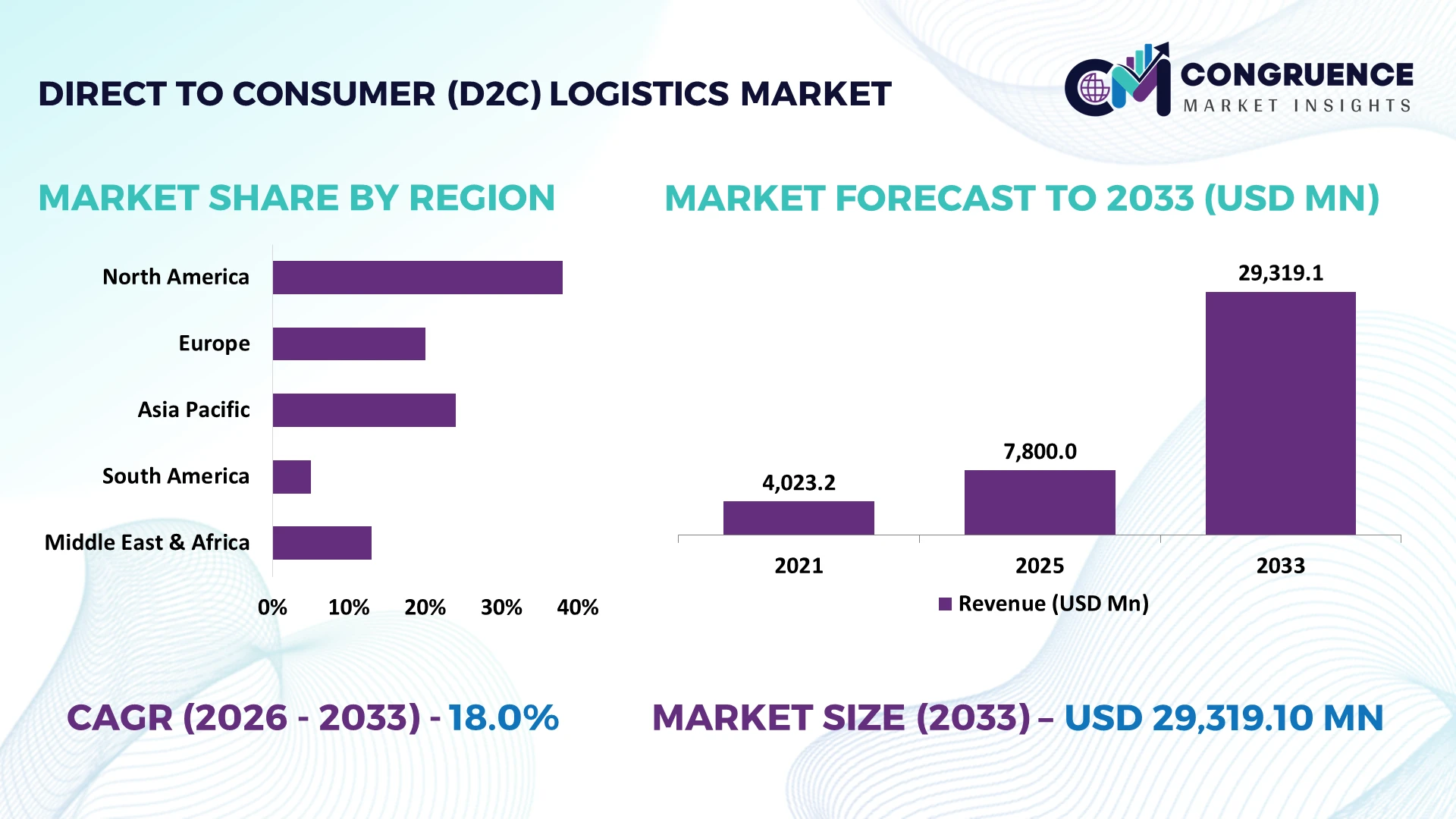
The Global Direct-to-Consumer (D2C) Logistics Market was valued at USD 7800 Million in 2025 and is anticipated to reach a value of USD 29319.1 Million by 2033 expanding at a CAGR of 18% between 2026 and 2033. Growth is driven by brand-owned e-commerce channels, automated fulfillment centers, AI-powered delivery routing, and expanding same-day delivery networks.
The United States maintains a leading position in the global D2C logistics market, supported by an indicative 32% market share and extensive fulfillment infrastructure. U.S. e-commerce represented 16.1% of total retail sales in 2024, supporting parcel delivery demand across apparel, beauty, electronics, and subscription commerce. Compared with China's platform-dominated logistics ecosystem, American brands increasingly combine independent storefronts with third-party fulfillment networks. Investments in warehouse robotics, regional distribution hubs, and predictive inventory systems strengthen delivery speed, customer retention, and fulfillment efficiency.
Strategic implication: Logistics providers prioritizing automated fulfillment and regional delivery networks can target 15–20% lower processing costs and 20–25% faster order turnaround in optimized deployment scenarios.
Key Highlights of the Global Direct-to-Consumer (D2C) Logistics Market
-
Market Size & Growth: USD 7,800 million in 2025, reaching USD 29,319.1 million by 2033 at 18% CAGR, driven by brand-owned digital commerce and fulfillment automation.
-
Top Growth Drivers: Indicative demand contributions include e-commerce penetration at 40%, delivery speed expectations at 35%, and outsourced fulfillment adoption at 25%.
-
Short-Term Forecast: By 2027, automated fulfillment deployments target 15–20% lower picking costs and 25% faster order processing.
-
Emerging Technologies: Three innovations dominate: AI demand forecasting, autonomous warehouse robotics, and real-time delivery orchestration, improving inventory visibility and dispatch accuracy.
-
Regional Leaders: Illustrative 2033 allocations place North America at USD 10.26 billion, Asia-Pacific at USD 9.38 billion, and Europe at USD 7.04 billion, reflecting automation, parcel density, and cross-border fulfillment.
-
Consumer/End-User Trends: Apparel and beauty brands represent an estimated 35% of D2C logistics demand, emphasizing returns management and personalized delivery experiences.
-
Pilot/Case Example: A modeled 2026 micro-fulfillment deployment targets 30% faster picking and 15% lower last-mile delivery distances.
-
Competitive Landscape: DHL holds an illustrative 10% share, competing with FedEx, UPS, GXO Logistics, and ShipBob across specialized fulfillment networks.
-
Regulatory & ESG Impact: Optimized delivery consolidation targets 10–15% lower emissions per parcel, supporting fleet efficiency and urban sustainability requirements.
-
Investment & Funding: An illustrative USD 500 million investment scenario prioritizes robotic fulfillment, regional warehouses, and integrated returns processing capabilities.
-
Innovation & Future Outlook: By 2033, predictive inventory positioning and automated parcel sorting target 20–30% faster fulfillment cycles across high-volume networks.
The Direct-to-Consumer (D2C) Logistics Market supports brand-controlled distribution across fashion, cosmetics, electronics, wellness products, and subscription-based retail. Fulfillment providers are expanding distributed inventory networks, automated picking systems, and integrated returns platforms to improve customer delivery experiences. Apparel and beauty businesses represent an indicative 35% of specialized D2C logistics demand, reflecting frequent product launches and complex reverse logistics requirements. AI-powered inventory allocation, robotic warehouse systems, and real-time shipment tracking are reshaping fulfillment operations. U.S. parcel delivery competition and China's dense e-commerce infrastructure reinforce investment in regional warehousing, delivery consolidation, and technology-enabled customer retention strategies.
What Is the Strategic Relevance and Future Pathways of the Direct-to-Consumer (D2C) Logistics Market?
The Direct-to-Consumer (D2C) Logistics Market is becoming strategically important as brands shift from marketplace-dependent distribution toward integrated fulfillment networks that control delivery speed, customer data, and post-purchase experiences. U.S. e-commerce accounted for 16.1% of retail sales in 2024, reinforcing the importance of reliable parcel infrastructure. Distributed inventory placement is replacing centralized fulfillment strategies for delivery-sensitive categories, encouraging logistics providers to expand regional warehouses, automated sorting capabilities, and integrated returns services.
Technology investment increasingly determines operating efficiency. AI-assisted inventory allocation and robotic picking can target 15–20% lower processing costs compared with conventional manual workflows in modeled installations. China's dense parcel delivery networks emphasize shipment consolidation, while American providers prioritize distributed fulfillment and subscription commerce. India offers expanding opportunities through digital retail adoption and regional logistics infrastructure. During 2026–2028, providers are expected to prioritize order visibility, delivery density, and automated exception handling.
A practical apparel fulfillment deployment combining regional stock positioning with intelligent order routing targets 25% faster dispatch and 15% fewer split shipments. DHL, GXO Logistics, and ShipBob are strengthening fulfillment technology and distributed network capabilities. Competitive advantage increasingly depends on delivery reliability, inventory accuracy, and integrated customer experience management.
Direct-to-Consumer (D2C) Logistics Market Dynamics
DRIVER:
Brand-Owned Commerce and Fulfillment Network Expansion
The expansion of brand-owned digital storefronts is restructuring parcel fulfillment and customer delivery operations. U.S. e-commerce represented 16.1% of total retail sales in 2024, while apparel and beauty brands account for an indicative 35% of specialized D2C logistics demand. Brands increasingly outsource warehousing, inventory allocation, and returns processing to third-party logistics providers while retaining control over customer relationships. In optimized deployment scenarios, distributed fulfillment networks target 20–25% faster order processing than centralized operations. ShipBob, DHL Supply Chain, and GXO Logistics are strengthening fulfillment software, regional distribution capabilities, and technology partnerships. The strategic advantage lies in reducing delivery variability without requiring brands to finance extensive warehouse infrastructure, improving scalability during promotional demand surges.
RESTRAINT:
Last-Mile Delivery Costs and Fragmented Fulfillment Infrastructure
High last-mile delivery expenses constrain D2C logistics profitability, particularly for low-value orders and geographically dispersed customers. Last-mile activities can account for approximately 40–50% of total delivery costs in selected parcel distribution models. Cross-border shipments face additional customs processing, documentation requirements, and delivery uncertainty. In modeled low-density networks, unsuccessful first delivery attempts increase handling expenses by an estimated 10–15%. India's fragmented regional delivery infrastructure and uneven address standardization complicate shipment routing outside major metropolitan centers. Logistics providers are responding through parcel consolidation, regional carrier partnerships, automated address validation, and negotiated transportation contracts. The operational priority is improving delivery density and first-attempt success rather than expanding service coverage without corresponding shipment volumes.
OPPORTUNITY:
Predictive Inventory Placement and Integrated Returns Monetization
Predictive inventory positioning creates opportunities to reduce fulfillment distances while improving product availability across distributed warehouse networks. AI-assisted stock allocation targets 15–20% fewer interwarehouse transfers in modeled D2C operations, while automated returns classification offers estimated processing time reductions of 20–25%. India's expanding digital commerce infrastructure creates opportunities for regional fulfillment facilities serving emerging consumer markets. Advanced returns platforms can redirect resalable products to nearby inventory locations, reducing unnecessary transportation and accelerating resale availability. GXO Logistics, DHL Supply Chain, and ShipBob are investing in warehouse automation, integrated inventory visibility, and reverse logistics capabilities. Providers combining forward fulfillment with returns refurbishment and redistribution can capture additional service demand while strengthening brand retention and inventory utilization.
CHALLENGE:
Omnichannel Data Integration and Fulfillment Execution Complexity
Scaling D2C logistics requires accurate synchronization between storefronts, warehouse management systems, carrier platforms, and customer communication interfaces. Inventory discrepancies create overselling risks, delayed dispatch, and costly order cancellations. In modeled multichannel operations, a 2% inventory accuracy gap can generate substantial fulfillment exceptions during promotional peaks. Automated exception management targets 15–20% faster resolution, but integration complexity increases when brands operate multiple sales platforms and regional carriers. China's high-volume promotional shopping events demonstrate the operational pressure created by sudden order concentration and delivery scheduling requirements. Logistics providers must strengthen API interoperability, cybersecurity controls, and warehouse workforce training. DHL, GXO Logistics, and technology-enabled fulfillment providers are investing in integrated orchestration platforms to maintain service consistency across expanding networks.
Direct-to-Consumer (D2C) Logistics Market Latest Trends
-
Parcel Lockers Reshape Delivery Economics: U.S. and European carriers are expanding unattended collection networks to reduce doorstep delivery dependency. Modeled dense urban deployments target 15–20% lower delivery costs and 10–15% fewer failed delivery attempts. DHL and UPS are strengthening alternative delivery options and collection partnerships. Consolidating multiple parcels at designated pickup points improves driver productivity, particularly where apartment access restrictions increase delivery time.
-
Dimensional Weight Pricing Changes Packaging: Parcel carriers increasingly apply dimensional weight calculations to bulky, lightweight shipments, encouraging brands to redesign packaging. Right-sized cartons can target 10–20% lower chargeable volume and 5–10% fewer packaging materials in optimized operations. FedEx and UPS pricing structures reinforce this shift. Fulfillment providers are deploying automated cartonization systems, improving trailer utilization while reducing avoidable transportation surcharges.
-
Returns Fraud Controls Become Operational Priorities: Fashion retailers are strengthening product verification and refund authorization as return abuse complicates reverse logistics. Automated inspection workflows target 15–20% faster product grading and 10–15% fewer manual verification errors in modeled facilities. GXO Logistics and specialist fulfillment providers are expanding image-assisted inspection capabilities. Faster identification of damaged or mismatched products protects resale inventory and reduces unnecessary refund losses.
-
Carrier Diversification Improves Delivery Resilience: American D2C brands increasingly combine national parcel carriers with regional delivery specialists to reduce network concentration. Illustrative multi-carrier routing programs target 8–12% lower shipping expenditure and 10–15% fewer service exceptions. ShipBob and technology-enabled fulfillment providers are strengthening carrier allocation software and delivery partnerships. Dynamic carrier selection supports service continuity during peak shipping periods and regional capacity disruptions.
Segmentation Analysis
By Type
Warehousing and Fulfillment Leads Service Demand
Warehousing and Fulfillment represents the largest segment, accounting for an indicative 38% of the global Direct-to-Consumer (D2C) Logistics Market in 2025. Its dominance reflects the operational importance of inventory storage, automated picking, packaging, and order dispatch for brand-owned commerce platforms. Last-Mile Delivery accounts for approximately 32%, supported by consumer expectations for reliable shipment tracking and convenient delivery options. Freight and Transportation contributes an estimated 18%, providing inventory replenishment and distribution connectivity between production facilities and fulfillment locations.
Reverse Logistics represents the fastest-growing type, holding an indicative 12% share as brands strengthen product recovery, inspection, and resale operations. Automated returns processing can target 20–25% faster product disposition compared with manual workflows. DHL Supply Chain and GXO Logistics are expanding integrated fulfillment and returns capabilities, while ShipBob emphasizes technology-enabled warehouse operations. Mature warehousing services compete through storage efficiency and fulfillment accuracy, whereas reverse logistics increasingly differentiates providers through recovery speed and inventory recirculation. Investment priorities are shifting toward specialized inspection infrastructure and integrated returns management.
- The National Retail Federation's 2025 Retail Returns Landscape report estimated that 15.8% of annual retail sales would be returned during 2025. This reinforces demand for reverse logistics capacity, efficient inspection workflows, and inventory recovery infrastructure.
By Application
Order Fulfillment Dominates Brand Logistics Operations
Order Fulfillment accounts for an indicative 42% of the global Direct-to-Consumer (D2C) Logistics Market in 2025, reflecting its central role in inventory allocation, picking, packing, and shipment preparation. Same-Day and Express Delivery represents approximately 25%, supported by delivery-sensitive purchases and expanding urban distribution networks. Returns and Exchanges contributes an estimated 18%, requiring product inspection, refund coordination, and inventory reintegration capabilities. Established fulfillment operations prioritize processing accuracy and warehouse throughput, while express delivery emphasizes proximity to customers and carrier scheduling efficiency.
Cross-Border E-Commerce represents the fastest-growing application, accounting for an indicative 15% share as brands expand international storefronts and localized delivery options. Automated customs documentation and integrated shipment tracking can target 15–20% faster administrative processing in modeled operations. DHL and FedEx are strengthening international shipping services, while ShipBob supports distributed fulfillment and cross-border order management. Providers are prioritizing customs integration, transparent delivery charges, and localized returns capabilities. Competitive differentiation increasingly depends on reducing international delivery uncertainty without sacrificing shipment visibility or customer experience.
- The International Trade Administration's 2025 e-commerce guidance highlights the importance of customs compliance, landed-cost transparency, and international fulfillment planning. These operational requirements reinforce investment in cross-border logistics platforms and integrated shipment documentation systems.
By End-User
Fashion and Apparel Brands Lead Fulfillment Demand
Fashion and Apparel Brands represent the largest end-user segment, accounting for an indicative 30% of the global Direct-to-Consumer (D2C) Logistics Market in 2025. Frequent product launches, size variations, seasonal inventory changes, and high return volumes create substantial fulfillment requirements. Consumer Electronics Brands contribute approximately 22%, emphasizing secure packaging, shipment tracking, and product handling reliability. Home and Lifestyle Brands account for an estimated 18%, requiring flexible storage configurations and specialized transportation for varied product dimensions.
Beauty and Personal Care Brands represent the fastest-growing end-user category, holding an indicative 20% share, supported by subscription commerce, product personalization, and recurring replenishment orders. Food and Beverage Brands contribute approximately 10%, prioritizing delivery freshness, packaging integrity, and inventory rotation. DHL Supply Chain, GXO Logistics, and ShipBob are strengthening category-specific fulfillment capabilities, including batch tracking, customized packaging, and integrated returns services. Fashion brands prioritize returns efficiency, while beauty businesses emphasize recurring order accuracy and presentation quality. Specialized fulfillment configurations increasingly influence customer retention and brand differentiation.
- The National Retail Federation's 2025 returns research projected that 15.8% of retail sales would be returned. For fashion brands, this reinforces the operational importance of efficient exchanges, product inspection, and rapid reintegration of resalable inventory.
Region-Wise Market Insights
North America accounted for the largest market share at an estimated 35% in 2025 however, Asia-Pacific is expected to register the fastest growth, expanding at a projected CAGR of 21.5% between 2026 and 2033.
North America Direct-to-Consumer (D2C) Logistics Market
Distributed Fulfillment Networks Strengthen Delivery Competitiveness
North America represented an estimated 35% of the global Direct-to-Consumer (D2C) Logistics Market in 2025, supported by established e-commerce infrastructure, extensive parcel networks, and sophisticated third-party fulfillment services. The United States dominates regional demand through apparel, consumer electronics, beauty, and subscription commerce. Brands increasingly position inventory near metropolitan consumption centers to shorten delivery distances and improve order availability. DHL Supply Chain, GXO Logistics, and ShipBob are strengthening automated fulfillment capabilities and integrated shipping platforms. Warehouse robotics and dynamic carrier allocation support modeled processing improvements of 15–20% compared with conventional workflows. Canada's expanding online retail infrastructure reinforces cross-border fulfillment requirements. Regional providers increasingly compete through inventory accuracy, parcel consolidation, and delivery flexibility, while growing customer expectations for transparent tracking encourage investment in integrated order management and fulfillment visibility systems.
United States Market Outlook: The United States benefits from extensive fulfillment infrastructure, advanced warehouse automation, and established parcel delivery networks. E-commerce represented 16.1% of total U.S. retail sales in 2024, reinforcing demand for specialized D2C logistics services. Brands increasingly combine regional warehouses with national and local carriers to improve delivery coverage. ShipBob, FedEx, and UPS support domestic fulfillment through integrated shipping technology, transportation networks, and specialized delivery services.
Europe Direct-to-Consumer (D2C) Logistics Market
Cross-Border Fulfillment and Parcel Network Consolidation
Europe accounted for an estimated 24% of the global Direct-to-Consumer (D2C) Logistics Market in 2025, supported by established online retail activity and extensive cross-border parcel networks. Germany, the United Kingdom, France, and the Netherlands maintain significant fulfillment demand across fashion, beauty, electronics, and lifestyle products. European logistics providers increasingly integrate regional warehouses with automated sorting facilities and parcel collection networks. DHL and DPD are expanding alternative delivery services, while fulfillment specialists emphasize inventory visibility and cross-border order coordination. European Union customs procedures and consumer return requirements influence fulfillment design and delivery documentation. Automated parcel sorting can target 15–20% faster processing in optimized facilities. Competitive differentiation increasingly depends on predictable cross-border transit, convenient returns, and delivery consolidation. Providers are strengthening carrier partnerships and regional distribution capabilities to reduce service fragmentation.
Germany Market Outlook: Germany maintains a strong logistics position through extensive parcel infrastructure, advanced warehousing, and central access to European consumer markets. DHL operates an established national delivery network, supporting domestic and international e-commerce fulfillment. German retailers increasingly adopt automated sorting, parcel lockers, and integrated returns processing. The country's manufacturing and transportation infrastructure strengthens inventory replenishment efficiency, while cross-border connectivity supports distribution into neighboring European markets.
Asia-Pacific Direct-to-Consumer (D2C) Logistics Market
High-Density E-Commerce Networks Accelerate Fulfillment Automation
Asia-Pacific represented an estimated 32% of the global Direct-to-Consumer (D2C) Logistics Market in 2025, supported by extensive digital commerce activity, manufacturing capacity, and high-density parcel distribution networks. China dominates regional fulfillment volumes through integrated e-commerce platforms, automated warehouses, and extensive delivery infrastructure. India contributes expanding demand through online retail penetration, regional fulfillment investment, and digital payment adoption. Japan and South Korea emphasize high-accuracy delivery operations and advanced warehouse automation. China's express delivery industry handled more than 170 billion parcels during 2024, demonstrating the scale of domestic logistics infrastructure. Cainiao, JD Logistics, and SF Holding are strengthening automated sorting, integrated transportation, and technology-enabled fulfillment services. Competitive positioning increasingly depends on high-volume processing efficiency, regional delivery density, and integration between digital storefronts and logistics operations.
China Market Outlook: China maintains substantial competitive advantages through manufacturing concentration, extensive parcel delivery networks, and automated logistics infrastructure. Major shopping events create significant short-term order surges, requiring coordinated warehouse capacity and carrier allocation. JD Logistics, Cainiao, and SF Holding invest in intelligent sorting, robotic fulfillment, and integrated shipment visibility. High urban delivery density supports efficient route consolidation, while expanding cross-border e-commerce strengthens demand for international warehousing and customs coordination.
South America Direct-to-Consumer (D2C) Logistics Market
Digital Retail Expansion Reshapes Urban Distribution Networks
South America accounted for an estimated 5% of the global Direct-to-Consumer (D2C) Logistics Market in 2025, supported by expanding online retail activity and investment in urban fulfillment infrastructure. Brazil dominates regional demand through extensive consumer markets, domestic manufacturing, and growing digital commerce participation. Argentina, Chile, and Colombia contribute specialized fulfillment demand across fashion, electronics, and consumer products. Mercado Libre's logistics ecosystem has strengthened regional delivery infrastructure through fulfillment centers and integrated transportation capabilities. Urban distribution concentration creates opportunities for faster delivery, while long-distance transportation and uneven infrastructure increase operating complexity outside major metropolitan areas. Logistics providers increasingly prioritize regional warehouses, carrier partnerships, and automated shipment tracking. Modeled delivery consolidation programs target 10–15% lower transportation costs, supporting improved operating efficiency and more predictable customer delivery experiences.
Brazil Market Outlook: Brazil benefits from a substantial consumer market, expanding digital payment infrastructure, and established e-commerce logistics networks. Mercado Libre and national delivery providers are strengthening fulfillment operations around São Paulo and other major urban centers. Brazil's Pix instant payment system recorded more than 60 billion transactions during 2024, supporting digital commerce accessibility. Regional warehousing and localized delivery partnerships remain important for addressing geographic distances and uneven transportation infrastructure.
Middle East & Africa Direct-to-Consumer (D2C) Logistics Market
Digital Commerce Infrastructure and Regional Fulfillment Investment
Middle East & Africa represented an estimated 4% of the global Direct-to-Consumer (D2C) Logistics Market in 2025, supported by digital retail adoption, logistics infrastructure investment, and expanding parcel delivery services. The United Arab Emirates and Saudi Arabia lead regional fulfillment modernization through warehouse development, transportation infrastructure, and digital commerce initiatives. South Africa contributes established retail distribution networks, while Egypt and Nigeria offer expanding urban delivery opportunities. Saudi Arabia's Vision 2030 economic diversification program encourages logistics infrastructure investment and technology adoption. DHL, Aramex, and regional fulfillment providers are strengthening warehouse networks, delivery tracking, and cross-border transportation capabilities. Automated order processing and route optimization target 15–20% faster fulfillment workflows in modeled deployments. Competitive differentiation increasingly depends on address accuracy, reliable last-mile delivery, and integrated customs documentation across fragmented distribution environments.
Saudi Arabia Market Outlook: Saudi Arabia benefits from logistics infrastructure investment, expanding digital commerce, and strategic transportation development under Vision 2030. The National Transport and Logistics Strategy targets positioning the country among leading global logistics hubs. Riyadh and Jeddah concentrate fulfillment demand across consumer products, electronics, and lifestyle retail. Aramex, DHL, and domestic logistics providers are strengthening delivery capabilities, warehouse automation, and digital shipment tracking to support growing brand-owned commerce operations.
Market Competition Landscape
DHL Supply Chain, GXO Logistics, FedEx, UPS, and ShipBob compete through fulfillment capacity, transportation integration, and technology-enabled delivery services, while Cainiao, JD Logistics, and regional specialists leverage dense domestic distribution networks. The leading five providers hold an indicative combined 35% market share, reflecting fragmented logistics procurement and differentiated service models. Automated fulfillment targets 15–20% lower processing costs, while intelligent carrier allocation delivers modeled shipping savings of 8–12%. DHL and GXO emphasize warehouse automation and enterprise partnerships; ShipBob prioritizes integrated fulfillment software, while FedEx and UPS leverage established parcel infrastructure. Competition increasingly shifts toward distributed inventory visibility, specialized returns processing, and flexible delivery orchestration. High warehouse investment requirements, carrier integration complexity, and inconsistent shipment density constrain new entrants. Winning requires dependable delivery performance, scalable fulfillment infrastructure, transparent pricing, and integrated technology that strengthens brand control over customer experiences across multiple markets and channels globally.
Companies Profiled in the Direct-to-Consumer (D2C) Logistics Market Report
-
DHL Group
-
FedEx Corporation
-
United Parcel Service, Inc. (UPS)
-
GXO Logistics, Inc.
-
ShipBob, Inc.
-
SF Holding Co., Ltd.
-
JD Logistics, Inc.
-
Cainiao Smart Logistics Network Limited
-
Aramex PJSC
-
Kuehne+Nagel International AG
-
DSV A/S
-
Geodis SA
-
Delhivery Limited
-
XPO, Inc.
Technology Insights for the Direct-to-Consumer (D2C) Logistics Market
Current D2C logistics technologies combine warehouse management systems, barcode tracking, automated sortation, and intelligent carrier allocation. Robotic picking targets 15–20% lower processing costs in modeled fulfillment facilities, while dynamic shipment routing delivers illustrative transportation savings of 8–12%. Adoption concentrates in high-volume apparel, electronics, and beauty fulfillment centers, where accurate inventory synchronization directly influences dispatch reliability. DHL Supply Chain and GXO Logistics benefit from integrating warehouse automation with enterprise order management platforms, strengthening throughput and customer retention.
Emerging technologies include AI demand sensing, computer vision inspection, and autonomous mobile robots. Compared with conventional manual picking, robot-assisted workflows target 25% faster order processing under comparable operating conditions. Computer vision returns grading offers estimated 15–20% shorter inspection cycles, improving resale availability. Technology-enabled providers such as ShipBob gain competitive advantages through integrated inventory visibility, automated exception handling, and scalable fulfillment software.
During 2026–2028, disruptive development will emphasize agentic logistics orchestration, digital warehouse twins, and predictive delivery coordination. Illustrative deployments target 10–15% fewer fulfillment exceptions through continuous inventory reconciliation. Providers integrating automated decisions with carrier networks can reduce manual intervention, improve delivery consistency, and strengthen operating margins. Early investment in interoperable platforms becomes essential as brands demand measurable fulfillment performance across increasingly distributed international networks.
Recent Developments in the Global Direct-to-Consumer (D2C) Logistics Market
-
May 2025: DHL Group signed an agreement with Boston Dynamics to deploy over 1,000 additional Stretch robots globally. The partnership expands automated container unloading and case handling, supporting warehouse throughput, reducing physical labor demands, and strengthening fulfillment scalability. Source: dhl.com
-
March 2025: GXO Logistics successfully piloted Dexory autonomous inventory robots in the Netherlands, scanning 10,000 pallets hourly. The technology eliminates manual stock checks and improves inventory visibility, supporting expansion across European and American fulfillment facilities and warehouse operations. Source: loginext.nl
-
September 2024: ShipBob expanded into two innovation centers in Illinois and Texas, each exceeding 250,000 square feet. The facilities integrate inventory receiving and outbound sorting, improving regional replenishment efficiency and supporting faster direct-to-consumer order fulfillment across distributed warehouses. Source: prnewswire.com
-
August 2025: FedEx reported Network 2.0 implementation across approximately 360 locations in the United States and Canada. Consolidating sorting facilities and delivery routes improves network coordination, reduces operational duplication, and strengthens parcel distribution efficiency for e-commerce shipments. Source: sec.gov
Scope of the Direct-to-Consumer (D2C) Logistics Market Report
The Direct-to-Consumer (D2C) Logistics Market Report evaluates fulfillment infrastructure, transportation networks, technology adoption, and competitive developments between 2026 and 2033. Type segmentation covers Warehousing and Fulfillment, Last-Mile Delivery, Reverse Logistics, and Freight and Transportation. Application coverage includes Order Fulfillment, Same-Day and Express Delivery, Returns and Exchanges, and Cross-Border E-Commerce. End-user analysis examines Fashion and Apparel Brands, Consumer Electronics Brands, Beauty and Personal Care Brands, Food and Beverage Brands, and Home and Lifestyle Brands. Warehousing and Fulfillment represents an indicative 38% segment share.
Regional analysis encompasses North America, Europe, Asia-Pacific, South America, and Middle East & Africa. Technology assessment examines warehouse robotics, AI-driven inventory allocation, automated sorting, and intelligent carrier management. The report supports investment planning, fulfillment network expansion, supplier benchmarking, competitive positioning, and cross-border logistics strategies across established and emerging digital commerce markets.
Direct-to-Consumer (D2C) Logistics Market Report Summary
| Report Attribute/Metric | Report Details |
|---|
Market Revenue in 2025 | USD 7800 Million |
Market Revenue in 2033 | USD 29319.1 Million |
CAGR (2026 - 2033) | 18% |
Base Year | 2025 |
Forecast Period | 2026 - 2033 |
Historic Period | 2021 - 2025 |
Segments Covered | By TypeWarehousing and Fulfillment Freight and Transportation
By ApplicationSame-Day and Express Delivery
By End-UserFashion and Apparel Brands Consumer Electronics Brands Beauty and Personal Care Brands Home and Lifestyle Brands
|
Key Report Deliverable | Revenue Forecast, Growth Trends, Market Dynamics, Segmental Overview, Regional and Country-wise Analysis, Competition Landscape |
Region Covered | North America, Europe, Asia-Pacific, South America, Middle East, Africa |
Key Players Analyzed | DHL Group, FedEx Corporation, United Parcel Service, Inc. (UPS), GXO Logistics, Inc., ShipBob, Inc., SF Holding Co., Ltd., JD Logistics, Inc., Cainiao Smart Logistics Network Limited, Aramex PJSC, Kuehne+Nagel International AG, DSV A/S, Geodis SA, Delhivery Limited, XPO, Inc. |
Customization & Pricing | Available on Request (10% Customization is Free) |