
Reports
The Global Direct Lithium Extraction Technology Services Market was valued at USD 457.4 Million in 2025 and is anticipated to reach a value of USD 11,879.9 Million by 2033 expanding at a CAGR of 50.25% between 2026 and 2033. Growth is anchored by U.S. critical-minerals policy execution and China’s industrial-scale salt-lake DLE conversion.
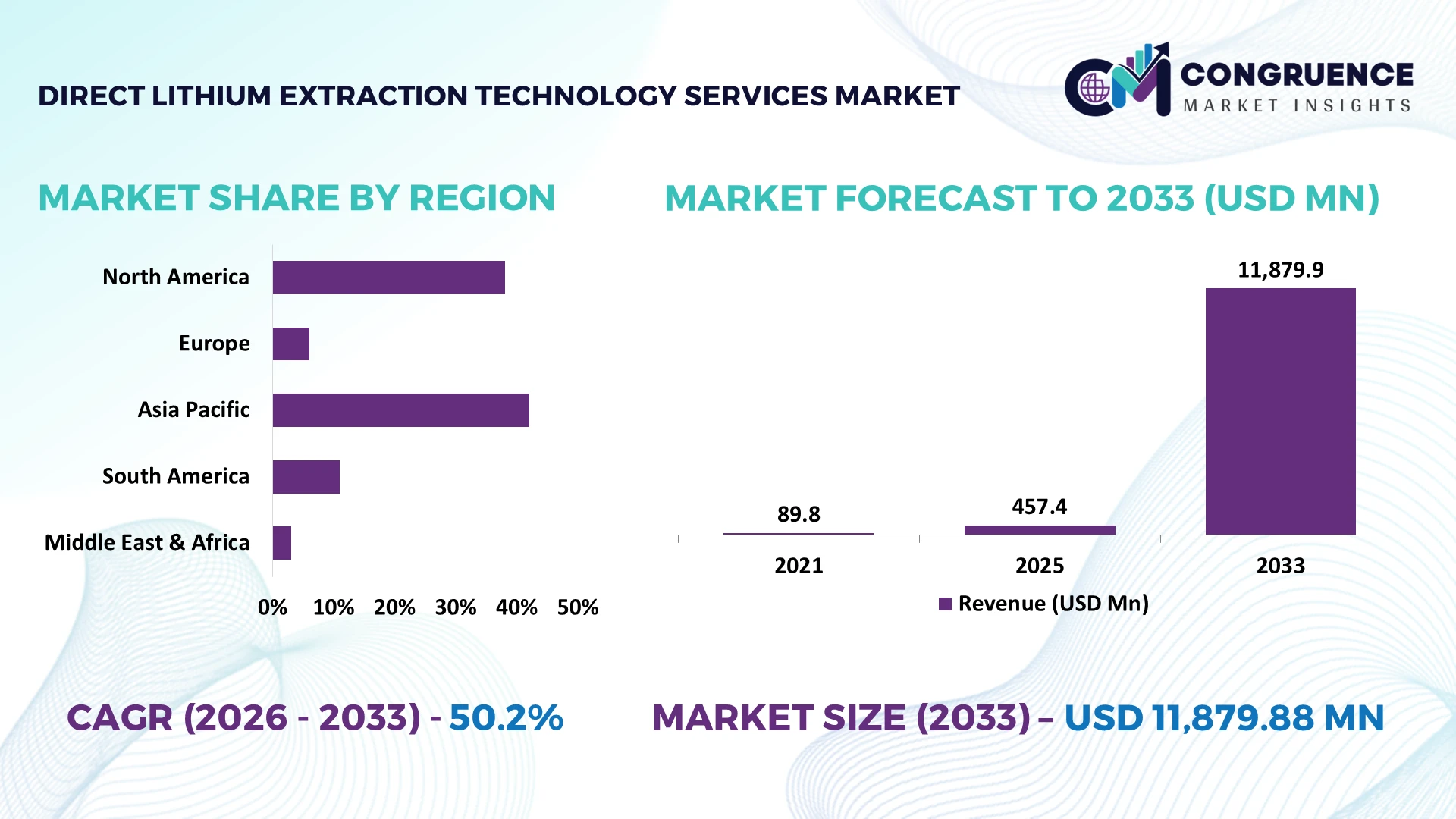
China commands the dominant position with approximately 42% of global service demand, led by Qinghai’s 20,000-tonne adsorption production line achieving 90.41% workshop recovery, alongside state-backed investment exceeding USD 1 billion in salt-lake lithium infrastructure. The United States follows with 38% share, supported by a USD 1.36 billion DOE conditional loan for California’s Project ATLiS targeting 20,000 tonnes lithium hydroxide annually. China’s recovery rate of 78% from solar ponds surpasses the industry’s sub-50% baseline, while U.S. geothermal brine projects target battery-grade production by 2027.
Service providers with jurisdiction-specific sorbent engineering and regulatory navigation capabilities will define the commercial deployment tier through 2030.
Market Size & Growth: Valued at USD 457.4 million in 2025, with adsorption-based DLE services commanding 65% technology share driven by commercial maturity and water-only regeneration advantages over ion exchange.
Top Growth Drivers: U.S. critical-minerals localization policy (38% of project pipeline), China’s 20,000-tonne salt-lake scale-up (42% of global demand), and oilfield brine repurposing reducing greenfield drilling costs by 35–45%.
Short-Term Forecast: By 2028, integrated DLE service contracts will reduce per-tonne lithium processing costs by 18–22% versus 2025 baselines as modular pilot-to-commercial scale-up compresses engineering timelines.
Emerging Technologies: AI-driven sorbent regeneration optimization, electrochemical ion-pumping for low-concentration brines (70 mg/L Li), and closed-loop spent-brine reinjection systems dominate advanced R&D portfolios.
Regional Leaders: Asia-Pacific leads with 42% share anchored by Qinghai’s industrial deployment; North America holds 38% backed by DOE loan commitments; South America represents 11% through Chile’s Maricunga and Argentina’s provincial projects.
Consumer/End-User Trends: Automotive OEMs represent 61% of DLE service demand as GM, Stellantis, and SK On secure upstream equity and offtake positions in U.S. brine projects.
Pilot/Case Example: Qinghai CITIC Guoan’s 2026 20,000-tonne adsorption line achieved 90.41% workshop recovery, up from 75.38% under conventional extraction, with solar-pond lithium recovery rising from below 50% to over 78%.
Competitive Landscape: Sunresin leads commercial-scale DLE services with approximately 22% project share; key players include Lilac Solutions, Jiuwu Hi-Tech, TUS-MEMBRANE, and Summit Nanotech, with top five holding over 94% combined share.
Regulatory & ESG Impact: The EU Critical Raw Materials Act targets 10% domestic extraction by 2030, while U.S. DOE loan conditions require domestic content and community benefit agreements across funded projects.
Investment & Funding: U.S. DOE committed up to USD 1.36 billion for Project ATLiS; Prairie Lithium advanced North America’s largest DLE facility in Saskatchewan with 4.6 million tonnes LCE resource base.
Innovation & Future Outlook: Direct-to-battery-grade lithium carbonate production from oilfield brines is shifting service models toward integrated build-own-operate contracts, reducing client capital exposure by an estimated 30%.
The Direct Lithium Extraction Technology Services Market is pivoting from pilot-stage engineering toward integrated commercial deployment, with demand concentrated in China’s Qinghai salt-lake cluster and U.S. Smackover and Salton Sea brine operators. Recent innovations include Lithios’ electrochemical ion-pumping system validating continuous operation on real-world brines and Lilac Solutions’ Gen 5 ion-exchange achieving 87% recovery from 70 mg/L lithium feed. A defining operational trend is the repurposing of existing oil and gas well infrastructure for DLE feedstock, reducing well-field capital expenditure by approximately 40% relative to greenfield salar development. With 54% of global brine lithium still processed through evaporation, the service opportunity lies in converting these legacy operations to DLE-enhanced flowsheets.
Direct lithium extraction services have shifted from technical curiosity to strategic necessity as automakers and governments race to secure battery-grade lithium outside Chinese refining channels. The U.S. DOE’s USD 1.36 billion conditional loan for Project ATLiS signals that DLE is now treated as critical infrastructure, not a laboratory experiment. Meanwhile, China’s Qinghai 20,000-tonne production line demonstrates that industrial-scale adsorption DLE is operationally proven, not theoretical—a contrast that rewards service providers with multi-jurisdictional engineering playbooks.
Technologically, modern adsorption and ion-exchange DLE systems demonstrate 90–99% lithium recovery from brine, compared to 40–60% for evaporation ponds, while reducing extraction timelines from 12–18 months to hours. Qinghai CITIC Guoan’s 2026 operational data shows workshop recovery climbing to 90.41% from 75.38%, with solar-pond recovery exceeding 78% versus the sub-50% industry norm. In Canada, Prairie Lithium’s Saskatchewan facility—North America’s largest DLE project—targets 4.6 million tonnes LCE from the Duperow Formation using established oilfield drilling techniques, with four commercial DLE columns arriving by April 2026.
Investment patterns reveal a clear strategic pivot: the U.S. DOE has committed over USD 3.5 billion in loans and grants across lithium projects, while EnergySource Minerals’ ATLiS facility targets 20,000 tonnes lithium hydroxide annually by 2027. For service providers, competitive advantage now hinges on three capabilities: brine-specific sorbent customization, regulatory navigation across U.S. and Chinese frameworks, and the engineering depth to retrofit DLE onto existing oilfield infrastructure. Firms that master all three will define the service tier that automakers depend on through 2030.
Critical-minerals legislation in the United States and China’s salt-lake industrialization strategy are converting DLE from an efficiency option into a compliance requirement for battery supply chains. The U.S. DOE’s USD 1.36 billion conditional commitment to Project ATLiS and China’s 20,000-tonne Qinghai production line create guaranteed demand corridors for DLE service providers. China’s lithium reserve share has risen from 6% to 16.5% globally, with over 82% of domestic resources hosted in salt-lake brines—a structural shift that mandates DLE adoption for supply security. Companies are responding by localizing sorbent manufacturing and engineering support: Sunresin and Jiuwu Hi-Tech are expanding capacity to serve both Qinghai operators and overseas projects in Argentina. Service providers with in-country regulatory expertise command pricing premiums of 15–20% over technology-only licensors.
DLE service scalability remains constrained by the absence of standardized sorbent performance across diverse brine compositions, forcing costly customization for each formation. Solvent extraction requires large organic solvent volumes with environmental handling costs, while ion-exchange systems depend on acidic or basic regenerants whose prices fluctuate with chemical markets. In Chile’s Salar de Atacama, brine reinjection uncertainties—including potential dilution of lithium-rich horizons—create permitting delays extending project timelines by 12–18 months. Companies are mitigating exposure through hybrid adsorption-ion exchange flowsheets and long-term reagent supply contracts. A non-obvious operational constraint: spent brine management now represents 8–12% of total DLE operating costs in water-stressed regions, pushing operators toward closed-loop reinjection systems that require additional capital but reduce regulatory friction.
The most underappreciated opportunity lies in retrofitting existing oil and gas well infrastructure for DLE feedstock, eliminating greenfield drilling costs that represent 35–45% of conventional brine project capital. Volt Lithium’s mobile DLE unit in North Dakota’s Bakken region processes produced water through existing well networks, with the Bakken containing nearly three times the lithium concentration of the Permian and potential for up to 50,000 tonnes per annum LCE. In Saskatchewan, Prairie Lithium leverages established oilfield drilling techniques to access brine at 2.3 kilometers depth, compressing development timelines by an estimated 30%. The modular “technology-as-a-service” model—where providers own and operate DLE units on client brine assets—is gaining traction, with service fees structured per tonne of battery-grade product rather than upfront licensing. Providers investing in mobile pilot plants redeployable across client sites within 90 days will capture the fragmented mid-tier operator segment.
Execution risk in DLE services is increasingly human-capital constrained, not technology constrained. Operating adsorption and ion-exchange systems at commercial scale requires chemical engineers versed in both hydrometallurgy and continuous process control—a skill combination in short supply across Qinghai, Arkansas, and Saskatchewan. Standard Lithium’s Arkansas demonstration required five years of continuous operation to optimize flowsheet parameters, institutional knowledge that cannot be replicated quickly. Digital integration adds another layer: AI-driven sorbent regeneration optimization promises 10–15% efficiency gains, but most DLE operators lack sensor infrastructure and data pipelines for effective deployment. China’s Qinghai facility achieved 98% production automation with full-process “one-click start-stop” capability, setting a benchmark that Western operators must match to remain competitive. Companies must invest in operator training and digital twin development before scale-up, or risk commissioning delays that erode project economics.
Oilfield Brine Retrofit Accelerates: Operators are converting existing oil and gas well networks into DLE feedstock infrastructure, cutting greenfield drilling costs by an estimated 35–45%. Volt Lithium’s Generation 5 unit in the Permian Basin and Bakken deployment demonstrate mobile DLE viability across multiple brine chemistries. Service providers are responding with modular pilot units deployable within 90 days, targeting mid-tier operators that cannot justify permanent infrastructure.
China’s Industrial Automation Sets Benchmark: Qinghai’s 40,000-tonne lithium salt facility achieved 98% production automation with full-process “one-click start-stop” and automatic parameter control, operating continuously for nine months. The integrated digital system couples with proprietary adsorption-membrane processes, reducing freshwater consumption by 47% and electricity use by 33%. This automation depth creates a competitive moat that Western service providers must match through digital twin deployment and sensor infrastructure investment.
Geothermal Co-Production Gains Commercial Traction: EnergySource Minerals’ Project ATLiS in California’s Imperial County integrates DLE with geothermal brine processing, targeting 20,000 tonnes lithium hydroxide annually for approximately 52 GWh of battery production. The dual-revenue model spreads fixed costs across energy and lithium streams, improving project bankability. A non-obvious insight: geothermal brine temperatures reduce external heating requirements for DLE desorption cycles, lowering operational energy intensity compared to ambient-temperature salar operations.
Electrochemical Ion-Pumping Emerges as Low-Concentration Solution: MIT spinout Lithios is commercializing electrochemical ion-pumping DLE that selectively captures lithium from brines with high impurity levels, addressing the low-concentration, high-contaminant profiles of U.S. Smackover resources. The modular system has operated continuously on real-world brines since June 2025, with a demonstration unit targeting 10–100 tonnes annually before scaling to 25,000 tonnes. Companies are investing in electrode material stability and cascade pre-treatment to manage scaling and co-insertion risks in geothermal and oilfield environments.
Adsorbent extraction holds approximately 65% of DLE technology services share, anchored by commercial maturity, high lithium selectivity, and suitability for diverse brine chemistries including low-concentration continental brines. China’s Qinghai operators have standardized adsorbent-based flowsheets at scale, with the 20,000-tonne production line achieving workshop recovery of 90.41%.
Ion exchange represents the fastest-growing type, driven by superior performance in ultra-low lithium concentration environments—Lilac Solutions’ Gen 5 system demonstrated 87% recovery from brine containing only 70 mg/L lithium. Solvent extraction remains a niche offering, constrained by organic reagent handling costs and environmental compliance burdens. Companies are responding by hybridizing adsorbent and ion-exchange stages, positioning multi-technology portfolios as a hedge against brine-specific performance variability.
Salt lake brine extraction accounts for approximately 97% of DLE technology service applications, reflecting concentration across China’s Qinghai-Tibet Plateau, Argentina’s Lithium Triangle, and Chile’s Salar de Atacama. The dominance is structural: salar brines offer established resource definition, existing permitting frameworks, and proximity to conventional processing infrastructure. Deep brine extraction represents the fastest-growing application, propelled by oilfield produced water and geothermal brine projects in the United States and Canada that bypass salar permitting constraints.
Prairie Lithium’s Saskatchewan project targets the Duperow Formation using oilfield drilling techniques, while Volt Lithium processes Bakken produced water through mobile DLE units. Companies are adapting service models accordingly—modular units with smaller footprints suit deep brine well-pad deployments, whereas salar operators require higher-throughput systems integrated with existing pond infrastructure.
The automotive sector represents the leading end-user group for DLE technology services, with battery-grade lithium hydroxide demand concentrated among EV manufacturers securing upstream supply through equity positions and offtake agreements. General Motors’ equity stake in Lithium Americas, Stellantis’ investment in Controlled Thermal Resources, and SK On’s offtake contracts with U.S. brine developers reflect automakers’ strategy to lock in domestic lithium supply chains.
Energy storage represents the fastest-growing end-user segment, driven by grid-scale battery deployment requiring high-purity lithium carbonate for LFP and NMC chemistries. Industrial chemical producers and pharmaceutical-grade lithium buyers remain smaller but stable segments with specialized purity requirements. Companies are targeting automotive clients through integrated build-own-operate service models that reduce OEM capital exposure, while energy storage customers favor shorter-term service contracts with performance guarantees.
Asia-Pacific accounted for the largest market share at 42% in 2025 however, South America is expected to register the fastest growth, expanding at a CAGR of 52.1% between 2026 and 2033.
North America’s DLE services market operates at the intersection of legacy oilfield infrastructure and critical-minerals policy. The region’s 38% share is anchored by Arkansas’ Smackover Formation, where Standard Lithium’s commercial-scale sorption unit has logged over 18 months of continuous operation, and by Prairie Lithium’s Saskatchewan project—designated North America’s largest DLE facility—with four commercial columns arriving by April 2026 and a 4.6 million tonne LCE resource base. Service demand is shifting toward modular, well-pad-deployable systems that leverage existing oil and gas drilling permits rather than greenfield salar concessions. Companies are responding by embedding engineering teams at client sites during pilot phases to compress commissioning timelines.
United States Market Outlook: The U.S. dominates regional DLE service demand through the Smackover trend across Arkansas and Texas, where Volt Lithium’s Generation 5 field unit achieved commercial-scale operation and processed oilfield brine across multiple basins. The DOE’s conditional commitment of up to USD 1.36 billion for Project ATLiS has de-risked commercial-scale adsorption deployment in California’s Salton Sea geothermal cluster. Service providers with Arkansas-specific sorbent tuning expertise command premium pricing.
Europe’s 6% share understates its strategic importance as a regulatory template for sustainable DLE. Germany’s Upper Rhine Valley hosts Vulcan Energy’s Lionheart project, which combines geothermal lithium extraction with renewable heat and power generation. The European Investment Bank’s financing signals institutional confidence in the co-production model. Service demand in Europe concentrates on closed-loop brine reinjection and low-carbon processing workflows that satisfy the EU Critical Raw Materials Act’s environmental standards. Companies are positioning through partnerships with geothermal operators and engineering firms specializing in high-temperature brine handling.
Germany Market Outlook: Germany leads European DLE service deployment through Vulcan’s Lionheart project, which has operated its Lithium Extraction Optimisation Plant since April 2024, producing high-purity lithium chloride from geothermal brine at pilot scale. The project’s integration of lithium production with municipal district heating creates a dual-revenue operational model that improves project bankability. Germany’s engineering workforce and chemical industry infrastructure provide a deployment advantage for service providers offering integrated geothermal-DLE flowsheets.
Asia-Pacific’s 42% share is driven by China’s industrial-scale deployment of adsorbent-based DLE across Qinghai’s salt lake brines. The world’s first 20,000-tonne lithium production line achieved workshop recovery rates of 90.41%, up from 75.38% under conventional extraction, with solar-pond recovery rising from below 50% to over 78%. The 40,000-tonne “4+2” project achieved 98% production automation with full-process “one-click start-stop” capability, reducing freshwater consumption by 47% and electricity use by 33%. Japan and South Korea are emerging as service clients rather than technology providers, with Prairie Lithium securing a binding offtake agreement with South Korea’s Hydro Lithium. Companies are responding by localizing sorbent manufacturing and engineering support within China’s industrial clusters.
China Market Outlook: China’s DLE service market is defined by state-directed scale-up and domestic technology maturity. The Qinghai 20,000-tonne production line demonstrates commercial viability of adsorption DLE at industrial throughput, reducing reliance on imported extraction technology. Chinese service providers, including Sunresin and Jiuwu Hi-Tech, are expanding engineering capacity to serve both domestic salt lake operators and overseas projects in Argentina and Bolivia. The strategic advantage lies in cost-competitive sorbent supply and experience with high-altitude, low-temperature, high-magnesium-to-lithium ratio brine operations.
South America’s 11% share reflects a project pipeline concentrated in Argentina and Chile that is advancing despite infrastructure and permitting friction. Rio Tinto’s binding agreement with Codelco to develop Chile’s Salar de Maricunga commits USD 350 million in initial funding and USD 500 million upon final investment decision, targeting first lithium by 2030 using DLE technology. The project’s high-grade brine supports favorable recovery economics, but altitude logistics, water stewardship requirements, and community consultation timelines extend development cycles. In Argentina, provincial ownership models have accelerated private DLE contracts, with Salta and Jujuy projects advancing modular pilot-to-commercial pathways. Companies are adapting by structuring phased service contracts that align engineering milestones with permitting gates.
Argentina Market Outlook: Argentina’s DLE service opportunity concentrates in Salta and Jujuy provinces, where provincial governments control lithium concessions and have demonstrated willingness to approve pilot-to-commercial transitions. The country’s brine chemistry supports both adsorption and ion-exchange flowsheets, attracting service providers with multi-technology portfolios. A binding offtake agreement between Prairie Lithium and South Korea’s Hydro Lithium illustrates Argentina’s integration into Asian battery supply chains, though domestic infrastructure for reagent supply and product logistics remains a constraint. Companies are investing in local engineering teams to navigate provincial regulatory variation.
The Middle East & Africa region holds 3% share, but Saudi Arabia’s entry into DLE marks a strategic inflection. Aramco has contracted National Energy Services Reunited (NESR) for a five-year, USD 200 million lithium demonstration project targeting 2,000 tonnes per year of battery-grade lithium carbonate from oilfield brine, with production starting late 2027. The LiThara modular platform integrates pre-treatment, DLE, and carbonation in a single deployable unit—a configuration suited to the region’s oilfield infrastructure and arid operating conditions. This project establishes a template for Gulf states seeking to monetize produced water while diversifying energy portfolios. Service providers with modular, low-water-intensity systems are positioned to capture subsequent commercial-scale contracts across the GCC.
Saudi Arabia Market Outlook: Saudi Arabia’s DLE service demand is nascent but policy-supported, driven by Aramco’s strategic interest in extracting value from oilfield brines and the Kingdom’s broader critical-minerals agenda. The NESR demonstration project’s modular architecture enables rapid scale-up if technical and economic parameters validate at the 2,000-tonne threshold. Aramco and Maaden’s non-binding agreement to form a lithium extraction joint venture by 2027 signals institutional commitment to commercial deployment. Service providers offering integrated brine-to-carbonate solutions with minimal freshwater consumption hold a distinct advantage in this water-constrained operating environment.
The DLE technology services market is structured around technology licensors competing against vertically integrated project developers. Lilac Solutions and Sunresin lead the ion-exchange and adsorption technology tier, while Standard Lithium, EnergyX, and Vulcan Energy pursue hybrid models combining proprietary DLE platforms with resource ownership. The top five players collectively hold approximately 55% of service contract value, though concentration varies sharply by region—Chinese adsorbent suppliers dominate Asia-Pacific, while Lilac and Koch Technology Solutions anchor North American deployments. Competition pivots on sorbent durability and brine-specific customization rather than price alone: Lilac’s Gen 5 media delivers up to 10,000 cycles before replacement, and Standard Lithium’s Koch-licensed system achieved 95.4% recovery across nearly 10,000 operational cycles . The decisive shift is toward performance-guaranteed service contracts, where providers absorb technology risk in exchange for per-tonne fees. Entry barriers are steep—proprietary sorbent chemistry, field-validation datasets spanning multiple brine types, and regulatory navigation across U.S. and Argentine frameworks. Winning requires demonstrated commercial-scale recovery data, not pilot promises.
Lilac Solutions
Standard Lithium
EnergyX
Vulcan Energy Resources
Sunresin New Materials
Koch Technology Solutions
Rio Tinto (Fenix and Sal de Vida operations)
Eramet
Lake Resources
Controlled Thermal Resources
Jiuwu Hi-Tech
International Battery Metals
Current commercial deployments center on adsorption and ion-exchange platforms, with adsorption dominating Chinese salar operations at 90%+ recovery and ion-exchange gaining traction for low-grade brines. Lilac’s Gen 5 IX system processes brine with 70 mg/L lithium at 87% recovery, while reducing water consumption 10x versus alumina adsorbents . Standard Lithium’s Koch-licensed Li-Pro column has completed nearly 10,000 cycles at 95.4% recovery, establishing a durability benchmark for Smackover brine .
Emerging electrochemical ion-pumping and solvent-extraction hybrids target ultra-low concentration brines and oilfield produced water. Digital twin integration and AI-driven sorbent regeneration optimization promise 10–15% operational efficiency gains, though adoption remains pilot-stage. Lilac’s commercial-scale IX media manufacturing line in Nevada, commissioned in 2025, signals the transition from imported to domestic sorbent supply .
Disruptive potential lies in direct-to-lithium-sulfide conversion, demonstrated by Standard Lithium and Telescope Innovations in June 2025, which bypasses conventional hydroxide-to-carbonate processing for solid-state battery feedstocks . Competitive advantage accrues to service providers owning proprietary sorbent chemistry and field-validation datasets across multiple brine types. By 2026–2028, projects incorporating Gen 5-class IX systems are projected to achieve first-quartile C1 costs of $3,200–$5,500 per tonne LCE, forcing lagging adsorbent providers to either license next-generation platforms or exit commercial-scale contracting .
June 2025 – Standard Lithium announced successful production of battery-quality lithium sulfide using lithium hydroxide from its Arkansas demonstration plant, via a patented low-temperature process (<100°C) developed with Telescope Innovations, with samples shipped to solid-state battery makers in Asia and North America . Source: standardlithium.com
October 2025 – Lilac Solutions released Gen 5 ion-exchange technology delivering 20x higher media productivity, 7x higher eluate lithium concentration, and up to 10,000 cycles before replacement versus conventional alumina adsorbents, with C1 costs projected at $3,200–$5,500/t LCE . Source: lilacsolutions.com
December 2025 – Vulcan Energy secured €250 million from the European Investment Bank for Phase One Lionheart in Germany, targeting 24,000 tonnes lithium hydroxide annually alongside 560 GWh renewable heat, with production slated for 2028 . Source: v-er.eu
July 2025 – EnergyX entered a binding agreement to acquire 35,000 acres of Smackover lithium brine resources in Arkansas from Pantera Lithium for A$40 million, expanding its U.S. holdings to nearly 50,000 acres and supporting Project Lonestar’s 50,000 tpa lithium hydroxide target by 2030 . Source: energyx.com
This report delivers a comprehensive assessment of the DLE technology services market across adsorbent extraction, ion exchange, and solvent extraction types, segmented by application (salt lake brine, deep brine, geothermal brine) and end-user (automotive, energy storage, industrial chemicals). Regional coverage spans North America, Europe, Asia-Pacific, South America, and the Middle East & Africa, with country-level granularity for the United States, Germany, China, Argentina, and Saudi Arabia.
Quantitative indicators include segment distribution, adoption rates, deployment statistics, and service contract structures, supported by company profiles of twelve active market participants. The analysis equips investors and operators with actionable intelligence for capital allocation, partnership structuring, and competitive positioning, mapping technology readiness against commercial deployment timelines through 2033.
| Report Attribute / Metric | Details |
|---|---|
| Market Revenue (2025) | USD 457.4 Million |
| Market Revenue (2033) | USD 11,879.9 Million |
| CAGR (2026–2033) | 50.25% |
| Base Year | 2025 |
| Forecast Period | 2026–2033 |
| Historic Period | 2021–2025 |
| Segments Covered |
By Type
By Application
By End-User
|
| Key Report Deliverables | Revenue Forecast; Market Trends; Growth Drivers & Restraints; Technology Insights; Segmentation Analysis; Regional Insights; Competitive Landscape; Regulatory & ESG Overview; Recent Developments |
| Regions Covered | North America; Europe; Asia-Pacific; South America; Middle East & Africa |
| Key Players Analyzed | Lilac Solutions; Standard Lithium; EnergyX; Vulcan Energy Resources; Sunresin New Materials; Koch Technology Solutions; Rio Tinto (Fenix and Sal de Vida operations); Eramet; Lake Resources; Controlled Thermal Resources; Jiuwu Hi-Tech; International Battery Metals |
| Customization & Pricing | Available on Request (10% Customization Free) |




