
Reports
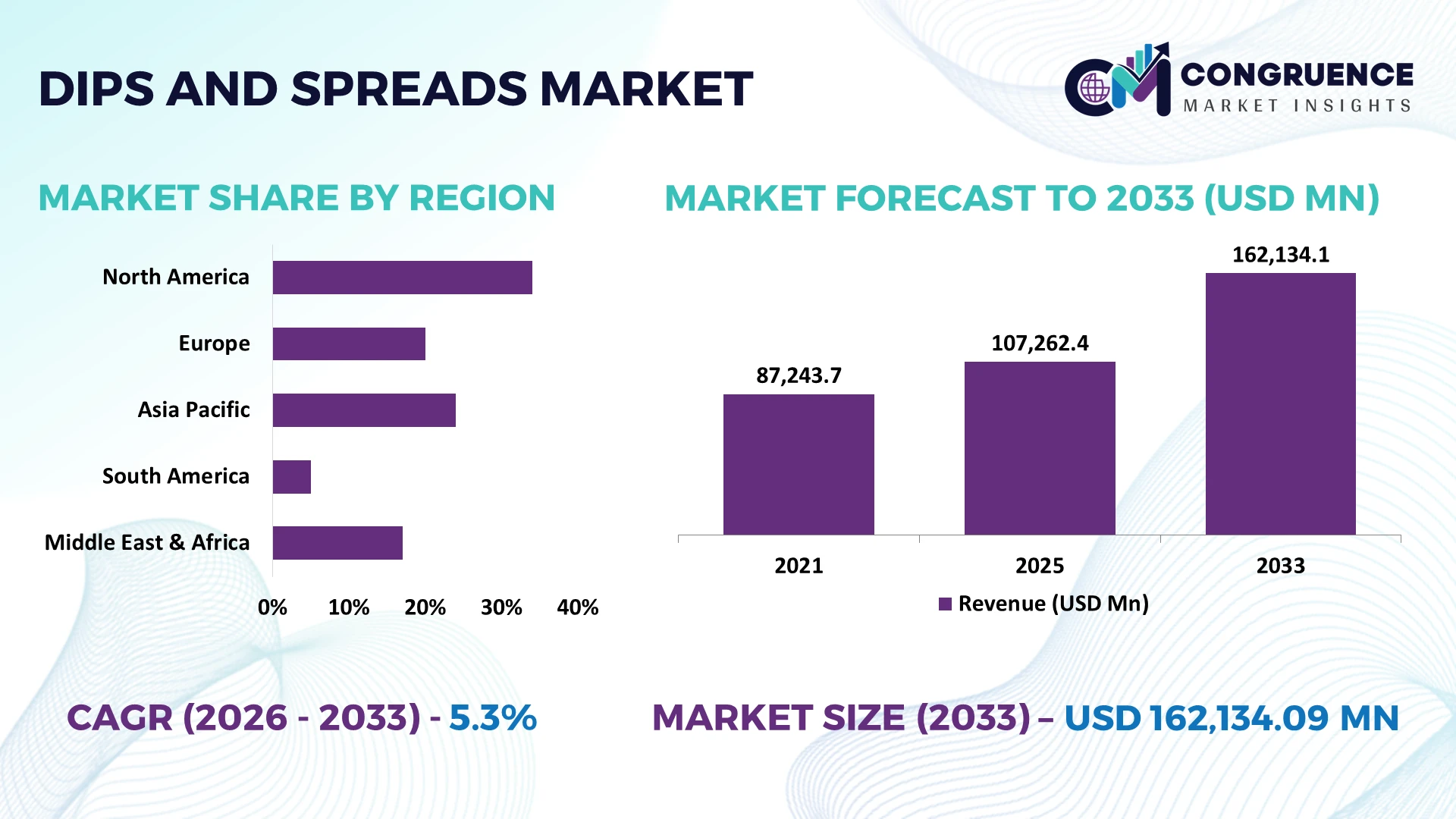
The Global Dips and Spreads Market was valued at USD 107262.37 Million in 2025 and is anticipated to reach a value of USD 162134.09 Million by 2033 expanding at a CAGR of 5.3% between 2026 and 2033. Growth is driven by premium clean-label formulations, refrigerated ready-to-eat formats, plant-based recipes, portion-controlled packaging, and rapid flavor innovation across hummus, salsa, guacamole, tahini, and nut spreads.
The United States dominates the global dips and spreads market, supported by extensive refrigerated retail, established snack consumption, and strong foodservice infrastructure. The country represents approximately 30% of global demand, while Canada remains below 10% of North American consumption. U.S. manufacturers increasingly deploy automated filling, cold-chain monitoring, and clean-label processing, strengthening operational efficiency and product safety across major retail and foodservice channels.
For investors and manufacturers, priority should center on North American scale, cold-chain reliability, clean-label innovation, and differentiated plant-based products.
Market Size & Growth: USD 107262.37 million in 2025 to USD 162134.09 million by 2033 at 5.3% CAGR, supported by refrigerated, plant-based, and premium product expansion.
Top Growth Drivers: Plant-based formulations 7.8%; organic products 7.1%; foodservice channels 7.5% — strengthening high-growth category economics.
Short-Term Forecast: By 2030, automated filling, portioning, and cold-chain monitoring are positioned to reduce processing losses by 3–5% and improve throughput by 5–8%.
Emerging Technologies: AI-assisted demand forecasting, automated filling, and smart cold-chain monitoring are accelerating SKU planning, production consistency, and shelf-life management.
Regional Leaders: North America leads at approximately USD 39003 million in 2025 with 36.4% share; Europe remains a major premium market, while Asia-Pacific records the fastest regional growth at 7.0%.
Consumer Trends: Nearly 50% of U.S. and Canadian consumers prioritize convenience, satiety, health, and indulgence in savory snacking, reinforcing portable and functional dips.
Pilot/Case Example: FDA’s 2021–2022 surveillance tested 747 refrigerated RTE dip and spread samples; only 4 contained detected human pathogens, highlighting the value of rigorous preventive controls.
Competitive Landscape: North America leads with 36.4% share, with major competition involving Sabra, PepsiCo, Hormel Foods, Conagra Brands, and B&G Foods across retail and foodservice.
Regulatory & ESG Impact: FDA testing identified pathogens in 4 of 747 samples, increasing pressure for stronger sanitation, traceability, supplier verification, and safer refrigerated production.
Investment & Funding: Global manufacturers are directing investment toward premium product renovation, automated processing, cold-chain expansion, and sustainable packaging as retail accounted for 65.1% of category distribution in 2025.
Innovation & Future Outlook: Next-generation growth centers on high-protein hummus, global flavors, clean-label recipes, portion packs, and advanced packaging, shifting competition toward speed-to-market and supply-chain resilience.
The global dips and spreads market is increasingly shaped by plant-based formulations, bold international flavors, clean-label ingredients, and convenient refrigerated formats. Hummus represented 15% of new savory spread launches, signaling continued innovation around protein-rich and Mediterranean-inspired products. At the same time, FDA surveillance and recurring tahini-related food-safety controls are strengthening supplier verification and cold-chain discipline, creating a strategic shift toward safer, traceable, and differentiated products.
The dips and spreads market is becoming strategically important as food manufacturers compete on formulation speed, shelf life, convenience, and premiumization rather than volume alone. Clean-label, plant-based, high-protein, and globally inspired recipes are reshaping portfolio decisions, while refrigerated distribution is pushing companies toward tighter cold-chain control. Over the next 2–3 years, automated filling, digital quality monitoring, and demand forecasting are positioned to improve production efficiency by roughly 5–8%.
Technology adoption is creating a measurable advantage over legacy operations. Automated filling and portioning can improve throughput by approximately 10–15% while reducing product giveaway by 2–4%, compared with manual or semi-automated lines. The United States remains the largest innovation and commercialization hub, while India and Southeast Asian markets are moving faster in affordable plant-based and regional-flavor formats, creating different investment priorities.
Companies are responding through localized sourcing, co-manufacturing partnerships, packaging upgrades, and expanded refrigerated capacity. A practical deployment involves integrating automated filling with inline weight inspection and cold-chain sensors, enabling tighter batch control and lower waste. Strategically, competitive positioning will increasingly depend on combining formulation innovation with manufacturing precision, supply-chain resilience, and differentiated consumer propositions.
Plant-based and premium formulations are strengthening category economics, with plant-based product demand expanding at roughly 7–8% in high-growth channels and clean-label launches increasing by approximately 5–7% annually. In the United States, hummus, avocado-based dips, nut spreads, and protein-oriented products are moving beyond specialty shelves into mainstream refrigerated retail. Rising ingredient traceability requirements are also encouraging manufacturers to redesign supplier networks. Companies are responding through local ingredient contracts, automated blending, and reformulation partnerships. The non-obvious advantage is faster SKU rotation: modular production lines allow manufacturers to introduce regional flavors without rebuilding entire processing systems, improving asset utilization and reducing commercialization time.
Refrigerated dips and spreads face structural cost pressure from energy-intensive storage, short shelf-life requirements, and temperature-sensitive transportation. Cold-chain operations can represent approximately 10–15% of distribution expenditure, while product losses of 2–5% remain material for poorly synchronized inventories. In the United States, strict refrigerated ready-to-eat handling requirements increase compliance and monitoring costs across manufacturing and retail interfaces. These pressures directly constrain margins when commodity and logistics costs rise simultaneously. Manufacturers are responding through regional production hubs, supplier diversification, longer-term procurement contracts, and predictive inventory systems. The strategic constraint is not ingredient availability alone; synchronized cold-chain capacity increasingly determines whether companies can scale new refrigerated SKUs profitably.
The strongest opportunities lie in intelligent production, functional formulations, and underpenetrated consumption markets. AI-supported demand planning can reduce forecast-related inventory errors by approximately 10–20%, while automated filling can raise line throughput by 10–15%. India, Indonesia, and other developing food markets offer attractive opportunities for affordable hummus, chili-based dips, nut spreads, and locally adapted flavors. Advanced high-barrier packaging and modified-atmosphere formats are also extending usable shelf life and reducing distribution losses. Companies are increasing R&D spending, partnering with ingredient specialists, and establishing localized manufacturing capabilities. A key opportunity is combining regional flavor development with standardized base formulations, allowing one production platform to serve multiple markets with lower incremental manufacturing costs.
Long-term competitiveness depends on integrating automation, food-safety controls, packaging systems, and formulation processes without disrupting production consistency. Manufacturers upgrading legacy facilities can face 10–20% higher implementation complexity when multiple filling, inspection, refrigeration, and enterprise-planning systems require integration. Workforce shortages in food processing further increase dependence on automated quality-control technologies, while regulatory expectations for traceability continue tightening. Companies must also manage formulation variability caused by seasonal ingredients, viscosity differences, and particulate content, which can reduce automated-line consistency by several percentage points. Leading manufacturers are addressing these barriers through modular equipment, standardized data architectures, operator training, and technology partnerships. The decisive challenge is achieving flexible automation without sacrificing product texture, safety, or throughput.
Hummus remains the leading named type, with an estimated 15% share of new savory spread launches and strong scalability across retail, foodservice, and meal occasions. Its standardized chickpea base supports consistent processing, broad flavor extensions, and efficient sourcing. Salsa remains highly established through snack applications, while cheese spreads benefit from familiar taste profiles and strong refrigerated placement. Nut and seed spreads occupy a premium niche, increasingly differentiated through protein and allergen-positioning strategies.
Guacamole is emerging as the fastest-moving premium option, supported by avocado-based positioning, Mexican-inspired menus, and fresh-food merchandising. Companies are investing in high-pressure processing, portion packs, and cold-chain optimization to extend usability and reduce formulation losses. Hummus manufacturers are broadening flavors and protein claims, while guacamole producers are strengthening sourcing and processing partnerships. The strategic shift is toward platforms that enable multiple flavors without major equipment changes. HPP is particularly important because it extends shelf life without relying on preservatives, improving distribution flexibility.
Snacks & Appetizers represent the leading application, estimated at approximately 35% of consumption, because dips integrate directly with chips, vegetables, crackers, and finger foods without additional preparation. Bread & Sandwiches remains a mature application at roughly 25%, supported by hummus, cheese spreads, and nut-based formulations. Dips & Platters maintain strong foodservice relevance, while Cooking & Meal Preparation is gaining importance as consumers use spreads as ingredients rather than standalone accompaniments.
Cooking & Meal Preparation is emerging as the fastest-growing application, with usage expanding approximately 6–8% as manufacturers promote spreads as sauces, marinades, sandwich bases, and recipe components. Companies are responding with larger foodservice packs, standardized portioning systems, and recipe-led packaging. Nearly 75% of U.S. restaurant traffic occurs off-premises in 2025, increasing the operational value of versatile, transport-stable dip formats.
Households remain the leading end-user group, representing approximately 48% of consumption, supported by supermarket purchasing, at-home snacking, and multipurpose spreads. Restaurants follow at roughly 22%, while cafés and catering services occupy smaller but increasingly specialized positions. Foodservice Operators represent the fastest-growing buyer group, as centralized procurement, standardized menus, and portion-control requirements encourage larger-volume purchasing and consistent formulations.
Foodservice adoption is expanding approximately 7–9% in high-volume channels as operators seek labor-efficient ingredients that can be deployed across sandwiches, appetizers, platters, and prepared meals. Companies are responding with bulk packs, customized formulations, contract manufacturing, and private-label partnerships. Approximately 28% of U.S. restaurant operators planned to invest in technologies such as AI in 2025, strengthening the case for digitally coordinated foodservice supply chains.
North America accounted for the largest market share at 36.4% in 2025 however, Asia-Pacific is expected to register the fastest growth, expanding at a CAGR of 7.0% between 2026 and 2033.

Refrigerated retail scale drives premiumization and automation
North America holds the strongest commercial position, supported by mature refrigerated retail, established snack consumption, and high foodservice penetration. The United States concentrates a substantial share of regional manufacturing and consumption, with major producers investing in automated filling, high-pressure processing, portion-control packaging, and digital cold-chain monitoring. Retail channels account for more than 65% of category distribution, increasing the importance of shelf-life management and inventory synchronization. Manufacturers are shifting toward clean-label, plant-based, protein-rich, and globally inspired formulations while expanding flexible production lines. Partnerships with retailers and foodservice operators are strengthening private-label and customized product development. The strategic priority is moving from volume expansion toward manufacturing flexibility, faster SKU turnover, and tighter refrigerated supply-chain control.
United States Market Outlook: The United States remains the region's primary demand, manufacturing, and innovation hub, supported by sophisticated refrigerated logistics and extensive retail infrastructure. Foodservice operators increasingly favor standardized bulk and portion formats, encouraging manufacturers to expand automation and localized production. Strong food-safety requirements for refrigerated ready-to-eat products are also accelerating investment in traceability, quality monitoring, and process-control systems.
Clean-label compliance reshapes European product strategies
Europe combines mature chilled-food infrastructure with stringent food-safety standards and strong demand for premium, organic, and clean-label formulations. Germany, the United Kingdom, France, and Italy represent important consumption and manufacturing centers, while private-label retailers exert significant influence over product specifications and pricing. Retail remains the dominant distribution environment, encouraging manufacturers to improve packaging efficiency, shelf-life performance, and ingredient transparency. Sustainability is also becoming commercially relevant as producers shift toward recyclable packaging and reduced-additive formulations. Companies are investing in flexible filling systems, traceable sourcing, and regional manufacturing partnerships to meet differentiated national requirements. The key competitive shift is that European producers increasingly compete through regulatory compliance, sustainability credentials, and formulation quality rather than price alone.
Germany Market Outlook: Germany combines advanced food-processing infrastructure, strong private-label capabilities, and highly organized grocery distribution. Its manufacturing base supports efficient national product launches and rapid formulation adjustments. Producers are increasing investment in automated filling, recyclable packaging, and ingredient traceability, strengthening operational efficiency while meeting increasingly demanding retailer and consumer specifications.
Manufacturing scale accelerates localized flavor innovation
Asia-Pacific represents the fastest-expanding demand environment, supported by urbanization, modern retail development, foodservice expansion, and growing acceptance of packaged convenience foods. China, India, Japan, Australia, and South Korea are important consumption and innovation centers, although product preferences vary considerably. Manufacturers are adapting hummus, salsa, nut spreads, and chili-based formulations to local tastes instead of transferring standardized Western recipes. E-commerce and convenience retail are accelerating packaged-food penetration, while domestic producers are adopting automated filling and digital inventory management. Companies are responding through joint ventures, contract manufacturing, localized sourcing, and smaller pack formats. India and Southeast Asia offer particularly strong opportunities because manufacturers can combine lower production costs with regional flavor customization, creating more competitive localized portfolios.
China Market Outlook: China provides substantial manufacturing depth, modern retail infrastructure, and digitally enabled food purchasing. E-commerce and convenience-oriented consumption are supporting portable and smaller-format products, while domestic manufacturers can rapidly adjust recipes to local preferences. Automated processing and localized sourcing are improving production flexibility, allowing companies to manage diverse SKUs while maintaining cost control.
Modern retail expands packaged-dip penetration
South America remains a developing commercial opportunity, with Brazil and Argentina representing important consumption and food-processing centers. Brazil's large consumer base supports salsa, cheese spreads, nut spreads, and increasingly diversified hummus offerings. Supermarkets, convenience stores, and organized foodservice are strengthening packaged-product distribution, while refrigerated infrastructure remains concentrated around major urban markets. Manufacturers are responding by locating production closer to metropolitan demand centers and using regional distributors to extend coverage. Local flavor adaptation is becoming increasingly important as domestic producers compete with imported premium products. Retailer partnerships and foodservice agreements are helping companies improve shelf positioning and develop customized pack sizes. The strategic opportunity lies in combining domestic ingredient sourcing with modern packaging and distribution rather than relying heavily on imported finished products.
Brazil Market Outlook: Brazil is the region's most significant market because of its large consumer base, established food-processing ecosystem, and extensive supermarket infrastructure. Domestic sourcing can reduce import exposure and support competitive pricing. Manufacturers are increasingly prioritizing portion-controlled packaging, localized flavors, and refrigerated distribution to serve both mainstream retail and expanding foodservice requirements.
Foodservice modernization accelerates premium product adoption
The Middle East & Africa market is increasingly shaped by premium foodservice development, modern grocery infrastructure, tourism investment, and expanding international food formats. Saudi Arabia and the United Arab Emirates are major commercial centers, supported by hospitality projects and sophisticated foodservice procurement networks. Hummus and tahini-based products benefit from established regional consumption, while international manufacturers are introducing premium, clean-label, and globally inspired variants. Companies are strengthening refrigerated logistics, local distribution, and private-label partnerships to manage short shelf-life products. Modern retail is increasing branded packaged-food availability, while hospitality expansion is creating demand for standardized bulk formats. Manufacturers are therefore combining regional production arrangements with distributor partnerships to improve availability and control logistics costs.
Saudi Arabia Market Outlook: Saudi Arabia offers strong commercial potential through hospitality investment, modern grocery development, and organized foodservice procurement. Tourism and entertainment infrastructure is increasing demand for standardized food ingredients and convenient packaged formats. Manufacturers are strengthening local distribution, foodservice partnerships, and refrigerated logistics to support premium and culturally aligned dips and spreads.
The competitive landscape is led by Sabra, PepsiCo, Hormel Foods, Conagra Brands, and B&G Foods, competing against regional manufacturers, private-label suppliers, and specialist producers. The top five players collectively hold an estimated 15–20% share, leaving significant room for differentiated regional competitors. Competition centers on pricing, formulation innovation, packaging, retailer access, and cold-chain execution. Premium formulations command approximately 5–10% higher pricing, while automated filling can improve throughput by 10–15%. Leading companies are expanding product portfolios, upgrading manufacturing lines, forming retail partnerships, and developing customized foodservice formats. Regional players compete through faster flavor localization and lower production costs. The competitive shift is toward flexible manufacturing and supply-chain control as refrigerated products increase operational sensitivity. Entry barriers include food-safety compliance, retailer qualification, refrigerated infrastructure, and established brand recognition. Winning requires scalable manufacturing, reliable cold-chain execution, rapid product innovation, and strong retail and foodservice relationships.
Sabra Dipping Company
PepsiCo, Inc.
Hormel Foods Corporation
Conagra Brands, Inc.
B&G Foods, Inc.
The Kraft Heinz Company
Nestlé S.A.
The Hain Celestial Group, Inc.
Danone S.A.
Olam Group Limited
Waymouth Farms, Inc.
Cedar's Mediterranean Foods, Inc.
Current production is centered on automated filling, inline weight control, high-pressure processing (HPP), and digital cold-chain monitoring. Automated filling improves throughput by 10–15% versus manual lines, while inline inspection can reduce product giveaway by 2–4%. Deployment is strongest among large North American manufacturers, where short shelf life makes precision, traceability, and consistent portioning commercially important.
Emerging technology is integrating AI demand forecasting, machine-vision inspection, smart refrigeration sensors, and modular processing platforms. AI-enabled forecasting can reduce inventory-related errors by 10–20%, while machine vision improves packaging inspection consistency by roughly 2–3%. HPP provides a disruptive preservation advantage by extending refrigerated usability without conventional preservatives, benefiting premium, clean-label producers competing on shelf life and distribution flexibility.
Between 2026 and 2028, integrated automation will shift from isolated equipment upgrades toward connected production environments linking formulation, filling, inspection, packaging, and cold-chain data. New automated lines can deliver 10–15% higher throughput than legacy systems while reducing labor-intensive handling. Large multinational manufacturers gain the strongest scale advantage, but regional producers can compete through modular automation and contract manufacturing. Acting now enables faster SKU changeovers, tighter quality control, lower waste, and stronger refrigerated supply-chain resilience.
November 2024 PepsiCo agreed to acquire the remaining 50% of Sabra and Obela, making both wholly owned; Sabra had nearly USD 400 million in U.S. retail hummus sales. The move strengthens PepsiCo’s refrigerated-dips portfolio and accelerates product innovation. Source: PepsiCo
May 2024 CAVA opened a USD 35 million Virginia processing and packaging facility for proprietary dips and spreads, supporting at least 750 restaurants. The investment expands centralized production capacity and strengthens supply consistency across its restaurant and consumer-packaged-food operations. Source: Food Processing
June 2025 Tyson Foods launched Hillshire Snacking Dips and Spreads nationally in three varieties, with each single-serve package providing 6 grams of protein. The launch expands portion-controlled premium snacking and strengthens Tyson’s presence in convenient refrigerated dip formats. Source: Tyson Foods
June 2026 Noice launched a tiffin-ready range of preservative-free spreads, dips, and protein snacks across five Indian cities: Bengaluru, Mumbai, Hyderabad, Pune, and Chennai. The expansion targets convenience-led consumption and broadens premium packaged-food distribution through localized availability. Source: Business Standard
The Dips and Spreads Market Report covers five major product types: Hummus, Guacamole, Salsa, Cheese Spreads, and Nut & Seed Spreads. Application analysis includes Bread & Sandwiches, Snacks & Appetizers, Dips & Platters, and Cooking & Meal Preparation, while end-user coverage spans Households, Restaurants, Cafés, Catering Services, and Foodservice Operators. The study evaluates established and emerging consumption patterns across major commercial markets.
Regional assessment covers North America, Europe, Asia-Pacific, South America, and the Middle East & Africa, with country-level analysis emphasizing manufacturing scale, retail infrastructure, foodservice deployment, and localization. Technology coverage includes automated filling, high-pressure processing, machine vision, digital cold-chain monitoring, AI forecasting, and advanced packaging. The report supports investment planning, market-entry decisions, expansion prioritization, competitive positioning, technology adoption, and portfolio strategy through 2026–2033, with particular attention to premiumization, clean-label innovation, refrigerated supply-chain efficiency, and emerging localized product formats.
| Report Attribute/Metric | Report Details |
|---|---|
Market Revenue in 2025 | USD 107262.37 Million |
Market Revenue in 2033 | USD 162134.09 Million |
CAGR (2026 - 2033) | 5.3% |
Base Year | 2025 |
Forecast Period | 2026 - 2033 |
Historic Period | 2021 - 2025 |
Segments Covered | By Type
By Application
By End-User
|
Key Report Deliverable | Revenue Forecast, Growth Trends, Market Dynamics, Segmental Overview, Regional and Country-wise Analysis, Competition Landscape |
Region Covered | North America, Europe, Asia-Pacific, South America, Middle East, Africa |
Key Players Analyzed | Sabra Dipping Company, PepsiCo, Inc., Hormel Foods Corporation, Conagra Brands, Inc., B&G Foods, Inc., The Kraft Heinz Company, Nestlé S.A., The Hain Celestial Group, Inc., Danone S.A., Olam Group Limited, Waymouth Farms, Inc., Cedar's Mediterranean Foods, Inc. |
Customization & Pricing | Available on Request (10% Customization is Free) |




