
Reports
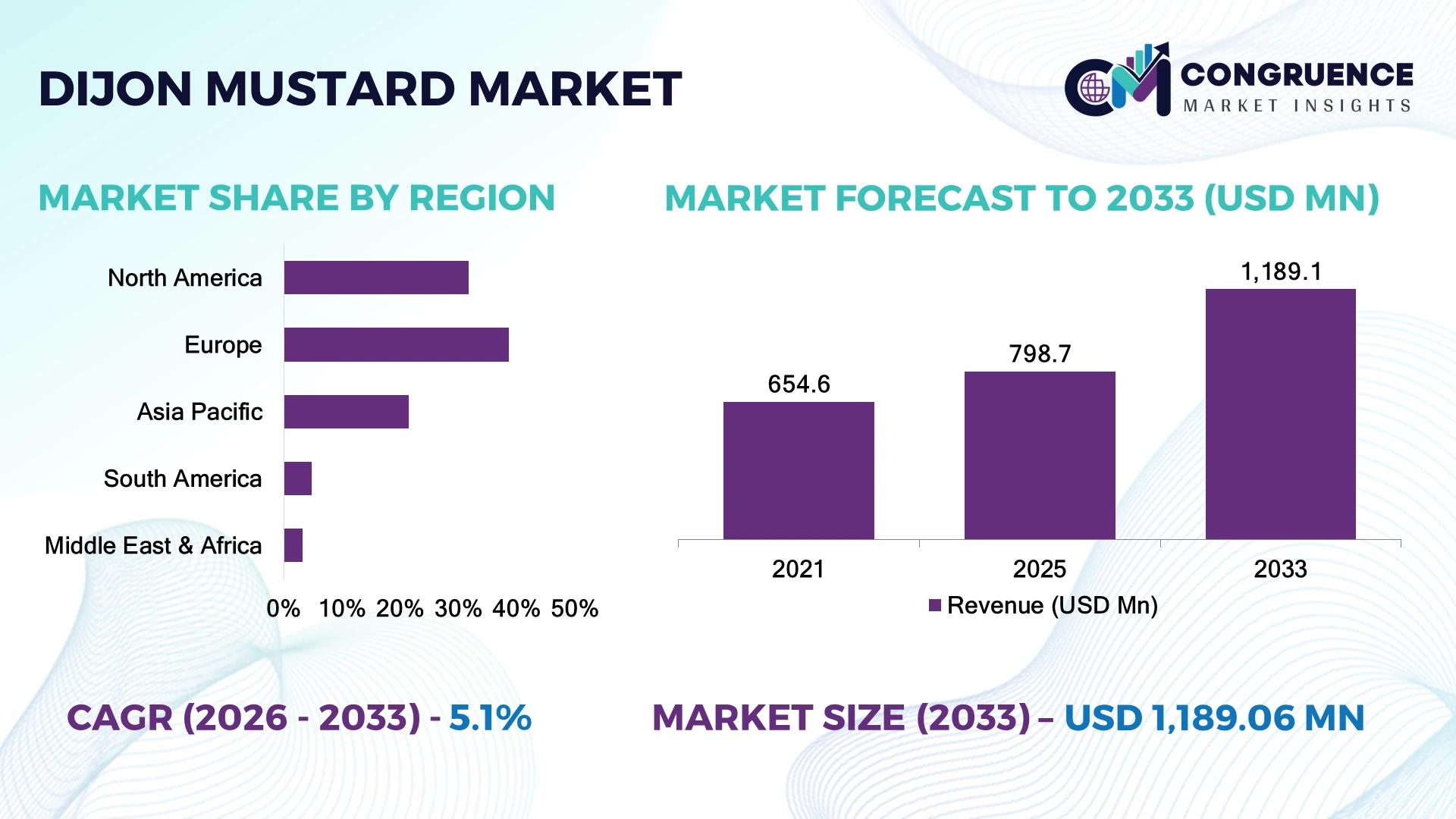
The Global Dijon Mustard Market was valued at USD 798.7 Million in 2025 and is anticipated to reach a value of USD 1,189.1 Million by 2033 expanding at a CAGR of 5.1% between 2026 and 2033. Growth is being driven by premium condiment consumption, clean-label reformulation, foodservice applications, and stronger use of Dijon-style mustard in sauces, dressings, marinades, and prepared foods.
France remains the strategic reference market for Dijon mustard, supported by established mustard-processing expertise, culinary positioning, and concentrated production capabilities in Burgundy. North America has a larger mass-market condiment base, while France retains stronger premium and gastronomic positioning. Mustard-seed supply remains internationally exposed, with Canada supplying a significant share of global mustard seed and weather volatility influencing procurement costs. Premium Dijon formulations increasingly use whole or traceable seeds, with clean-label variants commanding approximately 10–20% higher shelf pricing.
Strategically, manufacturers should secure mustard-seed supply while expanding premium, foodservice, and clean-label Dijon formulations.
Market Size & Growth: USD 798.7 Million in 2025 to USD 1,189.1 Million by 2033 at 5.1% CAGR, supported by premium condiments and foodservice applications.
Top Growth Drivers: Premiumization +6–9%, foodservice penetration +5–8%, clean-label formulations +7–10%.
Short-Term Forecast: By 2028, automated filling and batching can improve production efficiency 8–12% while reducing formulation-related waste by 3–6%.
Emerging Technologies: Precision milling, automated emulsification, optical quality inspection, and digital batch monitoring are improving mustard consistency and production control.
Regional Leaders: Europe is projected near USD 390 Million, North America around USD 330 Million, and Asia-Pacific approximately USD 220 Million, with premium mustard adoption strengthening in urban foodservice channels.
Consumer/End-User Trends: Clean-label and preservative-conscious condiment purchases are increasing premium Dijon product penetration by approximately 7–10% in developed retail markets.
Pilot/Case Example: 2025 premium condiment programs increasingly shifted toward recyclable packaging and controlled-dose formats, reducing packaging material use by approximately 10–15% in selected production lines.
Competitive Landscape: Maille remains a leading premium Dijon brand, competing with Grey Poupon, Edmond Fallot, Pommery, and regional private-label producers across retail and foodservice.
Regulatory & ESG Impact: Packaging redesign and recyclable-material adoption are reducing plastic or composite packaging intensity by approximately 10–20% across selected condiment portfolios.
Investment & Funding: Manufacturers are directing capital toward automated filling, flexible packaging, seed sourcing, and regional distribution, with selected modernization projects targeting 10–15% higher production efficiency.
Innovation & Future Outlook: Next-generation Dijon products are moving toward traceable mustard seed, organic formulations, reduced-sugar recipes, recyclable packaging, and foodservice-ready dispensing systems.
The Dijon Mustard Market is concentrated around premium retail condiments, sauces and dressings, marinades, sandwiches, prepared foods, and restaurant applications. Clean-label products, organic formulations, whole-seed textures, and reduced-additive recipes are strengthening premium positioning, with differentiated products achieving approximately 10–20% price premiums. Mustard-seed procurement remains strategically important as Canadian weather conditions and international commodity logistics influence ingredient availability and processing costs, creating a natural transition toward supply-chain resilience.
The Dijon Mustard Market is becoming strategically important because mustard is shifting from a basic condiment into a premium flavor ingredient used across retail, foodservice, sauces, dressings, marinades, and prepared foods. Manufacturers increasingly compete through ingredient provenance, texture, acidity balance, clean-label credentials, and packaging convenience rather than flavor alone. Supply-chain resilience is also becoming more important as mustard-seed procurement remains exposed to agricultural yields and international logistics.
Production modernization is creating measurable efficiency advantages. Automated batching, precision milling, inline filling, and optical inspection can improve processing efficiency by approximately 8–15% compared with labor-intensive workflows while reducing batch variability. France maintains strong premium and culinary positioning, whereas the United States and Canada emphasize larger retail and foodservice volumes. Asia-Pacific is developing through urban foodservice expansion and greater adoption of Western-style sauces and dressings.
During 2026–2028, manufacturers will prioritize traceable seed sourcing, recyclable packaging, automated production, and application-specific formulations. Foodservice partnerships provide an important deployment pathway because standardized dispensing formats can improve portion control and reduce product waste by approximately 5–10%. Companies that combine authentic Dijon positioning with reliable seed procurement, efficient processing, and scalable foodservice distribution will strengthen competitive positioning.
Premium condiment consumption is shifting Dijon mustard from a table condiment toward a formulation ingredient in sauces, dressings, marinades, sandwiches, and prepared foods. Premium and clean-label variants command approximately 10–20% higher pricing, while foodservice applications can increase Dijon-based usage by 6–9% through standardized recipes. France retains strong culinary positioning, while U.S. food processors are expanding mustard applications across premium prepared foods. Manufacturers are responding with organic lines, whole-seed textures, controlled acidity, and foodservice packs. The non-obvious driver is cross-category utilization: one Dijon formulation can serve retail, restaurant, and industrial sauce applications, improving production utilization and reducing SKU-specific manufacturing complexity.
Dijon mustard production remains exposed to mustard-seed availability, agricultural yields, and cross-border procurement, with raw mustard seed and related ingredients often representing approximately 20–30% of finished-product input costs. Weather disruptions can increase seed procurement costs by 10–25%, while extended logistics routes add further inventory requirements. Canadian production is particularly important to international mustard-seed supply, creating exposure to crop variability and trade conditions. Manufacturers are responding through multi-origin procurement, forward purchasing, safety-stock policies, and supplier diversification across Canada and European sources. The strategic restraint is therefore not processing capacity but ingredient-cost predictability: a processor with efficient filling equipment can still lose margin rapidly when seed costs rise faster than retail pricing.
Traceable seed sourcing, organic Dijon, whole-grain textures, reduced-additive recipes, and recyclable packaging are creating premium niches beyond conventional yellow condiments. Premium formats can support 10–20% higher shelf pricing, while foodservice-ready dispensing systems can reduce portion-related product waste by approximately 5–10%. France and Germany provide strong premium positioning, whereas urban U.S. and Asian foodservice channels offer expansion opportunities. Manufacturers are investing in QR-enabled provenance, automated portion control, and flexible packaging formats. A less obvious opportunity is ingredient-grade Dijon: concentrated mustard preparations can serve sauces, marinades, dressings, and prepared foods, allowing processors to monetize the same production platform across multiple downstream applications.
Dijon mustard requires tight control of seed particle size, acidity, moisture, spice intensity, and emulsion stability, creating execution complexity across high-volume production. Variations in seed characteristics can alter sensory intensity by approximately 5–15%, while batch-to-batch viscosity differences can increase filling adjustments by 5–10%. Export-oriented manufacturers must also maintain consistent specifications across different seed origins and production sites. Companies are responding with automated milling, inline viscosity monitoring, standardized blending protocols, and digital batch records. The long-term challenge is scaling authentic sensory characteristics without increasing quality-control labor or formulation adjustments. Producers that combine analytical testing with flexible processing lines can maintain consistent taste while supporting multiple pack sizes and customer specifications.
Seed Traceability Enters Premium Positioning: Dijon manufacturers are increasing emphasis on mustard-seed origin, farming practices, and ingredient transparency, with traceable or premium formulations supporting approximately 10–20% price premiums. European retailers are strengthening provenance requirements, while manufacturers are developing supplier documentation and digital traceability systems. The operational effect is greater procurement visibility, but also tighter qualification requirements for agricultural suppliers and processors.
Foodservice Formats Gain Importance: Restaurants, catering operators, and prepared-food manufacturers are shifting toward bulk and controlled-dose Dijon formats, with portion-control systems reducing product waste by approximately 5–10% and improving dispensing consistency by 8–12%. U.S. and European foodservice suppliers are expanding larger packs, squeeze systems, and standardized formulations. This creates recurring B2B demand distinct from retail jar purchases.
Packaging Redesign Reduces Material Intensity: Condiment producers are transitioning toward lighter jars, flexible packs, recyclable plastics, and optimized closures. Selected packaging redesigns can reduce material consumption by approximately 10–20% while lowering transport weight by 5–10%. European packaging requirements are accelerating redesign activity, prompting manufacturers to coordinate packaging engineers, filling-line suppliers, and retailers rather than treating packaging as a final-stage marketing decision.
Automated Processing Tightens Consistency: Modern Dijon production is increasingly using automated milling, controlled emulsification, inline viscosity measurement, and digital batch monitoring. Automated process control can improve throughput by approximately 8–15% and reduce batch variability by 5–10%. French and German producers are upgrading processing lines to preserve traditional flavor profiles while increasing industrial scale, demonstrating that automation is becoming a tool for authenticity rather than simply cost reduction.
Smooth/Traditional Dijon remains the leading type, accounting for approximately 56–60% of the global Dijon Mustard Market in 2025. Its dominance reflects established consumer recognition, scalable milling and emulsification processes, and broad compatibility with sandwiches, sauces, dressings, and marinades. Whole Grain Dijon represents roughly 22–26%, supported by premium texture and artisanal positioning, while flavored and specialty Dijon variants account for approximately 15–20% and remain important for premium differentiation.
Whole Grain Dijon is the fastest-growing type, with adoption increasing by approximately 7–10% as retailers and foodservice operators expand texture-led and culinary-positioned offerings. Companies are therefore allocating more R&D toward seed particle consistency, organic formulations, and premium packaging rather than relying solely on conventional smooth recipes. The strategic shift is significant: whole-grain products allow manufacturers to command higher shelf positioning while using the same underlying mustard-processing infrastructure.
Agriculture and Agri-Food Canada reported that Canadian mustard exports reached approximately 95,000 tonnes in 2025–26, while brown and oriental seed pricing remained stronger than yellow mustard, reinforcing manufacturers’ need to manage type-specific sourcing economics.
Sauces & Dressings represent the leading application, accounting for approximately 32–36% of Dijon mustard demand. Dijon’s emulsification capability, acidity, and flavor intensity make it particularly suitable for vinaigrettes, creamy sauces, dipping formulations, and prepared-food recipes. Sandwiches & Burgers account for approximately 24–28%, while Marinades & Meat Preparations represent 18–22%. Foodservice and culinary applications collectively continue shifting Dijon from a table condiment toward a formulation ingredient.
Marinades & Meat Preparations are among the fastest-growing applications, with usage expanding approximately 7–10% as processors and restaurant operators seek multipurpose flavor systems. Companies are developing standardized Dijon bases for sauces, marinades, and dressings, improving batch consistency and reducing formulation complexity. The commercial implication is greater B2B demand for bulk and foodservice formats, particularly in the U.S., France, and Germany, where menu innovation increasingly uses signature sauces as differentiation.
Datassential reported in 2025 that 3 in 5 consumers were interested in signature sauces, condiments, or dressings at restaurants, while 52% specifically expressed interest in signature sauces, strengthening the commercial case for Dijon-based culinary formulations.
Households remain the leading end-user, representing approximately 52–56% of global Dijon mustard demand, supported by established retail consumption and widespread use with sandwiches, meats, salads, and home cooking. Foodservice accounts for approximately 24–28%, while food manufacturers contribute roughly 16–20% through sauces, prepared foods, dressings, and marinades. Institutional users remain comparatively smaller but provide incremental demand through catering and standardized meal programs.
Foodservice is the fastest-growing end-user, expanding approximately 7–10% as restaurants use premium condiments to differentiate menus and develop proprietary sauces. Manufacturers are responding with larger-format packs, controlled-dose dispensing, customized formulations, and private-label partnerships. In France, established mustard consumption provides a stable household base, while U.S. restaurant chains create higher-value opportunities through signature sauce programs. The strategic shift is toward serving foodservice and industrial buyers with application-specific Dijon rather than relying exclusively on retail jars.
A 2026 Datassential update found that condiment, sauce, and dressing launches among major U.S. chains increased to 40 in 2025 from 36 in 2024 and 18 in 2023, indicating sustained foodservice experimentation and expanding demand for differentiated condiment formulations.
Europe accounted for the largest market share at 38.7% in 2025 however, Asia-Pacific is expected to register the fastest growth, expanding at a CAGR of 6.3% between 2026 and 2033.

Premium Retail and Foodservice Applications Broaden Demand
North America represents approximately 31.8% of global Dijon mustard demand, supported by the United States' large packaged-condiment and foodservice ecosystem. Retail remains the principal volume channel, while restaurant chains and prepared-food manufacturers are increasing Dijon usage in sauces, dressings, sandwiches, and marinades. Premium and clean-label formulations command approximately 10–20% higher shelf pricing, encouraging manufacturers to expand organic, reduced-additive, and whole-seed portfolios. U.S. processors are also shifting toward larger foodservice packs and controlled-dose dispensing, improving portion consistency and reducing product waste by approximately 5–10%. Private-label production remains strategically important as retailers seek differentiated premium condiments without fully absorbing brand-building costs. Manufacturers are therefore investing in flexible filling lines capable of handling multiple viscosities, jar sizes, and foodservice formats.
United States Market Outlook: The United States is the region's principal demand center, supported by extensive supermarket penetration, restaurant-chain purchasing, and a sophisticated private-label manufacturing base. Dijon is increasingly incorporated into signature sauces and prepared-food formulations, allowing suppliers to move from standalone condiment sales toward recurring B2B ingredient contracts. Foodservice-oriented formats provide manufacturers with higher-volume orders and more predictable production utilization.
Authenticity and Sustainable Processing Reinforce Premium Positioning
Europe accounts for approximately 38.7% of global Dijon mustard demand, with France providing the strongest culinary and production identity. Premiumization, geographical authenticity, organic ingredients, and clean-label formulations are increasingly influencing product development. European manufacturers are simultaneously responding to packaging and sustainability requirements through lighter containers, recyclable formats, and optimized closures, with selected redesigns reducing packaging-material consumption by approximately 10–20%. Germany, France, and the United Kingdom remain important retail and foodservice markets, while industrial sauce producers increasingly use Dijon as a standardized flavor component. The region's strategic advantage lies in combining culinary heritage with sophisticated food-processing infrastructure, allowing established producers to commercialize premium formulations without abandoning large-scale manufacturing economics.
France Market Outlook: France remains the strategic center of Dijon mustard production and premium positioning, particularly around Burgundy. Established mustard producers benefit from specialized milling, blending, filling, and culinary-development capabilities. The country's strong restaurant and gastronomy ecosystem also supports product experimentation, while premium, organic, and whole-seed formats enable manufacturers to defend higher price points.
Urban Foodservice Creates a New Condiment Consumption Layer
Asia-Pacific represents approximately 21.5% of global Dijon mustard demand but is developing the fastest consumption trajectory as Western-style dining, premium sandwiches, bakery products, salads, and prepared foods expand in China, Japan, South Korea, and Australia. Foodservice demand is particularly important because Dijon can be incorporated into sauces and marinades rather than consumed solely as a table condiment. Premium imported and locally formulated products can command approximately 10–20% pricing premiums, while foodservice formulations can improve bulk-product utilization by 5–10%. Manufacturers are responding through localized flavor profiles, smaller retail packs, foodservice partnerships, and domestic blending operations. The strategic opportunity is adaptation: suppliers that localize acidity, spice intensity, and packaging can broaden Dijon beyond its traditional Western culinary positioning.
China Market Outlook: China represents the region's most significant long-term expansion market, supported by urban restaurant development, premium grocery formats, bakery chains, and Western-style prepared foods. Dijon usage is increasingly shifting toward recipe integration rather than direct table consumption. Local formulation and packaging can shorten replenishment cycles and reduce imported-product cost disadvantages, giving domestic suppliers greater flexibility.
Premium Urban Foodservice Drives Selective Market Expansion
South America represents approximately 4.8% of global Dijon mustard demand, with Brazil accounting for the largest consumption base. Demand is concentrated in major urban centers where premium supermarkets, burger chains, hotels, restaurants, and packaged-food manufacturers support broader condiment variety. Dijon is increasingly used in sauces, meat marinades, sandwiches, and gourmet foodservice, with these applications generating approximately 6–9% stronger usage than conventional table-condiment positioning. Import dependence for specialized premium products can lengthen replenishment cycles and expose distributors to currency movements, encouraging local blending and private-label production. Manufacturers are therefore prioritizing flexible packaging, localized formulations, and foodservice contracts rather than relying exclusively on imported branded jars.
Brazil Market Outlook: Brazil is the region's principal commercial market, supported by its large packaged-food industry and extensive restaurant network. Major urban markets such as São Paulo and Rio de Janeiro provide the strongest premium-condiment demand. Local manufacturers can capture additional volume by adapting Dijon formulations to Brazilian meat, sandwich, and sauce applications while using domestic packaging and distribution infrastructure.
Hospitality Investment Expands Premium Condiment Demand
Middle East & Africa accounts for approximately 2.7% of global Dijon mustard demand, with consumption concentrated in Gulf hospitality markets, South African retail, and international restaurant chains. Saudi Arabia and the United Arab Emirates are particularly relevant because hotel, catering, quick-service restaurant, and premium dining investments create institutional demand for standardized imported and locally packed condiments. Foodservice formats can reduce portion waste by approximately 5–10%, making bulk dispensing attractive to large hospitality operators. Import logistics, temperature-controlled storage requirements, and fragmented retail infrastructure remain operational considerations. Suppliers are responding through distributor partnerships, larger-format packs, localized warehousing, and foodservice-specific contracts, with premium hospitality providing a more attractive entry point than broad mass-market penetration.
Saudi Arabia Market Outlook: Saudi Arabia is the region's most strategically significant market because hospitality, tourism, and restaurant infrastructure is expanding rapidly under economic diversification programs. Large hotels, international restaurant operators, and catering companies require consistent condiment specifications across multiple locations. Suppliers offering bulk Dijon formats, reliable local distribution, and standardized formulations can build recurring institutional demand beyond conventional retail channels.
Maille, Grey Poupon, Edmond Fallot, Reine de Dijon, and Charbonneaux-Brabant compete across branded, premium, private-label, and foodservice channels. Maille and Grey Poupon emphasize brand recognition and distribution, while Fallot and Reine de Dijon compete through French provenance, seed sourcing, and specialty formulations. The top five are estimated to represent 42% combined market share, leaving space for regional and private-label suppliers. Competition centers on price, authenticity, formulation flexibility, and supply security; premium products command roughly 10–20% pricing premiums, while localized seed sourcing can reduce transport exposure by 5–10%. Reine de Dijon is expanding bulk and organic formats, Fallot emphasizes regional seeds and stone-ground processing, and branded players leverage retail scale and foodservice distribution. The competitive shift is toward supply-chain control, provenance, and application-specific formats rather than branding. Entry barriers include retailer access, food-safety certification, seed quality, and formulation expertise. Winning requires secure sourcing, scalable processing, differentiated recipes, and multi-channel distribution.
Unilever PLC
Kraft Heinz Company
McCormick & Company, Inc.
Develey Senf & Feinkost GmbH
Edmond Fallot
Reine de Dijon SAS
Charbonneaux-Brabant SA
Delouis Fils
Bornier
Les Assaisonnements Briards
Moutarderie Bister
Mautner Markhof Feinkost GmbH
Stonewall Kitchen
Maille & Co.
Dijon mustard processing is adopting automated seed cleaning, precision dosing, inline viscosity control, and digital batch monitoring. Compared with labor-intensive manual batching, automated dosing can improve formulation consistency by 5–8% and processing efficiency by 8–12%. Adoption is strongest among French processors and private-label manufacturers handling multiple recipes. The competitive benefit is tighter sensory specifications, lower rework, and faster changeovers across jar and foodservice formats.
Traceability technology is becoming more important as manufacturers diversify seed origins and expand French sourcing. Digital lot tracking can reduce ingredient-traceability time by 20–30%, while automated quality checkpoints can cut manual inspection effort by 10–15%. Reine de Dijon and other industrial producers benefit through stronger procurement visibility, faster recall isolation, and reliable customer documentation. Smaller artisanal mills retain stone grinding as a differentiation technology rather than replacing it with high-throughput milling.
Between 2026 and 2028, optical inspection, predictive maintenance, recyclable-packaging automation, and AI-assisted formulation are likely to move from selective deployment toward broader industrial use. Optical checks can reduce packaging defects by 5–10%, while predictive maintenance can lower unplanned downtime by 5–8%. Cost-focused manufacturers gain from automation, whereas premium players gain from traceability and sensory repeatability. The priority is integrating digital controls without compromising flavor profiles.
August 2024 Reine de Dijon opened a new production line as Burgundy mustard output recovered, with regional growers targeting 12,000 tonnes. The expansion supported order fulfillment and reinforced local-seed integration after earlier shortages across French processors. Source: Dijon Beaune Mag
March 2025 Reine de Dijon expanded export visibility through Business France’s IFE 2025 program, presenting 15-tonne and 25-tonne tanker formats plus 200-kg drums. The move strengthened bulk foodservice positioning and international customer access across several new markets overseas. Source: Business France
August 2025 Taiwan authorities flagged a Beaufor mustard shipment from Charbonneaux-Brabant after detecting 0.079 g/kg sulfur dioxide against a 0.030 g/kg limit. The incident triggered return or destruction, highlighting export compliance pressure for French manufacturers globally today. Source: Taiwan FDA
June 2026 Burgundy’s mustard harvest began early, with Côte-d’Or producers estimating 14,000–15,000 tonnes. The recovery strengthens French seed availability for processors and reduces dependence on distant imports while increasing the importance of climate-resilient agronomy across Burgundy production. Source: dijonbeaunemag.fr (DijonBeaune.fr)
The Dijon Mustard Market Report evaluates demand across Smooth/Traditional Dijon, Whole Grain Dijon, and Flavored & Specialty variants, with application coverage spanning sauces and dressings, sandwiches and burgers, marinades and meat preparations, and other culinary uses. End-user analysis covers households, foodservice operators, food manufacturers, and institutional buyers, identifying shifts toward premium formulations, bulk formats, and ingredient-led applications.
The report provides regional analysis across North America, Europe, Asia-Pacific, South America, and Middle East & Africa, with country-level assessment of the United States, France, China, Brazil, and Saudi Arabia. Technology coverage examines automated dosing, precision milling, inline quality control, digital traceability, optical inspection, predictive maintenance, and sustainable packaging. Strategic analysis supports sourcing, capacity planning, geographic expansion, product positioning, competitive benchmarking, and investment decisions through 2026–2033, including emerging opportunities in foodservice, private label, organic products, provenance-led formulations, and localized mustard-seed supply.
| Report Attribute/Metric | Report Details |
|---|---|
|
Market Revenue in 2025 |
USD 798.7 Million |
|
Market Revenue in 2033 |
USD 1,189.1 Million |
|
CAGR (2026 - 2033) |
5.1% |
|
Base Year |
2025 |
|
Forecast Period |
2026 - 2033 |
|
Historic Period |
2021 - 2025 |
|
Segments Covered |
By Type
By Application
By End-User
|
|
Key Report Deliverable |
Revenue Forecast, Growth Trends, Market Dynamics, Segmental Overview, Regional and Country-wise Analysis, Competition Landscape |
|
Region Covered |
North America, Europe, Asia-Pacific, South America, Middle East, Africa |
|
Key Players Analyzed |
Unilever PLC, Kraft Heinz Company, McCormick & Company, Inc., Develey Senf & Feinkost GmbH, Edmond Fallot, Reine de Dijon SAS, Charbonneaux-Brabant SA, Delouis Fils, Bornier, Les Assaisonnements Briards, Moutarderie Bister, Mautner Markhof Feinkost GmbH, Stonewall Kitchen, Maille & Co. |
|
Customization & Pricing |
Available on Request (10% Customization is Free) |




