
Reports
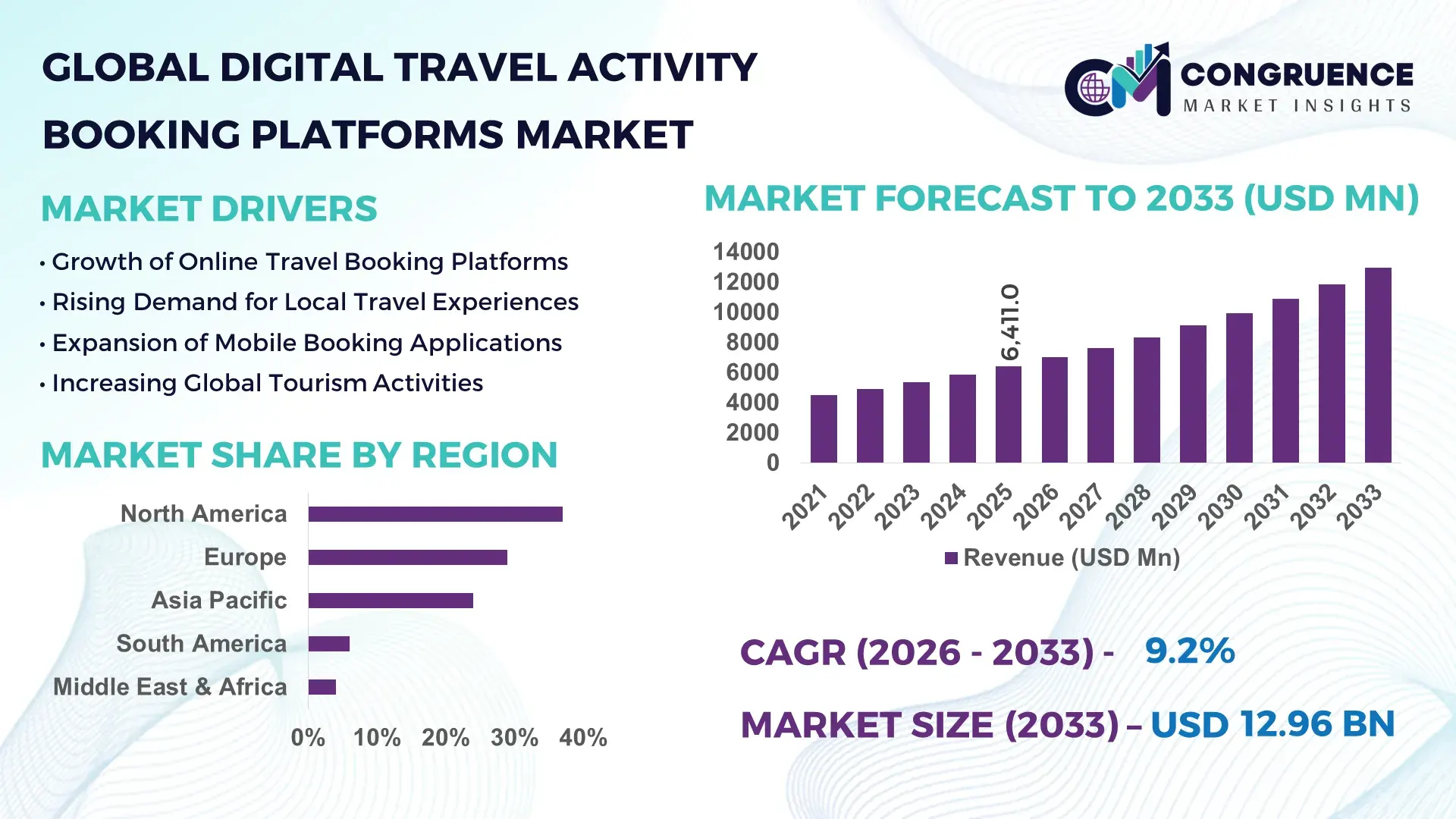
The Global Digital Travel Activity Booking Platforms Market was valued at USD 6,411.0 Million in 2025 and is anticipated to reach a value of USD 12,963.0 Million by 2033 expanding at a CAGR of 9.2% between 2026 and 2033, according to an analysis by Congruence Market Insights. The expansion is primarily supported by the rapid digitalization of travel planning, increasing mobile bookings, and growing demand for personalized travel experiences across global tourism markets.
The United Statesremains a dominant hub in the Digital Travel Activity Booking Platforms Market due to its strong digital travel infrastructure and high investment in tourism technology. Over 72% of U.S. travelers book travel experiences online, with mobile devices accounting for nearly 58% of activity bookings. Major travel platforms and aggregators have collectively invested over USD 2.5 billion in travel-tech innovation since 2022, supporting AI-driven itinerary planning and real-time availability systems. Additionally, the U.S. tourism sector hosted more than 66 million international visitors in 2024, creating extensive demand for guided tours, event tickets, and local experiences sold through digital booking platforms.
Market Size & Growth: The market was valued at USD 6,411.0 Million in 2025 and is projected to reach USD 12,963.0 Million by 2033, expanding at a 9.2% CAGR, driven by increasing online travel bookings and mobile-based activity reservations worldwide.
Top Growth Drivers: Mobile booking adoption exceeding 58%, AI-enabled recommendation engines improving booking conversion rates by 35%, and real-time inventory integration increasing supplier participation by 40%.
Short-Term Forecast: By 2028, digital travel booking platforms are expected to reduce manual reservation processing by 45%and improve booking confirmation speeds by 60% through automated inventory synchronization.
Emerging Technologies: AI-powered itinerary engines, blockchain-based payment authentication, and augmented reality (AR) previews for tourist activities are transforming digital travel experience marketplaces.
Regional Leaders: North America projected to reach USD 4.8 billion by 2033 with high mobile booking penetration; Europe expected to approach USD 3.9 billion driven by cultural tourism experiences; Asia-Pacific forecast to exceed USD 3.2 billion supported by rapid growth in online travel marketplaces.
Consumer/End-User Trends:Millennials and Gen-Z travelers account for nearly 64% of digital activity bookings, with experiential tourism such as local tours and adventure sports growing 30% fasterthan traditional sightseeing packages.
Pilot or Case Example:In 2024, a smart-tourism pilot implemented in Singapore integrated AI-driven booking platforms with tourism APIs, improving visitor activity bookings by 38%and reducing booking errors by 22%.
Competitive Landscape:Market leadership remains concentrated with Booking Holdings (~24%), followed by Expedia Group, Tripadvisor, Klook, and GetYourGuidecompeting through localized experiences and AI-based travel personalization.
Regulatory & ESG Impact:Tourism authorities in over 45 countriesnow require digital ticketing and verified vendor listings to improve traveler safety, while sustainability certification programs are influencing 30% of travel platform listings.
Investment & Funding Patterns:Global travel-tech startups secured more than USD 3.7 billion in venture investments between 2022 and 2025, with increasing funding directed toward AI travel assistants and automated booking engines.
Innovation & Future Outlook:Integration of AI travel planning, super-app travel ecosystems, and predictive demand analytics is expected to redefine traveler engagement and supplier distribution across digital travel activity marketplaces.
Digital Travel Activity Booking Platforms Market growth is strongly influenced by tourism, entertainment, and adventure travel sectors, contributing approximately 45%, 28%, and 17%of platform transactions respectively. AI-driven itinerary builders and dynamic pricing tools are improving booking conversion rates by nearly 30%. Regulatory digital ticketing mandates and growing mobile travel usage across Asia-Pacific and Europe continue to reshape regional consumption patterns, while super-app travel ecosystems and immersive booking interfaces are emerging as key future industry trends.
The Digital Travel Activity Booking Platforms Market has become strategically critical for the global tourism ecosystem as travelers increasingly rely on centralized digital marketplaces to discover, compare, and book local experiences. With more than 70% of global travelers now using digital platforms to plan activities, tourism operators are prioritizing online distribution channels to maximize visibility and booking efficiency. Platforms integrating artificial intelligence-based personalization tools can improve booking conversions by 32% compared to traditional manual search-based booking systems, highlighting the growing strategic importance of advanced analytics in travel marketplaces.
Technology transformation is shaping the competitive landscape of digital travel booking platforms. For instance, AI-powered recommendation engines deliver nearly 35% improvement in booking engagement compared to static listing interfaces, enabling travel companies to deliver hyper-personalized travel experiences. Similarly, automated supplier onboarding and API-driven inventory management systems allow tour operators to synchronize availability across multiple travel platforms, reducing booking conflicts by approximately 40%.
Regional dynamics also illustrate strategic variations. North America dominates in transaction volume, supported by a mature digital tourism ecosystem and high smartphone adoption. Meanwhile, Asia-Pacific leads in adoption intensity, with nearly 68% of travelers using mobile applications for activity reservations, particularly in countries such as China, South Korea, and Singapore where digital tourism ecosystems are integrated with super-apps.
Short-term technology projections suggest that by 2028, AI-enabled travel assistants will reduce travel planning time by 30%while improving itinerary accuracy and traveler satisfaction metrics. Sustainability compliance is also shaping platform strategies. Tourism platforms are committing to 20% improvements in eco-certified activity listings by 2030, helping travelers identify environmentally responsible experiences and supporting destination sustainability goals.
A micro-scenario illustrates the operational benefits of technology adoption. In 2024, a smart tourism initiative in Singapore integrated AI travel recommendations with local attraction booking platforms, improving tourist activity participation by 36%and reducing idle attraction capacity by 18% through predictive demand analytics.
As tourism becomes increasingly experience-driven, the Digital Travel Activity Booking Platforms Market is emerging as a foundational pillar for the digital tourism economy. The sector is expected to continue evolving through AI integration, sustainability frameworks, and advanced booking automation, positioning digital travel platforms as critical enablers of resilient, compliant, and sustainable tourism growth worldwide.
The Digital Travel Activity Booking Platforms Market is undergoing rapid transformation as global tourism becomes increasingly digitized and experience-driven. Travelers now rely heavily on online platforms to discover local tours, cultural experiences, adventure activities, and attraction tickets in real time. Nearly 65% of global leisure travelers search and reserve destination activities through digital platforms, reflecting a shift away from traditional travel agencies. The rise of mobile-first travel planning has further accelerated platform adoption, with smartphones accounting for more than 55% of activity reservations worldwide.
Digital integration between tourism operators and booking platforms is improving operational efficiency across the travel ecosystem. Automated inventory synchronization, API-based integrations with local operators, and real-time ticketing solutions are helping tourism companies reduce manual booking errors by nearly 40%. Additionally, travel activity marketplaces are expanding their supplier networks, with some platforms hosting over 100,000 local experiences across more than 150 countries. The growing popularity of experiential tourism, particularly among millennials and Gen-Z travelers, is also influencing market dynamics, with adventure tourism bookings rising by approximately 28% over the past three years. These developments highlight the increasing strategic importance of digital booking platforms within the global travel value chain.
Experiential tourism has become a major growth catalyst for digital travel activity booking platforms, as travelers increasingly prioritize unique experiences over traditional sightseeing packages. Surveys indicate that nearly 72% of global travelers prefer booking experiences such as guided tours, culinary workshops, cultural activities, and adventure sportsrather than purchasing conventional travel packages. Digital platforms enable travelers to compare thousands of activities across multiple destinations, significantly improving decision-making and convenience. The expansion of adventure tourism and local cultural experiences has further accelerated the adoption of digital booking systems. For example, adventure activities such as scuba diving, hiking expeditions, and wildlife tours recorded booking growth of more than 30% globally between 2022 and 2025. Digital platforms allow small local operators to access global audiences by listing their activities online, increasing visibility and customer reach. Additionally, personalization technologies are strengthening this trend. AI-based travel recommendation engines can analyze traveler preferences, past bookings, and behavioral patterns to suggest curated experiences, improving booking engagement by approximately 35%. As experiential travel continues to gain momentum worldwide, digital travel activity booking platforms are becoming essential intermediaries connecting tourists with local experience providers.
Despite strong adoption trends, the Digital Travel Activity Booking Platforms Market faces operational challenges due to fragmented supplier ecosystems. The global tourism industry consists of thousands of small and medium-sized tour operators who often lack standardized booking systems or digital inventory management tools. Nearly 60% of small tourism operators still rely on manual reservation processes, making real-time availability updates difficult for online platforms. This fragmentation results in inconsistent inventory synchronization, which can lead to double bookings or outdated listings. Such operational inefficiencies negatively affect customer satisfaction and platform reliability. In addition, smaller tourism providers often face technological and financial barriers when integrating with digital booking platforms, particularly in developing tourism destinations. Another restraint is the complexity of cross-border regulations affecting travel platforms. Different countries impose varying licensing requirements, digital taxation policies, and consumer protection regulations. Travel activity platforms operating globally must adapt to these regulatory frameworks, increasing operational complexity and compliance costs. These challenges highlight the need for standardized booking infrastructure and improved digital training for tourism operators worldwide.
The emergence of smart tourism ecosystems presents significant opportunities for digital travel activity booking platforms. Governments and tourism boards are increasingly investing in digital tourism infrastructure to enhance visitor experiences and improve destination management. More than 50 global tourism destinations have implemented smart tourism initiatives, integrating mobile applications, digital ticketing systems, and real-time travel data. Smart tourism infrastructure enables seamless integration between attractions, transportation services, and digital activity booking platforms. For example, integrated travel apps allow visitors to purchase attraction tickets, book guided tours, and reserve transportation services through a single digital interface. Such integration can increase tourist participation in local activities by 25–35%, improving destination revenue generation. Additionally, the rapid growth of super-app ecosystems in Asia is creating new opportunities for travel booking platforms. In markets such as China and Southeast Asia, super-apps integrate travel bookings with payment systems, ride-hailing services, and entertainment platforms. These integrated ecosystems simplify travel planning and expand distribution channels for activity booking platforms. As more destinations adopt smart tourism strategies, digital travel booking platforms are likely to play a central role in connecting travelers with curated local experiences.
Data security and trust concerns represent significant challenges for digital travel activity booking platforms. These platforms process large volumes of personal information, including payment data, travel preferences, and location details. As cyber threats continue to rise, online travel platforms have become frequent targets for phishing attacks, identity theft, and payment fraud. Industry reports suggest that travel and hospitality platforms experience approximately 20% higher cybersecurity incidents compared to other e-commerce sectors, largely due to the volume of financial transactions and user data processed during travel bookings. Any breach in platform security can damage consumer confidence and negatively affect platform adoption. Another challenge involves ensuring the authenticity and quality of listed activities. With thousands of independent tour operators using digital marketplaces, verifying service quality and safety standards becomes complex. Platforms must invest in vendor verification systems, customer review monitoring, and fraud detection algorithms to maintain trust among users. Furthermore, managing multilingual interfaces, cross-border payment systems, and local compliance requirements increases operational complexity. Overcoming these challenges requires strong cybersecurity infrastructure, robust vendor verification frameworks, and improved regulatory coordination within the global tourism industry.
Rapid growth in mobile-first travel booking ecosystems: Mobile applications have become the primary interface for travel activity bookings worldwide. More than 58% of global activity reservations are now completed through smartphones, reflecting a shift toward mobile-first travel planning. Travel platforms have introduced app-based booking features such as instant ticket downloads, location-based activity recommendations, and real-time customer support. In Asia-Pacific alone, mobile-based travel activity bookings increased by 42% between 2022 and 2025, supported by high smartphone penetration and widespread adoption of digital wallets.
AI-driven personalization improving traveler engagement by 30%+: Artificial intelligence is increasingly integrated into digital travel booking platforms to enhance user experience and improve booking conversion rates. AI recommendation engines analyze traveler preferences, browsing behavior, and past travel history to provide tailored activity suggestions. Platforms implementing AI-based personalization have reported engagement improvements of nearly 35%and booking conversion increases of around 28%. In addition, predictive demand analytics enables travel companies to forecast tourist activity demand with approximately 25% higher accuracy, improving operational planning for tour operators and destination managers.
Expansion of local experience marketplaces with 100,000+ activities: Digital travel activity marketplaces are expanding rapidly as tourism operators recognize the benefits of online distribution channels. Leading platforms now host more than 100,000 unique travel experiences across 150+ destinations worldwide, ranging from cultural tours and adventure sports to culinary workshops and city exploration packages. The number of small tourism operators listing their services online has increased by approximately 40% over the past four years, allowing travelers to access highly localized experiences previously unavailable through traditional travel agencies.
Integration of super-app ecosystems transforming travel booking behavior: Super-app ecosystems are significantly influencing travel activity booking patterns, particularly in Asia. Platforms integrating travel bookings with payment systems, ride-hailing services, and digital wallets are simplifying travel planning for millions of users. In Southeast Asia, more than 65% of online travelers use super-apps to manage multiple travel services, including attraction tickets and local experiences. These integrated ecosystems enable seamless booking journeys and improve transaction efficiency, reducing booking time by approximately 30% while expanding the reach of digital travel activity platforms.
The Digital Travel Activity Booking Platforms Market is segmented based on type, application, and end-user insights, reflecting the evolving digital travel ecosystem and the increasing shift toward experience-based tourism. Platforms vary significantly in their operational models, including online travel agency platforms, marketplace aggregators, and direct supplier booking systems. These types enable tourism providers and travelers to connect through integrated digital ecosystems that offer real-time inventory management, mobile booking capabilities, and personalized travel recommendations. From an application perspective, travel activity booking platforms support a wide range of tourism-related services, including sightseeing tours, adventure experiences, cultural events, attraction tickets, and local guided services. Increasing smartphone penetration and the rise of experiential tourism have significantly expanded the application scope of digital booking platforms, enabling travelers to reserve activities instantly while at the destination. End-user segmentation highlights the diversity of industry stakeholders involved in this market. Individual leisure travelers remain the primary users of digital travel activity booking platforms, while travel agencies, tourism boards, and corporate travel planners also rely on these systems to streamline itinerary planning and activity distribution. Additionally, the growth of digital tourism ecosystems and smart destination initiatives has encouraged tourism authorities and destination management organizations to integrate booking platforms into their visitor engagement strategies.
The Digital Travel Activity Booking Platforms Market includes several platform types, primarily Online Travel Agency (OTA) Platforms, Marketplace Aggregator Platforms, Direct Supplier Booking Platforms, and Niche or Local Experience Platforms. Each type plays a unique role in facilitating digital tourism transactions and connecting travelers with activity providers globally. Online Travel Agency (OTA) platforms currently account for approximately 48% of platform adoption, making them the leading segment in the market. These platforms dominate because they integrate travel activities with other travel services such as hotel reservations, flight bookings, and transportation planning. Their ability to bundle travel experiences into complete itineraries significantly improves traveler convenience and booking efficiency. Marketplace aggregator platforms hold around 29% of adoption, enabling independent tour operators and local guides to list activities directly. These platforms act as intermediaries connecting thousands of tourism suppliers with global travelers. However, direct supplier booking platforms are emerging as the fastest-growing type, expanding at nearly 12.6% annually, driven by the increasing digitalization of small tourism operators and the availability of cloud-based reservation systems. Niche experience platforms and specialized adventure booking services collectively contribute about 23% of the market, focusing on curated travel experiences such as culinary tours, eco-tourism packages, and adventure activities that appeal to highly targeted traveler segments.
In 2024, a global digital tourism initiative enabled more than 15,000 small tour operators to integrate direct booking engines into their websites, allowing real-time activity reservations and improving online travel experience accessibility for international travelers.
Applications within the Digital Travel Activity Booking Platforms Market primarily include Sightseeing and Cultural Tours, Adventure Tourism Activities, Event and Attraction Ticketing, and Local Experience Reservations. These applications represent the growing demand for curated travel experiences rather than traditional tour packages. Sightseeing and cultural tour bookings represent the leading application segment, accounting for nearly 41% of digital activity reservations.These tours remain popular among international travelers seeking guided experiences in historical landmarks, museums, and heritage sites. Digital booking platforms simplify itinerary planning by allowing travelers to reserve tickets and guided tours in advance. Adventure tourism bookings account for approximately 27% of activity reservations, including scuba diving, trekking, wildlife exploration, and outdoor sports. However, local experience reservations such as food tours, cultural workshops, and community-led activities represent the fastest-growing application segment, expanding at roughly 13.4% annually. Travelers increasingly prioritize authentic experiences that connect them with local culture and communities. Event ticketing and attraction reservations, including theme parks and entertainment events, collectively contribute about 32% of total platform usage, supported by integrated digital ticketing systems and QR-based entry management. Consumer adoption trends highlight strong demand across demographics. Nearly 64% of millennial travelers prefer booking travel activities online, while mobile bookings represent over 55% of total reservations globally. Additionally, digital ticketing solutions have reduced on-site ticket queues by nearly 30% in major tourist destinations.
In 2024, a large-scale digital ticketing initiative across several international tourist attractions introduced QR-based activity reservations, allowing more than 12 million visitors to access attractions through mobile bookings and reducing ticketing wait times by approximately 25%.
End-user segmentation within the Digital Travel Activity Booking Platforms Market includes Individual Leisure Travelers, Travel Agencies & Tour Operators, Corporate Travel Planners, and Destination Management Organizations (DMOs). These users rely on digital platforms to simplify activity discovery, reservation management, and itinerary coordination. Individual leisure travelers represent the dominant end-user segment, accounting for approximately 62% of total platform usage.The high adoption rate is driven by increasing smartphone penetration and the growing preference for independent travel planning. Travelers now frequently rely on digital platforms to compare experiences, read reviews, and secure instant reservations for local activities. Travel agencies and tour operators account for about 21% of platform utilization, leveraging booking platforms to distribute curated travel packages and bundled experiences to international tourists. Corporate travel planners contribute roughly 9% of usage, as companies increasingly integrate team-building experiences and corporate retreats into business travel programs. However, destination management organizations represent the fastest-growing end-user group, expanding at around 12.1% annually, as governments and tourism boards adopt digital booking systems to promote local tourism activities and improve visitor engagement. Industry adoption statistics reinforce these trends. Approximately 67% of travelers worldwide now plan activities independently through digital platforms, while over 45% of tourism operators have adopted online booking systems to reach international customers.
In 2025, a national tourism digitization program enabled more than 8,000 tourism operators to integrate digital booking platforms, allowing travelers to reserve guided tours, cultural experiences, and local attractions through centralized tourism portals.
North America accounted for the largest market share at 37% in 2025 however, Asia-Pacific is expected to register the fastest growth, expanding at a CAGR of 10.8% between 2026 and 2033.
The regional distribution of the Digital Travel Activity Booking Platforms Market reflects variations in digital infrastructure, tourism activity volumes, and consumer booking behavior. North America leads in terms of digital travel technology adoption, supported by high smartphone penetration exceeding 85%and strong integration of online travel services. Europe follows with approximately 29% market share, driven by cultural tourism and well-established travel platforms supporting more than 600 major tourist destinations. Asia-Pacific represents about 24% of the global market, with rapid growth supported by mobile-first travel ecosystems and strong domestic tourism activity. South America and the Middle East & Africa collectively contribute around 10%, supported by expanding tourism infrastructure and increasing adoption of digital travel marketplaces. Regional market dynamics are also influenced by the presence of major travel technology companies, government-led smart tourism programs, and increasing consumer demand for personalized travel experiences.
North America represents approximately 37% of the global Digital Travel Activity Booking Platforms Market, making it the largest regional market. The region benefits from strong digital tourism infrastructure, high internet penetration exceeding 90%, and a well-established ecosystem of travel technology providers. The United States and Canada account for the majority of digital travel activity reservations, with millions of travelers using mobile applications to book local experiences, guided tours, and attraction tickets. Key industries supporting market growth include tourism services, hospitality technology, and digital travel platforms. Government tourism initiatives promoting digital ticketing and smart tourism solutions are also strengthening market expansion. Several national parks and cultural attractions now utilize QR-based digital entry systems, improving visitor management efficiency. Technological advancements such as AI-based travel recommendation engines, predictive demand analytics, and dynamic pricing systems are widely adopted by travel platforms operating in the region. A major travel platform headquartered in the region has expanded its digital experience marketplace to include more than 90,000 travel activities globally, integrating AI-driven itinerary recommendations. Consumer behavior in this region reflects strong digital adoption. More than 70% of travelers in the region research and book travel activities online, while mobile bookings account for nearly 60% of activity reservations.
Europe holds approximately 29% of the global Digital Travel Activity Booking Platforms Market, driven by the region’s strong tourism sector and high demand for cultural experiences. Countries such as Germany, the United Kingdom, France, Italy, and Spainrepresent the largest travel activity markets, collectively hosting more than 500 million international tourist visits annually. European tourism authorities have actively supported digital travel platforms through initiatives that promote smart tourism infrastructure and sustainable travel practices. Regulatory frameworks emphasizing digital ticketing systems and visitor capacity management have accelerated the adoption of online booking platforms for museums, heritage sites, and cultural attractions. Technology adoption within European travel platforms includes AI-based itinerary planning tools, multilingual booking interfaces, and integrated mobile ticketing systems. Many travel platforms operating in the region provide localized travel experiences tailored to international visitors. A European travel platform specializing in curated tours has expanded its marketplace to include more than 30,000 local experiences across 120 cities, enabling small tourism operators to connect with global travelers. Consumer behavior across European markets shows strong demand for sustainable tourism experiences. More than 48% of travelers in the region prefer eco-certified travel activities, influencing digital booking platforms to prioritize sustainable tourism listings.
Asia-Pacific ranks among the most dynamic regions in the Digital Travel Activity Booking Platforms Market and represents roughly 24% of global market participation. The region’s rapid expansion is supported by strong domestic tourism activity, rising middle-class populations, and widespread smartphone adoption exceeding 75% in several major economies. Key consuming countries include China, Japan, India, South Korea, and Thailand, where millions of travelers rely on mobile travel applications to plan and book local experiences. Infrastructure investments in tourism and smart city initiatives are also expanding the role of digital travel booking platforms in regional tourism ecosystems. Technology innovation hubs across Asia-Pacific have introduced advanced travel solutions such as AI-based itinerary planning, mobile super-app integrations, and digital travel wallets. In some countries, travel bookings are increasingly integrated into multi-service mobile ecosystems that combine transportation, payment systems, and attraction ticketing. A regional travel platform has expanded its operations to include more than 200,000 travel experiences across Asia, enabling travelers to reserve guided tours, adventure activities, and local cultural experiences through mobile applications. Consumer behavior trends indicate strong reliance on mobile platforms, with nearly 65% of travelers in the region using smartphones to book travel activities and attractions.
South America contributes approximately 6% of the global Digital Travel Activity Booking Platforms Market, with growing adoption supported by increasing tourism activity and improving digital connectivity. Key markets include Brazil, Argentina, Chile, and Colombia, which collectively host millions of domestic and international travelers each year. Tourism infrastructure investments and government initiatives promoting digital tourism services are helping expand the use of online booking platforms. Several tourist destinations in Brazil and Argentina have introduced digital ticketing systems for national parks, museums, and cultural attractions. Local tourism companies and digital travel platforms are expanding their offerings to include adventure tourism, eco-tourism experiences, and cultural tours across the region. A regional travel technology company has introduced a digital marketplace enabling more than 4,000 local tour operatorsto list their services online. Consumer behavior variations show strong demand for culturally immersive experiences. Nearly 52% of travelers visiting South American destinations book guided tours and local experiences through digital platforms, reflecting growing confidence in online travel marketplaces.
The Middle East & Africa region represents around 4% of the global Digital Travel Activity Booking Platforms Market, supported by expanding tourism infrastructure and increasing investment in digital tourism technologies. Countries such as the United Arab Emirates, Saudi Arabia, and South Africaare key growth markets due to their strong tourism development strategies. Large-scale tourism projects and national economic diversification programs are accelerating the adoption of digital travel platforms. Several tourism initiatives have introduced integrated digital ticketing and booking systems that allow visitors to reserve attractions, guided tours, and entertainment experiences online. Technological modernization across the tourism sector includes AI-driven travel recommendation engines, multilingual travel booking interfaces, and mobile payment integration for international travelers. A regional travel platform operating in the Gulf region has expanded its digital experience marketplace to include over 5,000 curated tourism activities, ranging from desert excursions to cultural heritage tours. Consumer behavior in the region reflects increasing digital adoption, with nearly 45% of tourists using online platforms to reserve travel activities before arriving at destinations.
United States – 32% Market Share: Strong digital travel infrastructure, high smartphone penetration, and the presence of major global travel technology platforms drive leadership.
China – 19% Market Share: Rapid growth in mobile travel ecosystems, integration with super-app platforms, and high domestic tourism demand position China as a key leader.
The Digital Travel Activity Booking Platforms Marketfeatures a highly competitive environment characterized by a mix of global online travel agencies, specialized experience marketplaces, and regional travel-tech startups. The market structure is moderately fragmented, with more than 120 active digital travel experience platforms operating globally, including both international aggregators and niche local providers. Despite this fragmentation, the top five companies collectively control approximately 48–52% of global platform transactions, reflecting the strong influence of established travel marketplaces with large supplier networks and global customer reach.
Large technology-enabled travel companies compete primarily through platform scale, supplier inventory depth, and personalization technologies. Leading platforms host extensive inventories, often exceeding 150,000 bookable activities across more than 12,000 cities worldwide, enabling them to serve millions of travelers annually. Strategic partnerships with tour operators, tourism boards, and payment technology providers are central to competitive positioning. For example, integrations with distribution software networks allow platforms to expand their supplier ecosystems and offer travelers broader experience options.
Innovation is a major competitive differentiator. Platforms are investing heavily in AI-driven recommendation engines, automated inventory management systems, and predictive demand analyticsto improve traveler engagement and booking efficiency. Many leading players have also expanded into mobile-first travel ecosystems, where more than 55% of bookings occur through mobile applications.
Strategic initiatives such as mergers, acquisitions, and partnerships are shaping the competitive landscape. Companies are increasingly forming alliances with digital payment providers, travel technology platforms, and tourism authorities to strengthen their global distribution networks. Additionally, platform operators are expanding into live event bookings, cultural experiences, and real-time attraction ticketing, reflecting the rising demand for experience-driven tourism. These competitive dynamics highlight the rapid evolution of digital travel marketplaces as platforms compete to capture a growing share of the global experiential tourism economy.
Expedia Group
Tripadvisor
GetYourGuide
Klook
Trip.com Group
Viator
Airbnb Experiences
KKday
Musement
Civitatis
Headout
Tiqets
Yanolja
TBO Tek
Peek
Technological innovation is transforming the Digital Travel Activity Booking Platforms Market by enabling more efficient discovery, booking, and management of travel experiences. One of the most influential technologies shaping the industry is artificial intelligence (AI). AI-powered recommendation engines analyze traveler behavior, preferences, search history, and location data to provide personalized activity suggestions. Platforms implementing AI personalization tools have reported booking conversion improvements of nearly 30–35%, significantly enhancing traveler engagement.
Another critical technological advancement is the adoption of API-based travel ecosystem integrations. Modern travel platforms connect thousands of tourism operators through application programming interfaces that synchronize inventory, availability, and pricing in real time. Some global travel networks now integrate with more than 170,000 bookable experiences worldwide, enabling seamless connectivity between local tour providers and global travelers.
Mobile-first platform architecture is also redefining the travel booking experience. More than 55% of global travel activity reservations now occur through mobile applications, leading companies to prioritize mobile user interfaces, digital ticketing, and location-based recommendations. Mobile booking ecosystems integrate digital wallets, QR-code entry passes, and instant booking confirmations, enabling travelers to reserve activities directly at their destination.
Emerging technologies such as augmented reality (AR) and virtual previewsare also gaining traction. AR-based destination previews allow travelers to visualize attractions, guided tours, and adventure experiences before booking. This immersive browsing experience can improve user engagement and increase booking confidence.
Cloud-based supplier management systems are another key technological component. These platforms allow small and medium tourism operators to manage bookings, pricing, and schedules across multiple distribution channels simultaneously. As more than 40% of tourism operators digitize their booking processes, cloud-based management systems are becoming essential for scaling digital travel marketplaces.
Furthermore, advancements in secure payment technologies and localized digital payment solutions are expanding global accessibility. Integration with multi-currency payment gateways and fraud detection systems has reduced payment processing delays and improved transaction security, enabling travel platforms to operate efficiently across international markets. Together, these technological developments are shaping a more connected, automated, and personalized digital travel booking ecosystem.
In September 2025, Booking.com announced a global integration with FareHarbor’s distribution network, enabling the addition of more than 150,000 new attractions and activity listings across thousands of destinations worldwide. The collaboration significantly expanded the platform’s digital experiences marketplace for global travelers. Source: www.news.booking.com
In April 2025, GetYourGuide introduced a new suite of platform tools including AI Content Insights, seat-selection features, and enhanced event booking capabilities, enabling travelers to reserve seats for shows and cultural events directly within the app while improving visibility for experience operators.
In January 2025, GetYourGuide partnered with Checkout.com to enhance digital payment capabilities for travel experiences, enabling localized payment methods and flexible checkout options. The partnership supports the platform’s growing network of more than 150,000 bookable experiences worldwide.
In October 2025, a tourism survey conducted at Kansai International Airport revealed that Klook became the most-used platform for booking paid travel activities among international visitors to Japan, with 42.1% of travelers reporting they booked tours and experiences through the platform.
The Digital Travel Activity Booking Platforms Market Reportprovides a comprehensive evaluation of the global digital ecosystem that enables travelers to discover, compare, and book local experiences through online platforms. The report examines the structure of the global experience economy, which now includes hundreds of thousands of bookable tours, attraction tickets, and local activities across more than 150 countries. The scope covers digital platforms that facilitate reservations for guided tours, adventure experiences, cultural activities, attraction entry tickets, and event-based travel experiences.
The report analyzes market segmentation across platform types, applications, and end-user groups, highlighting how online travel agencies, marketplace aggregators, and direct supplier booking platforms contribute to the overall ecosystem. Application coverage includes sightseeing tours, adventure tourism, event and attraction ticketing, and curated local experiences. The report also explores adoption trends among major end-users such as individual travelers, travel agencies, tour operators, and destination management organizations.
Geographically, the report evaluates the market across North America, Europe, Asia-Pacific, South America, and the Middle East & Africa, examining regional variations in digital tourism infrastructure, traveler behavior, and mobile booking adoption. Several markets now record mobile booking shares exceeding 55%, highlighting the growing role of smartphones in travel activity reservations.
In addition to market structure and segmentation insights, the report provides detailed coverage of technological innovations shaping the sector, including AI-driven personalization engines, real-time inventory management systems, cloud-based supplier platforms, and integrated digital ticketing technologies. The report also examines emerging innovations such as immersive travel previews, smart tourism ecosystems, and multi-service travel super-apps.
Furthermore, the study evaluates competitive positioning, strategic partnerships, product innovation trends, and supplier network expansion, providing decision-makers with actionable insights into the evolution of digital travel experience marketplaces. By combining analysis of technology adoption, regional tourism dynamics, and platform innovation, the report delivers a strategic view of how digital travel activity booking platforms are reshaping the global tourism value chain and enabling the rapid growth of experience-driven travel.
| Report Attribute / Metric | Details |
|---|---|
| Market Revenue (2025) | USD 6,411.0 Million |
| Market Revenue (2033) | USD 12,963.0 Million |
| CAGR (2026–2033) | 9.2% |
| Base Year | 2025 |
| Forecast Period | 2026–2033 |
| Historic Period | 2021–2025 |
| Segments Covered |
By Type
By Application
By End-User Insights
|
| Key Report Deliverables | Revenue Forecast; Market Trends; Growth Drivers & Restraints; Technology Insights; Segmentation Analysis; Regional Insights; Competitive Landscape; Regulatory & ESG Overview; Recent Developments |
| Regions Covered | North America; Europe; Asia-Pacific; South America; Middle East & Africa |
| Key Players Analyzed | Booking Holdings; Expedia Group; Tripadvisor; GetYourGuide; Klook; Trip.com Group; Viator; Airbnb Experiences; KKday; Musement; Civitatis; Headout; Tiqets; Yanolja; TBO Tek; Peek |
| Customization & Pricing | Available on Request (10% Customization Free) |




