
Reports
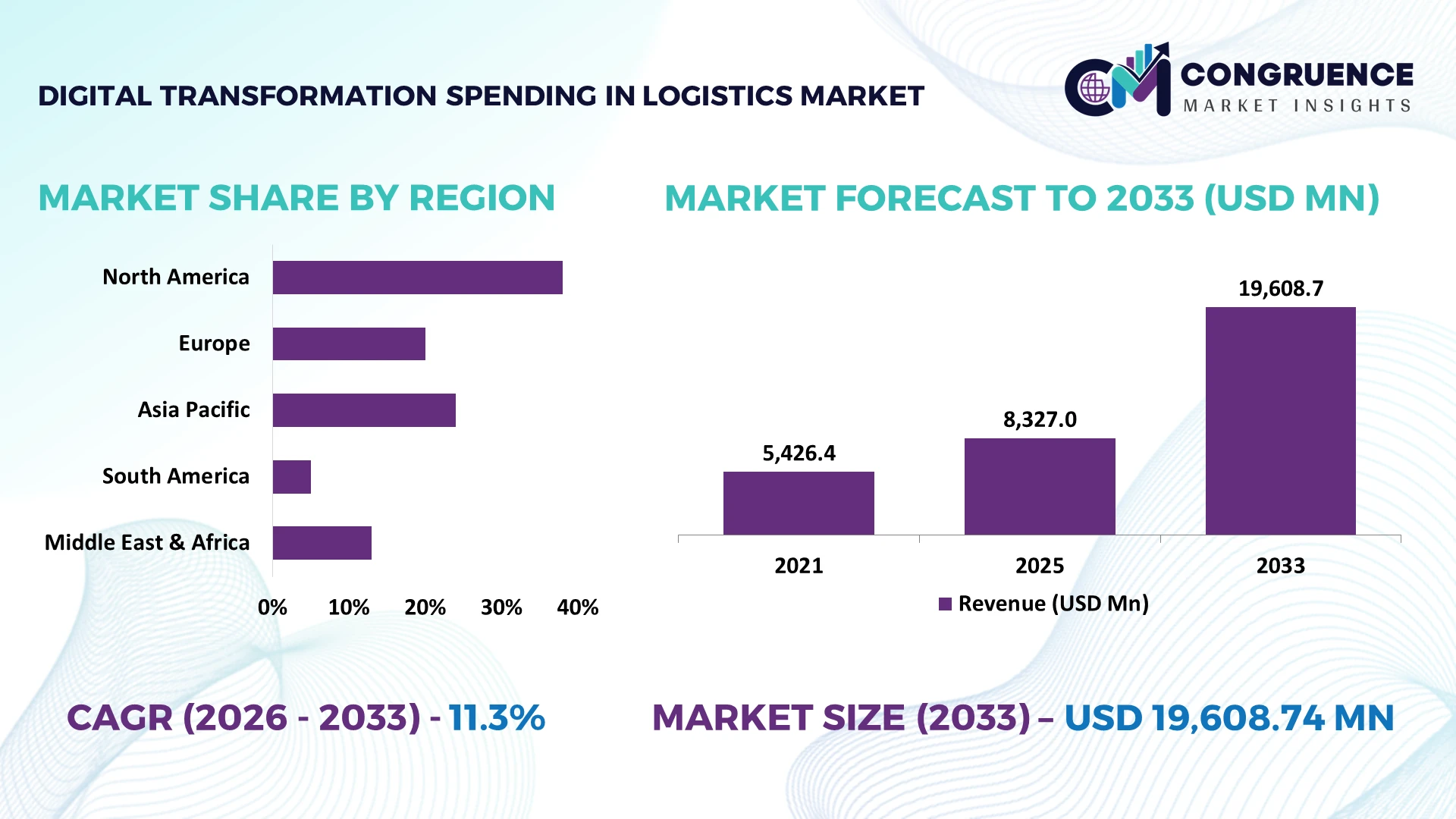
The Global Digital Transformation Spending in Logistics Market was valued at USD 8327 Million in 2025 and is anticipated to reach a value of USD 19608.74 Million by 2033 expanding at a CAGR of 11.3% between 2026 and 2033. Growth is driven by AI powered transportation management, warehouse robotics, predictive supply chain analytics, and increasing investment in integrated logistics automation.
The United States represents a major center for digital transformation spending in logistics, supported by extensive distribution infrastructure, established technology providers, and substantial enterprise automation investments. American logistics operators benefit from a transportation network carrying approximately 72.7% of domestic freight tonnage by truck. Investments in autonomous transportation, intelligent warehouse systems, and predictive inventory management are reshaping logistics operations. Compared with India, the United States has more established automated distribution infrastructure, while India's National Logistics Policy is accelerating digital integration across transportation and warehousing.
Strategically, logistics technology providers should prioritize integrated automation platforms, predictive transportation intelligence, and scalable warehouse management solutions serving infrastructure intensive distribution networks.
Market Size & Growth: USD 8327 million in 2025, reaching USD 19608.74 million by 2033 at 11.3% CAGR, supported by AI powered logistics automation.
Top Growth Drivers: Illustrative adoption indicators include 82% expected AI adoption, 83% robotics adoption, and 88% sensor technology adoption within five years.
Short Term Forecast: By 2028, automated logistics platforms target 20% improvement in operational productivity through intelligent scheduling and workflow optimization.
Emerging Technologies: AI powered analytics, autonomous mobile robots, and digital twins are transforming 3 critical logistics functions: planning, execution, and monitoring.
Regional Leaders: Illustrative 2033 allocation assigns North America USD 7843.50 million, Europe USD 5882.62 million, and Asia-Pacific USD 3921.75 million.
Consumer and End User Trends: Approximately 55% of surveyed supply chain leaders planned to increase technology investment, strengthening enterprise demand for integrated logistics platforms.
Pilot and Case Example: Walmart's 2025 automation program targeted approximately 20% improvement in unit handling costs through modernized distribution infrastructure.
Competitive Landscape: SAP, Oracle, IBM, Microsoft, and Manhattan Associates compete across enterprise logistics software, analytics, and integrated automation solutions.
Regulatory and ESG Impact: Transportation accounts for approximately 28% of American greenhouse gas emissions, strengthening interest in route optimization and fleet efficiency technologies.
Investment and Funding: Approximately 60% of surveyed supply chain executives anticipated investing more than USD 1 million in supply chain technology innovation.
Innovation and Future Outlook: Intelligent orchestration platforms increasingly integrate 3 capabilities: predictive analytics, autonomous execution, and real time operational visibility.
Digital transformation spending in logistics is increasingly concentrated on intelligent transportation management, automated warehouse operations, and integrated supply chain visibility. Freight operators, ecommerce distributors, and manufacturing logistics networks are modernizing fragmented information systems to improve shipment coordination and infrastructure utilization. Advanced computer vision, autonomous handling equipment, and predictive maintenance applications are changing operational workflows. Approximately 28% of surveyed supply chain organizations reported existing AI adoption in 2025, highlighting the transition toward intelligent logistics execution. India's expanding multimodal infrastructure and digital freight initiatives are creating additional opportunities for integrated technology deployment and specialized logistics software development.
Digital transformation spending in logistics is becoming strategically important as companies replace disconnected transportation, warehousing, and inventory systems with integrated operational platforms. Supply chain restructuring and rising delivery expectations are accelerating investment in intelligent logistics infrastructure. The 2025 MHI industry outlook indicated that 55% of surveyed supply chain leaders planned to increase technology investment, reflecting the importance of operational modernization. Companies are restructuring technology budgets around integrated execution systems, automated decision support, and improved shipment visibility to strengthen distribution competitiveness.
Advanced warehouse execution platforms combine robotic handling, intelligent inventory allocation, and automated operational monitoring. Compared with conventional manual distribution processes, Walmart's automation modernization strategy targeted approximately 20% improvement in unit handling costs, demonstrating the potential efficiency advantages of integrated technology. The United States benefits from established automated distribution infrastructure, while India is developing digitally connected freight networks through its National Logistics Policy. Logistics operators are expanding technology partnerships and integrating transportation platforms with existing enterprise systems.
Between 2026 and 2028, investment priorities will emphasize interoperable logistics platforms, intelligent transportation planning, and automated exception management. Integrated operational systems enable distribution companies to coordinate inventory availability, shipment allocation, and delivery execution. Providers combining scalable technology architectures with specialized implementation expertise will strengthen enterprise relationships and establish sustainable competitive advantages.
Fragmented logistics information systems are accelerating investment in integrated supply chain visibility platforms. The 2025 MHI industry outlook indicated that approximately 60% of surveyed organizations planned substantial supply chain technology investments, while 87% expected predictive analytics adoption within five years. Additionally, 88% anticipated implementing sensors and automatic identification technologies. These developments reflect increasing demand for coordinated inventory tracking, transportation monitoring, and automated operational intelligence. American logistics companies are connecting transportation management systems with warehouse execution platforms to improve shipment visibility and reduce information delays. Technology providers are expanding integration capabilities, developing standardized interfaces, and establishing partnerships with enterprise software companies. Unified operational data enables faster exception resolution and more reliable distribution planning.
Substantial implementation expenditure and incompatible legacy systems constrain logistics digital transformation, particularly among smaller transportation operators. The 2025 MHI industry outlook indicated that approximately 60% of surveyed organizations anticipated significant technology investment, while 55% planned to increase their technology budgets. However, investment intentions do not eliminate infrastructure modernization costs or integration requirements. India's fragmented logistics ecosystem illustrates the difficulties of connecting independent transportation operators, warehouse facilities, and enterprise technology platforms. Smaller operators face additional financial pressure from software licensing, equipment modernization, and specialized technical support. Companies are addressing these limitations through modular software deployment, subscription based technology contracts, and partnerships with regional implementation specialists. Prioritizing interoperable infrastructure reduces integration expenditure and protects operational continuity.
Digital freight marketplaces and intelligent capacity allocation create opportunities to improve transportation utilization without proportionate fleet expansion. India's Unified Logistics Interface Platform is strengthening digital connectivity across transportation and logistics services, creating opportunities for integrated freight applications. The country's logistics sector handles approximately 4.6 billion tonnes of freight annually, while road transportation carries nearly 60% of domestic freight movement. These structural characteristics support demand for automated carrier matching, electronic documentation, and predictive capacity allocation. Technology companies are developing integrated freight platforms, expanding digital payment capabilities, and partnering with transportation operators. Connecting fragmented carrier networks through standardized digital interfaces enables more efficient shipment allocation and strengthens participation among smaller logistics providers.
Expanding connected logistics infrastructure increases cybersecurity exposure and creates substantial workforce transformation requirements. The 2025 MHI industry outlook indicated that 82% of surveyed organizations expected artificial intelligence adoption within five years, while 83% anticipated robotics and automation deployment. These technology transitions increase demand for specialized engineering, cybersecurity monitoring, and advanced operational training. American logistics operators must secure interconnected warehouse equipment, transportation platforms, and enterprise information systems against operational disruption. Automated distribution environments also require consistent technical maintenance and effective coordination between human operators and intelligent machinery. Companies are investing in cybersecurity architecture, workforce certification, and specialized technology partnerships. Long term competitiveness depends on maintaining operational resilience while scaling increasingly interconnected logistics infrastructure.
Accelerating Adoption of Electric Fleet Intelligence: Logistics operators are integrating electric vehicle management with charging optimization and battery monitoring. DHL Group targets 66% electric vehicles across its last mile delivery fleet by 2030, while Amazon reported deploying more than 20,000 electric delivery vans in the United States during 2024. Fleet operators are connecting charging schedules with delivery assignments to reduce vehicle downtime and improve infrastructure utilization.
Expanding Automated Fulfillment Infrastructure Deployment: Labor availability and increasing order complexity are accelerating investment in automated distribution facilities. Amazon reported deploying more than 750,000 robots across its operations by 2023, subsequently introducing additional robotic systems for fulfillment automation. Operators are integrating robotic picking, automated storage, and intelligent order sequencing. These investments improve processing consistency while shifting workforce requirements toward equipment supervision and technical maintenance.
Strengthening Digital Customs Documentation Infrastructure: Regulatory modernization is accelerating the transition from fragmented customs documentation toward integrated electronic processing. The European Union's Import Control System 2 introduced additional road and rail transportation requirements in April 2025. Its Entry Summary Declaration framework requires shipment information before goods enter the European Union. Freight operators are integrating customs software with transportation platforms, improving documentation accuracy and reducing administrative interruptions.
Increasing Deployment of Predictive Equipment Maintenance: Logistics facilities are connecting material handling equipment with condition monitoring systems to identify mechanical deterioration before operational failure. DHL's deployment of smart warehouse technologies demonstrates growing interest in equipment connectivity and operational intelligence. Maintenance teams are integrating vibration monitoring, equipment diagnostics, and automated service scheduling. This transition improves equipment availability and supports more consistent processing during seasonal distribution peaks.
Cloud Solutions represent the leading technology category in the Digital Transformation Spending in Logistics Market, supported by scalable deployment, centralized data management, and integration with existing enterprise applications. Related industry research places cloud deployment at 70% of digital transformation spending in logistics in 2025. Another digital logistics assessment reports a 75.2% cloud deployment share, confirming the technology's established position. These figures measure cloud deployment categories rather than the precise spending distribution across the seven technology types examined here.
AI & Analytics represents an important emerging investment priority as logistics operators introduce automated decision support and predictive operational planning. IoT Solutions provide equipment connectivity, while Robotics improves physical handling efficiency. Blockchain supports specialized transaction verification, Digital Twins enable operational simulation, and Autonomous Systems address increasingly independent logistics execution. Companies are developing integrated technology portfolios that combine these capabilities with existing infrastructure. Cloud Solutions offer immediate scalability, whereas AI & Analytics provides opportunities for differentiated operational intelligence and increasingly automated decision making.
Fleet Management represents an established application within the Digital Transformation Spending in Logistics Market, supported by commercial vehicle connectivity, transportation monitoring, and recurring operational requirements. Research covering India's fleet management software market indicates that tracking and telematics accounted for 34.35% of functionality spending in 2025. Logistics and transportation operators represented 41.85% of that country's fleet management software market, illustrating the importance of connected transportation infrastructure. These percentages describe the Indian fleet management market rather than global application shares.
Warehouse Automation represents a significant emerging investment area as operators integrate robotic handling with warehouse execution software. Route Optimization supports transportation efficiency, while Shipment Tracking strengthens delivery visibility. Inventory Management improves stock coordination, Demand Forecasting supports procurement planning, and Last-Mile Delivery applications address increasingly complex distribution requirements. Technology providers are expanding modular software portfolios and developing partnerships with automation specialists. Established transportation applications benefit from extensive vehicle connectivity, whereas warehouse modernization requires coordinated investment in software, equipment, and facility infrastructure.
Third-Party Logistics represents an important customer category within the Digital Transformation Spending in Logistics Market because providers manage transportation, warehousing, and distribution requirements across multiple enterprises. India's Third-Party Logistics market illustrates the scale of these operations, with domestic transportation management accounting for 55.4% of service activity in 2025. Asset light operators represented 41.6% of the country's market, demonstrating the importance of technology platforms that coordinate transportation without requiring extensive infrastructure ownership. These figures measure India's logistics industry rather than global digital transformation spending.
E-Commerce represents a strategically important emerging customer category as digital retailers expand fulfillment infrastructure and invest in increasingly sophisticated delivery coordination. Freight & Shipping companies prioritize shipment visibility, while Warehousing operators emphasize facility automation. Retail businesses require integrated inventory management, Manufacturing companies focus on production logistics, and Transportation Companies invest in fleet connectivity. Technology providers are developing industry specific platforms, configurable subscription arrangements, and specialized implementation partnerships. Third-Party Logistics customers prioritize interoperability across enterprise systems, whereas ecommerce operators emphasize fulfillment responsiveness and scalable transaction processing.
North America accounted for the largest market share at an estimated 38% in 2025 however, Asia-Pacific is expected to register the fastest growth, expanding at a projected CAGR of 13.8% between 2026 and 2033.
Enterprise Automation and Integrated Logistics Infrastructure
North America represents an estimated 38% of the global Digital Transformation Spending in Logistics Market, supported by established enterprise software infrastructure, advanced distribution networks, and extensive commercial transportation operations. The United States dominates regional technology deployment through investments in warehouse robotics, connected fleet management, and intelligent supply chain platforms. Canada contributes through digital freight management and automated distribution infrastructure supporting domestic and international trade. Mexico's expanding manufacturing operations are strengthening demand for integrated transportation technology and cross border shipment visibility. American logistics enterprises are increasingly connecting warehouse execution platforms with transportation management applications to coordinate inventory allocation and freight movement. Large distribution operators are also introducing robotic handling systems and intelligent scheduling software. These investments support higher processing capacity, improved operational visibility, and increasingly sophisticated enterprise logistics management.
United States Market Outlook: The United States benefits from established logistics technology providers, extensive transportation infrastructure, and substantial enterprise automation capabilities. Amazon has deployed more than one million robots across its global fulfillment network, demonstrating the operational scale of advanced warehouse automation. American transportation companies are also integrating connected vehicle technology, predictive maintenance, and automated dispatch systems to strengthen fleet productivity and distribution reliability.
Regulatory Modernization and Intelligent Freight Coordination
Europe represents an estimated 28% of the global Digital Transformation Spending in Logistics Market, supported by integrated industrial supply chains, sophisticated transportation infrastructure, and regulatory modernization. Germany, France, the Netherlands, and the United Kingdom represent important centers for logistics technology deployment. European transportation operators are investing in digital freight documentation, integrated shipment management, and intelligent transportation planning. The European Union's electronic Freight Transport Information framework supports the transition toward standardized digital communication between freight operators and regulatory authorities. Its application framework is scheduled to become fully operational in July 2027. Logistics technology providers are developing interoperable documentation platforms and expanding partnerships with transportation companies. These developments strengthen cross border information exchange, reduce administrative duplication, and encourage investment in integrated freight management applications.
Germany Market Outlook: Germany benefits from extensive industrial manufacturing, established automotive supply chains, and sophisticated transportation infrastructure. Its central European location creates substantial requirements for coordinated international freight movement. German logistics operators are investing in intelligent warehouse systems, automated material handling, and integrated transportation applications. The country's industrial automation expertise also supports domestic development of robotics and specialized logistics software.
Manufacturing Digitization and Intelligent Distribution Expansion
Asia-Pacific represents an estimated 25% of the global Digital Transformation Spending in Logistics Market, supported by extensive manufacturing activity, expanding digital infrastructure, and increasingly sophisticated domestic distribution networks. China leads regional logistics automation through substantial investments in intelligent warehouses, robotic sorting, and automated delivery infrastructure. Japan contributes advanced robotics capabilities and integrated industrial logistics technology. India is developing digital freight infrastructure to improve transportation coordination across fragmented logistics networks. China's express delivery industry handled more than 170 billion parcels during 2024, demonstrating the operational scale supporting investment in intelligent sorting and automated shipment processing. Technology providers are expanding localized software capabilities and developing partnerships with major distribution operators. Increasing integration between manufacturing systems and logistics platforms is strengthening demand for connected industrial supply chain applications.
China Market Outlook: China benefits from extensive ecommerce distribution infrastructure, established electronics manufacturing capabilities, and domestic robotics development. Major logistics operators are deploying automated sorting equipment, intelligent warehouse systems, and advanced shipment tracking platforms. The country's extensive high speed transportation infrastructure and concentrated industrial clusters support large scale technology deployment. Integration between domestic technology suppliers and logistics enterprises strengthens implementation capacity and accelerates operational modernization.
Digital Freight Platforms and Distribution Modernization
South America represents an estimated 5% of the global Digital Transformation Spending in Logistics Market, supported by expanding digital commerce, industrial transportation requirements, and modernization of domestic distribution infrastructure. Brazil leads regional investment through its extensive agricultural supply chains, established manufacturing sector, and substantial consumer distribution networks. Chile contributes sophisticated international trade infrastructure, while Colombia is strengthening digital transportation services across major industrial corridors. Logistics companies are introducing cloud based transportation management, electronic freight documentation, and connected fleet monitoring. These investments address operational fragmentation and improve coordination between independent transportation providers. However, inconsistent digital infrastructure and substantial differences in operator capabilities constrain deployment consistency. Technology suppliers are responding through modular software applications, localized implementation partnerships, and flexible subscription arrangements designed for smaller transportation enterprises.
Brazil Market Outlook: Brazil represents a major opportunity for logistics technology deployment because of its extensive domestic transportation requirements and growing digital commerce infrastructure. The country's Pix instant payment system processed more than 60 billion transactions during 2024, demonstrating widespread adoption of digital transaction infrastructure. Logistics technology providers can integrate electronic payment capabilities with freight marketplaces, transportation management applications, and automated settlement platforms.
Smart Logistics Infrastructure and Digital Trade Integration
The Middle East & Africa represents an estimated 4% of the global Digital Transformation Spending in Logistics Market, supported by transportation infrastructure investment, international trade development, and industrial diversification. Saudi Arabia and the United Arab Emirates are investing in digitally connected logistics infrastructure, intelligent transportation systems, and advanced distribution facilities. South Africa contributes established industrial transportation networks and growing demand for digital freight management. Saudi Arabia's Vision 2030 initiatives are encouraging investment in integrated logistics platforms supporting industrial development and international trade. The United Arab Emirates is strengthening digital connections between maritime transportation, customs processing, and inland distribution operations. Technology companies are establishing regional partnerships and developing specialized applications for intelligent freight coordination. These investments improve transportation transparency and strengthen the commercial value of integrated logistics infrastructure.
United Arab Emirates Market Outlook: The United Arab Emirates benefits from established international trade infrastructure, advanced telecommunications networks, and substantial investment in digital government services. Dubai's strategic location supports integrated maritime, aviation, and inland logistics operations. The country's digital trade initiatives encourage electronic documentation, automated customs processing, and integrated shipment management. These capabilities create opportunities for enterprise logistics software and intelligent transportation technology providers.
The Digital Transformation Spending in Logistics Market features competition between enterprise software providers, industrial automation specialists, and logistics technology platforms. SAP, Oracle, Microsoft, IBM, and Manhattan Associates compete through integrated enterprise applications, cloud infrastructure, analytics, and specialized logistics execution capabilities. Their combined market share cannot be reliably established because reported operations span multiple technology categories. Competition centers on implementation flexibility, integration capabilities, operational intelligence, and enterprise scalability. Established software providers leverage extensive customer relationships and established application ecosystems, while specialized vendors emphasize industry functionality and deployment expertise. Robotics suppliers compete through equipment productivity and integration with warehouse execution systems. Strategic partnerships increasingly connect enterprise software, cloud infrastructure, and physical automation technologies. Implementation complexity, cybersecurity requirements, and established customer relationships create significant entry barriers. Competitive positioning increasingly depends on delivering interoperable technology, measurable operational improvements, reliable implementation, and sustained customer support across increasingly connected logistics environments.
Cloud warehouse platforms connect inventory, transport planning, and automated handling through shared operational data. Unlike isolated legacy applications requiring manual reconciliation, integrated warehouse software delivered 15% to 20% productivity improvements in a documented deployment. Connected sensors extend these platforms through equipment monitoring and shipment identification. Logistics providers prioritize modular integration because uninterrupted distribution matters alongside software functionality.
Artificial intelligence and robotic orchestration are changing facility workload allocation. A deployed robotic coordination model targets 10% shorter robot travel times than earlier movement planning, reducing congestion and accelerating processing. Autonomous mobile robots increasingly operate alongside conveyors, while computer vision supports handling verification. Large fulfillment networks benefit from extensive operational datasets; smaller operators access comparable capabilities through configurable software and robotics partnerships.
Between 2026 and 2028, digital twins and autonomous systems will strengthen investment decisions by testing facility changes before physical deployment. Real time simulation connects warehouse layouts, equipment telemetry, and shipment forecasts, exposing capacity constraints before capital commitments. Enterprise deployments already demonstrate simulation across entire logistics facilities, although standardized performance improvements remain unverified. Companies should prioritize interoperable architectures, cybersecurity, and measurable pilot results. Competitive advantage increasingly depends on converting experimental technologies into repeatable operational gains without disrupting established customer service commitments.
May 2025: DHL Group signed an agreement with Boston Dynamics to pursue 1,000 additional warehouse robots. The partnership extends robotic unloading toward case picking, helping DHL scale automation across facilities and reduce dependence on repetitive manual handling tasks.
June 2025: Amazon announced deployment of its millionth robot and introduced DeepFleet, an artificial intelligence model targeting 10% shorter robotic travel times. The technology coordinates warehouse robot movements, reducing congestion and improving fulfillment efficiency across its distribution network.
April 2026: Siemens partnered with KION to introduce digital twin simulation for intelligent warehouses, with KION becoming its first European Digital Twin Composer user. The collaboration integrates data and artificial intelligence to test facility changes before physical implementation.
February 2025: Reuters reported that Apptronik secured $350 million to expand production of Apollo humanoid robots, following commercial agreements involving GXO Logistics. The funding supports warehouse handling automation and provides logistics operators an option for labor intensive physical tasks.
The Digital Transformation Spending in Logistics Market Report evaluates technology investment, operational modernization, and competitive developments between 2026 and 2033. Technology segmentation covers Cloud Solutions, IoT Solutions, AI & Analytics, Robotics, Blockchain, Digital Twins, and Autonomous Systems. Application analysis examines Fleet Management, Warehouse Automation, Route Optimization, Shipment Tracking, Inventory Management, Demand Forecasting, and Last-Mile Delivery. End-user coverage includes Third-Party Logistics, Freight & Shipping, Warehousing, Retail, Manufacturing, E-Commerce, and Transportation Companies.
Regional analysis encompasses North America, Europe, Asia-Pacific, South America, and the Middle East & Africa. The report examines technology deployment patterns, enterprise integration requirements, infrastructure modernization, and competitive strategies. It evaluates emerging opportunities in intelligent freight coordination, autonomous logistics execution, and digital infrastructure development, supporting investment planning, geographic expansion, technology procurement, and competitive positioning throughout the forecast period.
| Report Attribute/Metric | Report Details |
|---|---|
Market Revenue in 2025 | USD 8327 Million |
Market Revenue in 2033 | USD 19608.74 Million |
CAGR (2026 - 2033) | 11.3% |
Base Year | 2025 |
Forecast Period | 2026 - 2033 |
Historic Period | 2021 - 2025 |
Segments Covered | By Type
By Application
By End-User
|
Key Report Deliverable | Revenue Forecast, Growth Trends, Market Dynamics, Segmental Overview, Regional and Country-wise Analysis, Competition Landscape |
Region Covered | North America, Europe, Asia-Pacific, South America, Middle East, Africa |
Key Players Analyzed | SAP, Oracle, Microsoft, IBM, Manhattan Associates, Blue Yonder, Descartes Systems Group, WiseTech Global, Trimble, Siemens, Körber, Dematic, Zebra Technologies |
Customization & Pricing | Available on Request (10% Customization is Free) |




