
Reports
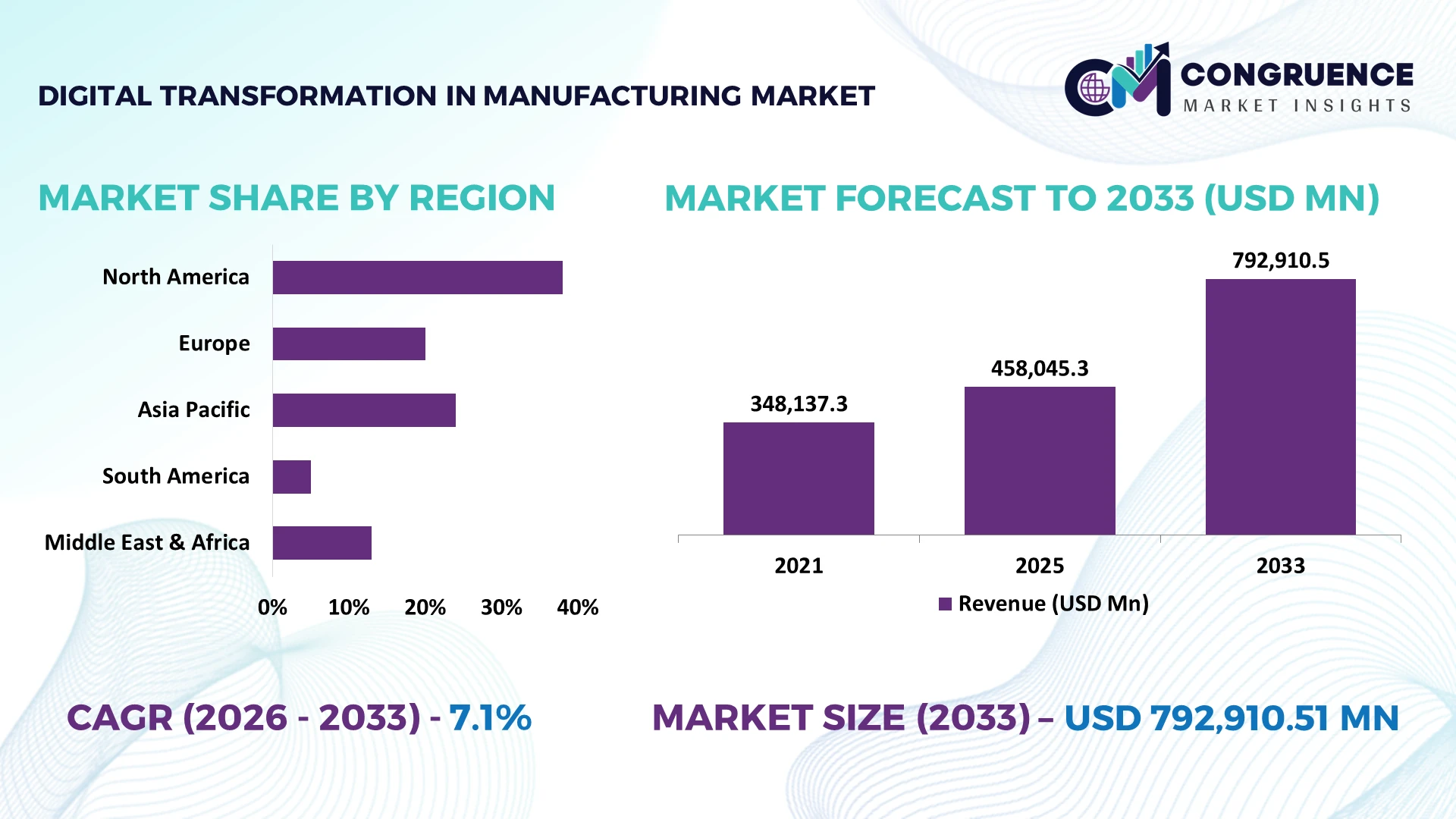
The Global Digital Transformation in Manufacturing Market was valued at USD 458045.28 Million in 2025 and is anticipated to reach a value of USD 792910.51 Million by 2033 expanding at a CAGR of 7.1% between 2026 and 2033. Industrial AI, connected production systems, digital twins, cloud manufacturing platforms, and predictive maintenance are accelerating factory modernization through improved asset utilization, production visibility, quality control, and supply chain resilience.
China provides the strongest industrial scale for digital transformation in manufacturing, accounting for more than 30% of global manufacturing value added, while 89.6% of major industrial enterprises had completed digital transformation initiatives by 2025. More than 35,000 basic smart factories have been established, with automotive manufacturing recording 94.4% digital upgrading. Germany provides a comparison, with 58.7% of manufacturing companies using AI in 2026. China’s technology self reliance strategy amid continuing global trade tensions is reinforcing industrial software, robotics, automation, and intelligent factory investment.
Manufacturers and technology vendors should prioritize scalable industrial AI, interoperable factory data architectures, and digital twin deployment where smart manufacturing is progressing from isolated pilots toward factory wide implementation.
Market Size & Growth: USD 458045.28 million in 2025 is projected to reach USD 792910.51 million by 2033 at a CAGR of 7.1%, driven by industrial AI, connected automation, digital twins, and intelligent production systems.
Top Growth Drivers: Data analytics represents 40% of smart manufacturing investment priorities, while cloud computing and artificial intelligence each account for 29%, demonstrating manufacturers’ focus on connected decision making and automated production intelligence.
Short Term Forecast: By 2028, scaled smart manufacturing programs are positioned to deliver 10% to 20% higher production output and 10% to 15% improvement in manufacturing capacity utilization.
Emerging Technologies: Generative AI has reached 24% deployment at facility or production network level, while digital twins, physical AI, edge computing, autonomous robotics, and machine vision are expanding intelligent factory capabilities.
Regional Leaders: North America represented about USD 109.6 billion and Europe USD 90.0 billion in 2025, while Asia Pacific maintains the strongest smart factory deployment momentum through electronics, automotive, semiconductor, and machinery modernization.
Consumer/End User Trends: 97% of surveyed German industrial companies used at least one Industry 4.0 application in 2026, demonstrating that connected manufacturing technologies have progressed from experimentation into mainstream industrial operations.
Pilot/Case Example: Apollo Tyres achieved 9% higher primary equipment productivity, 3% lower energy consumption, and 50% lower curing press idle time through connected industrial IoT and manufacturing analytics deployment.
Competitive Landscape: Siemens, Schneider Electric, ABB, Rockwell Automation, and SAP remain major participants, while the fragmented competitive structure is increasingly shaped by integrated industrial AI, automation, cloud software, digital twins, and data platforms.
Regulatory & ESG Impact: Advanced smart factories in China recorded 20.4% lower carbon emissions and 50.2% lower defect rates, demonstrating measurable alignment between manufacturing digitalization, resource efficiency, environmental targets, and production quality.
Investment & Funding: Siemens announced more than USD 10 billion in additional United States investment during 2025 across manufacturing, industrial software, and AI infrastructure, reinforcing regional production expansion and supply chain localization.
Innovation & Future Outlook: Germany’s industrial AI infrastructure initiative incorporates 10,000 GPUs, strengthening next generation simulation, robotics, engineering, digital twins, physical AI, and intelligent production capabilities across advanced manufacturing industries.
Digital Transformation in Manufacturing Market demand is concentrating across automotive, electronics, semiconductors, industrial equipment, aerospace, and process manufacturing, where connected assets enable faster production decisions and predictive operations. Industrial innovation is shifting toward physical AI, digital twins, autonomous robotics, machine vision, and integrated factory data platforms. Digital twin based factory planning has demonstrated the potential to reduce setup and planning time by 50%. Against continuing supply chain localization and technology sovereignty initiatives, manufacturers are treating interoperable digital infrastructure as a strategic production asset, establishing the foundation for broader competitive and investment decisions.
Digital transformation is becoming a competitive manufacturing requirement as production networks shift toward connected, data driven operations and supply chains become more localized. Among large United States manufacturers, 92% identify smart manufacturing as a primary competitiveness driver for the next three years, while 78% allocate more than 20% of improvement budgets to these initiatives. Companies are consequently moving investment from isolated automation projects toward integrated factory architecture, analytics, sensors, and operational intelligence.
Connected smart manufacturing systems have demonstrated production output improvements reaching 20% and unlocked capacity gains reaching 15%, giving digitally integrated factories a measurable advantage over legacy production environments dependent on fragmented systems and manual intervention. China has moved further toward deployment at industrial scale, with 89.6% of major industrial enterprises completing digital retrofits by the end of 2025, while Germany reports Industry 4.0 applications across 97% of surveyed industrial companies.
Practical deployments increasingly connect machine data, AI, quality systems, and predictive maintenance across entire facilities rather than individual production lines. Through 2028, manufacturers are prioritizing factory automation hardware, analytics, AI, and industrial IoT while expanding technology partnerships and internal transformation teams. Competitive positioning will increasingly depend on converting connected factory data into faster operational decisions, higher asset productivity, and scalable manufacturing intelligence.
Manufacturing digitization is advancing from individual equipment upgrades toward integrated production architecture. In China, 68.6% of key processes at major industrial enterprises were digitally controlled by the end of 2025, up from 52.1% in 2020. Automotive manufacturing has reached a 94.4% digital upgrade rate, while electronic information manufacturing stands at 93.9%. China’s deployment of 4.838 million 5G base stations strengthens the connectivity foundation required for machine monitoring, edge analytics, autonomous equipment, and industrial IoT. This infrastructure shift allows manufacturers to coordinate production data across plants instead of operating disconnected automation islands. Technology suppliers and manufacturers are responding through industrial 5G investment, intelligent equipment integration, factory software deployment, and partnerships connecting operational technology with enterprise data platforms.
Interoperability remains a structural constraint because manufacturers must connect legacy machinery, proprietary control systems, cloud platforms, sensors, and enterprise applications without disrupting production. Only 45% of surveyed large United States manufacturers report using an architecture standard, while 54% apply unified data standards. Meanwhile, 65% rank operational risk among their two leading mitigation priorities for smart manufacturing initiatives. The problem is particularly acute in older United States industrial facilities where equipment replacement cycles extend well beyond software upgrade cycles. Poorly standardized data increases integration expenditure and limits replication of successful pilots across multiple factories. Manufacturers are reducing exposure by adopting unified namespace architectures, standardized industrial protocols, modular edge platforms, and staged modernization programs rather than replacing complete production systems simultaneously.
Industrial AI offers substantial untapped value as manufacturers convert expanding machine data into autonomous production decisions. Among surveyed large United States manufacturers, 29% already use AI or machine learning at facility or network level, while another 23% are running pilots. Generative AI presents a wider conversion opportunity because 38% are piloting the technology but only 24% have achieved facility or network deployment. China demonstrates the operational endpoint: an automotive sheet production application using industrial large models has achieved defect detection above 99.9% while supporting 83 intelligent decision and control scenarios. Through 2028, manufacturers are positioned to expand AI from experimental applications into quality inspection, maintenance, scheduling, energy optimization, and process control. Vendors are consequently building partnerships around industrial data platforms, edge computing, digital twins, and domain specific AI models.
Scaling connected manufacturing creates execution risks extending beyond technology acquisition. Among surveyed large United States manufacturers, 55% identify unauthorized operational technology access as a major concern, 47% highlight intellectual property theft, and 46% cite operational disruption. Digital talent availability compounds the problem, with 69% to 72% reporting moderate to significant difficulty recruiting specialists across IT, operational technology, data science, engineering, application development, and cybersecurity. As factories integrate AI, cloud platforms, connected controllers, and remote access, a single security or skills weakness can undermine deployment consistency across production networks. Manufacturers are responding by allocating dedicated cybersecurity budgets, strengthening workforce training, and using specialist partners for technical functions. Sustainable digital transformation therefore depends on treating cyber resilience and workforce capability as production infrastructure rather than supporting IT functions.
Factory Data Becomes Operational Infrastructure: Manufacturers are standardizing production data before scaling advanced automation. In 2025, 57% of large manufacturers used data analytics at facility or network level, while 54% maintained unified data standards and 45% applied architecture standards. Multi plant operators are restructuring disconnected data environments into common industrial data layers, enabling faster replication of applications. Companies are scaling unified namespaces, cloud platforms, and standardized interfaces to improve production visibility and reduce integration effort.
Automation Investment Shifts Toward Flexibility: Labor availability and production volatility are redirecting capital toward adaptable automation. About 46% of manufacturers rank process automation among their top two investment priorities, 41% prioritize factory automation hardware, and 34% prioritize active sensors. Instead of automating fixed workflows alone, factories are connecting sensing, control, and scheduling systems. Manufacturers are expanding modular automation and flexible production cells to increase responsiveness when product mix, workforce availability, or supply conditions change.
Quality Intelligence Moves Into Production: AI enabled inspection is becoming embedded within manufacturing workflows rather than operating as a separate analytics function. Around 50% of manufacturers plan AI applications for product quality, while 48% specifically plan AI and machine learning deployment for quality improvement. Product quality and safety also influence sustainability programs for 43% of manufacturers. Companies are integrating machine vision, automated inspection, and production analytics to identify process deviations earlier, lowering scrap exposure while strengthening traceability.
Digital Programs Move Beyond Pilots: Smart manufacturing deployment is entering a scale conversion phase, with 56% of manufacturers piloting smart manufacturing, 20% already operating it at scale, and another 20% planning investment. This creates a non obvious shift from technology acquisition toward replication economics across multiple plants. Companies are establishing common deployment templates, centralized transformation teams, and technology partnerships so successful factory applications can be transferred without rebuilding integration architecture at every production site.
Industrial IoT represents the leading type, accounting for about 34% of the Digital Transformation in Manufacturing Market in 2025 as connected sensors, controllers, gateways, and production assets establish the data foundation required for real time manufacturing intelligence. Facility or network deployment already reaches 46% among surveyed large manufacturers, demonstrating substantial maturity. Cloud Computing supports centralized analytics and multisite coordination, while Robotics & Automation converts digital intelligence into physical production actions. Edge Computing is gaining strategic importance where machine vision and control workloads require immediate processing without dependence on centralized infrastructure.
AI & Machine Learning represents the fastest advancing type as manufacturers move from predictive algorithms toward adaptive process control and autonomous decision support. About 29% of large manufacturers already deploy AI and machine learning at facility or network scale, creating significant expansion headroom. Digital Twins increasingly connect engineering simulation with operating data, allowing virtual commissioning and production optimization. Vendors are consequently integrating Industrial IoT, AI, cloud infrastructure, Digital Twins, Robotics & Automation, and Edge Computing into interoperable portfolios rather than selling isolated technologies.
Predictive Maintenance accounts for about 32% of application demand, reflecting manufacturers’ focus on equipment availability, condition monitoring, and avoidance of production interruptions. Sensor streams and machine learning increasingly replace fixed maintenance schedules with asset specific intervention. Smart Manufacturing extends these capabilities across connected production environments, while Quality Management combines machine vision and analytics to control defects. Production Planning is becoming more data intensive as factories coordinate labor, equipment, materials, and changing order requirements through advanced scheduling platforms.
Supply Chain Optimization shows the strongest emerging adoption momentum as geopolitical disruption, localization strategies, and volatile material availability force manufacturers to connect factory schedules with supplier and logistics data. Around 35% of large manufacturers rank advanced production scheduling among their leading system investment priorities, compared with 28% prioritizing Quality Management systems. Asset Management remains important for lifecycle visibility and equipment performance. Technology providers are integrating Predictive Maintenance, Production Planning, Asset Management, and Supply Chain Optimization into connected operational platforms, allowing manufacturers to move from individual use cases toward coordinated production decision systems.
Automotive represents the largest end user group with about 29% market share, supported by extensive robotics, complex assembly operations, stringent traceability requirements, and large connected supplier networks. China illustrates the deployment intensity, with automotive manufacturing reaching a 94.4% digital upgrading rate. Electronics follows closely in technology intensity because short product cycles, precision manufacturing, and automated inspection require continuous production data. Heavy Machinery manufacturers increasingly prioritize connected assets and digital engineering, while Aerospace & Defense adoption centers on traceability, simulation, quality assurance, and highly controlled production environments.
Electronics is emerging as the fastest advancing end user as semiconductor capacity expansion and increasingly complex electronic products intensify requirements for AI inspection, automated material handling, and process analytics. Pharmaceuticals are expanding validated digital production and quality systems, while Food & Beverage companies emphasize automation, traceability, and process consistency. Chemicals increasingly use digital monitoring for process control, energy optimization, and asset reliability. Technology suppliers are responding with industry specific software configurations, ecosystem partnerships, modular automation, and manufacturing platforms designed around sector specific compliance and operating requirements.
North America accounted for the largest market share at 35% in 2025 however, Asia Pacific is expected to register the fastest growth, expanding at a CAGR of 8.6% between 2026 and 2033. Pasted markdown
Smart Factory Scaling Defines Investment Priorities
North America holds about 35% of the Digital Transformation in Manufacturing Market, supported by advanced industrial automation, cloud infrastructure, enterprise software penetration, and concentrated technology investment across the United States and Canada. United States manufacturers are shifting from isolated digital pilots toward connected plant architecture, with 92% identifying smart manufacturing as an important competitiveness driver over the next three years. Operational deployments have generated production output improvements of 10% to 20% and unlocked capacity gains of 10% to 15%. Automotive, aerospace, electronics, chemicals, and industrial equipment manufacturers are integrating production control, analytics, machine vision, and connected asset systems. Capital allocation is increasingly tied to measurable plant performance, with 78% of surveyed manufacturers directing more than 20% of their improvement budgets toward smart manufacturing initiatives.
United States Market Outlook: The United States combines hyperscale cloud infrastructure, industrial software expertise, automation vendors, and a large installed manufacturing base. About 88% of surveyed manufacturers expect smart manufacturing investment to continue or increase, reinforcing demand for integrated factory platforms, cybersecurity, industrial AI, and advanced automation rather than isolated equipment upgrades.
Industry 4.0 Moves Into AI Integration
Europe represents about 29% of global market activity, with Germany, France, Italy, and the United Kingdom supporting demand through automotive, machinery, pharmaceuticals, chemicals, and precision engineering. Manufacturing modernization increasingly combines established Industry 4.0 infrastructure with AI enabled process control, robotics, energy management, and digital engineering. Germany provides the strongest deployment signal: 97% of surveyed industrial companies used at least one Industry 4.0 application in 2026, while 81% considered these technologies important or indispensable for international competitiveness. European manufacturers are also connecting digital production investments with energy efficiency and industrial decarbonization requirements. This combination favors platforms capable of linking operational technology, enterprise systems, equipment data, and resource consumption, creating demand for integrated architectures rather than fragmented automation deployments.
Germany Market Outlook: Germany remains the region’s strategic manufacturing technology hub because of its automotive, machinery, electrical equipment, and industrial automation ecosystem. In 2026, more than 80% of surveyed manufacturers viewed Industry 4.0 as an opportunity, compared with 16% identifying it primarily as a risk, supporting continued adoption of AI and connected production technologies.
Manufacturing Scale Accelerates Smart Factory Deployment
Asia Pacific accounts for about 27% of the market and combines exceptionally large manufacturing ecosystems with aggressive automation programs across China, Japan, South Korea, and India. China has established more than 35,000 basic smart factories, 8,200 advanced facilities, 500 excellence level factories, and 15 pioneering facilities, demonstrating deployment depth unmatched by smaller industrial economies. Semiconductor production, electronics assembly, automotive manufacturing, batteries, machinery, and consumer goods are major digitization targets. Japan and South Korea contribute advanced robotics, electronics, and precision production capabilities, while India is expanding electronics and automotive manufacturing infrastructure. Supply chain localization and technology sovereignty are pushing enterprises toward domestic industrial software, machine vision, digital twins, and intelligent production control, strengthening demand for scalable factory transformation platforms.
China Market Outlook: China combines manufacturing scale with rapid industrial AI commercialization. An automotive sheet manufacturing deployment has achieved defect detection exceeding 99.9% while implementing 83 intelligent decision and control scenarios across production, energy management, research, and related functions, illustrating how AI is progressing from inspection toward integrated factory decision making.
Industrial Modernization Concentrates Around Brazil
South America represents about 5% of global market activity, with deployment concentrated in Brazil, followed by Argentina, Chile, and Colombia. Automotive assembly, mining equipment, food processing, chemicals, pulp and paper, and industrial machinery provide the strongest environments for connected production systems. Brazilian manufacturers increasingly combine industrial IoT, enterprise resource planning, automation, cloud platforms, and production analytics as multinational plants align local facilities with global operating standards. Deployment remains uneven because smaller manufacturers face weaker digital infrastructure, financing constraints, and shortages of specialized automation talent. This creates a two speed market in which large industrial groups scale connected operations while smaller factories adopt modular solutions. Technology providers are responding through cloud based deployment models, local systems integration partnerships, and phased modernization that reduces initial implementation complexity.
Brazil Market Outlook: Brazil offers the strongest addressable industrial base in South America, supported by automotive, aerospace, food processing, metals, and machinery clusters. Digital manufacturing investment is increasingly concentrated around São Paulo and other established industrial centers, where manufacturers can access stronger connectivity, engineering talent, automation integrators, and enterprise technology ecosystems.
Industrial Diversification Drives Factory Modernization
Middle East and Africa account for about 4% of market activity, with Saudi Arabia and the United Arab Emirates driving advanced manufacturing investment while South Africa maintains an established industrial automation base. Saudi Arabia’s Future Factories Program targets transformation of 4,000 factories from traditional operations toward automation and advanced manufacturing technologies. Government supported digital maturity assessments, transformation plans, and financing are reducing implementation barriers for industrial operators. Manufacturing digitization is also aligning with economic diversification strategies covering machinery, electronics, pharmaceuticals, food processing, chemicals, and emerging semiconductor activities. The region therefore presents a policy led deployment model in which industrial incentives, localization requirements, technology partnerships, and infrastructure investment jointly accelerate adoption rather than relying solely on enterprise modernization cycles.
Saudi Arabia Market Outlook: Saudi Arabia is building an increasingly structured smart manufacturing ecosystem. The Future Factories initiative targets 4,000 facilities, while industrial efficiency programs have demonstrated energy consumption reductions reaching 40% and production cost reductions around 12%, strengthening the operational case for combining automation, digitization, and resource optimization.
Siemens, Schneider Electric, ABB, Rockwell Automation, Microsoft, and SAP compete across industrial automation, software, cloud infrastructure, analytics, and connected factory architecture. The top five participants collectively account for about 30% of market activity, reflecting fragmentation across technology layers and manufacturing verticals. Competition increasingly centers on platform interoperability, AI integration, cybersecurity, deployment speed, and lifecycle service capabilities. Advanced automation can raise production output by 10% to 20%, while connected manufacturing programs unlock 10% to 15% additional capacity and employee productivity improvements reaching 20%. Siemens and ABB integrate automation with industrial software, while Microsoft expands cloud and AI infrastructure and SAP connects factory operations with enterprise workflows. Partnerships between hyperscalers, equipment suppliers, and systems integrators are accelerating as customers demand unified architectures. Legacy equipment integration, specialized engineering requirements, and cybersecurity create substantial entry barriers. Winning requires interoperable technology, manufacturing domain expertise, scalable implementation capability, and measurable operational returns.
Siemens
Schneider Electric
ABB
Rockwell Automation
Microsoft
SAP
IBM
Honeywell
Oracle
Cisco Systems
PTC
Dassault Systèmes
Emerson
Mitsubishi Electric
Current manufacturing transformation centers on industrial IoT, cloud platforms, edge computing, machine vision, and AI connected to MES and ERP environments. Cloud deployment reaches 57% at facility or network level, while industrial IoT reaches 46%. AI enabled quality inspection can reduce defect related intervention and accelerate root cause analysis, while connected production programs have delivered 10% to 20% output improvements. Manufacturers integrating operational and enterprise data gain faster scheduling, maintenance, and quality decisions.
Emerging investment is shifting toward generative AI, digital twins, software defined automation, and autonomous robotics. Generative AI deployment stands at 24% at facility or network scale, creating headroom beyond pilots. Compared with legacy physical commissioning, digital twin and physical AI environments can cut setup and commissioning time by 80% and reduce prototyping costs by 40%. Automotive, electronics, and discrete manufacturers benefit most because virtual validation shortens production ramp cycles.
Through 2026 to 2028, physical AI, agentic manufacturing, edge inference, and interoperable digital threads will connect engineering with production. Industrial copilots have demonstrated engineering time reductions reaching 50%, while robotic simulation can achieve 99% accuracy. Companies acting now can standardize data architectures, scale autonomous workflows across plants, and convert digital infrastructure into measurable productivity and launch speed advantages.
October 2024 World Economic Forum added 22 manufacturers to its Global Lighthouse Network. Siemens Erlangen deployed over 100 AI algorithms and digital twins, raising labor productivity 69% and cutting time to market 40%, validating scalable factory digitization globally.
March 2025 Siemens completed its Altair Engineering acquisition, adding simulation, high performance computing, data science and industrial AI to Xcelerator. The approximately USD 10 billion transaction strengthens integrated digital twin capabilities and accelerates virtual product development worldwide operations.
June 2025 Schneider Electric expanded its NVIDIA collaboration to develop power, cooling, controls and high density infrastructure for AI factories. The partnership supports Europe’s plan for at least 13 AI factories, accelerating scalable industrial AI infrastructure deployment globally.
March 2026 ABB Robotics partnered with NVIDIA to integrate Omniverse libraries into RobotStudio HyperReality. The platform targets up to 99% simulation accuracy and 80% shorter setup and commissioning times, enabling manufacturers to scale physical AI deployments faster globally.
The report evaluates Digital Transformation in Manufacturing Market dynamics across Cloud Computing, Industrial IoT, AI & Machine Learning, Digital Twins, Robotics & Automation, and Edge Computing. Application coverage includes Predictive Maintenance, Smart Manufacturing, Quality Management, Supply Chain Optimization, Production Planning, and Asset Management. Industrial IoT represents about 34% of type demand, while Predictive Maintenance accounts for about 32% of application deployment, highlighting concentration around connected assets and equipment availability.
End user analysis covers Automotive, Electronics, Pharmaceuticals, Food & Beverage, Chemicals, Aerospace & Defense, and Heavy Machinery across North America, Europe, Asia Pacific, South America, and Middle East & Africa. Automotive holds about 29% of end user demand, while emerging investment is shifting toward industrial AI, autonomous robotics, digital twins, and edge intelligence. The 2026 to 2033 assessment supports technology investment, geographic expansion, partnership selection, competitive positioning, and identification of scalable manufacturing transformation opportunities.
| Report Attribute/Metric | Report Details |
|---|---|
Market Revenue in 2025 | USD 458045.28 Million |
Market Revenue in 2033 | USD 792910.51 Million |
CAGR (2026 - 2033) | 7.1% |
Base Year | 2025 |
Forecast Period | 2026 - 2033 |
Historic Period | 2021 - 2025 |
Segments Covered | By Type
By Application
By End-User
|
Key Report Deliverable | Revenue Forecast, Growth Trends, Market Dynamics, Segmental Overview, Regional and Country-wise Analysis, Competition Landscape |
Region Covered | North America, Europe, Asia-Pacific, South America, Middle East, Africa |
Key Players Analyzed | Siemens, Schneider Electric, ABB, Rockwell Automation, Microsoft, SAP, IBM, Honeywell, Oracle, Cisco Systems, PTC, Dassault Systèmes, Emerson, Mitsubishi Electric |
Customization & Pricing | Available on Request (10% Customization is Free) |




