
Reports
The Global Digital Textile Printing Market was valued at USD 2,997.2 Million in 2025 and is anticipated to reach a value of USD 5,227.3 Million by 2033 expanding at a CAGR of 7.2% between 2026 and 2033. Growth is driven by high-speed inkjet printheads, pigment-ink advances, automated color management, and shorter production runs that reduce setup waste while enabling customized textile designs.
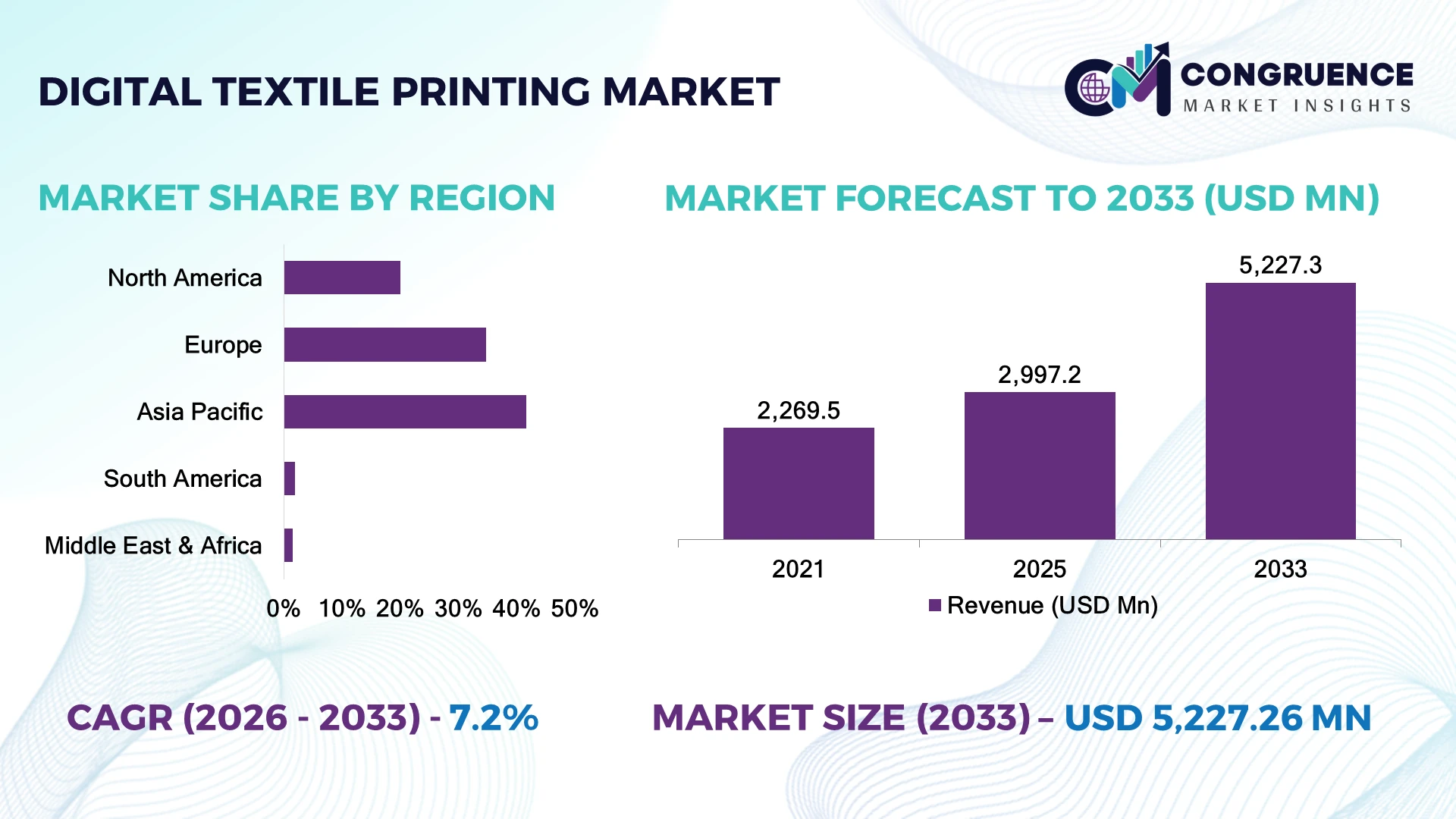
China remains the dominant textile manufacturing base, representing more than 50% of global textile production capacity, while India contributes roughly 7–8% and is expanding digital printing for apparel and home textiles; European converters increasingly deploy pigment and reactive inkjet systems, with digital workflows reducing setup and sampling waste by 20–30%. Red Sea shipping disruptions are also strengthening regional sourcing and nearshore production strategies.
Strategically, suppliers combining high-speed equipment, ink innovation, automation, and localized technical support are best positioned to capture the shift toward flexible textile production.
Market Size & Growth: USD 2,997.2 Million in 2025 to USD 5,227.3 Million by 2033 at 7.2% CAGR, driven by high-speed inkjet adoption and shorter production cycles.
Top Growth Drivers: 32% shorter-run production, 27% customized textile demand, and 21% automation-led workflow adoption strengthen the high-growth market.
Short-Term Forecast: By 2028, automated color management and digital workflow integration will reduce setup waste by 15–20% and improve production efficiency by 10–15%.
Emerging Technologies: AI color matching, high-speed inkjet printheads, pigment inks, and automated pre-treatment are reshaping advanced textile printing operations.
Regional Leaders: Asia-Pacific approaches USD 1.4 Billion, Europe USD 0.8 Billion, and North America USD 0.7 Billion, supported by rising digital printer deployment and localized production.
Consumer/End-User Trends: More than 35% of textile brands prioritize shorter production runs and customization, increasing reliance on digitally printed fabrics for seasonal collections.
Pilot/Case Example: 2025 automated pigment-printing deployments delivered approximately 20% lower setup waste and faster sampling cycles for short-run apparel production.
Competitive Landscape: Leading suppliers collectively command roughly 35% of the market, with EFI, Kornit Digital, Durst Group, Mimaki Engineering, and SPGPrints strengthening equipment and ink portfolios.
Regulatory & ESG Impact: Water-intensive conventional processes face increasing sustainability pressure, while digital printing reduces selected water consumption by 50–80% in suitable textile applications.
Investment & Funding: More than USD 600 Million is being directed toward printer capacity, ink development, automation, and regional production infrastructure, accelerating supplier partnerships.
Innovation & Future Outlook: 2026–2028 innovation centers on AI-driven color control, pigment-based printing, robotic finishing, recyclable substrates, and integrated print-to-garment workflows.
Digital Textile Printing is gaining traction across apparel, home textiles, sportswear, signage fabrics, and customized fashion, where rapid design changes and small-batch economics favor inkjet production. Pigment inks and automated color systems are expanding application flexibility, while roughly 30% of new textile-printing workflows increasingly emphasize reduced setup waste. Regional supply-chain diversification is further encouraging localized digital production, setting the foundation for strategic investment decisions.
Digital Textile Printing is becoming strategically important because it allows manufacturers to compete on speed, customization, inventory efficiency, and design complexity rather than relying solely on high-volume production. The shift toward shorter fashion cycles and regionalized supply chains is increasing the value of on-demand printing, particularly as brands reduce excess inventory and respond faster to localized demand.
Technology economics are reinforcing this transition. Digital inkjet printing eliminates several screens and plate-setting steps used in conventional workflows, cutting setup-related waste by roughly 15–30% and shortening sampling cycles by 30–50% for suitable short-run jobs. Asia-Pacific retains the strongest manufacturing scale, while Europe leads in premium digital applications, sustainability-driven pigment systems, and advanced workflow automation.
From 2026–2028, adoption is expected to concentrate on automated color management, high-speed printheads, pigment inks, and integrated production software, with digitally connected plants targeting 10–15% higher equipment utilization. A practical deployment involves linking RIP software, automated color control, printing, and finishing into one production workflow, reducing manual intervention and rework. Companies are consequently prioritizing equipment upgrades, application partnerships, regional service centers, and specialized ink development. Competitive advantage will increasingly depend on integrated digital production capability rather than printer capacity alone.
Digital textile printing is gaining structural momentum as apparel and home-textile manufacturers shift toward shorter production runs, faster sampling, and customized designs. Approximately 30–35% of new digital textile workflows now target short-run or variable-design production, while automated color-management systems can improve color consistency by 10–15% and reduce setup waste by 20–30%. In Italy and Germany, premium textile converters are expanding pigment and reactive inkjet capabilities to support faster collection cycles. Rising freight uncertainty, including Red Sea shipping disruptions, is reinforcing localized production. Equipment manufacturers are responding through high-speed printer upgrades, automated workflow partnerships, and application-specific ink development. The key advantage is not printing speed alone; digital systems convert lower minimum-order quantities into a commercially viable production model.
Consumable economics remain a significant barrier to wider digital textile printing deployment, particularly where ink consumption, pretreatment, and finishing requirements vary by substrate. Specialized textile inks can account for roughly 20–30% of variable printing costs, while pretreatment can add 10–20% to processing expenditure for selected reactive and pigment workflows. Manufacturers in India and Bangladesh also face dependence on imported specialty inks and printhead components, increasing exposure to freight delays and currency movements. These pressures directly affect margins on price-sensitive contract production. Companies are mitigating exposure through multi-supplier qualification, localized ink inventories, longer-term procurement contracts, and broader pigment-based systems. The strongest cost-control strategy is reducing process steps, not simply negotiating lower ink prices.
AI-enabled color prediction, automated artwork correction, and intelligent production scheduling are creating new efficiency opportunities beyond conventional printer upgrades. Connected workflow systems can reduce manual color-adjustment activity by 20–30%, while automated job scheduling can raise equipment utilization by 10–15% in high-mix environments. In the United States, digitally enabled apparel manufacturers are increasingly linking design software with print production to support rapid customization and on-demand collections. From 2026 onward, pigment inks, robotic handling, and AI-assisted color libraries will strengthen this model. Equipment suppliers are investing in software partnerships, application laboratories, and integrated print-management platforms. The less obvious opportunity is monetizing production flexibility itself, allowing converters to profitably serve low-volume, high-margin orders.
Enterprise-scale deployment remains constrained by integration between RIP software, color-management platforms, printers, pretreatment units, dryers, and finishing equipment. Approximately 25–35% of implementation effort in complex digital textile installations can involve workflow integration, while inconsistent substrate profiles can increase rework by 5–10%. In Japan and South Korea, highly automated manufacturing environments place greater emphasis on machine interoperability and production-data synchronization. Cybersecurity requirements are also expanding as connected printers become integrated into factory networks. Companies are addressing these pressures through standardized interfaces, industrial IoT architecture, operator training, and integrated equipment partnerships. Long-term competitiveness will depend on creating a reliable digital production stack rather than deploying isolated high-speed printers.
Pigment Printing Gains Ground: Pigment ink deployment is expanding as manufacturers seek simpler workflows, with adoption rising roughly 10–15% in selected apparel applications and reducing dependence on extensive post-print washing. Companies are investing in improved binders, pretreatment chemistry, and curing systems to shorten production cycles and support more localized manufacturing.
High-Speed Systems Move Upmarket: Printer installations above 100 meters per minute are increasingly targeted at commercial textile converters, improving throughput by approximately 20–30% versus older digital platforms. European and Asian manufacturers are upgrading printhead configurations and automated material handling to make digital printing viable for larger production batches.
Automation Reduces Labor Dependency: Automated loading, color calibration, nozzle monitoring, and finishing are reducing manual interventions by 15–25% at advanced facilities. Labor shortages in textile manufacturing hubs are accelerating this transition, prompting companies to integrate robotics and centralized production controls rather than simply adding operators.
On-Demand Models Reshape Inventory: Fashion brands are increasingly using digital printing for demand-responsive collections, with short-run orders reducing finished-fabric inventory requirements by approximately 15–20%. Companies are responding by establishing regional print hubs and closer brand-converter partnerships, creating a less inventory-intensive supply model that also limits unsold seasonal stock.
Direct-to-fabric printing represents approximately 42% of the global Digital Textile Printing Market, supported by broad compatibility with cotton, blends, and home-textile substrates and stronger suitability for industrial roll-to-roll production. Reactive and pigment systems together account for roughly 55% of industrial installations, reflecting established color performance and workflow integration. Dye-sublimation is the fastest-growing type, with adoption increasing around 12–15% as polyester-based sportswear, fashion, and soft-signage applications expand. Mature reactive systems remain important for high-volume cotton production, while pigment printing is gaining traction through simplified processing and reduced finishing requirements.
Companies are shifting investment toward high-speed printheads, automated pretreatment, intelligent color management, and integrated drying systems, targeting 10–20% higher equipment utilization. China continues to prioritize large-scale direct-to-fabric capacity, while India is expanding both direct-to-fabric and sublimation production. The strategic implication is a move from standalone printer procurement toward integrated production platforms that improve throughput, reduce manual intervention, and support shorter production runs.
WTiN reported that India digitally printed 461 million square meters of fabric in 2025, with direct-to-fabric printing accounting for 69% of national digital textile output.
Fashion apparel accounts for approximately 44% of digital textile printing demand, supported by seasonal collections, customized designs, sportswear, and shorter production runs. Home textiles contribute roughly 27%, while industrial textiles and soft signage represent approximately 17% and 12%, respectively. Fashion apparel is also the fastest-growing application, with adoption increasing around 13–16% as brands prioritize lower minimum-order quantities and faster design iteration. Digital printing enables artwork changes without screen replacement, making it particularly valuable for high-SKU collections.
Home textiles remain an established application, but digitally engineered bedding, curtains, upholstery, and decorative fabrics are increasing equipment utilization by 8–12%. Industrial textiles remain more specification-driven, requiring durability and substrate compatibility. Companies are responding with application-specific inks, automated color libraries, and high-speed roll-to-roll systems. China and India are expanding digitally printed apparel capacity, while European converters emphasize premium customization and rapid turnaround. This shift is making digital printing increasingly important for inventory control and demand-responsive manufacturing.
The International Textile Manufacturers Federation reported global textile capacity utilization of 72% in May 2025, while average order backlogs reached 2.3 months, reinforcing the value of flexible production capacity.
Textile manufacturers represent approximately 46% of Digital Textile Printing Market demand because their large production facilities require continuous roll-to-roll systems, automated finishing, and high equipment utilization. Print service providers account for nearly 24%, apparel brands and retailers 18%, and home-textile manufacturers and other users approximately 12%. Print service providers are the fastest-growing buyer group, with adoption rising around 14–17% as brands outsource customized and short-run production rather than maintaining dedicated printing capacity.
Large textile manufacturers prioritize throughput, printhead reliability, color consistency, and integration with existing finishing equipment, while print service providers emphasize rapid changeovers and substrate flexibility. Apparel brands increasingly use external digital converters to test collections before scaling, reducing inventory exposure. Companies are responding through equipment leasing, application partnerships, regional service networks, and modular printer configurations. India is developing a strong specialist printing ecosystem around Surat and other textile hubs, while China continues to favor high-volume industrial deployment. Future demand is therefore shifting toward service-oriented capacity and flexible production infrastructure.
WTiN reported that industrial-grade printers represented 51% of digital textile printing productivity in India in 2025, indicating that adoption is moving beyond sampling toward commercial-scale production.
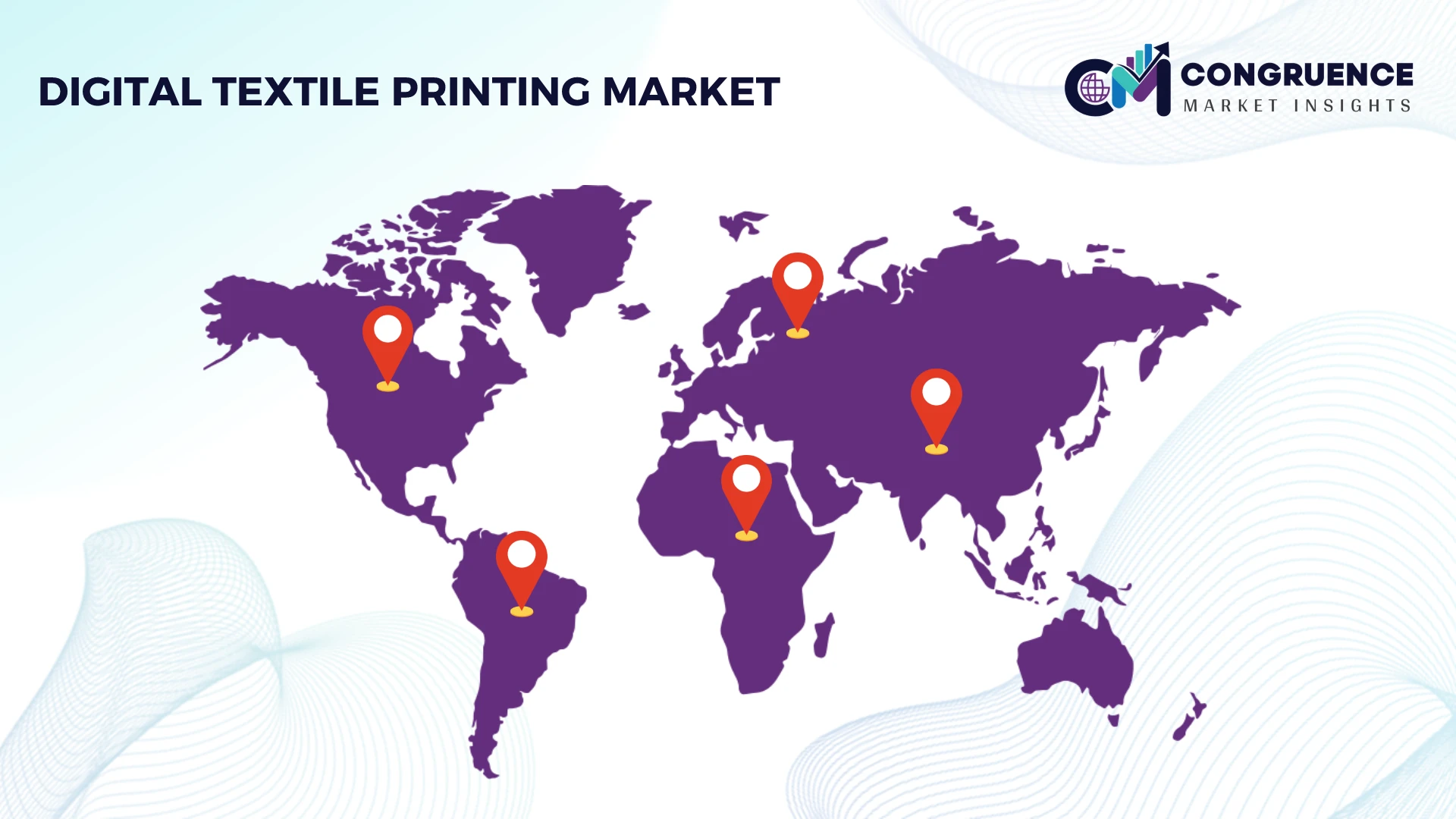
Asia-Pacific accounted for the largest market share at 41.7% in 2025 however, Middle East & Africa is expected to register the fastest growth, expanding at a CAGR of 13.2% between 2026 and 2033.
Nearshoring is shifting digital printing toward agile production hubs
North America accounts for approximately 20% of global Digital Textile Printing demand, with the United States representing the region's primary deployment base. E-commerce apparel, home décor, sportswear, and customized merchandise are driving investment in roll-to-roll pigment systems and direct-to-garment platforms. Nearshoring strategies are shortening selected apparel supply cycles from roughly 30 days to below 10 days, strengthening demand for localized digital production. Mexico and the southern United States are becoming important contract-printing locations, particularly for cotton-rich fabrics. Equipment suppliers are responding with automated color management, cloud-connected workflow systems, and regional service partnerships. The strategic shift is toward smaller, faster production hubs rather than dependence on long-distance imported printed inventory.
United States Market Outlook: The United States remains North America's technology and commercialization center, supported by sophisticated apparel brands, sportswear programs, décor manufacturers, and print-service providers. Clothing represents more than 41% of domestic digital textile printing applications, reinforcing demand for flexible short-run systems. Suppliers are increasingly emphasizing pigment inks, automated finishing, and integrated production software to serve customized orders with tighter delivery windows.
Premium textile clusters are accelerating sustainable digital conversion
Europe holds approximately 34.7% of the global Digital Textile Printing Market, supported by established textile clusters in Italy, Germany, France, Spain, and the Netherlands. Premium apparel, home textiles, fashion sampling, and customized fabrics favor digital systems because they reduce screen preparation and support complex artwork. Sustainability requirements are also encouraging water-efficient printing and pigment-based workflows. Germany is emerging as a particularly strong technology market, with industrial automation and advanced manufacturing infrastructure supporting printer integration. European converters are increasingly investing in connected color-management platforms and high-speed systems, targeting 10–20% improvements in workflow productivity while strengthening traceability and production consistency.
Germany Market Outlook: Germany combines advanced machinery engineering with a highly automated textile and industrial manufacturing base, making it strategically important for premium digital printing equipment and workflow technologies. Its digital textile printing market is projected to reach approximately USD 985.6 million by 2030. German manufacturers increasingly prioritize Industry 4.0 connectivity, automated quality control, and resource-efficient production, creating opportunities for integrated printer and software suppliers.
Manufacturing scale is turning digital printing into production infrastructure
Asia-Pacific accounts for approximately 41.7% of global Digital Textile Printing demand, anchored by China's textile clusters and India's rapidly expanding apparel ecosystem. China, India, Japan, South Korea, and Southeast Asian manufacturers are deploying digital systems for short-run fashion, sportswear, home textiles, and export production. India is strengthening capacity through textile manufacturing investments, while Chinese production hubs increasingly integrate digital printers with automated color and finishing systems. Digital printing adoption is particularly relevant where mills need faster replenishment and lower minimum-order volumes. Suppliers are responding through localized technical centers, application partnerships, and high-throughput printer configurations designed for continuous industrial operation.
China Market Outlook: China remains the region's largest textile manufacturing base, with major clusters in Shaoxing, Shengze, Hangzhou, and Guangzhou supporting substantial printing capacity. China's digital inkjet printing output is projected to exceed 7 billion meters by 2030, representing more than 30% of global digital printing volume. Manufacturers are therefore shifting investment toward high-speed equipment, automated production controls, and water-efficient technologies that support large-scale export and domestic fashion programs.
Brazil is moving digital printing into mainstream textile modernization
South America represents approximately 8–9% of global digital textile printing demand, with Brazil accounting for the largest share of regional activity. Apparel, home textiles, promotional fabrics, and e-commerce customization are increasing demand for flexible printing systems, while currency volatility and imported equipment costs continue to influence capital-investment timing. Brazilian converters are increasingly adopting direct-to-fabric platforms and digital finishing technologies to shorten production cycles and reduce screen-related setup requirements. Equipment suppliers are strengthening distributor networks and localized service coverage, while larger mills are evaluating staged automation investments. The key opportunity is converting Brazil's established textile manufacturing infrastructure into higher-value, digitally controlled production.
Brazil Market Outlook: Brazil has the region's deepest textile manufacturing ecosystem and remains the principal commercial base for digital printing equipment. Direct-to-fabric currently represents the leading digital process, while direct-to-garment is expanding faster as customized apparel and e-commerce orders increase. Brazil's broader textile printing market accounted for approximately 6.1% of global textile-printing activity in 2025, giving equipment suppliers a substantial installed manufacturing base for digital conversion.
Industrial diversification is creating new digital textile capacity
Middle East & Africa represents approximately 6.3% of global Digital Textile Printing demand but has a comparatively strong modernization opportunity. Saudi Arabia, the UAE, Egypt, and South Africa are developing textile, apparel, promotional-printing, and hospitality supply chains that favor flexible digital equipment. New industrial zones and manufacturing diversification programs are encouraging investment in automated production rather than legacy printing infrastructure. Gulf manufacturers increasingly evaluate single-pass and roll-to-roll systems during facility planning, avoiding expensive retrofits. Adoption remains constrained by specialized technician availability and imported consumables, prompting suppliers to establish distributor networks, spare-parts inventories, and local technical partnerships. This makes service infrastructure a critical competitive differentiator alongside printer performance.
Saudi Arabia Market Outlook: Saudi Arabia is emerging as the region's most strategically significant market as manufacturing diversification and local-content initiatives support new textile and apparel capacity. Industrial zones linked to MODON are creating opportunities for digitally enabled production facilities, while fashion, hospitality, sportswear, and promotional applications broaden the addressable customer base. Suppliers with local service capabilities, rapid spare-parts availability, and automated systems are better positioned to capture new facility investments.
EFI, Kornit Digital, Durst Group, Mimaki, and Atexco compete across industrial digital textile printing, while ColorJet and other regional OEMs pressure leaders on price and localized service. The top five players are estimated to control about 38% combined share. Competition centers on printer speed, ink economics, workflow integration, customization, and service: platforms can raise throughput 20–30%, while automated color management cuts setup waste 15–20%. EFI and Durst emphasize industrial scale and integrated workflows; Kornit focuses on on-demand apparel; Mimaki targets flexible mid-market production; Atexco competes through installed scale and cost efficiency. Players are expanding application centers, partnering with textile mills, integrating inks with hardware, and adding software controls. The competitive shift is moving from printer-only sales toward integrated print ecosystems and recurring consumables. Entry barriers remain high because customers require validated color consistency, service, and substrate expertise. Winning suppliers will combine speed, dependable inks, localized support, and low production cost.
EFI
Kornit Digital
Durst Group
Mimaki Engineering
Atexco
ColorJet Group
SPGPrints
Konica Minolta
Seiko Epson
Kyocera
Roland DG
Brother Industries
HP
Zhejiang Jinteng Machinery
High-speed single-pass inkjet, AI-assisted color management, pigment chemistry, and connected workflow software are defining the next production cycle, particularly for customized fashion and short-run home textiles. Single-pass systems can deliver throughput gains of 20–30% versus conventional multi-pass platforms, while automated color matching reduces manual adjustment by 15–20%. Adoption is strongest among industrial mills seeking continuous production and lower changeover losses.
Pigment inks are gaining attention because they reduce washing and finishing steps, potentially lowering process-related water and energy use by 10–20% in suitable applications. Cloud-connected RIP, MIS, and machine-monitoring platforms are also moving from isolated tools toward integrated production control, with advanced facilities targeting 10–15% higher equipment utilization. The competitive benefit favors OEMs that control printers, inks, software, and service relationships.
From 2026–2028, disruptive development will center on AI-driven scheduling, nozzle-health prediction, robotic material handling, and ultra-high-speed single-pass architectures. Compared with older screen-based workflows, digital production can cut setup time by 30–50% for short runs and eliminate screen preparation. Companies investing now gain faster sampling, lower minimum-order economics, and tighter color consistency, while suppliers with open interfaces and application partnerships can scale across diverse textile substrates and production environments while protecting recurring consumables and service revenue and improving asset returns.
July 2026 ColorJet became Official Technology Partner for Bharat Tex 2026, showcasing its 3.2-meter FabJet Pro. The partnership strengthens India’s digital-printing ecosystem, supporting home furnishings and technical textiles with localized equipment, sustainability, and export-oriented production. Source: colorjetgroup.com
March 2025 Kyocera’s FOREARTH technology powered HATRA’s 2025 collection at Rakuten Fashion Week TOKYO. The collaboration demonstrated water-efficient inkjet production using almost no water, strengthening premium fashion adoption and positioning sustainable digital printing for designers. Source: kyoceradocumentsolutions.us
December 2025 Embee Group launched Sapphire and Emerald digital textile printers at ITMA Asia, marking its first digital-printer portfolio after 65 years in textile machinery. The entry expands India’s domestic OEM base and intensifies equipment competition. Source: indiantextilemagazine.in
November 2025 True Colors partnered with Spain’s ITACA to distribute pigment and dye-based inks, pretreatment, and post-treatment chemistry in India. Products will be locally stocked at Surat, improving supply reliability and supporting consumables access for mills. Source: themachinemaker.com
The Digital Textile Printing Market Report covers direct-to-fabric, dye-sublimation, direct-to-garment, and specialty digital printing technologies across apparel, home textiles, industrial textiles, sportswear, soft signage, and customized fabrics. End-user analysis includes textile manufacturers, print service providers, apparel brands, retailers, and home-textile producers. Regional coverage spans North America, Europe, Asia-Pacific, South America, and Middle East & Africa, with detailed country assessment for major production and technology hubs.
The report evaluates high-speed inkjet, single-pass printing, pigment inks, AI-assisted color management, automated pretreatment, workflow software, and connected production systems. Digital apparel printing represents roughly 44% of application demand, while textile manufacturers account for approximately 46% of end-user demand. Strategic analysis supports equipment investment, capacity expansion, supplier selection, partnerships, technology adoption, competitive positioning, and market-entry planning through 2026–2033, including emerging opportunities in on-demand production, sustainable printing, and regionalized textile supply chains.
| Report Attribute/Metric | Report Details |
|---|---|
|
Market Revenue in 2025 |
USD 2,997.2 Million |
|
Market Revenue in 2033 |
USD 5,227.3 Million |
|
CAGR (2026 - 2033) |
7.2% |
|
Base Year |
2025 |
|
Forecast Period |
2026 - 2033 |
|
Historic Period |
2021 - 2025 |
|
Segments Covered |
By Type
By Application
By End-User
|
|
Key Report Deliverable |
Revenue Forecast, Growth Trends, Market Dynamics, Segmental Overview, Regional and Country-wise Analysis, Competition Landscape |
|
Region Covered |
North America, Europe, Asia-Pacific, South America, Middle East, Africa |
|
Key Players Analyzed |
EFI, Kornit Digital, Durst Group, Mimaki Engineering, Atexco, ColorJet Group, SPGPrints, Konica Minolta, Seiko Epson, Kyocera, Roland DG, Brother Industries, HP, Zhejiang Jinteng Machinery |
|
Customization & Pricing |
Available on Request (10% Customization is Free) |




