
Reports
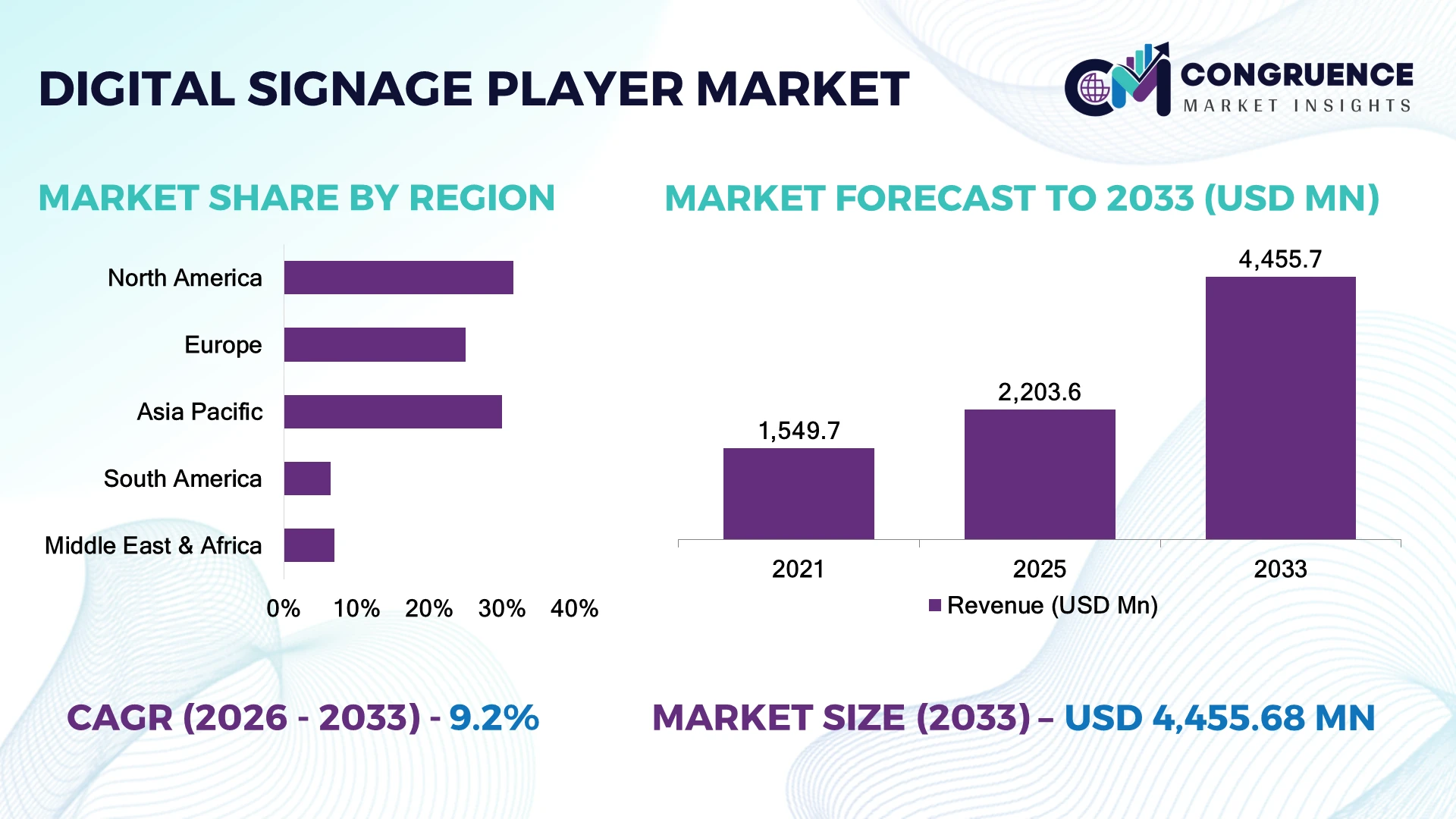
The Global Digital Signage Player Market was valued at USD 2,203.6 Million in 2025 and is anticipated to reach a value of USD 4,455.7 Million by 2033 expanding at a CAGR of 9.2% between 2026 and 2033. Growth is being driven by the shift from basic content playback toward AI-enabled, cloud-managed and edge-processing digital signage players supporting real-time personalization, remote fleet management, and multi-location content orchestration.
The United States remains a major deployment market, supported by retail, transportation, hospitality, and digital-out-of-home infrastructure, with hardware accounting for more than 64% of the U.S. digital signage market in 2025. China is expanding through retail modernization, smart-city programs, and 5G infrastructure, with its broader digital signage market approaching USD 3.0 billion in 2026. U.S. deployments are more software- and analytics-intensive, while China emphasizes large-scale commercial display infrastructure. The contrasting models reflect different investment priorities across mature and rapidly digitizing economies.
Strategically, suppliers combining edge AI, cybersecurity, remote device management, and energy-efficient playback are positioned to capture higher-value enterprise deployments.
Market Size & Growth: USD 2,203.6 million in 2025 is projected to reach USD 4,455.7 million by 2033 at a 9.2% CAGR, driven by AI-enabled playback, cloud management, and multi-screen automation.
Top Growth Drivers: Retail transformation 28%, transportation modernization 21%, and digital-out-of-home expansion 18% represent the leading demand drivers for advanced digital signage players.
Short-Term Forecast: By 2028, remote device management can reduce onsite service interventions by 20–30%, while automated content deployment improves fleet operating efficiency by 15–25%.
Emerging Technologies: Edge AI, 4K/8K playback, computer vision, secure cloud orchestration, and GPU-accelerated media processing are reshaping high-performance signage deployments.
Regional Leaders: Asia-Pacific is projected at approximately USD 1.9 billion by 2033, North America at USD 1.4 billion, and Europe at USD 0.9 billion, with AI-enabled and cloud-connected deployments accelerating across major commercial venues.
Consumer/End-User Trends: Retail remains a major deployment segment, with U.S. retail representing more than 28% of digital signage demand in 2025 as stores integrate displays with omnichannel customer journeys.
Pilot/Case Example: 2026 deployments increasingly use edge-AI media players to trigger content locally, reducing dependence on continuous cloud processing and improving response times across retail and transportation environments.
Competitive Landscape: BrightSign, Samsung, LG, Scala, and Cisco compete across hardware, software, and enterprise integration, while hardware represented more than 64% of the U.S. digital signage market in 2025.
Regulatory & ESG Impact: EU ecodesign requirements are increasing attention to energy efficiency, with regulated electronic-display measures targeting approximately 51 TWh of annual electricity savings by 2030.
Investment & Funding: Enterprise investment is shifting toward integrated display ecosystems combining media players, CMS platforms, analytics, and managed services, while transportation and public-venue projects are expanding demand for high-reliability hardware.
Innovation & Future Outlook: The market is shifting from standalone playback devices toward secure edge-computing nodes supporting AI analytics, sensor integration, predictive monitoring, and centralized fleet orchestration.
The Digital Signage Player Market is expanding across retail stores, transportation hubs, hospitality, corporate campuses, and public infrastructure, with AI-enabled players increasingly supporting localized content decisions and real-time analytics. More than 70% of U.S. digital signage revenue is associated with LCD/LED technologies, reinforcing demand for reliable high-resolution playback. European energy-efficiency requirements are also influencing procurement and system design.
Digital signage players are becoming strategic infrastructure rather than simple playback hardware because retailers, transport operators, and public venues increasingly connect displays with customer data, operational systems, and centralized content platforms. The commercial shift is toward managed fleets where device uptime, cybersecurity, analytics, and remote configuration directly influence operating economics.
Technology architecture is also changing. Edge-AI processing reduces the need to continuously transmit video or sensor data to cloud infrastructure, improving response speed and reducing bandwidth dependence compared with cloud-only workflows. A 2026 deployment can therefore support localized content triggers while retaining centralized governance. North America remains highly software- and analytics-oriented, while Asia-Pacific combines large-scale retail modernization with smart-city and 5G infrastructure expansion.
Over the next 2–3 years, enterprises are expected to prioritize remote diagnostics, automated provisioning, secure boot, encrypted communications, and energy-aware scheduling. Transportation operators can use centralized players to coordinate passenger information across hundreds of screens, while retailers can synchronize pricing, promotions, and inventory-linked content across locations. The strategic advantage will increasingly come from integrating reliable hardware with AI, cybersecurity, and lifecycle management rather than competing on playback specifications alone.
AI-enabled content management and centralized device orchestration are accelerating enterprise adoption, with approximately 30–35% of new large-scale deployments increasingly incorporating automated scheduling, audience analytics, or remote diagnostics. Cloud-connected players can reduce onsite service interventions by 20–30%, while centralized provisioning cuts device configuration time by approximately 40–50%. In the United States, retailers and transportation operators are moving from standalone media players toward managed fleets integrated with POS, inventory, passenger-information, and analytics systems. The shift toward edge processing also reduces bandwidth dependency for real-time applications. Companies are responding by expanding edge-AI capabilities, developing cloud management partnerships, and bundling hardware with recurring software and maintenance services.
Hardware fragmentation and interoperability remain significant constraints, particularly across mixed fleets using different operating systems, display interfaces, content-management protocols, and connectivity standards. Enterprises operating heterogeneous networks can face 15–25% higher integration and support costs, while legacy installations can require 20–30% additional engineering effort during modernization. In India and Southeast Asia, imported chipsets and specialized components also expose integrators to longer procurement cycles and currency-related cost pressure. HDMI, network, security, and CMS compatibility requirements increasingly influence purchasing decisions alongside processor performance. Companies are reducing exposure through standardized hardware platforms, multi-year component contracts, localized assembly, and support for broader API and device-management standards, shifting competition from hardware specifications toward total deployment cost.
Edge intelligence is creating opportunities beyond conventional content playback, particularly through computer vision, contextual advertising, queue analytics, and sensor-driven content. AI-enabled players can process selected visual or operational data locally, reducing cloud data transmission by approximately 25–40% while improving response latency for time-sensitive applications. In Japan, Singapore, and South Korea, high-density retail and transportation environments provide strong use cases for localized content orchestration and passenger-flow analytics. The next opportunity is monetizing the player as an operational intelligence node rather than a display accessory. Vendors are investing in GPU-enabled devices, privacy-preserving analytics, and API partnerships that connect signage with POS, CRM, smart-building, and advertising platforms, creating higher-value enterprise contracts.
Large distributed signage fleets are becoming more difficult to secure as players connect with corporate networks, cloud platforms, cameras, sensors, and third-party applications. Enterprises managing hundreds or thousands of endpoints can face 20–30% higher cybersecurity and monitoring requirements when legacy devices lack secure boot, automated patching, or centralized authentication. Transportation networks in the United States and Europe face additional pressure because passenger-information systems require continuous availability and rapid recovery from device failures. The operational challenge is no longer simply maintaining screen uptime; it is maintaining synchronized, authenticated, and compliant endpoints across diverse locations. Companies must therefore invest in zero-trust architectures, encrypted communications, automated firmware management, redundant connectivity, and long-term cybersecurity partnerships.
Edge AI Replaces Cloud-Only Processing: Retail and transportation deployments are increasingly shifting selected analytics and content decisions to edge devices, reducing cloud data transmission by 25–40% and improving response latency by 20–30%. Companies are deploying GPU-capable players with local computer vision, particularly where connectivity costs or latency constrain continuous cloud processing.
Remote Fleet Management Becomes Standard: Centralized provisioning, diagnostics, firmware updates, and content deployment are expanding across multi-site networks, reducing onsite interventions by approximately 20–30% and cutting configuration time by 40–50%. U.S. retailers are consolidating thousands of endpoints into unified management environments, while suppliers increasingly bundle monitoring and lifecycle support with hardware.
Energy-Aware Playback Gains Priority: European procurement is increasingly incorporating power-management capabilities as display efficiency requirements tighten. Automated brightness control, scheduled sleep modes, and workload optimization can reduce player and display-system electricity consumption by approximately 10–20%. Manufacturers are responding with low-power processors, dynamic workload management, and centralized energy-monitoring functions rather than relying solely on more efficient displays.
Cybersecurity Moves Into Hardware Design: Secure boot, device authentication, encrypted communications, and automated patching are moving from optional features toward procurement requirements, particularly for transportation and government-connected deployments. Security controls can increase initial hardware costs by roughly 5–10%, but centralized protection reduces manual maintenance exposure and strengthens fleet continuity. Vendors are therefore integrating security at chipset, firmware, and device-management levels.
Standalone digital signage players account for approximately 46–50% of the market, supported by broad compatibility, dedicated processing, easier replacement, and suitability for multi-display retail and transportation networks. These devices remain the preferred architecture where enterprises require consistent 4K playback, peripheral connectivity, and centralized device management. System-on-chip and embedded player configurations represent roughly 30–34%, gaining adoption where lower hardware complexity, reduced installation footprint, and simplified maintenance are priorities. Cloud-managed and software-defined players account for approximately 12–16% but represent the fastest-shifting category as enterprises move toward centralized content orchestration.
High-performance players supporting 4K/8K, AI inference, computer vision, and real-time data integration are capturing increasing investment, particularly in premium retail, transportation hubs, and large-format digital-out-of-home networks. Companies are responding with GPU acceleration, stronger cybersecurity, remote provisioning, and modular hardware platforms. The strategic shift is toward reducing separate infrastructure components while retaining sufficient processing capacity for analytics-intensive deployments.
India's video-wall segment accounted for 42.12% of the country's digital signage market in 2025, demonstrating strong demand for dedicated, high-performance playback infrastructure in large-format deployments.
Retail accounts for approximately 31–35% of Digital Signage Player demand, reflecting extensive deployment across stores, malls, supermarkets, checkout areas, digital shelves, and promotional displays. Corporate and hospitality applications collectively represent around 25–29%, supported by reception displays, meeting environments, digital menus, wayfinding, and internal communications. Transportation is the fastest-shifting application, representing approximately 15–19% and gaining adoption as airports, metro systems, railway stations, and bus terminals require synchronized passenger information, advertising, and emergency messaging.
The operational difference is significant: retail deployments prioritize content flexibility and POS integration, while transportation requires continuous uptime, redundant connectivity, and rapid content updates. Healthcare, education, and banking remain smaller but increasingly structured use cases, particularly for information delivery and queue management. Companies are adapting by developing application-specific players with stronger networking, remote diagnostics, peripheral connectivity, and 24/7 operating capabilities, while transportation projects increasingly favor centralized fleet management.
The U.S. retail segment accounted for more than 20.2% of the digital signage market in 2025, while retail adoption is increasingly tied to omnichannel experiences, including click-and-collect and real-time in-store information.
Retail chains and large-format retailers represent approximately 32–36% of Digital Signage Player purchases, making them the leading end-user group because a single contract can cover hundreds or thousands of locations. Transportation operators and infrastructure managers account for roughly 18–22%, while hospitality groups contribute approximately 14–18%. Retail buyers prioritize centralized content management, rapid provisioning, POS integration, and predictable lifecycle costs, whereas transportation buyers place greater emphasis on uptime, ruggedization, redundant connectivity, and real-time information delivery.
Transportation operators are emerging as the fastest-growing strategic buyer group as passenger-information networks become more connected and advertising infrastructure becomes increasingly digitized. Corporate enterprises, healthcare providers, educational institutions, and government facilities collectively represent approximately 25–30% of demand, with purchasing increasingly shifting from standalone hardware toward managed deployment contracts. Suppliers are responding through vertical-specific configurations, systems-integrator partnerships, subscription-based device management, and bundled hardware-software-service offerings that improve recurring revenue and fleet retention.
The U.S. digital signage market recorded 94% retail adoption for enhancing the in-store customer experience in 2025, highlighting how enterprise retailers are moving from isolated screens toward integrated digital signage networks.
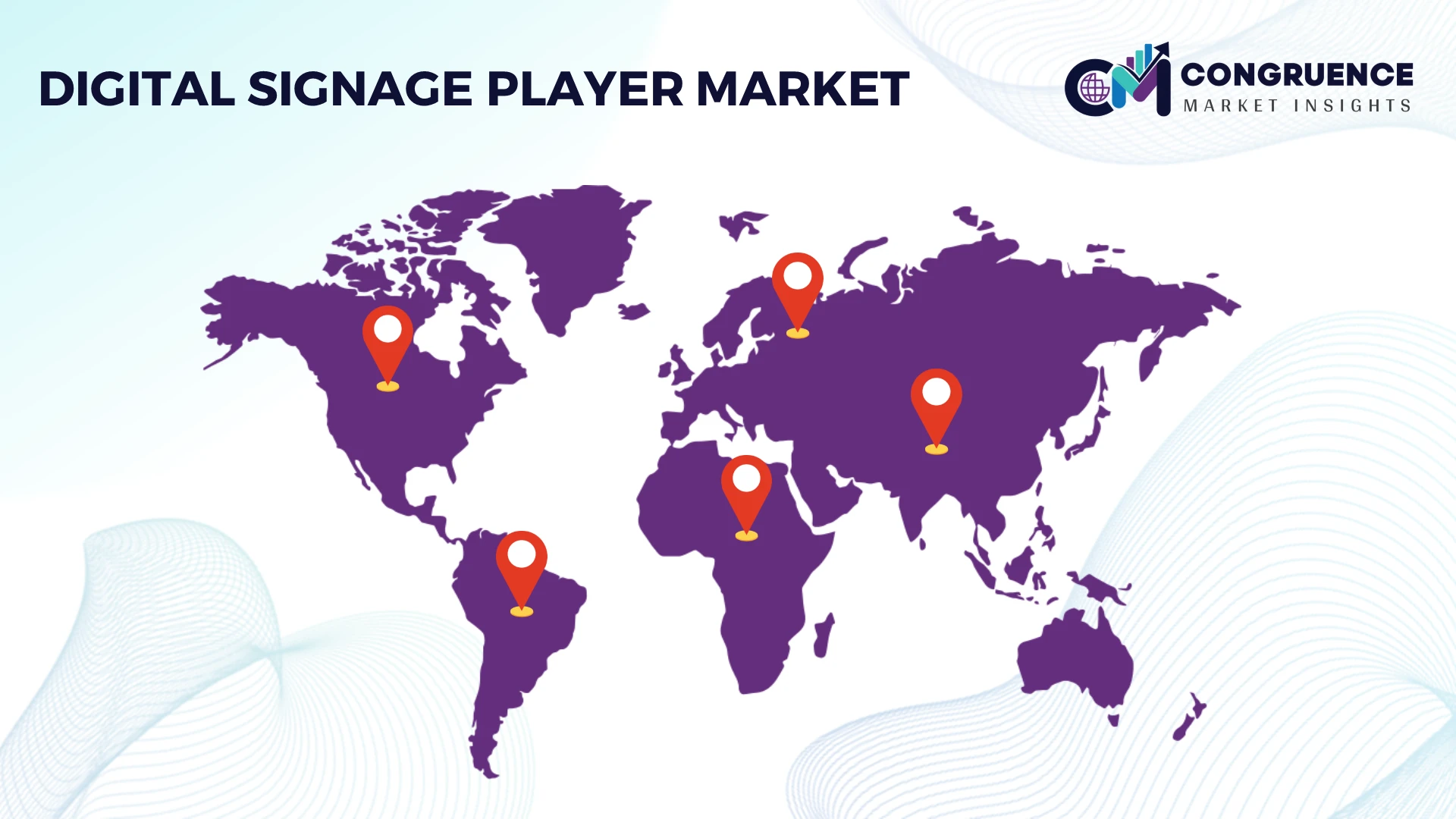
North America accounted for the largest market share at 31.5% in 2025 however, Asia-Pacific is expected to register the fastest growth, expanding at a CAGR of 11.8% between 2026 and 2033.
Enterprise fleet modernization shifts demand toward intelligent, centrally managed players
North America represents approximately 31.5% of the global Digital Signage Player Market, supported by dense retail networks, airports, quick-service restaurants, corporate campuses, and digital-out-of-home infrastructure. The United States accounts for more than 85% of regional demand, with large enterprises increasingly replacing standalone playback devices with cloud-managed and edge-enabled systems. 4K-capable hardware represents more than 70% of new enterprise deployments, while remote monitoring can reduce onsite service requirements by approximately 20–30%. Transportation modernization and retail automation are also increasing requirements for redundant connectivity, cybersecurity, and real-time content orchestration. Vendors are responding through enterprise software integration, channel partnerships, localized support, and bundled hardware-management contracts.
United States Market Outlook: The United States remains the region's primary technology and deployment center, with retail, transportation, hospitality, and digital-out-of-home networks driving large-scale installations. Major retailers operate thousands of geographically distributed displays, increasing demand for centralized provisioning and device diagnostics. AI-enabled content personalization and edge analytics are gaining traction, while enterprise buyers increasingly evaluate cybersecurity and lifecycle management alongside processor performance. This favors suppliers capable of combining high-performance media processing with long-term fleet support.
Energy efficiency and infrastructure modernization reshape procurement specifications
Europe accounts for approximately 25.0% of global Digital Signage Player demand, with Germany, the United Kingdom, France, Italy, and the Netherlands representing major deployment centers. Retail, public transportation, hospitality, and corporate communications remain the principal applications, while sustainability requirements increasingly influence hardware selection. Energy-aware scheduling and low-power processing can reduce system electricity consumption by approximately 10–20% in optimized deployments. European operators are also upgrading passenger-information and wayfinding infrastructure across rail stations and airports. Procurement increasingly favors remotely manageable devices with secure firmware, extended operating lifecycles, and lower maintenance requirements, pushing manufacturers toward efficient chipsets and standardized enterprise platforms.
Germany Market Outlook: Germany combines a large industrial base with extensive retail, transport, exhibition, and corporate infrastructure, creating demand for reliable commercial display networks. Major railway stations, airports, shopping centers, and industrial campuses increasingly require synchronized information systems and centralized device management. The country's emphasis on energy efficiency is also encouraging buyers to evaluate operating consumption over the full equipment lifecycle. Suppliers with low-power processors, secure remote management, and long-service hardware architectures are well positioned for institutional and enterprise deployments.
Large-scale retail digitization and smart infrastructure accelerate deployment
Asia-Pacific represents approximately 30.0% of global Digital Signage Player demand and is becoming the largest manufacturing and deployment ecosystem for commercial display infrastructure. China, Japan, South Korea, and India account for most regional activity, supported by retail modernization, transportation infrastructure, hospitality expansion, and smart-city projects. China alone contributes more than 45% of regional demand, while local electronics manufacturing provides significant advantages in component availability and system integration. 5G connectivity, high-resolution LED displays, and AI-enabled analytics are accelerating deployment of connected signage. Manufacturers are increasingly localizing assembly and software integration to shorten lead times and customize devices for large retail and transportation contracts.
China Market Outlook: China is the region's largest deployment and manufacturing hub, supported by extensive electronics production, major retail chains, metro networks, airports, and smart-city infrastructure. More than 75% of the country's internet users access digital services through mobile platforms, strengthening demand for connected customer experiences across physical locations. Domestic component availability enables competitive hardware development and rapid customization. Chinese suppliers are increasingly integrating AI processors, 5G connectivity, and centralized fleet management into signage players, creating scalable platforms for retail, transportation, advertising, and public-sector deployments.
Retail modernization and transportation digitization expand connected signage demand
South America accounts for approximately 6.5% of global Digital Signage Player demand, with Brazil representing more than 55% of regional consumption. Retail chains, shopping centers, airports, banking networks, and quick-service restaurants are the principal deployment environments. Brazil's large consumer market is encouraging multi-location signage rollouts, while transportation operators increasingly use digital displays for passenger information and advertising. Imported hardware remains important, creating exposure to currency fluctuations and longer replacement cycles compared with North American and Asian markets. Integrators are therefore emphasizing modular platforms, remote diagnostics, and standardized components that simplify maintenance. Cloud-managed deployments can reduce onsite servicing requirements by approximately 20–25%, improving economics for geographically dispersed installations.
Brazil Market Outlook: Brazil dominates South American demand because of its extensive retail infrastructure, large banking network, shopping-center ecosystem, and expanding airport modernization. Large retailers increasingly use centralized digital content across hundreds of locations, creating demand for reliable 24/7 media players rather than consumer-grade hardware. São Paulo represents a major commercial deployment center, particularly for retail advertising and corporate communications. Suppliers are strengthening local integrator partnerships and inventory availability to reduce imported-equipment lead times and improve after-sales support across the country's geographically dispersed customer base.
Mega-project investment accelerates high-performance digital infrastructure
Middle East & Africa contributes approximately 7.0% of global Digital Signage Player demand, with the Gulf states accounting for the majority of premium deployments. Saudi Arabia and the United Arab Emirates are driving investment through airports, tourism developments, retail complexes, stadiums, hospitality projects, and smart-city infrastructure. Large developments increasingly specify 4K/8K playback, centralized content control, redundant connectivity, and 24/7 operation. Saudi Arabia's major urban and tourism developments are expanding requirements for digital wayfinding and information systems, while Dubai remains a mature commercial signage hub. Suppliers are responding through project-based partnerships, regional integrators, ruggedized hardware, and localized technical support to address demanding operating environments.
Saudi Arabia Market Outlook: Saudi Arabia is becoming a major regional deployment center as large-scale urban, tourism, transportation, and entertainment projects integrate digital information and advertising infrastructure from the planning stage. New hospitality and destination developments require synchronized displays across multiple buildings and public spaces, increasing demand for centralized device management. The country's expanding digital infrastructure also supports network-connected signage rather than isolated playback systems. Vendors are targeting engineering and systems-integration partnerships to secure project specifications early and provide hardware, software, installation, and lifecycle support as integrated solutions.
BrightSign competes with Samsung, LG, Scala, and Android-based players, with dedicated media-player specialists challenging display OEMs on reliability while OEMs compete through integrated SoC platforms. The top five players are estimated to control approximately 35–40% of the market, leaving room for regional integrators and cost-focused suppliers.
Competition centers on hardware price, processing capability, ecosystem breadth, supply availability, and customization. Premium players command roughly 10–15% higher pricing for advanced 4K/8K, AI, security, and lifecycle features, while integrated platforms can reduce external hardware requirements by 15–25%. BrightSign is expanding CMS alliances and AI-enabled players; Samsung and LG are integrating signage management directly into display ecosystems; Scala is strengthening its software-led partner model. The competitive shift is moving toward vertical integration, cloud management, and AI-enabled experiences, while consolidation is accelerating. Entry barriers include enterprise certification, channel relationships, and installed-base switching costs. Winning requires dependable hardware, open integrations, rapid deployment, and recurring fleet-management capabilities.
BrightSign LLC
Samsung Electronics Co., Ltd.
LG Electronics Inc.
Scala
Cisco Systems, Inc.
STRATACACHE
Navori Labs
Broadsign
WebNMS
IAdea Corporation
SpinetiX AG
Telelogos
SignageLive
Korbyt
Digital signage player technology is shifting from dedicated playback toward AI-capable edge computing, GPU acceleration, and integrated device management. Advanced players can improve content-rendering performance by 15–25% versus legacy hardware while reducing onsite interventions by 20–30% through remote diagnostics. Approximately 45–50% of new enterprise deployments increasingly specify cloud-connected management, reflecting stronger demand for centralized provisioning and fleet visibility.
Emerging systems combine computer vision, NPU-based inference, secure boot, 4K/8K decoding, and real-time data APIs. Local AI processing can reduce cloud data transmission by 25–40%, while automated provisioning cuts configuration effort by 30–50%. Samsung and BrightSign benefit from combining processing, display ecosystems, and software management, while open-platform suppliers gain through compatibility with multiple CMS environments. The competitive advantage is shifting toward integration rather than processor speed alone.
Between 2026 and 2028, edge AI, cybersecurity, low-power architectures, and embedded analytics will shape procurement. Compared with conventional cloud-dependent playback, local inference can reduce response latency by approximately 20–30% and improve resilience during connectivity interruptions. Players supporting predictive diagnostics and API integration will gain stronger enterprise relevance as retailers, transport operators, and hospitality groups consolidate distributed signage fleets at scale. Suppliers that combine reliable hardware, open software ecosystems, and lifecycle services will capture higher-value deployments.
January 2025 BrightSign introduced a 5-year warranty for Series 5 and newer players, extending software updates. The program strengthened lifecycle economics and reliability positioning for enterprise buyers managing distributed signage fleets, supporting lower replacement frequency and procurement risk across deployments. Source: BrightSign
February 2024 Samsung secured ISO/IEC 27001:2022 and 27701:2019 certifications for VXT, MagicINFO and LYNK Cloud. Certification strengthened security and privacy controls across three signage CMS platforms, addressing enterprise cybersecurity requirements and improving suitability for connected commercial deployments worldwide. Source: Samsung
May 2026 Vertiseit agreed to acquire Scala for approximately SEK 265 million, expanding its digital signage and in-store experience platform. Scala brought more than 1,000 brands and over 100 partners, strengthening North American reach and accelerating software-led consolidation across signage. Source: Vertiseit
June 2024 BrightSign expanded its XC5 portfolio with BrightSignOS or Windows 10/11 IoT options and launched a trade-in program for older players. The strategy improved platform flexibility and accelerated upgrades from Series 1–3 hardware toward standardized Series 5 deployments globally. Source: invidis
The Digital Signage Player Market Report evaluates standalone, embedded, SoC, cloud-managed, and high-performance player architectures across retail, transportation, hospitality, corporate, healthcare, education, banking, and public-sector applications. End-user coverage includes retail chains, transportation operators, hospitality groups, enterprises, government organizations, and specialized digital-out-of-home operators. The analysis assesses 4K/8K playback, edge AI, computer vision, cloud device management, cybersecurity, remote diagnostics, and integrated content-management technologies.
Regional coverage spans North America, Europe, Asia-Pacific, South America, and Middle East & Africa, with country-level assessment across major deployment markets. The report examines mature enterprise installations alongside emerging applications such as AI-driven personalization, smart-city information systems, interactive wayfinding, and connected advertising networks. With standalone players representing approximately 46–50% of demand and cloud-connected management increasingly specified in enterprise deployments, the study supports investment planning, market expansion, partnership strategy, product positioning, and competitive decisions through 2026–2033.
| Report Attribute/Metric | Report Details |
|---|---|
|
Market Revenue in 2025 |
USD 2,203.6 Million |
|
Market Revenue in 2033 |
USD 4,455.8 Million |
|
CAGR (2026 - 2033) |
9.2% |
|
Base Year |
2025 |
|
Forecast Period |
2026 - 2033 |
|
Historic Period |
2021 - 2025 |
|
Segments Covered |
By Type
By Application
By End-User
|
|
Key Report Deliverable |
Revenue Forecast, Growth Trends, Market Dynamics, Segmental Overview, Regional and Country-wise Analysis, Competition Landscape |
|
Region Covered |
North America, Europe, Asia-Pacific, South America, Middle East, Africa |
|
Key Players Analyzed |
BrightSign LLC, Samsung Electronics Co., Ltd., LG Electronics Inc., Scala, Cisco Systems, Inc., STRATACACHE, Navori Labs, Broadsign, WebNMS, IAdea Corporation, SpinetiX AG, Telelogos, SignageLive, Korbyt |
|
Customization & Pricing |
Available on Request (10% Customization is Free) |




