
Reports
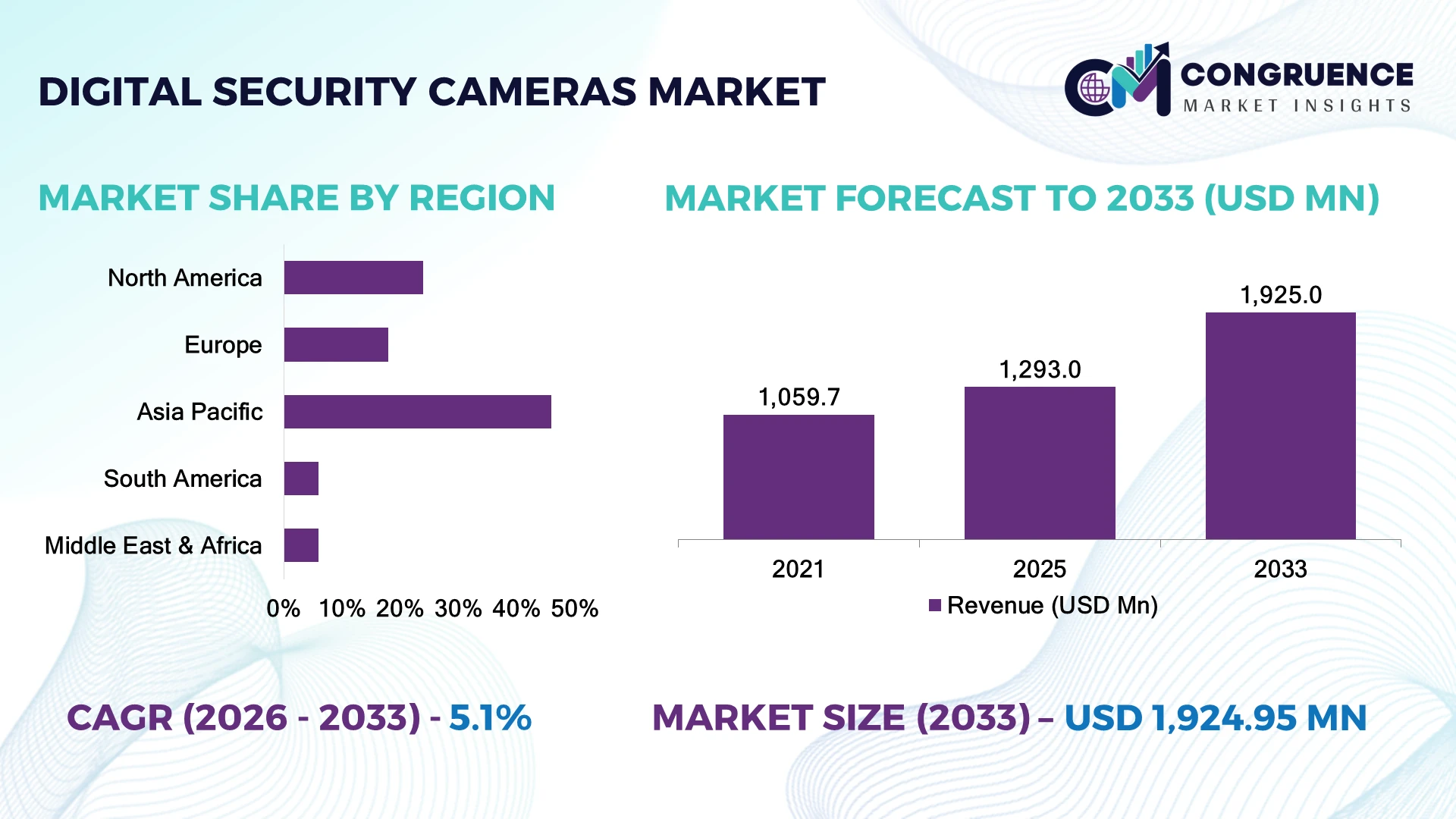
The Global Digital Security Cameras Market was valued at USD 1,293.0 Million in 2025 and is anticipated to reach a value of USD 1,925.0 Million by 2033 expanding at a CAGR of 5.1% between 2026 and 2033. Growth is driven by expanding AI-enabled video analytics, stricter public surveillance regulations, and accelerating smart infrastructure deployment across commercial and government facilities.
China dominates the global digital security cameras market with approximately 39% of worldwide manufacturing capacity, supported by investments exceeding USD 8 billion in smart city infrastructure and advanced electronics production. More than 72% of newly deployed urban surveillance systems incorporate AI-based video analytics, compared with about 58% in the United States. Continued infrastructure modernization and public security initiatives further strengthen China's leadership despite evolving global trade restrictions on surveillance technologies.
Organizations prioritizing AI-enabled surveillance ecosystems and diversified supply networks will strengthen long-term operational resilience and competitive positioning.
Market Size & Growth: USD 1,293.0 Million in 2025, reaching USD 1,925.0 Million by 2033 at 5.1% CAGR, supported by AI-powered surveillance and smart infrastructure expansion.
Top Growth Drivers: AI analytics adoption (+42%), smart city deployments (+36%), enterprise cloud surveillance integration (+31%).
Short-Term Forecast: By 2028, video processing efficiency improves by nearly 28% while monitoring response time decreases by approximately 35%.
Emerging Technologies: Edge AI, cloud video management, and deep-learning object recognition improve detection accuracy beyond 90%.
Regional Leaders: Asia Pacific (~USD 760 Million), North America (~USD 470 Million), Europe (~USD 360 Million), driven by infrastructure upgrades and industrial security modernization.
Consumer/End-User Trends: Nearly 67% of commercial facilities prefer AI-enabled IP cameras with remote monitoring capabilities.
Pilot/Case Example: In 2024, an AI-enabled smart city deployment reduced incident response time by approximately 32% through automated video analytics.
Competitive Landscape: Top manufacturers collectively control nearly 48% of global shipments, led by Hikvision, Dahua Technology, Axis Communications, Bosch Security Systems, and Hanwha Vision.
Regulatory & ESG Impact: Privacy compliance investments increased by 24%, while energy-efficient camera deployments reduced operational electricity usage by nearly 18%.
Investment & Funding: More than USD 3.5 billion supported manufacturing expansion, AI partnerships, and intelligent surveillance platform development amid supply-chain diversification.
Innovation & Future Outlook: AI edge computing, cybersecurity integration, and predictive video intelligence are redefining advanced global surveillance ecosystems.
Digital security cameras are becoming essential across transportation hubs, manufacturing facilities, healthcare institutions, and smart commercial buildings where continuous monitoring and automated threat detection improve operational visibility. AI-powered edge processing now supports over 45% of new enterprise deployments, while privacy-focused regulations encourage encrypted video management and secure cloud architectures. Ongoing electronics supply-chain diversification is accelerating localized manufacturing and technology partnerships, setting the foundation for broader strategic market expansion.
Digital security cameras have become a strategic component of modern digital infrastructure as organizations prioritize intelligent monitoring, operational resilience, and real-time decision support. Infrastructure modernization, cybersecurity requirements, and expanding smart-city investments are transforming surveillance from passive recording into proactive risk management. Enterprises are increasingly integrating AI-enabled monitoring platforms with access control and industrial automation systems to improve operational efficiency.
Compared with conventional analog surveillance, AI-enabled IP camera platforms reduce false alarms by nearly 40% while lowering manual monitoring requirements by approximately 30% through automated object recognition and event classification. China continues to lead large-scale manufacturing and deployment, while the United States focuses on cybersecurity compliance, critical infrastructure protection, and enterprise software integration, creating distinct competitive strengths across global markets.
Over the next two to three years, organizations are expected to expand intelligent edge deployments across logistics hubs, airports, healthcare campuses, and manufacturing facilities. Camera manufacturers are strengthening technology partnerships, expanding localized production, and investing in secure cloud ecosystems to support enterprise requirements. Companies that combine AI analytics, cybersecurity capabilities, and scalable deployment models will establish stronger competitive differentiation and long-term operational advantage.
AI-powered video analytics and intelligent surveillance platforms are reshaping enterprise security strategies across transportation, manufacturing, and public infrastructure. More than 72% of newly installed commercial surveillance systems now utilize IP-based architecture, while AI-enabled analytics improve threat detection accuracy by approximately 35% and reduce manual monitoring workloads by nearly 30%. Government-backed smart-city programs and stricter security regulations continue to accelerate deployment, particularly across China and the Middle East. In response, manufacturers are expanding AI software portfolios, increasing localized production, and forming strategic partnerships with cloud and semiconductor providers. Organizations integrating intelligent analytics with centralized security operations gain faster incident response, improved asset protection, and stronger long-term operational efficiency.
Global digital security camera manufacturers continue facing operational pressure from semiconductor dependency, evolving privacy regulations, and certification requirements. Imaging sensors and advanced processors account for nearly 38% of hardware costs, while compliance expenditures have increased by approximately 22% following stricter cybersecurity and data protection regulations. Export restrictions affecting advanced surveillance technologies have also disrupted procurement strategies across several international markets. To reduce operational risks, manufacturers are diversifying supplier networks, expanding regional assembly operations, and increasing long-term semiconductor procurement agreements. Companies achieving stronger supply-chain resilience and regulatory compliance are better positioned to maintain consistent production schedules and customer confidence.
Edge AI is creating new commercial opportunities by enabling real-time analytics directly within digital security cameras without continuous cloud processing. Nearly 52% of enterprise customers now prioritize edge-enabled surveillance systems because they reduce bandwidth consumption by approximately 40% while improving response speed for mission-critical operations. Japan and South Korea continue investing in intelligent manufacturing and automated infrastructure where AI-enabled cameras support predictive maintenance and worker safety monitoring. Manufacturers are expanding research partnerships, developing specialized AI chipsets, and integrating advanced cybersecurity features into next-generation devices. This evolution enables scalable surveillance ecosystems that deliver measurable operational efficiency across industrial and commercial environments.
Maintaining secure, interoperable surveillance ecosystems remains one of the industry's most significant execution challenges. Approximately 46% of organizations operate mixed surveillance environments containing multiple camera brands, increasing integration complexity and cybersecurity management requirements. Connected surveillance endpoints experience nearly 27% higher exposure to network-based security risks without standardized protection frameworks. Large infrastructure operators are therefore investing in zero-trust security architectures, encrypted communications, and unified video management platforms that simplify multi-vendor integration. Companies capable of delivering secure interoperability, automated software lifecycle management, and resilient cybersecurity frameworks will strengthen long-term competitiveness while supporting reliable enterprise-scale deployments.
AI Moves To The Edge Enterprise deployments of edge AI cameras increased by approximately 41% during the past year as organizations shift video analytics from centralized servers to on-device processing. Local inference reduces bandwidth consumption by nearly 35% and shortens event detection time by around 30%. Semiconductor optimization and stricter data-governance requirements are accelerating this transition. Manufacturers are expanding AI chipset partnerships, integrating neural processing units, and scaling edge-enabled product portfolios to improve operational efficiency while lowering network infrastructure requirements.
Cybersecure Video Platforms Expand End-to-end encrypted surveillance deployments have increased by nearly 33%, while zero-trust security integration across enterprise video networks has risen by approximately 27%. Stronger cybersecurity regulations and growing ransomware threats are encouraging organizations to replace isolated surveillance systems with unified security platforms. Companies are restructuring software development, accelerating firmware update cycles, and partnering with cybersecurity specialists to deliver secure lifecycle management and continuous vulnerability protection across connected camera ecosystems.
Domestic Manufacturing Gains Momentum Supply-chain diversification has shifted approximately 24% of enterprise procurement toward locally assembled surveillance equipment in countries including India and the United States. Component lead times have improved by nearly 18% following expanded regional electronics manufacturing initiatives. Organizations are reducing dependence on single-country sourcing by increasing localized production, expanding contract manufacturing partnerships, and redesigning procurement strategies to strengthen operational resilience against geopolitical trade disruptions.
Video Analytics Become Operational Tools Nearly 62% of industrial facilities now integrate surveillance cameras with manufacturing execution, warehouse management, or building automation systems instead of using them solely for security. Automated occupancy monitoring and workflow analytics improve operational visibility by approximately 29% while reducing manual inspection requirements by around 22%. Equipment vendors are expanding software ecosystems, forming industrial automation alliances, and embedding application programming interfaces that transform surveillance infrastructure into enterprise operational intelligence platforms.
The market is segmented by Type into IP Cameras, Analog HD Cameras, Wireless Cameras, PTZ Cameras, Thermal Cameras, and Others. IP Cameras account for approximately 48% of global demand because they provide superior image quality, scalable cloud connectivity, remote monitoring, and seamless integration with AI-powered analytics platforms. Analog HD Cameras continue serving cost-sensitive projects and infrastructure upgrades where existing cabling remains operational. PTZ Cameras maintain strong adoption across transportation hubs and city surveillance because of their wide-area monitoring capability, while Thermal Cameras remain strategically important for industrial safety, perimeter protection, and critical infrastructure. Wireless Cameras represent the fastest-growing segment, supported by deployment flexibility and increasing smart-building installations, with enterprise adoption rising by nearly 32%. Manufacturers are prioritizing AI-enabled IP platforms, cybersecurity enhancements, and wireless product expansion while strengthening partnerships with cloud software providers. Around 58% of newly introduced enterprise camera portfolios now include embedded AI acceleration, while more than 44% feature advanced encryption and centralized device management. Investment priorities continue shifting toward intelligent connected surveillance ecosystems capable of supporting predictive monitoring and automated operational workflows.
The market is segmented by Application into Commercial, Residential, Industrial, Government & Defense, Transportation, Healthcare, Education, and Others. Commercial facilities hold approximately 37% of market demand because retail chains, office campuses, financial institutions, and hospitality operators continue expanding AI-enabled surveillance for asset protection and operational monitoring. Government & Defense remains a mature segment supported by national security modernization, while Industrial deployments continue expanding through factory automation and worker safety initiatives. Transportation represents the fastest-growing application as airports, rail systems, and logistics operators deploy intelligent surveillance to improve passenger flow, asset visibility, and infrastructure security, with AI-assisted monitoring adoption increasing by approximately 34%. Healthcare and Education continue strengthening demand through centralized campus monitoring, emergency response integration, and access management. Nearly 61% of newly deployed commercial surveillance projects now incorporate cloud-based video management, while automated analytics reduce manual monitoring workloads by around 28%. Vendors are expanding vertical-specific software, industry partnerships, and integrated security platforms to improve operational performance across diverse deployment environments.
The market is segmented by End-User into Commercial Enterprises, Government Organizations, Industrial Facilities, Residential Users, Healthcare Providers, Educational Institutions, Transportation Operators, and Others. Commercial Enterprises represent the largest buyer group with approximately 39% market share, supported by extensive multi-site deployments, centralized monitoring requirements, and continuous investment in digital security infrastructure. Government Organizations maintain substantial procurement for public safety and municipal surveillance, while Industrial Facilities continue expanding intelligent monitoring for production environments. Transportation Operators represent the fastest-growing end-user category as airports, logistics centers, and metro systems increase AI-assisted surveillance, with intelligent monitoring deployments rising by approximately 31%. Residential Users continue adopting connected surveillance through integrated smart-home ecosystems, while Healthcare Providers and Educational Institutions strengthen demand through compliance-driven monitoring and campus security modernization. More than 54% of enterprise customers now prioritize unified surveillance platforms supporting remote management, automated alerts, and cybersecurity controls. Vendors are responding with industry-specific solution bundles, subscription-based software offerings, and strategic system integration partnerships to strengthen long-term customer retention and operational scalability.
Asia-Pacific accounted for the largest market share at 46% in 2025 however, South America is expected to register the fastest growth, expanding at a CAGR of 6.4% between 2026 and 2033.

North America represented approximately 24% of the global Digital Security Cameras Market in 2025, supported by widespread deployment across commercial buildings, logistics centers, healthcare facilities, transportation infrastructure, and government security projects. Organizations continue replacing legacy analog surveillance with AI-enabled IP camera ecosystems that improve operational visibility and cybersecurity resilience. More than 68% of newly installed enterprise surveillance systems now support cloud-based management and intelligent video analytics. Federal investment in transportation modernization and critical infrastructure security continues to accelerate enterprise deployments, while leading technology companies strengthen software integration through strategic alliances with cybersecurity and cloud platform providers. Operational priorities increasingly focus on predictive monitoring, automated event detection, and centralized security management across geographically distributed facilities.
United States Market Outlook: The United States remains the region's largest market because of extensive enterprise digitization, smart infrastructure investments, and advanced security technology adoption. Approximately 71% of large commercial organizations utilize network-connected surveillance platforms integrated with access control and cybersecurity systems. Continued modernization across airports, manufacturing facilities, logistics hubs, and healthcare campuses supports sustained deployment, while domestic software developers continue expanding AI-enabled analytics, cloud video management, and cybersecure surveillance architectures.
Europe accounted for approximately 18% of the global market, supported by industrial automation, transportation modernization, and stringent privacy regulations encouraging secure surveillance architectures. Enterprises increasingly deploy encrypted video management systems, edge analytics, and interoperable IP surveillance platforms to satisfy operational and regulatory requirements. More than 59% of new enterprise installations incorporate AI-assisted analytics while maintaining GDPR-compliant data governance practices. Rail infrastructure modernization, airport upgrades, and industrial digitalization continue expanding surveillance deployment across major economies. Equipment manufacturers are strengthening regional partnerships and increasing software development focused on cybersecurity, interoperability, and intelligent monitoring capabilities.
Germany Market Outlook: Germany leads the European market through its advanced manufacturing sector, industrial automation ecosystem, and strong enterprise investment in intelligent security technologies. Nearly 64% of large industrial facilities have adopted integrated IP surveillance systems connected with factory automation and building management platforms. Growing demand from automotive manufacturing, logistics operations, and critical infrastructure projects continues supporting innovation in AI-enabled industrial surveillance and secure video management solutions.
Asia-Pacific remains the largest regional market with approximately 46% global share, driven by extensive electronics manufacturing, smart city expansion, and rapid infrastructure modernization. China, Japan, South Korea, and India continue expanding intelligent surveillance deployment across transportation, manufacturing, public safety, and commercial facilities. Nearly 72% of newly installed metropolitan surveillance systems utilize AI-assisted video analytics and edge processing technologies. Regional manufacturers continue increasing production capacity, strengthening semiconductor partnerships, and expanding exports to international markets. Government-backed digital infrastructure programs further reinforce the region's leadership in intelligent surveillance technologies and enterprise-scale deployments.
China Market Outlook: China dominates global production and deployment of digital security cameras through its integrated electronics supply chain, advanced manufacturing ecosystem, and large-scale smart city initiatives. Approximately 39% of worldwide surveillance camera manufacturing capacity is concentrated within the country, while extensive investments in AI semiconductor development continue strengthening product innovation. Domestic companies are expanding international distribution, intelligent video analytics, and cloud-enabled surveillance ecosystems to maintain technology leadership.
South America represented approximately 6% of the global market, supported by expanding public security initiatives, transportation modernization, and commercial infrastructure upgrades. Enterprises increasingly deploy IP-based surveillance systems across retail, logistics, financial institutions, and municipal facilities to improve operational oversight and asset protection. Intelligent surveillance adoption increased by nearly 27% as organizations prioritize centralized monitoring and automated incident detection. Infrastructure limitations remain in certain areas, but regional governments continue supporting digital public safety projects while private organizations invest in scalable cloud surveillance platforms and managed security services.
Brazil Market Outlook: Brazil remains the largest market in South America due to extensive urban surveillance deployment, growing commercial infrastructure, and increasing enterprise investment in digital security technologies. More than 60% of large retail developments now integrate AI-enabled surveillance with centralized monitoring platforms. National demand continues expanding across transportation networks, financial institutions, and industrial facilities, encouraging technology providers to strengthen local distribution partnerships and service capabilities.
Middle East & Africa accounted for approximately 6% of the global market as governments and enterprises accelerate investment in intelligent infrastructure, transportation, energy facilities, and smart urban developments. Digital surveillance increasingly supports public safety, border security, industrial operations, and commercial asset management. Nearly 35% of newly developed smart infrastructure projects integrate AI-enabled surveillance systems during initial construction phases. Large infrastructure programs, airport modernization, and industrial diversification initiatives continue expanding demand for intelligent monitoring platforms. Technology vendors are strengthening regional partnerships, expanding technical support capabilities, and introducing cybersecure surveillance solutions tailored for large-scale infrastructure projects.
Saudi Arabia Market Outlook: Saudi Arabia leads regional deployment through large smart city developments, industrial diversification initiatives, and substantial investment in intelligent infrastructure. AI-enabled surveillance systems are increasingly integrated across transportation corridors, energy facilities, commercial developments, and public infrastructure projects. More than half of newly commissioned large-scale urban developments incorporate centralized digital surveillance platforms, encouraging global technology providers to expand local partnerships, implementation services, and advanced security solution portfolios.
The market is led by Hikvision, Dahua Technology, Axis Communications, Hanwha Vision, and Bosch Security Systems, while regional manufacturers and specialized AI surveillance providers compete through localized offerings and niche applications. Global technology leaders compete against cost-focused Asian manufacturers, whereas premium enterprise vendors challenge software-driven surveillance innovators. The top five players collectively account for approximately 52% of the global market, reflecting moderate consolidation. Competition centers on AI analytics, cybersecurity, imaging performance, cloud integration, and supply-chain resilience rather than price alone. AI-enabled cameras improve event detection accuracy by nearly 35%, while edge processing reduces bandwidth requirements by approximately 30%, creating strong product differentiation. Companies are expanding manufacturing footprints, strengthening semiconductor partnerships, integrating proprietary video management software, and pursuing vertical integration to improve delivery speed and lifecycle support. The competitive landscape is shifting toward intelligent software ecosystems instead of standalone hardware. High certification requirements, cybersecurity compliance, and AI investment create significant entry barriers. Winning requires scalable AI platforms, secure architectures, dependable supply networks, and enterprise-focused service capabilities.
Dahua Technology
Axis Communications
Hanwha Vision
Bosch Security Systems
i-PRO Co., Ltd.
Avigilon
Motorola Solutions
Teledyne FLIR
Sony Corporation
Uniview
VIVOTEK
CP PLUS
Artificial intelligence, edge computing, and cloud-native video management are redefining digital security camera performance. More than 58% of newly deployed enterprise cameras now include embedded AI analytics for object classification, intrusion detection, and behavioral recognition. Edge processing lowers network bandwidth consumption by approximately 35% while enabling faster event response. Organizations increasingly integrate surveillance with access control, industrial automation, and cybersecurity platforms to create unified operational intelligence environments.
Legacy analog surveillance depends heavily on centralized recording and manual monitoring, whereas AI-enabled IP platforms improve detection accuracy by nearly 40% and reduce false alarms by approximately 30%. Around 64% of large enterprise deployments now prioritize encrypted cloud management with automated firmware updates and zero-trust security controls. Premium technology vendors benefit most through software differentiation, subscription services, and integrated analytics rather than hardware volume alone.
Between 2026 and 2028, multimodal AI, generative video search, privacy-preserving analytics, and dedicated AI accelerators will become mainstream enterprise capabilities. Edge inference adoption is projected to exceed 70% of new professional deployments, enabling predictive monitoring and autonomous incident response. Companies investing early in secure AI software ecosystems, interoperable platforms, and advanced semiconductor optimization will achieve stronger operational efficiency, higher customer retention, and sustainable competitive differentiation.
March 2025 Axis Communications introduced AI-powered AXIS Q4809-PVE and Q3839-PVE panoramic cameras delivering up to 29 MP resolution with seamless 180° coverage, strengthening enterprise situational awareness for transportation and critical infrastructure deployments. Source: www.newsroom.axis.com
March 2025 Hanwha Vision showcased its Wisenet 9 System-on-Chip and expanded cloud-based surveillance portfolio at ISC West, introducing enhanced AI analytics that improve image processing efficiency while supporting flexible enterprise-scale video management. Source: www.hanwhavision.com
March 2025 Hikvision launched the Power X DVR platform featuring up to 8 intelligent perimeter-protection channels and integrated multi-function AI capabilities, improving intelligent video search and operational performance for commercial surveillance deployments. Source: www.hikvisionindia.com
October 2024 Hanwha Vision unveiled breakthrough AI deblurring technology for advanced surveillance imaging, improving image clarity under challenging conditions and reinforcing its long-term strategy around intelligent enterprise video analytics.
This report delivers comprehensive intelligence across the Digital Security Cameras Market by evaluating major product types, applications, end-user industries, and regional demand patterns. It examines IP Cameras, Analog HD Cameras, Wireless Cameras, PTZ Cameras, Thermal Cameras, and related product categories alongside commercial, residential, industrial, transportation, healthcare, education, and government applications. The analysis covers North America, Europe, Asia-Pacific, South America, and the Middle East & Africa while assessing enterprise adoption trends, deployment intensity, manufacturing concentration, and technology integration.
The report further evaluates AI-enabled video analytics, edge computing, cloud surveillance, cybersecurity, intelligent video management, and automation trends shaping competitive positioning through 2026–2033. It includes strategic assessment of leading companies, market concentration, investment priorities, deployment patterns, and innovation activity. Coverage also highlights emerging surveillance ecosystems, enterprise modernization initiatives, supply-chain developments, and operational benchmarks, enabling stakeholders to strengthen expansion planning, product strategy, competitive intelligence, partnership evaluation, and long-term investment decision-making.
| Report Attribute / Metric | Details |
|---|---|
| Market Revenue (2025) | USD 1,293.0 Million |
| Market Revenue (2033) | USD 1,925.0 Million |
| CAGR (2026–2033) | 5.1% |
| Base Year | 2025 |
| Forecast Period | 2026–2033 |
| Historic Period | 2021–2025 |
| Segments Covered |
By Type
By Application
By End-User
|
| Key Deliverables | Revenue Forecast; Market Trends; Growth Drivers & Restraints; Technology Insights; Segmentation Analysis; Regional Insights; Competitive Landscape; Regulatory & ESG Overview; Recent Developments |
| Regions Covered | North America; Europe; Asia-Pacific; South America; Middle East & Africa |
| Companies Profiled | Hikvision; Dahua Technology; Axis Communications; Hanwha Vision; Bosch Security Systems; i-PRO Co., Ltd.; Avigilon; Motorola Solutions; Teledyne FLIR; Sony Corporation; Uniview; VIVOTEK; CP PLUS |
| Customization & Pricing | Available on Request (10% Customization Free) |




