
Reports
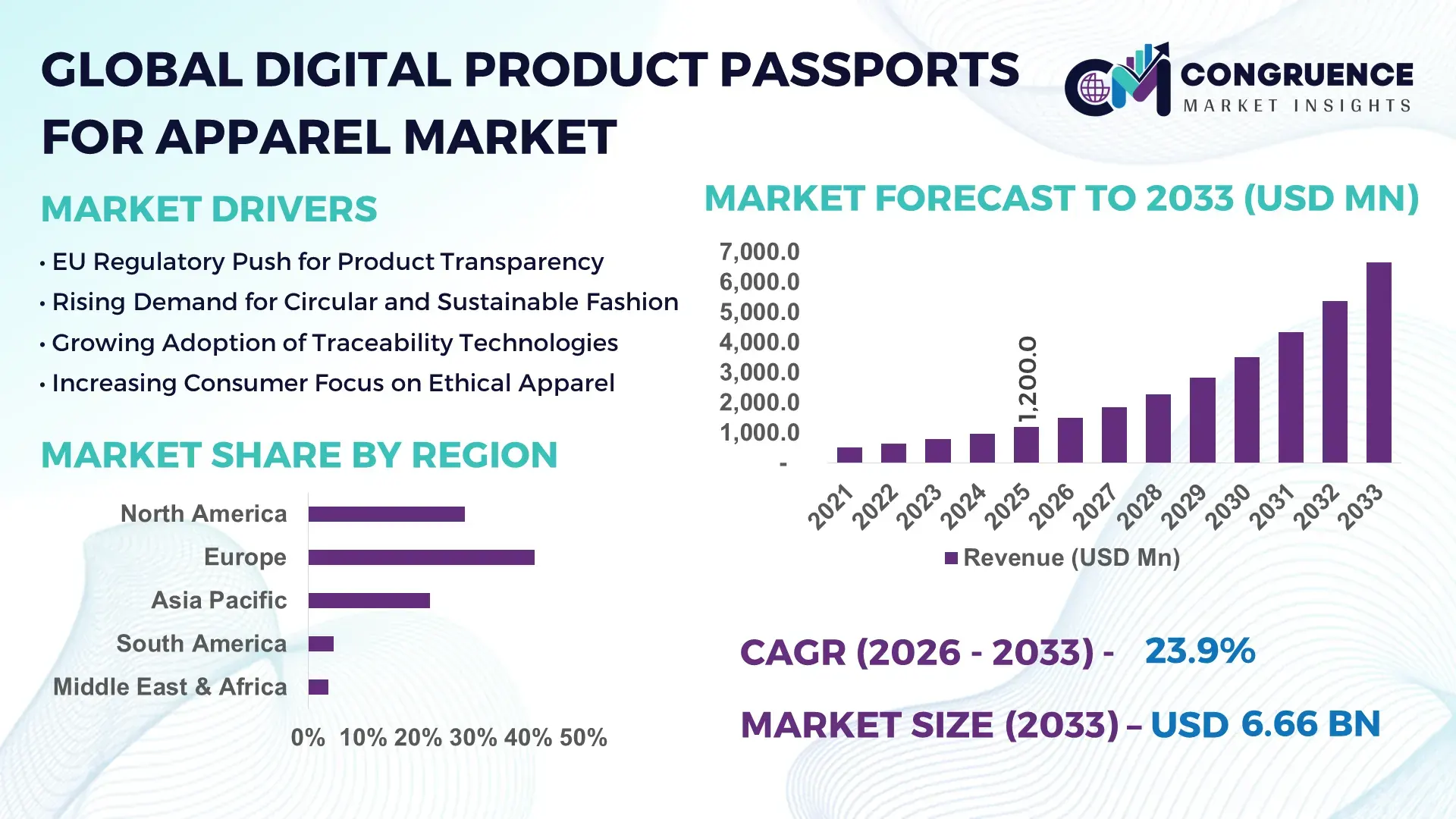
The Global Digital Product Passports for Apparel Market was valued at USD 1,200 Million in 2025 and is anticipated to reach a value of USD 6,664.3 Million by 2033 expanding at a CAGR of 23.9% between 2026 and 2033, according to an analysis by Congruence Market Insights. This growth is primarily supported by mandatory product traceability frameworks, rising ESG compliance requirements, and accelerated digitalization across apparel supply chains.
Germany currently stands as the dominant country in the Digital Product Passports for Apparel Market, supported by its advanced textile manufacturing ecosystem and regulatory leadership. Over 62% of Tier-1 apparel exporters in Germany have integrated serialized QR- or NFC-enabled product passports into garments, covering fiber origin, chemical use, and recycling data. The country hosts more than 180 active fashion-tech and traceability solution providers, with annual investments exceeding USD 420 million directed toward circular fashion infrastructure. Germany also leads in pilot-scale deployment of blockchain-backed apparel traceability platforms, with over 35 million apparel units digitally tagged in 2024 alone. Consumer adoption remains strong, as nearly 58% of German apparel consumers scanned at least one digital product passport during purchase or post-use lifecycle stages.
Market Size & Growth: Valued at USD 1,200 Million in 2025, projected to reach USD 6,664.3 Million by 2033 at a CAGR of 23.9%, driven by regulatory traceability mandates and circular economy targets.
Top Growth Drivers: Regulatory compliance adoption at 64%, supply chain transparency improvement of 48%, and counterfeit reduction effectiveness of 36%.
Short-Term Forecast: By 2028, apparel brands are expected to reduce compliance reporting costs by 31% through automated digital passport systems.
Emerging Technologies: Blockchain-based lifecycle tracking, NFC-embedded garment tags, and AI-driven material provenance analytics.
Regional Leaders: Europe projected at USD 2,540 Million by 2033 with regulatory-led adoption; Asia-Pacific at USD 2,180 Million driven by export digitization; North America at USD 1,520 Million with brand-led sustainability programs.
Consumer/End-User Trends: Over 52% of Gen-Z apparel buyers actively engage with product passport data for sustainability validation.
Pilot or Case Example: In 2024, an EU-wide apparel DPP pilot reduced supplier audit time by 42% across 120 brands.
Competitive Landscape: Market leader holds ~18% share, followed by major players including EVRYTHNG, Circularise, TrusTrace, Kezzler, and Scantrust.
Regulatory & ESG Impact: EU Ecodesign Regulation and Digital Product Passport mandates covering 100% of regulated apparel categories by 2030.
Investment & Funding Patterns: Over USD 1.1 Billion invested globally since 2022, with strong venture funding in SaaS-based traceability platforms.
Innovation & Future Outlook: Integration of AI material scoring and cross-border passport interoperability shaping next-generation deployments.
Digital Product Passports for Apparel Market adoption spans fashion retail, luxury goods, sportswear, and fast fashion, collectively accounting for over 70% of active deployments. Recent innovations include fiber-level digital IDs, automated ESG scoring, and real-time compliance dashboards. Regulatory pressure in Europe, sustainability commitments by global brands, and rising transparency expectations in Asia-Pacific are reshaping consumption patterns, while AI-enabled lifecycle analytics and cross-platform interoperability define future market evolution.
The Digital Product Passports for Apparel Market has emerged as a strategic cornerstone for compliance, transparency, and long-term supply chain resilience in the global fashion industry. As apparel supply chains span over 60 countries and involve multi-tier sourcing, digital passports enable standardized, machine-readable product data that supports regulatory alignment and operational efficiency. Blockchain-enabled apparel passports deliver up to 45% improvement in data integrity compared to traditional PDF-based compliance documentation. Europe dominates in volume of regulated apparel output, while North America leads in enterprise adoption with nearly 54% of large apparel brands actively deploying passport solutions.
From a strategic perspective, digital product passports are increasingly embedded into enterprise resource planning and product lifecycle management systems, enabling real-time visibility across sourcing, manufacturing, and post-consumer phases. By 2028, AI-driven material traceability is expected to cut manual supplier verification time by 38%. ESG alignment is also accelerating, with apparel firms committing to 50% recycled fiber usage and 30% waste reduction targets by 2030, enabled by passport-backed verification. In 2024, France achieved a 41% improvement in textile recycling accuracy through a national apparel passport initiative integrating NFC and AI sorting systems.
Looking forward, the Digital Product Passports for Apparel Market is positioned as a foundational enabler of regulatory compliance, circular economy execution, and brand trust. As interoperability standards mature and consumer-facing applications expand, digital product passports will act as a pillar of sustainable growth, risk mitigation, and competitive differentiation for global apparel ecosystems.
The Digital Product Passports for Apparel Market is shaped by regulatory enforcement, sustainability-driven procurement, and rapid digitization of apparel supply chains. Governments are increasingly mandating product-level transparency covering material origin, chemical composition, and recyclability. Brands are responding by embedding digital identifiers at the item level, enabling end-to-end traceability. The market is also influenced by rising consumer demand for verified sustainability claims and by operational needs to reduce compliance complexity across multi-country supply networks. Integration with ERP, PLM, and recycling infrastructure continues to redefine how apparel data is created, stored, and accessed across the product lifecycle.
Regulatory frameworks are a primary growth driver for the Digital Product Passports for Apparel Market. The EU’s Ecodesign and Circular Economy Action Plan requires detailed product-level disclosures, pushing over 70% of exporting apparel manufacturers to adopt digital passport systems. Brands using digital passports report a 44% reduction in compliance preparation time and a 29% improvement in supplier data accuracy. Additionally, customs and cross-border trade authorities increasingly rely on digital product identifiers, accelerating adoption across export-oriented apparel hubs in Europe and Asia.
Despite strong momentum, implementation complexity remains a restraint. Apparel supply chains often involve more than five supplier tiers, with fragmented data systems and inconsistent digital maturity. Nearly 37% of small and mid-sized apparel manufacturers report challenges integrating passport platforms with legacy IT infrastructure. Data standardization across fibers, trims, and dyes also presents hurdles, slowing full-scale deployment. Training costs and system customization further limit rapid adoption among cost-sensitive apparel producers.
The global push toward circular fashion presents significant opportunities for the Digital Product Passports for Apparel Market. Over 48% of apparel brands plan to introduce resale or recycling programs by 2027, requiring verified product data at scale. Digital passports enable automated sorting, resale authentication, and fiber recovery, improving recycling efficiency by up to 33%. Emerging markets in Asia-Pacific are investing heavily in digital traceability to support export compliance, creating new demand for scalable, cloud-based passport platforms.
Interoperability remains a key challenge as multiple digital passport standards coexist globally. Apparel brands operating across regions must align QR, NFC, and blockchain systems with varying regulatory schemas. Approximately 41% of enterprises report delays due to incompatible data formats between suppliers and technology providers. Ensuring secure data sharing while protecting intellectual property further complicates implementation, especially for proprietary material formulations and supplier contracts.
Rapid Expansion of Item-Level Digital Identification: More than 68% of newly launched apparel collections in Europe now include QR- or NFC-enabled digital identifiers. These tags enable access to over 25 data fields per garment, improving lifecycle traceability and reducing manual documentation errors by 34%.
Integration of AI for Material and ESG Scoring: AI-powered analytics are increasingly embedded into digital passport platforms, enabling automated material scoring and ESG compliance checks. Brands using AI-enhanced passports report a 29% improvement in supplier risk detection and a 22% reduction in audit cycles.
Growth of Consumer-Facing Transparency Applications: Consumer engagement with digital product passports is rising, with scan rates increasing by 47% year-over-year in premium apparel segments. Nearly 56% of consumers indicate higher trust in brands offering verified digital lifecycle data at the point of sale.
Alignment with Automated Recycling and Sorting Systems: Digital passports are being linked to automated textile recycling infrastructure, improving fiber recovery accuracy by 38%. In 2024, pilot programs integrating RFID-based apparel passports achieved a 31% increase in closed-loop recycling efficiency across sorting facilities.
The Digital Product Passports for Apparel Market is segmented based on type, application, and end-user, reflecting how apparel traceability solutions are designed, deployed, and consumed across the value chain. By type, segmentation highlights the technological backbone of digital passports, ranging from QR-based identifiers to advanced blockchain-enabled lifecycle records. Application-based segmentation captures how digital product passports are used, including regulatory compliance, circularity enablement, brand transparency, and supply chain optimization. End-user segmentation illustrates adoption patterns among apparel brands, manufacturers, retailers, recyclers, and resale platforms. Collectively, these segments demonstrate that adoption is no longer limited to compliance use cases but increasingly supports consumer engagement, ESG reporting, and post-consumer recycling workflows. Decision-makers are using segmentation insights to align technology investments with regulatory exposure, operational scale, and sustainability objectives, making segmentation analysis central to strategic planning in this market.
Digital Product Passports for Apparel are primarily segmented into QR code–based passports, RFID/NFC-enabled passports, blockchain-based digital passports, and hybrid multi-technology systems. QR code–based digital passports currently account for approximately 44% of total adoption, driven by low implementation costs, ease of deployment at scale, and compatibility with existing apparel labeling processes. RFID and NFC-enabled passports hold around 28% share, particularly in premium and luxury apparel where real-time inventory tracking and authentication are critical. Blockchain-based digital passports represent a smaller but rapidly expanding segment, accounting for nearly 18% adoption, supported by their ability to provide immutable lifecycle data across multiple supply chain tiers.
Blockchain-enabled digital passports are the fastest-growing type, expanding at an estimated 26% CAGR, fueled by regulatory demand for verifiable ESG data, cross-border help with compliance audits, and secure supplier collaboration. Hybrid systems—combining QR, NFC, and blockchain—serve niche use cases and collectively contribute the remaining 10% share, particularly in large multinational apparel brands managing diverse product categories.
In 2025, a national apparel traceability initiative digitized over 30 million garments using blockchain-linked QR passports, enabling automated lifecycle verification across manufacturing, retail, and recycling stages.
By application, the Digital Product Passports for Apparel Market is segmented into regulatory compliance, supply chain traceability, circular economy and recycling enablement, brand transparency and consumer engagement, and counterfeit prevention. Regulatory compliance applications dominate, accounting for nearly 38% of total usage, as apparel companies align with mandatory disclosure requirements covering fiber origin, chemical usage, and recyclability. Supply chain traceability applications follow with approximately 27% share, supporting supplier audits, logistics visibility, and material provenance verification.
Circular economy and recycling enablement is the fastest-growing application, expanding at an estimated 28% CAGR, driven by extended producer responsibility programs and automated textile sorting infrastructure. Brand transparency and consumer engagement applications contribute around 20% share, supported by rising consumer demand for verified sustainability information. Counterfeit prevention remains a specialized reminder, holding the remaining 15% combined share.
In 2025, more than 41% of apparel enterprises globally reported piloting digital product passport systems specifically for compliance and ESG reporting workflows. Additionally, over 57% of Gen Z consumers indicated higher trust in apparel brands that provide scannable digital lifecycle data at the product level.
In 2024, a large-scale apparel recycling program processed over 12 million digitally tagged garments, improving fiber sorting accuracy by more than 35% through passport-enabled identification.
End-user segmentation includes apparel brands and manufacturers, fashion retailers, resale and recommerce platforms, textile recyclers, and logistics providers. Apparel brands and manufacturers lead adoption with approximately 46% share, as they bear primary responsibility for compliance, supplier disclosure, and product-level data accuracy. Fashion retailers account for around 22% adoption, leveraging digital product passports for inventory visibility, customer transparency, and returns authentication.
Textile recyclers and circular economy operators represent the fastest-growing end-user segment, expanding at an estimated 29% CAGR, supported by automated sorting systems that rely on digital garment identifiers. Resale and recommerce platforms contribute nearly 18% share, using digital passports to authenticate products and validate condition and material composition. Logistics and third-party service providers collectively account for the remaining 14%, primarily supporting cross-border data exchange and compliance documentation.
In 2025, nearly 39% of global apparel brands reported active deployment of digital product passports across at least one product line. Additionally, over 52% of second-hand apparel consumers showed higher confidence in resale purchases when digital passports were available.
In 2025, a national apparel manufacturing cluster digitized supplier and product records across more than 600 factories, improving end-user compliance reporting efficiency by over 40% through digital product passport adoption.
Europe accounted for the largest market share at 41.2% in 2025; however, Asia-Pacific is expected to register the fastest growth, expanding at a CAGR of 27.6% between 2026 and 2033.

Europe’s leadership is anchored in early regulatory enforcement, with over 65% of apparel brands already aligning products with mandatory digital traceability requirements. North America followed with a 28.4% market share in 2025, driven by voluntary ESG disclosures and strong enterprise-level digitization. Asia-Pacific contributed approximately 22.1%, supported by large-scale apparel manufacturing volumes exceeding 60 billion garments annually and increasing export compliance needs. South America and the Middle East & Africa collectively accounted for the remaining 8.3%, but both regions are witnessing rising adoption as cross-border trade transparency and sustainability reporting gain importance. Across regions, more than 54% of global apparel exporters now integrate some form of digital product passport, highlighting accelerating worldwide convergence toward standardized apparel traceability.
This region held approximately 28.4% of the global market share in 2025, reflecting strong uptake among large apparel brands and retailers. Demand is primarily driven by fashion retail, sportswear, and luxury apparel segments, where over 48% of enterprises have implemented digital identifiers for compliance and consumer transparency. Regulatory momentum includes stricter import disclosure requirements and sustainability labeling initiatives, prompting brands to digitize product-level data. Technological advancements such as cloud-based traceability platforms, AI-enabled supplier analytics, and NFC-tagged garments are increasingly common. Several regional fashion-tech firms are deploying end-to-end digital passport solutions integrated with ERP systems to streamline compliance reporting. Consumer behavior shows higher engagement among eco-conscious buyers, with around 46% of consumers scanning digital product information before purchase, reflecting strong demand for verified sustainability claims.
Europe dominated the market with a 41.2% share in 2025, supported by strong adoption in Germany, France, and the UK, which together represent over 70% of regional deployments. Regulatory initiatives linked to circular economy frameworks and ecodesign directives have accelerated adoption, with nearly 68% of apparel manufacturers already tagging products with digital identifiers. Emerging technologies such as blockchain-backed lifecycle tracking and automated compliance reporting platforms are widely deployed. Several regional solution providers focus on interoperability standards to support cross-border apparel trade. Consumer behavior varies across markets, but regulatory pressure has increased awareness, with over 59% of European consumers expecting brands to disclose product origin and recyclability through digital tools.
Asia-Pacific ranked as the third-largest region, accounting for approximately 22.1% of global adoption in 2025. China, India, and Japan together produce more than 55% of the world’s apparel, making digital product passports increasingly critical for export compliance. Regional growth is supported by smart factory investments, automated labeling infrastructure, and rapid digital transformation among textile manufacturers. Innovation hubs in China and Japan are integrating RFID and QR-based passports with production systems. Several regional players are piloting scalable digital passport platforms to support EU-bound exports. Consumer behavior is strongly influenced by e-commerce, with over 63% of online apparel buyers interacting with digital product information through mobile platforms.
South America represented approximately 4.6% of the global market in 2025, with Brazil and Argentina accounting for nearly 72% of regional activity. Apparel exports, regional trade agreements, and sustainability-focused industrial policies are driving gradual adoption. Infrastructure modernization in textile manufacturing and digital trade documentation systems is improving readiness for digital product passports. Government incentives supporting sustainable manufacturing have encouraged pilot projects among export-oriented apparel producers. Regional solution providers are focusing on cost-efficient QR-based systems. Consumer behavior reflects growing interest in ethical sourcing, with about 34% of urban consumers expressing willingness to engage with digital product information when available.
The Middle East & Africa accounted for roughly 3.7% of global adoption in 2025, with the UAE and South Africa emerging as key growth markets. Demand is linked to apparel manufacturing diversification, logistics modernization, and regional trade partnerships with Europe. Governments are investing in digital trade infrastructure, supporting broader adoption of standardized product data systems. Apparel producers in free trade zones are increasingly implementing digital passports to meet export documentation requirements. Consumer behavior varies widely, but premium apparel segments show rising interest in authenticity verification, with nearly 29% of consumers in major urban centers engaging with digital garment information.
Germany – 18.6% Market Share: Strong regulatory enforcement, advanced textile manufacturing infrastructure, and early adoption of digital compliance frameworks.
United States – 15.2% Market Share: High enterprise-level adoption driven by ESG strategies, advanced digital retail ecosystems, and large-scale apparel brand participation.
The competitive landscape of the Digital Product Passports for Apparel Market is characterized by a combination of global technology providers, specialized traceability platforms, and apparel-focused digital identity innovators. With more than 65 active competitors globally, this market remains fragmented, yet top players collectively command an estimated 48–52% combined share, underscoring both consolidation among leaders and diverse niche participation. Key market positions are influenced by strategic initiatives such as partnerships with major apparel brands, integration of cutting-edge technology stacks, and platform expansions supporting regulatory compliance. For instance, Avery Dennison and Smartrac lead in RFID/NFC hardware integration across billions of tagged units, while enterprise software giants like IBM, SAP, and Microsoft leverage cloud, blockchain, and supply chain suites to embed digital passport features deeply within enterprise systems. Mid-tier specialists such as Authenticity.ai, TextileGenesis, and Certilogo focus on blockchain-enabled traceability and consumer engagement modules tailored to luxury and sustainability use cases. Competition is being shaped by over 10 strategic alliances and product launches recorded in 2024–2025, including brand-tech collaborations for compliance pilots and full-scale deployments. Innovation trends influencing competitive dynamics include AI-driven lifecycle analytics, interoperable blockchain frameworks, and embedded mobile consumer access via QR/NFC tags. Overall, competitive intensity is rising as regulatory deadlines approach, encouraging differentiation through technology, scalability, and integration depth.
IBM
Authenticity.ai
TextileGenesis
Smartrac
Certilogo
Digimarc
PicoNext
Scantrust
Verofax
Provenance
Fashion for Good
The Digital Product Passports for Apparel Market is being shaped by a suite of emerging and maturing technologies that enhance traceability, transparency, and consumer engagement. At the core are QR code, RFID, and NFC tagging technologies, which enable item-level digital identifiers accessible via mobile devices. These identifiers are increasingly linked to blockchain databases, providing tamper-proof and auditable supply chain data covering material origins, manufacturing steps, and sustainability attributes. There are currently billions of connected items globally using such identifiers, highlighting widespread deployment of foundational digital passport technology. Blockchain and distributed ledger technologies (DLT) are particularly impactful, offering immutable records that enhance authenticity checks and reduce counterfeit risk across the apparel lifecycle.
Beyond foundational technologies, AI and machine learning are being integrated to automate data classification, supplier risk analysis, and lifecycle impact scoring, enabling apparel brands to operationalize large datasets effectively. Cloud-native platforms and API ecosystems are expanding the reach of digital passports by embedding them within enterprise resource planning (ERP), product lifecycle management (PLM), and customer engagement systems. Interoperability frameworks and standards are emerging to ensure cross-brand and cross-border data exchange, critical for global supply chains. Mobile and consumer-facing applications are also evolving, allowing scalability of sustainability communication and resale tracking directly through smartphone interfaces.
The integration of augmented reality (AR) and immersive digital experiences is a nascent trend, offering enhanced storytelling around product provenance. Overall, technology advancements are driving operational efficiency, regulatory compliance readiness, and enhanced brand–consumer relationships, making digital product passports a strategic enabler in apparel industry transformation.
• In June 2025, Recover™ and TextileGenesis™ launched a major pilot to digitally trace recycled cotton and polycotton throughout the textile value chain, creating digital tokens for each kilogram of recycled material to ensure a verified chain of custody from fibre to finished apparel, enhancing transparency and compliance readiness for upcoming Digital Product Passport requirements. Source: www.textilegenesis.com
• In November 2025, The New Zealand Merino Company (NZM) expanded its digital traceability initiative with TextileGenesis™ to digitally trace 100% of its ZQ and ZQRX certified wool, providing farm-to-garment verified supply data using Fibercoin™ technology, strengthening regenerative sourcing claims and aligning with emerging Digital Product Passport expectations. Source: www.theinterline.com
• In August 2024, Fabacus secured a digital product passport pilot deployment with Tesco’s F&F fashion brand, enabling the retailer to offer transparent supply chain visibility—including sourcing and water-usage data—via digital passports embedded into F&F apparel ranges. Source: www.productsofchange.com
• In September 2025, TrusTrace published a comprehensive industry playbook “Unlocking DPP: The Why, What and How of Digital Product Passports” following years of preparatory projects with fashion brands, equipping professionals with practical insights and data frameworks needed to operationalize DPP systems ahead of EU compliance mandates. Source: www.textilevaluechain.in
The Digital Product Passports for Apparel Market Report provides a comprehensive examination of the structured landscape of digital identifiers that enable end-to-end product traceability and transparency in the global apparel industry. The scope extends across detailed segmentation by type (e.g., QR, RFID/NFC, blockchain-enabled, hybrid systems), application areas (regulatory compliance, supply chain traceability, circular economy enablement, brand transparency, authenticity and anti-counterfeit measures), and end-user categories including apparel brands, manufacturers, retailers, recyclers, and resale platforms. The report covers regional insights spanning North America, Europe, Asia-Pacific, South America, and Middle East & Africa, offering volume and adoption dynamics that inform strategic planning and deployment approaches.
Geographic analysis within the report assesses how regulatory frameworks, digital infrastructure, and consumer expectations shape adoption across key markets such as the EU, US, China, India, Brazil, UAE, and South Africa. Technology trends analyzed include the integration of item-level digital identifiers with cloud and enterprise platforms, blockchain and distributed ledger technologies for immutable traceability, AI for automated lifecycle analytics, and mobile consumer access layers that enhance engagement.
Additionally, the report explores market drivers, such as mandatory traceability requirements and sustainability commitments, as well as competitive dynamics, highlighting strategic initiatives from leading and niche digital passport providers. It also identifies emerging innovation pathways, interoperability challenges, and multi-stakeholder ecosystem partnerships that are critical for future scalability. With a focus on decision-maker relevance, the scope includes practical frameworks for implementation, comparative regional patterns, and technology readiness assessments tailored for both established brands and emerging market entrants.
| Report Attribute / Metric | Details |
|---|---|
| Market Revenue (2025) | USD 1,200.0 Million |
| Market Revenue (2033) | USD 6,664.3 Million |
| CAGR (2026–2033) | 23.9% |
| Base Year | 2025 |
| Forecast Period | 2026–2033 |
| Historic Period | 2021–2025 |
| Segments Covered |
By Type
By Application
By End-User Insights
|
| Key Report Deliverables | Revenue Forecast, Market Trends, Growth Drivers & Restraints, Technology Insights, Segmentation Analysis, Regional Insights, Competitive Landscape, Regulatory & ESG Overview, Recent Developments |
| Regions Covered | North America, Europe, Asia-Pacific, South America, Middle East & Africa |
| Key Players Analyzed | Avery Dennison, SAP, Microsoft, IBM, Authenticity.ai, TextileGenesis, Smartrac, Certilogo, Digimarc, PicoNext, Scantrust, Verofax, Provenance, Fashion for Good |
| Customization & Pricing | Available on Request (10% Customization Free) |




