
Reports
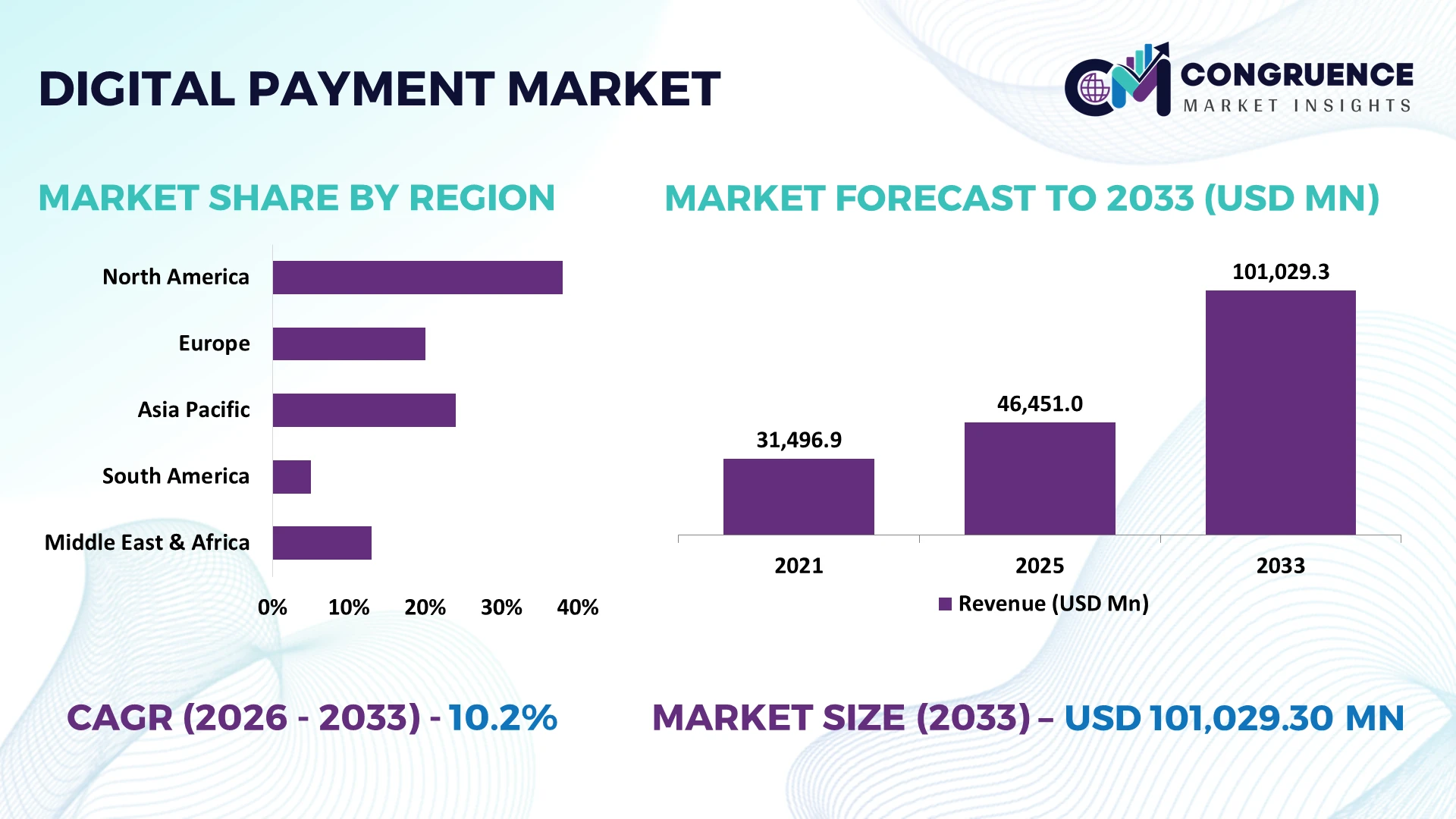
The Global Digital Payment Market was valued at USD 46450.95 Million in 2025 and is anticipated to reach a value of USD 101029.3 Million by 2033 expanding at a CAGR of 10.2% between 2026 and 2033. Growth is being accelerated by real-time payment infrastructure expansion, AI-driven fraud detection, embedded finance adoption, and government-backed digital transaction initiatives across retail, banking, healthcare, and e-commerce ecosystems.
China remains the dominant country, accounting for approximately 38% of global digital payment transaction volume, supported by widespread QR-based payment infrastructure, strong fintech investment, and high mobile wallet penetration exceeding 90% in urban consumers. Compared with the United States, where contactless card and digital wallet usage exceeds 65%, China processes significantly higher daily mobile payment volumes, while cross-border payment modernization continues to gain momentum amid evolving global trade dynamics and regional digital economy partnerships in 2026.
Organizations prioritizing scalable payment infrastructure, cross-border interoperability, and AI-enabled transaction security are positioned to strengthen competitive advantage in the high-growth global digital payment market.
Market Size & Growth: USD 46450.95 Million in 2025, projected to reach USD 101029.3 Million by 2033 at a CAGR of 10.2%, driven by real-time payments, embedded finance, and AI-powered fraud prevention.
Top Growth Drivers: Instant payments increase transaction speed by 35%, digital wallet adoption exceeds 70% in leading markets, and AI fraud detection improves payment security by approximately 28%.
Short-Term Forecast: By 2028, payment processing costs decline by nearly 18% while transaction authorization efficiency improves by approximately 25% through automation.
Emerging Technologies: AI risk analytics, tokenization, and blockchain-enabled cross-border settlements reduce fraud exposure by around 22% while accelerating payment processing.
Regional Leaders: Asia Pacific exceeds USD 43 Billion, North America surpasses USD 27 Billion, and Europe approaches USD 19 Billion, supported by real-time payment adoption and expanding digital commerce.
Consumer/End-User Trends: More than 72% of consumers prefer mobile wallets or contactless payments, accelerating omnichannel payment experiences.
Pilot/Case Example: In 2026, AI-enabled payment routing projects reduced transaction failures by approximately 20% while improving merchant settlement efficiency.
Competitive Landscape: Leading providers collectively hold about 42% market share, with Visa, Mastercard, PayPal, Stripe, and Adyen maintaining strong global expansion strategies.
Regulatory & ESG Impact: Digital identity frameworks and instant payment regulations improve compliance efficiency by approximately 19%, while paperless transactions support sustainability goals.
Investment & Funding: More than USD 18 Billion in fintech investments supports payment infrastructure modernization, strategic partnerships, and regional expansion despite evolving global trade conditions.
Innovation & Future Outlook: AI-native payment orchestration, biometric authentication, and embedded finance are reshaping high-growth digital payment ecosystems with stronger cross-border interoperability.
The Digital Payment Market continues to expand across retail, banking, healthcare, travel, and public services as organizations prioritize faster, secure, and seamless transaction experiences. AI-powered fraud prevention, biometric authentication, and tokenized payment solutions improve operational efficiency, while contactless payment adoption has increased by approximately 24% over recent years. Regulatory modernization and resilient payment infrastructure development are strengthening cross-border transaction capabilities, setting the foundation for the strategic market analysis that follows.
The Digital Payment Market has become a strategic foundation for competitive differentiation as financial institutions, merchants, and governments accelerate digital infrastructure modernization. Real-time payment networks, digital identity frameworks, and embedded financial services are reshaping transaction ecosystems while stricter cybersecurity regulations strengthen operational resilience. In 2026, cross-border payment interoperability initiatives and national instant payment programs are reducing settlement delays, enabling enterprises to streamline treasury operations and improve customer experience across multiple industries.
Modern AI-enabled payment orchestration platforms process transactions approximately 30% faster than legacy payment gateways while reducing fraud investigation costs by nearly 18% through automated risk scoring. India continues to lead in high-volume real-time payment deployment, whereas the United States maintains stronger enterprise adoption of cloud-based payment orchestration and value-added merchant services. Over the next two to three years, biometric authentication is expected to exceed 55% deployment among large financial institutions, while API-based payment integration will become standard across digital commerce platforms.
Global payment providers are expanding strategic alliances with fintech firms, cloud providers, and retail ecosystems to deliver scalable omnichannel payment experiences. A notable deployment trend involves AI-powered fraud monitoring integrated with instant payment infrastructure, enabling faster authorization without compromising compliance. Companies investing in interoperable platforms, cybersecurity capabilities, and cross-border payment networks are strengthening long-term competitive positioning while improving operational efficiency and customer retention.
Real-time payment adoption continues to reshape transaction ecosystems as enterprises prioritize speed, security, and interoperability. More than 72% of digital consumers now prefer instant or contactless transactions, while AI-driven fraud detection improves payment accuracy by approximately 28% and reduces false declines by nearly 15%. India's expansion of real-time payment infrastructure and the European Union's push toward instant payment regulation are accelerating enterprise digitalization and merchant onboarding. This structural shift increases transaction efficiency, supports cross-border commerce, and improves working capital management. Leading payment companies are responding through cloud-native platform expansion, strategic fintech partnerships, and investment in API-based payment infrastructure, creating stronger competitive differentiation and faster deployment across banking, retail, healthcare, and transportation sectors.
Fragmented payment ecosystems remain a structural limitation despite rapid digital adoption. Approximately 38% of financial institutions continue operating multiple legacy payment platforms, while compliance costs have increased by nearly 16% as digital payment regulations become more complex across jurisdictions. Cross-border settlement inconsistencies and differing national data governance requirements create operational friction for multinational merchants and financial service providers. These challenges reduce deployment speed, increase integration expenses, and complicate payment scalability. Companies are mitigating these pressures by diversifying payment infrastructure, adopting standardized API frameworks, strengthening regional processing capabilities, and negotiating long-term technology partnerships that improve interoperability while maintaining regulatory compliance and operational resilience.
Embedded finance and intelligent payment orchestration are creating high-value opportunities beyond traditional transaction processing. AI-powered payment optimization improves authorization success rates by approximately 20%, while embedded financial services increase customer engagement by nearly 25% across digital commerce platforms. Singapore and the United Arab Emirates continue expanding digital finance initiatives that encourage innovation through supportive regulatory frameworks and modern payment infrastructure. Companies are increasing investment in tokenization, programmable payments, and embedded lending capabilities while building ecosystem partnerships with retailers, software providers, and financial institutions. The strongest competitive advantage will come from unified platforms that combine payments, analytics, fraud management, and customer engagement into a single operational environment.
Long-term market expansion depends on balancing transaction speed with cybersecurity, resilience, and operational consistency. Global digital payment fraud attempts have increased by approximately 17%, while more than 40% of large enterprises report integration complexity when connecting multiple payment networks and legacy enterprise systems. Increasing transaction volumes also place greater pressure on cloud infrastructure, identity verification, and compliance monitoring. These execution challenges affect deployment consistency, customer trust, and long-term competitiveness. Companies must strengthen AI-enabled security, invest in scalable cloud-native architectures, expand cybersecurity partnerships, and modernize payment infrastructure to maintain secure, resilient, and interoperable transaction ecosystems capable of supporting future digital commerce demands.
AI-Powered Payment Intelligence AI-native payment orchestration is transforming transaction workflows as automated fraud analytics now detect suspicious activities with approximately 30% greater accuracy while reducing manual review volumes by nearly 25%. Financial institutions in the United States are integrating predictive risk engines into real-time payment platforms following stricter digital security requirements introduced during infrastructure modernization. This operational shift improves authorization speed, lowers compliance costs, and enables payment providers to expand strategic partnerships with cloud technology vendors for scalable transaction monitoring.
Cross-Border Network Modernization Payment operators are replacing fragmented settlement processes with interoperable instant payment networks, reducing transaction processing times by nearly 40% while improving settlement visibility by approximately 22%. Regulatory harmonization initiatives across Europe and Asia are accelerating standardized messaging adoption and digital identity verification. Global payment companies are restructuring correspondent banking relationships, expanding local processing capabilities, and investing in regional payment hubs to improve operational resilience and reduce cross-border transaction complexity.
Embedded Finance Expansion Embedded payment capabilities are becoming standard across retail, mobility, healthcare, and software platforms, with API-based payment deployments increasing by approximately 35% and merchant integration time declining by nearly 28%. Enterprise software vendors are incorporating payment acceptance directly into business workflows, eliminating multiple processing layers. Companies are strengthening fintech partnerships and expanding white-label payment services to improve customer retention while creating recurring transaction ecosystems beyond conventional payment processing.
Biometric Authentication Adoption Biometric verification is replacing password-based payment authorization as facial recognition and fingerprint authentication improve login success rates by approximately 20% while reducing account takeover incidents by nearly 18%. India's digital identity ecosystem and Japan's financial institutions are expanding biometric payment deployment to strengthen trust and operational efficiency. Payment providers are combining tokenization, behavioral analytics, and biometric authentication to simplify user experiences while maintaining stronger cybersecurity standards across high-volume digital commerce platforms.
Digital Wallets remain the leading segment, accounting for approximately 41% of market activity due to seamless mobile integration, rapid authentication, and broad merchant acceptance. Their scalability across online, offline, and cross-platform transactions has made them the preferred payment method in China, India, and several Southeast Asian economies. Bank Cards continue to retain strong relevance for enterprise and international transactions, while Bank Transfers remain essential for high-value business payments because of reliability and regulatory acceptance. Cryptocurrencies occupy a specialized position, primarily supporting selected cross-border and decentralized payment use cases.
Buy Now Pay Later (BNPL) represents the fastest-growing segment as installment-based purchasing expands among younger consumers and digital merchants. BNPL transaction volumes are increasing by approximately 24%, while digital wallet usage exceeds 70% among smartphone-based payment users in advanced digital economies. Payment providers are expanding embedded financing capabilities, integrating loyalty programs, and forming retailer partnerships to strengthen customer acquisition. Investment priorities increasingly favor unified payment ecosystems combining wallets, financing, and value-added financial services rather than standalone transaction platforms.
Retail Payments represent the largest application, contributing approximately 39% of transaction activity as merchants increasingly prioritize contactless checkout, omnichannel commerce, and integrated customer experiences. High-frequency consumer transactions, extensive merchant acceptance, and mobile-first purchasing behavior continue to strengthen this segment. Bill Payments remain operationally significant through automated recurring transactions, while Peer-to-Peer Transfers continue expanding with instant payment infrastructure. E-commerce has become the fastest-growing application as digital marketplaces and embedded checkout solutions reduce transaction friction and improve conversion rates.
Cross-Border Payments are gaining strategic importance as businesses modernize international settlement capabilities through standardized messaging and real-time processing. Digital commerce transactions have increased by approximately 26%, while API-enabled payment integration reduces checkout abandonment by nearly 18%. Companies are scaling payment gateways, deploying AI-based routing, and expanding regional acquiring capabilities to improve authorization rates. Investment priorities increasingly focus on interoperable payment platforms capable of supporting both domestic and international transaction ecosystems.
Banking & Financial Services remains the dominant end-user segment, representing approximately 44% of overall deployment due to extensive transaction volumes, regulatory obligations, and continuous investment in payment modernization. Banks depend on digital payment infrastructure for retail banking, commercial transactions, and cross-border settlement, making operational resilience a critical priority. Retail & E-commerce follows closely through omnichannel commerce expansion, while Telecommunications continues integrating digital payment services into mobile ecosystems. Government agencies increasingly deploy digital payment platforms for tax collection, benefit distribution, and public service transactions.
Healthcare is the fastest-growing end-user segment as hospitals and insurers digitize patient billing and reimbursement workflows. Healthcare payment digitization has expanded by approximately 22%, while enterprise payment automation improves processing efficiency by nearly 19%. Payment providers are developing industry-specific platforms, forming partnerships with healthcare technology vendors, and offering customized compliance capabilities. Competitive positioning increasingly depends on vertical-focused payment solutions rather than standardized transaction services, enabling stronger customer retention across regulated industries.
Asia-Pacific accounted for the largest market share at 45% in 2025 however, Middle East & Africa is expected to register the fastest growth, expanding at a 13.1% between 2026 and 2033.
AI-Led Payment Infrastructure Modernization
North America accounted for approximately 26% of global digital payment activity, supported by mature banking infrastructure, widespread cloud adoption, and advanced merchant payment ecosystems. The United States and Canada continue accelerating real-time payment deployment through API-enabled financial platforms, AI-driven fraud analytics, and tokenized authentication. More than 74% of consumers regularly use contactless or digital wallet payments, encouraging retailers and financial institutions to modernize payment acceptance infrastructure. Financial technology providers are expanding partnerships with banks to strengthen embedded payment capabilities while improving cross-border settlement efficiency. Large enterprises are increasingly integrating payment orchestration platforms that reduce transaction routing complexity and improve authorization performance by nearly 20%, reinforcing the region's leadership in enterprise-scale payment innovation.
United States Market Outlook: The United States remains the operational center of North America's digital payment ecosystem through strong fintech investment, advanced cloud infrastructure, and rapid enterprise technology adoption. Digital wallets account for more than 60% of online transactions across major retail platforms, while AI-enabled payment security continues expanding across financial institutions. Payment providers are prioritizing embedded finance, real-time settlement, and strategic partnerships with enterprise software companies to strengthen transaction efficiency and customer retention.
Regulatory Harmonization Accelerates Digital Transactions
Europe represents nearly 23% of global digital payment deployment, supported by strong financial regulation, standardized payment frameworks, and continuous investment in digital banking modernization. Instant payment mandates, open banking implementation, and digital identity initiatives continue improving payment interoperability across multiple countries. Contactless payment penetration exceeds 70% across several European markets, while merchants increasingly adopt unified commerce platforms integrating online and offline transactions. Financial institutions are investing in AI-powered compliance monitoring and fraud prevention to improve operational resilience. Strategic collaboration between payment processors, banks, and technology providers is accelerating innovation while simplifying cross-border transaction processing within the region.
Germany Market Outlook: Germany maintains a leading position through its advanced financial infrastructure, strong enterprise digitalization, and expanding real-time payment capabilities. Businesses continue investing in secure payment gateways and cloud-native processing platforms to improve operational performance. Contactless card and digital wallet transactions now represent over half of retail payment activity, while financial institutions prioritize API integration and cybersecurity modernization to strengthen payment ecosystem resilience.
Large-Scale Mobile Payment Leadership
Asia-Pacific leads the global market with approximately 45% share, driven by extensive smartphone penetration, high-volume digital commerce, and government-backed payment infrastructure. China, India, Japan, and South Korea continue expanding instant payment systems, QR-based payment acceptance, and interoperable digital platforms across retail and financial services. Mobile wallet adoption exceeds 80% in several leading economies, while real-time payment transactions continue replacing conventional banking channels. Enterprises are strengthening fintech partnerships and investing in cloud-native payment infrastructure to improve scalability, operational speed, and cross-border interoperability across rapidly expanding digital economies.
China Market Outlook: China remains the world's largest digital payment ecosystem through extensive QR payment deployment, mature fintech innovation, and advanced merchant integration. Urban mobile wallet adoption exceeds 90%, enabling high-frequency digital transactions across retail, transportation, healthcare, and public services. Technology providers continue strengthening AI-driven fraud prevention, embedded finance, and cross-border payment connectivity while expanding digital payment capabilities for international commerce.
Financial Inclusion Drives Digital Adoption
South America continues expanding digital payment adoption through financial inclusion initiatives, mobile banking growth, and rapid e-commerce development. The region contributes approximately 5% of global market activity while benefiting from increasing smartphone usage and expanding fintech ecosystems. Instant payment infrastructure and QR-based merchant acceptance are reducing cash dependency across urban and semi-urban markets. Financial institutions are partnering with fintech companies to broaden digital payment accessibility while improving operational efficiency. Infrastructure limitations remain in rural areas, but continuous investment in cloud-based payment systems and digital identity solutions is strengthening long-term deployment capacity.
Brazil Market Outlook: Brazil leads the regional market through extensive instant payment adoption and continuous modernization of financial infrastructure. The country's digital payment ecosystem benefits from widespread QR payment acceptance and strong fintech participation. More than 65% of digital consumers actively use instant payment services, encouraging payment providers to expand merchant acquisition, fraud analytics, and embedded financial products supporting both consumers and businesses.
Digital Infrastructure Investment Accelerates Transformation
Middle East & Africa is emerging as the fastest-transforming digital payment landscape through smart city initiatives, financial inclusion programs, and expanding cloud infrastructure. Governments continue supporting cashless economies through digital identity systems, fintech regulation, and payment modernization strategies. Mobile payment adoption has increased by approximately 30% across key markets over recent years, while telecommunications providers increasingly integrate financial services into mobile platforms. Banks, fintech firms, and technology vendors are expanding strategic partnerships to strengthen payment interoperability and improve digital transaction accessibility across commercial sectors.
United Arab Emirates Market Outlook: The United Arab Emirates has established itself as the region's technology leader through advanced payment regulation, smart infrastructure, and rapid fintech deployment. Contactless transactions account for more than 75% of in-store payments, supported by strong digital banking adoption and government-backed innovation initiatives. Financial institutions continue investing in AI-enabled payment security, cross-border payment infrastructure, and embedded financial ecosystems to reinforce the country's position as a regional digital finance hub.
The Digital Payment Market is led by Visa, Mastercard, PayPal, Stripe, and Adyen, while regional fintech firms and domestic payment networks compete aggressively on localization and transaction speed. The top five players collectively control approximately 48% of the global market. Competition centers on AI-driven fraud prevention, real-time payment processing, API integration, and merchant customization, with advanced payment routing improving authorization rates by nearly 20% and automated fraud detection reducing operational losses by approximately 25%. Global payment leaders compete through infrastructure expansion, fintech partnerships, embedded finance, and cloud-native payment orchestration, whereas regional providers differentiate through local compliance expertise and lower transaction costs. The competitive landscape is shifting toward integrated payment ecosystems combining payments, lending, analytics, and identity verification. High regulatory compliance requirements, cybersecurity investment, and interoperability standards remain significant entry barriers. Sustained success depends on scalable infrastructure, intelligent automation, trusted security capabilities, and seamless cross-border transaction performance.
Visa Inc.
Mastercard Incorporated
PayPal Holdings, Inc.
Stripe, Inc.
Adyen N.V.
Block, Inc.
Fiserv, Inc.
Global Payments Inc.
Worldline S.A.
FIS (Fidelity National Information Services, Inc.)
ACI Worldwide, Inc.
Nuvei Corporation
Checkout.com
Network International Holdings PLC
Artificial intelligence, cloud-native payment orchestration, and tokenization are defining the current technology landscape of the Digital Payment Market. AI-powered fraud detection improves transaction accuracy by approximately 28%, while cloud-based payment routing lowers processing latency by nearly 18%. More than 70% of large payment providers have deployed API-driven payment platforms to support omnichannel commerce and real-time settlements. Integrated payment ecosystems enable faster merchant onboarding, automated compliance monitoring, and improved transaction visibility, creating measurable operational advantages across banking, retail, and digital commerce.
Emerging technologies between 2026 and 2028 include biometric authentication, programmable payments, stablecoin-enabled settlement, and embedded finance. Biometric verification increases authentication success rates by around 20%, while tokenization reduces card data exposure by approximately 25%. Compared with legacy payment gateways, AI-enabled payment orchestration processes transactions nearly 30% faster with lower manual intervention. Financial institutions are integrating digital identity, open banking APIs, and machine learning into unified payment infrastructure, improving customer experience while reducing fraud management costs and settlement complexity.
Disruptive innovation is shifting competition toward intelligent payment ecosystems rather than standalone transaction processing. Providers combining AI, real-time payments, blockchain-based settlement, and advanced analytics are strengthening enterprise competitiveness through faster deployment and scalable infrastructure. Global payment leaders benefit from stronger cross-border interoperability, while fintech companies gain flexibility through modular cloud platforms. Organizations investing in interoperable, AI-driven payment technology today will establish stronger operational resilience and sustainable competitive differentiation through 2028.
August 2025 Visa expanded Click to Pay across Asia-Pacific through partnerships with Adyen, 2C2P, AsiaPay, and Worldpay, delivering an average 2.5% improvement in payment success rates while reducing checkout friction for merchants. Business impact: stronger e-commerce conversion and merchant adoption.
March 2026 Visa expanded its collaboration with Bridge to scale stablecoin-linked Visa cards from 18 countries toward more than 100 countries, enabling on-chain settlement across Visa's network. Business impact: accelerated cross-border digital payment infrastructure and broader fintech adoption. Source: Visa Inc.
June 2026 Mastercard launched Agent Pay for Machines with support from more than 30 technology and payment partners, enabling secure machine-to-machine transactions with multi-rail settlement. Business impact: establishes infrastructure for AI-driven autonomous commerce and programmable payments. Source: Mastercard
July 2026 Visa introduced Payment Passkey in India with IDFC FIRST Bank, replacing OTP-based authentication using FIDO standards across leading merchants and fintech platforms. Business impact: reduces authentication friction, strengthens payment security, and improves digital checkout efficiency. Source: Visa
The report provides comprehensive analysis of the Digital Payment Market across Digital Wallets, Bank Cards, Bank Transfers, Buy Now Pay Later (BNPL), and Cryptocurrencies, with detailed assessment of Retail Payments, Bill Payments, E-commerce, Peer-to-Peer Transfers, and Cross-Border Payments. It further evaluates demand across Banking & Financial Services, Retail & E-commerce, Healthcare, Government, and Telecommunications while examining adoption patterns, deployment trends, technology integration, and competitive positioning across more than 20 major country markets.
The study delivers strategic coverage of North America, Europe, Asia-Pacific, South America, and the Middle East & Africa, highlighting enterprise deployment, payment infrastructure modernization, AI-enabled fraud detection, tokenization, biometric authentication, embedded finance, and real-time payment technologies. With quantitative insights into segment shares, technology adoption exceeding 70% among leading providers, and competitive benchmarking across major market participants, the report supports expansion planning, investment prioritization, partnership evaluation, operational optimization, and long-term strategic decision-making for the 2026–2033 market outlook.
| Report Attribute/Metric | Report Details |
|---|---|
Market Revenue in 2025 | USD 46450.95 Million |
Market Revenue in 2033 | USD 101029.3 Million |
CAGR (2026 - 2033) | 10.2% |
Base Year | 2025 |
Forecast Period | 2026 - 2033 |
Historic Period | 2021 - 2025 |
Segments Covered | By Type
By Application
By End-User
|
Key Report Deliverable | Revenue Forecast, Growth Trends, Market Dynamics, Segmental Overview, Regional and Country-wise Analysis, Competition Landscape |
Region Covered | North America, Europe, Asia-Pacific, South America, Middle East, Africa |
Key Players Analyzed | Visa Inc., Mastercard Incorporated, PayPal Holdings, Inc., Stripe, Inc., Adyen N.V., Block, Inc., Fiserv, Inc., Global Payments Inc., Worldline S.A., FIS (Fidelity National Information Services, Inc.), ACI Worldwide, Inc., Nuvei Corporation, Checkout.com, Network International Holdings PLC |
Customization & Pricing | Available on Request (10% Customization is Free) |




