
Reports
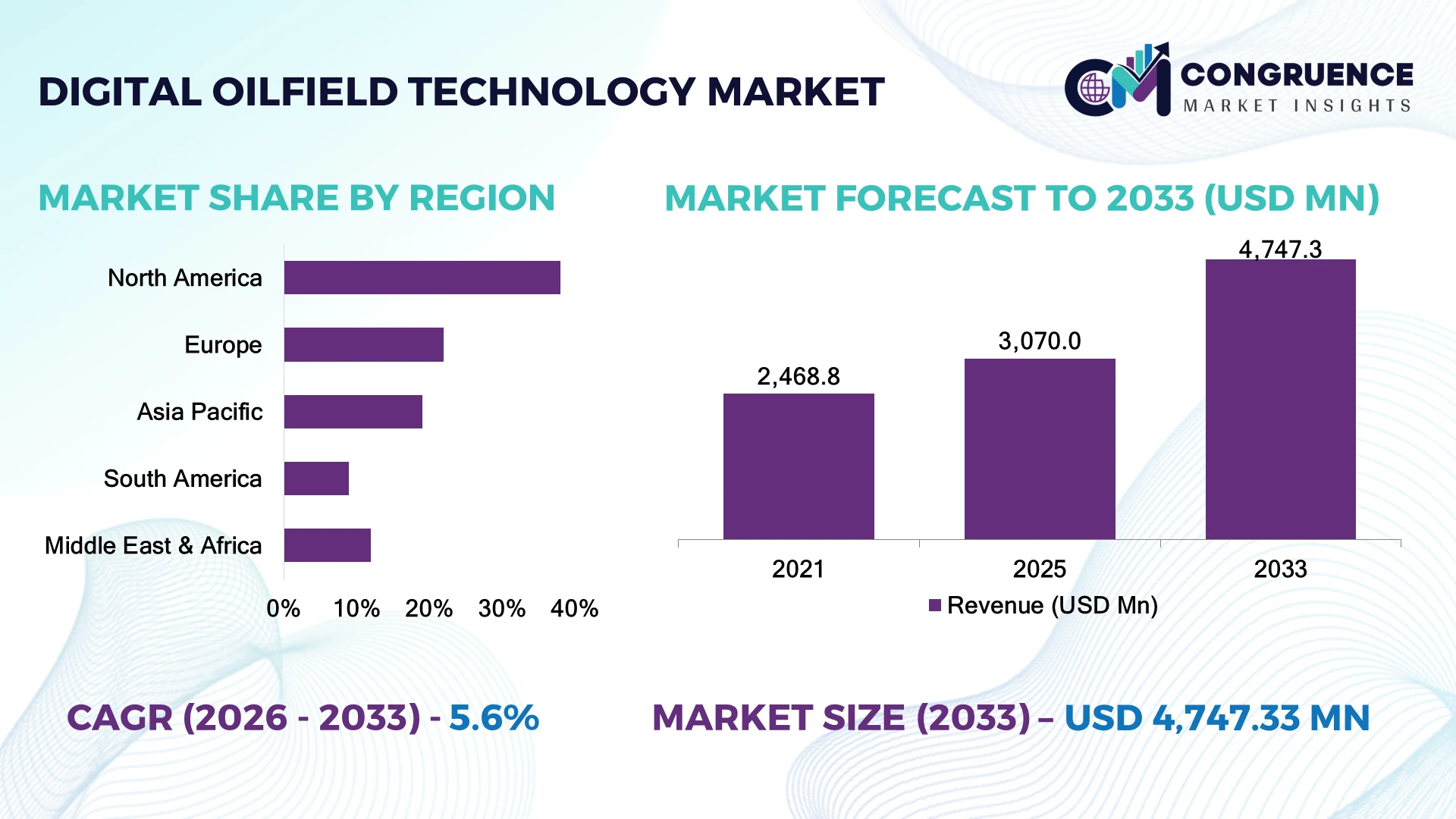
The Global Digital Oilfield Technology Market was valued at USD 3,070.0 Million in 2025 and is anticipated to reach a value of USD 4,747.3 Million by 2033 expanding at a CAGR of 5.6% between 2026 and 2033. Growth is driven by accelerated deployment of AI-enabled reservoir optimization, real-time production monitoring, and remote asset management systems across mature and unconventional oilfields.
The United States dominates the market with an estimated 34% share, supported by over 900,000 active oil and gas wells, extensive shale operations, and digital monitoring adoption exceeding 65% across major upstream operators. Compared with Canada, where digital deployment remains below 45% in upstream assets, the U.S. benefits from larger automation investments and advanced cloud-based field analytics. Following energy security priorities intensified after the Russia–Ukraine conflict, operators increased spending on predictive maintenance and production intelligence platforms to improve field efficiency and operational resilience.
Strategic implication companies prioritizing integrated analytics, autonomous field operations, and cybersecurity-enabled infrastructure are securing stronger operational performance and long-term competitive differentiation.
Market Size & Growth: USD 3,070.0 Million in 2025, reaching USD 4,747.3 Million by 2033, supported by AI-driven production optimization and remote operations.
Top Growth Drivers: AI analytics adoption (+32%), remote monitoring deployment (+28%), predictive maintenance utilization (+25%).
Short-Term Forecast: By 2028, unplanned downtime is expected to decline by nearly 20% through advanced asset monitoring.
Emerging Technologies: AI, digital twins, and edge computing improve field decision-making speed by over 30%.
Regional Leaders: North America (~USD 1.6 Billion), Middle East (~USD 1.1 Billion), Asia Pacific (~USD 0.9 Billion); all advancing intelligent oilfield programs.
Consumer/End-User Trends: More than 60% of large upstream operators utilize cloud-based production analytics platforms.
Pilot/Case Example: In 2024, a Middle Eastern smart field deployment improved well productivity by approximately 15%.
Competitive Landscape: Leading providers control nearly 40% market share; key players include SLB, Halliburton, Baker Hughes, Weatherford, and Honeywell.
Regulatory & ESG Impact: Digital monitoring solutions reduce operational emissions intensity by up to 12% through optimized production control.
Investment & Funding: Over USD 2 Billion in industry digitalization investments support automation, analytics, and connected infrastructure programs.
Innovation & Future Outlook: Autonomous operations centers and AI-powered reservoir management are reshaping next-generation oilfield productivity strategies.
Digital Oilfield Technology solutions are increasingly deployed across reservoir management, drilling optimization, production surveillance, and asset integrity monitoring. AI-assisted workflows have improved production forecasting accuracy by nearly 25%, while digital twins enable faster field-level decision-making. Growing integration of cloud platforms and industrial IoT networks supports remote operations in complex environments. Rising focus on operational resilience, cybersecurity readiness, and energy infrastructure modernization continues to accelerate adoption, setting the stage for deeper strategic transformation across upstream operations.
Digital oilfield technology has become a strategic enabler for upstream competitiveness as operators face pressure to maximize recovery rates, improve asset utilization, and control operating expenditures. Industry-wide infrastructure modernization and increasing deployment of connected industrial systems are transforming field operations from reactive management to data-driven decision-making. Energy security priorities and production optimization initiatives are further accelerating digital investments across major producing nations.
Modern AI-enabled production platforms deliver measurable advantages over legacy monitoring systems. Advanced predictive maintenance solutions reduce equipment failures by 20–30% while improving asset availability through continuous diagnostics and automated alerts. The United States leads in large-scale deployment across shale basins, whereas Saudi Arabia and the UAE focus on smart-field ecosystems integrated with national energy transformation programs. Over 60% of major operators now utilize some form of advanced production analytics within core assets.
A practical example is the deployment of digital twins for reservoir and well performance management, enabling faster intervention planning and improved production consistency. Companies are expanding technology partnerships, strengthening cloud infrastructure, and investing in cybersecurity frameworks. Over the next two to three years, adoption of autonomous operations centers and AI-assisted decision support systems is expected to accelerate, positioning digital oilfield capabilities as a critical source of operational advantage and long-term industry leadership.
Growing adoption of intelligent oilfield architectures is fundamentally reshaping upstream production strategies. More than 65% of large operators now deploy real-time production monitoring systems, while predictive maintenance applications reduce equipment downtime by up to 30%. AI-enabled reservoir management has improved production forecasting accuracy by approximately 25%, enabling more efficient field development planning. Following heightened energy security concerns after the Russia–Ukraine conflict, operators in the United States and Saudi Arabia accelerated investments in production optimization technologies. This shift is creating measurable gains in operational reliability and asset productivity. In response, technology providers are expanding digital platforms, forming strategic cloud partnerships, and integrating industrial IoT capabilities to deliver end-to-end field intelligence solutions. The operational advantage increasingly lies in converting field data into actionable production decisions.
A significant limitation remains the integration of modern digital platforms with aging oilfield infrastructure. Nearly 40% of existing upstream assets continue to operate on legacy control systems, while data compatibility challenges affect over 30% of digital transformation projects. Many operators in Latin America and parts of Africa face infrastructure modernization delays due to fragmented technology environments and limited communications networks. These constraints increase implementation complexity, extend deployment timelines, and reduce scalability of advanced analytics initiatives. To mitigate risks, companies are adopting open architecture frameworks, localized integration strategies, and multi-vendor interoperability standards. The strategic challenge is not technology availability but achieving seamless connectivity across diverse operational environments without disrupting production continuity.
The emergence of autonomous oilfield ecosystems presents a significant opportunity beyond conventional monitoring applications. AI-assisted workflows have improved decision-making speed by more than 35%, while digital twin adoption has increased by nearly 20% among major upstream operators. Saudi Arabia, the UAE, and the United States are investing heavily in intelligent production environments that combine automation, edge computing, and advanced analytics. Future deployment of generative AI for operational recommendations and reservoir optimization is expected to further enhance production efficiency. Companies are expanding R&D programs, establishing technology alliances, and developing integrated digital platforms. A particularly valuable opportunity lies in optimizing mature fields, where incremental recovery improvements of 5–10% can deliver substantial long-term production value without major infrastructure expansion.
As oilfield operations become increasingly connected, cybersecurity and workforce capability gaps are emerging as critical long-term challenges. Cyber incidents targeting industrial infrastructure increased by over 25% in recent years, while nearly 45% of energy companies report shortages of specialized digital and analytics talent. Expanding use of cloud-connected field assets increases exposure to operational disruptions and data integrity risks. Unlike infrastructure limitations, this challenge directly affects scalability, resilience, and sustained technology performance. Operators must strengthen cybersecurity frameworks, implement zero-trust architectures, and invest in workforce development programs focused on AI, automation, and industrial analytics. Companies that successfully align digital security with operational expertise will achieve more consistent deployment outcomes and stronger competitive positioning across increasingly automated energy production environments.
AI-Driven Production Intelligence AI-enabled production optimization platforms are now deployed across more than 60% of large upstream operations, while predictive analytics usage has increased by nearly 30% over the past two years. Operators are shifting from periodic reporting to continuous decision support, reducing troubleshooting time by approximately 25%. In response to workforce constraints and rising operational complexity, companies are expanding AI partnerships and embedding machine-learning models directly into field management workflows.
Expansion of Remote Operations Centers Centralized remote operations centers are managing up to 40% more field assets than conventional site-based control models. Digital monitoring adoption exceeds 65% across major U.S. shale operators, while remote intervention requirements have fallen by nearly 20%. Labor availability pressures and field safety priorities are accelerating deployment. Service providers are scaling cloud-connected platforms and integrating real-time visualization tools to improve operational consistency across geographically dispersed assets.
Industrial IoT Network Integration Connected sensor deployments have increased by more than 35%, enabling continuous equipment health monitoring and automated production surveillance. Data acquisition frequency has improved by nearly 50% compared with legacy supervisory systems. A less obvious shift is the growing use of edge computing to process field data locally, reducing network latency and bandwidth costs. Companies are investing in interoperable architectures that connect legacy infrastructure with modern digital ecosystems.
Cybersecurity-First Digitalization Strategies Industrial cybersecurity spending has risen by approximately 25% as operators expand cloud-based asset management environments. More than 55% of large energy companies have adopted advanced threat monitoring for operational technology networks. Growing geopolitical cyber risks and stricter infrastructure protection requirements are driving investment. Companies are restructuring digital programs around zero-trust frameworks, secure data exchanges, and resilient operational technology architectures.
Software platforms account for approximately 46% of the Digital Oilfield Technology Market, making them the leading segment due to their ability to integrate production data, reservoir intelligence, and operational analytics within a single environment. Enterprise operators increasingly prioritize scalable software ecosystems because they support predictive maintenance, remote monitoring, and real-time optimization without extensive physical infrastructure upgrades. Hardware solutions maintain strong relevance for sensing, telemetry, and field connectivity, representing nearly 32% of deployments. Services continue to support implementation, integration, and managed operations across complex asset portfolios. The fastest-growing segment is software analytics and AI-enabled operational platforms, where adoption rates have increased by nearly 28% as operators seek greater automation and decision speed. Hardware suppliers are focusing on advanced sensor networks and edge devices, while service providers are expanding digital consulting and cybersecurity offerings. Investment priorities are increasingly shifting toward integrated software environments that deliver measurable productivity gains and operational visibility. As upstream operators modernize aging infrastructure, partnerships between technology vendors and energy companies are accelerating platform standardization and deployment efficiency.
Production optimization represents the largest application segment with an estimated 38% market share, driven by continuous pressure to maximize output, reduce downtime, and improve recovery efficiency. Real-time monitoring, automated production controls, and predictive maintenance capabilities have become operational priorities across mature and unconventional fields. Reservoir management remains a significant application area as operators increasingly rely on advanced analytics for reserve evaluation and field planning. Drilling optimization continues to benefit from automation technologies that improve drilling accuracy and reduce non-productive time. Reservoir management is emerging as the fastest-growing application segment, supported by increased deployment of AI-assisted modeling and digital twin technologies. Adoption of advanced reservoir analytics has expanded by approximately 24%, while drilling optimization programs have reduced operational inefficiencies by nearly 15% in several large-scale projects. Companies are integrating production, drilling, and reservoir datasets into unified workflows to strengthen decision-making speed and accuracy. Demand is increasingly concentrated in applications that directly influence production efficiency, asset reliability, and field profitability.
Large oil and gas operators constitute the dominant end-user group, accounting for approximately 52% of market demand due to extensive infrastructure footprints, higher digital investment capacity, and complex operational requirements. These organizations manage thousands of connected assets across upstream portfolios, making digital monitoring and automation essential for operational continuity. National oil companies also represent a substantial share of deployments as governments prioritize energy security, production optimization, and infrastructure modernization initiatives. Independent operators continue to adopt targeted digital solutions focused on efficiency improvements and cost control. Independent exploration and production companies are the fastest-growing end-user segment, with digital adoption increasing by nearly 22% as cloud-based platforms lower implementation barriers. National oil companies are accelerating deployment through strategic partnerships and large-scale modernization programs, while major integrated operators continue expanding autonomous operations capabilities. Vendors are responding through flexible subscription models, customized analytics packages, and ecosystem partnerships tailored to different operator profiles. Future demand is increasingly shifting toward organizations seeking scalable, lower-cost digital transformation pathways without compromising operational performance.
North America accounted for the largest market share at 38% in 2025 however, Asia-Pacific is expected to register the fastest growth, expanding at a CAGR of 6.8% between 2026 and 2033.
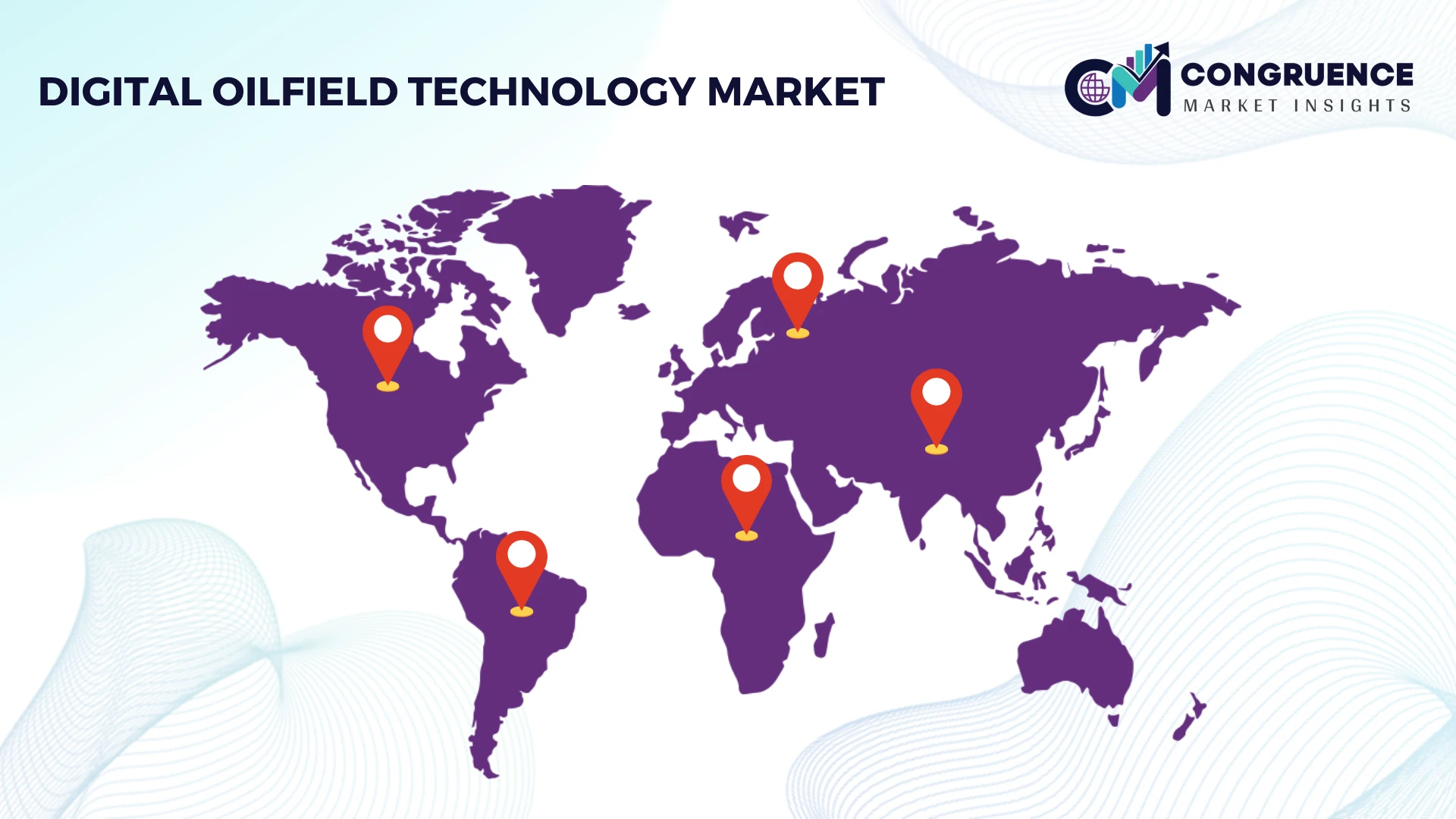
North America remains the leading Digital Oilfield Technology market, supported by extensive shale production, advanced upstream infrastructure, and widespread deployment of intelligent field management systems. The region contributes approximately 38% of global demand, with digital monitoring and predictive analytics integrated across major unconventional resource basins. Operators continue expanding remote operations centers, automated production optimization platforms, and AI-driven asset management capabilities. More than 65% of large upstream operators utilize advanced production analytics, while connected field deployments have increased significantly across the Permian Basin and other high-output regions. Strategic partnerships between energy producers and technology providers are accelerating cloud integration and operational intelligence adoption. Strong cybersecurity investments and modernization of legacy field systems further reinforce the region’s leadership position.
United States Market Outlook: The United States represents the largest national market due to its extensive shale infrastructure, high digital maturity, and strong technology ecosystem. Operators across the Permian, Eagle Ford, and Bakken formations increasingly deploy AI-enabled production optimization and predictive maintenance solutions. More than 900,000 active oil and gas wells create substantial demand for connected monitoring systems. Investment priorities remain focused on autonomous operations, industrial IoT deployment, and cybersecurity-enhanced field management platforms that improve production reliability and operational efficiency.
Europe is characterized by a strong focus on operational efficiency, digital asset modernization, and intelligent management of mature offshore and onshore fields. The region accounts for approximately 22% of global market activity, with operators emphasizing production optimization and predictive maintenance to extend asset life. Digital twin deployment, remote inspection technologies, and advanced analytics platforms are increasingly integrated into North Sea operations. Environmental compliance requirements and infrastructure modernization initiatives continue influencing technology procurement decisions. Several operators have reported double-digit improvements in maintenance planning efficiency through data-driven asset management systems. Technology vendors are expanding partnerships with energy companies to enhance operational visibility and support long-term field optimization strategies.
Norway Market Outlook: Norway serves as the region’s most strategically significant market due to its technologically advanced offshore sector and strong digital infrastructure. Operators on the Norwegian Continental Shelf have accelerated deployment of digital twins, automated monitoring systems, and integrated production management platforms. More than 80% of major offshore assets utilize advanced digital solutions for operational optimization. Continued investment in intelligent offshore operations, combined with robust regulatory support for innovation and efficiency improvements, strengthens Norway’s leadership position within Europe’s digital oilfield landscape.
Asia-Pacific is emerging as the fastest-expanding market as national oil companies and independent producers accelerate field modernization programs. The region represents approximately 19% of global demand and benefits from increasing upstream investment, expanding energy infrastructure, and broader digital transformation initiatives. Operators are deploying intelligent production systems, remote monitoring platforms, and AI-driven reservoir management solutions across both mature and newly developed assets. Connected oilfield deployments have increased by more than 25% in key producing countries over recent years. Growing demand for production efficiency and energy security is encouraging large-scale digital infrastructure investments. Technology providers are strengthening local partnerships and expanding implementation capabilities to support rising deployment volumes.
China Market Outlook: China is the most influential market within Asia-Pacific due to its large upstream sector, extensive energy infrastructure, and strong government-backed digitalization initiatives. Major national oil companies continue integrating AI, industrial IoT, and advanced analytics across production assets. Intelligent field deployments have expanded significantly within major onshore production regions, while digital reservoir management capabilities are becoming standard practice. Continued investment in domestic technology ecosystems and industrial automation strengthens China's position as a leading adopter of next-generation oilfield technologies.
South America is witnessing increasing adoption of digital oilfield technologies as operators seek to improve offshore productivity, optimize asset performance, and manage operational complexity. The region contributes approximately 9% of global market demand, with deployment activity concentrated around offshore developments and high-value production assets. Real-time monitoring systems, production analytics, and predictive maintenance solutions are becoming more common across large-scale projects. Digital technologies are helping reduce operational inefficiencies while supporting enhanced production planning. Infrastructure limitations and uneven digital readiness remain challenges in certain markets; however, investment momentum continues to strengthen. Companies are expanding technology partnerships and prioritizing scalable solutions that deliver measurable operational improvements without major infrastructure overhauls.
Brazil Market Outlook: Brazil dominates the regional market through its extensive offshore production network and continued investment in deepwater and pre-salt developments. Operators increasingly deploy digital monitoring platforms, intelligent production systems, and advanced analytics to improve field performance. Large offshore assets generate significant demand for predictive maintenance and remote operations technologies. Ongoing modernization of offshore infrastructure and growing adoption of integrated operational platforms position Brazil as the primary driver of digital oilfield investment and innovation across South America.
The Middle East & Africa region accounts for approximately 12% of global market demand and remains one of the most strategically important areas for large-scale digital oilfield deployment. Major producing nations are investing heavily in smart-field infrastructure, automated production systems, and AI-driven operational management. National oil companies continue implementing integrated digital platforms to improve production efficiency and asset utilization. Several large-scale intelligent oilfield programs have achieved production optimization gains exceeding 15% through advanced analytics and real-time monitoring. Long-term infrastructure modernization strategies, coupled with energy sector diversification initiatives, are accelerating adoption. Technology suppliers are expanding regional partnerships and establishing dedicated digital operations capabilities to support implementation requirements.
Saudi Arabia Market Outlook: Saudi Arabia represents the region’s leading market due to its vast hydrocarbon resources, large-scale infrastructure investments, and aggressive smart-field transformation initiatives. National operators continue expanding AI-enabled reservoir management, automated production optimization, and integrated operations centers across major assets. Intelligent field technologies are increasingly embedded within production workflows to improve efficiency and operational visibility. Strong investment in industrial digitalization, advanced analytics, and next-generation field management platforms reinforces Saudi Arabia’s role as a global leader in digital oilfield deployment and innovation.
The Digital Oilfield Technology Market is led by global technology providers including SLB, Halliburton, Baker Hughes, Weatherford International, and Honeywell, competing against regional digital integrators and specialized software vendors. The top five players collectively control approximately 52% of market activity, creating a moderately consolidated competitive structure. Competition centers on analytics accuracy, automation capability, deployment speed, cybersecurity performance, and integration flexibility rather than price alone. AI-enabled workflows improve operational decision speed by nearly 30%, while predictive maintenance solutions reduce equipment downtime by up to 25%, creating measurable differentiation. Leading vendors are expanding through cloud partnerships, autonomous operations platforms, and digital ecosystem development. The competitive shift is increasingly driven by AI-powered field intelligence and integrated software environments. High implementation complexity and deep domain expertise remain major entry barriers. Success requires scalable platforms, proven operational outcomes, strong cybersecurity, and enterprise-wide integration capabilities.
Halliburton
Baker Hughes
Weatherford International plc
Honeywell International Inc.
Siemens Energy AG
Emerson Electric Co.
ABB Ltd.
Schneider Electric SE
Rockwell Automation, Inc.
Kongsberg Digital AS
IBM Corporation
Oracle Corporation
AVEVA Group plc
Digital oilfield operations are increasingly built around AI analytics, industrial IoT, cloud-based production platforms, and digital twins. More than 60% of large upstream operators now utilize advanced production analytics, while connected sensor deployments have increased by over 35%. These technologies improve production visibility, accelerate intervention planning, and reduce troubleshooting cycles by nearly 25%. Integration between field devices, cloud infrastructure, and operational technology networks is becoming a standard deployment model across large producing assets.
Emerging technologies are shifting from monitoring toward autonomous decision support. AI-assisted reservoir management improves forecasting accuracy by approximately 20%, while digital twins reduce engineering evaluation time by nearly 30%. Compared with legacy manual optimization workflows, integrated AI-driven platforms can improve operational response speed by over 40%. Major technology providers and large operators benefit most because they can scale analytics across thousands of assets while maintaining centralized operational control.
Between 2026 and 2028, agentic AI, edge computing, and autonomous drilling optimization platforms are expected to reshape operational execution. Adoption of intelligent workflow automation is projected to exceed 50% among major upstream operators. Companies acting now gain stronger production consistency, faster decision cycles, and improved asset utilization. The competitive advantage increasingly belongs to organizations capable of integrating AI, automation, and cybersecurity into a unified digital operating environment.
April 2025 – SLB announced a partnership with Shell to deploy Petrel™ subsurface software across assets worldwide, expanding digital seismic interpretation and subsurface workflows. The initiative supports enterprise-scale digital standardization and operational efficiency improvements across global upstream operations. Source: www.slb.com
June 2025 – SLB and Cactus Drilling expanded their collaboration to scale automated and autonomous drilling technologies, including DrillSync™ and DrillOps™ platforms. The deployment strengthens real-time drilling intelligence and improves equipment utilization while accelerating intelligent well construction practices. Source: www.slb.com
February 2025 – Honeywell announced deployment of Honeywell Forge Performance+ for Utilities with SECO Energy, enabling automation and modernization of grid operations. The project supports improved operational visibility across one of the ten largest U.S. electric cooperatives and advances digital infrastructure management capabilities. Source: www.automation.honeywell.com
November 2025 – SLB launched Tela™, an agentic AI assistant designed for upstream energy workflows. The platform automates interpretation, planning, and operational decision support, strengthening AI-driven productivity and accelerating adoption of autonomous digital oilfield processes.
This report provides a comprehensive assessment of the Digital Oilfield Technology Market across major technology categories, applications, end-user groups, and geographic regions. The analysis covers software platforms, hardware infrastructure, and digital services supporting production optimization, drilling optimization, reservoir management, and related upstream workflows. Regional evaluation spans North America, Europe, Asia-Pacific, South America, and the Middle East & Africa, highlighting deployment concentration, digital maturity, infrastructure modernization, and technology adoption patterns. More than 60% of large operators have implemented advanced analytics or connected monitoring systems, underscoring the increasing role of intelligent field operations.
The report examines competitive positioning, technology innovation, digital transformation strategies, and operational deployment trends shaping industry direction between 2026 and 2033. It evaluates AI-enabled analytics, digital twins, industrial IoT, automation platforms, cloud integration, and cybersecurity frameworks. Strategic insights support investment prioritization, expansion planning, partnership development, operational benchmarking, and identification of emerging opportunities across both mature and evolving oilfield environments.
| Report Attribute / Metric | Details |
|---|---|
| Market Revenue (2025) | USD 3,070.0 Million |
| Market Revenue (2033) | USD 4,747.3 Million |
| CAGR (2026–2033) | 5.6% |
| Base Year | 2025 |
| Forecast Period | 2026–2033 |
| Historic Period | 2021–2025 |
| Segments Covered |
By Type
By Application
By End-User
|
| Key Deliverables | Revenue Forecast; Market Trends; Growth Drivers & Restraints; Technology Insights; Segmentation Analysis; Regional Insights; Competitive Landscape; Regulatory & ESG Overview; Recent Developments |
| Regions Covered | North America; Europe; Asia-Pacific; South America; Middle East & Africa |
| Companies Profiled | SLB; Halliburton; Baker Hughes; Weatherford International plc; Honeywell International Inc.; Siemens Energy AG; Emerson Electric Co.; ABB Ltd.; Schneider Electric SE; Rockwell Automation, Inc.; Kongsberg Digital AS; IBM Corporation; Oracle Corporation; AVEVA Group plc |
| Customization & Pricing | Available on Request (10% Customization Free) |




