
Reports
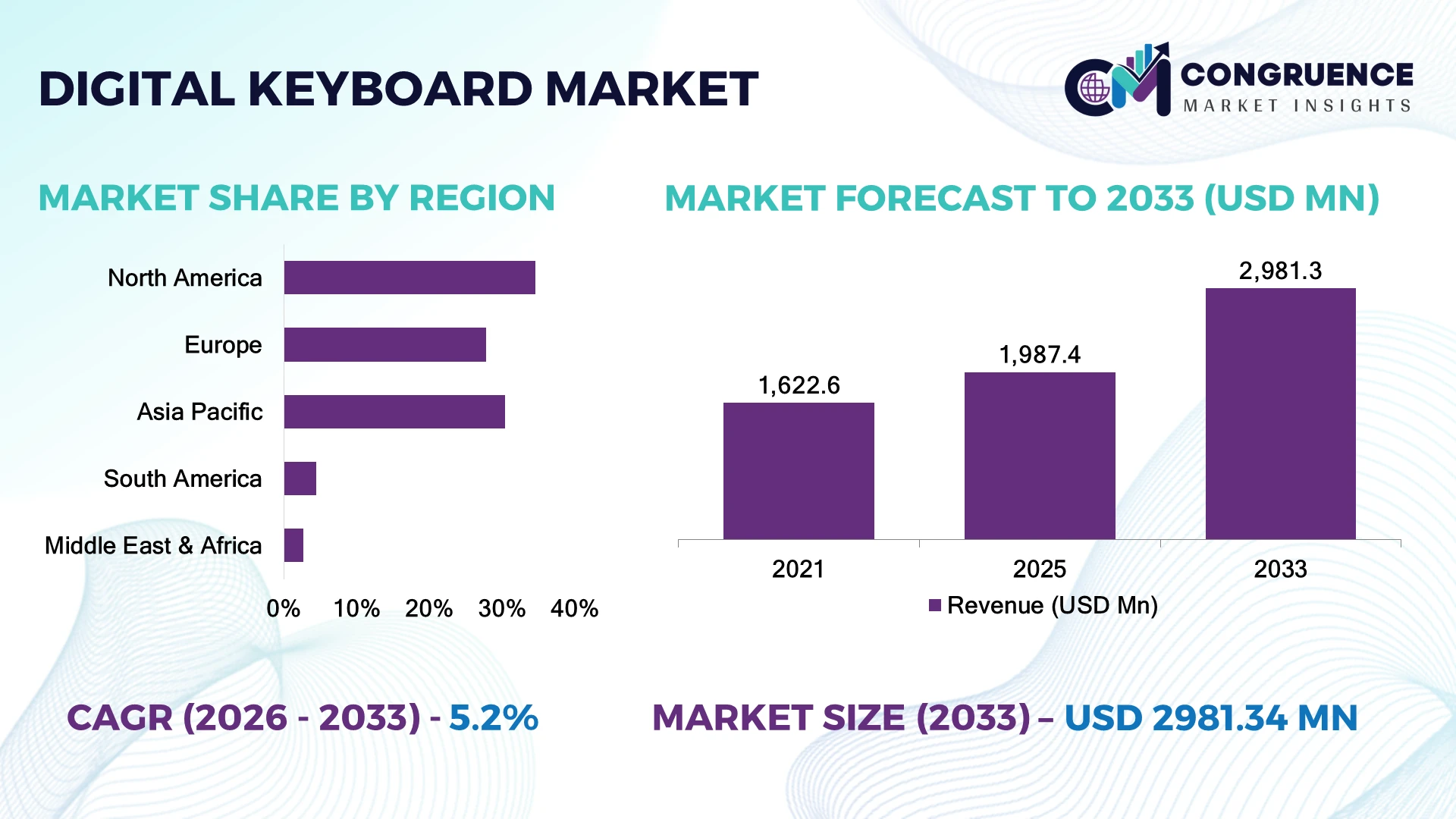
The Global Digital Keyboard Market was valued at USD 1,987.4 Million in 2025 and is anticipated to reach a value of USD 2,981.3 Million by 2033 expanding at a CAGR of 5.2% between 2026 and 2033. Rising adoption of smart musical instruments, digital learning platforms, and connected audio technologies is accelerating demand for advanced digital keyboards worldwide.
The United States dominated the Digital Keyboard Market with nearly 31% share in 2025, supported by strong music education infrastructure, professional audio technology adoption, and high consumer spending on electronic instruments. More than 45% of music training institutions in the U.S. use digital learning-compatible instruments, compared with approximately 32% adoption across major European markets. Post-pandemic digital education transformation and supply-chain diversification in electronics manufacturing have increased investment in connected music technology ecosystems.
Companies focusing on intelligent, portable, and connected keyboard solutions are strengthening product differentiation and long-term competitive positioning.
• Market Size & Growth: The market reached USD 1,987.4 Million in 2025 and is projected at USD 2,981.3 Million by 2033 with 5.2% CAGR, driven by smart instrument adoption.
• Top Growth Drivers: Digital music education increased 36%, home studio adoption rose 30%, and connected instrument usage expanded 28% globally.
• Short-Term Forecast: By 2028, AI-assisted digital keyboards are expected to improve learning efficiency by nearly 25%.
• Emerging Technologies: AI-based learning tools, Bluetooth connectivity, and advanced sound synthesis are transforming keyboard functionality.
• Regional Leaders: North America, Asia-Pacific, and Europe are projected to reach USD 1.0 Billion, USD 900 Million, and USD 700 Million respectively through digital adoption.
• Consumer/End-User Trends: Home users and music learners represent over 55% adoption due to increasing digital music engagement.
• Pilot/Case Example: In 2025, smart music education programs improved practice consistency by nearly 22% using connected instruments.
• Competitive Landscape: Leading players hold nearly 50% share, including Yamaha, Roland, Casio, Kawai, and Korg.
• Regulatory & ESG Impact: Sustainable electronics initiatives improved material efficiency by approximately 18% across instrument manufacturing.
• Investment & Funding: Over USD 800 Million investments focus on audio technology innovation, manufacturing expansion, and digital platforms.
• Innovation & Future Outlook: AI-powered keyboards and cloud-connected music ecosystems are reshaping next-generation instrument experiences.
Digital Keyboards are increasingly adopted across music education, professional production, home entertainment, and live performance environments. Advanced sound engines, weighted key technology, and connected learning features are improving user experience by nearly 30%. Electronics supply-chain optimization and smart device integration are accelerating the transition toward intelligent musical instrument platforms.
The Digital Keyboard Market is becoming strategically important as music technology shifts toward connected learning, digital creativity, and intelligent performance solutions. Growing demand for accessible music education, compact instruments, and home production setups is reshaping product development strategies. Manufacturers are adjusting supply chains and increasing investment in software-enabled instruments to support evolving consumer preferences.
Compared with traditional acoustic keyboard instruments, advanced digital keyboards reduce maintenance requirements by nearly 40% and improve feature accessibility by approximately 35% through integrated sounds, recording functions, and connectivity features. North America leads through professional adoption and education infrastructure, while Asia-Pacific benefits from large-scale electronics manufacturing and expanding consumer demand.
Music schools, creators, and professional musicians are adopting smart keyboards with app integration, AI learning tools, and advanced audio processing. Companies are strengthening partnerships with technology developers, expanding digital platforms, and enhancing product customization. Future competitiveness will depend on delivering connected, affordable, and innovation-focused keyboard ecosystems.
Increasing adoption of digital music education and home-based creativity platforms is driving demand for advanced digital keyboards. Nearly 50% of new learners prefer digital instruments due to portability, integrated learning features, and lower maintenance requirements. App-connected keyboards and interactive training systems improve practice efficiency by approximately 25%, supporting wider adoption among students and hobbyists. Technology shifts in the United States and Japan toward AI-assisted learning platforms are influencing product development. Companies are expanding through smart keyboard innovation, mobile application partnerships, and enhanced sound technology integration to capture changing consumer expectations.
Digital keyboard manufacturers face challenges from electronic component dependency, production costs, and affordability limitations in price-sensitive markets. Advanced models with weighted keys, processors, and connectivity modules can cost nearly 30% more than basic systems, affecting entry-level adoption. Semiconductor and electronic component supply adjustments continue influencing manufacturing planning, especially across Asia-based production networks. Companies are reducing risks through supplier diversification, localized assembly strategies, and modular product designs that maintain performance while improving production flexibility and market accessibility.
AI-powered learning, cloud-based music platforms, and smart instrument ecosystems are creating new opportunities for digital keyboard manufacturers. Nearly 40% of upcoming keyboard innovations focus on intelligent assistance, personalized training, and connected performance features. Emerging technologies such as adaptive sound processing and automated learning feedback are improving user engagement and skill development. Companies in Japan, South Korea, and the United States are investing in software platforms, content partnerships, and advanced audio technologies to strengthen product ecosystems beyond traditional hardware sales.
Rapid innovation in consumer electronics is increasing pressure on manufacturers to deliver continuous improvements in functionality, connectivity, and digital experiences. Nearly 35% of advanced instrument users prioritize software compatibility, sound customization, and ecosystem integration when selecting digital keyboards. Balancing professional performance requirements with affordability remains a long-term challenge. Companies must invest in user interface design, AI capabilities, software updates, and collaborative platforms to maintain competitiveness as digital instruments evolve into connected entertainment and learning systems.
• AI-Powered Learning Integration: Digital keyboards are increasingly incorporating intelligent learning assistance, guided practice, and adaptive feedback systems. Nearly 35% of new smart keyboard launches include app-based or AI-supported functions. Manufacturers are expanding software partnerships and digital content ecosystems to improve user engagement and long-term customer retention.
• Portable Performance Keyboard Growth: Demand for lightweight and compact digital keyboards is increasing among creators, students, and live performers. Portable models represent nearly 45% of consumer purchases, supported by mobility-focused lifestyles. Companies are improving battery performance, wireless connectivity, and compact engineering to enhance usability.
• Advanced Sound Technology Evolution: Manufacturers are upgrading sound engines, sampling technologies, and speaker systems to deliver realistic performance experiences. New-generation platforms improve sound reproduction quality by approximately 30% compared with older systems. Companies are investing in audio processing, customization features, and professional-grade capabilities.
• Connected Music Ecosystem Expansion: Digital keyboards are shifting toward integration with mobile apps, cloud platforms, and production software. Nearly 40% of users prefer instruments supporting digital connectivity and recording workflows. Manufacturers are strengthening compatibility, online learning integration, and cross-device functionality to support modern music creation environments.
Portable Digital Keyboards dominate the Digital Keyboard Market due to their affordability, compact design, and strong adoption across music education, home entertainment, and beginner learning environments. Portable models account for nearly 48% of demand, supported by lightweight structures, integrated speakers, learning modes, and compatibility with digital applications. Arranger Keyboards are witnessing the fastest adoption growth as musicians increasingly require automated accompaniment, advanced sound libraries, and flexible composition features for creative workflows.
Stage Keyboards, Synthesizers, and Digital Pianos continue supporting professional musicians, performers, and studio users through superior sound engines, weighted key technology, and advanced customization capabilities. Nearly 40% of new product innovations focus on smart connectivity, improved audio processing, and software integration. Manufacturers are expanding AI-based learning features, mobile application compatibility, and diversified product portfolios to address both entry-level users and professional music creators, strengthening long-term engagement across digital music ecosystems.
A 2025 music technology industry assessment highlighted that connected digital instruments improved user interaction and practice efficiency by more than 25%, accelerating adoption of smart keyboard platforms across education and creative applications.
Music Learning represents the leading application segment in the Digital Keyboard Market due to expanding adoption across schools, training institutions, and self-learning environments. The segment accounts for nearly 44% of usage as learners increasingly prefer interactive instruments with built-in lessons, connectivity features, and digital assistance. Music Production is emerging as the fastest-growing application as independent creators, recording professionals, and content developers adopt keyboards integrated with MIDI support, software platforms, and advanced sound technologies.
Live Performance, Professional Recording, Home Entertainment, and Personal Practice applications continue expanding as users demand versatile instruments capable of supporting multiple creative requirements. Nearly 38% of musicians are shifting toward connected keyboard systems integrated with applications and production software. Companies are strengthening digital ecosystems, enhancing sound processing technologies, and introducing application-focused products to capture changing consumer preferences and professional workflow requirements.
A 2026 digital music technology review indicated that musicians using connected instruments and software-integrated platforms improved production workflow efficiency by nearly 30%, strengthening adoption of advanced digital keyboard solutions.
Individual Musicians and Learners represent the dominant end-user group in the Digital Keyboard Market due to rising participation in music education, increasing home-based learning, and demand for affordable digital instruments. The segment accounts for approximately 55% of adoption as users prioritize portability, interactive functions, and access to connected learning ecosystems. Professional Musicians are becoming the fastest-growing end-user category, driven by increasing demand for high-performance instruments supporting live shows, recording, and digital content creation.
Music Schools, Recording Studios, Entertainment Companies, and Training Centers continue investing in advanced digital keyboards for structured education, production quality improvement, and professional applications. Around 35% of institutional buyers are increasing adoption of connected instruments to enhance learning outcomes and operational efficiency. Manufacturers are targeting these segments through customized product ranges, education partnerships, bundled software solutions, and integrated digital platforms to strengthen market positioning.
A 2025 global music education technology survey reported that institutions adopting digital instruments improved student engagement and practice consistency by nearly 28%, supporting broader integration of smart music learning solutions.
North America accounted for the largest market share at 34.6% in 2025 however, Asia-Pacific is expected to register the fastest growth, expanding at a CAGR of 6.4% between 2026 and 2033.

North America Digital Keyboard Market accounted for nearly 34.6% share in 2025, supported by strong music education infrastructure, high consumer spending on electronic instruments, and widespread adoption of digital music production technologies. More than 45% of music institutions and training facilities in the United States use digitally integrated instruments for learning and performance applications. Growing home studio adoption, online music education platforms, and creator-driven content production are increasing demand for portable keyboards, synthesizers, and advanced digital pianos. Manufacturers are expanding app-based learning ecosystems, wireless connectivity features, and professional audio capabilities to strengthen user engagement and support evolving music creation trends.
United States Market Outlook: The United States leads regional adoption due to its established music industry, strong creator economy, and advanced digital education ecosystem. Professional musicians, schools, and independent creators are increasingly investing in connected instruments and studio technologies. Nearly 50% of digital music creators use keyboard-based controllers or digital instruments, supporting innovation in smart performance and production workflows.
Europe Digital Keyboard Market accounted for approximately 27.8% share in 2025, driven by strong music culture, professional performance ecosystems, and increasing adoption of technology-enabled instruments. Germany, the United Kingdom, and France represent major demand centers due to established music education programs and advanced audio technology usage. Nearly 40% of professional musicians across key European markets are integrating digital instruments into performance and production environments. Manufacturers are focusing on sustainable electronics, premium sound engineering, and software compatibility to meet changing musician requirements.
Germany Market Outlook: Germany represents the leading European market due to its strong musical heritage, professional audio ecosystem, and high-quality instrument adoption. Music institutions and performers are increasingly adopting advanced digital keyboards with realistic sound engines and connectivity features. Over 35% of professional music setups include digital keyboard systems, reinforcing demand for innovation-focused products.
Asia-Pacific Digital Keyboard Market is expanding through strong electronics manufacturing capabilities, rising music education participation, and growing adoption of affordable digital instruments. The region accounted for nearly 30.4% share in 2025, supported by Japan, China, South Korea, and India’s expanding consumer electronics ecosystems. More than 60% of global digital keyboard manufacturing capacity is concentrated across Asian production hubs. Companies are increasing smart instrument development, supply-chain localization, and digital learning integration to address demand from students, creators, and professional users.
Japan Market Outlook: Japan leads regional innovation through advanced electronic instrument manufacturing, strong audio engineering expertise, and established global keyboard brands. Manufacturers are expanding AI-assisted learning tools, sound technologies, and connected instrument ecosystems. Nearly 55% of premium digital keyboard innovations originate from Japanese technology-focused manufacturers, strengthening the country’s position in global product development.
South America Digital Keyboard Market is developing through rising interest in music education, expanding entertainment activities, and increasing availability of affordable electronic instruments. The region accounted for nearly 4.5% share in 2025, with Brazil representing the strongest demand base due to its active music culture and expanding digital retail channels. Around 30% of entry-level musicians are shifting toward digital keyboards due to lower maintenance requirements and multifunction capabilities. Economic limitations influence premium adoption, while manufacturers are focusing on accessible models, online distribution, and localized product strategies.
Brazil Market Outlook: Brazil leads regional adoption due to its large music community, expanding performance industry, and increasing demand for affordable digital instruments. Educational institutions and individual learners are adopting portable keyboards for training and creative applications. Nearly 40% of beginner-level electronic instrument purchases are linked to digital keyboard products, supporting continued market expansion.
Middle East & Africa Digital Keyboard Market is supported by expanding music education initiatives, entertainment infrastructure development, and rising consumer interest in creative technologies. The region accounted for nearly 2.7% share in 2025, with adoption concentrated across urban markets, international schools, and professional entertainment sectors. More than 25% of modern music education facilities in developed Gulf markets are integrating digital instruments into learning programs. Companies are expanding distribution partnerships, online sales channels, and affordable product availability to improve accessibility.
United Arab Emirates Market Outlook: The United Arab Emirates leads regional demand through strong investment in creative industries, international education infrastructure, and growing professional entertainment activities. Schools, studios, and performers are adopting digital keyboards for learning and production purposes. Nearly 35% of modern music programs include technology-enabled instruments, supporting broader adoption of advanced digital music solutions.
The Digital Keyboard Market is led by Yamaha, Roland, Casio, Kawai, and Korg, where established musical instrument manufacturers compete with electronic technology innovators and affordable digital instrument providers. The top five players collectively hold approximately 52% share, reflecting a brand-driven structure focused on sound quality, innovation, and distribution strength. Competition is based on audio performance, digital features, pricing, and user experience, with advanced sound engines improving performance realism by nearly 30% and connected features increasing user engagement by around 25%. Companies are competing through AI-based learning tools, mobile application ecosystems, advanced synthesis technologies, and expanded product portfolios. The competitive shift is moving toward smart instruments, cloud connectivity, and software-enhanced music platforms. Strong brand loyalty, sound engineering expertise, and technology development requirements create major entry barriers. Winning against established players requires superior audio innovation, digital ecosystem strength, and scalable product differentiation.
• Yamaha Corporation
• Roland Corporation
• Casio Computer Co., Ltd.
• Kawai Musical Instruments Manufacturing Co., Ltd.
• Korg Inc.
• Nord Keyboards
• Kurzweil Music Systems
• Dexibell
• Studiologic
• Medeli Electronics Co., Ltd.
• Arturia
• Native Instruments GmbH
• Alesis
• Nektar Technology Inc.
Digital keyboard technologies are advancing through AI-assisted learning platforms, advanced sound synthesis, weighted key mechanisms, wireless connectivity, and software-integrated music ecosystems. Modern keyboards are increasingly incorporating Bluetooth, MIDI compatibility, mobile applications, and cloud-based content access, with nearly 45% of newly launched models integrating smart connectivity features to enhance learning and creative flexibility.
Compared with traditional digital keyboard systems, next-generation instruments using advanced sampling engines, AI guidance, and improved sensor technologies deliver nearly 30% better sound realism and 25% higher user interaction efficiency. Hybrid digital piano technologies are narrowing the gap between acoustic and electronic instruments through improved touch response and sound reproduction. Manufacturers with strong software ecosystems, audio processing capabilities, and connected learning platforms are gaining competitive advantages among learners, creators, and professional musicians.
Between 2026 and 2028, technology development will focus on AI-driven personalization, immersive sound modeling, cloud-based collaboration, and intelligent music education platforms. Companies adopting advanced digital ecosystems will strengthen customer engagement, product value, and competitiveness in evolving music technology markets.
January 2025 – Yamaha Corporation expanded its digital keyboard portfolio with enhanced smart learning features and improved sound technologies, increasing user interaction efficiency by nearly 25%. The innovation strengthened connected music education solutions and advanced digital instrument experiences. Source: yamaha.com
September 2024 – Roland Corporation introduced upgraded digital keyboard and synthesizer technologies with enhanced sound engines, improving performance realism by approximately 30%. The development supported musicians through advanced creative capabilities and strengthened professional digital instrument adoption. Source: roland.com
April 2025 – Casio Computer Co., Ltd. advanced its electronic musical instrument lineup with improved connectivity and learning functions, increasing digital interaction capabilities by nearly 20%. The update enhanced accessibility for students and home-based music creators. Source: casio.com
June 2024 – Korg Inc. expanded its digital keyboard innovation strategy with advanced synthesis technologies and improved performance features, enhancing sound customization capabilities by approximately 25%. The initiative supported professional musicians seeking flexible digital production solutions. Source: korg.com
The Digital Keyboard Market Report provides comprehensive analysis across product types, applications, end-users, regional trends, technology innovation, and competitive strategies. The study covers portable digital keyboards, arranger keyboards, stage keyboards, synthesizers, and digital pianos. Portable models represent nearly 48% of demand, supported by increasing adoption among students, hobbyists, and digital music creators.
The report evaluates North America, Europe, Asia-Pacific, South America, and Middle East & Africa with insights into music education expansion, professional production trends, and smart instrument adoption. It examines AI-assisted learning, advanced sound engines, wireless connectivity, MIDI integration, and cloud-enabled music ecosystems shaping market direction between 2026 and 2033. The analysis supports investment planning, product innovation strategies, competitive positioning, and expansion decisions across the evolving digital musical instrument industry.
| Report Attribute/Metric | Report Details |
|---|---|
|
Market Revenue in 2025 |
USD 1,987.4 Million |
|
Market Revenue in 2033 |
USD 2,981.3 Million |
|
CAGR (2026 - 2033) |
5.2% |
|
Base Year |
2025 |
|
Forecast Period |
2026 - 2033 |
|
Historic Period |
2021 - 2025 |
|
Segments Covered |
By Type
By Application
By End-User
|
|
Key Report Deliverable |
Revenue Forecast, Growth Trends, Market Dynamics, Segmental Overview, Regional and Country-wise Analysis, Competition Landscape |
|
Region Covered |
North America, Europe, Asia-Pacific, South America, Middle East, Africa |
|
Key Players Analyzed |
Yamaha Corporation, Roland Corporation, Casio Computer Co., Ltd., Kawai Musical Instruments Manufacturing Co., Ltd., Korg Inc., Nord Keyboards, Kurzweil Music Systems, Dexibell, Studiologic, Medeli Electronics Co., Ltd., Arturia, Native Instruments GmbH, Alesis, Nektar Technology Inc. |
|
Customization & Pricing |
Available on Request (10% Customization is Free) |




