
Reports
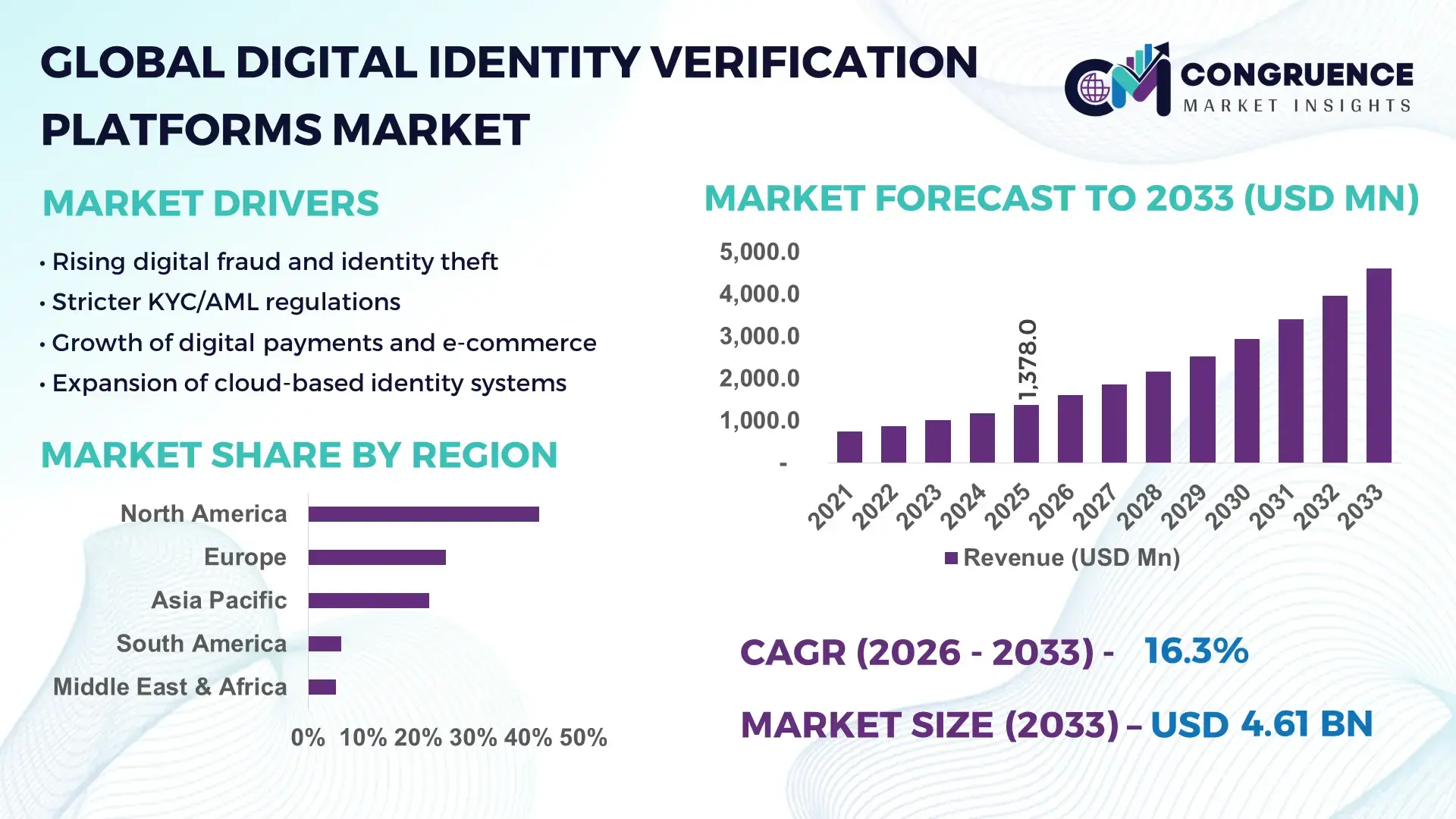
The Global Digital Identity Verification Platforms Market was valued at USD 1,378.0 Million in 2025 and is anticipated to reach USD 4,612.0 Million by 2033, expanding at a CAGR of 16.3% between 2026 and 2033, according to an analysis by Congruence Market Insights. This growth is being propelled by the rapid digitization of financial services, government services, and e-commerce, which has made secure identity verification a core digital infrastructure requirement rather than an optional compliance tool.
The United States leads the Digital Identity Verification Platforms ecosystem through large-scale deployment capacity across banking, fintech, healthcare, and government programs. More than 85% of major U.S. banks now integrate biometric or AI-based identity checks into onboarding workflows, while federal and state agencies have expanded digital ID pilots covering over 120 million citizens. Annual private investment in U.S.-based identity tech exceeds USD 2.5 billion, with cloud-native platforms, advanced liveness detection, and document-forensics R&D centers concentrated in California, Texas, and Virginia. Over 60% of U.S. enterprises have adopted multi-factor digital identity frameworks, supported by strong cybersecurity budgets and continuous innovation in AI, biometrics, and privacy-enhancing technologies.
Market Size & Growth: USD 1,378.0 Million in 2025 to USD 4,612.0 Million by 2033, driven by mandatory digital KYC, fraud prevention, and expansion of cashless ecosystems.
Top Growth Drivers: Biometric adoption +38%, fraud-loss reduction 25–35%, onboarding automation efficiency +30%.
Short-Term Forecast: By 2028, automated identity workflows are expected to cut customer onboarding time by 40% across regulated industries.
Emerging Technologies: AI-powered liveness detection, decentralized identity (DID), and privacy-preserving zero-knowledge verification.
Regional Leaders (2033): North America ~USD 1.7B (enterprise-first adoption), Europe ~USD 1.4B (privacy-led design), Asia-Pacific ~USD 1.2B (mass consumer digital ID).
Consumer/End-User Trends: Strong uptake in fintech, e-commerce, travel, healthcare, and gig platforms with frictionless verification.
Pilot/Case Example: In 2024, a national e-ID pilot reduced identity fraud by 42% and cut verification time from days to minutes.
Competitive Landscape: Leader ~20% share, followed by Onfido, Jumio, Trulioo, ID.me, and Socure.
Regulatory & ESG Impact: Alignment with GDPR, AMLD6, and carbon-efficient cloud data centers.
Investment & Funding Patterns: Over USD 6B invested globally since 2022, with rising corporate venture participation.
Innovation & Future Outlook: Integration with digital wallets, interoperable IDs, and real-time risk scoring.
Financial services contribute roughly 35–40% of demand, followed by government and healthcare at 20–25%, and e-commerce at 15–20%. AI-driven document analytics, biometric passkeys, and decentralized identity frameworks are reshaping product roadmaps. Stricter AML/KYC rules, data localization laws, and rising cyber fraud are accelerating adoption, particularly in North America and Asia-Pacific, while Europe prioritizes privacy-first architectures and cross-border interoperability standards.
Digital identity verification has evolved from a compliance function into a core layer of digital trust, underpinning financial inclusion, secure commerce, and government service delivery. Strategically, these platforms reduce systemic risk by enabling real-time identity assurance across borders, devices, and sectors. Banks using AI-based identity orchestration report 25–35% lower fraud losses while improving customer conversion rates by 15–20%, demonstrating a clear economic payoff beyond regulatory compliance. Compared with legacy rule-based checks, AI-driven verification delivers ~30% higher accuracy and cuts manual review workloads by 40–50%, creating a compelling productivity benchmark for enterprises.
Regionally, Asia-Pacific dominates in transaction volume due to large-scale national digital ID programs, while Europe leads in adoption, with roughly 65% of regulated enterprises integrating privacy-preserving identity frameworks such as decentralized identifiers and selective disclosure credentials. North America balances both scale and innovation through cloud-native identity stacks and biometric-first architectures.
In the short term, by 2028, advanced liveness detection and continuous authentication are expected to reduce identity spoofing incidents by 30% while cutting verification costs per user by 20%. On the ESG front, major providers are committing to 25–40% reductions in data-center emissions by 2030 through renewable energy usage and optimized AI models that consume less computational power.
A notable micro-scenario occurred in 2024, when a government-led digital ID rollout in a large economy improved benefit-disbursement accuracy by 37% and eliminated millions of duplicate identities using AI-driven deduplication.
Looking ahead, the Digital Identity Verification Platforms Market is positioned as a foundational pillar for resilient digital economies—enabling secure access, regulatory compliance, fraud mitigation, and sustainable, inclusive growth across both public and private sectors.
The Digital Identity Verification Platforms Market is shaped by accelerating digital transformation, rising cyber fraud, and stricter regulatory oversight across banking, telecom, healthcare, and government services. Increasing reliance on remote onboarding, cloud-based services, and mobile-first transactions has made identity verification a mission-critical infrastructure. At the same time, advances in AI, biometrics, and privacy-enhancing technologies are improving accuracy while reducing friction for users. Governments worldwide are deploying national digital ID systems, while enterprises are shifting from point solutions to integrated identity orchestration platforms. However, data privacy concerns, interoperability gaps, and evolving regulations continue to influence adoption speed and technology choices.
The rapid shift toward digital payments, neobanking, and remote customer onboarding has significantly increased demand for reliable identity verification. Globally, over 70% of new bank accounts are now opened digitally, requiring automated KYC checks rather than in-person verification. E-commerce platforms processing billions of transactions annually face mounting fraud risks, pushing adoption of biometric and AI-based verification tools. In telecom, SIM-card fraud and account takeovers have driven operators to implement real-time identity checks covering tens of millions of users. Healthcare providers are also deploying digital identity systems to secure patient records and telehealth services. These cross-industry needs are embedding identity verification into core operational workflows rather than treating it as an optional compliance layer.
Strict data protection regulations such as GDPR, CPRA, and emerging data localization laws limit how identity data can be stored, processed, and shared across borders. Many organizations struggle to balance compliance with operational efficiency, leading to slower deployment timelines. Interoperability remains another major barrier, as different identity standards and proprietary platforms prevent seamless data exchange between institutions. Smaller enterprises often lack the technical capacity to integrate complex identity systems, while consumers remain wary of biometric data collection due to misuse risks. Additionally, high implementation costs, ongoing maintenance expenses, and cybersecurity threats—where identity platforms themselves become attack targets—further restrain market expansion in certain regions.
Decentralized identity frameworks and digital wallets are opening new growth avenues by allowing users to control and share credentials selectively. Several governments and private consortia are piloting wallet-based IDs that can be reused across banking, travel, and e-government services, reducing redundant verification processes. In the EU, cross-border digital wallet initiatives aim to cover hundreds of millions of citizens within this decade. Enterprises are also exploring verifiable credentials for supply chains, employee verification, and secure access management. As interoperability standards mature and consumer trust improves, decentralized identity could significantly expand the addressable market beyond traditional KYC use cases.
Fraudsters are increasingly using sophisticated techniques such as deepfakes, synthetic identities, and real-time spoofing attacks that can bypass basic verification systems. This forces providers to continuously upgrade AI models, raising operational costs and complexity. Data breaches targeting identity databases pose severe reputational and legal risks, making organizations cautious about centralized storage models. Moreover, uneven regulatory frameworks across countries create compliance uncertainty for global deployments. Shortage of specialized talent in AI, biometrics, and cybersecurity further constrains scaling efforts, particularly for smaller vendors and emerging markets.
Rise in Modular and Prefabricated Construction (cross-industry digital identity use): Modular and prefabricated construction projects increasingly require secure digital identity systems for contractors, suppliers, and onsite workers. Around 55% of new modular projects report cost savings through standardized digital credentialing, while automated identity checks have cut site access processing time by 30%. Europe and North America are integrating identity platforms into smart construction workflows to track worker safety, certifications, and equipment access in real time.
Expansion of Biometric Passkeys and Passwordless Login: Biometric passkeys are replacing passwords in more than 40% of consumer apps in leading markets, reducing account takeover incidents by roughly 35%. Device-bound credentials tied to smartphones and secure enclaves are becoming mainstream, improving both usability and security while lowering help-desk costs by 20–25%.
AI Liveness Detection and Anti-Deepfake Verification: Advanced liveness detection tools now analyze over 120 behavioral and facial signals, improving spoof detection accuracy by 30% compared with earlier systems. Financial institutions report 25% fewer false approvals while maintaining faster verification times under two minutes in most cases.
Growth of Decentralized and Interoperable Digital IDs: Pilot decentralized identity programs now cover more than 150 million users across multiple countries, enabling cross-service reuse of credentials. Early adopters report 28% reduction in repeated verification steps, accelerating adoption in travel, payments, and public services.
The Digital Identity Verification Platforms Market is segmented across type, application, and end-user to reflect the diversity of technologies, use cases, and adopting industries shaping demand. On the type axis, solutions range from document-based verification and biometric authentication to emerging decentralized identity frameworks and behavioral analytics, each serving different risk profiles and regulatory needs. Applications are concentrated around digital onboarding, fraud prevention, access management, and compliance workflows, with financial services and e-commerce representing the most data-intensive use cases. End-user adoption varies widely: large regulated institutions prioritize accuracy and auditability, while digital-native firms emphasize speed and user experience. Across all segments, demand is increasingly influenced by mobile-first interactions, cross-border transactions, and the need for interoperable identity systems that can operate across public and private digital ecosystems.
Document-based identity verification remains foundational, relying on AI-driven optical character recognition, document forensics, and tamper detection to validate passports, IDs, and licenses in real time. It is widely used in banking, telecom, and travel due to its regulatory acceptance and standardized formats. Biometric authentication (facial recognition, fingerprint, and iris scanning) has become the leading type, accounting for 48% of market adoption because it offers higher assurance levels, reduces identity spoofing, and supports frictionless mobile onboarding. Continuous improvements in liveness detection and anti-deepfake analytics have further strengthened its reliability across high-risk transactions. Behavioral biometrics and risk analytics analyze typing patterns, device telemetry, and user behavior to flag anomalies without interrupting user journeys; this approach is gaining traction in fraud-heavy sectors such as payments and online gaming. Decentralized identity (DID) and digital wallets represent the fastest-growing type, expanding at ~22% CAGR, driven by government-backed digital ID initiatives, privacy-first regulations, and the rise of interoperable credential ecosystems that allow users to control data sharing. Knowledge-based authentication and token-based verification continue to serve niche roles in legacy systems and multi-layer security architectures, collectively representing about 12% of total adoption, mainly in hybrid environments.
• In 2025, the U.S. Department of Homeland Security expanded biometric exit-entry testing at major airports using facial matching to reduce manual passport checks and speed processing for millions of travelers.
Digital identity verification is most heavily deployed in digital onboarding and KYC, which leads the application landscape with roughly 45% share, as banks, fintechs, and telecom providers require instant yet compliant customer verification. Fraud prevention and risk management is the fastest-growing application area at about 20% CAGR, fueled by rising synthetic identity fraud, account takeovers, and deepfake-based scams that require real-time identity analytics. Access management and identity lifecycle governance supports secure employee and partner authentication across cloud environments, especially in hybrid workplaces where zero-trust security models are becoming standard. Regulatory compliance and audit workflows are increasingly automated to track consent, data lineage, and verification trails, reducing manual review burdens in highly regulated sectors. Together, these secondary applications account for roughly 40% of overall usage, with strong momentum in government services, healthcare, and travel. In 2025, 41% of global enterprises reported piloting advanced identity verification systems to streamline customer experience platforms. Over 63% of Gen Z users expressed greater trust in brands that use transparent, AI-based identity checks instead of password-heavy processes.
• In 2025, the European Union’s digital identity wallet pilots were rolled out across multiple member states, enabling cross-border credential sharing for millions of citizens accessing public services.
Banking, Financial Services, and Insurance (BFSI) is the leading end-user segment with approximately 50% adoption share, reflecting strict AML/KYC mandates, high fraud exposure, and the need for seamless digital onboarding across mobile and online channels. Government and public sector is the fastest-growing end-user category at about 21% CAGR, driven by national digital ID programs, e-governance expansion, and secure benefit distribution systems that reduce identity duplication and leakage. E-commerce and digital platforms rely heavily on identity verification to curb marketplace fraud, protect sellers, and prevent account abuse, while telecom operators use these tools to combat SIM fraud and comply with subscriber verification laws. Healthcare and travel & hospitality are emerging adopters, integrating identity checks into patient portals, telehealth services, and contactless travel systems. Combined, these secondary end-users represent roughly 30% of market usage, with adoption rates rising rapidly as interoperability improves. In 2025, 44% of hospitals in the U.S. were testing AI-enabled identity systems to secure patient data and streamline admissions. About 36% of mid-sized enterprises globally reported deploying biometric or document-based verification for workforce access management.
• In 2025, India’s Aadhaar-linked digital identity framework supported secure authentication for over 1.3 billion citizens across welfare, banking, and mobile services, significantly reducing identity fraud in public programs.
North America accounted for the largest market share at 42% in 2025 however, Asia-Pacific is expected to register the fastest growth, expanding at a CAGR of 18.5% between 2026 and 2033.
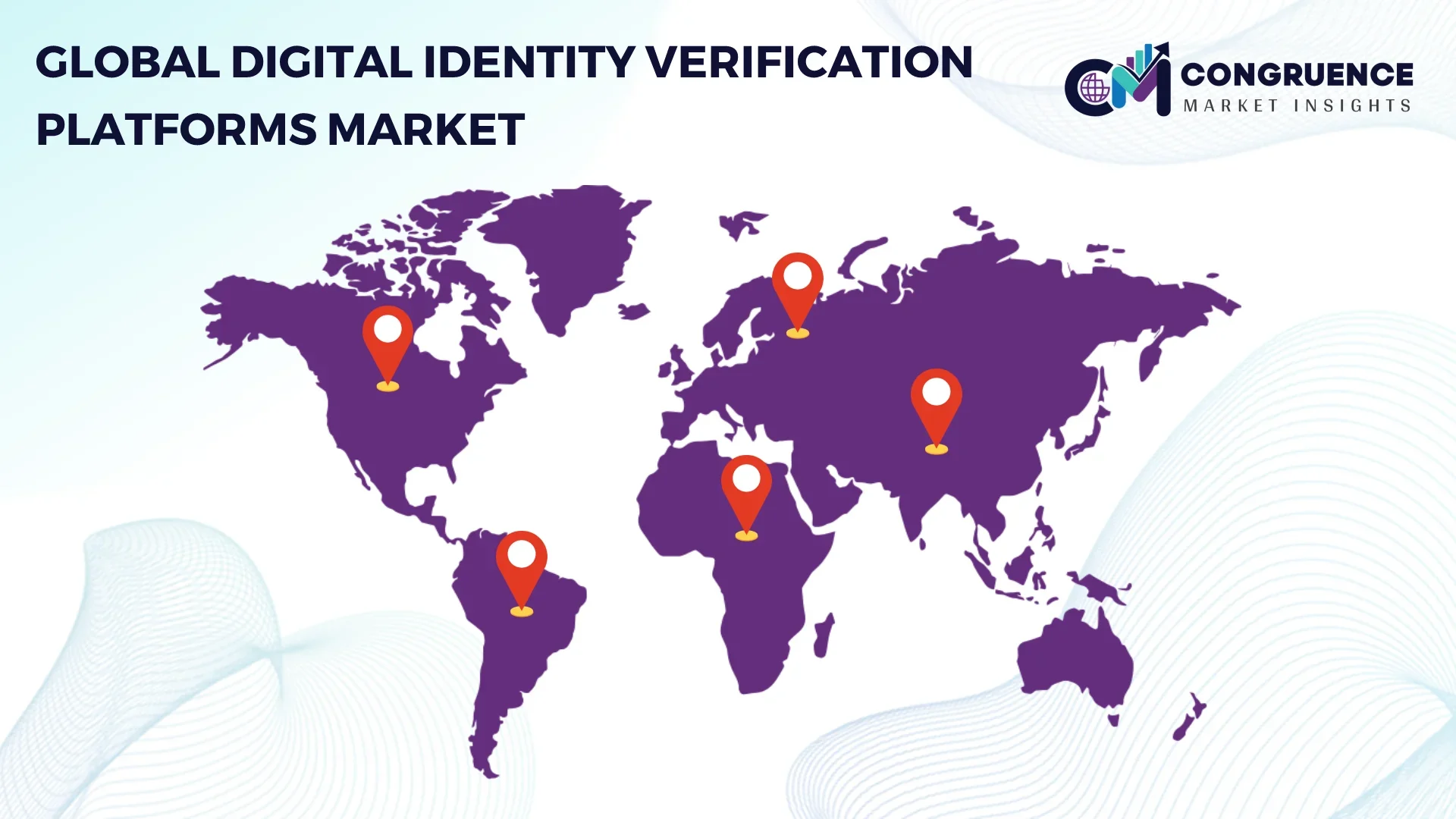
North America’s lead reflects deep digitalization of financial services, large-scale cloud adoption, and widespread biometric deployment across public and private systems. In 2025, more than 68% of U.S. banks used AI-based identity orchestration, while 120+ government programs piloted digital IDs. Europe followed with 25% share, driven by privacy-first frameworks and cross-border interoperability initiatives. Asia-Pacific held 22% share but generated the highest transaction volumes due to national digital ID ecosystems in India, China, and Singapore. South America contributed 6%, with Brazil dominating regional demand through fintech expansion, while the Middle East & Africa (MEA) held 5%, supported by smart-city programs and digital governance in the UAE and South Africa. Overall, identity verification adoption is accelerating as mobile commerce, remote services, and fraud risks rise across all regions.
North America represents roughly 42% of global adoption, making it the most advanced market for digital identity infrastructure. Banking, fintech, healthcare, and government remain the strongest demand engines, with more than 70% of large enterprises integrating biometric or AI-driven verification into onboarding workflows. Federal and state agencies have expanded digital ID pilots covering 120 million+ citizens, while private firms invest heavily in cloud-native identity stacks and zero-trust security models. Regulatory momentum around AML, data security, and consumer protection has accelerated deployment of real-time identity analytics, particularly in payments and lending. Technologically, the region leads in liveness detection, document forensics, and passkey-based authentication tied to secure device hardware. Local players such as ID.me are scaling government identity programs and secure login solutions across tax, healthcare, and benefits platforms. From a consumer behavior perspective, adoption is highest in healthcare and finance, where users expect frictionless but highly secure digital access.
Europe holds approximately 25% of the market, anchored by Germany, the UK, and France as leading adopters. Strong regulatory frameworks such as GDPR and upcoming EU Digital Identity Wallet standards have pushed organizations toward explainable, transparent, and consent-based verification models. Governments are rolling out interoperable digital credentials that can be reused across public and private services, reducing duplication and compliance costs. Financial institutions and telecom operators are major users, while travel and healthcare are emerging as fast adopters. European firms are prioritizing decentralized identity (DID), privacy-preserving cryptography, and minimal data-sharing approaches. Sustainability initiatives are also influencing cloud architecture choices, with providers targeting lower energy footprints in data centers. Local players such as Veridos (Germany) are advancing secure document and biometric solutions for national ID and border control systems. Consumers in Europe increasingly favor platforms that offer explainable AI and strict data control, shaping vendor strategies across the region.
Asia-Pacific is the fastest-growing region by volume, fueled by mass digitalization and smartphone penetration. India, China, and Japan are the top consuming countries, with India’s Aadhaar-linked ecosystem alone serving over 1.3 billion citizens for payments, welfare, and authentication. Governments across Southeast Asia are deploying national digital IDs, while super-app platforms integrate biometric login for millions of users daily. Cloud expansion, 5G rollout, and AI innovation hubs in Singapore, Shenzhen, and Bengaluru are accelerating product development in liveness detection and real-time fraud analytics. E-commerce and mobile payments dominate demand, with many platforms verifying millions of new users per month. Local players such as Singapore’s GovTech and India’s UIDAI-linked private vendors are advancing interoperable identity rails for both public and commercial use. Regional consumer behavior shows strong acceptance of biometric logins, with growth driven primarily by e-commerce and mobile AI applications.
South America accounts for roughly 6% of the market, with Brazil and Argentina as the primary demand centers. Brazil leads adoption due to rapid fintech expansion, instant payment systems, and government digital ID initiatives that link citizens to banking and social services. Regional infrastructure upgrades, including broadband expansion and cloud migration, are improving the scalability of verification platforms across urban and semi-urban areas. Governments are introducing incentives for digital inclusion and secure authentication to reduce welfare fraud and improve tax compliance. Local banks and neobanks are integrating biometric onboarding at scale, processing millions of verifications annually. Players such as Serpro (Brazil) support secure government identity systems and digital credential programs. Consumer behavior is closely tied to media, language localization, and mobile engagement, with rising demand for Spanish- and Portuguese-optimized identity solutions.
MEA holds around 5% share, with demand concentrated in UAE, Saudi Arabia, and South Africa. Smart-city projects, digital banking, and large-scale infrastructure developments in the Gulf are major drivers of identity platform adoption. Oil & gas, construction, and logistics sectors increasingly use digital credentials for secure workforce access and vendor verification. Governments are modernizing services through e-ID programs, mobile wallets, and cloud-based identity registries. Cross-border trade partnerships and regional digital frameworks are improving interoperability across Gulf Cooperation Council (GCC) states. Technological modernization includes biometric border systems, facial recognition in airports, and AI-driven fraud detection in fintech. A notable local initiative is UAE Pass, which enables secure digital identity access across government and private services. Consumers in the region favor mobile-first authentication with strong biometric features, especially for banking and public services.
United States – 36% Market Share: Strong enterprise demand across banking, healthcare, and government plus large-scale biometric deployment.
India – 14% Market Share: Nationwide digital ID ecosystem driving mass authentication for payments, welfare, and telecom.
The competitive environment in the Digital Identity Verification Platforms Market is marked by a mix of global incumbents, specialized innovators, and emerging challengers, resulting in a moderately fragmented competitive structure with both established and niche players vying for differentiated positioning. Over 100 competitors actively provide identity verification solutions worldwide, spanning biometric authentication, document verification, risk analytics, and reusable digital identity services. The top 5 companies collectively command approximately 38–45% of total market activity, reflecting a landscape where no single entity monopolizes demand but leaders maintain significant influence through technology, scale, and partnerships. Strategic initiatives such as platform integrations, expanded product suites, and ecosystem alliances are reshaping competition. For example, identity orchestration partnerships, reusable ID frameworks, and AI-driven anti-fraud capabilities are key differentiators influencing procurement decisions. Companies are investing heavily in integrations with payments networks, cloud ecosystems, and regulatory compliance tooling, increasing cross-platform relevance. Innovation trends include reusable verified credentials, advanced liveness detection, multi-modal biometrics, and ecosystem interoperability, which are redefining user experience, conversion rates, and fraud resilience. Competitive pressure is also driving enhanced customer support offerings, flexible deployment models, and localized verification solutions to serve regional compliance nuances. Overall, the market is highly dynamic, with rapid product evolution and collaboration across sectors such as finance, telecommunications, healthcare, and government services.
Jumio
Sumsub
Equifax
ID.me
Socure
IDnow
iProov
Persona
Clear
iDenfy
AuthID
AU10TIX
SecureKey
DocuSign (identity verification suite)
Experian ID Solutions
Veridos
Technological innovation continues to be the primary catalyst driving transformation in the Digital Identity Verification Platforms Market. Advanced biometric authentication technologies — including facial recognition, fingerprint scanning, iris detection, and behavioral biometrics — are becoming foundational due to their high assurance levels and usability in mobile-first environments. Dynamic liveness detection algorithms analyze hundreds of biometric cues to differentiate genuine users from synthetic attacks, helping reduce spoofing incidents in real-time interactions. AI and machine learning underpin risk scoring systems that evaluate patterns across devices, geolocation, and network signals, significantly enhancing fraud detection precision. Emerging reusable digital identity frameworks enable users to authenticate once and leverage verified credentials across multiple services, reducing onboarding friction and operational costs. Multi-factor and passwordless authentication systems integrate device-based passkeys, cryptographic attestations, and contextual risk signals to extend security beyond static credentials. Interoperability protocols such as W3C Verifiable Credentials and decentralized identifiers (DIDs) are shaping ecosystems that support cross-platform identity portability while preserving user privacy and consent. Cloud-native architectures and zero-trust models are increasingly adopted for scalable identity orchestration, enabling real-time verification workflows across global geographies and high-volume transaction environments. The convergence of identity verification with access management, fraud analytics, and compliance tooling is enabling holistic identity ecosystems, reflecting an evolution from point solutions to integrated trust platforms tailored for sectors like finance, healthcare, government services, and commerce.
• In October 2025, Trulioo unveiled significant enhancements to its identity platform, adding advanced biometric authentication, a “known faces” repeat-fraud flagging feature that reduced repeat fraud by 15% and cut manual reviews by 12%, and expanded non-ID document tamper-detection capabilities to safeguard verification workflows across enterprises. These updates aim to strengthen fraud defenses and streamline global compliance. Source: www.trulioo.com
• In September 2025, DocuSign partnered with CLEAR to integrate CLEAR’s biometric verification directly into the DocuSign digital agreements flow, enabling secure identity proofing via selfie authentication and risk-based verification tailored by risk profile, improving identity protection without compromising user experience for millions of agreement signers. Source: www.docusign.com
• In August 2025, Sumsub was named a Leader in the Gartner® Magic Quadrant™ for Identity Verification Solutions for the second consecutive year, reflecting expanded platform capabilities including next-generation case management tools, reusable digital identity features, and compliant Non-Doc Verification that can verify over 5 billion users in as little as 4.5 seconds. Source: www.prnewswire.com
• In November 2025, iProov became the first biometric vendor to demonstrate resilience against AI-generated deepfakes under the new NIST SP 800-63-4 digital identity guidelines, validating dynamic liveness and injection attack detection at high assurance levels compatible with U.S. federal standards, positioning it for widespread adoption in high-security government and enterprise use cases. Source: www.iproov.com
The scope of the Digital Identity Verification Platforms Market Report encompasses comprehensive analysis across technology types, application segments, end-user industries, and regional landscapes. The report examines core technology categories such as biometric authentication, document verification, behavioral analytics, reusable digital identity frameworks, and multi-factor authentication systems, detailing how each technology addresses specific use cases, risk profiles, and compliance requirements. Application coverage includes digital onboarding, fraud prevention, access management, regulatory compliance workflows, and identity lifecycle governance across sectors such as BFSI, healthcare, government, e-commerce, telecom, and travel. End-user segmentation identifies distinct adoption patterns among large enterprises, SMEs, digital-native firms, and regulated institutions, with insights into decision criteria, implementation challenges, and performance benchmarks. Geographic analysis spans North America, Europe, Asia-Pacific, South America, and Middle East & Africa, highlighting regional infrastructure trends, regulatory influences, and consumer behavior differences that shape market demand. The report also evaluates competitive dynamics by profiling major global players, strategic partnerships, product innovations, and market positioning. Additionally, it explores emerging segments such as decentralized identity, privacy-preserving authentication, interoperability standards, and reusable credential networks. Future-looking elements include technological innovation trajectories, integration with broader digital ecosystems, and enterprise priorities in secure and seamless identity verification solutions. The report is designed to support strategic planning, investment decisions, and technology roadmaps for decision-makers and industry professionals operating in or entering the digital identity landscape.
| Report Attribute / Metric | Details |
|---|---|
| Market Revenue (2025) | USD 1,378.0 Million |
| Market Revenue (2033) | USD 4,612.0 Million |
| CAGR (2026–2033) | 16.3% |
| Base Year | 2025 |
| Forecast Period | 2026–2033 |
| Historic Period | 2021–2025 |
| Segments Covered |
By Type
By Application
By End-User Insights
|
| Key Report Deliverables | Revenue Forecast, Market Trends, Growth Drivers & Restraints, Technology Insights, Segmentation Analysis, Regional Insights, Competitive Landscape, Regulatory & ESG Overview, Recent Developments |
| Regions Covered | North America; Europe; Asia-Pacific; South America; Middle East & Africa |
| Key Players Analyzed | Onfido; Trulioo; Okta; Jumio; Sumsub; Equifax; ID.me; Socure; IDnow; iProov; Persona; CLEAR; iDenfy; AuthID; AU10TIX; SecureKey; DocuSign (Identity); Experian ID Solutions; Veridos |
| Customization & Pricing | Available on Request (10% Customization Free) |




