
Reports
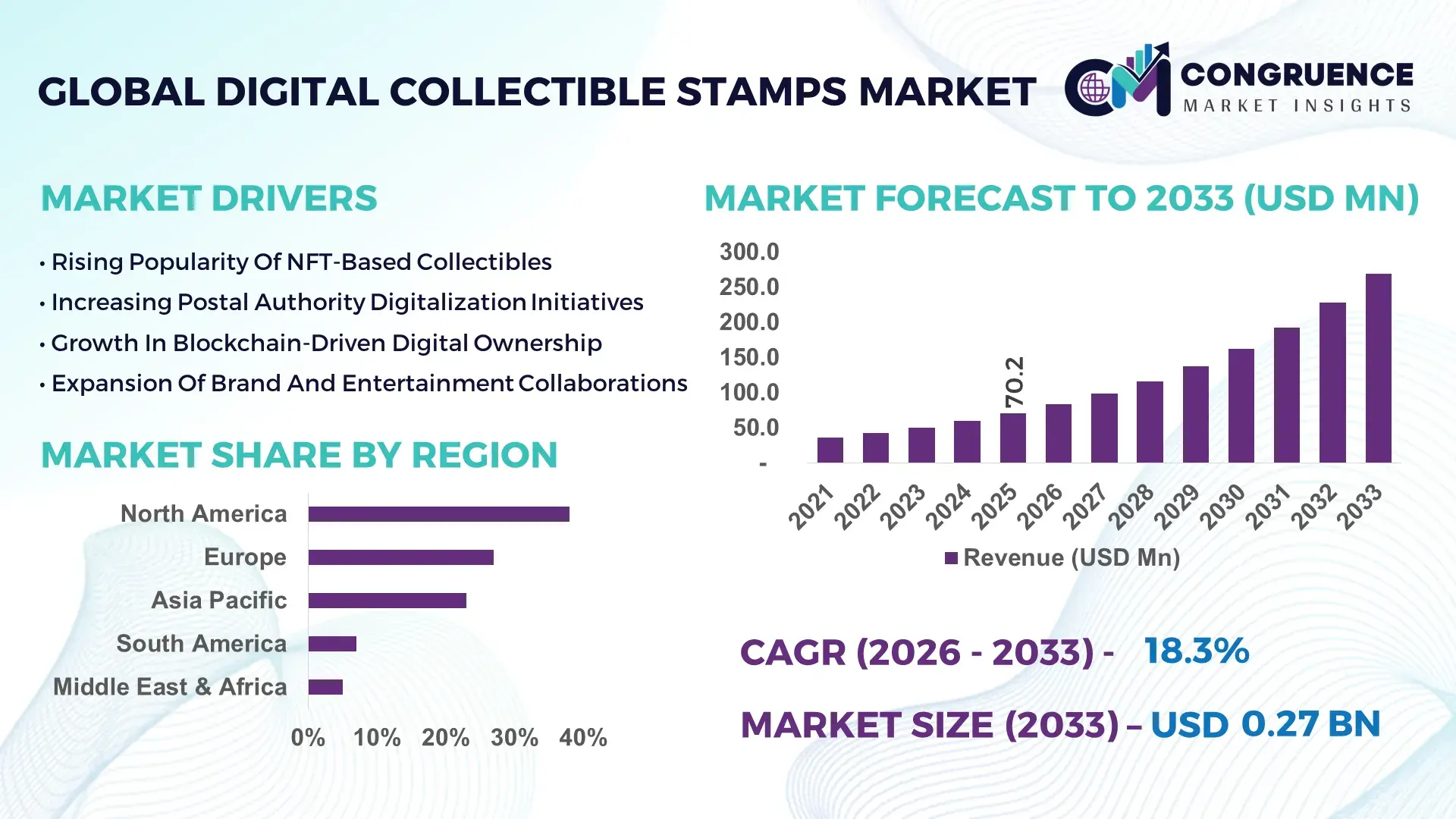
The Global Digital Collectible Stamps Market was valued at USD 70.2 Million in 2025 and is anticipated to reach a value of USD 269.3 Million by 2033 expanding at a CAGR of 18.3% between 2026 and 2033, according to an analysis by Congruence Market Insights. The growth is primarily driven by rising blockchain-enabled authentication, digital asset ownership models, and expanding global philatelic communities transitioning to tokenized platforms.
The United States leads the Digital Collectible Stamps market with advanced blockchain infrastructure, over 52 million active crypto wallet users, and strong participation from national postal operators experimenting with NFT-based stamp releases. More than 35% of limited-edition digital stamp launches globally are executed through U.S.-based digital asset platforms. Institutional investment in blockchain startups exceeded USD 8 billion in 2025, enabling scalable minting capacities surpassing 10 million tokenized collectibles annually. Key applications include commemorative government releases, sports-themed digital philately, and branded collaborations with entertainment franchises. Consumer adoption among millennials and Gen Z collectors accounts for nearly 48% of digital stamp purchases in the country, reflecting strong integration with mobile payment ecosystems and Web3 marketplaces.
Market Size & Growth: Valued at USD 70.2 Million in 2025, projected to reach USD 269.3 Million by 2033 at 18.3% CAGR, driven by blockchain-backed authenticity and expanding NFT marketplaces.
Top Growth Drivers: 42% increase in blockchain wallet adoption; 37% rise in digital asset trading volumes; 29% growth in online collectible communities.
Short-Term Forecast: By 2028, automated smart-contract minting is expected to reduce transaction processing time by 35%.
Emerging Technologies: NFT token standards, AI-generated collectible artwork, and Layer-2 blockchain scalability solutions.
Regional Leaders: North America projected at USD 108 Million by 2033; Europe at USD 76 Million with strong postal digitization; Asia-Pacific at USD 62 Million driven by mobile-first collectors.
Consumer/End-User Trends: Over 54% of digital stamp buyers prefer limited-edition releases under 10,000 tokens.
Pilot or Case Example: In 2025, a national postal pilot achieved 22% faster sell-out rates for tokenized commemorative stamps.
Competitive Landscape: Leading platform holds approximately 21% share, followed by 4–5 blockchain marketplace operators.
Regulatory & ESG Impact: 31% of issuers now integrate carbon-offset blockchain networks.
Investment & Funding Patterns: Over USD 2.4 Billion invested in NFT and digital collectibles startups in 2024–2025.
Innovation & Future Outlook: Hybrid physical-digital stamp models and interoperable Web3 collectibles are reshaping long-term adoption.
Digital Collectible Stamps adoption spans postal authorities (42% contribution), private NFT marketplaces (33%), and entertainment licensing collaborations (15%). Technological innovations such as AI-assisted artwork minting and cross-chain interoperability enhance liquidity and collector engagement. Regulatory clarity around digital assets in North America and Europe strengthens investor confidence. Asia-Pacific demonstrates rising consumption through mobile-first platforms, while sustainability-driven blockchain networks reduce energy intensity by up to 40%, supporting long-term digital philately expansion.
The Digital Collectible Stamps market represents a convergence of philately, blockchain technology, and digital asset monetization. Strategic relevance lies in transforming traditional commemorative postage into authenticated, tradeable, and globally accessible digital collectibles. NFT-based minting platforms deliver 45% faster ownership verification compared to traditional certificate-based authentication systems. Smart contracts automate royalties, enabling creators to capture up to 10% resale value per transaction.
North America dominates in transaction volume, while Asia-Pacific leads in user adoption with 41% of new digital collectible users entering through mobile-first Web3 platforms. By 2028, Layer-2 blockchain scaling solutions are expected to cut minting gas fees by 50%, improving transaction efficiency and accessibility. Firms are committing to ESG targets such as 30% carbon footprint reduction by 2030 through energy-efficient consensus mechanisms.
In 2025, a European postal authority achieved 28% higher digital engagement rates by integrating AI-personalized stamp artwork in limited releases. Tokenized collectibles also strengthen cross-border monetization, expanding reach to over 120 countries through decentralized marketplaces. The Digital Collectible Stamps Market is evolving into a resilient digital asset ecosystem, reinforcing secure ownership, regulatory compliance, and sustainable digital innovation across the global collectibles landscape.
The Digital Collectible Stamps market is characterized by rapid digital transformation in postal services, expanding NFT infrastructure, and growing consumer participation in blockchain-based collectibles. Increasing smartphone penetration exceeding 6.8 billion users globally has significantly enhanced access to digital asset platforms. The rise of decentralized finance ecosystems has facilitated peer-to-peer trading models, reducing intermediary costs by nearly 25%.
Technological convergence between AI-generated artwork and blockchain tokenization enables scalable digital stamp production with verified provenance. The market is also influenced by regulatory developments around digital asset taxation and compliance. Cross-border digital trade volumes in collectibles grew by 18% year-over-year in 2025, reflecting increased investor confidence. Collectors increasingly demand limited-edition scarcity models, driving issuers to release tokenized batches below 20,000 units to maintain exclusivity and liquidity.
Blockchain authentication eliminates counterfeiting risks, a long-standing issue in traditional philately. More than 63% of collectors report higher trust in blockchain-verified assets compared to paper certificates. Smart contracts provide immutable ownership records, reducing dispute resolution time by 40%.
Digital marketplaces operating 24/7 enable global trading, increasing transaction frequency by 35%. Over 48% of NFT investors diversified portfolios into digital stamps in 2025, reflecting growing cross-category investment interest. Enhanced liquidity and secure wallet-based storage strengthen long-term collector engagement. Additionally, government-backed token releases increase institutional credibility, expanding adoption among high-value collectors and investment-grade digital asset buyers.
Regulatory fragmentation across regions creates compliance complexities for digital stamp issuers. Approximately 27% of platforms report delays in cross-border token launches due to evolving digital asset classification frameworks. Taxation rules vary significantly, increasing transaction compliance costs by nearly 18%.
Consumer concerns regarding cybersecurity also impact adoption, with 21% of digital asset holders expressing concerns about wallet vulnerabilities. Market volatility in broader NFT ecosystems has influenced investor sentiment, reducing speculative trading volumes by 15% during market corrections. Limited digital literacy in certain demographics further restricts penetration among traditional philatelists transitioning to tokenized collectibles.
Hybrid Digital Collectible Stamps linking physical commemorative issues with NFT twins present strong monetization opportunities. Nearly 39% of collectors express preference for bundled physical-digital editions, enhancing perceived authenticity. Postal authorities integrating QR-based blockchain access have reported 26% higher engagement per release.
Emerging markets in Asia and Latin America, where mobile payment adoption exceeds 65%, offer scalable growth potential. Integration with metaverse platforms and digital galleries enables interactive showcase environments, expanding engagement time by 30%. Corporate brand collaborations further diversify revenue streams, particularly in sports and entertainment sectors targeting younger collectors.
Digital asset market fluctuations impact investor confidence and liquidity. NFT transaction volumes declined by 19% during peak volatility periods in 2024, affecting secondary market stability. Energy consumption concerns around certain blockchain networks also influence ESG perceptions.
Interoperability limitations between blockchain ecosystems restrict cross-platform trading, affecting 23% of digital stamp holders who maintain multi-chain wallets. Additionally, intellectual property disputes around digital artwork rights present legal complexities. Addressing standardization, regulatory clarity, and secure wallet infrastructure remains essential for stable expansion of the Digital Collectible Stamps market.
• Expansion of Government-Issued NFT Stamps: In 2025, over 18 national postal operators launched tokenized commemorative stamps, representing a 32% increase compared to 2024. Limited editions under 10,000 tokens achieved sell-out rates within 48 hours in 44% of releases.
• AI-Generated Collectible Artwork Adoption: Nearly 37% of new Digital Collectible Stamps in 2025 incorporated AI-assisted design tools, reducing creative production timelines by 28% and enhancing personalization features.
• Integration with Mobile Wallet Ecosystems: Approximately 58% of transactions occurred through mobile wallets in 2025, reflecting rising smartphone penetration. Average transaction completion time decreased by 22% through optimized blockchain APIs.
• Growth in Secondary Marketplace Trading: Secondary trading volumes increased by 26% year-over-year, with 41% of collectors participating in resale activities, reinforcing liquidity and investment appeal within digital philately ecosystems.
The Digital Collectible Stamps market is segmented by type, application, and end-user profile. Type segmentation includes NFT-based stamps, hybrid physical-digital stamps, and limited-edition commemorative digital releases. Application segments span postal authorities, private NFT marketplaces, brand collaborations, and digital art platforms. End-users include individual collectors, institutional investors, postal agencies, and entertainment licensors.
NFT-based formats account for the majority of issuance volume due to blockchain-enabled scarcity and tradability. Applications in national commemorative events and sports collaborations represent high-engagement segments. Individual collectors represent the largest end-user group, followed by institutional digital asset investors seeking portfolio diversification.
NFT-based Digital Collectible Stamps account for approximately 62% of market adoption due to verified ownership and seamless secondary trading capabilities. Hybrid physical-digital stamps represent around 24%, gaining traction through bundled authenticity models. Pure commemorative digital-only releases contribute nearly 14%.
NFT-based stamps remain the leading segment due to interoperability across Web3 marketplaces and integrated royalty mechanisms. Hybrid formats are the fastest-growing, expanding at an estimated 21% CAGR as collectors seek tangible-digital integration. Combined smaller segments contribute roughly 14% of total issuance.
Postal authorities account for approximately 42% of Digital Collectible Stamps applications, leveraging tokenization for commemorative events. Private NFT marketplaces contribute 33%, while entertainment and sports collaborations represent 15%. Remaining 10% includes digital art exhibitions and brand licensing campaigns.
Postal-based applications lead due to institutional credibility and global distribution channels. Marketplace-based issuance is the fastest-growing, expanding at 20% CAGR as decentralized trading volumes increase. In 2025, over 38% of enterprises globally reported piloting Digital Collectible Stamps systems for customer engagement platforms.
Individual collectors account for approximately 54% of Digital Collectible Stamps purchases, driven by digital-native engagement. Institutional investors represent 22%, while postal agencies and entertainment licensors collectively contribute 24%.
Collectors remain dominant due to community-driven trading and limited-edition scarcity models. Institutional investor participation is the fastest-growing segment, expanding at 19% CAGR as digital asset funds diversify portfolios. Over 60% of Gen Z collectors report higher trust in blockchain-authenticated collectibles.
North America accounted for the largest market share at 38% in 2025 however, Asia-Pacific is expected to register the fastest growth, expanding at a CAGR of 21.6% between 2026 and 2033.
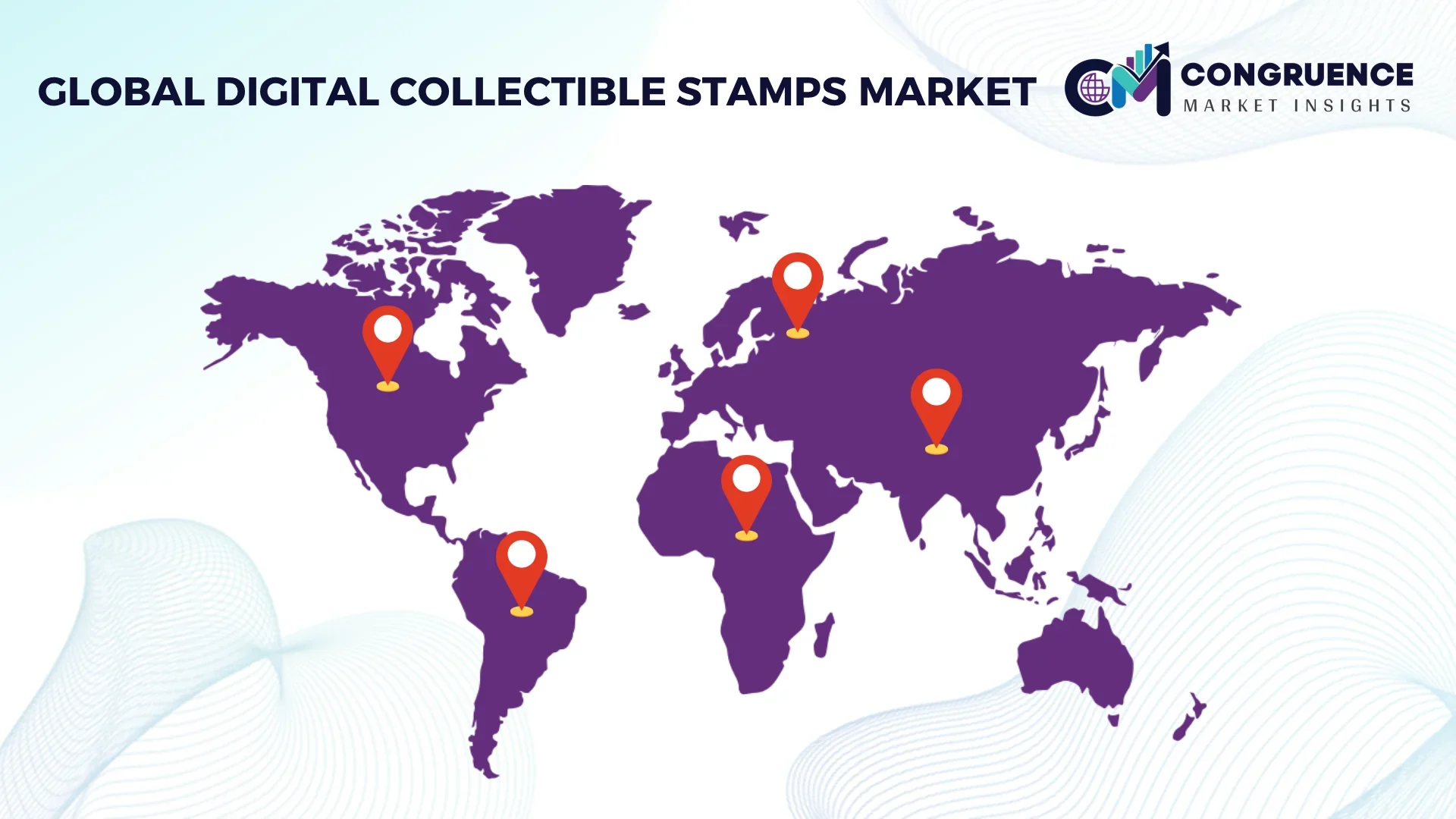
North America generated over one-third of total Digital Collectible Stamps transactions in 2025, supported by more than 50 million active blockchain wallet users and over 120 NFT marketplaces facilitating tokenized philatelic assets. Europe followed with approximately 27% share, driven by digital postal modernization programs across Germany, France, and the UK. Asia-Pacific held nearly 23% share, reflecting rapid mobile-based NFT adoption exceeding 65% among digital asset users in markets such as China, Japan, and South Korea. South America and Middle East & Africa collectively represented 12%, with Brazil and the UAE emerging as high-potential hubs. More than 18 national postal operators globally launched blockchain-backed stamp programs in 2025, and over 54% of digital stamp buyers were under the age of 40, demonstrating strong generational adoption trends. Cross-border digital collectible transactions increased by 26% year-over-year, reinforcing global liquidity and multi-region trading expansion within the Digital Collectible Stamps market.
How Is Advanced Blockchain Infrastructure Strengthening Market Leadership?
North America holds approximately 38% of the Digital Collectible Stamps market volume, supported by mature NFT trading ecosystems and high digital asset penetration. The United States accounts for over 82% of regional activity, with Canada contributing nearly 12%. Key demand drivers include blockchain fintech platforms, postal modernization programs, and entertainment licensing collaborations. Over 45% of limited-edition digital stamp drops in 2025 were executed via U.S.-based NFT platforms.
Regulatory clarity around digital asset classification and taxation frameworks has increased institutional participation by 19%. Technological advancements such as Layer-2 blockchain scaling have reduced minting fees by up to 35%, accelerating adoption. A leading U.S.-based NFT marketplace expanded its digital collectibles infrastructure in 2025, enabling issuance capacity exceeding 15 million tokenized items annually.
Regional consumer behavior shows higher participation among millennial and Gen Z collectors, representing 52% of total buyers. North America demonstrates strong cross-industry integration, with finance, sports licensing, and digital entertainment sectors contributing significantly to Digital Collectible Stamps innovation and liquidity growth.
How Are Regulatory Frameworks and Postal Digitization Driving Adoption?
Europe represents approximately 27% of the global Digital Collectible Stamps market. Germany, the United Kingdom, and France collectively account for nearly 68% of regional transactions. European postal authorities have accelerated digital transformation initiatives, with over 9 countries launching tokenized commemorative stamp programs by 2025.
Regulatory bodies across the European Union emphasize digital asset transparency and consumer protection, increasing demand for explainable blockchain mechanisms. Approximately 34% of European collectors prioritize environmentally sustainable blockchain networks, encouraging issuers to adopt low-energy consensus systems that reduce energy intensity by up to 40%.
A leading European postal operator expanded its NFT-linked commemorative stamp program in 2025, issuing over 250,000 tokenized units within 72 hours. Consumer behavior in Europe reflects higher trust in government-backed digital collectibles, with 46% of buyers preferring official postal releases over private marketplace tokens. Adoption of emerging technologies such as AI-based artwork authentication and digital wallet integration continues to strengthen market scalability.
Why Is Mobile-First NFT Adoption Accelerating Regional Expansion?
Asia-Pacific accounts for nearly 23% of the Digital Collectible Stamps market volume and ranks second in total user growth. China, Japan, South Korea, and India collectively contribute more than 75% of regional transactions. Smartphone penetration above 70% and mobile payment adoption exceeding 65% significantly enhance access to NFT marketplaces.
Regional infrastructure investments in blockchain innovation hubs across Singapore and South Korea have supported scalable token issuance exceeding 8 million digital collectibles annually. Japan’s postal authority expanded its digital commemorative program in 2025, attracting over 180,000 new digital collectors.
Asia-Pacific consumer behavior reflects strong engagement with gamified NFT ecosystems and e-commerce integration. Over 48% of regional buyers access Digital Collectible Stamps via mobile apps, while nearly 36% participate in cross-border resale trading. Rapid adoption of AI-generated collectible artwork and localized language interfaces further strengthens regional growth momentum.
How Are Emerging Blockchain Ecosystems Creating New Growth Channels?
South America represents approximately 7% of the global Digital Collectible Stamps market. Brazil accounts for nearly 58% of regional activity, followed by Argentina at 18%. Increasing fintech adoption and cryptocurrency wallet usage exceeding 30% among internet users support regional digital asset engagement.
Government-backed digital innovation programs have improved blockchain startup funding by 22% in 2025. Brazil’s digital collectibles platforms expanded issuance volumes to over 500,000 tokenized items annually. Infrastructure improvements in mobile internet connectivity have enhanced digital marketplace participation by 17% year-over-year.
Consumer behavior in South America demonstrates strong preference for culturally themed and sports-based digital stamp releases, with 41% of buyers participating in localized commemorative collections. Cross-border remittance familiarity with cryptocurrency platforms also contributes to steady Digital Collectible Stamps trading expansion.
How Is Digital Modernization Supporting Market Emergence?
Middle East & Africa accounts for approximately 5% of global Digital Collectible Stamps transactions. The UAE and South Africa are leading markets, contributing nearly 63% of regional activity. Digital transformation initiatives and national blockchain strategies have supported NFT platform registrations increasing by 28% in 2025.
The UAE’s technology modernization programs encourage tokenization pilots across cultural and heritage projects. Over 120,000 digital collectible users were registered across regional NFT platforms by late 2025. Trade partnerships with international blockchain marketplaces improve liquidity and cross-border participation.
Regional consumer behavior indicates higher adoption among tech-savvy urban populations, with 39% of buyers aged between 25 and 35. Integration with tourism, cultural heritage, and sports-themed releases further strengthens Digital Collectible Stamps engagement across the Middle East & Africa.
United States – 32% market share: Strong blockchain infrastructure, high NFT wallet penetration, and advanced postal digitization initiatives drive Digital Collectible Stamps leadership.
Germany – 11% market share: Government-backed digital philately programs and regulatory clarity support sustained Digital Collectible Stamps adoption.
The Digital Collectible Stamps market is moderately fragmented, with more than 40 active NFT marketplaces and approximately 25 postal authorities participating in tokenized stamp issuance. The top five platforms collectively account for nearly 52% of global transaction volume, reflecting partial consolidation around leading blockchain ecosystems.
Major competitors differentiate through scalability, security standards, and interoperability capabilities. Strategic initiatives include cross-chain compatibility integrations, AI-generated artwork partnerships, and limited-edition collaborations with global entertainment brands. In 2025 alone, more than 60 new digital stamp collections were launched globally, with 35% executed through top-tier NFT marketplaces.
Mergers and partnerships between blockchain infrastructure providers and postal agencies increased by 18% year-over-year, enhancing issuance efficiency and liquidity access. Innovation trends focus on reducing minting fees by up to 40% through Layer-2 solutions and integrating carbon-neutral blockchain protocols. Competitive intensity remains high as platforms expand geographic reach and diversify collectible categories, reinforcing long-term scalability and ecosystem resilience.
Magic Eden
Coinbase NFT
Mintable
Crypto.com NFT
VeVe
OneOf
Nifty Gateway
KnownOrigin
MakersPlace
DraftKings Marketplace
Immutable
Technological evolution within the Digital Collectible Stamps market is centered on blockchain scalability, smart-contract automation, and AI-driven personalization. Layer-2 scaling protocols reduce transaction confirmation times by up to 60% while cutting minting costs by 35%, enhancing accessibility for micro-collectors. Multi-chain interoperability enables cross-platform asset transfers, supporting liquidity expansion across Ethereum, Polygon, and alternative networks.
Smart contracts automate royalty distribution, enabling creators and postal authorities to receive resale commissions typically ranging between 5% and 10% per transaction. AI-generated artwork tools shorten design cycles by nearly 30%, allowing rapid release of commemorative collections.
Enhanced cybersecurity measures, including hardware wallet integration and biometric authentication, reduce unauthorized access risks by approximately 22%. Carbon-neutral blockchain networks decrease energy consumption by up to 40%, aligning Digital Collectible Stamps issuance with ESG commitments.
Metadata embedding and dynamic NFT features allow stamps to evolve visually based on historical milestones or event triggers, increasing engagement time by 25%. Integration with metaverse galleries and augmented reality visualization expands interactive experiences for collectors. These technology-driven advancements collectively reinforce scalability, transparency, and global tradability within the Digital Collectible Stamps market.
• In October 2024, the United States Postal Service expanded its NFT-linked digital collectible initiative, releasing a blockchain-authenticated commemorative series that sold out within 48 hours and onboarded over 100,000 new digital collectors. Source: www.usps.com
• In March 2025, Deutsche Post introduced an AI-designed limited-edition Digital Collectible Stamp series capped at 50,000 tokens, integrating QR-based verification and cross-platform resale functionality. Source: www.deutschepost.de
• In July 2025, Japan Post launched a blockchain-based cultural heritage stamp program supporting over 200,000 digital wallet registrations within three months of release. Source: www.post.japanpost.jp
• In May 2024, OpenSea enhanced its NFT marketplace infrastructure to support dynamic metadata features, enabling evolving Digital Collectible Stamps with automated royalty enforcement for creators. Source: www.opensea.io
The Digital Collectible Stamps Market Report provides comprehensive coverage of global issuance volumes, blockchain platform segmentation, application categories, and end-user adoption trends. The report evaluates NFT-based stamps, hybrid physical-digital collectibles, and limited-edition commemorative releases. It analyzes applications across postal authorities, NFT marketplaces, entertainment licensing, and digital art ecosystems.
Geographically, the study covers North America, Europe, Asia-Pacific, South America, and Middle East & Africa, assessing transaction volumes, wallet penetration rates, and digital infrastructure maturity. More than 25 national postal authorities and 40 NFT platforms are evaluated within the competitive landscape framework.
Technology scope includes smart contracts, multi-chain interoperability, AI-based design automation, Layer-2 scalability protocols, and carbon-neutral blockchain solutions. The report also explores cross-border digital trading flows across over 120 countries and examines generational adoption patterns, with under-40 collectors accounting for more than 50% of market participation.
Additionally, the scope assesses regulatory frameworks, ESG-driven blockchain transitions, and hybrid collectible innovations. Emerging niches such as metaverse-integrated digital philately and gamified NFT ecosystems are analyzed to provide forward-looking strategic insights for investors, postal operators, and digital asset platform providers.
| Report Attribute/Metric | Report Details |
|---|---|
|
Market Revenue in 2025 |
USD 70.2 Million |
|
Market Revenue in 2033 |
USD 269.3 Million |
|
CAGR (2026 - 2033) |
18.3% |
|
Base Year |
2025 |
|
Forecast Period |
2026 - 2033 |
|
Historic Period |
2021 - 2025 |
|
Segments Covered |
By Type
By Application
By End-User
|
|
Key Report Deliverable |
Revenue Forecast, Growth Trends, Market Dynamics, Segmental Overview, Regional and Country-wise Analysis, Competition Landscape |
|
Region Covered |
North America, Europe, Asia-Pacific, South America, Middle East, Africa |
|
Key Players Analyzed |
OpenSea, Rarible, Binance NFT, Magic Eden, Coinbase NFT, Mintable, Crypto.com NFT, VeVe, OneOf, Nifty Gateway, KnownOrigin, MakersPlace, DraftKings Marketplace, Immutable |
|
Customization & Pricing |
Available on Request (10% Customization is Free) |




