
Reports
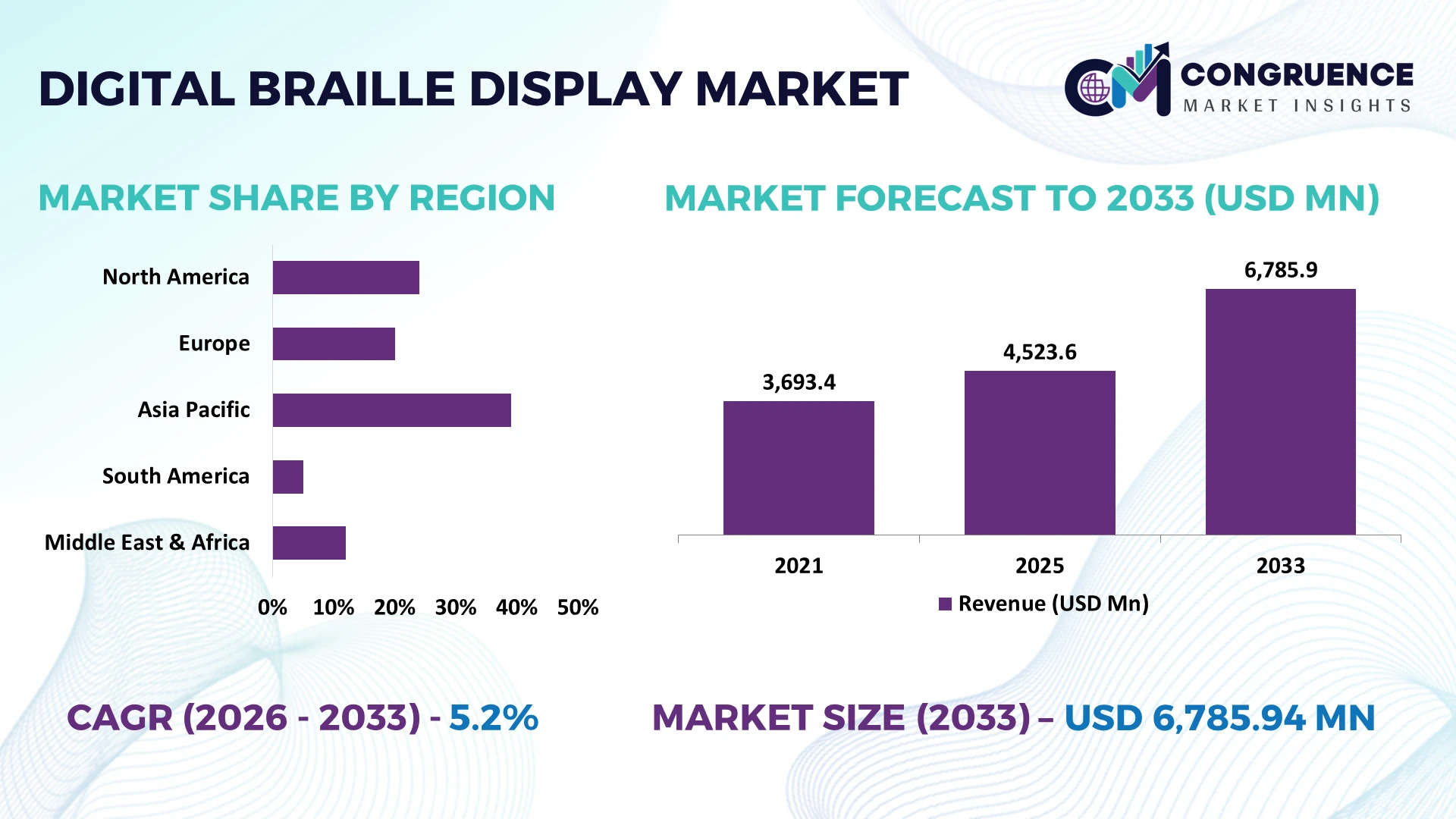
The Global Digital Braille Display Market was valued at USD 4523.6 Million in 2025 and is anticipated to reach a value of USD 6785.94 Million by 2033 expanding at a CAGR of 5.2% between 2026 and 2033. Multiline refreshable Braille, tactile-graphics integration, digital textbook conversion, screen-reader interoperability, and enforceable accessibility standards are moving Braille displays from single-line reading aids toward connected education and workplace platforms.
The United States represents an estimated 30–35% of global deployment, supported by federal special-education funding, institutional procurement and advanced assistive-technology development. New devices provide 10 lines × 32 Braille cells and 3,840 tactile pins, compared with conventional 20–40-cell single-line displays. Germany and the UK maintain strong accessibility adoption, while the U.S. leads commercialization as Europe implements the European Accessibility Act across a market serving more than 100 million people with disabilities.
Strategic implication: manufacturers should prioritize multiline tactile hardware, standardized digital content and screen-reader interoperability while building education and enterprise distribution partnerships in countries where accessibility mandates increasingly influence technology procurement.
Market Size & Growth: USD 4,523.6 million in 2025 reaches USD 6,785.94 million by 2033 at 5.2%, driven by multiline tactile computing and digital accessibility mandates.
Top Growth Drivers: Multiline displays provide 10× vertical reading capacity, 100% digital refreshability and substantially faster textbook availability than embossed Braille workflows.
Short-Term Forecast: By 2028, advanced digital-content workflows are positioned to reduce specialized educational-material preparation time by over 50%, improving classroom accessibility and device utilization.
Emerging Technologies: 3,840-pin tactile arrays, eBraille files and AI-assisted image conversion are transforming displays from text peripherals into interactive tactile-computing platforms.
Regional Leaders: Modeled 2033 values approach USD 2.3 billion for North America, USD 1.9 billion for Europe and USD 1.7 billion for Asia-Pacific, supported by education, regulation and digitization respectively.
Consumer/End-User Trends: Modern 10-line × 32-cell systems provide 320 simultaneous Braille cells versus typically 20–40 cells on conventional portable single-line devices.
Pilot/Case Example: Texas expanded Monarch deployment around a 3,840-pin platform capable of simultaneously presenting multiline Braille and tactile graphics for accessible classroom instruction.
Competitive Landscape: HumanWare, Freedom Scientific, HIMS, Help Tech and Orbit Research compete through cell density, portability, software compatibility and institutional accessibility ecosystems.
Regulatory & ESG Impact: The European Accessibility Act entered application in 2025, addressing accessibility across the EU’s 100 million-plus citizens with disabilities and strengthening assistive-technology procurement.
Investment & Funding: Advanced platforms consolidate 2,000+ downloadable tactile graphics alongside digital textbooks, shifting institutional investment from separate embossing resources toward reusable connected tactile infrastructure.
Innovation & Future Outlook: Over 1,000 Monarch units are already deployed, signaling commercialization of multiline Braille, tactile graphics, cloud access and standardized eBraille within unified devices.
Digital Braille Display demand is concentrating across inclusive education, workplace accessibility, STEM learning and digital publishing. Multiline devices now deliver 320 Braille cells simultaneously while supporting tactile graphics, cloud documents and screen-reader connectivity. The European Accessibility Act is reinforcing accessible digital ecosystems, while eBraille and dynamic tactile interfaces are reducing dependence on embossed materials and establishing the foundation for the market’s strategic technology transition.
Digital Braille displays are becoming strategically important as accessibility procurement shifts from static embossed materials toward connected tactile computing. The European Accessibility Act, effective from June 2025, strengthens digital-accessibility requirements across a population that includes more than 100 million people with disabilities. Education agencies, employers and technology vendors are therefore prioritizing interoperable Braille hardware that connects directly with digital textbooks, screen readers and cloud-based content.
Technology performance is also redefining competitive positioning. Conventional portable displays typically provide 20–40 Braille cells, while multiline systems deliver up to 320 cells and 3,840 tactile pins, increasing simultaneous readable content by more than 700% versus a 40-cell device. North America leads advanced classroom deployment, while Europe benefits from regulatory-led accessibility adoption and Asia-Pacific remains more price-sensitive. By 2028, institutional deployments should increasingly favor multiline devices, standardized eBraille content and automated tactile-graphics conversion.
A practical example is the Monarch platform, deployed across U.S. education systems for multiline Braille and tactile STEM graphics. Manufacturers are expanding partnerships with schools, accessibility agencies and publishers while investing in software compatibility and tactile-content libraries. Long-term leadership will depend on combining high-density tactile hardware with scalable digital-content ecosystems.
Accessibility regulation and digital education infrastructure are the strongest structural drivers for Digital Braille Display adoption. More than 100 million people in the European Union live with disabilities, while the European Accessibility Act began applying in 2025 across major digital products and services. In education, multiline displays provide up to 320 Braille cells versus 20–40 cells on conventional devices, increasing visible tactile information by more than 700%. This shift enables faster interaction with mathematics, coding and spatial content while reducing dependence on embossed documents. U.S. schools are expanding deployment of tactile-learning platforms, while European institutions are aligning procurement with accessibility standards. Manufacturers are responding through education partnerships, interoperable software, eBraille support and higher-density tactile hardware designed for institutional deployment.
High-density tactile hardware remains a structural constraint because refreshable Braille cells require precise electromechanical components, specialized assembly and long-term maintenance. A conventional 40-cell device contains only one reading line, while advanced multiline systems incorporate up to 3,840 tactile pins and 320 Braille cells, increasing component density by more than 700%. Repair requirements, limited specialist servicing and dependence on proprietary tactile-cell technologies raise lifecycle costs for schools and public agencies. In price-sensitive markets such as India, device affordability remains substantially weaker than in government-supported U.S. education programs, restricting broad classroom penetration. Manufacturers are responding by extending device lifecycles, modularizing components, localizing distribution and developing alternative actuator technologies. The strategic constraint is not demand; it is delivering high tactile density at an economically sustainable unit cost.
The strongest opportunity lies in transforming Braille displays from reading peripherals into multifunction tactile-computing platforms. Multiline systems with 320 Braille cells and 3,840 tactile pins support text, equations, charts and spatial graphics within one device, eliminating multiple specialized tools. Compared with a 40-cell single-line display, the accessible information area increases more than eightfold, improving classroom workflow and STEM accessibility. More than 1,000 advanced Monarch units have already entered educational deployment, signaling early institutional acceptance. AI-assisted image conversion and standardized eBraille publishing will further reduce manual content preparation between 2026 and 2028. Manufacturers are investing in tactile-graphics libraries, publisher partnerships and cloud connectivity. The non-obvious opportunity is software monetization and content integration surrounding hardware rather than relying solely on device replacement cycles.
Long-term execution depends on maintaining compatibility across operating systems, screen readers, digital textbooks and tactile-content standards. A modern multiline platform can render 320 Braille cells and thousands of tactile points, but its value falls sharply when applications cannot expose structured accessibility data. Conventional 20–40-cell displays operate through mature screen-reader protocols; multiline devices require richer spatial formatting, graphics interpretation and synchronized navigation. Educational institutions also need trained teachers and accessibility specialists, creating workforce constraints as deployment scales. In the United States, more than 1,000 advanced multiline devices are already in circulation, increasing pressure for consistent software updates and content interoperability. Vendors must invest in open standards, developer integrations, cybersecurity, educator training and publisher partnerships. Competitive durability will depend on ecosystem compatibility as much as tactile hardware performance.
Multiline Devices Enter Classroom Deployment: U.S. education programs are moving advanced tactile devices from pilots into routine instruction, with more than 1,000 Monarch units deployed and each system providing 320 Braille cells across 10 lines. Compared with 40-cell hardware, simultaneous tactile reading capacity increases eightfold. Vendors are expanding educator training, curriculum integration and institutional support to improve device utilization.
Tactile Graphics Become Digitally Accessible: New displays combine Braille with dynamic diagrams using arrays containing up to 3,840 tactile pins and access to libraries exceeding 2,000 graphics. Mathematics, maps and scientific diagrams can therefore move from separately embossed materials into reusable digital workflows. Manufacturers are integrating graphics libraries and automated conversion tools, reducing content-handling steps for specialist education teams.
Standardized eBraille Changes Publishing Workflows: The eBraille standard is shifting accessible publishing toward reflowable, digitally distributed Braille capable of supporting navigation and tactile graphics. One electronic file can replace multiple embossed volumes while supporting 20-, 40- and 320-cell configurations. Publishers and assistive-technology companies are restructuring content pipelines around device-independent files, improving distribution speed and reducing physical storage requirements.
Accessibility Compliance Reaches Procurement: The European Accessibility Act became applicable in June 2025 across a bloc where more than 100 million people have disabilities. Accessibility requirements now extend deeper into digital services, e-commerce and electronic content. Device suppliers are strengthening interoperability testing, documentation and software compatibility, while institutional buyers increasingly evaluate Braille hardware as part of broader digital-accessibility infrastructure rather than isolated assistive equipment.
Refreshable Displays lead the Digital Braille Display Market with an estimated 45–50% share, reflecting their established integration with computers, smartphones, screen readers and digital documents. Their electronically actuated cells eliminate repeated embossing and provide immediate access to changing content. Single-Line Displays remain the mature configuration because 20–40-cell formats balance portability, functionality and procurement cost, making them common among students and individual users. Portable Displays overlap strongly with this installed base, benefiting from Bluetooth connectivity, standalone note-taking and mobile-device integration.
Multi-Line Displays represent the fastest-growing type as education shifts toward spatially structured mathematics, tables and tactile graphics. Advanced platforms provide 320 Braille cells across 10 lines and 3,840 tactile pins, delivering eight times the simultaneous text capacity of a 40-cell display. Manufacturers are consequently redirecting product development toward high-density tactile arrays, graphics rendering and eBraille interoperability while maintaining compact refreshable products for price-sensitive users. Investment priorities are moving from cell-count competition toward complete tactile-computing ecosystems.
Education represents the leading application with an estimated 40–45% share, supported by specialized schools, inclusive classrooms, disability-support programs and requirements for accessible mathematics and literacy materials. Digital displays enable students to access changing text immediately rather than waiting for embossed documents. A 320-cell multiline device provides eight times the simultaneous reading area of a conventional 40-cell unit, materially improving navigation through equations, tables and structured educational content. Digital Reading remains another established application as eBraille expands access to reflowable books and documents.
Computer Access is emerging as the fastest-growing application as screen-reader interoperability, USB connectivity and Bluetooth increasingly connect Braille interfaces with mainstream computing environments. Workplace Accessibility benefits from the same integration as employers digitize accessibility infrastructure, while Assistive Communication supports users requiring tactile interaction with connected information systems. Manufacturers are expanding software compatibility, cloud connectivity and device-independent content support. Competitive positioning increasingly depends on supporting education and mainstream computing through the same hardware architecture rather than maintaining application-specific devices.
Educational Institutions lead end-user demand with an estimated 45–50% share because schools require structured Braille literacy, mathematics, STEM and tactile-graphics resources alongside specialist teaching support. Institutional procurement also supports higher-specification equipment that remains expensive for individual buyers. Multiline platforms offering 320 cells and 3,840 tactile pins increasingly consolidate functions previously handled by separate Braille displays and tactile-graphics materials. Individuals remain an important established group, particularly for portable 20–40-cell displays used with smartphones and computers, while Libraries extend accessible digital-reading infrastructure.
Corporate Offices represent the fastest-growing end-user segment as accessibility compliance and inclusive digital workplaces increase demand for screen-reader-compatible Braille interfaces. Government Agencies also influence procurement through disability services and accessibility programs. Manufacturers are responding with institutional training, extended support contracts and enterprise software compatibility, while Libraries receive content-oriented solutions. Competitive investment is shifting toward ecosystems that serve institutional deployments and individual mobility requirements through shared software, standardized files and interoperable hardware.
North America accounted for the largest market share at 34.2% in 2025 however, Asia-Pacific is expected to register the fastest growth, expanding at a CAGR of 7.1% between 2026 and 2033.
Multiline Tactile Computing Moves Into Classrooms
North America accounts for approximately 34.2% of Digital Braille Display demand, supported by structured special-education procurement, established assistive-technology distribution and advanced accessible-content infrastructure. The region is shifting beyond conventional 20–40-cell refreshable displays toward multiline tactile platforms supporting mathematics, graphics and spatial learning. The Monarch platform provides 320 Braille cells through 3,840 tactile pins, creating eight times the simultaneous reading area of a conventional 40-cell display. More than 1,000 devices have entered deployment, indicating movement from technology validation toward institutional use. U.S. education agencies, specialist schools and accessibility organizations are integrating digital textbooks and tactile graphics into common workflows. Manufacturers are responding through educator training, content partnerships, firmware development and stronger screen-reader interoperability, making software ecosystems increasingly important alongside tactile hardware.
United States Market Outlook: The United States leads through federal accessibility requirements, specialist educational infrastructure and collaboration among technology developers, schools and accessibility organizations. APH-supported deployment is accelerating multiline Braille adoption, while standardized digital content reduces dependence on physical embossing. Procurement increasingly favors platforms supporting Braille literacy, mathematics, tactile graphics and mainstream computing within one connected device.
Accessibility Regulation Reshapes Technology Procurement
Europe represents approximately 28–30% of global Digital Braille Display activity, supported by mature disability services, public education systems and established assistive-technology manufacturers in Germany and neighboring markets. The European Accessibility Act became applicable in June 2025, extending accessibility obligations across digital services, electronic commerce and technology ecosystems serving more than 100 million Europeans with disabilities. This regulatory shift is strengthening demand for interoperable Braille devices capable of working with mainstream operating systems, screen readers and accessible electronic publications. Germany contributes manufacturing expertise through established Braille hardware specialists, while France, the UK and Nordic countries maintain institutional accessibility programs. Procurement is consequently moving from standalone hardware specifications toward lifecycle considerations covering software compatibility, updates and accessible content. Suppliers are expanding multilingual firmware, USB/Bluetooth interoperability and support services to address increasingly standardized digital-accessibility requirements.
Germany Market Outlook: Germany combines strong assistive-device engineering with structured disability-support systems and established specialist manufacturers. Its technology base supports 20-, 40- and higher-cell refreshable configurations for education and professional use. Accessibility implementation increasingly rewards durable hardware, multilingual software and reliable integration with Windows, Android and iOS environments, strengthening Germany's role in premium professional Braille technology.
Scale Meets Affordable Assistive Technology
Asia-Pacific holds approximately 22–24% of market demand but presents the broadest untapped user base, particularly across China, India, Japan, South Korea and Australia. Deployment varies sharply: Japan and Australia maintain developed accessibility ecosystems, while India and parts of Southeast Asia remain constrained by device affordability and specialist support availability. India has more than 5 million people with visual disabilities under official census classifications, creating substantial potential for lower-cost refreshable technology. Regional electronics manufacturing provides an additional advantage for component localization, compact hardware and alternative tactile-actuator development. Vendors are increasingly targeting portable displays, smartphone interoperability and multilingual Braille support instead of relying exclusively on premium institutional devices. Partnerships with educational organizations and accessibility programs are becoming critical for expanding deployment while keeping training and maintenance requirements manageable.
India Market Outlook: India combines a substantial visually impaired population with rapidly digitizing education and public services. Smartphone-led accessibility creates a practical route for portable Bluetooth Braille displays, particularly where dedicated computing equipment remains expensive. Domestic manufacturing initiatives and institutional procurement can reduce import dependence, making affordable refreshable cells and localized language support decisive competitive priorities.
Inclusive Education Drives Institutional Procurement
South America represents approximately 6–8% of Digital Braille Display activity, with Brazil providing the region's largest accessible-technology user base and institutional procurement opportunity. Brazil's 2022 Census identified approximately 7.3 million people aged two or older with difficulty seeing even when using corrective aids, highlighting the scale of accessibility requirements. Public education, universities, libraries and disability-support organizations remain important deployment channels, while imported hardware costs constrain broader individual ownership. Spanish- and Portuguese-language software compatibility is therefore essential for regional expansion. Digital education initiatives are creating opportunities to replace portions of embossed Braille workflows with reusable electronic content, although maintenance infrastructure and specialist training remain uneven outside major urban centers. Suppliers are addressing these limitations through local distributors, education partnerships, portable product portfolios and remote technical support rather than capital-intensive direct distribution.
Brazil Market Outlook: Brazil offers the strongest institutional scale through its large population, federal accessibility framework and extensive education system. Digital inclusion programs provide a foundation for connected Braille technology, while universities and specialist institutions support deployment expertise. Vendors prioritizing Portuguese localization, affordable portable hardware and reliable domestic servicing are positioned more effectively than premium-only import strategies.
Digital Inclusion Expands Accessibility Infrastructure
Middle East & Africa represents approximately 5–7% of Digital Braille Display demand, with deployment concentrated in the UAE, Saudi Arabia, South Africa and selected education initiatives elsewhere. Gulf countries are integrating accessibility into broader digital-government and smart-service modernization, creating stronger institutional demand for connected assistive technologies. Saudi Arabia's digital transformation has pushed electronic government-service availability above 90%, increasing the importance of accessible interfaces for visually impaired users. The UAE combines advanced digital infrastructure with inclusive-education initiatives, while South Africa provides a comparatively mature disability-services ecosystem. Across lower-income African markets, device cost, limited specialist maintenance and inconsistent accessible-content availability remain significant deployment constraints. Suppliers are consequently emphasizing institutional partnerships, portable hardware, training programs and cloud-connected content rather than depending on individual purchasing power.
United Arab Emirates Market Outlook: The UAE provides a strategically attractive deployment environment through digitally advanced government services, high connectivity and accessibility-focused public infrastructure. Inclusive education and smart-government initiatives support demand for screen-reader-compatible Braille hardware. Suppliers can differentiate through Arabic Braille support, institutional training and integration with mobile and cloud-based services rather than competing solely on device specifications.
HumanWare, Freedom Scientific, HIMS, Help Tech and Orbit Research compete across premium, portable and institutional Digital Braille Display categories, with technology specialists challenging cost-focused suppliers through multiline interfaces, tactile graphics and software ecosystems. The top five players hold an estimated 55–60% combined share, reflecting specialized intellectual property and distribution requirements. HumanWare differentiates through multiline technology delivering 320 Braille cells, while conventional devices typically offer 20–40 cells, creating up to 700% greater simultaneous reading capacity. Portable suppliers compete through pricing, Bluetooth integration and lighter hardware, where optimized designs can reduce device weight by 20–40%. Companies increasingly partner with schools, accessibility agencies, publishers and software developers while integrating digital-content libraries and standardized eBraille. Competition is shifting from standalone cell counts toward complete tactile-computing ecosystems. Precision actuator manufacturing, specialist servicing and screen-reader interoperability remain formidable entry barriers. Winning requires reliable hardware, affordable lifecycle economics, accessible content integration and sustained institutional partnerships globally.
HumanWare
Freedom Scientific
HIMS Inc.
Help Tech GmbH
Orbit Research
Harpo
Handy Tech Elektronik GmbH
Nippon Telesoft Co., Ltd.
KGS Corporation
Metec AG
Eurobraille
Dot Inc.
VisioBraille GmbH
American Printing House for the Blind
Current digital Braille technology centers on refreshable piezoelectric cells, Bluetooth connectivity, screen-reader integration, and portable computing. Modern 40-cell displays connect across Windows, macOS, iOS, Android, ChromeOS, and Linux, while multiline platforms provide 320 cells. Compared with legacy 40-cell single-line hardware, 320-cell surfaces deliver 700% more simultaneous Braille capacity, improving navigation through tables, mathematics, and structured documents while reducing repetitive panning.
Emerging systems combine dynamic tactile graphics, cloud storage, eBraille, wireless terminal modes, and software-defined content workflows. Displays with 3,840 tactile pins can integrate text and graphics on one surface, while eBraille reflows across 20-cell, 40-cell, single-line, and multiline devices. Digital tactile workflows can eliminate two to three months of textbook delivery delay, strengthening education-sector efficiency and giving vendors with interoperable content ecosystems a procurement advantage.
Disruptive development is shifting toward multimodal tactile computers combining Braille, graphics, speech, audio, touch, and online services. Developer SDKs are opening tactile hardware to third-party applications, while AI-assisted graphics conversion should further automate accessible-content creation. From 2026–2028, institutional adoption will increasingly favor cloud-connected, upgradeable platforms supporting multiple screen readers and standardized files. Manufacturers investing now gain stronger software ecosystems, faster content deployment, broader education partnerships, and lower dependence on durable hardware-only product differentiation globally.
September 2024 — American Printing House for the Blind officially released Monarch, developed with HumanWare and NFB, featuring 10×32 Braille cells and 3,840 tactile pins. Digital textbooks can eliminate two-to-three-month delivery delays, transforming accessible classroom workflows. Source: aph.org
September 2025 — HumanWare released Monarch firmware 1.3 with native multiline JAWS compatibility developed alongside Vispero. Its 10-line interface enables spatial navigation through tables and spreadsheets, replacing single-line workflows and strengthening professional computer accessibility alongside classroom deployment. Source: humanware.com
August 2025 — DAISY Consortium released eBraille 1.0, establishing a reflowable standard supporting 20-cell, 40-cell, single-line and multiline displays. Integrated tactile graphics and structured navigation improve content portability, reducing device-specific formatting barriers for publishers, libraries and educational institutions. Source: daisy.org
March 2026 — Orbit Research introduced Strata and Flow device families at CSUN, adding its first piezo-based products alongside established Tactuator technology. Strata spans 20-cell and 40-cell multimodal systems, expanding choice across portable Braille, speech, audio and online-service workflows.
The Digital Braille Display Market report evaluates Single-Line Displays, Multi-Line Displays, Portable Displays and Refreshable Displays across Education, Workplace Accessibility, Digital Reading, Computer Access and Assistive Communication. End-user coverage includes Educational Institutions, Libraries, Government Agencies, Corporate Offices and Individuals. The assessment tracks the transition from conventional 20–40-cell devices toward multiline platforms delivering up to 320 Braille cells and 3,840 tactile pins.
Geographic analysis covers North America, Europe, Asia-Pacific, South America, and Middle East & Africa, alongside country-level accessibility infrastructure and procurement patterns. Technology coverage includes piezoelectric and alternative actuators, dynamic tactile graphics, eBraille, Bluetooth, cloud connectivity, screen-reader interoperability and multimodal computing. The 2026–2033 framework evaluates institutional deployment, affordable portable devices, digital-content ecosystems and accessibility regulation, supporting investment planning, geographic expansion, product development, partnership selection and long-term competitive positioning.
| Report Attribute/Metric | Report Details |
|---|---|
Market Revenue in 2025 | USD 4523.6 Million |
Market Revenue in 2033 | USD 6785.94 Million |
CAGR (2026 - 2033) | 5.2% |
Base Year | 2025 |
Forecast Period | 2026 - 2033 |
Historic Period | 2021 - 2025 |
Segments Covered | By Type
By Application
By End-User
|
Key Report Deliverable | Revenue Forecast, Growth Trends, Market Dynamics, Segmental Overview, Regional and Country-wise Analysis, Competition Landscape |
Region Covered | North America, Europe, Asia-Pacific, South America, Middle East, Africa |
Key Players Analyzed | HumanWare, Freedom Scientific, HIMS Inc., Help Tech GmbH, Orbit Research, Harpo, Handy Tech Elektronik GmbH, Nippon Telesoft Co., Ltd., KGS Corporation, Metec AG, Eurobraille, Dot Inc., VisioBraille GmbH, American Printing House for the Blind |
Customization & Pricing | Available on Request (10% Customization is Free) |




