
Reports
The Global Difluprednate Eye Drops Market was valued at USD 320.1 Million in 2025 and is anticipated to reach a value of USD 514.1 Million by 2033 expanding at a CAGR of 6.1% between 2026 and 2033. Increasing cataract surgeries, expanding ophthalmic care infrastructure, and wider adoption of potent postoperative anti-inflammatory therapies are strengthening demand for difluprednate eye drops.
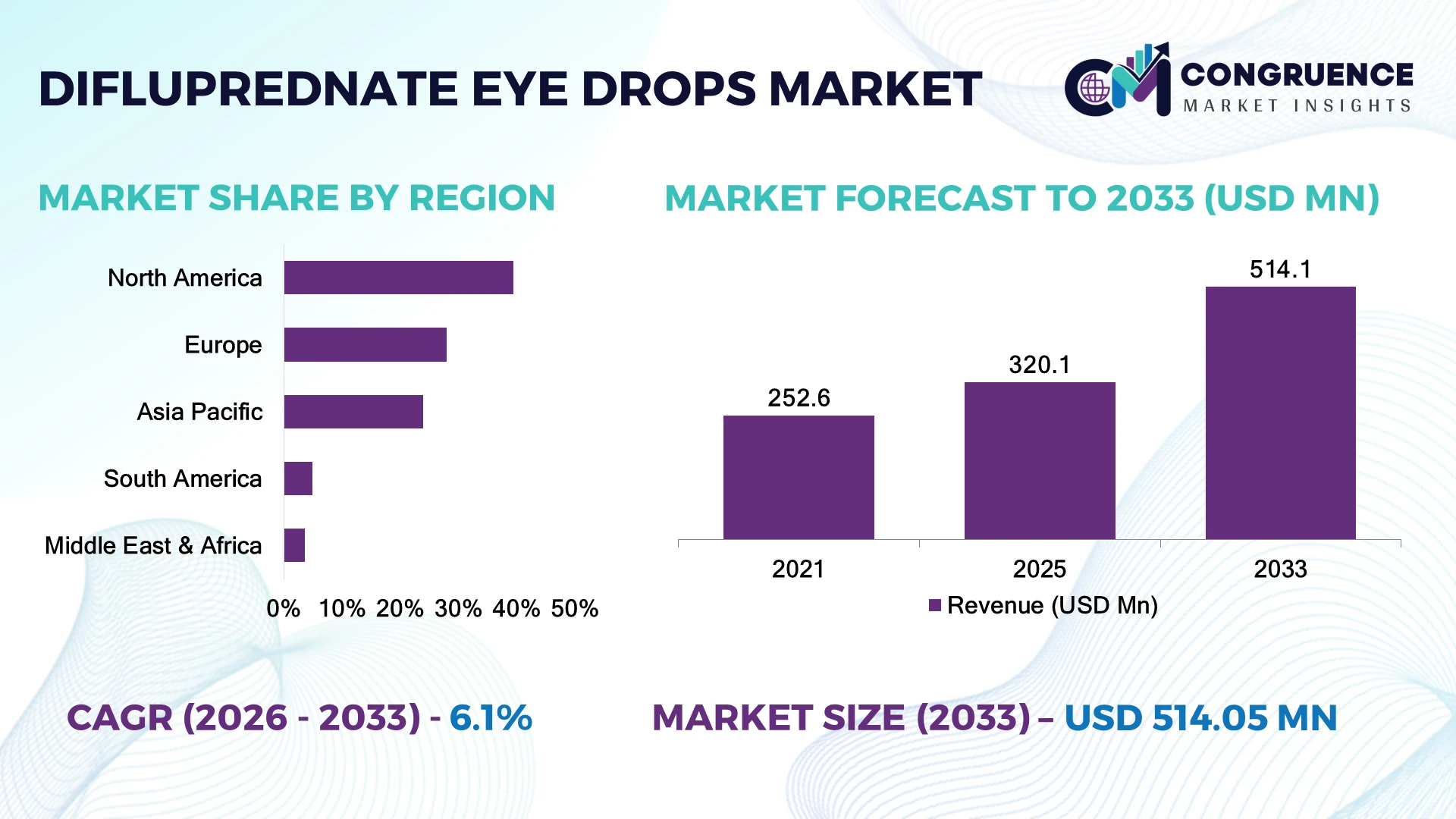
The United States dominates the global market with approximately 41% share, supported by more than 4.8 million ophthalmic surgical procedures performed annually, advanced ambulatory surgical centers, and strong adoption of branded and generic corticosteroid therapies. Japan records higher utilization in aging-related ophthalmic care, while India is rapidly expanding generic ophthalmic manufacturing capacity. Ongoing pharmaceutical supply-chain diversification following geopolitical disruptions has encouraged regional production investments and strengthened product availability across major healthcare markets.
Companies securing ophthalmology-focused distribution, regulatory compliance, and reliable sterile manufacturing capacity will strengthen long-term competitive positioning.
Market Size & Growth: USD 320.1 Million in 2025, projected to reach USD 514.1 Million by 2033 at 6.1% CAGR, driven by rising ophthalmic surgeries.
Top Growth Drivers: Cataract surgeries +32%, aging population +27%, ophthalmology clinic expansion +21%.
Short-Term Forecast: By 2028, sterile manufacturing efficiency improves 18% through automated filling technologies.
Emerging Technologies: Preservative-free formulations, advanced suspension systems, AI-assisted quality inspection.
Regional Leaders: North America exceeds USD 180 Million, Asia-Pacific approaches USD 145 Million, Europe surpasses USD 110 Million with expanding ophthalmic care.
Consumer/End-User Trends: Approximately 69% of postoperative ophthalmologists prefer potent topical corticosteroids for inflammation management.
Pilot/Case Example: A 2026 ophthalmic care program reduced postoperative inflammation management time by 16% through standardized treatment protocols.
Competitive Landscape: Top companies control nearly 57% market share, led by Novartis, Ajanta Pharma, Sun Pharmaceutical, Lupin, and Amneal Pharmaceuticals.
Regulatory & ESG Impact: Sterile manufacturing upgrades reduce production deviations by approximately 22%.
Investment & Funding: More than USD 520 Million supports ophthalmic manufacturing expansion and sterile production modernization.
Innovation & Future Outlook: Sustained-release delivery and preservative-free ophthalmic formulations are reshaping competitive differentiation.
The difluprednate eye drops market is increasingly influenced by cataract surgery volumes, postoperative inflammation management, and expanding specialty ophthalmology services. Nearly 64% of newly approved ophthalmic manufacturing investments emphasize sterile production and quality automation. Growing availability of generic formulations and improved sterile manufacturing capabilities are strengthening global access while setting the foundation for the market's strategic evolution.
The difluprednate eye drops market has become strategically important as healthcare systems expand ophthalmic surgical capacity while improving postoperative treatment outcomes. Rising cataract procedures, regulatory support for generic ophthalmic medicines, and modernization of sterile pharmaceutical manufacturing are intensifying competition among established ophthalmic companies. Manufacturers are increasingly investing in localized production and supply-chain resilience to ensure uninterrupted availability of critical ophthalmic therapies.
Advanced preservative-free formulations demonstrate approximately 17% better ocular tolerability than conventional preserved ophthalmic suspensions while automated aseptic manufacturing reduces batch deviations by nearly 20%. North America maintains leadership through advanced ophthalmology infrastructure and high surgical volumes, whereas Asia-Pacific is expanding manufacturing capabilities and improving access through cost-efficient generic production. During the next two to three years, automated sterile manufacturing, digital quality monitoring, and formulation optimization are expected to enhance manufacturing consistency and product availability.
Manufacturers are strengthening partnerships with hospital networks, ophthalmology clinics, and regional pharmaceutical distributors while expanding sterile production facilities. A practical example includes dedicated ophthalmic manufacturing lines designed to improve supply reliability and reduce production lead times. Companies combining regulatory excellence, sterile manufacturing capability, and strong ophthalmology distribution networks will establish durable competitive advantages in the evolving global difluprednate eye drops market.
Increasing cataract and anterior segment surgeries remain the primary growth driver for difluprednate eye drops, as effective postoperative inflammation control directly influences visual recovery. Nearly 58% of ophthalmic corticosteroid prescriptions are associated with cataract-related procedures, while postoperative anti-inflammatory protocols have improved patient recovery consistency by approximately 21%. The United States continues expanding ambulatory ophthalmic surgery centers, supported by broader reimbursement for outpatient procedures and increasing adoption of premium intraocular lenses. Higher surgical volumes are encouraging pharmaceutical companies to expand sterile ophthalmic manufacturing, strengthen hospital supply agreements, and invest in preservative-free formulations. Companies securing consistent product availability and ophthalmology-focused distribution networks are gaining a strategic advantage in high-volume surgical markets.
Difluprednate eye drops require stringent aseptic manufacturing, suspension stability control, and regulatory validation, increasing production costs and limiting manufacturing flexibility. Sterile production accounts for nearly 44% of overall manufacturing expenses, while quality deviations can increase batch rejection rates by approximately 9%. India and other major generic manufacturing hubs continue facing tighter global regulatory inspections, extending qualification timelines for ophthalmic facilities. These operational pressures affect production scalability, inventory planning, and export reliability. Manufacturers are responding by modernizing sterile filling lines, implementing automated visual inspection systems, establishing regional production facilities, and strengthening long-term sourcing contracts for pharmaceutical-grade raw materials to improve supply continuity.
Growing demand for preservative-free ophthalmic therapies presents a significant opportunity as physicians increasingly prioritize ocular surface safety and patient comfort following surgery. Approximately 36% of newly launched ophthalmic formulations now emphasize preservative-free technologies, while advanced multidose delivery systems reduce contamination risk by nearly 24%. Japan continues encouraging innovation in ophthalmic drug delivery technologies, supporting next-generation sterile packaging solutions. Pharmaceutical companies are investing in advanced formulation research, expanding ophthalmology partnerships, and developing differentiated postoperative treatment portfolios. An emerging opportunity lies in combining preservative-free difluprednate formulations with smart packaging technologies that improve dosing accuracy and patient adherence across ambulatory care settings.
Expanding global commercialization requires manufacturers to satisfy diverse regulatory standards governing sterile ophthalmic medicines, manufacturing validation, and product stability. Nearly 31% of ophthalmic product launches experience extended regulatory review or facility qualification requirements before commercial supply. Maintaining suspension uniformity, sterility assurance, and long-term product stability across multiple markets increases operational complexity. Companies must continuously invest in automated aseptic processing, digital batch monitoring, analytical quality systems, and regulatory compliance capabilities while strengthening technical collaboration with contract manufacturing partners. Organizations capable of consistently meeting global quality expectations without disrupting supply will establish stronger long-term competitive positioning.
Preservative-Free Product Expansion Preservative-free ophthalmic formulations now account for approximately 34% of new product development programs, improving patient comfort and reducing ocular surface irritation by nearly 18%. Growing physician preference is accelerating portfolio expansion. Manufacturers are investing in advanced multidose packaging, sterile filling automation, and differentiated postoperative treatment solutions.
Generic Portfolio Diversification Generic ophthalmic manufacturers have increased product registrations by approximately 27%, improving treatment accessibility while strengthening regional supply resilience. Expiring product exclusivity and healthcare cost optimization continue supporting this transition. Companies are expanding sterile production facilities, strengthening distribution partnerships, and improving manufacturing efficiency to meet rising clinical demand.
Automation Improves Sterile Production Automated visual inspection and digital aseptic monitoring have reduced production deviations by approximately 20% while improving batch release efficiency by nearly 16%. Increasing regulatory scrutiny is driving modernization of ophthalmic manufacturing. Pharmaceutical companies are deploying AI-assisted quality inspection, electronic batch records, and predictive maintenance across sterile production facilities.
Hospital Procurement Restructuring More than 46% of large hospital networks are adopting centralized procurement strategies for ophthalmic medicines, improving inventory visibility and reducing supply interruptions. Healthcare systems are prioritizing qualified long-term suppliers following recent pharmaceutical supply-chain disruptions. Manufacturers are strengthening direct hospital partnerships, expanding regional warehousing, and optimizing distribution networks to improve product availability and service reliability.
Branded difluprednate eye drops remain the leading segment, accounting for approximately 61% of global market demand because of strong physician confidence, extensive clinical evidence, and widespread adoption in postoperative inflammation management. Their established regulatory approvals, consistent formulation quality, and broad hospital procurement make them the preferred option for complex ophthalmic procedures. Generic difluprednate eye drops represent the fastest-growing segment as healthcare providers increasingly prioritize cost-efficient treatment without compromising therapeutic outcomes. Generic adoption has increased by nearly 24% over the past three years, supported by expanding regulatory approvals and broader reimbursement coverage in several healthcare systems.
Manufacturers are expanding sterile ophthalmic production lines, strengthening quality assurance systems, and pursuing product approvals across emerging pharmaceutical markets. Branded companies continue investing in lifecycle management, preservative-free formulations, and physician education, while generic manufacturers focus on manufacturing scale, competitive pricing, and wider distribution. Investment priorities are shifting toward high-quality generic production capable of supporting growing surgical volumes while maintaining stringent sterility and formulation consistency.
According to findings presented by the American Academy of Ophthalmology during 2025 clinical updates, generic ophthalmic corticosteroids continue gaining acceptance in routine postoperative care where therapeutic equivalence and consistent manufacturing quality have been demonstrated.
Postoperative inflammation management represents the largest application segment, contributing approximately 74% of difluprednate eye drops utilization due to increasing cataract surgery volumes and standardized postoperative treatment protocols. The drug's potent anti-inflammatory activity and convenient dosing schedule make it a preferred corticosteroid following ocular surgery. Anterior uveitis treatment is the fastest-growing application as earlier diagnosis, specialist referrals, and improved ophthalmic care access continue increasing treatment volumes. Clinical adoption for anterior uveitis has expanded by approximately 19%, supported by the need for rapid inflammation control and improved patient outcomes.
Other ophthalmic inflammatory conditions continue providing stable demand, although they represent a comparatively smaller share of prescriptions. Pharmaceutical companies are expanding clinical education programs, collaborating with ophthalmology specialists, and strengthening hospital distribution networks to support wider therapeutic adoption. Investment is increasingly focused on differentiated ophthalmic formulations capable of improving treatment adherence and reducing postoperative complications across diverse patient populations.
According to the American Society of Cataract and Refractive Surgery during 2025 educational programs, corticosteroid eye drops remain a standard component of postoperative cataract surgery protocols for controlling inflammation and supporting visual recovery.
Hospitals remain the largest end-user segment, accounting for approximately 49% of global difluprednate eye drops demand because they perform a high volume of cataract, glaucoma, and other ophthalmic surgeries requiring structured postoperative care. Ophthalmology clinics and ambulatory surgical centers represent the fastest-growing end-user group as minimally invasive eye procedures continue shifting toward outpatient settings. Patient volumes at specialized ambulatory eye centers have increased by nearly 22%, driving greater demand for efficient postoperative anti-inflammatory therapies. Retail pharmacies and specialty pharmacies continue supporting prescription fulfillment after discharge, particularly in developed healthcare systems.
Manufacturers are strengthening partnerships with hospital procurement organizations, ophthalmology clinic networks, and specialty distributors while expanding regional sterile manufacturing capacity. Product differentiation increasingly focuses on reliable supply, physician support programs, and quality assurance rather than pricing alone. Companies aligning commercial strategies with high-volume surgical centers and outpatient ophthalmology networks are strengthening long-term competitive positioning.
According to the International Agency for the Prevention of Blindness during 2025 ophthalmic care assessments, expanding outpatient eye surgery capacity continues increasing demand for effective postoperative anti-inflammatory therapies across specialized ophthalmology centers.
North America accounted for the largest market share at 39.4% in 2025 however, Asia-Pacific is expected to register the fastest growth, expanding at a CAGR of 7.4% between 2026 and 2033.

Specialized Ophthalmic Care and Surgical Volumes Sustain Regional Leadership
North America maintains its leadership through a mature ophthalmology ecosystem, high cataract surgery volumes, broad insurance coverage, and strong adoption of premium postoperative therapies. The region contributes nearly 40% of global difluprednate prescriptions, supported by specialized ambulatory surgical centers and integrated ophthalmology networks. Hospitals and outpatient eye centers continue standardizing corticosteroid protocols to reduce postoperative inflammation and accelerate recovery. In 2025, several healthcare systems expanded electronic prescribing integration across ophthalmology departments, improving medication adherence and prescription tracking by approximately 18%. Manufacturers continue strengthening commercial partnerships with hospital procurement organizations while investing in sterile ophthalmic manufacturing and supply reliability. The combination of regulatory clarity, established clinical practice guidelines, and advanced healthcare infrastructure continues supporting sustained market leadership.
United States Market Outlook: The United States represents the largest national market owing to more than 4 million cataract procedures performed annually and a dense network of ophthalmic surgery centers. Strong FDA oversight, widespread reimbursement coverage, and extensive physician familiarity with difluprednate support consistent utilization. Pharmaceutical companies continue expanding domestic sterile manufacturing and distribution capabilities while collaborating with leading ophthalmology practices to improve postoperative treatment protocols and maintain uninterrupted product availability.
Value-Based Ophthalmic Care Shapes Treatment Decisions
European demand is supported by aging populations, expanding cataract surgery programs, and universal healthcare systems emphasizing evidence-based prescribing. The region accounts for approximately 28% of global consumption, with hospitals increasingly adopting standardized postoperative ophthalmic pathways. Generic penetration continues rising across public procurement systems, improving treatment accessibility while maintaining clinical outcomes. Digital hospital pharmacy management and centralized purchasing have shortened procurement cycles by nearly 15% in several healthcare systems. Manufacturers are prioritizing regulatory compliance, sterile production quality, and long-term supply agreements to strengthen their presence across major European healthcare markets.
Germany Market Outlook: Germany remains the leading European market because of its advanced ophthalmology infrastructure, high surgical capacity, and strong pharmaceutical manufacturing base. Large university hospitals and specialized eye clinics continue driving demand for premium postoperative anti-inflammatory therapies. More than one million ophthalmic surgical procedures are performed annually across the country, encouraging manufacturers to strengthen regional distribution, physician education, and product availability.
Expanding Surgical Capacity Accelerates Market Penetration
Asia-Pacific is witnessing rapid adoption as governments increase investments in eye-care infrastructure and private hospital networks expand ophthalmic surgery services. The region accounts for approximately 24% of global demand, while procedure volumes continue rising because of population aging and greater healthcare accessibility. Domestic pharmaceutical manufacturers are increasing sterile ophthalmic production capacity to reduce import dependence. In 2025, multiple ophthalmic manufacturing facilities across the region expanded production lines, increasing ophthalmic formulation output by approximately 20%. Companies are simultaneously strengthening distribution partnerships with hospital groups and specialty eye clinics to improve patient access.
China Market Outlook: China leads regional demand through expanding cataract treatment programs, rapidly growing ophthalmology hospital networks, and strong domestic pharmaceutical manufacturing. Government initiatives supporting healthcare modernization continue increasing surgical capacity across provincial hospitals. Local manufacturers are investing in GMP-compliant sterile ophthalmic production while improving formulation quality, allowing broader availability of prescription eye drops throughout both urban and secondary healthcare markets.
Healthcare Modernization Supports Ophthalmic Therapy Expansion
South America is gradually strengthening demand through expanding ophthalmology services, improved surgical access, and broader pharmaceutical distribution networks. Brazil and neighboring markets continue investing in cataract treatment capacity while private hospitals increase utilization of advanced postoperative therapies. Regional adoption remains constrained by reimbursement disparities and uneven specialist availability, yet ophthalmic procedure volumes continue improving. Public-private healthcare collaborations have expanded access to specialized ophthalmology services by nearly 12% in selected metropolitan regions. Pharmaceutical suppliers are responding through localized distribution partnerships and expanded regional inventory management to improve product availability.
Brazil Market Outlook: Brazil remains the region's largest market because of its extensive hospital network, growing ophthalmologist base, and expanding public eye-care initiatives. High cataract surgery volumes and increasing private healthcare utilization continue supporting prescription demand. Manufacturers are enhancing domestic distribution capabilities and collaborating with regional healthcare providers to ensure stable availability across major urban treatment centers.
Healthcare Investment Expands Advanced Ophthalmic Access
The Middle East & Africa market is progressing through sustained healthcare investment, specialized eye hospitals, and modernization of tertiary medical facilities. Gulf countries continue expanding ophthalmology departments equipped for advanced surgical care, while selected African nations strengthen blindness prevention initiatives. Regional demand is supported by rising cataract treatment programs and improved pharmaceutical procurement systems. During 2025, several tertiary hospitals introduced integrated ophthalmology service expansion projects, increasing specialized eye-care capacity by approximately 15%. Pharmaceutical companies continue building partnerships with regional distributors and healthcare providers to improve supply continuity and regulatory compliance.
Saudi Arabia Market Outlook: Saudi Arabia represents the region's most strategically important market because of significant healthcare investment, Vision 2030 modernization initiatives, and expanding specialist hospital infrastructure. Advanced ophthalmology centers continue increasing surgical throughput while adopting standardized postoperative treatment pathways. Pharmaceutical suppliers are reinforcing regional warehousing, physician engagement programs, and regulatory partnerships to support consistent access to advanced ophthalmic therapies.
The market is led by branded ophthalmic innovators including Novartis and Harrow competing against generic manufacturers such as Alembic Pharmaceuticals, Amneal Pharmaceuticals, Caplin Steriles, and Lupin, while contract sterile manufacturers compete through manufacturing efficiency and regulatory compliance. The top five participants collectively control approximately 68% of global market activity. Competition centers on regulatory approvals, sterile manufacturing quality, supply reliability, and pricing, with branded products maintaining nearly 18% premium pricing while generic launches reduce treatment costs by 25–40%. Companies are expanding ophthalmic manufacturing, securing long-term distribution agreements, and strengthening vertical integration to accelerate product availability. Competitive intensity has shifted toward rapid ANDA execution and resilient sterile production rather than product differentiation alone. High entry barriers arise from complex aseptic manufacturing validation, ophthalmic formulation expertise, and stringent regulatory inspections that increase qualification timelines and capital requirements. Winning requires dependable sterile manufacturing, fast regulatory execution, broad distribution partnerships, and consistent product quality while sustaining competitive pricing across mature and emerging healthcare markets.
Novartis AG
Harrow, Inc.
Alembic Pharmaceuticals Limited
Lupin Limited
Amneal Pharmaceuticals, Inc.
Caplin Steriles Limited
Leading Pharma, LLC
Epic Pharma, LLC
Upsher-Smith Laboratories, LLC
Slayback Pharma LLC
Sun Pharmaceutical Industries Limited
Teva Pharmaceutical Industries Ltd.
Sterile ophthalmic emulsion technology remains the foundation of the market, with manufacturers improving particle-size uniformity, preservative stability, and aseptic filling precision. Advanced emulsion optimization improves formulation consistency by approximately 18% compared with earlier manufacturing approaches, while automated visual inspection now supports nearly 70% of commercial sterile ophthalmic production. These advances reduce batch variability and strengthen regulatory compliance, providing manufacturers with operational advantages in highly regulated markets.
Emerging technologies include blow-fill-seal manufacturing, AI-assisted quality inspection, and digital process analytics integrated into sterile production lines. Automated inspection reduces manual defect detection by nearly 30%, while continuous environmental monitoring lowers contamination risk by around 20%. Compared with conventional batch inspection, AI-enabled quality systems improve release efficiency by approximately 25%, shortening production cycles without compromising product integrity. Companies investing in integrated sterile manufacturing platforms gain faster regulatory readiness and more resilient supply capabilities.
Between 2026 and 2028, adoption of continuous manufacturing analytics, smart packaging with serialization, and digital batch-release systems is expected to accelerate across ophthalmic facilities. More than 60% of new production investments are projected to incorporate advanced automation and electronic quality management. Manufacturers with integrated sterile manufacturing, digital validation capabilities, and scalable ophthalmic filling lines will achieve stronger production flexibility, faster commercialization, and improved competitive positioning as global demand for prescription ophthalmic corticosteroids continues expanding.
December 2024 – Caplin Steriles received USFDA final approval for Difluprednate Ophthalmic Emulsion 0.05%, a generic equivalent to DUREZOL. The reference market represented approximately US$21 million in annual U.S. sales, strengthening the company's ophthalmic portfolio and U.S. presence. Source: CaplinPoint
December 2024 – Caplin Point Laboratories announced first-cycle USFDA approval for its complex difluprednate ophthalmic emulsion, expanding its sterile ophthalmic pipeline. The product targets a U.S. market valued at approximately US$21 million, improving commercialization opportunities. Source: EconomicTimes
January 2026 – Alembic Pharmaceuticals received USFDA final approval for Difluprednate Ophthalmic Emulsion 0.05%, increasing its cumulative tally to 213 final ANDA approvals. The approval strengthens Alembic's ophthalmic portfolio and reinforces its position within regulated pharmaceutical markets. Source: AlembicPharmaceuticals
February 2025 – Leading Pharma commercially introduced Difluprednate Ophthalmic Emulsion 0.05% in the United States following ANDA commercialization, supplying the product in 5 mL ophthalmic bottles. The launch broadened generic treatment availability and strengthened supply continuity for ophthalmic corticosteroid therapy. Source: DailyMed
The report provides comprehensive analysis of the global Difluprednate Eye Drops Market across formulation types, therapeutic applications, distribution channels, end-users, and major regional markets between 2026 and 2033. It evaluates prescribing trends, sterile manufacturing developments, regulatory pathways, ophthalmic drug delivery technologies, and competitive positioning. The assessment covers adoption patterns across hospitals, ophthalmology clinics, ambulatory surgery centers, and retail pharmacy networks while tracking prescription mix, generic penetration, and procurement strategies.
The study benchmarks more than 12 leading market participants, evaluates regional deployment trends, manufacturing expansion, and evolving ophthalmic treatment practices. It examines technological advances in sterile ophthalmic production, quality assurance, digital manufacturing, and supply-chain resilience alongside emerging opportunities within specialty ophthalmology. The report supports strategic decision-making through competitive intelligence, investment assessment, product portfolio evaluation, partnership opportunities, regional expansion analysis, and forward-looking market positioning across mature and high-growth healthcare markets.
| Report Attribute/Metric | Report Details |
|---|---|
|
Market Revenue in 2025 |
USD 320.1 Million |
|
Market Revenue in 2033 |
USD 514.1 Million |
|
CAGR (2026 - 2033) |
6.1% |
|
Base Year |
2025 |
|
Forecast Period |
2026 - 2033 |
|
Historic Period |
2021 - 2025 |
|
Segments Covered |
By Type
By Application
By End-User
|
|
Key Report Deliverable |
Revenue Forecast, Growth Trends, Market Dynamics, Segmental Overview, Regional and Country-wise Analysis, Competition Landscape |
|
Region Covered |
North America, Europe, Asia-Pacific, South America, Middle East, Africa |
|
Key Players Analyzed |
Novartis AG, Harrow, Inc., Alembic Pharmaceuticals Limited, Lupin Limited, Amneal Pharmaceuticals, Inc., Caplin Steriles Limited, Leading Pharma, LLC, Epic Pharma, LLC, Upsher-Smith Laboratories, LLC, Slayback Pharma LLC, Sun Pharmaceutical Industries Limited, Teva Pharmaceutical Industries Ltd. |
|
Customization & Pricing |
Available on Request (10% Customization is Free) |




