
Reports
The Global Diet and Nutrition Apps Market was valued at USD 6475.22 Million in 2025 and is anticipated to reach a value of USD 16004.8 Million by 2033 expanding at a CAGR of 13.8% between 2026 and 2033. Growth is driven by AI-based food recognition, wearable-device synchronization, automated meal planning, and personalized nutrition recommendations that reduce manual tracking.
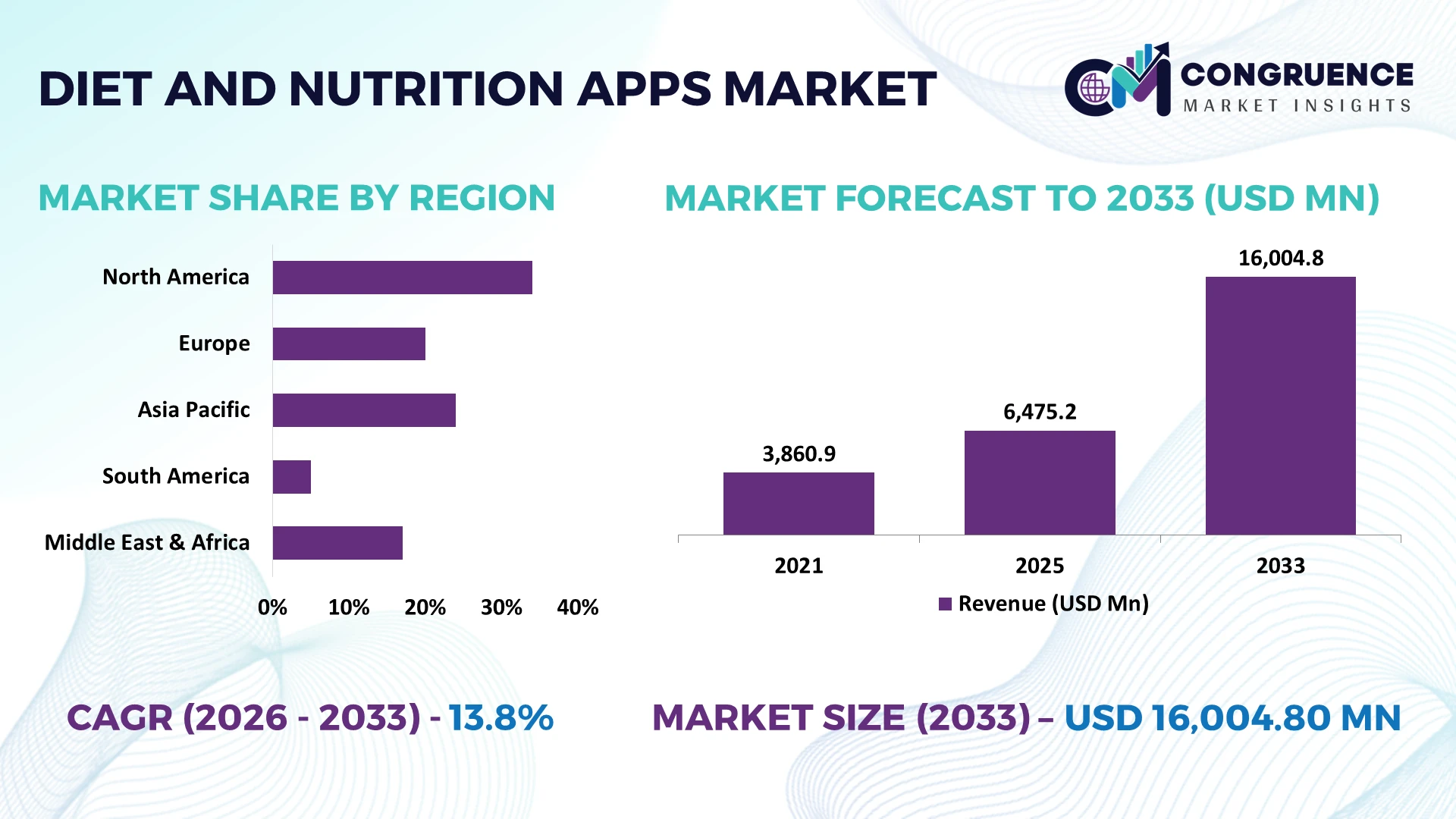
The United States remains the dominant country, accounting for approximately 31.5% of global demand, supported by strong digital-health investment, obesity-management programs, corporate wellness, and advanced AI platforms. Smartphone adoption exceeds 80%, while India is expanding rapidly through mobile-first nutrition services and localized meal databases. U.S. platform maturity remains substantially ahead of India, although India offers stronger volume-led expansion potential.
The U.S. lead and Asia-Pacific’s faster adoption favor localized AI, wearable integration, and regulatory-ready platforms in investment decisions.
Market Size & Growth: USD 6475.22 million in 2025 is projected to reach USD 16004.8 million by 2033 at 13.8% CAGR, driven by AI-enabled nutrition personalization and automated food logging.
Top Growth Drivers: AI personalization delivers 15%–20% engagement gains, wearable integration increases tracking frequency by 10%–15%, and computer vision reduces manual logging effort by 30%–40%.
Short-Term Forecast: By 2028, automated food recognition is positioned to cut manual entry time by 35% and raise nutrition-tracking efficiency by 20%–25%.
Emerging Technologies: AI coaching, computer-vision food recognition, continuous glucose integration, and wearable APIs are shifting apps toward real-time, automated nutrition intelligence.
Regional Leaders: North America held 36.4% share in 2024, Europe remains a major digital-health market, while Asia Pacific is the fastest-growing region through smartphone and wearable adoption.
Consumer/End-User Trends: Smartphones accounted for 66.7% of deployment in 2025, confirming mobile-first tracking as the dominant consumer behavior.
Pilot/Case Example: A 2024 Taiwan digital-nutrition intervention achieved 4.78% weight loss versus 1.54% among controls, demonstrating measurable outcomes from app-supported dietary management.
Competitive Landscape: North America leads, with MyFitnessPal, Noom, Lifesum, MyNetDiary, and HealthifyMe competing through AI personalization, subscriptions, and connected-health ecosystems.
Regulatory & ESG Impact: Privacy, cybersecurity, and AI-governance requirements are increasing development costs while pushing platforms toward auditable algorithms and stronger data controls.
Investment & Funding: The 2026 acquisition of Cal AI by MyFitnessPal reinforces consolidation around AI-powered food recognition, personalized coaching, and automated nutrition tracking.
Innovation & Future Outlook: Next-generation platforms are integrating AI, wearables, glucose data, and culturally localized meal intelligence, shifting competition from calorie counters toward personalized digital nutrition ecosystems.
The Diet and Nutrition Apps Market is seeing strongest demand across weight management, calorie tracking, personalized meal planning, chronic-disease prevention, and sports nutrition. AI-assisted food recognition and wearable integration are replacing manual tracking with automated, real-time insights, while specialized keto, vegan, and culturally localized platforms strengthen user segmentation. Smartphone deployment already represents 66.7%, reinforcing mobile-first engagement as developers prioritize personalization, interoperability, and privacy-ready digital nutrition solutions.
Diet and nutrition apps are becoming strategic digital-health assets because they convert fragmented dietary behavior into continuous, actionable data for consumers, clinicians, insurers, and wellness providers. AI-assisted assessment is replacing recall-heavy tracking, while India’s 85.5% household smartphone ownership creates a large mobile deployment base. The market is shifting from standalone calorie counters toward connected nutrition ecosystems integrating wearables, glucose data, and health platforms.
Technology is creating a measurable operating advantage. AI image recognition can identify food items with accuracy above 85%, compared with the slower manual-entry model, while automated assessment reduces user effort and improves data continuity. North America leads in clinical and commercial integration, whereas India combines high smartphone penetration with substantial whitespace in digital-health adoption, creating a different investment profile centered on localization, affordability, and vernacular nutrition databases.
Over the next 2–3 years, platforms will prioritize automated meal capture, interoperability, and clinician dashboards, targeting 20%–30% reductions in logging effort and higher user retention. Practical deployment is moving toward AI-assisted dietary assessment in chronic-care programs, with companies increasing partnerships across wearables, healthcare providers, and food databases. Competitive positioning will increasingly depend on validated AI accuracy, secure data architecture, and scalable ecosystem integration.
AI-based food recognition is accelerating adoption by reducing the friction of manual dietary entry, which remains a major engagement constraint. Validated applications have demonstrated food-identification accuracy above 85%, while AI-assisted assessment can capture dietary information in real time rather than relying entirely on retrospective recall. India’s 85.5% household smartphone ownership strengthens the deployment base, particularly for mobile-first nutrition services. The shift toward automated image recognition is also changing product investment priorities as developers integrate computer vision, wearable signals, and personalized coaching. Companies are responding through AI partnerships, proprietary food databases, and localized meal-recognition models. The strategic advantage lies in converting more frequent user interactions into higher-value behavioral and clinical datasets.
Accuracy inconsistency remains a structural limitation because AI performance varies across mixed dishes, portion sizes, cuisines, and image conditions. Independent evaluations report calorie-estimation errors averaging 18.7% across image-based applications, while accuracy ranges of 60%–95% have been observed across AI and wearable dietary-assessment tools. Interoperability adds another constraint as nutrition data must connect with wearables, electronic health records, glucose platforms, and food databases. European developers also face tighter AI-governance requirements following the EU AI Act becoming broadly applicable in 2026. Companies are reducing exposure through standardized APIs, human-in-the-loop validation, localized food datasets, and contractual data-governance controls. Accuracy, rather than download volume, increasingly determines enterprise deployment viability.
The strongest opportunity lies in combining AI nutrition assessment with localized food intelligence and clinical workflows. India’s digital-health app penetration remains only about 17% of the population, leaving substantial adoption whitespace despite widespread connectivity and smartphone access. AI food recognition already achieves above 85% identification accuracy in validated applications, creating a foundation for automated meal analysis across regional cuisines. Over the next 2–3 years, platforms integrating vernacular interfaces, wearable biomarkers, and clinician dashboards can target 20%–30% lower tracking friction. Companies are positioning through hospital partnerships, employer wellness programs, and wearable integrations. The non-obvious opportunity is regional food-data ownership: proprietary Indian meal and portion datasets can become a defensible competitive asset.
Long-term competitiveness depends on scaling AI models without compromising privacy, accuracy, or deployment consistency. Wearable dietary-assessment studies report accuracy ranging from approximately 60% to 95%, while continuous sensing introduces privacy exposure because cameras and sensors can capture unintended environmental information. AI governance is becoming more demanding as the EU AI Act enters its broader application phase in 2026, increasing requirements for transparency, risk management, and documentation. Companies must therefore invest in privacy-preserving architectures, edge processing, model validation, cybersecurity, and multilingual testing. The operational challenge is not simply deploying AI; it is maintaining consistent performance across cuisines, devices, languages, and healthcare workflows. Platforms that solve this infrastructure complexity will secure stronger enterprise partnerships and longer-term user trust.
AI Automates Dietary Logging: AI food recognition and automated portion estimation are shifting nutrition logging from manual entry toward image-based workflows. Adoption of automated readings is increasingly important, while accuracy remains a differentiator; companies are expanding food databases, integrating computer vision, and reducing user input to improve retention and processing speed.
Wearable Integration Deepens: Diet apps are increasingly connected with wearables, activity trackers, and health metrics, creating continuous nutrition-performance workflows. In India, 56% of consumers already use wearables and 40% plan purchases, accelerating synchronization between calorie, activity, and wellness data. Developers are prioritizing APIs and ecosystem partnerships to strengthen engagement.
Clinical Workflows Become Digital: Nutrition tracking is moving beyond consumer self-monitoring into clinician-supported programs, particularly weight-management workflows. Technology-enabled nutrition programs are combining app usage with appointments and structured dietary monitoring; companies are responding with provider dashboards, patient adherence tools, and scalable medical nutrition therapy infrastructure.
Local Food Data Gains Importance: Localization is becoming a non-obvious competitive factor as users expect accurate regional foods, portions, and dietary patterns rather than generic databases. Earlier user research found 27.5% considered missing local foods a limitation. Companies are therefore expanding regional databases and partnerships to improve accuracy and reduce churn.
Calorie Tracking Leads Adoption: Calorie Tracking is estimated to hold the leading share at approximately 29%, supported by simple workflows, broad consumer familiarity, and easy integration with wearables and weight-management features. Its mature position makes it highly scalable, while Nutrition Tracking follows at about 23% as users increasingly seek deeper macro- and micronutrient visibility. Weight Management represents roughly 19%, retaining strong commercial relevance through outcome-oriented subscriptions and coaching integration.
Meal Planning is emerging as one of the faster-growing types, with adoption expanding as apps connect dietary recommendations with grocery planning and personalized menus. Diet Coaching is also gaining traction, particularly where human guidance is combined with automated tracking. Companies are shifting investment toward integrated platforms rather than standalone counters, with approximately 15–20% of product development emphasis increasingly moving toward personalization, coaching, and cross-feature integration. The implication is greater competition around retention and measurable outcomes rather than basic calorie logging.
Weight Loss Remains the Anchor: Weight Loss is estimated to account for approximately 32% of application demand, reflecting its measurable outcomes, recurring engagement cycles, and strong alignment with calorie and activity tracking. Healthy Eating follows at roughly 24%, supported by broader preventive-health behavior. Fitness Nutrition represents about 18%, increasingly integrating exercise metrics and personalized nutrient targets to support performance-oriented users.
Meal Planning is among the faster-growing applications as personalization engines connect dietary preferences, schedules, and food choices into actionable plans. Nutrient Monitoring is also strengthening, particularly among users seeking detailed macro- and micronutrient control. Companies are expanding automated recommendations, wearable synchronization, and behavioral prompts, with integrated applications potentially improving engagement by 10–15% versus isolated tracking workflows. The strategic shift is toward applications that convert data into repeatable actions, increasing subscription value and reducing reliance on one-time tracking activity.
Individual Consumers Dominate Usage: Individual Consumers are estimated to represent approximately 61% of market demand, reflecting low deployment barriers, smartphone accessibility, and direct subscription purchasing. Their scale supports rapid product testing and freemium conversion, while Fitness Centers account for nearly 14% through connected member-management and nutrition coaching services. Nutrition Clinics contribute about 10%, increasingly seeking structured tracking and patient-monitoring capabilities.
Healthcare Providers are the fastest-growing end-user group as nutrition apps become more compatible with clinical workflows, patient monitoring, and technology-enabled nutrition therapy. Corporate Wellness Programs are also expanding from basic wellness content toward measurable health-management platforms. Companies are responding with enterprise dashboards, provider integrations, tiered pricing, and customized data controls. The strategic implication is a gradual shift from consumer-only monetization toward institutional contracts, where workflow integration, evidence of outcomes, and interoperability increasingly determine competitive positioning.
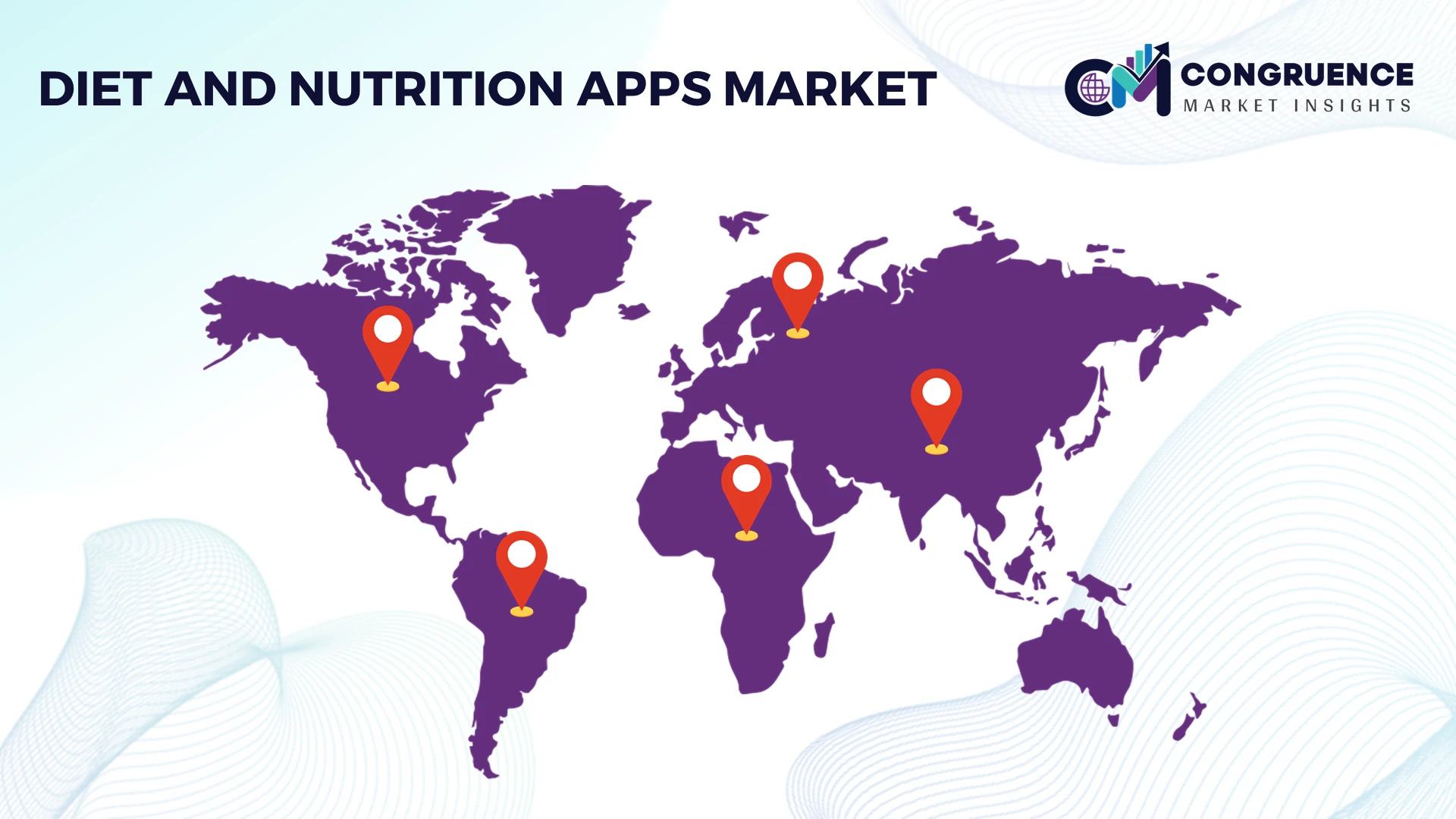
North America accounted for the largest market share at 36.0% in 2025 however, Asia-Pacific is expected to register the fastest growth, expanding at a CAGR of 31.3% between 2026 and 2033.
AI-enabled nutrition ecosystems strengthen enterprise monetization
North America remains the primary commercial hub for diet and nutrition apps, supported by high smartphone penetration, mature subscription models, and dense integration with wearables, health platforms, and fitness services. The U.S. represented the dominant country market, while smartphone-based deployment accounted for approximately 67.5% of regional usage in 2025. MyFitnessPal's U.S. platform reported 5.7 million free monthly active users in 2026, with users opening the app about five times daily and logging approximately 16 foods per day. Developers are therefore shifting from basic tracking toward AI-assisted logging, advertising ecosystems, clinical integrations, and personalized nutrition workflows, increasing monetization opportunities beyond subscriptions.
U.S. Market Outlook: The U.S. leads through advanced digital-health infrastructure, strong wearable penetration, established health-data ecosystems, and high consumer willingness to pay for recurring wellness services. Enterprise-scale platforms are increasingly linking nutrition tracking with fitness, advertising, coaching, and preventive-health workflows. MyFitnessPal's database exceeds 20 million foods, demonstrating the operational advantage of large-scale food-data infrastructure for personalization and automated logging.
Privacy-led personalization reshapes digital nutrition deployment
Europe represents a mature secondary market, with approximately 26.6% of global nutrition-app activity in 2025 and strong demand for localized, privacy-conscious digital wellness services. Germany held approximately 43.7% of the European market, reflecting strong preventive-health adoption and established digital fitness infrastructure. Product development increasingly emphasizes transparent data controls, wearable synchronization, AI-assisted dietary recommendations, and localized food databases rather than acquisition alone. Real-time integration with Fitbit, Garmin, and Apple Watch is becoming increasingly standard, allowing applications to combine dietary, activity, sleep, and health information within unified workflows. Companies are responding through compliance-oriented product design, partnerships with healthcare and fitness ecosystems, and premium personalization features that support retention and differentiation.
Germany Market Outlook: Germany offers the region's strongest combination of digital-health infrastructure, consumer wellness adoption, and technology readiness. Its 43.7% European share provides developers with a concentrated commercial base, while expanding AI-powered tracking and wearable integration create opportunities for higher-value nutrition services. Companies can use Germany as a reference market for privacy-focused product deployment and localized nutrition functionality.
Scale, localization, and mobile integration accelerate deployment
Asia-Pacific is emerging as the principal scale opportunity, supported by expanding smartphone access, wearable adoption, preventive-health initiatives, and localized digital nutrition services. The region represented approximately 22.8% of the broader nutrition-app market in 2025, while dedicated diet and nutrition app analysis identifies particularly strong momentum across China, India, Japan, and South Korea. China maintains a leading regional position through large urban digital-health ecosystems and domestic app developers, while India is positioned as a particularly rapid-adoption market. Developers are localizing food databases, integrating AI-based food recognition, and adapting pricing to mobile-first consumers. The operational advantage is scale: a single platform can expand across multiple high-density smartphone markets while tailoring food catalogs, languages, payment models, and coaching workflows.
China Market Outlook: China provides a major deployment base because of extensive smartphone usage, established digital fitness ecosystems, and strong domestic technology capabilities. Local developers and international platforms are increasingly combining nutrition tracking with wearable data and personalized recommendations. The country's large urban consumer base enables rapid feature testing and localized scaling, while partnerships across digital wellness ecosystems can reduce customer-acquisition friction and strengthen recurring engagement.
Affordable mobile wellness expands beyond premium subscriptions
South America remains a smaller but increasingly addressable market, with Latin America representing approximately 6.7% of the broader nutrition-app market in 2025. Brazil is the principal commercial opportunity, supported by a large smartphone user base, expanding fitness culture, and growing interest in weight-management and healthy-eating applications. Adoption is increasingly shaped by mobile-first onboarding, simplified meal logging, local food catalogs, and flexible payment structures rather than high-cost clinical functionality. Companies are adapting through freemium tiers, localized content, influencer-led acquisition, and partnerships with fitness providers. Infrastructure and payment fragmentation remain execution constraints, particularly outside major metropolitan areas. Consequently, successful platforms are prioritizing lightweight applications and low-friction workflows that can operate effectively under variable connectivity and purchasing conditions.
Brazil Market Outlook: Brazil provides the strongest country-level opportunity through its population scale, established fitness ecosystem, and growing demand for mobile health management. Localized Brazilian food databases and Portuguese-language coaching can materially improve relevance compared with generic global platforms. Developers are increasingly using freemium acquisition and partnership-led distribution to overcome payment sensitivity while building recurring engagement around weight management and meal planning.
Mobile health infrastructure supports targeted wellness transformation
Middle East & Africa accounted for approximately 4.4% of the broader nutrition-app market in 2025, making it smaller than the major digital-health markets but increasingly attractive for mobile-first deployment. Adoption is strongest where smartphone connectivity, private healthcare infrastructure, and wellness investment intersect. Gulf markets are moving toward integrated digital-health ecosystems, creating opportunities for nutrition applications linked with fitness centers, healthcare providers, and corporate wellness programs. Companies are responding with Arabic-language interfaces, culturally relevant meal databases, personalized coaching, and partnerships with healthcare and wellness organizations. Uneven digital infrastructure and differences in recurring-payment behavior remain important constraints. The competitive opportunity therefore favors platforms capable of combining localized content with scalable cloud deployment rather than solutions requiring extensive physical infrastructure.
Saudi Arabia Market Outlook: Saudi Arabia offers a strategically important deployment environment because national healthcare modernization and digital transformation are encouraging technology-enabled preventive wellness services. Nutrition platforms can benefit from integration with fitness, healthcare, and corporate wellness ecosystems, while Arabic-language personalization improves user relevance. Companies emphasizing secure data handling, culturally appropriate dietary recommendations, and institutional partnerships are better positioned to convert digital-health investment into sustained app adoption.
The competitive landscape is led by global platforms such as MyFitnessPal, Noom, Lifesum, and MyNetDiary, alongside regional specialists including HealthifyMe and Cronometer. Global leaders compete primarily on scale, data depth, personalization, and subscription monetization, while regional players differentiate through localization and pricing. The top five players are estimated to control approximately 35–40% of market activity, leaving meaningful room for specialized challengers. Technology is becoming decisive: AI-assisted food recognition can reduce manual logging effort by roughly 20–30%, while wearable synchronization can increase engagement by approximately 10–15% compared with standalone tracking workflows. Players are responding through AI deployment, wearable partnerships, clinical integrations, localized food databases, and broader ecosystem development. Competition is shifting from calorie-counting functionality toward automated nutrition intelligence and outcome-oriented services. The primary entry barrier is the cost of building comprehensive food databases, trusted recommendations, interoperability, and sustained user retention. Winning requires superior data infrastructure, frictionless automation, localized accuracy, and measurable health outcomes.
MyFitnessPal
Noom
Lifesum
FatSecret
MyNetDiary
Cronometer
YAZIO
HealthifyMe
Foodvisor
Nutrium
MacroFactor
Carb Manager
Nutracheck
Ate Food Journal
Artificial intelligence, machine learning, and computer vision are transforming core nutrition workflows through Meal Scan, voice logging, automated food recognition, and personalized recommendations. AI-assisted logging can reduce manual entry effort by approximately 20–30%, while machine-learning recognition improves processing speed by 10–15%. Adoption is moving from isolated features toward integrated AI coaching, with leading platforms combining food databases, behavioral data, and wearable inputs. This benefits technology leaders with proprietary datasets and stronger personalization capabilities.
Wearable APIs, cloud analytics, and conversational interfaces are becoming the next operational layer. Integration with smartwatches and activity trackers can improve engagement by roughly 10–15%, while cloud-based synchronization reduces duplicated data processing by about 5–10%. Enterprise deployment is expanding across fitness, healthcare, and wellness ecosystems, enabling continuous calorie, activity, sleep, and nutrient monitoring. Compared with manual diary-based tracking, AI-assisted workflows can deliver approximately 25% faster logging, giving digitally integrated providers a measurable service-speed advantage.
From 2026–2028, generative AI, multimodal food recognition, predictive coaching, and interoperable health-data platforms will increasingly shift apps from tracking tools into decision-support ecosystems. Early adopters can gain 10–20% workflow efficiency through automated recommendations and adaptive meal planning. Companies combining proprietary nutrition data with AI and clinical integration will benefit most, while legacy manual-entry platforms face rising retention and differentiation pressure.
March 2026 MyFitnessPal acquired Cal AI, an AI-native nutrition app, keeping it standalone while funding product development and marketing. Cal AI expands performance-focused tracking within MyFitnessPal’s portfolio. Nearly 1 million people achieve goals annually, strengthening portfolio reach. Source: MyFitnessPal
July 2025 Noom joined the CMS Digital Health Ecosystem Shared Framework, supporting interoperable health-data exchange and AI-enabled patient tools. Noom also pledged a free U.S. app tier and 30-day access for Medicare and Medicaid members, widening preventive-care reach. Source: Noom
January 2025 Noom introduced AI Body Scan and Noom Body Age to free and paid members. The smartphone scan takes 10 seconds and generates personalized reports covering body fat, lean mass, and measurements, expanding low-cost digital health assessment without dedicated hardware. Source: Noom
December 2025 Noom introduced its 7 Ms whole-person wellbeing framework, combining metabolic, physical, and psychological dimensions. The framework emphasizes measurable, intervention-ready health management, supporting broader positioning beyond weight loss toward integrated nutrition, lifestyle, and longevity services. Source: Noom
The Diet and Nutrition Apps Market Report covers Calorie Tracking, Meal Planning, Nutrition Tracking, Weight Management, and Diet Coaching across Weight Loss, Healthy Eating, Fitness Nutrition, Meal Planning, and Nutrient Monitoring applications. End-user coverage includes Individual Consumers, Fitness Centers, Nutrition Clinics, Healthcare Providers, and Corporate Wellness Programs. Regional assessment spans North America, Europe, Asia-Pacific, South America, and Middle East & Africa, with country-level analysis of major deployment markets and emerging adoption areas.
The report evaluates AI-powered food recognition, machine learning, wearable integration, conversational coaching, cloud analytics, and health-data interoperability. It assesses adoption intensity, personalization, enterprise integration, deployment models, and competitive positioning across established and emerging providers. These insights support investment planning, geographic expansion, partnership development, product prioritization, and competitive positioning by identifying changing consumer and institutional demand. The analysis also evaluates technology transitions and operational priorities influencing market direction between 2026 and 2033.
| Report Attribute/Metric | Report Details |
|---|---|
Market Revenue in 2025 | USD 6475.22 Million |
Market Revenue in 2033 | USD 16004.8 Million |
CAGR (2026 - 2033) | 13.8% |
Base Year | 2025 |
Forecast Period | 2026 - 2033 |
Historic Period | 2021 - 2025 |
Segments Covered | By Type
By Application
By End-User
|
Key Report Deliverable | Revenue Forecast, Growth Trends, Market Dynamics, Segmental Overview, Regional and Country-wise Analysis, Competition Landscape |
Region Covered | North America, Europe, Asia-Pacific, South America, Middle East, Africa |
Key Players Analyzed | MyFitnessPal, Noom, Lifesum, FatSecret, MyNetDiary, Cronometer, YAZIO, HealthifyMe, Foodvisor, Nutrium, MacroFactor, Carb Manager, Nutracheck, Ate Food Journal |
Customization & Pricing | Available on Request (10% Customization is Free) |




