
Reports
The Global Diesel Rotary UPS (DRUPS) Market was valued at USD 247.29 Million in 2025 and is anticipated to reach a value of USD 346.33 Million by 2033 expanding at a CAGR of 4.3% between 2026 and 2033. Growth is being driven by rising investments in hyperscale data centers, semiconductor manufacturing facilities, airport infrastructure, and mission-critical industrial operations requiring uninterrupted high-capacity power protection.
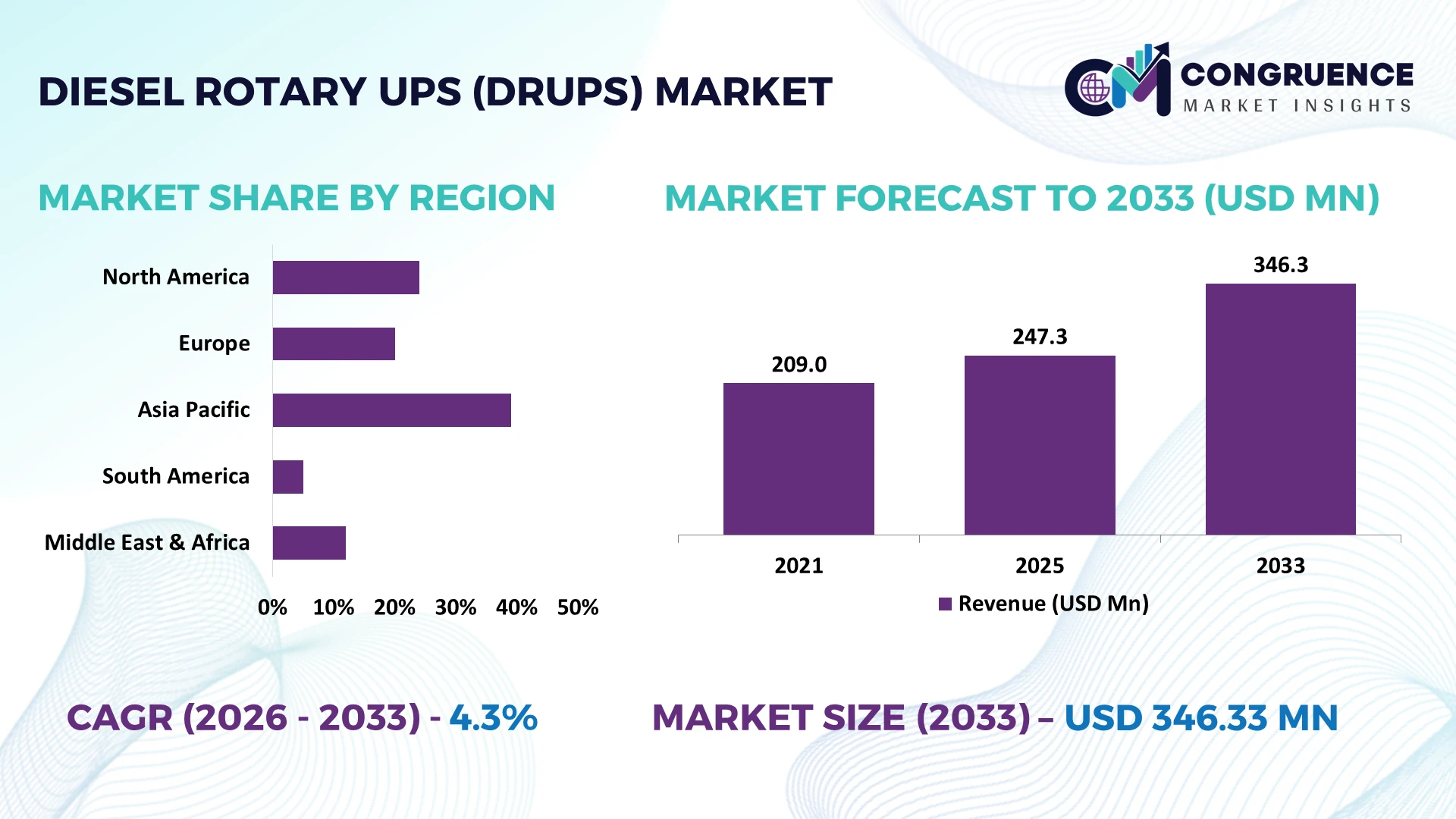
The United States accounts for approximately 34% of global DRUPS installations, supported by expanding hyperscale data center capacity, defense infrastructure upgrades, and over USD 25 billion in digital infrastructure investments. Germany holds nearly 11% of market demand through advanced manufacturing and industrial automation, while the U.S. maintains more than three times Germany's installed critical power capacity. Strengthened energy security strategies following ongoing geopolitical disruptions in Europe have further accelerated resilient backup power deployment across essential facilities.
Organizations prioritizing resilient, integrated power infrastructure are securing stronger operational continuity and long-term infrastructure competitiveness across critical industries.
Market Size & Growth: USD 247.29 Million in 2025, reaching USD 346.33 Million by 2033 at 4.3% CAGR, supported by expanding hyperscale digital infrastructure and critical power modernization.
Top Growth Drivers: Data center expansion contributes nearly 38% of demand, industrial automation 24%, and healthcare infrastructure upgrades 18%.
Short-Term Forecast: By 2028, integrated DRUPS solutions reduce maintenance costs by approximately 14% while improving system availability by 11%.
Emerging Technologies: AI-enabled predictive maintenance, digital monitoring platforms, and high-efficiency flywheel energy storage improve operational efficiency by up to 16%.
Regional Leaders: North America exceeds USD 120 Million, Europe approaches USD 88 Million, and Asia Pacific surpasses USD 82 Million, driven by rapid digital infrastructure expansion.
Consumer/End-User Trends: More than 62% of new mission-critical facilities prioritize integrated DRUPS systems to minimize downtime and reduce lifecycle maintenance.
Pilot/Case Example: A 2026 data center modernization program improved backup power response by 19% while reducing maintenance interventions by 15%.
Competitive Landscape: Top manufacturers collectively hold approximately 58% market share, with Rolls-Royce Power Systems, Hitec Power Protection, Piller Power Systems, Euro-Diesel, and Hitzinger leading deployments.
Regulatory & ESG Impact: High-efficiency system upgrades lower fuel consumption by nearly 9%, supporting stricter resilience and energy-efficiency requirements across critical infrastructure.
Investment & Funding: More than USD 1.4 Billion has been directed toward resilient power infrastructure expansion, emphasizing strategic partnerships and regional manufacturing diversification.
Innovation & Future Outlook: Advanced hybrid DRUPS architectures, intelligent diagnostics, and modular designs strengthen long-term infrastructure resilience amid ongoing global supply chain realignment.
Demand for Diesel Rotary UPS (DRUPS) systems continues to strengthen across hyperscale data centers, semiconductor fabrication plants, airports, and healthcare campuses requiring uninterrupted high-capacity power protection. Recent innovations include AI-enabled predictive diagnostics, digital remote monitoring, and higher-efficiency flywheel technologies, improving operational reliability by approximately 15%. Regional manufacturing expansion and localized component sourcing are also accelerating deployment, setting the stage for broader strategic market developments.
The Diesel Rotary UPS (DRUPS) Market has become strategically important as operators of mission-critical infrastructure prioritize uninterrupted power continuity, lower maintenance complexity, and resilient energy systems. Infrastructure modernization across data centers, semiconductor fabrication facilities, airports, and healthcare campuses is accelerating replacement of conventional backup architectures with integrated DRUPS platforms. Supply-chain restructuring after recent global component disruptions has also encouraged localized manufacturing and dual-sourcing strategies, strengthening procurement resilience and reducing delivery uncertainty for critical power equipment.
Modern DRUPS systems equipped with digital monitoring and high-efficiency flywheel technology improve energy conversion efficiency by approximately 12% while reducing maintenance interventions by nearly 18% compared with legacy static UPS and generator combinations. The United States continues to lead large-scale deployments across hyperscale facilities, while Germany emphasizes industrial automation and energy-efficient manufacturing applications. Over the next two to three years, predictive maintenance adoption is expected to exceed 45% of newly commissioned DRUPS installations, improving operational reliability and asset utilization.
A 2026 hyperscale data center expansion integrating modular DRUPS architecture demonstrated faster commissioning and improved system availability through centralized power management. Manufacturers are strengthening competitive positioning through localized production, technology partnerships, and digital service platforms, enabling customers to enhance operational resilience while securing long-term infrastructure performance.
Rapid expansion of hyperscale data centers, semiconductor manufacturing, and healthcare infrastructure is accelerating demand for integrated DRUPS solutions capable of delivering uninterrupted high-capacity power. More than 60% of newly developed mission-critical facilities prioritize resilient backup architectures, while predictive maintenance platforms improve equipment availability by approximately 15% and reduce service interventions by nearly 12%. The United States continues expanding AI-ready digital infrastructure, increasing demand for high-reliability power systems. Equipment manufacturers are responding through localized assembly, strategic technology alliances, and modular product development, enabling faster deployment and stronger lifecycle performance. This structural transition shifts competition from equipment supply toward long-term operational reliability and integrated service capabilities.
Initial installation costs remain significantly higher than conventional backup configurations, creating adoption barriers for mid-sized industrial facilities. Specialized rotating machinery and power electronics account for nearly 35% of total system costs, while delivery lead times have extended by approximately 20% during periods of component shortages. Germany and Japan continue facing procurement challenges for precision-engineered components required in advanced DRUPS platforms. These structural constraints affect project scheduling, profitability, and deployment scalability. Manufacturers are mitigating risk through supplier diversification, localized component sourcing, and long-term procurement agreements while redesigning systems with standardized components to improve production flexibility and reduce supply dependency.
Integration of AI-enabled diagnostics, digital twins, and hybrid energy management platforms is creating new value beyond traditional backup power functionality. Intelligent monitoring reduces unplanned maintenance by approximately 17%, while automated performance optimization improves operational efficiency by nearly 13%. Singapore and the United Arab Emirates are accelerating investments in digitally managed critical infrastructure, encouraging adoption of advanced resilient power ecosystems. Companies are expanding software capabilities through strategic partnerships and increasing R&D investment in predictive asset management. A significant emerging opportunity lies in combining DRUPS with microgrid architectures, allowing operators to strengthen resilience while optimizing long-term operating efficiency across complex industrial campuses.
Integrating DRUPS platforms with existing building management systems, energy management software, and industrial automation networks remains a major execution challenge. Nearly 28% of modernization projects require extensive engineering modifications, while skilled commissioning specialists remain in limited supply across several industrial markets. Cybersecurity expectations for connected power infrastructure have increased substantially as remote monitoring becomes standard practice. These factors directly influence deployment consistency, operational resilience, and long-term competitiveness. Companies must strengthen engineering expertise, invest in secure digital architectures, and establish technology partnerships with automation providers to ensure seamless integration, standardized maintenance practices, and reliable performance throughout increasingly complex mission-critical environments.
Integrated Digital Monitoring Expansion Intelligent monitoring platforms are now integrated into nearly 48% of newly commissioned DRUPS installations, reducing maintenance visits by approximately 16% and improving fault detection accuracy by 20%. Operators in the United States are centralizing asset management through cloud-connected diagnostics as skilled maintenance labor remains constrained. Manufacturers are expanding software partnerships and remote service capabilities to improve lifecycle performance while shortening response times.
Localized Manufacturing Strategies Supply-chain diversification has accelerated production localization, with nearly 35% of critical rotating components sourced through regional manufacturing networks compared with pre-disruption procurement models. Germany and India are strengthening domestic engineering capabilities to reduce delivery delays by approximately 18%. Companies are restructuring supplier ecosystems, expanding local assembly operations, and standardizing component platforms to improve inventory resilience and project execution.
Modular Infrastructure Deployment Modular DRUPS configurations now represent approximately 42% of new large-scale critical infrastructure projects, reducing installation time by nearly 22% while improving future expansion flexibility. Digital infrastructure operators increasingly deploy scalable power blocks rather than oversized centralized systems. Equipment suppliers are introducing modular product families and collaborative engineering programs, enabling phased investments with lower commissioning complexity and improved operational continuity.
Efficiency-Focused Hybrid Architectures Hybrid DRUPS designs combining flywheel technology with intelligent energy management have lowered fuel consumption by approximately 10% while increasing system availability by 14%. Infrastructure modernization programs and stricter energy-performance expectations are accelerating deployment across healthcare campuses and airports. Manufacturers are investing in automation, advanced control software, and strategic technology alliances, with lifecycle optimization emerging as a stronger competitive differentiator than equipment capacity alone.
Kinetic DRUPS holds the leading position with approximately 44% of total installations, supported by superior reliability, high overload capability, and lower lifecycle maintenance for mission-critical operations. These systems are widely deployed across hyperscale data centers and airports where uninterrupted power and rapid response are operational priorities. Medium Voltage DRUPS follows with nearly 27% share, serving large industrial facilities requiring higher-capacity power protection. Low Voltage systems remain important for smaller commercial and healthcare applications, offering installation flexibility and lower infrastructure requirements.
Battery-Based DRUPS is the fastest-growing segment as digital monitoring, advanced battery chemistry, and hybrid energy management improve operational flexibility. Adoption has increased by approximately 18% in newly designed facilities, while maintenance requirements have declined by nearly 15% through intelligent monitoring. Manufacturers are expanding hybrid product portfolios, strengthening battery technology partnerships, and investing in modular system development. Investment priorities are gradually shifting toward flexible architectures capable of supporting evolving digital infrastructure and energy resilience requirements.
Data Centers account for approximately 46% of total DRUPS deployments due to continuous expansion of AI computing, cloud infrastructure, and hyperscale facilities requiring uninterrupted power availability. Industrial Facilities represent another significant segment, where automated manufacturing processes and semiconductor production depend on high-reliability backup systems. Airports maintain consistent adoption because uninterrupted operations directly affect passenger movement, air traffic management, and security infrastructure.
Healthcare Facilities are emerging as the fastest-growing application, with deployment increasing by approximately 17% as hospitals modernize critical care infrastructure and digital medical systems. Around 58% of newly commissioned healthcare campuses now prioritize integrated resilient power solutions for essential services. Companies are expanding healthcare-focused product configurations, integrating intelligent monitoring, and strengthening engineering partnerships to address specialized operational requirements. Demand is increasingly shifting toward application-specific solutions rather than standardized backup power platforms.
Data Centers remain the largest end-user group, representing approximately 43% of purchasing activity because uninterrupted operations directly influence cloud computing, AI workloads, and enterprise digital services. Manufacturing follows through continuous investment in automated production, while Utilities deploy DRUPS for grid support and operational continuity. Transportation operators continue strengthening resilient power systems across airports and critical mobility infrastructure where downtime creates significant operational disruption.
Healthcare represents the fastest-growing end-user category, with adoption expanding by nearly 16% as hospitals digitize intensive care, diagnostic imaging, and emergency response systems. Utilities have increased intelligent monitoring implementation by approximately 19%, while manufacturing companies continue investing in customized modular DRUPS platforms to improve production resilience. Suppliers are responding through vertical-specific engineering, long-term service agreements, ecosystem partnerships, and flexible deployment models, positioning themselves more competitively in specialized critical infrastructure markets where operational continuity has become a defining procurement criterion.
North America accounted for the largest market share at 39.2% in 2025 however, Asia-Pacific is expected to register the fastest growth, expanding at a 5.8% between 2026 and 2033.

Critical Digital Infrastructure Drives Premium Power Protection
North America remains the largest deployment hub for Diesel Rotary UPS systems due to extensive investments in hyperscale data centers, semiconductor manufacturing, defense facilities, and healthcare infrastructure. The region contributes approximately 39.2% of global installations, supported by large-scale modernization of mission-critical facilities and strong adoption of integrated resilient power architectures. More than 55% of newly commissioned hyperscale campuses incorporate advanced DRUPS solutions to strengthen operational continuity. Enterprise operators increasingly deploy modular systems with predictive diagnostics to reduce maintenance downtime and improve lifecycle performance. Strategic partnerships between infrastructure developers and power equipment manufacturers are accelerating deployment schedules while localized engineering capabilities improve commissioning efficiency and aftermarket support. The regional market increasingly competes on digital service capability rather than hardware specifications alone.
United States Market Outlook: The United States remains the region's operational center through continuous investment in AI-ready data centers, semiconductor fabrication, and defense infrastructure. Approximately 34% of global DRUPS installations are concentrated in the country, supported by advanced engineering capabilities and high infrastructure resilience requirements. Manufacturers continue expanding service networks, localized assembly, and digital monitoring platforms to improve equipment availability and strengthen long-term customer relationships across mission-critical industries.
Industrial Modernization and Energy Resilience Shape Deployment
Europe represents a mature market where industrial automation, energy resilience, and infrastructure modernization sustain DRUPS demand across manufacturing, transportation, and healthcare. The region accounts for nearly 28% of global deployment activity, with increasing replacement of aging backup power infrastructure by digitally managed integrated systems. Approximately 46% of new industrial facilities prioritize intelligent monitoring capabilities alongside resilient backup power. Energy security initiatives and stricter operational efficiency standards continue encouraging modernization across essential infrastructure. Equipment suppliers are strengthening regional manufacturing partnerships and expanding engineering services to support customized deployment while improving maintenance responsiveness and operational reliability.
Germany Market Outlook: Germany leads the European market through advanced manufacturing, industrial automation, and strong engineering expertise. Around 11% of worldwide DRUPS demand originates from German industrial and mission-critical infrastructure projects. Companies continue integrating digital asset management, predictive maintenance, and modular power systems to improve operational efficiency while supporting highly automated manufacturing environments requiring uninterrupted production continuity.
Rapid Infrastructure Expansion Accelerates Deployment
Asia-Pacific is emerging as the fastest-expanding market due to large-scale digital infrastructure construction, industrial manufacturing growth, and increasing investments in resilient critical facilities. The region represents approximately 24% of global deployment activity, while over 50% of newly announced hyperscale data center projects are located within major Asian economies. Manufacturing localization and expanding engineering capacity are reducing delivery timelines by nearly 15%. Equipment providers are increasing regional production, strengthening technology alliances, and developing scalable modular systems tailored to rapidly expanding enterprise infrastructure and industrial campuses.
China Market Outlook: China leads regional deployment through continuous expansion of cloud computing infrastructure, advanced manufacturing, and smart industrial facilities. Large domestic engineering capacity and integrated supply chains enable faster project execution across mission-critical installations. Manufacturers continue investing in localized production, intelligent monitoring technologies, and strategic collaborations, supporting high-volume deployment while improving operational reliability for expanding industrial and digital infrastructure.
Infrastructure Reliability Becomes Operational Priority
South America continues strengthening demand for DRUPS solutions as operators modernize digital infrastructure, industrial facilities, mining operations, and airport power systems. The region contributes approximately 5% of global installations, with enterprise investment increasingly focused on operational continuity rather than emergency backup alone. Critical infrastructure upgrades have increased resilient power deployments by nearly 13% across selected industrial projects. Although logistics complexity and infrastructure gaps remain execution constraints, manufacturers are expanding distributor partnerships, regional service centers, and technical support capabilities to improve deployment efficiency and long-term equipment performance.
Brazil Market Outlook: Brazil remains the largest national market through investments in digital infrastructure, industrial production, mining operations, and airport modernization. Large enterprise facilities increasingly deploy integrated backup power systems supporting uninterrupted operations. Suppliers are strengthening local engineering partnerships, expanding maintenance capabilities, and improving equipment availability, enabling more efficient execution of complex infrastructure projects throughout the country.
Strategic Infrastructure Investment Supports Critical Power
The Middle East & Africa market is advancing through sustained investment in airports, healthcare infrastructure, energy facilities, and large-scale digital transformation projects. The region accounts for approximately 3.8% of global deployments, while mission-critical infrastructure investment continues expanding across government-led modernization initiatives. Around 18% more integrated resilient power projects entered implementation during recent infrastructure programs. Companies are strengthening regional partnerships, expanding engineering support, and establishing localized maintenance capabilities to improve operational reliability while addressing demanding environmental operating conditions and complex infrastructure requirements.
Saudi Arabia Market Outlook: Saudi Arabia leads regional deployment through smart city initiatives, hyperscale digital infrastructure, and strategic industrial diversification projects. Government-backed infrastructure modernization continues increasing demand for resilient integrated power systems supporting critical operations. Equipment manufacturers are expanding local partnerships, technical service capabilities, and project engineering resources to improve deployment efficiency while supporting long-term operational resilience across national infrastructure developments.
Global leaders including Rolls-Royce Power Systems, Piller Power Systems, Hitec Power Protection, Euro-Diesel, and Hitzinger compete directly against regional engineering specialists and system integrators, while OEMs increasingly challenge independent power solution providers through integrated lifecycle services. The top five companies collectively control approximately 58% of the market. Competition is driven by technology performance, lifecycle reliability, commissioning speed, and service capability rather than equipment pricing alone. Digital monitoring platforms improve maintenance efficiency by nearly 15%, while modular system designs reduce installation time by approximately 20%, creating measurable differentiation. Companies are expanding regional manufacturing, strengthening technology partnerships, investing in predictive maintenance software, and increasing vertical integration to secure critical component availability. The competitive landscape is shifting toward intelligent power ecosystems instead of standalone backup equipment. High engineering certification requirements, specialized manufacturing expertise, and long-term service expectations remain significant barriers to entry. Winning requires superior lifecycle performance, digital service integration, localized support, and dependable supply-chain execution.
Rolls-Royce Power Systems
Piller Power Systems
Hitec Power Protection
Euro-Diesel
Hitzinger Electric Power
Hitzinger UK
Kinetic Power
KOHLER Power Systems
Himoinsa
Mitsubishi Electric
Toshiba Infrastructure Systems & Solutions Corporation
ABB
Schneider Electric
Eaton Corporation
Digital monitoring, high-speed flywheel energy storage, and intelligent control platforms define current DRUPS technology. Nearly 58% of newly deployed systems incorporate predictive maintenance software, reducing unplanned service events by approximately 16% while improving operational availability by 13%. Compared with conventional static UPS and diesel generator configurations, modern integrated DRUPS architectures deliver around 12% higher energy efficiency and reduce maintenance complexity by approximately 18%. Enterprise operators benefit through lower lifecycle operating costs, faster fault diagnostics, and improved resilience across data centers, airports, and semiconductor facilities.
Emerging technologies are centered on AI-assisted diagnostics, digital twins, remote asset management, and hybrid energy optimization. Around 42% of new mission-critical infrastructure projects now specify intelligent monitoring as a standard deployment requirement. Advanced automation shortens commissioning time by nearly 15%, while adaptive load management improves power quality by approximately 10%. Manufacturers are integrating cloud-based analytics with modular DRUPS platforms, allowing operators to optimize maintenance schedules, improve asset utilization, and strengthen business continuity through centralized infrastructure management.
Between 2026 and 2028, battery-assisted hybrid DRUPS, cybersecurity-enabled supervisory controls, and predictive service ecosystems will reshape competitive differentiation. Adoption of digitally connected DRUPS platforms is expected to exceed 50% of new installations, while automated diagnostics reduce lifecycle maintenance costs by nearly 14%. Global technology leaders investing in software integration, modular engineering, and intelligent service platforms will strengthen long-term competitive positioning as customers increasingly prioritize operational intelligence alongside power reliability.
August 2024 HITEC Power Protection announced all new Dynamic Rotary UPS systems would be supplied with HVO-compatible engines after successful testing, enabling lifecycle greenhouse-gas reductions of up to 90% when HVO fuel is used. The move strengthened sustainability positioning for mission-critical facilities.
February 2025 Rolls-Royce reported restructuring its Power Systems business to address accelerating data-center demand, with more than 500 HVO-powered mtu generators delivered, representing roughly 1.3 GW of standby capacity. This expanded resilient power capability for critical infrastructure customers.
2025 HITEC Power Protection secured new DRUPS project wins covering data centers in the United States and Germany, semiconductor facilities in Asia, and a Singapore data-center expansion, reinforcing international deployment momentum across multiple mission-critical sectors. S
July 2026 Rolls-Royce announced four mtu 12V 396 TE54 generator sets, each rated at 1 MW, for India's INS Mahendragiri, enhancing mission-critical onboard electrical reliability and demonstrating continued investment in resilient high-availability power technologies. Source: Rolls-Royce
The report provides a comprehensive assessment of the Diesel Rotary UPS (DRUPS) market across Kinetic DRUPS, Battery-Based DRUPS, Low Voltage, and Medium Voltage systems, covering deployments in data centers, industrial facilities, healthcare facilities, and airports. It further evaluates demand across data centers, manufacturing, healthcare, transportation, and utilities while examining deployment patterns, technology adoption, and competitive positioning across North America, Europe, Asia-Pacific, South America, and the Middle East & Africa. More than 50% of recent installations emphasize digitally monitored resilient power architectures.
The analysis supports strategic decision-making by evaluating technology evolution, regional deployment priorities, supply-chain developments, competitive benchmarking, and operational trends expected between 2026 and 2033. It highlights intelligent monitoring, modular system integration, predictive maintenance, and hybrid power architectures alongside enterprise investment priorities, enabling stakeholders to identify expansion opportunities, optimize product positioning, strengthen partnership strategies, and anticipate shifting customer requirements across established and emerging mission-critical infrastructure markets.
| Report Attribute/Metric | Report Details |
|---|---|
Market Revenue in 2025 | USD 247.29 Million |
Market Revenue in 2033 | USD 346.33 Million |
CAGR (2026 - 2033) | 4.3% |
Base Year | 2025 |
Forecast Period | 2026 - 2033 |
Historic Period | 2021 - 2025 |
Segments Covered | By Type
By Application
By End-User
|
Key Report Deliverable | Revenue Forecast, Growth Trends, Market Dynamics, Segmental Overview, Regional and Country-wise Analysis, Competition Landscape |
Region Covered | North America, Europe, Asia-Pacific, South America, Middle East, Africa |
Key Players Analyzed | Rolls-Royce Power Systems, Piller Power Systems, Hitec Power Protection, Euro-Diesel, Hitzinger Electric Power, Hitzinger UK, Kinetic Power, KOHLER Power Systems, Himoinsa, Mitsubishi Electric, Toshiba Infrastructure Systems & Solutions Corporation, ABB, Schneider Electric, Eaton Corporation |
Customization & Pricing | Available on Request (10% Customization is Free) |




