
Reports
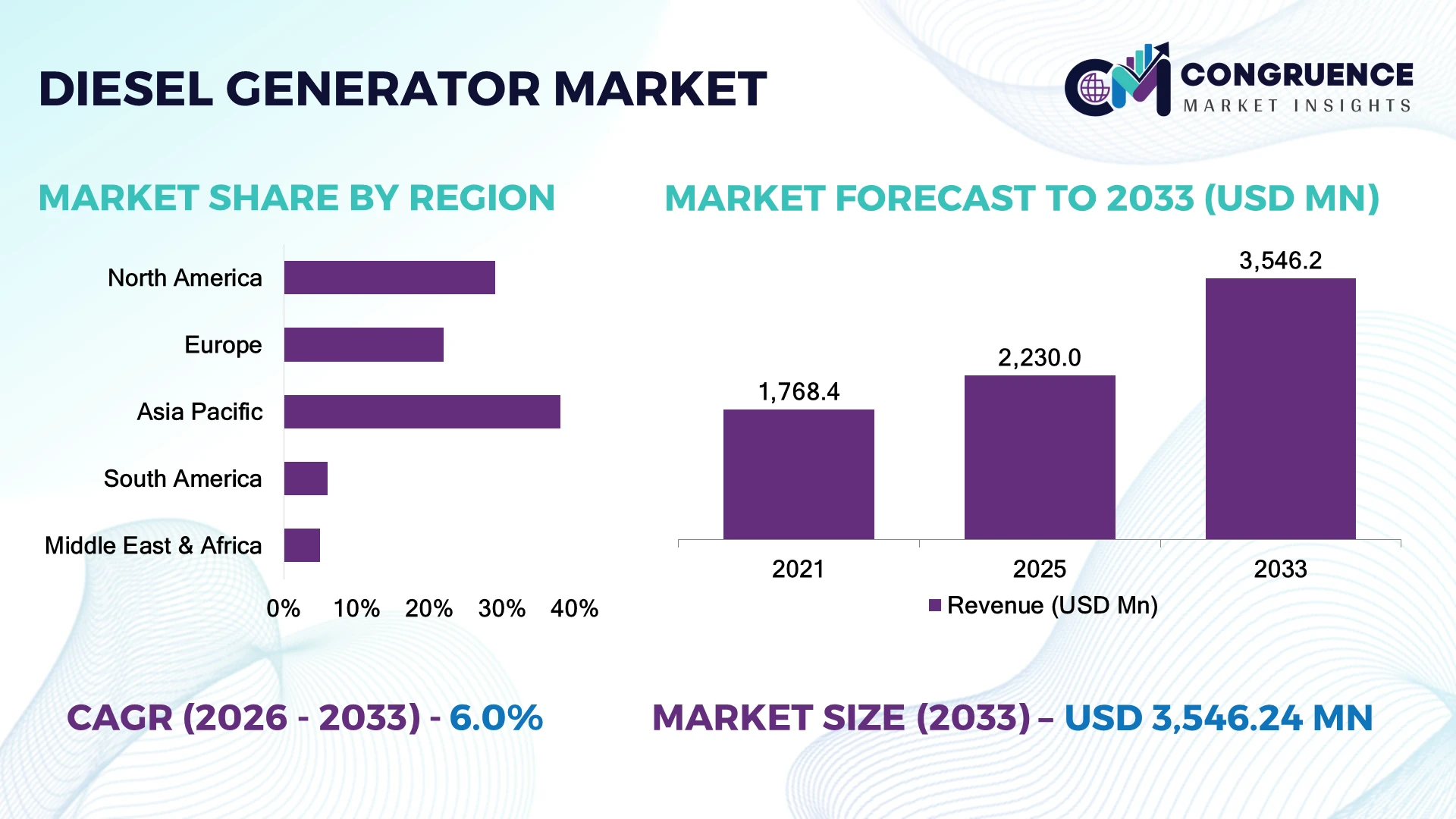
The Global Diesel Generator Market was valued at USD 2,230.0 Million in 2025 and is anticipated to reach a value of USD 3,546.2 Million by 2033 expanding at a CAGR of 5.97% between 2026 and 2033. Rapid expansion of hyperscale data centers, grid reliability concerns, and critical backup power requirements across manufacturing and energy infrastructure continue to accelerate diesel generator deployment globally.
The United States dominates the global diesel generator landscape with an estimated 24% market share, supported by more than 5,300 operational data centers, large-scale shale oil production, and over USD 70 billion in recent digital infrastructure investments. Compared with Germany, which emphasizes energy-efficient standby systems for industrial continuity, the U.S. deploys significantly larger prime-power capacities across energy, telecom, and cloud facilities. More than 85% of Tier III and Tier IV data centers maintain diesel-based backup systems, reinforcing national leadership amid ongoing energy security concerns linked to global geopolitical disruptions.
Strategically, suppliers that align generator portfolios with data center resilience, emissions compliance, and intelligent monitoring capabilities are best positioned to secure long-term industrial contracts.
Market Size & Growth: USD 2,230.0 Million in 2025, reaching USD 3,546.2 Million by 2033, driven by a 35% increase in global data center backup power installations and grid resilience investments.
Top Growth Drivers: Data center expansion (+35%), industrial backup power adoption (+28%), and critical infrastructure modernization (+22%) remain the three strongest demand catalysts.
Short-Term Forecast: By 2028, remote monitoring adoption is expected to improve generator fleet uptime by 18% while reducing maintenance costs by nearly 15%.
Emerging Technologies: AI-enabled predictive maintenance, IoT-based fuel optimization, and hybrid diesel-battery integration are improving operational efficiency by up to 20%.
Regional Leaders: North America (USD 950 Million), Asia-Pacific (USD 820 Million), and Europe (USD 510 Million) lead deployment, supported by digital infrastructure, industrial expansion, and energy security initiatives.
Consumer/End-User Trends: More than 70% of hyperscale data centers and approximately 65% of healthcare facilities rely on diesel backup systems for uninterrupted operations.
Pilot/Case Example: In 2024, a major data center project integrated intelligent generator controls, reducing unplanned downtime by 30% and fuel consumption by 12%.
Competitive Landscape: Caterpillar holds approximately 16% market share, with Cummins, Generac, Rolls-Royce, Mitsubishi Heavy Industries, and Kohler strengthening global competition.
Regulatory & ESG Impact: Advanced emission-control technologies have lowered particulate emissions by nearly 40%, supporting compliance with stricter environmental regulations.
Investment & Funding: More than USD 8 billion has been directed toward power resilience projects, strategic partnerships, and manufacturing capacity expansion globally.
Innovation & Future Outlook: Hybrid backup architectures, digital fleet management, and low-emission diesel platforms are reshaping competitive differentiation across high-growth markets.
Diesel generators remain essential for mission-critical operations across data centers, healthcare facilities, mining sites, and industrial manufacturing hubs. Recent innovations include intelligent load management, predictive maintenance software, and hybrid diesel-battery systems that improve fuel efficiency by over 15%. Growing deployment in emerging digital economies, combined with stricter operational continuity requirements and ongoing energy security initiatives, is accelerating technology upgrades and creating new opportunities for advanced backup power solutions, setting the stage for broader strategic transformation.
Diesel generators are becoming increasingly strategic as organizations prioritize operational resilience, power security, and infrastructure continuity. Rising investments in data centers, telecommunications networks, semiconductor facilities, and critical healthcare infrastructure have elevated backup power systems from operational assets to board-level strategic priorities. Simultaneously, grid modernization efforts and supply-chain restructuring are increasing demand for dependable onsite power capabilities.
Technology evolution is reshaping deployment economics. Modern digitally monitored diesel generators deliver approximately 15–20% better fuel efficiency and significantly lower maintenance requirements than legacy units through predictive diagnostics and automated performance optimization. In the United States, large-scale deployments focus on hyperscale data centers and energy infrastructure, while Germany emphasizes high-efficiency standby solutions for industrial manufacturing and export-driven production facilities. This contrast highlights different pathways toward operational resilience and energy reliability.
Companies are responding by expanding manufacturing capacity, strengthening service networks, and developing hybrid power partnerships that combine diesel systems with battery storage. A practical example is the integration of intelligent control systems within data center backup fleets, improving uptime performance while reducing fuel consumption. Over the next two to three years, adoption of connected fleet-management platforms and advanced emissions-control technologies is expected to accelerate, strengthening competitive positioning and reinforcing diesel generators as critical infrastructure assets across multiple industrial ecosystems.
The rapid growth of mission-critical infrastructure is accelerating diesel generator deployment across key industries. More than 70% of hyperscale data centers maintain diesel-based backup power systems, while global data center capacity additions have increased by over 30% during the past three years. Industrial operators increasingly require 99.9% power availability to protect production continuity and digital assets. Energy security concerns following geopolitical disruptions have further elevated investment priorities in backup power resilience. As a result, manufacturers are expanding production facilities, strengthening service networks, and introducing AI-enabled monitoring solutions. A notable strategic insight is that procurement decisions are increasingly driven by lifecycle reliability metrics rather than equipment acquisition costs, creating competitive advantages for suppliers offering integrated maintenance, analytics, and long-term service agreements.
Stricter emissions regulations and fuel-price volatility remain significant structural constraints for diesel generator adoption. Advanced emission-control systems can increase equipment costs by 12–18%, while diesel fuel expenses account for nearly 40% of long-term operating costs in intensive-use environments. In Germany and several other industrialized economies, tighter nitrogen oxide and particulate emission requirements are increasing compliance complexity. These pressures directly affect deployment economics, particularly for small and mid-sized enterprises. To mitigate risks, manufacturers are localizing component sourcing, diversifying supplier networks, and introducing lower-emission engine platforms. An important operational insight is that regulatory compliance costs increasingly influence purchasing decisions as much as power output specifications, reshaping competitive dynamics across industrial and commercial end-user segments.
The integration of hybrid power architectures presents a major opportunity for diesel generator providers. Combining diesel generators with battery storage can reduce fuel consumption by 15–25% while lowering maintenance requirements and extending asset life. India, Indonesia, and several African industrial hubs are accelerating investments in hybrid energy systems to improve grid reliability and support industrial expansion. Digital fleet-management platforms are also improving operational visibility, with predictive analytics reducing unplanned maintenance events by approximately 20%. Companies are responding through software partnerships, battery-storage collaborations, and targeted R&D programs. A less obvious opportunity lies in microgrid deployments, where hybrid diesel solutions can deliver reliable power in remote industrial environments while reducing overall energy costs and improving operational flexibility for resource-intensive sectors.
Long-term deployment complexity remains a critical challenge for the diesel generator ecosystem. More than 60% of large industrial facilities operate mixed fleets consisting of equipment from multiple vendors, creating interoperability and maintenance challenges. Skilled technician shortages exceeding 20% in several developed economies are increasing service delays and operational risks. At the same time, growing digital connectivity introduces cybersecurity requirements for remote monitoring and control systems. These factors affect deployment consistency, asset utilization, and long-term competitiveness. Companies must invest in workforce development, standardized digital platforms, and stronger technology partnerships to address these issues. A key strategic insight is that future market leaders will be defined not only by equipment performance but also by their ability to deliver integrated service ecosystems that simplify fleet management and ensure operational continuity.
Smart Fleet Monitoring Expansion Digital monitoring platforms are becoming standard across large generator fleets, with connected asset adoption increasing by 32% and predictive maintenance reducing unplanned outages by nearly 25%. Remote diagnostics now shorten service response times by 18%, improving uptime for critical facilities. Operators in the United States are integrating centralized control systems, while manufacturers are expanding software partnerships and cloud-based monitoring capabilities to strengthen recurring service revenues.
Hybrid Backup Systems Scaling Hybrid diesel-battery configurations are gaining traction as fuel optimization becomes a priority. Integrated systems are lowering fuel consumption by 15–25% and reducing maintenance interventions by approximately 20%. Stricter emissions requirements and rising energy resilience planning are accelerating deployment across industrial campuses and healthcare facilities. Suppliers are responding through battery-storage partnerships, modular power architectures, and expanded hybrid product portfolios designed for continuous operation environments.
Data Center Resilience Investments Hyperscale data center operators increased backup power infrastructure spending by more than 30%, while over 85% of new Tier III and Tier IV facilities continue specifying diesel-based emergency power systems. The rapid expansion of AI workloads and cloud computing capacity is reshaping procurement priorities. Generator manufacturers are scaling production, securing long-term supply agreements, and developing high-capacity units capable of supporting larger critical-load requirements.
Localized Supply Chain Strategies Equipment suppliers are restructuring sourcing networks as lead-time volatility remains a concern. Localized manufacturing initiatives have reduced component procurement delays by nearly 20%, while inventory visibility improvements have increased fulfillment reliability by 15%. A less obvious shift is the growing preference for regional assembly hubs, allowing faster customization and compliance adaptation. Companies are investing in supplier diversification, automation, and regional production capabilities to improve operational responsiveness.
Standby diesel generators remain the leading type segment, accounting for approximately 48% of total deployments. Their dominance is supported by widespread adoption across hospitals, data centers, commercial buildings, and public infrastructure where uninterrupted power availability is critical. Compared with other generator categories, standby systems offer superior emergency response capability, simpler integration with existing electrical infrastructure, and lower operational complexity. Prime generators represent a substantial portion of industrial and remote-site installations, particularly in mining and construction operations. More than 70% of large healthcare facilities continue relying on standby systems as their primary emergency power solution.
Prime power generators are the fastest-growing segment as industrial operators increasingly require continuous power support in regions with grid instability. Adoption within remote industrial projects has increased by approximately 22% over the past few years. Peak-shaving generators continue gaining relevance for energy-cost management and load-balancing applications. Manufacturers are responding through higher-capacity product launches, intelligent controls, and expanded service offerings. Investment priorities are increasingly shifting toward digitally connected platforms that enhance reliability and lifecycle performance.
Industrial applications lead the diesel generator market with an estimated 44% share, supported by manufacturing facilities, mining operations, energy projects, and heavy industrial infrastructure. Demand concentration stems from the requirement for uninterrupted operations, production continuity, and equipment protection. Industrial users frequently deploy larger-capacity systems capable of supporting critical processes during grid disruptions. Commercial applications follow closely, benefiting from adoption across office complexes, retail facilities, logistics hubs, and healthcare institutions. Approximately 65% of large industrial facilities maintain dedicated backup power assets to minimize operational downtime.
Commercial infrastructure is emerging as the fastest-growing application segment due to rapid digitalization, increased data center construction, and expanding telecommunications networks. Residential applications remain strategically important in countries experiencing recurring grid instability, although deployments typically involve lower-capacity units. Companies are scaling production, integrating remote monitoring technologies, and developing customized solutions tailored to sector-specific requirements. Demand is increasingly becoming operationally critical where business continuity directly influences revenue protection and service reliability.
Data centers represent the dominant end-user group, accounting for approximately 28% of diesel generator demand. Their leadership is driven by large-scale deployment requirements, high uptime standards, and expanding AI and cloud computing infrastructure. Backup power systems remain essential because even brief outages can disrupt mission-critical workloads. Telecommunications operators, healthcare institutions, and manufacturing facilities also represent major purchasing groups due to their dependence on continuous operations. More than 85% of hyperscale facilities maintain dedicated diesel backup infrastructure to support resilience requirements.
Telecommunications is the fastest-growing end-user segment as network expansion, edge computing deployment, and digital connectivity initiatives accelerate. Healthcare facilities continue strengthening emergency preparedness capabilities, while oil and gas operators prioritize power reliability in remote production environments. Companies are targeting these buyers through customized service agreements, intelligent monitoring systems, and long-term maintenance partnerships. Competitive positioning increasingly depends on the ability to deliver sector-specific reliability, compliance support, and lifecycle optimization rather than equipment supply alone.
Asia-Pacific accounted for the largest market share at 38% in 2025 however, Middle East & Africa is expected to register the fastest growth, expanding at a CAGR of 7.2% between 2026 and 2033.
North America accounted for approximately 29% of global diesel generator demand, supported by large-scale data center construction, energy infrastructure investments, and industrial backup power requirements. The United States and Canada continue prioritizing power resilience as extreme weather events and grid stability concerns increase operational risk. More than 85% of hyperscale data centers across the region deploy diesel-based emergency power systems. Healthcare facilities, telecommunications networks, and manufacturing operations are also expanding backup power capacity to ensure operational continuity. A notable development includes multibillion-dollar investments in AI-focused data center campuses that require high-capacity standby power infrastructure. Manufacturers are strengthening service networks, increasing localized assembly capabilities, and integrating predictive maintenance technologies to improve uptime performance and lifecycle efficiency.
United States Market Outlook: The United States remains the largest contributor within North America due to its unmatched concentration of hyperscale data centers, industrial facilities, and energy infrastructure assets. More than 5,300 operational data centers support sustained demand for advanced backup power solutions. Ongoing semiconductor manufacturing investments, energy-sector expansion, and cloud infrastructure deployment continue reinforcing generator procurement activity. Enterprises are increasingly prioritizing intelligent monitoring systems and long-term service agreements to improve reliability and reduce operational interruptions across critical infrastructure environments.
Europe represents approximately 22% of global diesel generator deployment, with demand increasingly influenced by industrial continuity requirements and stricter emissions standards. Manufacturing hubs, logistics facilities, healthcare institutions, and digital infrastructure operators continue investing in modern backup power systems capable of meeting evolving regulatory expectations. Advanced emission-control technologies and fuel-efficiency enhancements are becoming important procurement criteria. More than 60% of new commercial installations now include remote monitoring functionality to improve operational visibility and maintenance planning. The market is also benefiting from infrastructure modernization programs designed to strengthen energy security and operational resilience. Suppliers are focusing on compliant product platforms, service expansion, and technology upgrades to maintain competitiveness within a highly regulated operating environment.
Germany Market Outlook: Germany serves as the region's most influential diesel generator market due to its industrial manufacturing base, export-oriented economy, and advanced engineering ecosystem. Automotive production facilities, chemical processing plants, and precision manufacturing operations rely heavily on backup power reliability. Industrial enterprises continue upgrading power resilience infrastructure as operational continuity becomes increasingly critical. The country's strong focus on engineering performance and environmental compliance has accelerated adoption of low-emission generator technologies and intelligent asset management platforms across large-scale industrial installations.
Asia-Pacific holds the leading global position with approximately 38% market share, supported by extensive industrialization, manufacturing expansion, digital infrastructure development, and ongoing urbanization. Large-scale deployments are concentrated across manufacturing facilities, mining operations, telecommunications networks, and commercial infrastructure projects. Countries throughout the region continue investing heavily in power resilience to support economic development and industrial productivity. Data center construction activity has increased by more than 30% in several major markets, creating sustained demand for high-capacity standby systems. Equipment suppliers are expanding production facilities, strengthening distribution channels, and localizing supply chains to improve responsiveness and deployment efficiency. The region's combination of industrial scale and infrastructure investment continues reinforcing its dominant market position.
China Market Outlook: China remains the most strategically significant market due to its extensive manufacturing capacity, industrial infrastructure, and expanding digital economy. Large industrial parks, telecommunications deployments, and cloud computing investments support substantial backup power requirements. The country also serves as a major production hub for generator components and related equipment. Industrial modernization initiatives and ongoing data center expansion have accelerated procurement of higher-efficiency systems. Enterprises increasingly favor digitally connected generators capable of supporting predictive maintenance and operational optimization across large asset fleets.
South America accounts for approximately 6% of global market demand, driven primarily by mining operations, industrial facilities, energy projects, and infrastructure development activities. Operational reliability remains a key purchasing factor due to grid variability in several markets. Mining operators continue investing in prime-power generator systems to support remote production sites where uninterrupted electricity is essential. Recent infrastructure upgrades and industrial development initiatives have improved deployment opportunities across strategic sectors. However, logistics complexity and uneven infrastructure quality continue influencing project execution timelines. Suppliers are responding through localized service support, expanded dealer networks, and tailored maintenance programs that improve equipment availability and operational efficiency.
Brazil Market Outlook: Brazil represents the region's largest and most influential diesel generator market due to its industrial scale, mining activity, agricultural operations, and expanding commercial infrastructure. Large mining projects and remote industrial sites create consistent demand for reliable power generation assets. Telecommunications expansion and healthcare infrastructure development further support procurement activity. Enterprises increasingly seek generator solutions with improved fuel efficiency and digital monitoring capabilities to optimize operating costs while maintaining dependable performance across geographically dispersed operations.
Middle East & Africa accounts for approximately 5% of global diesel generator demand but represents one of the most dynamic deployment environments. Infrastructure modernization, industrial diversification programs, oil and gas operations, and large-scale construction projects continue driving procurement activity. Reliable backup and prime power solutions remain critical in locations where grid infrastructure expansion is still underway. Major industrial and commercial developments are increasing demand for high-capacity systems capable of supporting continuous operations. Several national infrastructure initiatives have accelerated investment in power resilience assets, while data center and telecommunications projects are creating additional deployment opportunities. Suppliers are expanding regional partnerships, service capabilities, and localized support infrastructure to strengthen market presence.
Saudi Arabia Market Outlook: Saudi Arabia stands as the most strategically significant market within the region due to its large-scale infrastructure programs, industrial diversification initiatives, and expanding digital economy. Major construction projects, industrial cities, and energy-sector investments continue generating substantial demand for backup and prime power systems. The country is also witnessing increasing deployment of advanced monitoring technologies that improve asset utilization and maintenance planning. Growing investments in data centers, telecommunications networks, and critical infrastructure projects are further reinforcing the importance of reliable diesel-powered energy solutions across multiple sectors.
The Diesel Generator Market is led by Caterpillar, Cummins, Rolls-Royce Power Systems (mtu), Generac Holdings, and Mitsubishi Heavy Industries, which collectively control approximately 55% of global market activity. Competition is primarily between global OEMs and regional manufacturers, while technology-focused suppliers increasingly challenge cost-driven competitors in premium infrastructure segments. Caterpillar and Cummins compete aggressively for hyperscale data center and industrial projects, whereas Rolls-Royce differentiates through high-performance backup systems and integrated power solutions. Technology, delivery speed, and lifecycle support increasingly outweigh upfront pricing. Advanced monitoring platforms improve fleet uptime by nearly 20%, while fuel-efficiency enhancements of 10–15% influence procurement decisions. Companies are expanding manufacturing capacity, securing supply-chain control, forming infrastructure partnerships, and integrating digital service ecosystems. The competitive shift is moving toward intelligent, connected, and hybrid-ready power systems rather than standalone equipment sales. High certification requirements, service-network depth, and emissions compliance remain major entry barriers. Winning requires reliability leadership, scalable production, digital capabilities, and long-term customer support excellence.
Cummins Inc.
Rolls-Royce Power Systems AG (mtu)
Generac Holdings Inc.
Mitsubishi Heavy Industries Ltd.
Kohler Energy
Yanmar Holdings Co., Ltd.
Kirloskar Oil Engines Ltd.
Atlas Copco AB
FG Wilson
HIMOINSA S.L.
Deere & Company
Wärtsilä Corporation
Mahindra Powerol
Digitalization is transforming diesel generator operations through IoT connectivity, predictive maintenance, and remote asset management. More than 60% of newly installed commercial and industrial units now incorporate connected monitoring capabilities. Predictive diagnostics reduce unplanned downtime by approximately 20% while lowering maintenance interventions by nearly 15%. Operators benefit from higher asset utilization, improved service planning, and stronger operational continuity across critical infrastructure environments.
Hybrid integration has emerged as a major technology transition. Modern diesel-battery systems reduce fuel consumption by 15–25% compared with conventional standalone generator installations. Advanced load-management software optimizes runtime and balances energy demand dynamically. Adoption is accelerating across data centers, healthcare facilities, and industrial campuses seeking greater resilience. Companies with strong software, storage integration, and energy-management expertise are gaining a competitive advantage over equipment-only providers.
The next wave of innovation includes AI-enabled fleet optimization, HVO-compatible engines, advanced emissions-control systems, and intelligent microgrid architectures. Compared with legacy generator platforms, digitally optimized systems can improve overall operational efficiency by up to 20%. Between 2026 and 2028, adoption of intelligent power-management ecosystems is expected to expand significantly as enterprises prioritize resilience, compliance, and lifecycle performance. Organizations acting now secure stronger operational flexibility, lower operating costs, and greater infrastructure readiness.
March 2025 – Rolls-Royce announced a USD 24 million expansion of its Minnesota facility to support mtu backup power systems for data centers. Production capacity is expected to increase by more than 120% by 2026, strengthening supply availability for critical infrastructure customers. Source: rolls-royce.com
December 2025 – Rolls-Royce and AVK signed a five-year capacity agreement for mtu emergency power generators. The partnership follows deployment of more than 600 mtu gensets and improves long-term supply security for rapidly expanding European data center projects. Source: rolls-royce.com
August 2025 – Caterpillar partnered with Joule Capital Partners and Wheeler Machinery to support a high-performance computing campus in Utah. The project targets 4 GW of energy capacity using advanced generator and cooling solutions, significantly expanding mission-critical power infrastructure. Source: caterpillar.com
August 2025 – Caterpillar launched a new 1.5 MW diesel generator set featuring a smaller installation footprint designed for space-constrained standby applications. The launch enhances deployment flexibility for commercial facilities, healthcare infrastructure, and data center operators. Source: cat.com
This report provides comprehensive analysis of the Diesel Generator Market across key generator types, applications, end-user industries, and major geographic regions. The study evaluates standby, prime, and peak-shaving generator segments while examining deployment patterns across industrial, commercial, and residential environments. Regional assessment covers North America, Europe, Asia-Pacific, South America, and the Middle East & Africa, representing more than 95% of global deployment activity. The report also examines technology adoption trends including intelligent monitoring, hybrid power integration, remote diagnostics, and advanced emissions-control systems.
The analysis incorporates competitive positioning of major manufacturers, evolving procurement strategies, infrastructure investment trends, and operational deployment priorities. More than half of new enterprise installations now integrate digital monitoring capabilities, highlighting the market’s ongoing technology transition. Strategic insights support investment planning, capacity expansion decisions, partnership evaluation, product development priorities, and long-term competitive positioning. The report also assesses emerging opportunities in data centers, telecommunications networks, healthcare infrastructure, industrial facilities, and resilient power ecosystems expected to shape market direction between 2026 and 2033.
| Report Attribute / Metric | Details |
|---|---|
| Market Revenue (2025) | USD 2,230.0 Million |
| Market Revenue (2033) | USD 3,546.2 Million |
| CAGR (2026–2033) | 5.97% |
| Base Year | 2025 |
| Forecast Period | 2026–2033 |
| Historic Period | 2021–2025 |
| Segments Covered |
By Type
By Application
By End-User
|
| Key Deliverables | Revenue Forecast; Market Trends; Growth Drivers & Restraints; Technology Insights; Segmentation Analysis; Regional Insights; Competitive Landscape; Regulatory & ESG Overview; Recent Developments |
| Regions Covered | North America; Europe; Asia-Pacific; South America; Middle East & Africa |
| Companies Profiled | Caterpillar Inc.; Cummins Inc.; Rolls-Royce Power Systems AG (mtu); Generac Holdings Inc.; Mitsubishi Heavy Industries Ltd.; Kohler Energy; Yanmar Holdings Co., Ltd.; Kirloskar Oil Engines Ltd.; Atlas Copco AB; FG Wilson; HIMOINSA S.L.; Deere & Company; Wärtsilä Corporation; Mahindra Powerol |
| Customization & Pricing | Available on Request (10% Customization Free) |




