
Reports
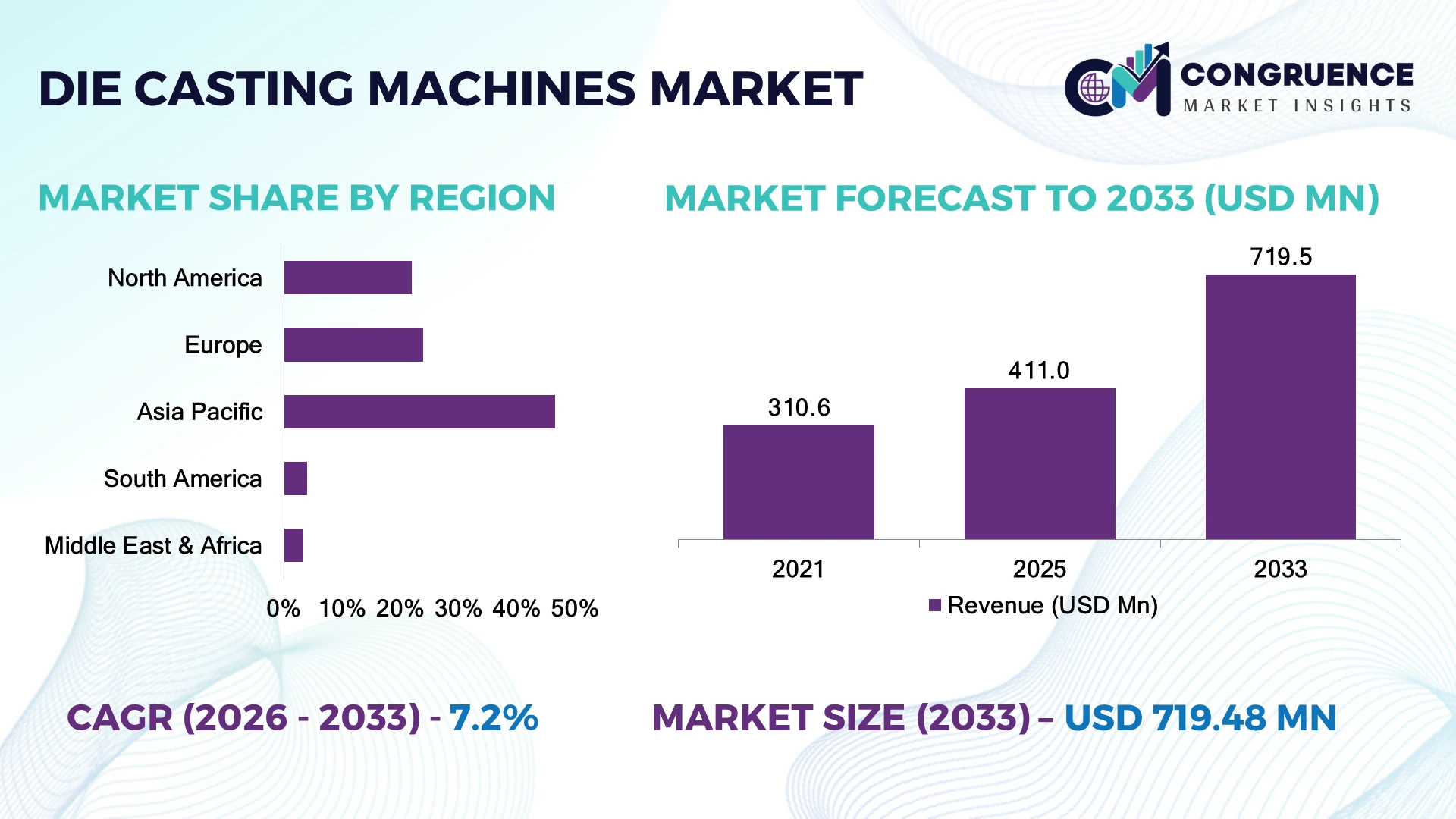
The Global Die Casting Machines Market was valued at USD 411.0 Million in 2025 and is anticipated to reach a value of USD 719.5 Million by 2033 expanding at a CAGR of 7.3% between 2026 and 2033. Growth is driven by the shift toward high-tonnage aluminum die casting, structural megacasting, electric-vehicle component integration, and automated production cells that reduce part counts and assembly requirements.
China dominates manufacturing capacity, accounting for about 46% of global die-casting machine production, while India is strengthening its position through automotive localization and advanced casting investments; India produced 30.61 million vehicles in 2024, compared with 31.28 million in China, while pressure die casting represented more than 68% of India's automotive aluminum die-casting process mix. India's proposed USD 1.2 billion advanced-manufacturing incentive initiative, partly driven by supply-chain vulnerabilities exposed by geopolitical tensions with China, reinforces localization opportunities for casting-equipment suppliers.
Strategically, machine suppliers should prioritize high-tonnage platforms, localized service networks, and intelligent automation to capture automotive and electronics capacity migration.
Market Size & Growth: Market value reaches USD 719.5 million by 2033 from USD 411.0 million in 2025, at a 7.3% CAGR, driven by megacasting and lightweight aluminum component production.
Top Growth Drivers: Automotive electrification 30%; industrial automation 25%; lightweight aluminum adoption 20%.
Short-Term Forecast: By 2028, automated machine-cell adoption is positioned to lift production efficiency by approximately 15%, while integrated process monitoring reduces quality-related downtime by around 10%.
Emerging Technologies: AI process control, robotic extraction, digital twins, vacuum-assisted casting, and advanced aluminum alloys are reshaping high-pressure die-casting operations.
Regional Leaders: North America is projected at about USD 244.6 million by 2033, Europe at USD 208.7 million, and Asia-Pacific at USD 201.5 million, supported by EV platforms, automation, and manufacturing localization.
Consumer/End-User Trends: Automotive applications remain dominant, with automotive accounting for about 41% of India's foundry-equipment demand and OEM/Tier-1 suppliers representing nearly 75% of India's automotive aluminum die-casting market.
Pilot/Case Example: In 2025, large-scale megacasting projects advanced across the United States, Europe, China, and Vietnam, with individual castings replacing up to 100 structural parts and reducing assembly complexity.
Competitive Landscape: Bühler leads with approximately 18% share, followed by Toshiba Machine at about 15%; Frech, UBE Machinery, Yizumi, and L.K. Group remain key competitors.
Regulatory & ESG Impact: Energy-efficiency requirements and low-carbon manufacturing programs are accelerating equipment upgrades, while closed-loop systems can reduce process-water consumption and material waste by approximately 10%–20%.
Investment & Funding: India's proposed USD 1.2 billion manufacturing incentive plan and targeted private investment of USD 1.8 billion strengthen localization and advanced-equipment opportunities amid global supply-chain restructuring.
Innovation & Future Outlook: Next-generation platforms are shifting toward 6,000–9,000-ton presses, AI-enabled quality control, integrated machining, and lower-energy electric or hybrid systems, moving competition from machine price toward complete production-cell performance.
Die Casting Machines Market demand is concentrating around automotive structural parts, EV battery housings, motor housings, electronics enclosures, and industrial components. Pressure die casting represented 68.74% of India's automotive aluminum die-casting process in 2025, reinforcing the importance of high-speed, precision equipment. Supply-chain localization and tighter sustainability requirements are accelerating investment in automated, resource-efficient casting cells, creating a stronger strategic case for integrated equipment solutions.
Die casting machines are becoming strategically important because automotive manufacturers are redesigning vehicle architectures around fewer, larger aluminum components. Megacasting can replace up to 100 structural parts with a single casting, reducing assembly complexity and creating a direct competitive advantage for manufacturers with high-tonnage equipment and integrated process control.
Technology differentiation is increasingly measurable: advanced automated cells can improve production efficiency by around 15% and reduce quality-related downtime by approximately 10% versus less-integrated production environments. China retains major manufacturing scale, while India is building a cost-competitive alternative through automotive localization, with pressure die casting representing more than 68% of its automotive aluminum die-casting process mix.
Over the next 2–3 years, manufacturers will prioritize automated extraction, AI-enabled monitoring, vacuum systems, and 6,000–9,000-ton platforms. India's installation of a 4,400-ton high-pressure machine in Pune demonstrates the move toward large structural components, while global suppliers are expanding local service and production capabilities. Companies that combine machine supply with tooling, software, maintenance, and process engineering will secure stronger customer retention and operational positioning.
The primary growth driver is the automotive industry's transition toward structural aluminum casting and integrated EV platforms. Pressure die casting already represents 68.74% of India's automotive aluminum die-casting process mix, while OEM/Tier-1 suppliers control 74.88% of the market, creating concentrated demand for advanced equipment. Geopolitical supply-chain restructuring is also pushing manufacturers toward localized production. Companies are responding by investing in high-tonnage presses, automated cells, vacuum systems, and integrated machining. The non-obvious advantage is reduced assembly complexity: megacasting can replace up to 100 structural components, shifting equipment purchasing decisions from individual machines toward complete production systems.
High equipment costs and specialized component requirements constrain adoption among smaller foundries. Machines above 6,000 tons require substantial engineering capability, tooling investment, and infrastructure, while electricity, aluminum alloy, hydraulic components, and precision controls remain exposed to supply-chain volatility. Capital-intensive installations also increase project payback sensitivity when automotive production schedules change. Companies are reducing exposure through multi-year procurement contracts, localized component sourcing, refurbished equipment, and retrofit programs. The operational pressure is strongest for smaller Indian and Southeast Asian manufacturers that need large machines to compete for structural components but lack the utilization rates of global Tier-1 suppliers. Strategic partnerships and shared capacity models therefore provide a practical route to lower asset-utilization risk.
The strongest opportunity lies in combining large-tonnage casting with AI, digital twins, robotic handling, and closed-loop process control. More than 45% of recent industry investment programs are directed toward next-generation machinery and intelligent production systems, indicating a shift from mechanical equipment toward connected manufacturing platforms. India offers a particularly attractive expansion opportunity as automotive localization and electronics manufacturing increase demand for precision aluminum housings. Companies are positioning through R&D, local service centers, and partnerships with OEMs and tooling suppliers. A less obvious opportunity is retrofit technology: upgrading installed machines with sensors, automation, and predictive maintenance can extend asset life while delivering measurable efficiency gains without full equipment replacement.
Scaling advanced die casting requires simultaneous integration of machine controls, robotics, tooling, thermal management, inspection, and manufacturing software. Production efficiency gains of approximately 15% depend on consistent integration rather than machine capability alone, increasing the importance of skilled technicians and process engineers. Cybersecurity and data interoperability add further complexity as connected equipment becomes embedded within smart factories. Companies must strengthen technical training, standardized machine interfaces, remote diagnostics, and supplier partnerships. The strategic challenge is maintaining repeatable quality across multiple plants while transferring digital recipes and process parameters securely. Manufacturers that solve workforce and integration bottlenecks will achieve more consistent deployment, lower commissioning delays, and stronger long-term competitiveness.
Megacasting Reshapes Production Cells: Automotive plants are shifting toward 3,500–9,000-ton cold-chamber systems as structural castings replace dozens of stamped and welded parts. Large-machine deployments are rising as OEMs pursue 10%–20% reductions in assembly complexity and shorter takt times. Supply-chain localization is accelerating this transition, particularly in China, India, and North America, while equipment suppliers are bundling robotics, vacuum systems, and inline inspection into complete casting cells.
Energy-Efficient Presses Gain Ground: Servo-hydraulic drives, heat recovery, variable-speed pumps, and closed-loop cooling are becoming standard upgrade priorities, with advanced systems targeting 15%–25% lower energy consumption than conventional hydraulic configurations. European manufacturers face stronger decarbonization pressure, while Asian plants increasingly evaluate equipment on total cost of ownership. Suppliers are responding with retrofit packages that improve machine efficiency without requiring complete press replacement.
AI Monitoring Enters Mainstream: Connected die casting cells are moving beyond basic machine monitoring toward predictive quality control, with automated systems targeting approximately 10%–15% reductions in unplanned downtime and 15%+ improvements in dimensional consistency. Real-time shot-pressure, melt-temperature, die-condition, and cooling data are increasingly integrated into plant analytics. Labor shortages are reinforcing adoption as manufacturers use automation to stabilize output with fewer highly skilled operators.
Hot-Chamber Electronics Demand Accelerates: Zinc and magnesium components for electronics, telecommunications, and precision hardware are pushing hot-chamber deployments toward faster-cycle configurations, with optimized systems achieving cycle-time improvements of roughly 15%–25%. The non-obvious shift is that electronics buyers increasingly prioritize repeatability and automated inspection over maximum machine tonnage. Suppliers are expanding compact robotic cells and multi-slide-compatible platforms as production moves closer to regional electronics manufacturing hubs.
Cold chamber die casting machines remain the leading type, accounting for approximately 64%–68% of global deployment because they process aluminum and other higher-melting-point alloys required for automotive structures, powertrain components, and industrial housings. Their scalability across medium and high clamping forces gives manufacturers greater flexibility than hot chamber systems, while large automotive programs increasingly favor machines above 3,500 tons. Companies are consequently prioritizing servo injection, vacuum assistance, automated ladling, and closed-loop cooling to improve throughput and casting integrity.
Hot chamber machines represent roughly 32%–36% of deployment but are gaining traction in high-volume zinc and magnesium applications. Their integrated metal-feeding architecture enables cycle times around 15%–25% faster than comparable cold-chamber operations for suitable alloys. Electronics, hardware, and compact automotive components are driving this shift, prompting suppliers to expand high-speed platforms and automated cells.
The Automobile Industry is the leading application, representing approximately 54%–56% of global machine installations. Demand is concentrated around aluminum engine components, transmission housings, motor housings, chassis structures, and increasingly large EV structural castings. Automotive production requires high machine utilization and tight dimensional consistency, giving cold-chamber systems a substantial advantage over equipment designed primarily for smaller components. Manufacturers are increasing automation, robotic extraction, vacuum casting, and inline inspection to support higher-volume programs while reducing manual handling.
The 3C Industry is the fastest-growing application group, with approximately 11%–15% of installations and increasing demand for compact, high-precision components. Household Appliances account for roughly 18%, maintaining steady requirements for compressor frames, control housings, heat sinks, and hardware. Compared with mature automotive programs, 3C applications emphasize shorter cycles and tighter surface-finish requirements.
Transportation is the dominant end-user category, accounting for approximately 50%–55% of global die casting machine demand because automotive and commercial-vehicle manufacturers require high-volume aluminum production, large structural components, and repeatable dimensional quality. These buyers increasingly specify complete casting islands rather than standalone machines, integrating robotics, trimming, inspection, and process analytics. Companies are responding with customized high-tonnage platforms, long-term service agreements, and partnerships covering tooling and automation to secure major vehicle-program contracts.
Mechanical & Manufacturing Equipment represents approximately 20%–25% of demand and is becoming an important diversification channel, while Building & Construction contributes roughly 10%–15% through hardware, fittings, structural accessories, and specialized components. Other end-users account for the balance and include aerospace, medical, and specialized industrial production. Compared with transportation buyers, these customers favor flexible medium-tonnage equipment and shorter changeover cycles.
Asia-Pacific accounted for the largest market share at 46.6% in 2025 however, Middle East & Africa is expected to register the fastest growth, expanding at a CAGR of 7.7% between 2026 and 2033.
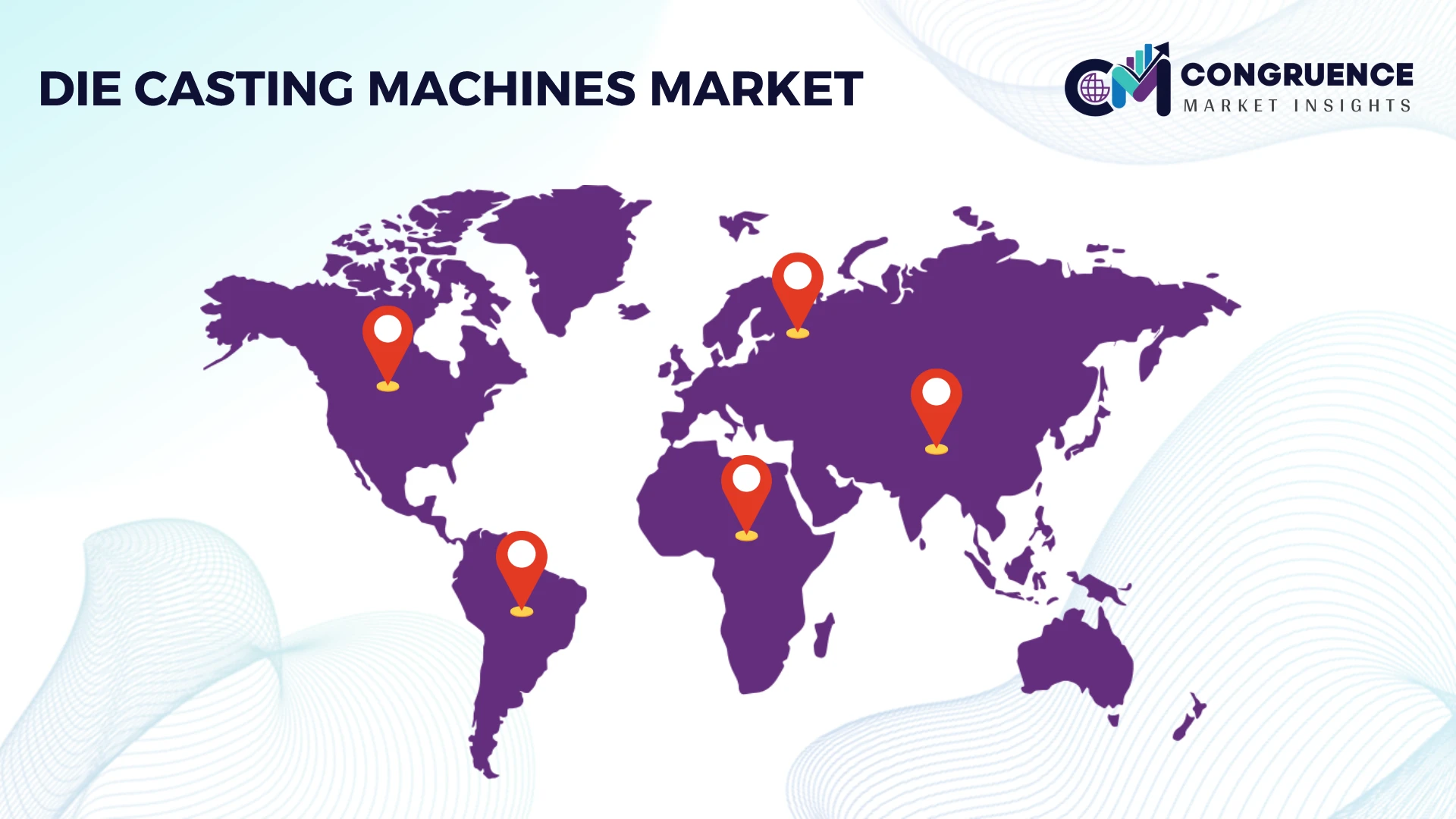
North America represents approximately 22.0% of global die casting machinery demand, supported by automotive, aerospace, industrial equipment, and EV component manufacturing. The United States remains the principal deployment center, while Mexico is strengthening its role as a nearshoring hub for automotive and electronics supply chains. More than 1,200 die casting facilities operate across the United States, with Michigan, Ohio, and Indiana together representing about 41% of domestic production capacity. Large casting cells are increasingly integrated with robotic extraction, automated trimming, and real-time inspection. Companies are prioritizing replacement of legacy hydraulic equipment with energy-efficient platforms and expanding supplier partnerships to shorten commissioning cycles. The strategic shift is from standalone press procurement toward complete automated casting-cell investments.
United States Market Outlook: The United States remains the region's most important equipment market because of its dense automotive manufacturing base, advanced industrial infrastructure, and accelerating EV localization. Domestic suppliers operate extensive fleets spanning approximately 250 to 3,000 tons, supporting automotive, aerospace, appliance, and industrial component programs. Investment is increasingly directed toward automated aluminum casting, structural components, and digitally monitored production cells.
Europe holds approximately 24.0% of global die casting machinery demand, with Germany, Italy, France, and the United Kingdom forming the principal industrial markets. Automotive manufacturing remains the largest deployment base, but equipment purchasing is increasingly shaped by energy efficiency, emissions reduction, and replacement of aging presses. More than 46% of newly installed European machines use servo-hydraulic technology, reflecting stronger emphasis on energy management and process control. Italy's established machine-building ecosystem supports large-scale casting equipment and tooling development, while Germany emphasizes smart-factory integration and advanced aluminum processing. Companies are combining machine upgrades with predictive maintenance, closed-loop cooling, and automated quality inspection. The competitive advantage increasingly comes from lowering lifetime operating costs rather than simply maximizing press capacity.
Germany Market Outlook: Germany remains Europe's strategic technology center because of its concentration of automotive OEMs, Tier-1 suppliers, engineering companies, and specialized machinery producers. Automotive applications account for more than half of regional utilization, keeping demand focused on high-precision aluminum components. Manufacturers are increasingly combining casting equipment with digital process monitoring and low-energy production systems to meet tighter industrial efficiency requirements.
Asia-Pacific commands approximately 46.6% of global die casting machinery demand, supported by China's automotive and electronics ecosystems, Japan's precision-engineering capabilities, South Korea's electronics manufacturing, and India's expanding automotive and EV production. China accounts for roughly 62% of Asia-Pacific installations, giving the country an exceptional equipment and supplier-network concentration. India is emerging as a complementary manufacturing hub through automotive localization and new lightweight-component capacity. ASEAN markets are attracting mid-capacity equipment as manufacturers diversify sourcing and establish regional backup production. Companies are responding through local manufacturing, faster installation cycles, service-center expansion, and partnerships with automotive and electronics producers. The region's non-obvious advantage is its ability to combine high-volume machine procurement with vertically integrated tooling, alloy, automation, and component ecosystems.
China Market Outlook: China remains the dominant country within Asia-Pacific because its automotive, electronics, appliance, and machinery clusters generate sustained demand for die casting capacity. The country accounts for approximately 62% of regional machine installations and benefits from extensive domestic tooling and component supply chains. EV manufacturing further strengthens demand for high-tonnage aluminum equipment, automated cells, and structural casting technologies.
South America represents approximately 4.0% of global die casting equipment demand, with Brazil accounting for the majority of regional activity through automotive, appliances, industrial machinery, and consumer-product manufacturing. Equipment procurement remains more project-driven than in China or the United States, with buyers placing greater emphasis on utilization rates, maintenance support, and import economics. Brazil's automotive production base continues to support aluminum component demand, while industrial modernization is encouraging replacement of older presses with semi-automated and automated systems. Local manufacturers are increasingly seeking equipment packages that combine casting, trimming, robotics, and inspection to offset skilled-labor constraints. Companies are also strengthening distributor partnerships and regional service networks because imported machinery can face longer delivery and spare-parts cycles. The strategic opportunity lies in supplying flexible medium-tonnage platforms rather than competing solely on maximum press capacity.
Brazil Market Outlook: Brazil is the region's most significant market because it combines the largest manufacturing base with established automotive and industrial supply chains. Demand is concentrated around automotive components, appliance hardware, and machinery parts, creating a diversified utilization profile. Manufacturers are prioritizing equipment with adaptable tooling and stronger automation because production runs vary more widely than in high-volume Asian clusters.
Middle East & Africa represents approximately 3.4% of global die casting machinery demand but is becoming an important equipment-development market as Gulf economies diversify beyond hydrocarbons. Saudi Arabia and the United Arab Emirates together account for nearly half of regional machine demand, supported by industrial parks, metals processing, automotive initiatives, construction equipment, and renewable-energy manufacturing. Saudi Arabia increased industrial manufacturing investment by approximately 21% in 2025, strengthening the business case for aluminum processing and downstream component production. New facilities are increasingly designed around automated material handling, high-pressure casting, and digitally monitored production rather than traditional labor-intensive workflows. Companies are responding through joint ventures, technology partnerships, local service infrastructure, and capacity expansion. However, imported equipment and specialized technical skills remain important constraints, making supplier localization a decisive factor in successful deployments.
Saudi Arabia Market Outlook: Saudi Arabia is the region's leading strategic market because industrial diversification programs are creating new demand for locally manufactured transportation, machinery, energy, and infrastructure components. Manufacturing investment increased by approximately 21% in 2025, strengthening demand for advanced metal-processing equipment. Suppliers with local technical support, training capabilities, and integrated automation packages are best positioned to capture new industrial capacity.
Bühler and UBE Machinery compete as premium engineering-led suppliers against YIZUMI, LK Technology, and Haitian Die Casting, which combine aggressive pricing, scale, and expanding international service networks. The top five players collectively command an estimated 55% of the market, creating a moderately concentrated structure. Competition centers on technology, with AI-enabled control and ultra-large machines influencing roughly 30% of purchasing decisions, while energy efficiency affects about 20% and delivery/service responsiveness about 15%. Bühler is expanding megacasting deployments, UBE is extending 4,500–9,000-ton platforms, YIZUMI is combining AI with rheocasting, and LK and Haitian emphasize integrated manufacturing ecosystems. The competitive shift is moving from standalone presses toward turnkey casting cells, digital controls, and localized after-sales support. High tooling expertise, application engineering, installed-base relationships, and capital requirements create significant entry barriers. Winning requires combining machine performance, rapid commissioning, local service, automation integration, and cost competitiveness rather than competing on equipment price alone.
Bühler Group
UBE Machinery Corporation
YIZUMI Group
LK Technology Holdings Limited
Haitian Die Casting
Oskar Frech GmbH + Co. KG
Toshiba Machine Co., Ltd.
S. Pranav Die Casting Machines
Italpresse Gauss
AGRATI AEE
Toshiba Machine Co., Ltd.
BuhlerPrince
Zitai Precision Machinery
ZheJiang Wanfeng Technology
AI-enabled process control is becoming a core differentiator as manufacturers integrate real-time shot monitoring, automatic parameter adjustment, defect analytics, and digital production records. YIZUMI reports that AI-assisted setup can reduce parameter-adjustment time from about two hours to five minutes, while manual intervention falls by up to 90%. By 2028, these systems will increasingly connect machine data with MES and quality platforms, strengthening consistency and reducing operator dependence.
Ultra-large two-platen machines are replacing conventional presses for structural aluminum components. Current platforms reach 9,000 tons, while newer giga-casting configurations target 4,500–7,300 tons. YIZUMI reports 50% energy savings and 10% footprint reduction for its NEXT² platform versus its reference configuration. This technology favors OEMs and Tier-1 suppliers pursuing fewer components, faster assembly, and localized structural manufacturing.
Semi-solid rheocasting and magnesium thixomolding represent the disruptive layer through 2026–2028. YIZUMI's RHEO portfolio spans 530–2,500 tons, while its magnesium technology has reached 10,000 tons. Rheocasting improves material density and defect control, supporting higher-value structural applications. Equipment suppliers that combine advanced metallurgy, AI control, automation, and turnkey process engineering will gain an advantage as manufacturers shift toward integrated production cells rather than standalone machines.
May 2025 — UBE Machinery expanded its giga-casting portfolio with UH7300 and UH4500 machines, extending its range to 4,500–9,000 metric tons. The expansion strengthens its position in large structural BEV components and gives automotive customers broader machine-selection flexibility. Source: ube.com
June 2025 — Bühler reached its 50th Carat megacasting order, with six of the world's ten largest automakers already using megacasting and four purchasing Bühler solutions. The milestone confirms growing OEM adoption and strengthens Bühler's installed-base advantage in structural casting. Source: buhlergroup.com
July 2025 — YIZUMI delivered a 6,600-ton MGII Plus magnesium thixomolding machine to Sinyuan ZM, advancing scalable semi-solid magnesium production. The deployment expands YIZUMI's technology reach into EV and lightweight structural applications while demonstrating its technology-plus-service model. Source: yizumi.com
August 2025 — UBE Machinery received an order for its 4,500-metric-ton UH4500 giga-casting machine from Yamada Manufacturing, scheduled for installation by March 2027. The order converts UBE's expanded ultra-large portfolio into a concrete automotive manufacturing deployment and reinforces Japan's giga-casting capacity. Source: ube.com
The report covers the global Die Casting Machines Market across cold-chamber and hot-chamber machine types, automobile, 3C, household-appliance, and other application environments, and transportation, mechanical and manufacturing equipment, building and construction, and other end-user groups. Analysis spans North America, Europe, Asia-Pacific, South America, and Middle East & Africa, with country-level emphasis on major manufacturing hubs.
The study evaluates high-tonnage machines, two-platen systems, AI-enabled controls, automation, vacuum-assisted casting, rheocasting, thixomolding, digital monitoring, and energy-efficient technologies. It also assesses deployment concentration, adoption patterns, competitive positioning, localization strategies, and supplier capabilities. The findings support equipment investment decisions, capacity expansion, technology selection, partnership development, geographic entry, and competitive planning through 2033, with particular attention to automotive lightweighting, EV structural components, electronics, and industrial modernization.
| Report Attribute / Metric | Details |
|---|---|
| Market Revenue (2025) | USD 411.0 Million |
| Market Revenue (2033) | USD 719.5 Million |
| CAGR (2026–2033) | 7.3% |
| Base Year | 2025 |
| Forecast Period | 2026–2033 |
| Historic Period | 2021–2025 |
| Segments Covered |
By Type
By Application
By End-User
|
| Key Deliverables | Revenue Forecast; Market Trends; Growth Drivers & Restraints; Technology Insights; Segmentation Analysis; Regional Insights; Competitive Landscape; Regulatory & ESG Overview; Recent Developments |
| Regions Covered | North America; Europe; Asia-Pacific; South America; Middle East & Africa |
| Companies Profiled | Bühler Group; UBE Machinery Corporation; YIZUMI Group; LK Technology Holdings Limited; Haitian Die Casting; Oskar Frech GmbH + Co. KG; Toshiba Machine Co., Ltd.; S. Pranav Die Casting Machines; Italpresse Gauss; AGRATI AEE; BuhlerPrince; Zitai Precision Machinery; ZheJiang Wanfeng Technology |
| Customization & Pricing | Available on Request (10% Customization Free) |




