
Reports
The Global Detection Tools Market was valued at USD 5720 Million in 2025 and is anticipated to reach a value of USD 8845.19 Million by 2033 expanding at a CAGR of 5.6% between 2026 and 2033. Growth is driven by rising deployment of AI-enabled detection platforms across cybersecurity, industrial inspection, healthcare diagnostics, and critical infrastructure monitoring to improve accuracy, response speed, and operational resilience.
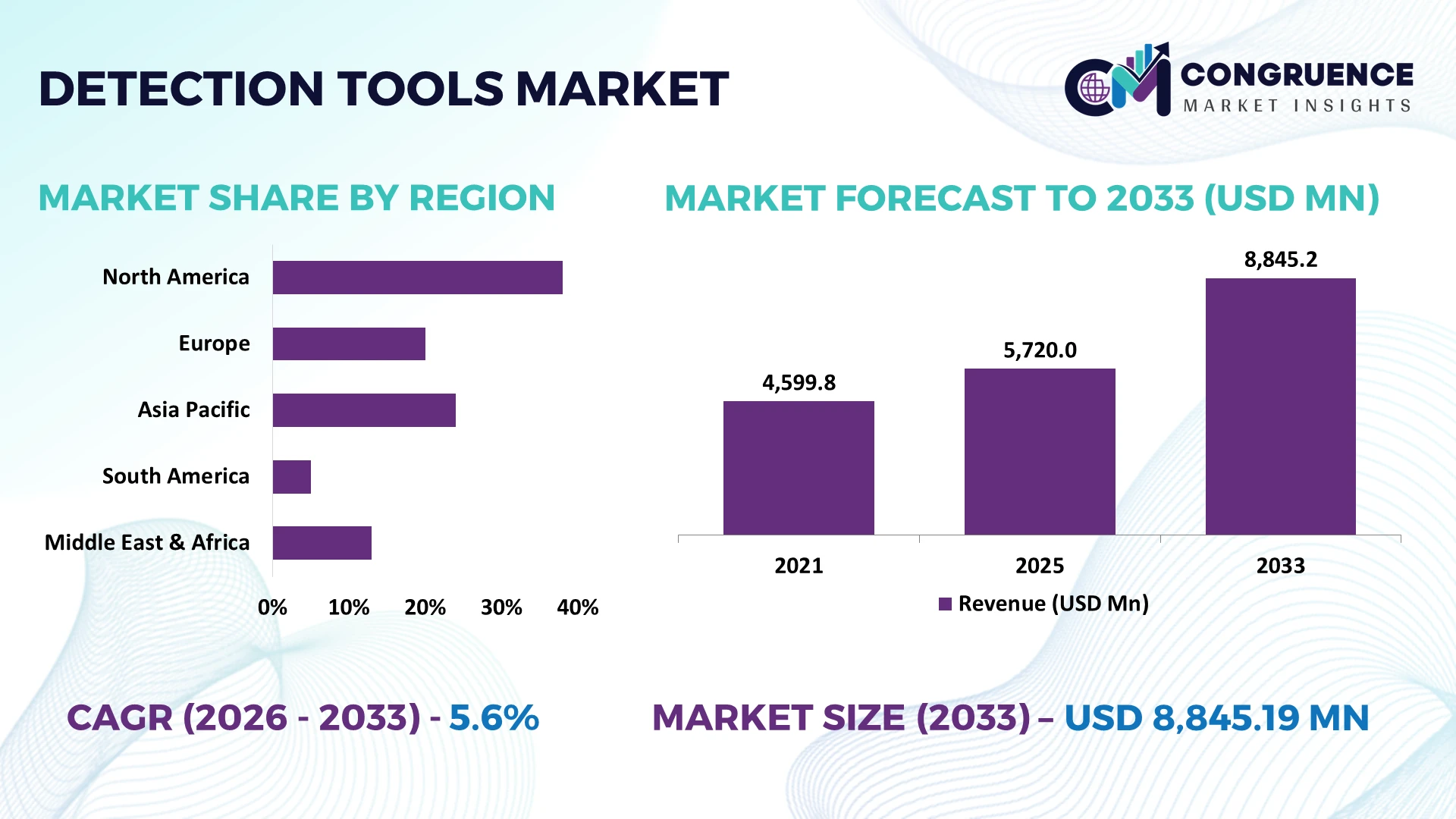
The United States remains the dominant market, accounting for approximately 34% of global deployment, supported by sustained investments in cybersecurity, defense, semiconductor manufacturing, and healthcare diagnostics. AI-assisted detection solutions exceed 60% adoption across large enterprises, while Germany leads European industrial inspection with Industry 4.0 integration across advanced manufacturing facilities. Ongoing digital infrastructure modernization and heightened cyber resilience initiatives following persistent geopolitical tensions further accelerate enterprise deployment across high-value sectors.
Organizations prioritizing scalable, intelligent detection platforms gain stronger operational visibility, regulatory readiness, and long-term competitive resilience.
Market Size & Growth: USD 5720 million (2025) to USD 8845.19 million (2033) at 5.6% CAGR, supported by AI-powered threat detection and industrial digitalization.
Top Growth Drivers: AI analytics improve detection accuracy by 35%, cloud monitoring adoption exceeds 48%, and industrial automation deployments increase 29%.
Short-Term Forecast: By 2028, automated detection workflows reduce incident response time by 32% and operational costs by 18%.
Emerging Technologies: AI, edge analytics, and real-time sensor fusion increase detection precision by nearly 30% across advanced monitoring environments.
Regional Leaders: North America approaches USD 3.2 billion, Europe USD 2.1 billion, Asia-Pacific USD 2.6 billion, supported by expanding digital infrastructure and regional manufacturing investment.
Consumer/End-User Trends: More than 62% of large enterprises deploy intelligent detection platforms for continuous monitoring and predictive risk management.
Pilot/Case Example: In 2026, an AI-enabled industrial detection deployment improved anomaly identification by 28% while reducing false alarms by 24%.
Competitive Landscape: Leading vendors collectively control approximately 42% of the market, with Honeywell, Siemens, Bosch, Fortinet, and Cisco maintaining strong technology portfolios.
Regulatory & ESG Impact: Compliance-driven monitoring reduces reporting delays by 25% while strengthening operational transparency across regulated industries.
Investment & Funding: More than USD 3 billion supports partnerships, AI integration, manufacturing expansion, and supply-chain resilience across global detection technologies.
Innovation & Future Outlook: Next-generation multimodal AI, autonomous inspection, and edge intelligence accelerate enterprise transformation and strengthen cross-border operational resilience.
Detection Tools Market demand continues expanding across cybersecurity, industrial automation, healthcare diagnostics, and smart infrastructure as organizations prioritize faster threat identification and predictive monitoring. AI-enabled analytics improve detection precision by approximately 30%, while edge-based processing reduces latency in mission-critical operations. Strengthening compliance frameworks and resilient supply-chain operations further accelerate adoption, setting the foundation for the strategic market assessment that follows.
Detection tools have become a strategic priority as organizations strengthen cyber resilience, industrial quality assurance, healthcare diagnostics, and critical infrastructure protection. Competitive advantage increasingly depends on real-time visibility and predictive detection rather than reactive inspection. Infrastructure modernization and stricter compliance requirements are accelerating enterprise deployment, while supply-chain restructuring encourages manufacturers to adopt intelligent monitoring systems that improve traceability, reduce downtime, and support faster operational decision-making across interconnected production environments.
AI-enabled detection platforms now identify anomalies approximately 35% faster than conventional rule-based systems while reducing false positives by nearly 25%, lowering investigation workloads and improving operational efficiency. The United States leads large-scale enterprise deployment through mature cybersecurity and industrial ecosystems, whereas Japan emphasizes precision manufacturing applications with advanced machine vision and automated inspection. Over the next two to three years, enterprise AI-assisted detection adoption is expected to exceed 70% among large organizations, driven by integrated cloud-edge architectures and continuous monitoring capabilities.
A practical example is automotive manufacturing, where AI-powered visual detection continuously inspects production lines, reducing defect escape rates by around 30% while improving throughput consistency. Companies are expanding software partnerships, investing in edge computing, and strengthening analytics capabilities to deliver integrated detection ecosystems. Organizations that combine intelligent automation with scalable detection infrastructure will secure stronger operational resilience, faster compliance, and lasting competitive differentiation.
Rapid enterprise adoption of intelligent monitoring platforms is reshaping the detection tools market across manufacturing, healthcare, logistics, and cybersecurity. AI-assisted inspection improves detection accuracy by nearly 32%, while automated workflows reduce response time by approximately 28% and predictive maintenance lowers unexpected equipment downtime by 20%. Germany continues expanding Industry 4.0 implementation across advanced manufacturing, increasing demand for integrated detection technologies. Companies are responding through AI investments, cloud-based analytics, and strategic technology partnerships that combine software with intelligent sensors. The strongest competitive advantage now comes from unified detection ecosystems capable of delivering continuous monitoring, operational transparency, and faster decision-making across multiple industrial environments.
Legacy infrastructure and fragmented technology environments remain significant barriers to efficient deployment. Nearly 45% of industrial facilities continue operating mixed-generation control systems, while integration expenses account for approximately 18% of implementation budgets. In the United Kingdom, highly regulated industrial environments require extensive system validation before intelligent detection platforms can be integrated into critical operations, extending deployment timelines. Companies are reducing operational exposure through localized system integration, standardized software architectures, and long-term vendor agreements that improve compatibility across multiple platforms. Organizations with stronger interoperability strategies achieve faster deployment while limiting operational disruption and implementation costs.
Edge AI, multimodal analytics, and digital twin integration are creating new commercial opportunities beyond traditional monitoring applications. Edge-based detection reduces processing latency by approximately 40%, while AI-assisted automation improves inspection productivity by nearly 30% across high-volume manufacturing environments. South Korea continues expanding smart factory initiatives that encourage intelligent detection deployment through advanced semiconductor and electronics production. Companies are increasing R&D spending, strengthening ecosystem partnerships, and developing scalable software platforms that combine cloud intelligence with local processing. The most valuable opportunity lies in delivering adaptive detection capabilities that continuously optimize operational performance without requiring extensive infrastructure replacement.
Scaling advanced detection platforms across complex enterprises requires consistent data quality, specialized technical expertise, and secure digital infrastructure. Around 38% of organizations report shortages of AI and industrial analytics professionals, while cybersecurity incidents involving operational technology have increased by nearly 22% over recent years. The United States faces growing pressure to secure connected industrial assets as digital transformation expands across critical infrastructure. Companies must strengthen workforce development, cybersecurity architecture, and cross-platform governance while investing in interoperable AI models and trusted technology partnerships. Long-term competitiveness will depend on delivering secure, scalable detection ecosystems that maintain consistent performance across increasingly connected operational environments.
AI-Powered Detection Standardization AI-enabled detection platforms are becoming enterprise standards, with automated anomaly identification improving detection accuracy by approximately 34% and reducing manual inspection workloads by 29%. Semiconductor expansion in the United States and stricter industrial compliance requirements are accelerating deployment. Companies are integrating machine learning into inspection workflows while expanding software partnerships to shorten response cycles and improve operational consistency across distributed facilities.
Edge Processing Gains Momentum Edge-enabled detection systems now reduce data transmission latency by nearly 40% while lowering network bandwidth usage by around 30%. Manufacturing sites in Japan increasingly process inspection data locally to support continuous production without cloud dependency. Vendors are restructuring product portfolios around embedded AI processors and scalable edge architectures, improving reliability where real-time operational decisions are critical under constrained industrial environments.
Multi-Sensor Platform Integration Enterprises are replacing isolated monitoring solutions with unified detection platforms combining gas, thermal, optical, and acoustic sensing. Integrated deployments improve incident correlation by approximately 27% while decreasing maintenance requirements by 18%. Supply-chain resilience initiatives are encouraging standardized hardware architectures, prompting technology providers to expand ecosystem partnerships that simplify deployment across multiple industrial sites and reduce lifecycle operating costs.
Predictive Compliance Automation Detection tools increasingly support automated compliance reporting through continuous monitoring and intelligent event classification. Automated documentation reduces audit preparation time by roughly 35%, while predictive maintenance lowers unexpected equipment failures by nearly 22%. Large industrial operators in Germany are scaling digital compliance platforms, encouraging solution providers to combine detection technologies with analytics, cybersecurity, and asset management for stronger long-term operational governance.
Gas Detection remains the leading segment, accounting for approximately 38% of the global detection tools market due to widespread deployment across manufacturing, energy, chemical processing, and confined workplace safety applications. Continuous monitoring capability, regulatory compliance requirements, and seamless integration with industrial automation systems strengthen its leadership. Metal Detection follows with extensive use in food processing, pharmaceuticals, and packaging, where inspection precision directly influences product quality and brand protection. Companies continue introducing compact wireless sensors and AI-assisted monitoring platforms to improve operational efficiency while reducing maintenance frequency.
Leak Detection represents the fastest-growing segment as utilities, hydrogen infrastructure, and water management operators increase investments in predictive monitoring technologies. Adoption has expanded by nearly 24% across digitally monitored industrial facilities, while intelligent leak analytics reduce inspection time by approximately 30%. Radiation Detection maintains strategic importance for healthcare, nuclear operations, and border security despite its specialized deployment profile. Technology providers are prioritizing integrated detection ecosystems, expanding industrial partnerships, and developing multi-function sensing platforms that improve scalability while supporting evolving operational safety requirements.
Safety Monitoring accounts for approximately 41% of market demand, reflecting widespread deployment across industrial production, utilities, mining, and energy infrastructure where continuous hazard identification is operationally essential. Enterprise compliance requirements and workforce protection initiatives continue strengthening investment priorities. Quality Inspection remains a mature application supported by automated production environments, while Security Screening maintains consistent demand across transportation, public infrastructure, and government facilities. Vendors continue integrating AI vision, sensor fusion, and centralized monitoring software to improve inspection consistency and reduce manual intervention.
Environmental Monitoring is the fastest-growing application as industrial operators strengthen emissions tracking, air quality assessment, and environmental compliance programs. Intelligent environmental sensing improves monitoring efficiency by approximately 28%, while automated reporting reduces administrative workloads by nearly 20%. Companies are expanding cloud-based monitoring platforms, integrating edge analytics, and scaling digital compliance services to address increasingly complex operational requirements. Demand is shifting toward unified monitoring ecosystems capable of supporting environmental performance alongside industrial productivity objectives.
Manufacturing represents the largest end-user segment with approximately 36% market share, driven by automated production, predictive maintenance, workplace safety, and product quality requirements. Large factories increasingly deploy integrated detection platforms that improve operational visibility while reducing unexpected downtime by nearly 25%. Oil & Gas continues investing heavily in continuous gas and leak monitoring because operational continuity and regulatory compliance remain critical. Suppliers are strengthening industrial partnerships, delivering customized platforms, and expanding lifecycle service offerings for complex production environments.
Healthcare is the fastest-growing end-user as hospitals, diagnostic laboratories, and pharmaceutical facilities expand advanced detection technologies for contamination control, laboratory automation, and patient safety. Deployment of intelligent monitoring solutions has increased by approximately 27% across modern healthcare environments. Mining and Government remain strategically important through infrastructure modernization, critical asset protection, and occupational safety initiatives. Companies are differentiating through sector-specific product customization, subscription-based software platforms, and integrated service ecosystems that strengthen long-term customer retention and operational performance.
North America accounted for the largest market share at 36% in 2025 however, Asia-Pacific is expected to register the fastest growth, expanding at a 6.8% between 2026 and 2033.
Advanced Digital Detection Ecosystems Drive Enterprise Modernization
North America maintains the leading position through extensive deployment across cybersecurity, industrial manufacturing, healthcare diagnostics, oil and gas, and critical infrastructure. Approximately 36% of global installations are concentrated in the region, supported by mature cloud infrastructure and enterprise automation strategies. AI-enabled detection platforms now represent more than 62% of new enterprise deployments, while industrial operators increasingly integrate edge analytics with predictive monitoring. Large technology partnerships continue accelerating unified detection ecosystems that combine software intelligence with connected sensors, improving operational visibility and reducing manual intervention by nearly 28%. Continued investment in industrial digitalization and critical infrastructure resilience strengthens long-term deployment across both public and private sectors.
United States Market Outlook: The United States remains the regional technology leader due to its advanced industrial base, cybersecurity investment, and widespread enterprise AI adoption. More than 65% of large organizations have integrated intelligent detection capabilities into operational monitoring platforms. Defense modernization, semiconductor manufacturing expansion, and healthcare digital transformation continue driving deployment, while technology vendors strengthen product portfolios through AI development, cloud integration, and strategic enterprise collaborations that enhance scalable detection performance.
Regulatory Compliance Accelerates Intelligent Monitoring
Europe continues strengthening its market position through industrial automation, environmental compliance, and advanced manufacturing modernization. The region contributes approximately 28% of global deployment, supported by strict workplace safety regulations and digital industrial transformation. Nearly 58% of new industrial facilities integrate connected monitoring technologies during commissioning, reducing manual inspection requirements while improving compliance reporting efficiency. Detection tool providers increasingly combine AI analytics, machine vision, and industrial software to deliver integrated operational intelligence. Sustainability initiatives and digital manufacturing investments continue encouraging long-term adoption across production-intensive industries.
Germany Market Outlook: Germany leads European deployment through its strong manufacturing ecosystem and Industry 4.0 implementation. Approximately 60% of advanced production facilities have adopted connected inspection and monitoring technologies supporting predictive maintenance and quality assurance. Domestic manufacturers continue investing in intelligent sensing, robotics integration, and industrial software partnerships that strengthen operational efficiency while supporting export-oriented manufacturing competitiveness.
Industrial Scale and Smart Manufacturing Expansion
Asia-Pacific represents the fastest-expanding regional market, supported by rapid industrialization, electronics manufacturing, semiconductor investment, and smart factory deployment. The region contributes approximately 31% of global production activity related to detection technologies and continues expanding intelligent monitoring across automotive, electronics, and infrastructure sectors. Smart manufacturing initiatives have increased connected detection deployments by nearly 35% across major industrial facilities. Companies continue expanding localized production, automation capabilities, and regional technology partnerships to strengthen supply resilience and shorten implementation timelines for enterprise customers.
China Market Outlook: China remains the largest country market due to extensive manufacturing capacity, industrial automation investment, and expanding electronics production. More than 68% of newly established smart manufacturing facilities integrate intelligent inspection and detection technologies. Domestic technology companies continue strengthening AI development, sensor manufacturing, and industrial software capabilities while expanding deployment across automotive, semiconductor, and infrastructure modernization projects.
Industrial Safety Modernization Strengthens Demand
South America continues expanding detection tool deployment across mining, energy, food processing, and public infrastructure despite infrastructure constraints. The region accounts for approximately 5% of global market activity, with industrial safety modernization remaining the primary demand driver. Mining operators increasingly deploy automated monitoring systems, reducing inspection time by approximately 24% while improving worker protection. Companies are expanding service networks, establishing regional partnerships, and introducing localized support models that improve operational continuity despite logistics and supply-chain limitations.
Brazil Market Outlook: Brazil leads regional demand through large-scale mining, manufacturing, and energy operations requiring continuous monitoring technologies. Industrial modernization programs have accelerated deployment of connected detection systems across processing facilities, with adoption increasing by nearly 26% among large industrial enterprises. Technology suppliers continue investing in local partnerships, technical support capabilities, and customized industrial solutions aligned with evolving workplace safety requirements.
Infrastructure Investment Supports Smart Monitoring
The Middle East & Africa market is advancing through infrastructure modernization, energy diversification, industrial expansion, and smart city development. Approximately 6% of global deployment originates from the region, with oil and gas facilities remaining major adopters of advanced detection technologies. Digital monitoring implementation across strategic infrastructure has improved operational visibility by approximately 27%, encouraging broader investment in AI-enabled safety and asset monitoring. Technology providers increasingly establish regional partnerships while expanding engineering and service capabilities to support long-term industrial transformation initiatives.
Saudi Arabia Market Outlook: Saudi Arabia leads regional adoption through energy infrastructure modernization, industrial diversification, and large-scale development programs. More than 55% of newly commissioned industrial projects incorporate connected monitoring technologies supporting operational safety and predictive maintenance. Companies continue strengthening technology partnerships, localized engineering services, and intelligent industrial infrastructure to improve efficiency across manufacturing, petrochemicals, and strategic national development initiatives.
Honeywell, Siemens, Bosch, Fortinet, and Cisco compete directly for enterprise contracts, while specialized detection technology providers challenge global leaders through application-specific innovation and faster customization. The top five players collectively control approximately 42% of the market, creating a moderately consolidated competitive structure. Competition centers on AI capability, integration speed, cybersecurity performance, and lifecycle service support rather than pricing alone. AI-enabled platforms improve detection efficiency by nearly 30%, while cloud-native architectures reduce deployment time by approximately 25%, giving technology innovators a measurable advantage over legacy hardware-focused suppliers. Companies strengthen market position through strategic partnerships, software acquisitions, regional expansion, and vertical integration across sensors, analytics, and cloud platforms. Specialized vendors increasingly compete by delivering customized industrial solutions with shorter implementation cycles. High integration complexity, certification requirements, and enterprise switching costs remain significant entry barriers. Winning requires scalable AI, interoperable platforms, strong industrial partnerships, rapid deployment capability, and continuous innovation aligned with evolving enterprise operational requirements.
Honeywell International Inc.
Siemens AG
Bosch
Fortinet, Inc.
Cisco Systems, Inc.
Teledyne FLIR LLC
MSA Safety Incorporated
Drägerwerk AG & Co. KGaA
Emerson Electric Co.
ABB Ltd.
Thermo Fisher Scientific Inc.
Yokogawa Electric Corporation
FLUKE Corporation
Smiths Detection Group Ltd.
Artificial intelligence, machine vision, and advanced sensor fusion are redefining detection tool performance across industrial inspection, security screening, healthcare, and environmental monitoring. AI-assisted analytics improve anomaly detection accuracy by approximately 32%, while edge computing reduces response latency by nearly 40% in time-critical applications. Around 64% of new enterprise deployments now integrate cloud-connected monitoring with real-time analytics, enabling predictive maintenance and continuous operational visibility. Businesses benefit through fewer false alarms, lower manual inspection workloads, and improved compliance across distributed operations.
Emerging technologies include multimodal sensing, digital twins, hyperspectral imaging, and embedded AI processors that combine optical, thermal, acoustic, and gas detection within unified platforms. Compared with conventional rule-based systems, AI-enabled detection delivers roughly 30% faster decision-making and reduces inspection costs by approximately 22%. Adoption of intelligent edge devices has surpassed 45% across advanced manufacturing facilities, while software-defined detection architectures enable faster upgrades without replacing core hardware. Industrial operators gain operational flexibility, shorter deployment cycles, and higher asset utilization through integrated technology ecosystems.
Between 2026 and 2028, autonomous inspection, federated AI learning, and cybersecurity-enabled detection platforms will become major competitive differentiators. Global technology leaders and specialized software innovators will benefit most by combining intelligent analytics with interoperable hardware ecosystems. Companies investing early in scalable AI platforms, edge intelligence, and open integration frameworks are expected to improve operational productivity by nearly 25%, strengthen enterprise resilience, and accelerate deployment across increasingly automated industrial and critical infrastructure environments.
April 2025 Smiths Detection partnered with BigBear.ai to integrate AI-powered threat detection into its X-ray screening portfolio through its Ada Initiative, strengthening open-architecture interoperability and accelerating automated screening capabilities for aviation security.
January 2026 Smiths Detection completed deployment of HI-SCAN 6040 CTiX 3D X-ray scanners across all Heathrow Airport terminals as part of a £1 billion modernization program, enabling passengers to keep liquids and electronics in bags while improving checkpoint efficiency.
March 2026 Smiths Detection announced the sale of its 2,000th HI-SCAN 6040 CTiX 3D X-ray scanner, reflecting expanding global deployment of computed tomography screening technology and reinforcing its leadership in advanced aviation and border security inspection systems.
April 2026 Smiths Detection secured ECAC approval for its AI-driven cabin baggage screening solution, enabling certified deployment of advanced automated threat detection across European aviation checkpoints while strengthening regulatory compliance and operational throughput.
The report provides comprehensive analysis across Gas Detection, Metal Detection, Radiation Detection, and Leak Detection technologies, together with Safety Monitoring, Quality Inspection, Security Screening, and Environmental Monitoring applications. It evaluates demand across Manufacturing, Oil & Gas, Healthcare, Mining, and Government sectors while examining adoption trends across North America, Europe, Asia-Pacific, South America, and the Middle East & Africa. More than 40% of market activity is concentrated within industrial safety and monitoring deployments, reflecting increasing enterprise digitalization.
The study assesses AI-enabled sensing, edge computing, machine vision, cloud-integrated monitoring, and predictive analytics while benchmarking competitive positioning, deployment strategies, and technology integration. It also evaluates regional investment priorities, enterprise adoption patterns, product innovation, and evolving operational requirements between 2026 and 2033. The report supports expansion planning, portfolio optimization, partnership evaluation, supply-chain decisions, and long-term competitive strategy through detailed segmentation, technology assessment, and regional performance analysis.
| Report Attribute/Metric | Report Details |
|---|---|
Market Revenue in 2025 | USD 5720 Million |
Market Revenue in 2033 | USD 8845.19 Million |
CAGR (2026 - 2033) | 5.6% |
Base Year | 2025 |
Forecast Period | 2026 - 2033 |
Historic Period | 2021 - 2025 |
Segments Covered | By Type
By Application
By End-User
|
Key Report Deliverable | Revenue Forecast, Growth Trends, Market Dynamics, Segmental Overview, Regional and Country-wise Analysis, Competition Landscape |
Region Covered | North America, Europe, Asia-Pacific, South America, Middle East, Africa |
Key Players Analyzed | Honeywell International Inc., Siemens AG, Bosch, Fortinet, Inc., Cisco Systems, Inc., Teledyne FLIR LLC, MSA Safety Incorporated, Drägerwerk AG & Co. KGaA, Emerson Electric Co., ABB Ltd., Thermo Fisher Scientific Inc., Yokogawa Electric Corporation, FLUKE Corporation, Smiths Detection Group Ltd. |
Customization & Pricing | Available on Request (10% Customization is Free) |




