Global Destination Management Service Market Report Overview
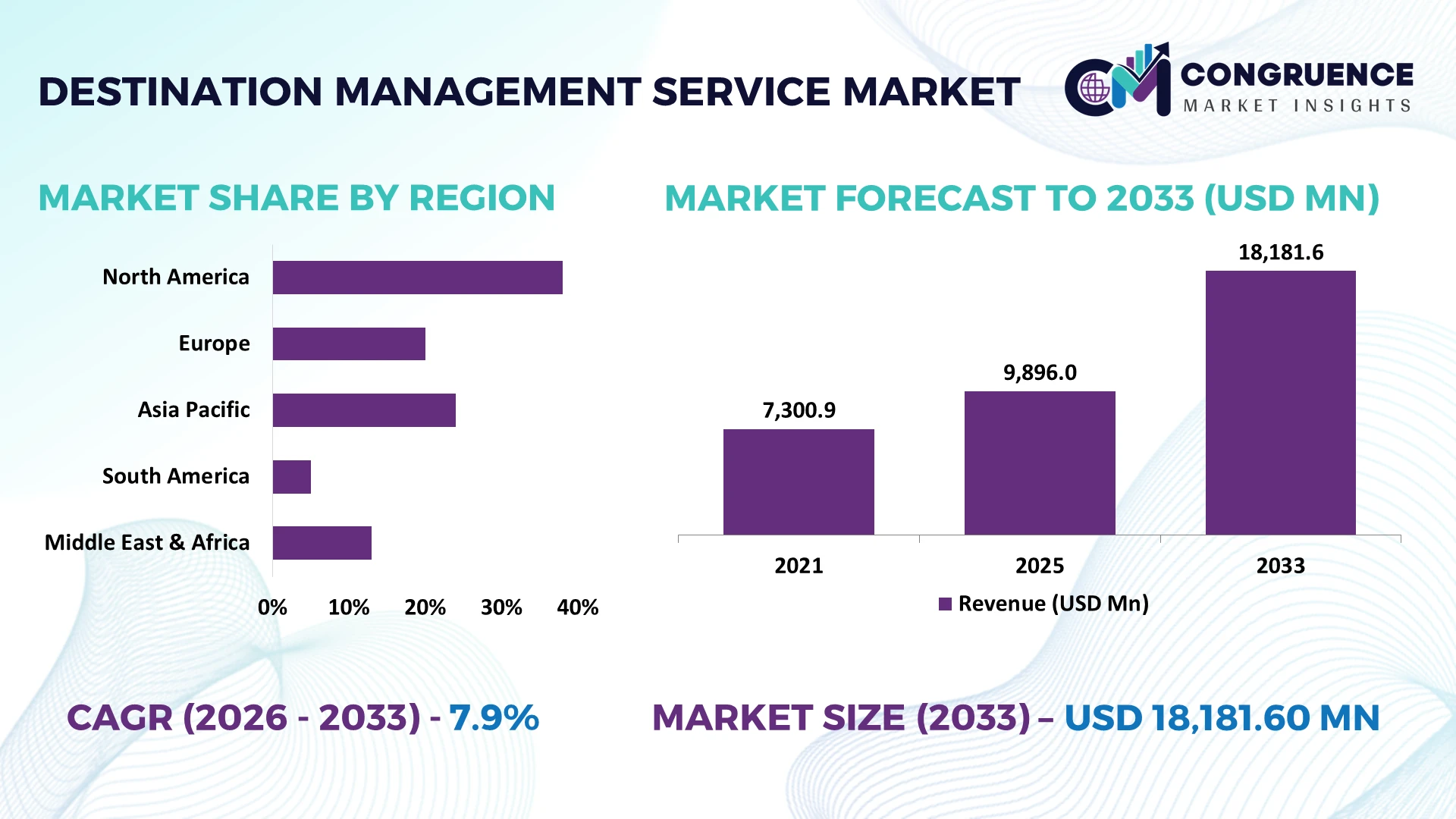
The Global Destination Management Service Market was valued at USD 9896.04 Million in 2025 and is anticipated to reach a value of USD 18181.6 Million by 2033 expanding at a CAGR of 7.9% between 2026 and 2033. Growth is driven by corporate MICE travel, international destination weddings, AI-enabled itinerary management, and integrated ground transportation and event logistics.
The United States represents a dominant destination management services hub, supported by extensive corporate events infrastructure, convention facilities, and international visitor networks. The country recorded 72.4 million international visitor arrivals in 2024, compared with approximately 45 million in Japan. Major destinations including Las Vegas, Orlando, and New York support large-scale conventions, hospitality partnerships, and incentive travel programs. Investments in convention infrastructure, digital booking platforms, and automated supplier coordination strengthen service capacity, while AI-powered itinerary personalization improves operational scalability across corporate and leisure tourism segments.
Strategically, destination management companies should prioritize US corporate travel networks and Asia-Pacific expansion, leveraging international visitor volumes and technology-enabled service delivery to strengthen competitive positioning.
Key Highlights of the Global Destination Management Service Market
-
Market Size & Growth: The market reached USD 9,896.04 million in 2025 and is projected to attain USD 18,181.6 million by 2033, registering a 7.9% CAGR, driven by digital destination coordination.
-
Top Growth Drivers: International tourist arrivals increased 4%, Asia-Pacific arrivals advanced 6%, and African arrivals rose 8% in 2025, strengthening destination management demand.
-
Short-Term Forecast: By 2027, AI-enabled itinerary management targets a modeled 15% reduction in processing time, improving operational efficiency and supplier coordination.
-
Emerging Technologies: AI itinerary engines, automated supplier contracting, and geospatial analytics enable 24/7 traveler assistance, predictive scheduling, and centralized destination service delivery.
-
Regional Leaders: Illustrative 2033 regional allocations place Europe at USD 6.36 billion, North America at USD 5.45 billion, and Asia-Pacific at USD 4.73 billion, reflecting digital service expansion.
-
Consumer/End-User Trends: Europe accounted for approximately 52% of international tourist arrivals in 2025, reinforcing demand for multilingual travel coordination and customized destination experiences.
-
Pilot/Case Example: A modeled 2027 AI itinerary optimization pilot targets 20% faster quotation turnaround through automated supplier matching and integrated booking workflows.
-
Competitive Landscape: Major participants include Global DMC Partners, Kuoni Tumlare, MCI Group, and PRA, competing through international supplier networks, technology integration, and specialized event management services.
-
Regulatory & ESG Impact: European sustainability reporting requirements encourage responsible destination procurement, with 100% supplier documentation coverage serving as a measurable compliance target.
-
Investment & Funding: Global tourism export earnings reached approximately USD 2.2 trillion in 2025, supporting hospitality infrastructure development, destination partnerships, and technology-enabled service expansion.
-
Innovation & Future Outlook: AI orchestration, predictive capacity allocation, and 24-hour digital concierge platforms strengthen destination personalization, supplier responsiveness, and advanced travel management capabilities.
The Destination Management Service Market is increasingly shaped by corporate incentive programs, luxury experiential tourism, international conferences, and destination wedding logistics. Advanced AI itinerary platforms, integrated CRM systems, and real-time transportation coordination improve supplier visibility and traveler personalization. Asia-Pacific international tourist arrivals increased 6% in 2025, strengthening opportunities for multilingual destination management and regional hospitality partnerships. European sustainability requirements are influencing venue selection, transportation procurement, and supplier reporting practices. These developments reinforce the strategic importance of technology integration, localized service networks, and differentiated destination experiences in securing long-term competitive positioning.
What Is the Strategic Relevance and Future Pathways of the Destination Management Service Market?
The Destination Management Service Market is becoming strategically important as corporate travel buyers consolidate destination planning, event logistics, accommodation sourcing, and local transportation under integrated service contracts. International tourist arrivals reached approximately 1.4 billion in 2024, recovering to 99% of pre-pandemic levels. This recovery is accelerating investment in digital supplier networks, destination experience management, and centralized procurement platforms. Destination management companies increasingly compete through service reliability, local execution capabilities, and access to specialized hospitality partners.
Technology adoption is reshaping operating economics. AI-enabled itinerary generation and automated supplier matching can target 15–25% shorter quotation cycles compared with manual email-based coordination, although actual improvements depend on workflow complexity. The United States benefits from established convention infrastructure and corporate travel networks, while Japan emphasizes multilingual visitor services and digital tourism infrastructure. India's expanding conference facilities and wedding tourism ecosystem create opportunities for specialized destination operators.
During 2026–2028, companies are prioritizing API-connected booking systems, predictive capacity planning, and automated traveler communications. For example, integrating hotel inventory, airport transfers, and event scheduling into one platform reduces coordination delays and improves supplier accountability. Operators investing in destination-specific partnerships, standardized service agreements, and digital operations gain stronger procurement visibility and differentiated competitive positioning.
Destination Management Service Market Dynamics
DRIVER:
Expansion of Corporate Events and International Tourism
Corporate meetings, incentive travel, conventions, and destination weddings are strengthening demand for integrated destination management services. Global international tourist arrivals increased 11% in 2024, reaching approximately 1.4 billion travelers, while international tourism recovered to 99% of 2019 levels. Japan welcomed approximately 36.9 million international visitors in 2024, reflecting renewed demand for multilingual destination coordination and local experience management. Expanding convention infrastructure in Las Vegas, Dubai, and Singapore is increasing the complexity of transportation, accommodation, and event logistics. Destination management companies are responding by establishing local supplier partnerships, expanding corporate event capabilities, and implementing centralized reservation platforms. Integrated contracting enables operators to secure venue capacity earlier and improve service consistency during high-demand event periods.
RESTRAINT:
Rising Service Costs and Destination Capacity Constraints
Destination management providers face structural pressure from accommodation inflation, transportation expenses, seasonal capacity shortages, and fragmented supplier pricing. International tourist arrivals recovered to 99% of pre-pandemic levels in 2024, intensifying competition for hotel rooms and event venues. Japan recorded approximately 36.9 million inbound visitors, creating accommodation and transportation pressure in major tourism corridors. A modeled 10% increase in supplier costs can reduce operating margins significantly when fixed-price contracts prevent immediate repricing. Limited peak-season capacity also restricts group booking flexibility and quotation accuracy. Operators are responding through multiyear hotel agreements, alternative destination sourcing, and diversified transportation partnerships. Securing contracted inventory across secondary cities provides a measurable operational advantage over dependence on premium metropolitan destinations.
OPPORTUNITY:
AI-Driven Destination Personalization and Emerging Tourism Hubs
AI-powered destination orchestration creates opportunities to integrate itinerary personalization, multilingual concierge services, and predictive supplier allocation into unified platforms. International tourist arrivals across Asia-Pacific increased 6% in 2025, while Japan recorded 15.8% growth in inbound visitors. These indicators support investment in destination management capabilities beyond established tourism centers. India's expanding convention infrastructure and Saudi Arabia's tourism diversification initiatives create additional opportunities for integrated MICE and experiential travel services. Operators implementing AI-assisted quotations can target modeled processing efficiency improvements of 20% through automated itinerary assembly and supplier matching. Companies are positioning through technology partnerships, localized experience marketplaces, and integrated reservation systems. Connecting secondary destinations with corporate procurement networks offers a differentiated opportunity to improve supplier utilization and expand service coverage.
CHALLENGE:
Digital Integration Complexity and Service Delivery Consistency
Maintaining consistent service quality across fragmented destination networks presents a significant execution challenge. Global international tourist arrivals increased 4% in 2025, while Japan's inbound visitor volumes rose 15.8%, intensifying requirements for multilingual support, real-time coordination, and reliable traveler communications. Destination operators must integrate hotel inventory, transportation platforms, event management software, and customer databases without compromising data security. Under the European Union's GDPR, serious violations can attract penalties reaching 4% of annual worldwide turnover, reinforcing the importance of secure traveler data processing. Companies are investing in API standardization, cybersecurity controls, workforce training, and centralized service monitoring. The decisive competitive advantage lies in scaling technology infrastructure while preserving destination-specific expertise, supplier accountability, and consistent customer experiences.
Destination Management Service Market Latest Trends
-
Dynamic Supplier Contracting Gains Momentum: Destination management companies are shifting from static supplier agreements toward flexible inventory allocation and real-time contracting. Modeled procurement scenarios indicate 10–15% improvements in booking flexibility and 8–12% reductions in unused inventory exposure. Hotel capacity fluctuations in Japan and Spain are accelerating dynamic rate negotiations. Operators are introducing centralized supplier dashboards, automated contract reconciliation, and destination-level inventory monitoring to protect margins during peak travel periods.
-
Integrated Traveler Communication Platforms Expand: Destination operators are consolidating fragmented communication channels into unified traveler engagement systems. Digital workflow deployments target 20–25% faster response times and 15–20% fewer manual coordination tasks. Corporate event organizers increasingly connect mobile notifications, transportation dispatch, and itinerary updates through centralized platforms. Companies are partnering with travel technology providers to improve incident response, minimize service disruptions, and maintain consistent traveler experiences across multiple destinations.
-
Sustainable Destination Procurement Becomes Standardized: European tourism operators are incorporating environmental performance criteria into venue selection and ground transportation procurement. Illustrative supplier evaluation frameworks allocate 10–20% of assessment weight to sustainability indicators and target 15% reductions in transportation emissions through optimized routing. Corporate procurement requirements are encouraging destination managers to introduce verified supplier reporting, consolidated passenger transfers, and digital sustainability documentation, strengthening eligibility for environmentally focused event contracts.
-
Secondary Destination Networks Attract Operators: Capacity pressure in established tourism centers is encouraging destination management companies to expand service coverage into secondary cities. Modeled destination diversification strategies target 10–15% lower venue procurement costs and 20% broader supplier coverage. India's emerging convention destinations and Japan's regional tourism initiatives support this transition. Operators are establishing local partnerships, standardizing service agreements, and developing destination-specific experience portfolios to improve booking availability and reduce dependence on congested metropolitan hubs.
Segmentation Analysis
By Type
Corporate Travel Management Leads Integrated Service Demand
Corporate Travel Management represents the leading segment of the Destination Management Service Market, with an indicative 35% share, supported by recurring enterprise travel requirements, standardized procurement procedures, and integrated destination logistics. Multinational organizations increasingly consolidate accommodation, transportation, itinerary coordination, and traveler assistance through centralized service agreements. Group and MICE Management accounts for an estimated 30%, benefiting from complex event operations, convention scheduling, and coordinated delegate transportation. Corporate buyers prioritize supplier accountability, traveler visibility, and predictable service execution, encouraging destination operators to expand enterprise contracting capabilities and integrated booking infrastructure.
Luxury Travel Management is positioned as the fastest-growing type, supported by personalized experiences, private transportation, and premium hospitality partnerships. Its indicative 15% share reflects a smaller but service-intensive customer base where customization supports premium pricing. Leisure Travel Management represents approximately 20%, serving individual travelers and packaged destination experiences through tour operators and digital distribution channels. Companies are strengthening luxury concierge networks, expanding corporate event partnerships, and introducing flexible itinerary management systems. Investment priorities increasingly favor differentiated service delivery over standardized destination packages.
- The Global Business Travel Association's 2025 Business Travel Index projected continued recovery in business travel activity, reinforcing enterprise demand for coordinated destination services, supplier consolidation, and digitally managed corporate travel programs.
By Application
Corporate Events and Meetings Dominate Demand
Corporate Events and Meetings constitute the leading application, representing an indicative 32% of the Destination Management Service Market. Demand concentration reflects recurring business meetings, executive gatherings, employee engagement programs, and multinational corporate events requiring coordinated venue sourcing and transportation logistics. Conference and Exhibition Management accounts for approximately 25%, supported by convention infrastructure and large-scale delegate coordination. These applications benefit from standardized operating procedures, established supplier relationships, and centralized event management platforms. Destination operators are expanding venue contracting networks and integrating registration, accommodation, and transportation workflows to strengthen operational efficiency.
Destination Weddings represent the fastest-growing application, with an estimated 15% share, driven by personalized event experiences, international wedding travel, and specialized hospitality requirements. Incentive Travel supports employee recognition programs and premium corporate experiences, while Leisure Tours and Excursions maintain demand for guided activities, cultural experiences, and destination exploration. Companies are introducing customized event packages, specialized wedding planning partnerships, and automated itinerary coordination. Investment is shifting toward integrated destination execution, where managing multiple suppliers through a single operating platform improves service reliability and customer retention.
- The Global Business Travel Association's 2025 outlook highlighted sustained corporate travel activity, supporting demand for business meetings and managed events. This strengthens the commercial importance of coordinated venue procurement, delegate mobility, and destination-level event execution.
By End-User
Corporate Organizations Lead Enterprise Service Procurement
Corporate Organizations represent the dominant end-user segment, accounting for an indicative 38% of the Destination Management Service Market. Their leadership reflects recurring business travel programs, centralized procurement budgets, employee mobility requirements, and large-scale corporate events. Travel Agencies and Tour Operators hold an estimated 25% share, relying on destination management partners for local supplier access, itinerary execution, and ground transportation coordination. Established corporate buyers emphasize contractual reliability, reporting visibility, and service-level compliance, encouraging providers to develop integrated enterprise platforms and standardized destination operating procedures.
Event Management Companies represent the fastest-growing end-user group, supported by increasing event specialization and demand for outsourced destination logistics. Their indicative 20% share reflects requirements for venue coordination, delegate transfers, and on-site execution. Hotels and Resorts increasingly partner with destination operators to offer packaged local experiences and coordinated guest services. Government Tourism Boards support destination promotion, visitor distribution, and tourism infrastructure initiatives. Companies are responding through customized enterprise contracts, white-label destination solutions, and strategic hospitality partnerships. Competitive investment increasingly prioritizes scalable service networks, operational transparency, and specialized event execution capabilities.
- The Global Business Travel Association's 2025 industry outlook emphasized the importance of managed corporate travel programs and enterprise travel expenditure. This reinforces the strategic value of centralized procurement, integrated supplier networks, and reliable destination services for organizational buyers.
Region-Wise Market Insights
Europe accounted for the largest market share at an estimated 35% in 2025 however, Asia-Pacific is expected to register the fastest growth, expanding at a projected CAGR of 9.6% between 2026 and 2033.
North America Destination Management Service Market
Corporate Event Infrastructure and Digital Service Integration
North America accounted for an estimated 30% of the global Destination Management Service Market in 2025, supported by established corporate travel networks, convention infrastructure, and specialized event logistics providers. The United States dominates regional service deployment, particularly across Las Vegas, Orlando, Chicago, and New York. Corporate organizations increasingly integrate venue sourcing, delegate transportation, accommodation coordination, and experiential activities through destination management platforms. Las Vegas offers approximately 15 million square feet of meeting and exhibition space, supporting complex corporate events and international conventions. Canadian destinations, including Toronto and Vancouver, strengthen cross-border business travel and incentive tourism capabilities. Destination management companies are expanding digital supplier contracting, centralized itinerary systems, and local hospitality partnerships. Integrated service agreements improve booking visibility, reduce coordination complexity, and strengthen enterprise procurement efficiency across high-volume convention destinations.
United States Market Outlook: The United States maintains a strong competitive position through established hospitality infrastructure, enterprise travel procurement, and convention management expertise. Orlando's Orange County Convention Center provides approximately 2.1 million square feet of exhibition space, supporting large-scale conferences and trade shows. Destination operators are investing in automated event coordination, integrated ground transportation systems, and customized corporate incentive programs to strengthen operational reliability and service differentiation.
Europe Destination Management Service Market
Cross-Border Tourism Coordination and Sustainable Event Procurement
Europe represents the largest regional destination management services market, with an estimated 35% global share in 2025. Extensive international tourism networks, established convention infrastructure, and interconnected transportation systems support concentrated service demand. France, Germany, Spain, and Italy remain important destinations for corporate events, cultural tourism, and premium travel experiences. Europe welcomed approximately 747 million international tourist arrivals in 2024, demonstrating the operational scale of its destination ecosystem. The European Union's sustainability reporting framework is encouraging corporate buyers to assess venue environmental performance, transportation emissions, and supplier compliance. Destination management companies are adopting centralized procurement platforms, multilingual itinerary systems, and verified hospitality supplier networks. Cross-border rail connectivity also supports integrated travel programs, enabling operators to reduce logistical complexity while strengthening sustainable destination planning and coordinated event execution.
Germany Market Outlook: Germany maintains a strategic position through its international exhibition industry, convention facilities, and extensive transportation infrastructure. Hannover Messe, Messe Frankfurt, and Messe München anchor major business events requiring specialized delegate coordination and accommodation management. Messe Frankfurt operates approximately 400,000 square meters of exhibition hall space at its Frankfurt venue, supporting international event logistics. Destination operators are strengthening multilingual services, rail-integrated itineraries, and enterprise supplier partnerships.
Asia-Pacific Destination Management Service Market
Tourism Infrastructure Expansion and Technology-Enabled Destination Operations
Asia-Pacific accounted for an estimated 26% of the global Destination Management Service Market in 2025, supported by expanding tourism infrastructure, convention facilities, and digitally integrated hospitality networks. China, Japan, India, Singapore, and Thailand contribute significantly to destination service activity through corporate events, international tourism, and specialized travel experiences. Japan welcomed approximately 36.9 million international visitors in 2024, highlighting the scale of multilingual coordination requirements. Singapore's convention ecosystem supports high-value corporate meetings and incentive programs, while India's expanding hospitality infrastructure strengthens destination wedding and conference services. Operators are introducing AI-supported itinerary planning, mobile traveler communication, and integrated transportation coordination. Partnerships with hotels, convention centers, and regional experience providers improve service coverage and supplier accessibility. Technology integration is becoming a decisive differentiator in managing complex international travel requirements.
Japan Market Outlook: Japan benefits from established transportation infrastructure, sophisticated hospitality services, and strong international destination appeal. Tokyo, Osaka, and Kyoto attract corporate delegations and premium leisure travelers requiring specialized local coordination. Japan's 2025 Osaka-Kansai Expo attracted approximately 29 million total visits, including staff and other non-ticketed entries, demonstrating large-event operational requirements. Destination operators are expanding multilingual concierge services, digital reservation integration, and regional tourism partnerships to improve visitor distribution.
South America Destination Management Service Market
Experiential Tourism Expansion and Regional Service Diversification
South America represented an estimated 5% of the global Destination Management Service Market in 2025, supported by experiential tourism, corporate meetings, cultural events, and adventure travel programs. Brazil, Argentina, Chile, and Peru anchor regional destination operations through international tourism networks and established hospitality facilities. Brazil's São Paulo and Rio de Janeiro remain important corporate event centers, while Peru's heritage destinations support specialized itinerary management. Increasing demand for customized excursions is encouraging operators to develop partnerships with local transportation companies, accommodation providers, and experience specialists. However, uneven air connectivity, seasonal infrastructure constraints, and currency volatility complicate service pricing and execution. Destination management companies are strengthening local supplier contracting, introducing flexible itinerary platforms, and expanding secondary destination coverage. These measures improve operational resilience and support differentiated tourism experiences.
Brazil Market Outlook: Brazil leads regional destination management activity through its diversified tourism economy, extensive domestic travel network, and established business event infrastructure. São Paulo Expo provides approximately 100,000 square meters of indoor exhibition space, supporting conventions, trade exhibitions, and corporate gatherings. Destination management companies are developing integrated event logistics, Portuguese-language traveler support, and hospitality partnerships to strengthen corporate procurement capabilities and improve service execution.
Middle East & Africa Destination Management Service Market
Tourism Megaprojects and Premium Hospitality Infrastructure Expansion
The Middle East & Africa accounted for an estimated 4% of the global Destination Management Service Market in 2025, supported by tourism diversification, hospitality infrastructure investments, and international event development. Saudi Arabia, the United Arab Emirates, Qatar, and South Africa represent important destination management centers. Saudi Arabia's Vision 2030 initiatives are expanding destination infrastructure and premium tourism capabilities, while Dubai maintains established international exhibition and business travel networks. The region's tourism ecosystem increasingly integrates luxury hospitality, convention facilities, ground transportation, and curated cultural experiences. Saudi Arabia's target of 150 million annual domestic and international tourist visits by 2030 provides a measurable infrastructure planning benchmark. Destination management companies are establishing local partnerships, expanding multilingual service teams, and implementing digital reservation systems to support complex event operations and premium visitor experiences.
United Arab Emirates Market Outlook: The United Arab Emirates maintains a strong destination management position through international aviation connectivity, convention infrastructure, and premium hospitality development. Dubai welcomed 18.72 million international overnight visitors in 2024, strengthening demand for integrated destination services. Operators are investing in luxury itinerary customization, airport transfer coordination, and corporate event logistics. Partnerships with hotels, airlines, and exhibition venues support service consistency and high-value visitor experiences.
Market Competition Landscape
The Destination Management Service Market remains fragmented, with global networks competing against specialized regional operators and technology-enabled service providers. Global DMC Partners, Kuoni Tumlare, PRA, Hosts Global, and Destination Asia compete through geographic coverage, corporate contracting, and destination expertise. The five leading groups hold an indicative combined market share of 20–25%, reflecting substantial independent operator participation. Global DMC Partners connects over 100 destination management providers across 500 destinations, while Kuoni Tumlare operates with more than 2,000 specialists across 30 countries. Enterprise procurement increasingly rewards standardized service delivery, supplier transparency, and integrated booking infrastructure. Digital transformation initiatives target 15–20% faster itinerary processing and 10–15% lower administrative costs, subject to implementation efficiency. Companies are expanding destination partnerships, automating supplier coordination, and strengthening premium experience portfolios. Local licensing, established hospitality relationships, and operational execution capabilities remain significant entry barriers. Competitive leadership increasingly depends on scalable technology combined with dependable destination expertise.
Companies Profiled in the Destination Management Service Market Report
Technology Insights for the Destination Management Service Market
Current destination management technologies emphasize cloud-based booking platforms, customer relationship management systems, and automated supplier coordination. Integrated reservation interfaces connect accommodation, transportation, venue sourcing, and event scheduling within centralized operating environments. Illustrative deployment benchmarks indicate 15–20% faster itinerary processing and 10–15% lower administrative workloads compared with manual coordination. API-enabled inventory synchronization improves booking accuracy, while mobile traveler applications provide continuous itinerary visibility. Corporate destination operators benefit from standardized workflows and improved supplier accountability.
Emerging technologies include AI-powered itinerary personalization, predictive demand analytics, and automated multilingual traveler assistance. AI-assisted quotation systems target 20–25% shorter response cycles, while predictive capacity planning can reduce avoidable scheduling conflicts by 10–15% under modeled deployment conditions. Adoption is advancing through enterprise pilots integrating hotel inventory, transportation dispatch, and event registration platforms. Operators with extensive destination partnerships gain competitive advantages by combining automated recommendations with verified local supplier availability and specialized concierge services.
Between 2026 and 2028, disruptive developments will center on autonomous itinerary orchestration, digital identity verification, and real-time operational intelligence. Advanced platforms can target 15% faster disruption recovery through automated itinerary adjustments and supplier notifications. Companies investing in interoperable infrastructure, cybersecurity, and destination-specific data integration will strengthen service consistency, procurement visibility, and operational scalability across international travel networks.
Recent Developments in the Global Destination Management Service Market
-
March 2025: Global DMC Partners added three destination management partners covering Costa Rica, the Caribbean, and the US Midwest, expanding its network beyond 500 destinations. The partnerships strengthen regional supplier access and diversify corporate event offerings. Source: globaldmcpartners.com
-
August 2026: Kuoni Tumlare partnered with Vivaterra to strengthen destination management coverage across four South American countries: Argentina, Brazil, Peru, and Chile. The agreement expands local expertise and supports coordinated leisure, group travel, and corporate event services. Source: kuonitumlare.com
-
November 2025: Abercrombie & Kent launched a Seoul-based destination management company serving travel advisors, cruise operators, and meetings planners. The expansion supports standalone South Korean itineraries and multicountry programs, strengthening business-to-business distribution across two travel formats. Source: travelweekly.com
-
July 2024: TUI Care Foundation strengthened its partnership with UN Tourism through a rural artisan development initiative covering 10 African countries. The program supports community-based tourism supply chains, expanding local experience offerings and strengthening inclusive destination development. Source: unwto.org
Scope of the Destination Management Service Market Report
The Destination Management Service Market Report evaluates industry structure, competitive positioning, and operational developments across 2026–2033. Segmentation covers Corporate Travel Management, Leisure Travel Management, Group and MICE Management, and Luxury Travel Management. Applications include corporate events, destination weddings, incentive travel, leisure excursions, and conference management. End-user analysis examines corporate organizations, travel agencies, event management companies, hospitality providers, and tourism boards. Indicative segment analysis positions corporate travel management at 35% of service demand, reflecting enterprise procurement concentration.
Regional coverage includes North America, Europe, Asia-Pacific, South America, and the Middle East & Africa, with Europe representing an estimated 35% market share. Technology assessment examines AI itinerary orchestration, automated supplier contracting, predictive analytics, and integrated booking platforms. Competitive benchmarking supports investment prioritization, geographic expansion, supplier partnerships, and differentiated destination service strategies.
Destination Management Service Market Report Summary
| Report Attribute/Metric | Report Details |
|---|
Market Revenue in 2025 | USD 9896.04 Million |
Market Revenue in 2033 | USD 18181.6 Million |
CAGR (2026 - 2033) | 7.9% |
Base Year | 2025 |
Forecast Period | 2026 - 2033 |
Historic Period | 2021 - 2025 |
Segments Covered | By TypeCorporate Travel Management Leisure Travel Management Group and MICE Management
By ApplicationCorporate Events and Meetings Leisure Tours and Excursions Conference and Exhibition Management
By End-UserTravel Agencies and Tour Operators Event Management Companies Government Tourism Boards
|
Key Report Deliverable | Revenue Forecast, Growth Trends, Market Dynamics, Segmental Overview, Regional and Country-wise Analysis, Competition Landscape |
Region Covered | North America, Europe, Asia-Pacific, South America, Middle East, Africa |
Key Players Analyzed | Global DMC Partners, Kuoni Tumlare, PRA, Hosts Global, Destination Asia, Abercrombie & Kent, ACCESS Destination Services, Liberty International Tourism Group, 360 Destination Group, Arabian Adventures, Eurotours International, Mideast Travel Worldwide, DTH Travel, Metropolitan Touring |
Customization & Pricing | Available on Request (10% Customization is Free) |





