
Reports
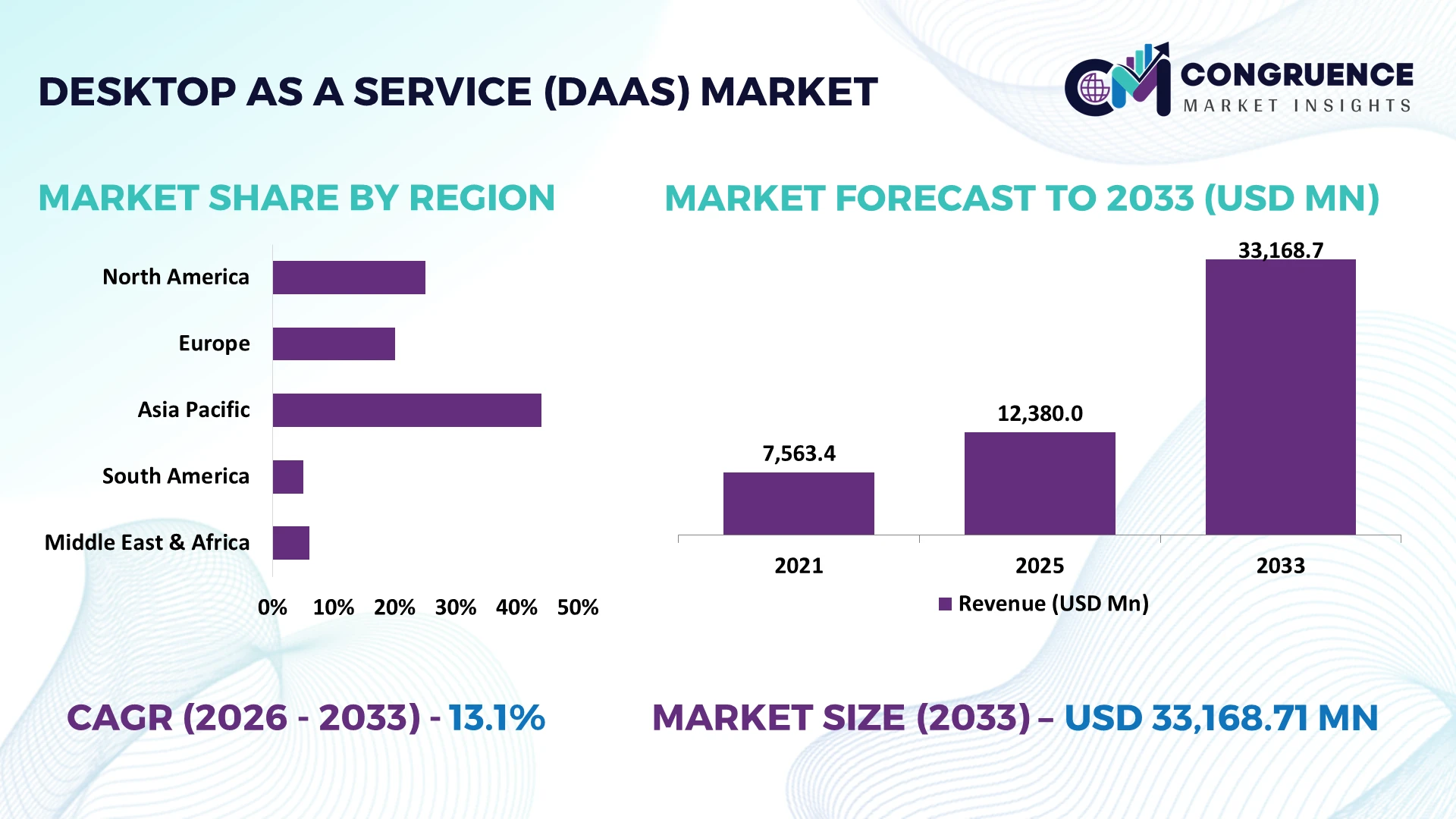
The Global Desktop As-A-Service (DaaS) Market was valued at USD 12380 Million in 2025 and is anticipated to reach a value of USD 33168.71 Million by 2033 expanding at a CAGR of 13.11% between 2026 and 2033. Growth is driven by enterprise migration from physical desktops to cloud hosted workspaces, hybrid workforce management, Windows 10 support expiration, and increasing adoption of centralized endpoint security and virtual desktop infrastructure.
The United States dominates the global Desktop As A Service ecosystem, supported by Microsoft, Amazon Web Services, Citrix, and enterprise cloud infrastructure providers. Microsoft operates more than 60 Azure regions globally, strengthening virtual desktop availability and geographic deployment flexibility. The October 2025 expiration of standard Windows 10 support accelerated enterprise endpoint modernization. Compared with India, where IT outsourcing and business process services support virtual workspace adoption, the United States benefits from stronger hyperscaler infrastructure concentration and established enterprise software ecosystems across banking, healthcare, and government.
Strategically, enterprises should prioritize cloud desktop platforms offering 99.9% availability targets, centralized security, and flexible resource allocation to reduce endpoint management complexity and strengthen operational resilience.
Market Size & Growth: USD 12,380 million in 2025, reaching USD 33,168.71 million by 2033 at 13.11% CAGR, driven by cloud desktop migration and endpoint modernization.
Top Growth Drivers: Illustrative planning assumptions identify 35% hybrid workspace expansion, 30% endpoint modernization, and 25% centralized security adoption.
Short Term Forecast: By 2028, automated desktop provisioning targets 30% faster employee onboarding compared with manual endpoint configuration.
Emerging Technologies: Three priorities include AI powered workspace management, GPU enabled virtual desktops, and zero trust endpoint authentication.
Regional Leaders: Illustrative 2033 allocations place North America at USD 13,931 million, Europe at USD 9,287 million, and Asia Pacific at USD 7,297 million, reflecting enterprise migration, compliance requirements, and IT outsourcing.
Consumer / End User Trends: Microsoft's 2025 Work Trend Index found 81% of surveyed leaders expected AI agents to enter organizational strategies, reinforcing interest in automated digital workspaces.
Pilot / Case Example: In 2025, Windows 365 Cloud PCs supported enterprise desktop modernization following Windows 10 support expiration, enabling centralized operating system management.
Competitive Landscape: Microsoft leads enterprise cloud desktop integration, competing with Amazon Web Services, Citrix, Omnissa, and Parallels across managed workspace services.
Regulatory & ESG Impact: The EU Digital Operational Resilience Act became applicable in January 2025, strengthening ICT risk governance across 27 EU member states.
Investment & Funding: Microsoft's USD 80 billion fiscal 2025 AI infrastructure investment plan illustrates broader cloud capacity expansion supporting enterprise computing services.
Innovation & Future Outlook: Through 2033, GPU accelerated workspaces, automated policy management, and consumption based desktop provisioning will strengthen cloud workspace flexibility.
The Desktop As A Service Market is evolving as organizations replace fragmented endpoint infrastructure with centrally managed virtual workspaces. Financial institutions, healthcare providers, and technology outsourcing companies increasingly require secure access to enterprise applications across distributed workforces. Microsoft Windows 365 and Amazon WorkSpaces provide cloud hosted desktop environments with centralized provisioning, identity integration, and policy management. Microsoft's Windows 10 support expiration in October 2025 created a measurable modernization trigger for enterprises managing legacy devices. Emerging adoption of GPU enabled desktops and automated workspace optimization is strengthening demand for specialized computing environments, establishing security, performance, and deployment flexibility as strategic priorities.
The Desktop As A Service (DaaS) Market is becoming strategically important as enterprises modernize workplace infrastructure, strengthen endpoint security, and replace device dependent computing with centrally managed cloud desktops. Microsoft's October 2025 Windows 10 support expiration accelerated operating system migration decisions across enterprise environments. Windows 365, Azure Virtual Desktop, and Amazon WorkSpaces enable centralized application delivery, remote access, and standardized security policies. Cloud hosted desktops also allow organizations to separate employee computing environments from physical devices, reducing hardware replacement dependencies and improving workforce mobility.
Compared with traditional desktop provisioning, automated DaaS deployment can reduce illustrative onboarding time from 120 minutes to 30 minutes, representing a 75% improvement under standardized configurations. The United States leads through hyperscaler infrastructure and enterprise cloud integration, while India benefits from large IT outsourcing operations and distributed service delivery centers. During 2026 to 2028, enterprises are prioritizing automated provisioning, identity based access, and workload specific desktop configurations to improve utilization and operational efficiency.
Microsoft Windows 365 illustrates practical deployment through centrally managed Cloud PCs supporting contractors and distributed employees. Enterprises are strengthening cloud partnerships, adopting consumption based desktop licensing, and integrating endpoint management platforms. Competitive advantage increasingly depends on predictable user experience, flexible capacity allocation, and consistent security enforcement across geographically distributed workforces.
Enterprise desktop modernization is accelerating DaaS adoption as organizations replace aging endpoint infrastructure with centrally managed cloud workspaces. Microsoft's October 2025 Windows 10 support expiration created a major migration trigger for businesses maintaining legacy devices. In an illustrative enterprise deployment, automated provisioning reduces desktop configuration time by 75%, while standardized image management can lower repetitive administrative tasks by an estimated 30%. Financial institutions and IT outsourcing companies in the United States increasingly require secure access for geographically distributed employees and contractors. Microsoft and Amazon Web Services are strengthening cloud desktop integration with identity management, application delivery, and endpoint security services. Centralized provisioning improves onboarding consistency, reduces device dependency, and enables organizations to scale workforce computing capacity without equivalent hardware expansion.
Desktop As A Service adoption faces structural constraints from recurring cloud consumption charges, network dependency, and application compatibility requirements. In a modeled deployment, 20% overprovisioned desktop capacity increases infrastructure consumption costs, while 15% idle resource allocation reduces utilization efficiency. Enterprises operating latency sensitive applications must also account for network connectivity and geographic distance from cloud infrastructure. In India, distributed service centers face variable connectivity conditions that complicate consistent desktop performance. Legacy applications requiring specialized peripherals or local hardware integration further increase migration complexity. Providers are responding through reserved capacity pricing, regional infrastructure expansion, and hybrid desktop architectures. Effective cost management depends on aligning desktop configurations with actual usage rather than provisioning identical computing resources for every employee.
AI assisted workspace management and GPU enabled virtual desktops create opportunities to extend DaaS beyond conventional office productivity applications. Automated resource allocation can target 25% lower idle computing capacity, while intelligent session scheduling can reduce unnecessary desktop runtime by approximately 30% in illustrative enterprise scenarios. GPU accelerated cloud desktops support engineering visualization, digital content creation, and specialized analytics without requiring dedicated workstation hardware. In Japan, advanced manufacturing and engineering organizations provide opportunities for centralized access to computationally intensive design applications. Microsoft, Amazon Web Services, and specialized workspace providers are expanding graphics enabled configurations and automated desktop management capabilities. The strategic opportunity lies in matching computing resources to application intensity, enabling differentiated service offerings and more efficient infrastructure utilization.
Maintaining reliable user experience across geographically distributed cloud desktops presents substantial execution challenges involving application latency, session performance, identity security, and infrastructure orchestration. A deployment supporting 10,000 concurrent users experiences 500 disrupted sessions when availability falls to 95%, demonstrating the operational sensitivity of large workspace environments. A 10% increase in session latency can also affect responsiveness for interactive applications, depending on workload characteristics. In the United States, enterprises managing remote employees must coordinate identity protection, endpoint compliance, and application access across multiple networks. Providers are investing in session monitoring, automated capacity scaling, and zero trust security integration. Long term competitiveness requires consistent desktop performance, rapid incident recovery, and secure application delivery without excessive operational complexity.
Cloud Desktop Licensing Models Evolve: Microsoft and Amazon Web Services are refining desktop subscription structures to accommodate variable workforce requirements. Windows 365 supports fixed monthly Cloud PC licensing, while Amazon WorkSpaces offers hourly and monthly billing options. Organizations operating 8 hour shifts across 22 working days can compare approximately 176 monthly usage hours against continuous desktop allocation. Providers are expanding flexible licensing and consumption visibility, enabling procurement teams to align spending with actual workforce utilization.
Browser Based Workspace Access Expands: Enterprises are increasingly delivering virtual desktops through HTML5 browsers to simplify access across managed and personal devices. Browser access eliminates dedicated client installation for supported workflows, while a workforce using 3 operating systems can maintain a consistent desktop interface. Microsoft and Citrix are strengthening browser connectivity, session security, and application compatibility. This transition reduces endpoint configuration requirements and improves accessibility for temporary workers and external contractors.
Cloud Desktop Resilience Gains Priority: Enterprise procurement increasingly emphasizes service continuity following major cloud infrastructure disruptions. A 99.9% monthly availability target permits approximately 43.2 minutes of downtime during a 30 day period, while 99.99% permits approximately 4.3 minutes. Providers are strengthening regional recovery architectures, session monitoring, and automated restoration capabilities. Financial institutions increasingly evaluate recovery procedures alongside availability commitments to reduce business interruption exposure.
Endpoint Sustainability Influences Refresh Decisions: Organizations are reassessing physical device replacement schedules as cloud desktops separate computing workloads from endpoint hardware. Extending a device replacement cycle from 3 years to 5 years reduces annualized replacement frequency by 40%. Following Windows 10 support expiration in October 2025, enterprises are evaluating compatible endpoint reuse and secure remote desktop access. Workspace providers are strengthening thin client partnerships and device management integration to support controlled hardware lifecycle extension.
Persistent Desktops represent the leading segment of the Desktop As A Service Market, with an indicative 38% share in 2025, supported by enterprise requirements for personalized computing environments, application continuity, and consistent user configurations. These desktops retain individual settings and installed applications between sessions, making them suitable for employees requiring dedicated digital workspaces. Microsoft Windows 365 supports persistent Cloud PC environments with centralized management and predictable provisioning. Non Persistent Desktops account for an estimated 29% share, offering standardized sessions that reset after use. Their architecture supports shared workforce environments where centralized image management and rapid session allocation improve administrative efficiency.
GPU Enabled Desktops represent the fastest growing type as engineering, digital design, and advanced visualization workloads increasingly migrate toward cloud infrastructure. Their deployment supports specialized graphics processing without dedicated workstation ownership. Virtual App Desktops remain important for organizations requiring centralized application delivery without complete desktop virtualization. Microsoft, Amazon Web Services, and Citrix are expanding workload specific configurations, graphics acceleration, and application delivery capabilities. Investment priorities increasingly favor matching desktop persistence and computing intensity to actual employee requirements rather than maintaining uniform infrastructure allocations.
Remote Workforce represents the leading application segment, holding an indicative 36% share of the Desktop As A Service Market in 2025. Its dominance reflects enterprise requirements for secure application access, centralized desktop management, and consistent computing environments across distributed employees. Microsoft Windows 365 and Amazon WorkSpaces support remote desktop delivery without requiring applications and business data to reside permanently on employee devices. BYOD Environments account for an estimated 24% share, supported by organizations seeking to separate corporate computing sessions from personally owned hardware. Centralized policy enforcement strengthens data protection while reducing device compatibility constraints.
Software Development represents the fastest growing application as engineering teams increasingly adopt cloud hosted development environments with standardized tools, isolated workloads, and configurable computing capacity. Call Centers maintain substantial demand through shared desktop provisioning, standardized application access, and shift based resource allocation. Education institutions use virtual desktops to deliver controlled learning environments and specialized software across student devices. Providers are expanding browser access, automated provisioning, and application compatibility features. Competitive differentiation increasingly depends on reducing configuration time while maintaining reliable access across varied devices and network conditions.
IT and Telecommunications represent the largest end user segment, with an indicative 30% share of the Desktop As A Service Market in 2025. Large distributed workforces, outsourced service operations, and extensive application infrastructure support sustained demand for centralized virtual desktops. Technology service providers use cloud desktops to standardize employee environments, manage contractor access, and simplify application deployment. Banking and Finance account for an estimated 24% share, reflecting strict information security requirements, regulated application access, and operational continuity priorities. Financial institutions emphasize identity integration, session monitoring, and controlled desktop environments for sensitive business activities.
Healthcare represents the fastest growing end user segment as hospitals, clinical networks, and healthcare administrators modernize access to electronic health records and specialized applications. Government agencies prioritize secure remote access and standardized infrastructure management, while Education institutions require flexible desktop provisioning for academic software. Retail organizations use cloud desktops for distributed administrative operations and seasonal workforce access. Providers are strengthening industry specific configurations, compliance integrations, and flexible licensing structures. Competitive advantage increasingly depends on delivering predictable performance and simplified governance across distinct enterprise operating environments.
North America accounted for the largest market share at an estimated 42% in 2025 however, Asia Pacific is expected to register the fastest growth, expanding at a CAGR of approximately 16.2% between 2026 and 2033.
Enterprise Cloud Workspace Consolidation and Infrastructure Leadership
North America accounts for an estimated 42% of the global Desktop As A Service Market, supported by extensive enterprise cloud infrastructure, established virtualization ecosystems, and concentrated technology investment. Microsoft, Amazon Web Services, Citrix, and Omnissa support cloud desktop deployment across banking, healthcare, telecommunications, and professional services. The United States leads regional adoption through mature enterprise identity infrastructure and advanced endpoint management capabilities. Canada contributes through financial services modernization and increasing cloud adoption among government institutions. Microsoft's planned USD 80 billion investment in AI enabled data center infrastructure during fiscal 2025 demonstrates the broader computing capacity expansion supporting cloud services. Enterprises increasingly combine desktop virtualization with identity governance, application delivery, and centralized security monitoring. Competitive differentiation depends on predictable desktop performance, integration with existing enterprise software, and efficient management of distributed computing environments.
United States Market Outlook: The United States benefits from established hyperscaler infrastructure, enterprise software integration, and extensive managed service provider networks. Microsoft's October 2025 Windows 10 support expiration accelerated desktop replacement assessments across corporate environments. Financial institutions and healthcare organizations are evaluating Windows 365, Azure Virtual Desktop, and Amazon WorkSpaces for secure application access. Federal cybersecurity modernization priorities further reinforce centralized identity management and controlled remote access across sensitive enterprise operations.
Regulated Cloud Adoption and Sovereign Workspace Modernization
Europe represents an estimated 28% of global Desktop As A Service Market activity, supported by enterprise infrastructure modernization, regulatory requirements, and expanding sovereign cloud capabilities. Germany, the United Kingdom, and France lead deployment across financial services, manufacturing, government, and professional services. The Digital Operational Resilience Act became applicable in January 2025, strengthening information technology risk management requirements for regulated financial institutions. European enterprises increasingly evaluate desktop virtualization through data residency, access governance, and business continuity considerations. Cloud infrastructure providers are expanding regional deployment options and integrating security controls with established identity management platforms. Manufacturing organizations require application compatibility for engineering and operational software, while financial institutions prioritize auditable access and standardized workspace configurations. Regional competition increasingly emphasizes regulatory alignment, service reliability, and integration with established enterprise infrastructure rather than desktop provisioning capabilities alone.
Germany Market Outlook: Germany holds strategic importance through its industrial manufacturing ecosystem, financial institutions, and enterprise software infrastructure. The country's 16 federal states operate within a demanding regulatory and administrative environment, supporting interest in standardized digital workplace management. German manufacturers increasingly require controlled access to enterprise resource planning systems and specialized engineering applications. Data protection obligations encourage cloud desktop configurations that maintain centralized access policies and support geographically appropriate information processing.
IT Outsourcing Scale and Cloud Workspace Expansion
Asia Pacific accounts for an estimated 22% of the global Desktop As A Service Market, supported by expanding enterprise cloud infrastructure, technology outsourcing operations, and distributed workforce requirements. India, China, Japan, Australia, and Singapore contribute through distinct enterprise computing priorities. India's large IT services ecosystem supports demand for standardized desktop environments across geographically distributed delivery centers. Japan emphasizes secure application access and infrastructure modernization, while Australia prioritizes cloud based workplace services and enterprise cybersecurity. China's enterprise virtualization ecosystem reflects domestic cloud infrastructure development and data governance requirements. Technology providers are expanding regional availability, local partnerships, and managed workspace capabilities. Deployment strategies increasingly emphasize network performance, identity integration, and flexible computing configurations. The region's competitive advantage lies in combining large service delivery workforces with scalable cloud infrastructure and localized enterprise support capabilities.
India Market Outlook: India represents a significant adoption opportunity through its IT services, business process outsourcing, financial technology, and enterprise support industries. India's technology sector employed approximately 5.8 million people during fiscal 2025, according to industry estimates, illustrating the scale of its digital workforce. Major delivery hubs including Bengaluru, Hyderabad, Pune, and Chennai support demand for standardized computing environments. Enterprises increasingly evaluate cloud desktops for contractor onboarding, application security, and geographically distributed service operations.
Financial Services Digitization and Managed Workspace Adoption
South America represents an estimated 5% of global Desktop As A Service Market activity, with Brazil leading regional adoption through financial services, telecommunications, technology outsourcing, and enterprise cloud modernization. Chile and Colombia contribute through banking infrastructure development and expanding managed technology services. Organizations increasingly evaluate cloud desktops to centralize application access across distributed offices and customer service operations. Brazil's established digital financial ecosystem supports demand for secure employee workspaces and standardized identity management. Regional enterprises face constraints involving network quality differences, cloud infrastructure concentration, and sensitivity to foreign currency denominated technology costs. Providers are responding through regional cloud infrastructure, managed service partnerships, and flexible desktop configurations. Competitive positioning depends on balancing performance consistency, predictable operating expenditure, and practical integration with established enterprise applications across diverse national markets.
Brazil Market Outlook: Brazil leads through its extensive banking industry, enterprise technology services, and established cloud infrastructure presence. Amazon Web Services operates its South America São Paulo Region with 3 Availability Zones, supporting geographically localized enterprise workloads. Brazilian organizations increasingly use managed workspace solutions for financial operations, customer support, and administrative services. The General Data Protection Law strengthens the importance of controlled information access, centralized security policies, and accountable processing of corporate and customer data.
Digital Government Investment and Enterprise Cloud Infrastructure Expansion
The Middle East and Africa account for an estimated 3% of the global Desktop As A Service Market, supported by government digitization, enterprise cloud investment, and modernization of workplace technology infrastructure. The United Arab Emirates and Saudi Arabia lead regional cloud adoption initiatives, while South Africa contributes through established financial services and enterprise technology operations. Government institutions increasingly require centralized application delivery, secure remote access, and consistent desktop management across administrative locations. Microsoft Azure operates cloud regions in the UAE and South Africa, supporting regional enterprise computing requirements. Saudi Arabia's digital transformation programs encourage investment in cloud infrastructure and managed workplace services. Providers are strengthening local partnerships, identity security integration, and regional service delivery capabilities. Deployment decisions increasingly depend on data residency, network connectivity, application performance, and availability of qualified technical support.
United Arab Emirates Market Outlook: The United Arab Emirates benefits from advanced telecommunications infrastructure, digital government initiatives, and established international cloud provider operations. Microsoft Azure maintains 2 UAE cloud regions, located in Dubai and Abu Dhabi, supporting enterprise requirements for regional infrastructure availability. Financial institutions, government agencies, and multinational businesses are evaluating centralized virtual desktops for secure workforce access. Local data governance requirements reinforce demand for controlled application delivery and identity integrated workspace management.
Microsoft, Amazon Web Services, Citrix, Omnissa, and Parallels compete across cloud desktop infrastructure, virtualization software, and enterprise workspace management. Their combined share is provisionally estimated at 65%, reflecting an indicative market structure rather than verified provider revenues. Microsoft differentiates through Windows 365, Azure Virtual Desktop, and Microsoft Intune integration, while Amazon Web Services emphasizes WorkSpaces infrastructure and consumption flexibility. Citrix and Omnissa compete through application delivery optimization, hybrid deployment capabilities, and enterprise virtualization expertise. Parallels targets simplified workspace administration and application access. Illustrative enterprise models indicate that automated provisioning can reduce configuration time by 75%, while right sizing can lower idle resource allocation by 20%. Providers are expanding cloud partnerships, management automation, and security integration. Migration complexity, licensing economics, and application compatibility constrain market entry. Competitive leadership requires predictable performance, transparent consumption pricing, seamless identity integration, and reliable enterprise support across diverse deployment environments.
Microsoft Corporation
Amazon Web Services, Inc.
Citrix Systems, Inc.
Omnissa, LLC
Parallels International GmbH
V2 Cloud Solutions Inc.
Dizzion, Inc.
Workspot, Inc.
Kasm Technologies Inc.
Nutanix, Inc.
Accops Systems Pvt. Ltd.
Anunta Technology Management Services Ltd.
Apporto, Inc.
Current Desktop As A Service technologies combine cloud hosted virtual machines, centralized image management, identity federation, and adaptive display protocols. Microsoft Windows 365, Amazon WorkSpaces, and Citrix DaaS support persistent desktops, application streaming, and managed user sessions. In modeled enterprise deployments, automated provisioning reduces setup time from 120 minutes to 30 minutes, delivering 75% faster onboarding. Replacing continuously running desktops with scheduled instances can reduce allocated computing hours by 50% for standard working shifts, improving infrastructure utilization and expenditure control.
Emerging technologies include AI assisted session diagnostics, intelligent capacity allocation, and fractional GPU virtualization. Amazon WorkSpaces introduced NVIDIA L4 powered graphics configurations in 2026, offering up to twice the performance of previous G4dn instances for representative workloads. Fractional GPU access expands deployment options for engineering and visualization teams. Microsoft and Citrix strengthen application delivery integration, enabling enterprises to match computing resources with workload requirements while maintaining centralized governance.
Between 2026 and 2028, disruptive innovation will emphasize autonomous desktop operations, predictive performance management, and secure AI agent interaction with legacy applications. Providers integrating identity controls, automated remediation, and flexible graphics resources will gain competitive advantages. Enterprises should prioritize measurable session reliability, workload compatibility, and consumption transparency when selecting cloud desktop platforms.
March 2026: Amazon Web Services launched G6, Gr6, and G6f graphics bundles for WorkSpaces, offering up to 2 times better performance than G4dn instances on representative workloads. The expansion strengthens capabilities for engineering, graphics, and machine learning applications. Source: aws.amazon.com.
September 2025: Microsoft opened Windows 365 Cloud Apps public preview, enabling individual application streaming through shared Frontline Cloud PCs. One active session per license supports shift based access, allowing organizations to deliver applications without allocating full desktops to everyone. Source: microsoft.com.
May 2025: Omnissa detailed Horizon 8 version 2503, introducing native SAML authentication, infrastructure monitoring, and extended maintenance support lasting up to 3 years. These enhancements simplify identity integration and strengthen operational continuity for enterprises maintaining complex hybrid virtual desktop estates. Source: omnissa.com.
November 2024: Citrix announced general availability of Citrix DaaS for Amazon WorkSpaces Core, integrating Windows Server 2019 and 2022 single session support with encrypted disks. The partnership combines cloud infrastructure and desktop management, simplifying enterprise migration and governance. Source: citrix.com.
The Desktop As A Service Market Report examines industry developments between 2026 and 2033, covering Persistent Desktops, Non Persistent Desktops, GPU Enabled Desktops, and Virtual App Desktops. Application analysis includes Remote Workforce, BYOD Environments, Software Development, Call Centers, and Education. End user coverage evaluates IT and Telecommunications, Banking and Finance, Healthcare, Government, Education, and Retail, examining deployment requirements, infrastructure modernization, and enterprise security priorities.
Regional assessment encompasses North America, Europe, Asia Pacific, South America, and the Middle East and Africa. The report profiles 14 technology providers and evaluates automated provisioning, fractional GPU virtualization, identity integration, and intelligent session management. Strategic analysis examines competitive positioning, infrastructure investment, consumption optimization, geographic expansion, and emerging application streaming opportunities, supporting enterprise procurement decisions and long term cloud workspace planning.
| Report Attribute/Metric | Report Details |
|---|---|
Market Revenue in 2025 | USD 12380 Million |
Market Revenue in 2033 | USD 33168.71 Million |
CAGR (2026 - 2033) | 13.11% |
Base Year | 2025 |
Forecast Period | 2026 - 2033 |
Historic Period | 2021 - 2025 |
Segments Covered | By Type
By Application
By End-User
|
Key Report Deliverable | Revenue Forecast, Growth Trends, Market Dynamics, Segmental Overview, Regional and Country-wise Analysis, Competition Landscape |
Region Covered | North America, Europe, Asia-Pacific, South America, Middle East, Africa |
Key Players Analyzed | Microsoft Corporation, Amazon Web Services, Inc., Citrix Systems, Inc., Omnissa, LLC, Parallels International GmbH, V2 Cloud Solutions Inc., Dizzion, Inc., Workspot, Inc., Kasm Technologies Inc., Nutanix, Inc., Accops Systems Pvt. Ltd., Anunta Technology Management Services Ltd., Shells.com, Apporto, Inc. |
Customization & Pricing | Available on Request (10% Customization is Free) |




