
Reports
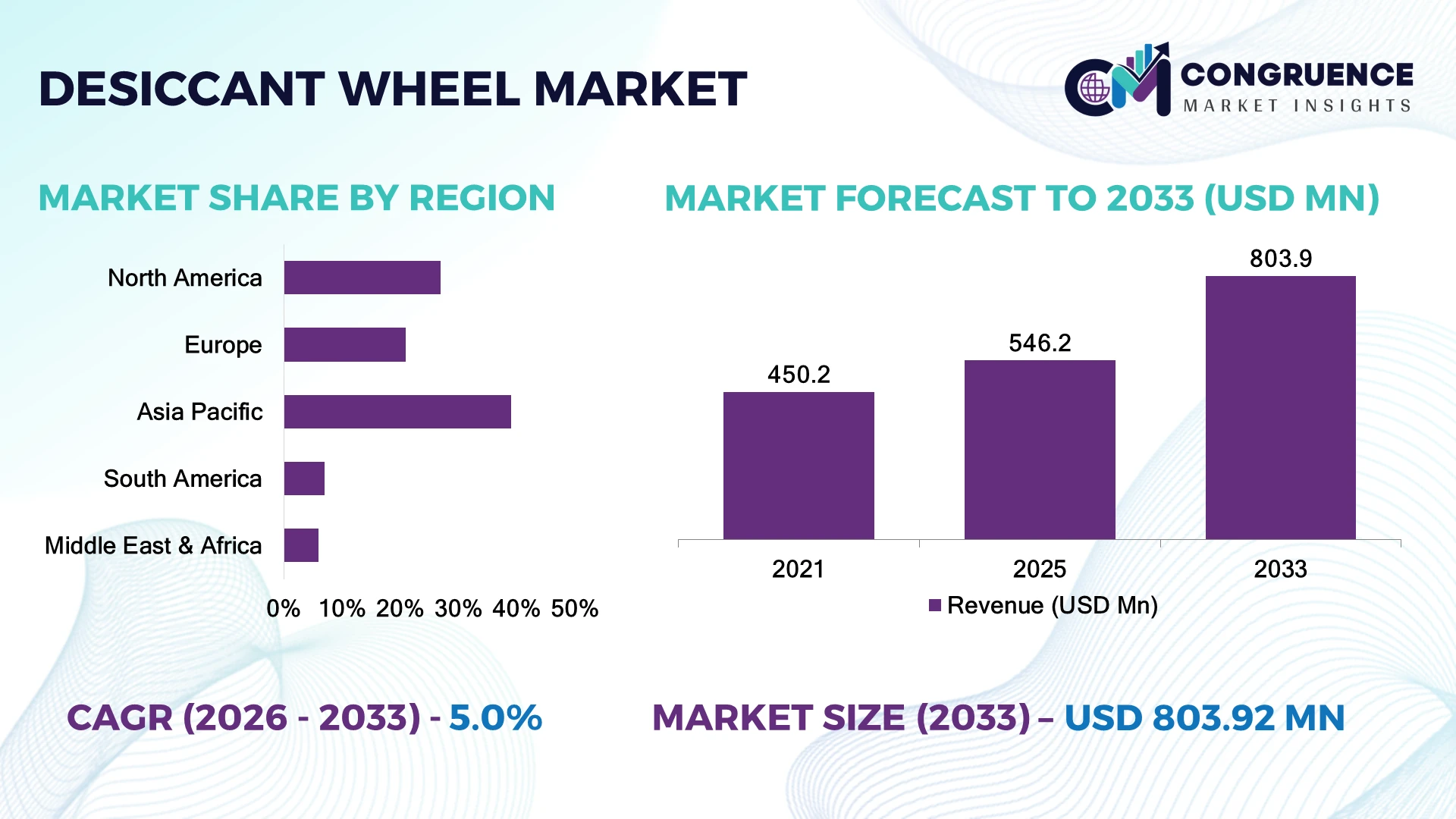
The Global Desiccant Wheel Market was valued at USD 546.2 Million in 2025 and is anticipated to reach a value of USD 803.9 Million by 2033 expanding at a CAGR of 4.95% between 2026 and 2033. Growth is driven by the shift toward ultra-low-humidity manufacturing in lithium-ion batteries, semiconductors, pharmaceuticals, and precision food processing, where desiccant systems reduce latent-load energy requirements and improve process stability.
China represents the dominant country market at approximately 18.9% share, supported by semiconductor, battery, pharmaceutical, and electronics manufacturing investments and expanding high-efficiency HVAC deployment. India is emerging rapidly, with pharmaceutical and electronics facilities increasingly adopting precision humidity control; China therefore maintains a substantially larger installed industrial base. Advanced systems can reduce heat demand by 29.4%, strengthening adoption where energy efficiency is a procurement priority.
Strategically, suppliers should prioritize China-scale manufacturing ecosystems while targeting India's expanding precision-production infrastructure with localized, energy-efficient systems.
Market Size & Growth: USD 546.2 Million in 2025 is projected to reach USD 803.9 Million by 2033 at a 4.95% CAGR, supported by low-humidity manufacturing and energy-efficient HVAC modernization.
Top Growth Drivers: Precision humidity control 30%+, industrial HVAC energy optimization 25–40%, and advanced manufacturing adoption 20%+ are strengthening deployment.
Short-Term Forecast: By 2028, optimized regeneration and heat-recovery configurations are positioned to reduce energy costs by 9–15% while improving humidity-control consistency.
Emerging Technologies: AI-based controls, three-zone heat-recovery wheels, and advanced molecular-sieve and composite coatings are reshaping high-performance dehumidification.
Regional Leaders: Asia-Pacific is projected near USD 311 Million by 2033, North America around USD 249 Million, and Europe approximately USD 177 Million, with battery, pharmaceutical, and cleanroom adoption accelerating.
Consumer/End-User Trends: Industrial and pharmaceutical facilities increasingly target humidity conditions below 3.5 g/kg, reinforcing demand for continuous precision dehumidification.
Pilot/Case Example: A 2026 industrial deployment achieved 29.4% lower regeneration heat demand and an additional 15.4% reduction through heat recovery, demonstrating measurable operational gains.
Competitive Landscape: Munters leads a fragmented field alongside Seibu Giken, Thermax, Daikin, and Johnson Controls, with leading suppliers competing through efficiency, customization, and integrated HVAC solutions.
Regulatory & ESG Impact: Energy-efficiency programs and decarbonization targets are accelerating systems that deliver 25–40% lower HVAC energy consumption than conventional cooling-based approaches.
Investment & Funding: Industrial manufacturers are increasing multi-million-dollar investments in battery, semiconductor, and pharmaceutical capacity, creating stronger demand for integrated humidity-control partnerships.
Innovation & Future Outlook: Passive regeneration, digital optimization, modular architectures, and waste-heat integration are shifting competition toward lifecycle efficiency rather than equipment price alone.
The Desiccant Wheel Market is gaining traction across pharmaceutical cleanrooms, battery plants, semiconductor fabs, food processing, and high-performance commercial HVAC. Advanced regeneration controls and heat-recovery configurations are becoming key differentiators, while industrial systems targeting ultra-low humidity increasingly prioritize energy optimization. With energy costs and manufacturing localization reshaping procurement, technology selection is moving toward measurable lifecycle efficiency and operational resilience.
Desiccant wheels are becoming strategically important because humidity control is moving from a supporting HVAC function to a production-quality requirement. Battery electrodes, semiconductor processes, pharmaceuticals, and specialty foods require stable moisture conditions to prevent defects and material degradation. This shift is strengthening investment in integrated dehumidification rather than standalone cooling.
Technology economics increasingly favor advanced configurations. Conventional cooling-coil systems can require substantially more energy for deep dehumidification, while optimized desiccant configurations have demonstrated energy savings of 30% or more in selected operating conditions. Three-zone heat-recovery architectures further reduce regeneration heat demand, improving the economics of continuous industrial operation. China has the strongest manufacturing scale, while India is building momentum through pharmaceutical, electronics, and battery investments.
Over the next 2–3 years, deployment will increasingly emphasize automated controls, waste-heat utilization, and modular retrofits. In industrial battery environments, systems delivering dew points below −30°C demonstrate the technology's role in precision manufacturing. Companies are responding through localized manufacturing, technology partnerships, digital controls, and application-specific engineering. Competitive advantage will increasingly depend on delivering lower lifecycle energy use while maintaining precise humidity stability.
Ultra-low-humidity manufacturing is becoming a decisive demand catalyst as lithium-ion batteries, semiconductors, and pharmaceuticals require tightly controlled moisture conditions. Industrial HVAC can account for roughly 30–50% of building energy use, while dehumidification can represent more than 30% of air-conditioning energy consumption in demanding facilities. Advanced desiccant configurations address this burden by separating latent-load removal from conventional cooling. China's expanding battery and electronics manufacturing base and India's pharmaceutical infrastructure are therefore creating application-specific demand. Recent industrial testing has demonstrated 29.4% lower regeneration heat demand through process-air reuse, while heat recovery delivered another 15.4% reduction. Manufacturers are responding with two-stage systems, heat recovery, and digitally optimized regeneration, shifting procurement toward measurable energy performance.
Regeneration heat remains a structural limitation for conventional desiccant-wheel installations, particularly where facilities lack inexpensive waste heat or stable thermal-energy infrastructure. Traditional configurations can require substantially higher thermal input than passive or heat-recovery designs, making lifecycle economics sensitive to energy prices. In hot and humid markets, inefficient regeneration can also increase operating expenditure when systems run continuously. India's industrial facilities, for example, face different economics depending on access to recovered process heat, electricity, and steam. Advanced designs address the constraint through heat recovery, lower regeneration temperatures, and hybrid heat-pump integration. Companies are increasingly diversifying thermal-energy sources and specifying systems around site-specific operating conditions rather than standardized wheel configurations, making energy-source integration a critical purchasing criterion.
Waste-heat recovery and intelligent controls represent a high-value opportunity because regeneration energy can be reduced without sacrificing humidity performance. Advanced industrial configurations have demonstrated 29.4% lower heat demand through low-humidity process-air reuse and a further 15.4% reduction through regeneration-air preheating. AI-assisted control can build on this advantage by continuously adjusting wheel speed, regeneration temperature, airflow, and cooling capacity according to production loads and electricity prices. China, India, and Southeast Asia offer particularly attractive opportunities as pharmaceutical, battery, and electronics capacity expands. Passive regeneration technologies also create new commercial-building applications by eliminating thermal regeneration requirements. Equipment suppliers are positioning through modular systems, controls partnerships, heat-pump integration, and application-specific R&D, creating a shift from component sales toward energy-performance solutions.
The next challenge is integrating desiccant wheels consistently with chillers, heat pumps, air-handling units, sensors, and building-management platforms across diverse operating conditions. On-site industrial testing has recorded system COP values ranging from 1.29–1.38 during typical summer operation, while optimized operating strategies produced energy savings of up to 30% under specific conditions. These variations demonstrate how strongly performance depends on temperature, humidity, airflow, regeneration conditions, and control logic. Semiconductor and battery plants require particularly stable low-dew-point conditions, increasing commissioning complexity and workforce requirements. Companies must therefore invest in controls engineering, sensor calibration, predictive maintenance, and local technical support. Strategic partnerships between wheel manufacturers, HVAC integrators, and automation providers will be essential to maintain deployment consistency as systems become increasingly digitally controlled.
Smart Regeneration Controls Accelerate: Manufacturers are integrating variable-speed drives, humidity sensors, and predictive controls, reducing regeneration energy by 10–18% and improving moisture-control accuracy by 15–20%. In China and Japan, automated air-handling systems are increasingly replacing fixed-cycle operation, allowing facilities to match wheel performance with production loads. This shift is reducing operator intervention by roughly 20% and encouraging suppliers to bundle digital controls with new installations.
Heat Recovery Gains Industrial Traction: Waste-heat regeneration is expanding across pharmaceutical, chemical, and food-processing plants, with optimized configurations delivering 15–30% lower thermal requirements and 8–15% lower operating costs. Rising industrial energy prices and decarbonization programs are accelerating retrofits. European manufacturers are increasingly connecting desiccant systems with heat pumps and recovered process heat, turning previously wasted thermal energy into a usable regeneration input.
Ultra-Dry Production Reshapes Demand: Battery and semiconductor facilities are increasing deployment of high-performance wheels capable of maintaining dew points below −30°C, while low-humidity production requirements are pushing specialized configurations 12–20% faster than conventional HVAC applications. Supply-chain localization in India, South Korea, and Southeast Asia is creating new dry-room installations. Equipment companies are responding with modular systems, advanced sorbent coatings, and application-specific airflow engineering.
Retrofit Models Expand Faster: Energy-efficiency upgrades are shifting procurement toward retrofit-compatible wheels, with retrofit activity increasing approximately 15–22% in mature HVAC installations and reducing conditioning energy use by 10–25% in suitable facilities. Aging air-handling infrastructure and tighter building-efficiency requirements are driving replacement decisions. Suppliers are developing compact rotors, standardized interfaces, and faster commissioning packages, creating a less obvious opportunity in existing commercial and industrial facilities.
Silica gel desiccant wheels lead the market with approximately 48% share, supported by broad HVAC compatibility, strong moisture adsorption, established supply chains, and relatively flexible regeneration requirements. Their mature installation base gives them an estimated 12–18 percentage-point advantage over molecular-sieve configurations in general-purpose dehumidification. Activated alumina remains strategically relevant for demanding industrial environments where thermal stability and contaminant tolerance are important. Companies continue expanding silica-gel product portfolios because replacement compatibility and lifecycle servicing create recurring commercial opportunities.
Molecular sieve is the fastest-growing type, gaining traction in battery dry rooms, semiconductor production, and pharmaceutical applications requiring extremely low humidity. Adoption in these precision environments is expanding approximately 8–12% faster than conventional HVAC-oriented installations. Molecular-sieve systems command greater engineering attention because pore structure and adsorption selectivity support deeper drying. Suppliers are therefore increasing R&D around rotor coatings, airflow optimization, and regeneration efficiency, while activated alumina remains targeted toward specialized industrial duty. The investment implication is clear: silica gel remains the volume anchor, but molecular sieve is attracting disproportionate innovation spending.
Air dehumidification represents approximately 44% of application demand, supported by commercial HVAC, industrial climate control, and humidity-sensitive facilities. Its installed base provides a significant scale advantage over specialized applications, while established ducting and air-handling infrastructure simplifies integration. Refrigeration precooling remains important where desiccant systems reduce downstream compressor loading, but environmental test chambers account for a smaller specialized niche. Companies are increasingly offering packaged wheel-and-air-handler solutions, helping reduce engineering complexity by approximately 10–15% and shortening commissioning schedules.
Process drying is the fastest-growing application, expanding roughly 8–11% faster than conventional air-dehumidification deployments as manufacturers seek tighter moisture control in food, plastics, chemicals, and advanced materials. Environmental test chambers continue to gain importance where repeatable temperature-humidity cycles are required, while refrigeration precooling is increasingly used to reduce latent-load pressure. In India and Southeast Asia, new manufacturing facilities are incorporating process drying directly into plant designs rather than adding it after commissioning. This favors suppliers capable of integrating wheels with heat recovery, automated controls, and production-line airflow requirements.
Commercial HVAC represents approximately 42% of end-user demand, supported by hospitality, office buildings, retail facilities, and centralized air-handling infrastructure. Its dominance reflects the breadth of installed HVAC equipment and the increasing emphasis on indoor humidity management and energy optimization. Industrial facilities follow closely because continuous process operation requires stable environmental conditions. Food and beverage users remain important for moisture-sensitive processing and storage, while pharmaceutical facilities command higher-value deployments because qualification and low-humidity requirements justify advanced configurations.
Pharmaceutical is the fastest-growing end-user group, with specialized deployments increasing approximately 8–12% faster than general commercial installations as tablet manufacturing, sterile production, laboratories, and controlled storage expand. Pharmaceutical buyers increasingly specify redundant controls, validated humidity ranges, and continuous monitoring, while food manufacturers prioritize sanitation, product quality, and operating-cost reduction. Commercial buyers favor standardized retrofit packages, creating different procurement models across the market. Companies are responding with sector-specific engineering, service agreements, and partnerships with HVAC integrators. Future competitive positioning will depend increasingly on application customization rather than rotor capacity alone.
Asia-Pacific accounted for the largest market share at 39.0% in 2025 however, Middle East & Africa is expected to register the fastest growth, expanding at a CAGR of 6.1% between 2026 and 2033.

North America accounted for approximately 27% of global demand in 2025, with the United States representing the overwhelming share of regional installations. Demand is concentrated across pharmaceutical manufacturing, food processing, semiconductor facilities, data centers, and commercial HVAC modernization. Industrial operators are increasingly integrating desiccant wheels with heat-recovery systems to reduce latent-load pressure and improve air-treatment efficiency. The U.S. semiconductor and advanced-manufacturing investment cycle is strengthening demand for precision humidity systems, particularly in facilities requiring tightly controlled production environments. Retrofit applications represent a significant opportunity because existing air-handling infrastructure can accommodate modular wheel systems without complete HVAC replacement. Suppliers are responding with variable-speed rotors, automated controls, and packaged air-treatment solutions that shorten commissioning periods and improve lifecycle economics.
United States Market Outlook: The United States remains North America's principal demand center because of its extensive pharmaceutical, semiconductor, food-processing, and advanced-manufacturing base. Semiconductor and cleanroom investments are particularly important, with ultra-low-humidity production requiring continuous dehumidification. More than 50% of U.S. industrial desiccant-wheel deployments are concentrated in demanding manufacturing and specialized HVAC environments, reinforcing the country's technology-led purchasing profile.
Europe held approximately 21% of global demand in 2025, supported by stringent building-efficiency requirements, pharmaceutical production, food processing, and industrial decarbonization programs. Germany, the United Kingdom, France, and Italy represent the principal deployment markets, with demand increasingly tied to HVAC modernization rather than new construction alone. Heat-recovery integration is becoming a procurement priority as industrial operators seek 15–25% reductions in thermal energy requirements from optimized regeneration configurations. European manufacturers are also emphasizing low-temperature regeneration and hybrid heat-pump systems to reduce fossil-fuel dependence. The region's regulatory emphasis on building performance is encouraging suppliers to develop digitally monitored systems capable of documenting energy consumption and humidity performance. This is shifting competition toward lifecycle efficiency, retrofit compatibility, and measurable environmental performance.
Germany Market Outlook: Germany represents Europe's most strategically significant market because of its advanced industrial base, engineering expertise, and large pharmaceutical, chemical, automotive, and food-processing sectors. Industrial facilities increasingly prioritize heat recovery and automated air treatment. Approximately 35% of new high-efficiency industrial HVAC specifications incorporate some form of energy-recovery strategy, supporting demand for desiccant systems capable of integrating with existing thermal infrastructure.
Asia-Pacific represented approximately 39% of global demand in 2025, making it the largest regional market. China, Japan, South Korea, and India account for most industrial deployment, supported by electronics, batteries, pharmaceuticals, food processing, and commercial construction. China remains the dominant country market, while India is gaining strategic importance as manufacturing capacity diversifies. Battery and semiconductor facilities are particularly important because dry-room environments can require dew points below −30°C. Industrial investments in electronics and battery production are increasing demand for molecular-sieve and high-capacity desiccant configurations. Suppliers are expanding localized manufacturing, partnering with HVAC integrators, and developing modular systems to address shorter project timelines. The region's manufacturing concentration gives equipment producers opportunities to standardize components while customizing controls and airflow configurations for individual production processes.
China Market Outlook: China is the region's largest deployment center, supported by its extensive battery, electronics, semiconductor, pharmaceutical, and industrial manufacturing ecosystem. Large-scale factory construction increasingly incorporates humidity-control equipment during initial facility design rather than as a retrofit. China's battery manufacturing capacity exceeds 1,000 GWh annually, creating substantial dry-room requirements and supporting continued investment in high-performance desiccant technologies.
South America represented approximately 7% of global demand in 2025, with Brazil accounting for the largest portion of regional installations. Pharmaceutical production, food processing, mining, chemicals, and commercial HVAC projects form the principal demand base. Brazil's large food and beverage processing industry creates consistent requirements for humidity management, while mining and mineral-processing facilities increasingly use engineered air treatment in sensitive operating environments. Adoption remains more selective than in China or North America because capital budgets, imported equipment costs, and technical-service availability constrain large-scale deployment. Energy-efficient retrofit projects are nevertheless gaining traction, particularly where desiccant systems reduce refrigeration loads by 10–20%. Suppliers are responding through distributor partnerships, localized technical support, and application-specific packages rather than broad infrastructure expansion.
Brazil Market Outlook: Brazil is the region's primary market because of its diversified industrial base, large food-processing sector, pharmaceutical manufacturing, and extensive commercial infrastructure. Industrial refrigeration and moisture-control upgrades are creating opportunities for desiccant systems where conventional cooling becomes inefficient under high latent loads. Food and beverage facilities account for an estimated 30% of regional industrial deployments, giving suppliers a strong platform for sector-specific expansion.
Middle East & Africa accounted for approximately 6% of global demand in 2025, with deployment concentrated in the Gulf states and major African industrial centers. The United Arab Emirates and Saudi Arabia lead regional activity because of large commercial developments, airports, hospitals, data centers, hospitality projects, and industrial diversification programs. High ambient temperatures and humidity create substantial latent-load challenges, making desiccant-assisted air treatment increasingly attractive for energy-intensive facilities. Saudi Arabia's infrastructure and industrial diversification investments are supporting new HVAC installations, while UAE developers increasingly incorporate high-efficiency air-treatment systems into large commercial projects. Desiccant configurations can reduce cooling-related energy requirements by approximately 15–25% in suitable hot-humid applications. Suppliers are therefore prioritizing packaged systems, local service partnerships, and integration with district cooling and heat-recovery infrastructure.
Saudi Arabia Market Outlook: Saudi Arabia is the region's most strategically significant market due to its large-scale infrastructure pipeline, industrial diversification, hospitality development, and expanding data-center and healthcare facilities. New projects increasingly specify high-efficiency HVAC systems capable of managing severe outdoor conditions. District-cooling expansion and large commercial developments provide a strong integration pathway for desiccant wheels, particularly where humidity control can reduce the burden on centralized chilled-water systems.
Munters, Seibu Giken, Bry-Air, Proflute, and Trane compete as global technology leaders, while regional OEMs and component specialists target cost-sensitive projects and retrofit niches. The top five players hold an estimated 38% combined share, indicating a moderately fragmented structure. Competition centers on technology, customization, delivery, and lifecycle cost: advanced systems deliver 10–30% energy advantages, customized configurations command 15–20% project premiums, and localized supply can shorten delivery 20–30%. Munters is expanding regional production; Seibu Giken is automating rotor manufacturing; Bry-Air is pushing low-temperature regeneration; Trane integrates desiccant wheels with HVAC platforms; Proflute competes through rotor specialization. The competitive shift is moving from equipment pricing toward energy performance, ultra-low-dew-point capability, and integrated controls. High engineering requirements, qualification standards, application expertise, and established OEM relationships create entry barriers. Winning requires proprietary sorbent technology, supply, rapid commissioning, engineering, and measurable lifecycle savings. Regional firms pressure incumbents through short lead times, service, and application-specific engineering.
Munters
Seibu Giken Co., Ltd.
Bry-Air
Proflute AB
Trane Technologies
Fisair
Condair Group
CAREL Industries
DRI
Rotor Source
NICHIAS Corporation
FläktGroup
Airxchange
NovelAire
Desiccant-wheel technology is shifting from conventional silica-gel rotors toward advanced sorbents, lower-temperature regeneration, variable-speed drives, and integrated heat recovery. Bry-Air’s newer rotor approach regenerates at 95°C versus a conventional 140°C benchmark, cutting energy use by more than 30%. Munters is developing super-adsorbent materials designed for lower regeneration temperatures. Adoption is strongest in pharmaceutical, battery, semiconductor, and cleanroom projects requiring stable low dew points.
Digital controls are becoming a competitive differentiator. Sensors, automated wheel-speed control, and load-based regeneration can improve operating efficiency by roughly 10–18% while reducing unnecessary thermal input. Seibu Giken’s compact low-dew-point systems support −15°C dew point operation, while customized configurations target more demanding environments. This enables smaller footprints, faster installation, and better process stability. Companies pairing rotor technology with intelligent controls gain an advantage in energy-sensitive facilities.
From 2026–2028, heat-pump regeneration, waste-heat integration, advanced composite sorbents, and predictive maintenance will reshape procurement. Integrated systems can reduce conditioning energy by 15–30% in suitable applications. Suppliers with proprietary materials and controls benefit most as buyers shift from equipment price toward verified lifecycle performance, lower emissions, and automated operation. This transition also favors retrofit-ready architectures that preserve existing air handlers, reducing disruption during modernization projects and strengthening service-led differentiation today.
May 2025 Munters inaugurated a 430,000-ft² facility in Amesbury, Massachusetts, dedicated to desiccant dehumidification and climate-control production. The expansion increases North American manufacturing capacity, improves workflows, and strengthens localized delivery for precision temperature and humidity-control applications. Source: Munters
2025 Bry-Air introduced its P95°x pharmaceutical dehumidifier featuring a G4 desiccant rotor operating at 95°C regeneration temperature and delivering energy savings above 30%. The technology targets pharmaceutical cleanrooms and manufacturing facilities, improving thermal efficiency while supporting FDA and cGMP requirements. Source: Bry-Air
June 2025 Airxchange launched its Blue Wave energy-recovery wheel for commercial and institutional HVAC systems. The design combines lower pressure drop, removable energy-transfer segments, and existing cabinet compatibility, strengthening retrofit economics while simplifying maintenance and supporting increasingly stringent building-energy requirements. Source: Airxchange
May 2025 Munters' new North American facility incorporated electrified processes, energy-efficiency improvements, renewable electricity, and rooftop solar alongside expanded production. The approximately 430,000-ft² site demonstrates the industry's shift toward regionalized manufacturing and lower-footprint production while increasing capacity for advanced humidity-control equipment. Source: Munters
The report covers the global Desiccant Wheel Market across silica gel, molecular sieve, and activated alumina technologies, with application analysis spanning air dehumidification, process drying, refrigeration precooling, and environmental test chambers. End-user coverage includes commercial HVAC, industrial facilities, food and beverage, and pharmaceutical operations. Regional assessment encompasses North America, Europe, Asia-Pacific, South America, and the Middle East & Africa, with country-level emphasis on major deployment and manufacturing centers.
The scope evaluates advanced rotor materials, low-temperature regeneration, heat recovery, automated controls, modular systems, and ultra-low-dew-point configurations. Approximately 40% of demand is concentrated in Asia-Pacific, while precision manufacturing is increasing adoption of advanced low-humidity systems. The analysis supports investment planning, product portfolio prioritization, geographic expansion, partnership development, competitive positioning, technology selection, and operational strategy through 2026–2033.
| Report Attribute / Metric Details | Details |
|---|---|
| Market Revenue (2025) | USD 546.2 Million |
| Market Revenue (2033) | USD 803.9 Million |
| CAGR (2026–2033) | 4.95% |
| Base Year | 2025 |
| Forecast Period | 2026–2033 |
| Historic Period | 2021–2025 |
| Segments Covered |
By Type
By Application
By End-User
|
| Key Deliverables | Revenue Forecast; Market Trends; Growth Drivers & Restraints; Technology Insights; Segmentation Analysis; Regional Insights; Competitive Landscape; Regulatory & ESG Overview; Recent Developments |
| Regions Covered | North America; Europe; Asia-Pacific; South America; Middle East & Africa |
| Companies Profiled | Munters; Seibu Giken Co., Ltd.; Bry-Air; Proflute AB; Trane Technologies; Fisair; Condair Group; CAREL Industries; DRI; Rotor Source; NICHIAS Corporation; FläktGroup; Airxchange; NovelAire |
| Customization & Pricing | Available on Request (10% Customization Free) |




