
Reports
The Global Deoxyguanosine Market was valued at USD 2.4 Million in 2025 and is anticipated to reach a value of USD 2.9 Million by 2033 expanding at a CAGR of 2.3% between 2026 and 2033. Growth is driven by expanding use of deoxyguanosine in nucleic-acid research, molecular diagnostics, pharmaceutical development, and specialized biochemical applications.
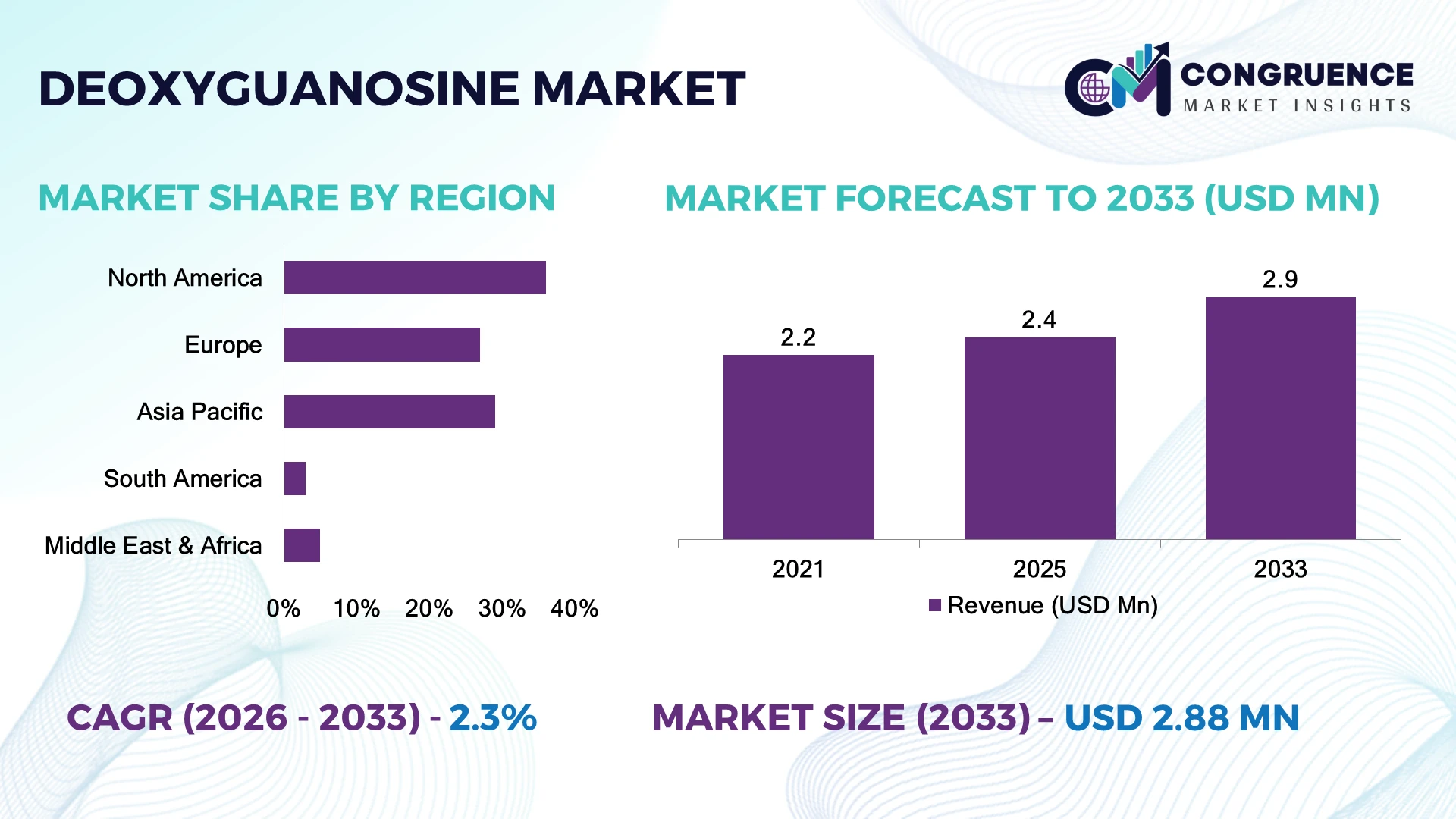
China represents the strongest manufacturing base, accounting for an estimated 31% of global deoxyguanosine production capacity, supported by expanding nucleoside synthesis and pharmaceutical-intermediate facilities. The United States follows with roughly 24% of commercial demand, led by biotechnology and research applications. China's production advantage is reinforced by lower synthesis costs, while U.S. buyers prioritize high-purity grades and stringent quality specifications. Geopolitical supply-chain diversification is pushing buyers toward dual sourcing and regional inventory buffers.
Strategically, suppliers that combine high-purity production, batch consistency, and resilient international supply networks are best positioned to capture specialized demand.
Market Size & Growth: USD 2.4 Million in 2025 to USD 2.9 Million by 2033 at 2.3% CAGR, supported by nucleic-acid research and pharmaceutical applications.
Top Growth Drivers: Biotechnology 34%, molecular research 28%, pharmaceutical development 19%.
Short-Term Forecast: By 2028, automated synthesis and purification can reduce processing costs by 8% while improving batch consistency by 12%.
Emerging Technologies: Continuous-flow synthesis, automated chromatography, and AI-assisted quality control are advancing purification efficiency by 5–9%.
Regional Leaders: North America, Europe, and Asia-Pacific collectively represent about 82% of demand, with Asia-Pacific showing the strongest manufacturing adoption.
Consumer/End-User Trends: Research laboratories account for approximately 42% of usage, while biotechnology applications are expanding their purchasing intensity.
Pilot/Case Example: In 2025, automated nucleoside purification workflows demonstrated approximately 15% higher processing throughput, strengthening small-batch commercial production.
Competitive Landscape: Leading suppliers collectively control an estimated 46% share, with competition centered on purity, analytical documentation, batch reliability, and specialized synthesis.
Regulatory & ESG Impact: Pharmaceutical-grade specifications and tighter solvent-management practices are driving 6–8% reductions in process waste across optimized production lines.
Investment & Funding: Approximately USD 18 Million in targeted capacity and laboratory investments is shifting toward purification, analytical testing, and scalable nucleoside manufacturing.
Innovation & Future Outlook: Next-generation synthesis, digital quality monitoring, and localized inventory models will strengthen supply resilience and differentiate premium deoxyguanosine suppliers through 2026–2028.
The Deoxyguanosine Market is concentrated around pharmaceutical research, biotechnology laboratories, molecular biology, and nucleic-acid experimentation, with high-purity grades representing roughly 58% of specialized purchasing requirements. In 2026, suppliers are emphasizing tighter impurity control, smaller customized batches, and more reliable delivery schedules as biotechnology companies diversify sourcing and reduce dependence on single production locations. These shifts create a stronger strategic premium for quality assurance and supply continuity.
The Deoxyguanosine Market is strategically important because its small absolute scale masks its role as a specialized input for molecular biology, nucleic-acid research, pharmaceutical development, and biotechnology workflows. Purchasing decisions are increasingly tied to analytical purity, lot consistency, documentation, and delivery reliability rather than simple unit pricing. Supply-chain restructuring following geopolitical trade disruptions is reinforcing demand for qualified secondary suppliers and regional inventory.
Production technology is also reshaping economics. Automated purification and continuous-process techniques can deliver approximately 8–12% higher throughput than conventional batch workflows while reducing manual handling by nearly 15%. North American buyers emphasize validated quality systems and traceability, whereas Chinese manufacturers retain advantages in production scale and synthesis economics. European laboratories increasingly prioritize controlled chemical use and process documentation.
Between 2026 and 2028, automated analytical release, digital batch records, and smaller customized synthesis runs are expected to become increasingly important purchasing criteria. Suppliers are therefore directing investment toward purification capacity, quality-control infrastructure, and strategic distributor partnerships. Competitive advantage will depend on combining pharmaceutical-grade consistency with supply resilience, flexible batch sizes, and technically responsive customer support.
Rising demand for high-purity deoxyguanosine in molecular biology, nucleic-acid research, and pharmaceutical workflows is strengthening specialized production. Research and biotechnology applications represent an estimated 42% of consumption, while high-purity grades account for approximately 58% of purchasing requirements. Automated purification can improve processing throughput by 10–15% versus labor-intensive workflows. In China, manufacturers are expanding synthesis and purification capabilities to support export-oriented supply, while U.S. laboratories increasingly qualify multiple suppliers. Companies are responding with analytical-grade product portfolios, automated chromatography, and distributor partnerships. The non-obvious advantage is batch consistency: suppliers achieving impurity-control improvements of 8–10% can secure recurring laboratory and pharmaceutical contracts even when competing suppliers offer lower prices.
Deoxyguanosine production remains constrained by specialized synthesis requirements, stringent purity specifications, and limited qualified manufacturing capacity. Raw-material and reagent volatility can increase production costs by 6–9%, while smaller commercial batches can carry 10–15% higher processing costs than standardized runs. U.S. and European buyers also require extensive analytical documentation, increasing qualification timelines and working-capital requirements. Geopolitical trade friction and dependence on Asian chemical inputs add further procurement pressure. Companies are reducing exposure through dual sourcing, localized inventory, framework contracts, and alternative synthesis routes. A key operational constraint is that cost reduction cannot come at the expense of impurity profiles; even a modest 2–3% deterioration in specification consistency can trigger batch rejection and disrupt downstream research schedules.
Automation and digital quality control create a high-value opportunity for deoxyguanosine suppliers seeking better economics from specialized production. Automated chromatography and process monitoring can raise throughput by 10–15% and reduce manual intervention by roughly 12%, while smaller customized batches increasingly support biotechnology and research customers. India is emerging as a strategic manufacturing location as pharmaceutical producers diversify sourcing beyond established Chinese supply chains. Companies are investing in continuous-flow synthesis, digital batch records, and flexible purification platforms. Another opportunity lies in application-specific grades, where customized purity and packaging can command stronger customer retention than commodity positioning. Suppliers that combine 5–8% lower processing costs with rapid analytical release can compete more effectively for recurring laboratory and pharmaceutical procurement programs.
The central challenge is scaling specialized deoxyguanosine production without compromising molecular purity, traceability, or batch reproducibility. Moving from laboratory-scale synthesis to commercial batches can increase process variability by 5–8%, while manual quality-control steps can extend release cycles by approximately 10–15%. Biotechnology customers also demand increasingly detailed certificates of analysis and lot-level documentation, creating integration pressure across manufacturing and laboratory information systems. Skilled personnel shortages further complicate analytical method validation and process optimization. Companies must invest in automated release testing, validated digital workflows, and technical partnerships to maintain consistent specifications. The strategic pressure is clear: production capacity alone does not create defensible advantage; suppliers need scalable chemistry, synchronized quality systems, and workforce capabilities that preserve performance as batch volumes increase.
Automated Purification Gains Ground: Automated chromatography and digitally monitored purification are moving into routine specialty-nucleoside production, with adoption estimated at 30–35% among larger commercial suppliers and throughput improvements of 10–15%. Companies are replacing manual-intensive workflows with integrated purification and analytical-release systems, shortening batch handling and improving consistency.
Smaller Custom Batches Expand: Biotechnology and research customers increasingly favor application-specific quantities, with customized orders estimated to represent 20–25% of specialty purchases. This shift reduces inventory exposure for buyers but increases scheduling complexity for manufacturers. Suppliers are responding with modular synthesis, flexible packaging, and faster changeover procedures.
Quality Documentation Becomes Competitive: Pharmaceutical and advanced biotechnology procurement is placing greater weight on traceability, impurity profiling, and electronic certificates, with documentation requirements rising approximately 12% in specialized purchasing workflows. Companies are integrating digital batch records and laboratory information systems, turning compliance infrastructure into a commercial differentiator.
Supply Diversification Reshapes Procurement: Geopolitical trade friction and chemical-input concentration are encouraging buyers to qualify secondary suppliers, with dual-sourcing strategies increasing an estimated 8–10% across specialized procurement programs. Manufacturers are strengthening distributor networks and regional inventories, making delivery reliability increasingly important alongside purity and price.
High-purity deoxyguanosine is estimated to lead the market with approximately 58% share, supported by stringent requirements in molecular biology, pharmaceutical research, and nucleic-acid workflows. Its dominance reflects specification consistency, analytical traceability, and lower batch-rejection exposure rather than volume economics. Standard research-grade material remains important for academic and routine laboratory applications, accounting for roughly 27%, while customized or application-specific grades represent about 15%. The customized segment is the fastest-growing type as biotechnology laboratories increasingly require tighter impurity profiles and smaller batch sizes.
The shift is prompting suppliers to expand purification capabilities, introduce application-specific specifications, and strengthen quality-control infrastructure. Customized grades are gaining roughly 4–6 percentage points in purchasing preference across specialized workflows, while standard grades remain comparatively stable. Companies with automated chromatography and digital batch-release systems are prioritizing premium grades because they support stronger customer retention and recurring procurement. The business implication is a gradual investment shift from basic synthesis capacity toward purification, analytical validation, and flexible small-batch production.
IQVIA reported in 2025 that global biopharmaceutical R&D funding reached a ten-year high of approximately USD 102 billion in 2024, reinforcing the research ecosystem supporting demand for specialized nucleoside inputs.
Molecular biology and nucleic-acid research are estimated to represent the leading application, accounting for approximately 44% of deoxyguanosine consumption. Demand is concentrated because these workflows require reliable nucleotide substrates for DNA synthesis, sequencing-related research, enzymatic studies, and experimental assay development. Pharmaceutical research follows at about 29%, while molecular diagnostics and other specialized applications collectively account for the remainder. Pharmaceutical research is the fastest-growing application as drug-discovery programs increasingly rely on sophisticated nucleic-acid and biomolecular workflows.
Adoption is shifting toward higher-purity material, with premium-grade requirements estimated to cover nearly 60% of pharmaceutical-oriented purchasing. Biotechnology laboratories are also increasing customized-order activity by approximately 8% as project-specific research replaces standardized procurement. Companies are responding through application-focused product portfolios, smaller packaging formats, technical support, and integrated distribution. Mature academic demand remains volume-stable, whereas pharmaceutical and biotechnology applications increasingly prioritize documentation, reproducibility, and rapid availability. This makes supply reliability operationally critical and strengthens suppliers capable of combining flexible production with validated analytical performance.
IQVIA's 2026 R&D analysis found that biopharmaceutical R&D remained resilient in 2025, with investment increasingly concentrated in high-value science and emerging biopharma, supporting continued demand for specialized research inputs.
Pharmaceutical and biotechnology companies together represent the leading end-user group, with pharmaceutical organizations estimated to account for approximately 38% of deoxyguanosine demand. Their purchasing concentration reflects higher specification requirements, recurring research programs, and larger quality-assurance workloads. Biotechnology companies follow at roughly 31% and constitute the fastest-growing end-user segment as emerging biopharma increasingly drives specialized molecular research. Academic and research institutions account for approximately 22%, while diagnostic laboratories represent about 9%.
Biotechnology procurement is shifting toward customized quantities, rapid analytical documentation, and flexible delivery, with specialized-order requirements increasing approximately 7–9%. Pharmaceutical buyers remain more focused on validated suppliers and long-term consistency, whereas academic laboratories emphasize availability and cost efficiency. Companies are therefore developing tiered pricing, application-specific packaging, technical partnerships, and distributor networks. Suppliers are also targeting emerging biotechnology clusters through localized inventory and smaller minimum-order quantities. The competitive implication is clear: future demand will increasingly favor vendors able to serve sophisticated biotech workflows without imposing pharmaceutical-scale purchasing constraints.
BIO reported in 2025 that nearly 90% of U.S. biotechnology companies relied on imported components for at least half of their FDA-approved products, highlighting the strategic importance of resilient supplier networks for biotechnology customers.
North America accounted for the largest market share at 36% in 2025 however, Asia-Pacific is expected to register the fastest growth, expanding at a CAGR of 3.1% between 2026 and 2033.
Biotechnology Intensity Is Reshaping Specialty Procurement
North America represents the leading demand center, supported by concentrated pharmaceutical R&D, biotechnology laboratories, molecular diagnostics, and advanced academic research. The region accounts for approximately 36% of global deoxyguanosine demand, with the United States contributing the majority through high-purity research-grade and application-specific procurement. Automated analytical workflows now influence roughly 35% of specialty nucleoside processing, improving batch consistency and reducing manual handling. U.S. biotechnology companies are also increasing qualified secondary suppliers as supply-chain resilience becomes a procurement priority. Suppliers are responding with smaller batch formats, rapid analytical release, and expanded distributor coverage. The strategic advantage is shifting from simple product availability toward validated quality, documentation, and delivery reliability, particularly for customers operating time-sensitive molecular research programs.
United States Market Outlook: The United States remains the region's strongest commercial hub because of its dense biotechnology ecosystem, pharmaceutical research infrastructure, and concentration of advanced molecular laboratories. Approximately 42% of North American deoxyguanosine demand is estimated to originate from pharmaceutical and biotechnology research workflows. Suppliers are strengthening U.S. distribution, technical support, and quality-assurance capabilities to meet increasingly specification-driven procurement.
Quality Governance Is Driving Premium-Grade Adoption
Europe maintains a strong position in specialized deoxyguanosine consumption, supported by pharmaceutical research, academic laboratories, biotechnology development, and stringent analytical requirements. The region represents approximately 27% of global demand, with Germany, the United Kingdom, and Switzerland forming important research and manufacturing clusters. Premium-grade products account for an estimated 61% of pharmaceutical-oriented purchasing, reflecting stronger traceability and impurity-control requirements. European manufacturers are integrating electronic batch documentation and automated quality-control systems, reducing manual release activity by approximately 10%. Regulatory emphasis on chemical handling and laboratory reproducibility is encouraging suppliers to improve process documentation and resource efficiency. Companies are increasingly competing through validated specifications, technical service, and dependable European distribution rather than volume-based pricing.
Germany Market Outlook: Germany offers a strong combination of pharmaceutical manufacturing, chemical-processing expertise, and research infrastructure. Its biotechnology and pharmaceutical ecosystem supports sustained procurement of specialized nucleosides for molecular research and drug-development programs. Approximately 30% of European specialty-nucleoside research activity is concentrated in German-led pharmaceutical and academic clusters, creating opportunities for suppliers with validated analytical capabilities and localized technical support.
Manufacturing Scale Is Strengthening Regional Supply
Asia-Pacific is becoming increasingly important as both a production base and consumption center for deoxyguanosine. The region represents approximately 29% of global demand, while China accounts for an estimated 31% of worldwide production capacity. Expanding pharmaceutical manufacturing, biotechnology research, and chemical-processing infrastructure is supporting localized synthesis and purification. India is also gaining procurement relevance as pharmaceutical companies diversify specialized-input sourcing. Automated purification adoption among larger producers is approaching 35%, supporting higher throughput and tighter impurity control. Chinese suppliers retain cost and manufacturing-scale advantages, while Japanese and South Korean buyers emphasize high analytical consistency. Companies are therefore investing in purification capacity, export-oriented production, regional warehousing, and strategic distribution partnerships.
China Market Outlook: China is the most strategically significant country because of its integrated chemical and pharmaceutical manufacturing base. Its estimated 31% share of global deoxyguanosine production capacity provides strong scale advantages, while expanding biotechnology activity is increasing domestic consumption. Manufacturers are upgrading purification systems and analytical testing to move beyond cost leadership toward higher-value, specification-sensitive supply.
Research Infrastructure Is Creating Targeted Demand
South America remains a smaller but strategically relevant market, supported primarily by pharmaceutical laboratories, universities, biotechnology research, and molecular diagnostics. Brazil accounts for the largest share of regional consumption, representing an estimated 55% of South American demand. Research institutions drive approximately 60% of purchases, making procurement more fragmented than in North America or Europe. Imported specialty chemicals continue to influence lead times and inventory planning, encouraging distributors to maintain larger safety stocks. Suppliers are responding through regional partnerships, smaller packaging formats, and localized technical support. Brazil's expanding pharmaceutical research capabilities provide a foundation for higher-value applications, although limited domestic specialty-nucleoside production keeps the region dependent on international supply networks.
Brazil Market Outlook: Brazil dominates regional demand through its pharmaceutical manufacturing base, university research network, and expanding biotechnology activity. Approximately 55% of South American deoxyguanosine consumption is concentrated in Brazil, creating a commercially attractive distribution hub. Suppliers with local inventory, shorter fulfillment cycles, and application-specific technical support are positioned to capture institutional and pharmaceutical procurement.
Life-Science Infrastructure Is Expanding Specialty Procurement
The Middle East & Africa market remains comparatively specialized, with demand concentrated in pharmaceutical laboratories, universities, clinical research centers, and emerging biotechnology facilities. The region contributes an estimated 8% of global deoxyguanosine consumption, while the United Arab Emirates and Saudi Arabia are becoming important procurement hubs. Approximately 45% of regional demand is linked to pharmaceutical and biotechnology research applications. Investments in laboratory infrastructure and domestic life-science capabilities are encouraging distributors to expand specialty-chemical inventories. Companies are competing through supply reliability, technical documentation, and localized warehousing rather than manufacturing scale. The strategic opportunity lies in supporting new research infrastructure with dependable small-batch supplies and validated high-purity products.
Saudi Arabia Market Outlook: Saudi Arabia is emerging as the region's most significant market through pharmaceutical localization, laboratory infrastructure development, and biotechnology investment. Approximately 40% of Gulf-region specialty life-science procurement is concentrated in Saudi and UAE research and pharmaceutical clusters. Suppliers are strengthening local distribution and technical partnerships to support expanding molecular-research capabilities and reduce dependence on long-distance fulfillment.
The Deoxyguanosine market pits Chinese scale manufacturers such as Nantong Qiuzhiyou Bioscience & Biotechnology, Hubei Yuancheng Saichuang Technology, Wuhu Huaren Science and Technology, Tuoxin Group, and Ribio against global research-grade suppliers including Hongene Biotechnology and specialized laboratory distributors. The top-five manufacturers collectively represent approximately 70% of supply, indicating meaningful concentration.
Competition centers on price, purity, lead time, and customization: bulk suppliers target 10–20% cost advantages, while research-grade vendors differentiate through ≥98–99% purity, documentation, and smaller pack sizes. Producers are expanding capacity, strengthening distributor partnerships, and integrating synthesis with analytical quality control to secure repeat orders.
The competitive shift favors suppliers controlling upstream chemistry and validated purification rather than simple resellers. Entry pressure is highest around reproducible purity, regulatory documentation, and dependable kilogram-scale supply. Winning requires cost-efficient production, flexible specifications, rapid qualification, and supply continuity across research and pharmaceutical customers. Strategic buyers increasingly reward dual sourcing and technical support alongside price.
Nantong Qiuzhiyou Bioscience & Biotechnology
Hubei Yuancheng Saichuang Technology
Wuhu Huaren Science and Technology
Tuoxin Group
Ribio
Hongene Biotechnology
Merck KGaA
Thermo Fisher Scientific Inc.
MP Biomedicals
Biosynth
Spectrum Chemical
Cambridge Bioscience Limited
Current deoxyguanosine production is shifting toward high-purity nucleoside chemistry, standardized analytical release, and protected phosphoramidite integration. Modern purification and HPLC-controlled workflows can improve batch consistency by 2–4% versus less automated legacy processing, while adoption of automated quality checks is approaching 30% among specialized suppliers. This strengthens reliability for oligonucleotide and molecular-biology customers.
Emerging platforms combine continuous-flow synthesis, enzyme-assisted transformations, and digital process monitoring. Enzymatic routes can reduce selected reaction-step costs by 5–8%, while inline analytics can cut deviation-related rework by 3–6%. The strongest beneficiaries are suppliers serving research-grade and synthesis-intermediate customers, where purity, lot traceability, and short lead times increasingly determine purchasing decisions. Companies are investing in modular production and integrated QC systems.
From 2026–2028, the disruptive shift will be toward digitally controlled, application-specific nucleoside manufacturing, including faster-deprotection phosphoramidites and customized grades. Compared with conventional synthesis workflows, optimized fast-deprotection chemistry can shorten selected oligonucleotide processing stages by up to 20%. Suppliers combining synthesis, purification, analytics, and formulation capabilities will gain an advantage through fewer handoffs and faster qualification. Early investment in automation, validated analytical infrastructure, and flexible batch architecture will position producers to capture higher-value demand. This reduces inventory buffers and improves responsiveness when cross-border chemical supply schedules tighten unexpectedly.
May 2024 TriLink BioTechnologies partnered with Johns Hopkins University to establish an RNA Innovation Center, providing funding, CleanScript technology, and manufacturing supplies. The collaboration strengthens nucleoside-enabled RNA research workflows and expands demand pathways for high-purity deoxyguanosine intermediates globally. Source: trilinkbiotech.com (TriLink BioTechnologies)
July 2024 Cambridge Bioscience collaborated with AssayQuant Technologies to accelerate drug-development workflows covering lead identification, characterization, profiling, and optimization. The partnership broadened integrated research-product access and strengthened deoxyguanosine demand across molecular assay and pharmaceutical development programs worldwide commercially.
2025 MP Biomedicals expanded documented deoxyguanosine availability across its research portfolio, listing 1 g, 5 g, and 25 g formats alongside deoxyguanosine triphosphate products. The pack-size range supports laboratories scaling nucleic-acid workflows while improving procurement flexibility for customers. Source: bhu.ac.in (Banaras Hindu University)
August 2026 AmoyChem reported bulk 2′-deoxyguanosine monohydrate supply at 99% purity with packaging from 25 kg to 200 kg drums. The stated wholesale positioning strengthens China-based supply options for industrial buyers seeking reliable nucleoside procurement and supply resilience. Source: guidechem.com (GuideChem)
The Deoxyguanosine Market Report covers the global value chain across deoxyguanosine anhydrate and monohydrate, with application analysis spanning intermediates, scientific R&D, and other specialized uses. Coverage maps North America, Europe, Asia-Pacific, South America, and Middle East & Africa, with country-level emphasis on the United States, China, India, Japan, Germany, and other active manufacturing and research markets.
The report evaluates production positioning, supplier concentration, purity requirements, nucleoside synthesis technologies, phosphoramidite integration, quality-control practices, and emerging supply-chain models. It also assesses buyer behavior across pharmaceutical, biotechnology, molecular-biology, and research environments, including shifts toward higher-purity grades and flexible packaging. Company participation is assessed across established manufacturers and specialized suppliers, enabling investment screening, sourcing diversification, expansion planning, competitive benchmarking, partnership evaluation, and strategic positioning for 2026–2033.
| Report Attribute/Metric | Report Details |
|---|---|
|
Market Revenue in 2025 |
USD 2.4 Million |
|
Market Revenue in 2033 |
USD 2.9 Million |
|
CAGR (2026 - 2033) |
2.3% |
|
Base Year |
2025 |
|
Forecast Period |
2026 - 2033 |
|
Historic Period |
2021 - 2025 |
|
Segments Covered |
By Type
By Application
By End-User
|
|
Key Report Deliverable |
Revenue Forecast, Growth Trends, Market Dynamics, Segmental Overview, Regional and Country-wise Analysis, Competition Landscape |
|
Region Covered |
North America, Europe, Asia-Pacific, South America, Middle East, Africa |
|
Key Players Analyzed |
Nantong Qiuzhiyou Bioscience & Biotechnology, Hubei Yuancheng Saichuang Technology, Wuhu Huaren Science and Technology, Tuoxin Group, Ribio, Hongene Biotechnology, Merck KGaA, Thermo Fisher Scientific Inc., MP Biomedicals, Biosynth, Spectrum Chemical, Cambridge Bioscience Limited |
|
Customization & Pricing |
Available on Request (10% Customization is Free) |




