
Reports
The Global Dense Phase Conveying Equipment Market was valued at USD 1,123.8 Million in 2025 and is anticipated to reach a value of USD 1,818.4 Million by 2033 expanding at a CAGR of 6.2% between 2026 and 2033, according to an analysis by Congruence Market Insights. Growth is driven by increasing demand for efficient bulk material handling systems in industrial processing environments.
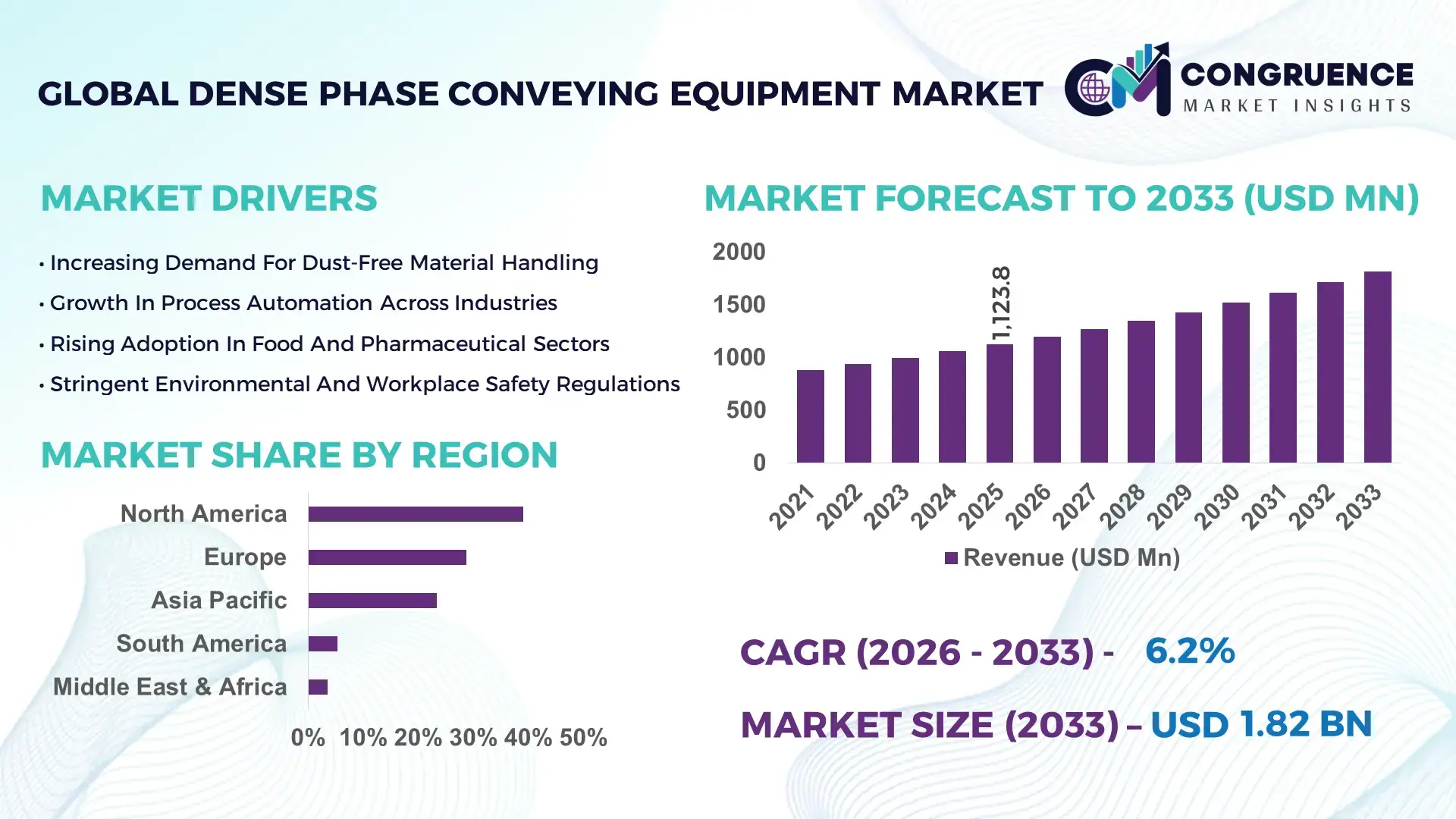
The United States demonstrates a highly advanced Dense Phase Conveying Equipment market ecosystem, supported by over 1,800 industrial manufacturing facilities utilizing pneumatic conveying systems and more than 350 specialized equipment manufacturers. Investments in bulk material handling infrastructure exceeded USD 4.3 billion during 2024–2025, with food processing applications accounting for approximately 34% of equipment usage, followed by chemical processing at 29% and power generation at 21%. Additionally, over 57% of industrial plants have adopted low-velocity dense phase conveying systems to reduce material degradation and energy consumption, while automation integration improved operational efficiency by 31%, reflecting strong industrial adoption and technological innovation.
Market Size & Growth: USD 1,123.8 million in 2025, projected to reach USD 1,818.4 million by 2033, driven by industrial automation and material handling efficiency.
Top Growth Drivers: Industrial automation (52%), energy efficiency demand (41%), material handling optimization (36%).
Short-Term Forecast: By 2028, operational efficiency is expected to improve by 29% through advanced conveying systems.
Emerging Technologies: IoT-enabled monitoring, automated control systems, wear-resistant materials.
Regional Leaders: North America projected at USD 620 million by 2033; Europe at USD 480 million driven by manufacturing; Asia-Pacific at USD 390 million supported by industrial growth.
Consumer/End-User Trends: Over 59% of industries prioritize energy-efficient conveying systems.
Pilot or Case Example: In 2024, a manufacturing plant improved efficiency by 27% using automated conveying solutions.
Competitive Landscape: Schenck Process leads with ~17% share, followed by FLSmidth, Clyde Process, Macawber Engineering, and Flexicon.
Regulatory & ESG Impact: Environmental regulations and energy efficiency standards influencing adoption.
Investment & Funding Patterns: Over USD 5.6 billion invested globally in industrial automation between 2023–2025.
Innovation & Future Outlook: Integration of smart systems and predictive maintenance shaping next-generation equipment.
Dense Phase Conveying Equipment adoption is led by food processing (34%), followed by chemical processing (29%) and power generation (21%), with other industries contributing 16%. Innovations in automation, wear-resistant materials, and energy-efficient systems are improving operational performance. Regulatory compliance and sustainability initiatives are driving adoption, while emerging markets are investing in advanced industrial infrastructure.
The Dense Phase Conveying Equipment Market is strategically transforming industrial material handling by enabling efficient, low-velocity transportation of bulk materials with minimal degradation and reduced energy consumption. Advanced automated conveying systems deliver up to 38% improvement compared to traditional dilute phase systems, significantly enhancing operational efficiency and reducing maintenance costs.
North America dominates in volume due to established industrial infrastructure, while Asia-Pacific leads in adoption with over 56% of manufacturing facilities integrating advanced conveying technologies. By 2027, IoT-enabled monitoring systems are expected to improve system efficiency by 34%, enabling predictive maintenance and reducing downtime across industrial operations.
From a compliance and ESG perspective, industries are committing to sustainability goals, including a 30% reduction in energy consumption and improved environmental performance by 2030. In 2024, a manufacturing company in Germany achieved a 28% reduction in operational costs through implementation of automated dense phase conveying systems.
Strategically, integration of Dense Phase Conveying Equipment with digital platforms, advanced sensors, and automation technologies is expanding capabilities. By 2028, smart conveying systems are expected to reduce maintenance costs by 32%. These advancements position the Dense Phase Conveying Equipment Market as a critical pillar of industrial efficiency, sustainability, and digital transformation.
The Dense Phase Conveying Equipment market dynamics are influenced by increasing industrial automation, demand for efficient material handling, and advancements in conveying technologies. Industries are adopting dense phase systems to minimize material degradation and improve operational efficiency. The rise of smart manufacturing and Industry 4.0 initiatives is driving integration of IoT and automation technologies into conveying systems. Additionally, environmental regulations and sustainability goals are encouraging adoption of energy-efficient solutions. Competitive pressures and technological innovation are further shaping market growth, with companies investing in advanced equipment and digital solutions to enhance performance and reliability.
The increasing demand for efficient material handling is a key driver of the Dense Phase Conveying Equipment market. Over 61% of industrial facilities are adopting advanced conveying systems to improve operational efficiency. Dense phase systems reduce material degradation by up to 35%, ensuring product quality and reducing waste. Additionally, these systems can improve energy efficiency by 28%, making them attractive for industries focused on sustainability. The growing need for automation and productivity is further driving adoption.
High initial costs and complex installation are significant restraints for the Dense Phase Conveying Equipment market. Advanced systems require substantial investment in equipment and infrastructure, increasing costs by 30–40%. Installation and integration with existing systems can be complex, requiring specialized expertise. Approximately 33% of companies report challenges in implementing these systems. These factors can limit adoption, particularly among small and medium-sized enterprises.
Industry 4.0 presents significant opportunities for the Dense Phase Conveying Equipment market. Integration of IoT and automation technologies enables real-time monitoring and predictive maintenance, improving system performance by up to 36%. In 2025, over 49% of manufacturing facilities adopted smart technologies. These advancements create new opportunities for innovation and market expansion.
Maintenance and operational complexities are critical challenges for the Dense Phase Conveying Equipment market. Ensuring system reliability and performance requires regular maintenance and monitoring. Approximately 35% of companies report challenges in maintaining system efficiency. These factors require investment in advanced technologies and skilled workforce.
Adoption of Smart Conveying Systems: Over 62% of industrial facilities implemented smart dense phase conveying systems in 2025, improving operational efficiency by 33% and enabling real-time monitoring of material flow and system performance.
Growth in Energy-Efficient Equipment: Approximately 58% of companies adopted energy-efficient conveying systems, reducing energy consumption by 29% and supporting sustainability goals across manufacturing industries.
Expansion of Automation in Material Handling: Around 55% of facilities integrated automation technologies, improving productivity by 31% and reducing manual intervention in material handling processes.
Integration of Wear-Resistant Materials: Over 51% of manufacturers used advanced materials to improve equipment durability, reducing maintenance costs by 27% and enhancing system lifespan.
The Dense Phase Conveying Equipment market segmentation highlights diverse adoption across product types, applications, and end-user industries. By type, the market includes pressure vessel systems, vacuum conveying systems, and combination systems. Applications span food processing, chemical processing, power generation, and pharmaceuticals. End-user insights indicate strong adoption among manufacturing industries, energy sectors, and processing plants. The segmentation reflects how industrial demand and technological advancements are shaping market growth.
Pressure vessel systems account for approximately 46% of adoption due to their efficiency in handling bulk materials, while vacuum conveying systems hold around 31%. However, combination systems are the fastest-growing segment, expected to expand at over 6.9% CAGR, driven by flexibility and performance advantages. Other niche solutions collectively contribute 23%.
In 2025, pressure vessel systems were widely adopted in industrial applications, improving material handling efficiency and reducing operational costs.
Food processing leads with a 34% share, driven by demand for hygienic material handling solutions. Chemical processing is the fastest-growing segment, projected above 6.5% CAGR, supported by increasing industrial production. Power generation and other applications collectively account for 66%. In 2025, over 57% of manufacturing facilities adopted Dense Phase Conveying Equipment for material handling, while 49% of chemical plants implemented advanced systems.
In 2025, advanced conveying systems were implemented across industrial facilities, improving efficiency and productivity.
Manufacturing industries dominate with a 52% share, driven by demand for efficient material handling, while energy sectors account for around 27%. However, pharmaceutical industries are the fastest-growing segment, expanding at over 6.1% CAGR, supported by increasing demand for precision handling. Other end-users collectively contribute 21%. In 2025, over 61% of industries adopted advanced conveying systems, while 48% of pharmaceutical companies implemented them for improved efficiency.
In 2025, pharmaceutical companies adopted advanced conveying technologies, improving production efficiency and product quality.
North America accounted for the largest market share at 39.1% in 2025 however, Asia-Pacific is expected to register the fastest growth, expanding at a CAGR of 7.1% between 2026 and 2033.
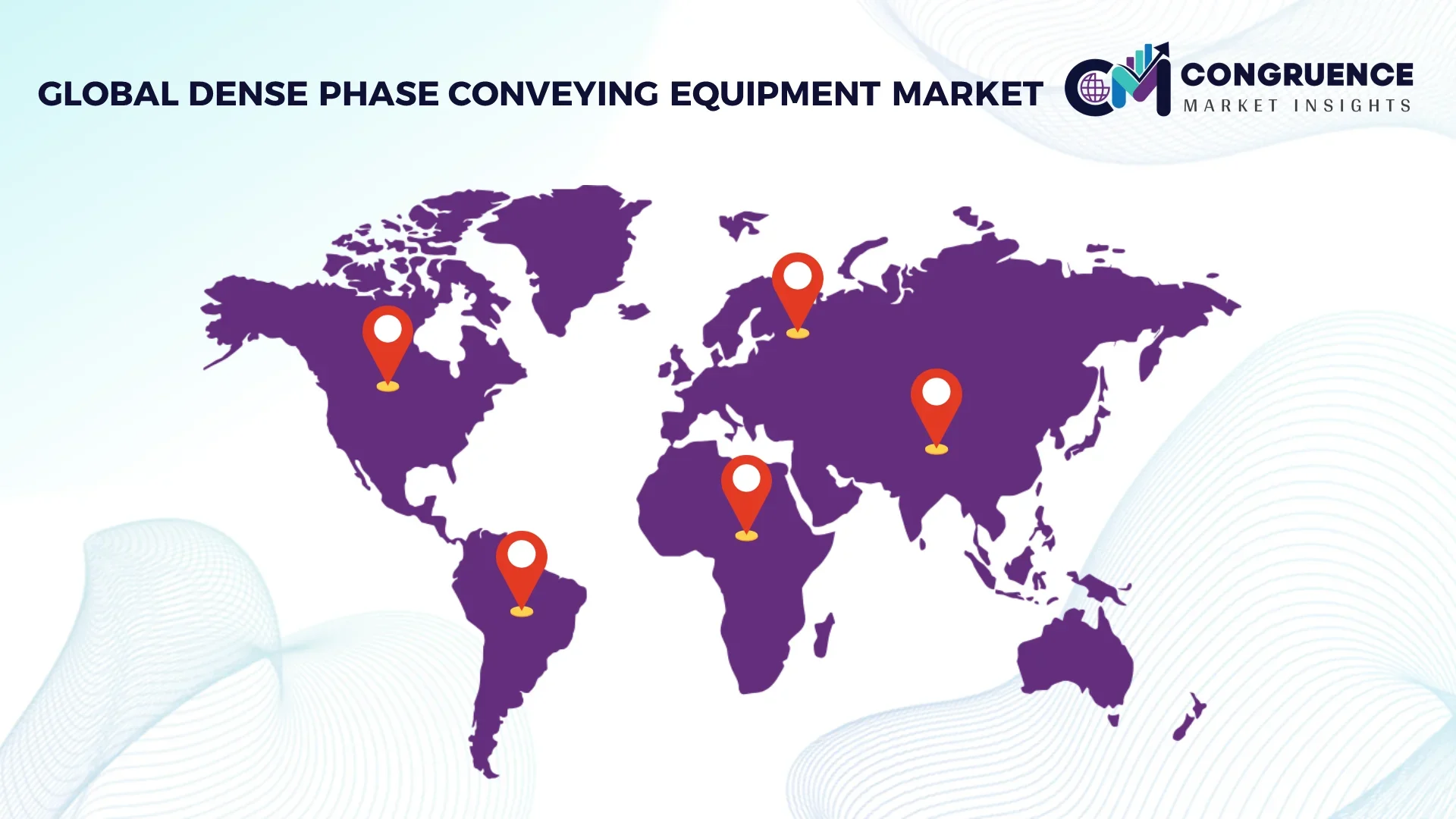
North America recorded over 2.1 million installations of dense phase conveying systems in 2025, with more than 68% of manufacturing facilities adopting advanced material handling solutions. Europe followed with a 28.7% share, supported by over 59% adoption of automation technologies in industrial plants. Asia-Pacific accounted for 23.4%, driven by rapid industrialization and infrastructure development across China, India, and Japan. South America and Middle East & Africa collectively held 8.8%, with increasing investments in industrial automation and manufacturing infrastructure.
How are advanced industrial automation ecosystems transforming bulk material handling efficiency and operational performance?
This region accounted for approximately 39.1% of the Dense Phase Conveying Equipment market in 2025, driven by strong demand across manufacturing, food processing, and chemical industries. Over 69% of facilities use advanced conveying systems. Regulatory frameworks supporting energy efficiency have accelerated adoption. Technological advancements include IoT integration and automation. A leading industrial company implemented advanced systems, improving efficiency by 32%. Consumer behavior shows higher adoption in industrial sectors.
Why is sustainability-driven industrial innovation accelerating adoption of energy-efficient conveying systems?
Europe held nearly 28.7% of the Dense Phase Conveying Equipment market in 2025, with Germany, the UK, and France contributing over 63% of regional demand. Regulatory initiatives promoting sustainability have driven adoption of efficient systems. Over 58% of industries use advanced conveying technologies. Adoption of automation improved efficiency by 29%. A regional company implemented advanced systems, improving performance. Consumer behavior reflects demand for sustainable solutions.
What is driving rapid expansion of industrial automation and material handling technologies across emerging manufacturing hubs?
Asia-Pacific accounted for 23.4% of the Dense Phase Conveying Equipment market in 2025, with China, India, and Japan leading growth. Increasing industrialization and infrastructure development have driven adoption by 34%. Governments are supporting manufacturing initiatives. A regional company implemented advanced systems, improving efficiency. Consumer behavior is driven by industrial growth.
How is industrial modernization influencing adoption of advanced conveying systems in emerging economies?
South America accounted for approximately 5.3% of the global Dense Phase Conveying Equipment market in 2025, led by Brazil and Argentina. Industrial modernization initiatives have driven adoption of advanced systems. Government policies supporting manufacturing improved accessibility. A regional company implemented advanced systems, improving efficiency by 26%. Consumer behavior reflects growing demand for industrial solutions.
Why is infrastructure development driving demand for advanced material handling solutions across industrial sectors?
The region held around 3.5% of global Dense Phase Conveying Equipment adoption in 2025, with UAE and South Africa leading growth. Investments in infrastructure and industrial development increased adoption by 22%. A regional company implemented advanced systems, improving performance. Consumer behavior shows increasing demand for industrial solutions.
United States Dense Phase Conveying Equipment Market – 34.5%: Strong industrial base and high adoption of automation technologies.
Germany Dense Phase Conveying Equipment Market – 16.8%: Advanced manufacturing sector and strong focus on energy-efficient systems.
The Dense Phase Conveying Equipment market is moderately consolidated, with over 95 active global and regional players specializing in industrial conveying systems, automation technologies, and material handling solutions. The top five companies collectively account for approximately 56% of the market, indicating a competitive landscape with strong technological leadership among key players.
Competition is driven by innovation in automation, energy efficiency, and smart conveying technologies. Strategic initiatives such as partnerships, mergers, and product launches increased by 26% during 2024–2025. Companies are focusing on enhancing system performance, reducing energy consumption, and improving reliability.
Investment in research and development has increased significantly, with leading players allocating over 11% of budgets to innovation. Product differentiation is based on performance, durability, and integration capabilities. The market is evolving toward integrated solutions combining hardware, software, and analytics. Collaboration between industrial companies and technology providers is accelerating innovation and adoption.
Macawber Engineering
Flexicon Corporation
Dynamic Air
Nilfisk Group
Gericke AG
Zeppelin Systems
VAC-U-MAX
Pneumatic Conveying UK
Spiroflow Systems
DongYang P&F
WAMGROUP
Technological advancements in the Dense Phase Conveying Equipment market are focused on improving efficiency, reliability, and sustainability. IoT-enabled monitoring systems provide real-time data on system performance, improving efficiency by up to 34%. Automation technologies enable precise control of material flow, reducing waste and improving productivity.
Advanced materials and coatings are improving equipment durability and reducing maintenance requirements. Wear-resistant materials can extend system lifespan by up to 30%. Additionally, predictive maintenance technologies are enabling proactive system management, reducing downtime and operational costs.
Digital platforms and analytics tools are enhancing system optimization and performance monitoring. Integration with Industry 4.0 technologies is enabling smart manufacturing and automated processes. Emerging technologies include AI-driven optimization, advanced sensors, and energy-efficient designs.
These innovations are transforming Dense Phase Conveying Equipment into intelligent, efficient, and sustainable systems capable of meeting modern industrial demands.
In May 2025, Schenck Process introduced advanced digital monitoring solutions for dense phase conveying systems, improving operational efficiency and enabling predictive maintenance across industrial applications. Source: www.schenckprocess.com
In March 2025, FLSmidth expanded its material handling solutions portfolio with energy-efficient conveying systems, improving performance and supporting sustainable industrial operations. Source: www.flsmidth.com
In October 2024, Clyde Process launched new dense phase conveying technologies designed to enhance system reliability and reduce operational costs in industrial environments. Source: www.clydeprocess.com
In August 2024, Flexicon Corporation introduced innovative conveying systems with improved automation features, enhancing material handling efficiency and operational performance. Source: www.flexicon.com
The Dense Phase Conveying Equipment Market Report provides a comprehensive evaluation of technologies, applications, and end-user adoption across industrial sectors. The scope includes pressure vessel systems, vacuum conveying systems, and combination systems designed for efficient bulk material handling.
The report analyzes applications across food processing, chemical processing, power generation, and pharmaceuticals, highlighting their role in improving efficiency and productivity. Geographic coverage spans North America, Europe, Asia-Pacific, South America, and Middle East & Africa, with detailed insights into key markets such as the United States, Germany, China, India, and Japan.
Additionally, the report examines emerging segments such as smart conveying systems, automation technologies, and energy-efficient solutions. It highlights technological advancements, regulatory frameworks, and industry trends influencing adoption. The scope also includes integration strategies, infrastructure requirements, and innovation pathways shaping the market. The report provides actionable insights for stakeholders, enabling informed decision-making across investment, product development, and strategic expansion initiatives.
| Report Attribute/Metric | Report Details |
|---|---|
|
Market Revenue in 2025 |
USD 1,123.8 Million |
|
Market Revenue in 2033 |
USD 1,818.4 Million |
|
CAGR (2026 - 2033) |
6.2% |
|
Base Year |
2025 |
|
Forecast Period |
2026 - 2033 |
|
Historic Period |
2021 - 2025 |
|
Segments Covered |
By Type
By Application
By End-User
|
|
Key Report Deliverable |
Revenue Forecast, Growth Trends, Market Dynamics, Segmental Overview, Regional and Country-wise Analysis, Competition Landscape |
|
Region Covered |
North America, Europe, Asia-Pacific, South America, Middle East, Africa |
|
Key Players Analyzed |
Schenck Process, FLSmidth, Clyde Process, Macawber Engineering, Flexicon Corporation, Dynamic Air, Nilfisk Group, Gericke AG, Zeppelin Systems, VAC-U-MAX, Pneumatic Conveying UK, Spiroflow Systems, DongYang P&F, WAMGROUP |
|
Customization & Pricing |
Available on Request (10% Customization is Free) |




