
Reports
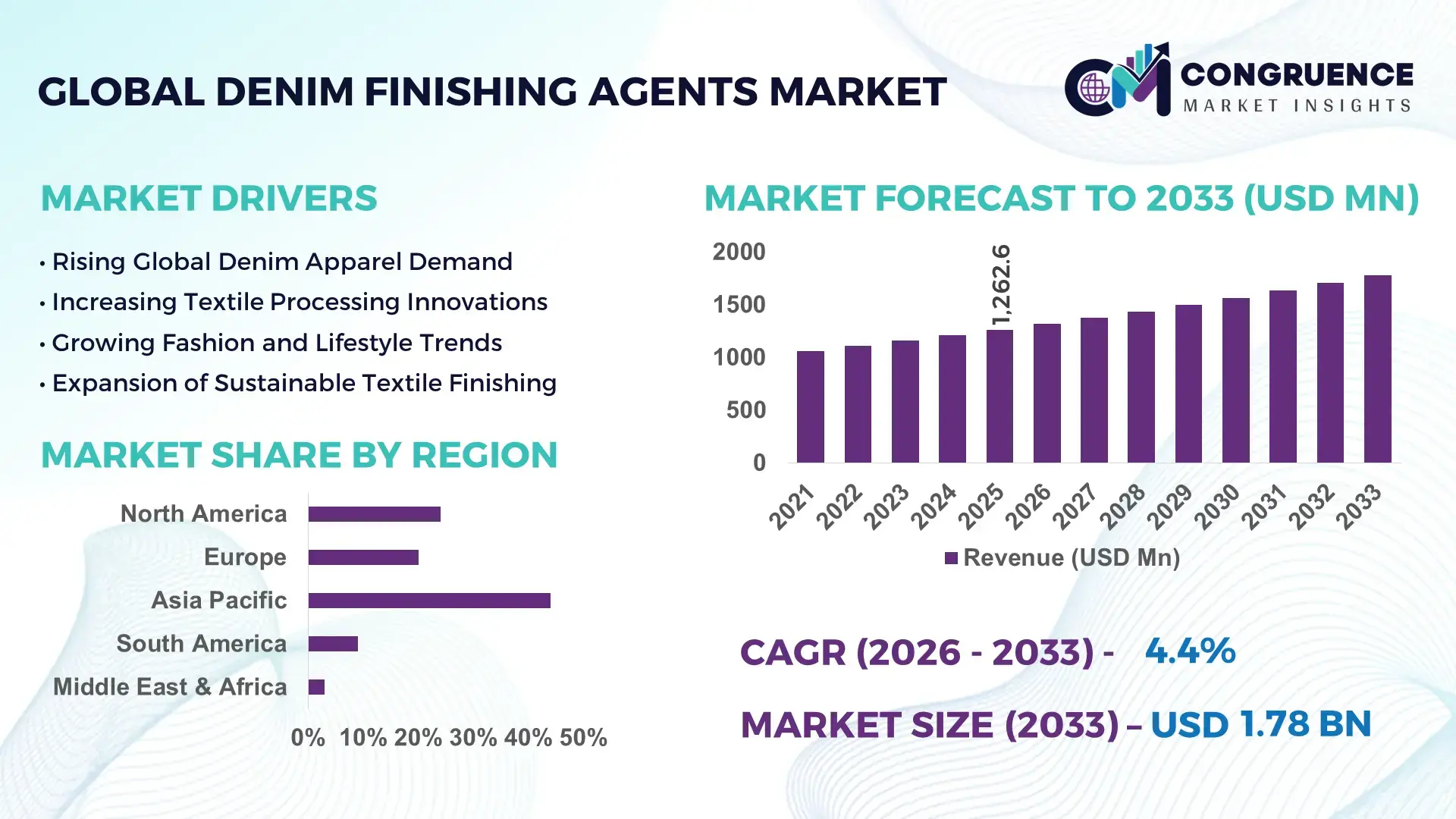
The Global Denim Finishing Agents Market was valued at USD 1262.58 Million in 2025 and is anticipated to reach a value of USD 1781.81 Million by 2033 expanding at a CAGR of 4.4% between 2026 and 2033. The growth is primarily driven by rising global demand for premium denim apparel combined with the adoption of advanced textile processing chemicals that improve fabric softness, durability, and visual appeal.
China remains a central production hub for denim finishing agents due to its large-scale textile processing ecosystem and extensive denim manufacturing capacity. The country processes more than 1.5 billion meters of denim fabric annually across major textile clusters such as Guangdong and Zhejiang. Over 35% of the denim finishing chemical formulations produced in Asia are consumed domestically within China’s integrated garment manufacturing sector. Additionally, Chinese textile chemical manufacturers have invested heavily in eco-friendly enzyme-based finishing technologies and low-water chemical treatments, with more than 120 textile chemical R&D facilities supporting innovation in finishing agents for abrasion resistance, color retention, and sustainable denim processing.
• Market Size & Growth: The Denim Finishing Agents Market reached USD 1262.58 million in 2025 and is projected to attain USD 1781.81 million by 2033 at a CAGR of 4.4%, supported by expanding denim garment production and demand for enhanced fabric finishing technologies.
• Top Growth Drivers: Sustainable textile processing adoption at 38%, enzyme-based finishing efficiency improvement of 27%, and rising demand for premium denim apparel increasing by 22%.
• Short-Term Forecast: By 2028, automated chemical dosing systems in textile processing plants are projected to reduce finishing chemical wastage by nearly 18% while improving production efficiency by 14%.
• Emerging Technologies: Bio-enzyme finishing agents, nano-coating textile technologies, and water-saving foam finishing techniques are transforming denim treatment processes.
• Regional Leaders: Asia-Pacific projected to reach USD 820 million by 2033 due to large textile manufacturing clusters; Europe expected to reach USD 410 million driven by sustainable finishing technology adoption; North America projected at USD 310 million supported by premium denim manufacturing.
• Consumer/End-User Trends: Apparel manufacturers and textile finishing mills represent the largest end-users, with nearly 70% of finishing agents utilized in garment washing and fabric treatment stages.
• Pilot or Case Example: In 2024, a textile processing facility in Turkey implemented enzyme-based denim finishing technology, achieving a 32% reduction in water consumption and 21% improvement in fabric softness consistency.
• Competitive Landscape: The market leader holds approximately 18% share, followed by major participants including Archroma, Huntsman Corporation, Rudolf Group, DyStar Group, and Tanatex Chemicals.
• Regulatory & ESG Impact: Textile sustainability standards are pushing manufacturers to reduce chemical discharge by nearly 30% while encouraging adoption of biodegradable finishing agents.
• Investment & Funding Patterns: Over USD 210 million in recent investments have been directed toward sustainable textile chemicals and advanced finishing technologies across Asia and Europe.
• Innovation & Future Outlook: Integration of digital textile process monitoring and low-impact chemical formulations is expected to redefine efficiency and sustainability standards in denim finishing operations.
The Denim Finishing Agents Market is strongly influenced by expanding denim garment production and the increasing demand for innovative fabric treatment technologies. Textile manufacturers are integrating silicone-based softeners, enzyme wash agents, and anti-back staining chemicals to improve fabric quality and durability. Regulatory pressure to minimize water usage and chemical discharge has accelerated the development of eco-friendly finishing formulations, particularly in Europe and Asia-Pacific. Additionally, technological innovations such as nano-functional finishing agents and biodegradable textile chemicals are reshaping product development strategies. Demand is also growing in emerging apparel manufacturing hubs such as Bangladesh, Vietnam, and Turkey, where denim garment exports continue to rise and finishing technologies are becoming more advanced and environmentally compliant.
The Denim Finishing Agents Market plays a strategically important role within the global textile chemicals ecosystem because finishing technologies directly determine fabric aesthetics, durability, and sustainability performance. As denim production continues to expand across global garment manufacturing hubs, textile processors are investing in specialized chemical finishing agents designed to enhance softness, abrasion effects, and color stability while reducing water and chemical consumption. Industry data indicates that more than 65% of denim garments undergo multiple chemical finishing treatments such as enzyme wash, silicone softening, and anti-back staining processes before entering retail distribution. Technological innovation is increasingly shaping the market’s strategic direction. Advanced bio-enzyme finishing systems now enable textile processors to achieve faster and more uniform denim abrasion effects while minimizing fiber damage. Comparative testing shows that bio-enzyme finishing delivers nearly 28% higher efficiency compared to conventional pumice stone washing methods. These process improvements reduce machine downtime and improve consistency in denim texture, which is critical for large-scale apparel production. In the short term, digital textile processing technologies are expected to significantly improve operational efficiency. By 2028, AI-driven textile chemical management systems are projected to reduce finishing chemical overuse by nearly 20% while improving process precision across denim washing facilities. These technologies enable real-time monitoring of chemical concentration levels, water consumption, and finishing quality. A notable micro-scenario illustrates the impact of technological innovation. In 2024, a textile processing cluster in Bangladesh implemented automated enzyme-based denim finishing solutions, achieving a 25% reduction in processing time and a 30% decrease in water consumption during garment washing operations.
The expansion of global denim apparel manufacturing has significantly increased the demand for denim finishing agents used in garment washing and fabric treatment processes. The global apparel industry produces more than 4 billion pairs of denim jeans annually, with a substantial portion undergoing chemical finishing treatments to achieve softness, fading effects, and color stability. Textile finishing facilities rely on specialized agents such as enzymes, silicone softeners, and anti-back staining chemicals to improve fabric quality while reducing fiber damage during processing. Large-scale garment manufacturing hubs in countries such as Bangladesh, China, and Vietnam operate thousands of industrial washing machines dedicated to denim finishing processes. In many facilities, chemical finishing treatments account for nearly 40% of the processing cycle required to achieve desired denim textures and fashion effects. Enzyme-based finishing technologies have also improved efficiency by reducing the need for mechanical abrasion methods such as pumice stone washing. These developments have increased the adoption of advanced finishing agents across textile processing plants, making them a critical component in modern denim garment manufacturing operations.
Strict environmental regulations governing textile chemical discharge are creating limitations for the Denim Finishing Agents Market, particularly in regions with high concentrations of garment processing facilities. Denim finishing processes typically require significant volumes of water and chemical inputs, which can generate wastewater containing dyes, surfactants, and chemical residues. Regulatory authorities across Europe and several Asian countries are enforcing strict limits on chemical effluent discharge from textile processing plants. Textile finishing units are increasingly required to install advanced wastewater treatment systems capable of removing up to 90% of chemical contaminants before releasing effluent into water bodies. These environmental compliance requirements significantly increase operational costs for garment processing facilities. In addition, certain chemical formulations traditionally used in denim finishing are being restricted due to potential environmental hazards. As a result, textile manufacturers must reformulate finishing chemicals and adopt environmentally friendly alternatives, which can involve higher production costs and longer product development cycles for chemical manufacturers.
Sustainable textile processing innovations are creating substantial opportunities for the Denim Finishing Agents Market. Global apparel brands are increasingly adopting environmentally responsible manufacturing practices, which has accelerated the demand for biodegradable finishing agents and low-water chemical treatment technologies. Enzyme-based finishing agents have emerged as a key solution because they allow textile processors to achieve desired abrasion and fading effects while using significantly less water and energy. Water-saving finishing technologies such as foam-based chemical application and ozone denim processing are also gaining industry attention. These technologies can reduce water consumption during garment finishing by nearly 50% compared with conventional washing methods. Additionally, the development of plant-based surfactants and biodegradable textile chemicals is enabling manufacturers to meet stricter environmental regulations while maintaining product performance. As sustainability commitments become central to apparel brand strategies, chemical suppliers that develop eco-friendly finishing solutions are expected to gain strong competitive advantages within the global Denim Finishing Agents Market.
One of the major challenges affecting the Denim Finishing Agents Market is the rising cost and complexity associated with raw materials used in chemical formulations. Many finishing agents rely on specialty surfactants, silicone compounds, and enzyme formulations that require advanced manufacturing processes. Fluctuations in the prices of petrochemical-based inputs and bio-enzyme production materials can significantly affect production costs for chemical manufacturers. Additionally, developing high-performance finishing agents that meet both environmental regulations and textile performance standards requires extensive research and testing. Chemical formulations must ensure compatibility with various denim fabrics, dyes, and washing processes while maintaining consistent finishing quality. Achieving this balance often requires multiple laboratory trials and industrial-scale testing phases. Furthermore, textile processing facilities frequently demand customized finishing solutions tailored to specific denim styles and production methods, increasing formulation complexity and extending product development timelines for chemical manufacturers operating in the global Denim Finishing Agents Market.
• Enzyme-Based Finishing Technologies Expanding Across Denim Processing Plants: Enzyme-based finishing agents are increasingly replacing traditional pumice stone washing methods in denim treatment facilities. Industry assessments indicate that nearly 48% of denim washing plants globally have transitioned to enzyme-assisted finishing systems, enabling fabric processing time reductions of approximately 25% while lowering fiber damage rates by nearly 18%.
• Growing Adoption of Water-Saving Finishing Processes: Water-efficient finishing technologies are becoming a central focus in denim manufacturing. Ozone and foam-based chemical finishing processes can reduce water consumption by up to 50% compared to conventional denim washing techniques. Approximately 41% of newly established denim processing units in Asia have incorporated low-water finishing equipment to meet environmental compliance standards.
• Rapid Shift Toward Biodegradable Textile Chemicals: Sustainability requirements are accelerating the adoption of biodegradable denim finishing agents. Textile chemical suppliers report that over 36% of new finishing formulations launched since 2023 are based on plant-derived surfactants and eco-friendly enzymes. These chemicals help reduce chemical discharge loads by nearly 28% in industrial denim washing facilities.
• Automation and Digital Chemical Dosing Systems in Textile Plants: Automated dosing and digital monitoring systems are transforming denim finishing operations. Around 33% of large textile finishing plants have installed automated chemical management technologies that precisely control chemical concentrations during garment washing. These systems reduce chemical wastage by nearly 20% while improving finishing consistency across large denim production batches.
The Denim Finishing Agents Market is segmented by type, application, and end-user industries that support global denim manufacturing. Enzyme-based finishing agents account for the largest adoption due to their efficiency in fabric abrasion and fading processes. Applications are primarily concentrated in garment washing, fabric finishing, and dye fixation processes. Textile finishing mills and garment manufacturers represent the most prominent end-users as denim apparel production continues to expand in Asia and emerging textile hubs. Sustainability-driven innovations, particularly biodegradable finishing chemicals and water-efficient processing agents, are increasingly influencing product development and adoption patterns across all segmentation categories.
The Denim Finishing Agents Market includes enzyme-based finishing agents, silicone softeners, anti-back staining agents, resins, and specialty chemicals. Enzyme-based finishing agents represent the leading segment with approximately 46% adoption due to their ability to create controlled abrasion effects and improve fabric softness while minimizing fiber damage. Silicone softeners account for nearly 28% of usage because they enhance denim flexibility and smooth texture. However, biodegradable enzyme finishing agents are the fastest-growing type, expanding at nearly 6.2% CAGR as textile processors increasingly replace traditional pumice-based treatments with eco-friendly chemical alternatives. Anti-back staining agents and resin-based finishing chemicals collectively represent around 26% of the market, primarily supporting color retention and fabric durability improvements.
Applications of denim finishing agents include garment washing, fabric finishing, dye fixation, and specialty denim treatment processes. Garment washing represents the leading application, accounting for approximately 52% of market usage, as nearly every pair of denim garments undergoes chemical finishing to achieve specific fashion effects such as fading, whiskering, or softness. Fabric finishing accounts for around 27% of applications and focuses on improving durability and surface texture of denim fabrics before garment manufacturing. Dye fixation treatments represent roughly 12% of applications but remain essential for improving color fastness and reducing dye bleeding during washing. Specialty finishing processes such as anti-back staining treatments collectively account for around 9%. Adoption within specialty denim finishing applications is rising fastest, expanding at nearly 6.5% CAGR due to the increasing demand for premium and designer denim styles.
Textile finishing mills represent the leading end-user segment in the Denim Finishing Agents Market, accounting for nearly 58% of total adoption because they conduct large-scale garment washing and finishing processes for denim apparel manufacturers. Denim garment manufacturers hold approximately 27% of market usage as many vertically integrated apparel producers operate in-house finishing units to control fabric quality and finishing consistency. However, fashion apparel brands that operate specialized denim treatment facilities represent the fastest-growing end-user segment, expanding at nearly 6.7% CAGR due to the rising popularity of premium and designer denim collections. Contract garment processing units and textile chemical service providers collectively contribute around 15% of adoption within the market landscape.
Region Asia-Pacific accounted for the largest market share at 52% in 2025 however, Region Europe is expected to register the fastest growth, expanding at a CAGR of 5.1% between 2026 and 2033.

Asia-Pacific processed more than 2.3 billion meters of denim fabric annually across major textile clusters in China, India, Bangladesh, and Vietnam. Europe represented approximately 21% of global consumption, driven by sustainability-focused textile finishing technologies. North America contributed nearly 16% of demand, supported by premium denim apparel brands and advanced textile chemical adoption. South America held about 7% share, while the Middle East & Africa accounted for nearly 4%, supported by expanding textile processing infrastructure.
North America holds nearly 16% of the global Denim Finishing Agents Market, supported by strong demand from premium denim apparel brands and technologically advanced textile finishing facilities. The United States accounts for more than 70% of regional consumption, driven by high-value denim garment production and specialized finishing processes such as enzyme washing and silicone softening. Government environmental regulations have pushed textile processing facilities to reduce chemical discharge by nearly 30%, encouraging the adoption of biodegradable finishing chemicals and automated chemical dosing systems. Technological transformation is also accelerating through digital textile monitoring systems capable of improving chemical dosing precision by about 20%. A regional textile chemical producer, Huntsman Corporation, has introduced sustainable enzyme-based finishing formulations designed to reduce water usage by nearly 25% in denim garment washing operations. Consumer behavior in the region shows strong preference for premium and eco-friendly denim products, with nearly 42% of apparel brands integrating sustainable finishing processes into their production supply chains.
Europe accounts for approximately 21% of the Denim Finishing Agents Market, supported by strong textile processing industries in Germany, Italy, Spain, and France. Germany and Italy collectively represent nearly 45% of regional finishing chemical consumption due to their advanced textile engineering and high-end fashion manufacturing sectors. European environmental policies require textile manufacturers to reduce hazardous chemical discharge by nearly 35%, pushing finishing facilities toward biodegradable enzymes and water-efficient finishing agents. Sustainability initiatives are driving technological adoption, including ozone-based denim washing systems capable of reducing water consumption by nearly 40%. The Rudolf Group, a regional textile chemical manufacturer, has introduced advanced silicone-based finishing agents that improve denim softness while lowering chemical load during processing. Consumer behavior across European markets strongly favors environmentally responsible apparel production, with more than 50% of fashion brands committing to sustainable textile finishing practices to comply with regional environmental standards.
Asia-Pacific leads the Denim Finishing Agents Market in production volume, processing more than 2.3 billion meters of denim fabric annually across China, India, Bangladesh, Vietnam, and Pakistan. China alone accounts for nearly 38% of regional denim fabric production capacity, while India contributes more than 19% through expanding garment export operations. The region hosts over 6,000 industrial denim washing units, many of which rely on enzyme-based finishing chemicals to achieve desired fading and abrasion effects. Manufacturing infrastructure investments in textile parks and garment processing zones are accelerating finishing chemical adoption. A regional textile chemical company, Archroma, has deployed low-impact denim finishing solutions across more than 300 garment processing facilities in Asia. Technological innovation hubs in Japan and South Korea are also developing nano-based textile finishing agents that improve color retention by nearly 20%. Regional consumer behavior shows strong growth in fashion-driven denim apparel purchases supported by expanding e-commerce retail platforms.
South America represents approximately 7% of the global Denim Finishing Agents Market, with Brazil and Argentina emerging as key regional denim manufacturing hubs. Brazil accounts for nearly 60% of regional denim fabric production and hosts more than 500 garment finishing facilities specializing in enzyme-based denim washing processes. Textile manufacturing expansion in the region has been supported by trade policies encouraging domestic apparel production and chemical processing industries. Government programs promoting local textile manufacturing have enabled finishing plants to upgrade washing equipment capable of reducing water consumption by nearly 22%. A regional textile processing company in Brazil has implemented ozone-based finishing technology that reduces chemical usage by approximately 18% during denim treatment processes. Consumer behavior in the region shows growing interest in locally manufactured denim garments, with domestic apparel brands accounting for nearly 48% of denim product sales in regional retail markets.
The Middle East & Africa accounts for nearly 4% of the Denim Finishing Agents Market, with growing textile manufacturing activities in countries such as Turkey, the United Arab Emirates, and South Africa. Turkey processes more than 350 million denim garments annually and operates over 200 industrial denim washing facilities that rely on specialized finishing chemicals. Infrastructure modernization within textile processing zones has improved production capacity and finishing technology adoption across the region. Regional trade partnerships supporting garment exports to Europe have increased the need for environmentally compliant finishing agents capable of meeting international textile standards. A Turkish textile chemical manufacturer has introduced low-impact enzyme finishing solutions capable of reducing water usage by nearly 28% in garment washing operations. Consumer behavior across regional markets shows increasing preference for durable and fashion-oriented denim apparel, particularly among younger demographics in urban retail markets.
• China – 34% market share: China leads the Denim Finishing Agents Market due to its extensive denim textile manufacturing infrastructure and large-scale garment export industry.
• India – 18% market share: India holds a major position in the Denim Finishing Agents Market supported by rapidly expanding denim garment production and strong textile processing capacity.
The Denim Finishing Agents Market features a moderately fragmented competitive structure with more than 70 active chemical manufacturers and textile solution providers globally. The top five companies collectively account for nearly 44% of total market activity, indicating a mix of global leaders and regional specialists. Major participants are focusing on product innovation, eco-friendly chemical formulations, and strategic collaborations with textile processing facilities. Several companies have launched biodegradable enzyme finishing agents capable of reducing water usage by up to 30% during denim washing processes. Industry players are also investing in automated textile chemical dosing systems that improve operational efficiency by nearly 20%. Strategic partnerships between chemical manufacturers and denim garment producers are increasing, particularly in Asia where more than 300 textile processing facilities have adopted advanced finishing technologies developed through collaborative research initiatives. Continuous product innovation and sustainability-driven solutions remain the primary factors shaping competition within the global Denim Finishing Agents Market.
Archroma
Huntsman Corporation
DyStar Group
Rudolf Group
Tanatex Chemicals
Pulcra Chemicals
Zschimmer & Schwarz
Sarex Chemicals
CHT Group
Bozzetto Group
Nicca Chemical Co., Ltd.
Resil Chemicals Pvt. Ltd.
Kemin Industries
Croda International Plc
Solvay SA
Technological innovation is rapidly transforming the Denim Finishing Agents Market as textile manufacturers seek more efficient, sustainable, and automated finishing processes. Enzyme-based finishing technology remains one of the most widely adopted innovations, currently used in nearly 48% of industrial denim washing facilities. These bio-catalytic agents enable controlled abrasion effects while reducing mechanical damage to fibers by approximately 30%. Compared with traditional pumice stone washing, enzyme finishing systems can shorten processing cycles by nearly 25%.
Low-water and waterless finishing technologies are also gaining industry traction. Ozone-based denim processing systems are capable of reducing water consumption by up to 50% while lowering chemical usage by around 20%. Foam-based finishing techniques are emerging as another sustainable solution, allowing finishing agents to be applied with minimal water during garment processing.
Digital transformation is further influencing the market through automated chemical dosing systems and AI-driven textile process monitoring. Approximately 33% of large textile finishing plants have deployed automated dosing technologies that precisely control finishing agent concentration, reducing chemical waste by nearly 18%. Nanotechnology-based finishing agents are also under development to improve color retention, stain resistance, and fabric durability. These advanced nano-coating treatments can increase color fastness performance by nearly 20% while maintaining the soft texture demanded by premium denim apparel brands.
• In March 2025, Archroma expanded its sustainable textile chemical portfolio by introducing advanced enzyme-based finishing solutions designed specifically for denim processing. The new formulations enable up to 30% reduction in water usage during garment washing while improving abrasion consistency and color retention for industrial denim manufacturing operations. Source: www.archroma.com
• In September 2024, Huntsman Corporation enhanced its textile effects division by launching a new generation of low-impact silicone softeners aimed at denim finishing applications. These finishing agents improve fabric softness by nearly 25% while lowering chemical consumption during washing cycles across large-scale garment processing facilities. Source: www.huntsman.com
• In May 2024, Rudolf Group introduced an eco-friendly denim finishing system combining enzyme technology with biodegradable surfactants to reduce wastewater chemical load by approximately 28%. The solution was designed for high-volume denim garment washing plants focused on meeting stricter environmental compliance requirements.
• In January 2025, DyStar Group announced the expansion of its sustainable textile chemical solutions portfolio with finishing agents designed to support water-saving denim processing technologies. The products enable textile manufacturers to reduce overall finishing chemical usage by nearly 20% while maintaining consistent fabric texture and durability.
The Denim Finishing Agents Market Report provides a comprehensive evaluation of the global textile chemical industry focused on specialized finishing solutions used in denim garment processing. The report examines key market segments including enzyme-based finishing agents, silicone softeners, anti-back staining chemicals, resin-based finishing agents, and specialty textile treatment formulations. These products support multiple applications such as garment washing, fabric finishing, dye fixation, and specialty denim treatment processes used by textile processing plants worldwide.
The report analyzes industry demand across major geographic regions including Asia-Pacific, North America, Europe, South America, and the Middle East & Africa, covering more than 25 key textile manufacturing countries. It evaluates industrial denim production clusters that process over 4 billion denim garments annually and operate thousands of garment washing facilities that rely on specialized finishing chemicals.
In addition to product segmentation, the report assesses technological advancements such as enzyme-based finishing systems, ozone denim processing, foam-based finishing technologies, and automated chemical dosing platforms used in modern textile processing plants. It also covers industry adoption patterns across major end-users including textile finishing mills, garment manufacturers, and contract denim processing units. The report further highlights sustainability initiatives, water-reduction technologies, biodegradable chemical formulations, and emerging innovations shaping the next generation of denim finishing solutions.
| Report Attribute/Metric | Report Details |
|---|---|
|
Market Revenue in 2025 |
USD V2025 Million |
|
Market Revenue in 2033 |
USD V2033 Million |
|
CAGR (2026 - 2033) |
4.4% |
|
Base Year |
2025 |
|
Forecast Period |
2026 - 2033 |
|
Historic Period |
2021 - 2025 |
|
Segments Covered |
By Types
By Application
By End-User
|
|
Key Report Deliverable |
Revenue Forecast, Growth Trends, Market Dynamics, Segmental Overview, Regional and Country-wise Analysis, Competition Landscape |
|
Region Covered |
North America, Europe, Asia-Pacific, South America, Middle East, Africa |
|
Key Players Analyzed |
Archroma, Huntsman Corporation, DyStar Group, Rudolf Group, Tanatex Chemicals, Pulcra Chemicals, Zschimmer & Schwarz, Sarex Chemicals, CHT Group, Bozzetto Group, Nicca Chemical Co., Ltd., Resil Chemicals Pvt. Ltd., Kemin Industries, Croda International Plc, Solvay SA |
|
Customization & Pricing |
Available on Request (10% Customization is Free) |




