
Reports
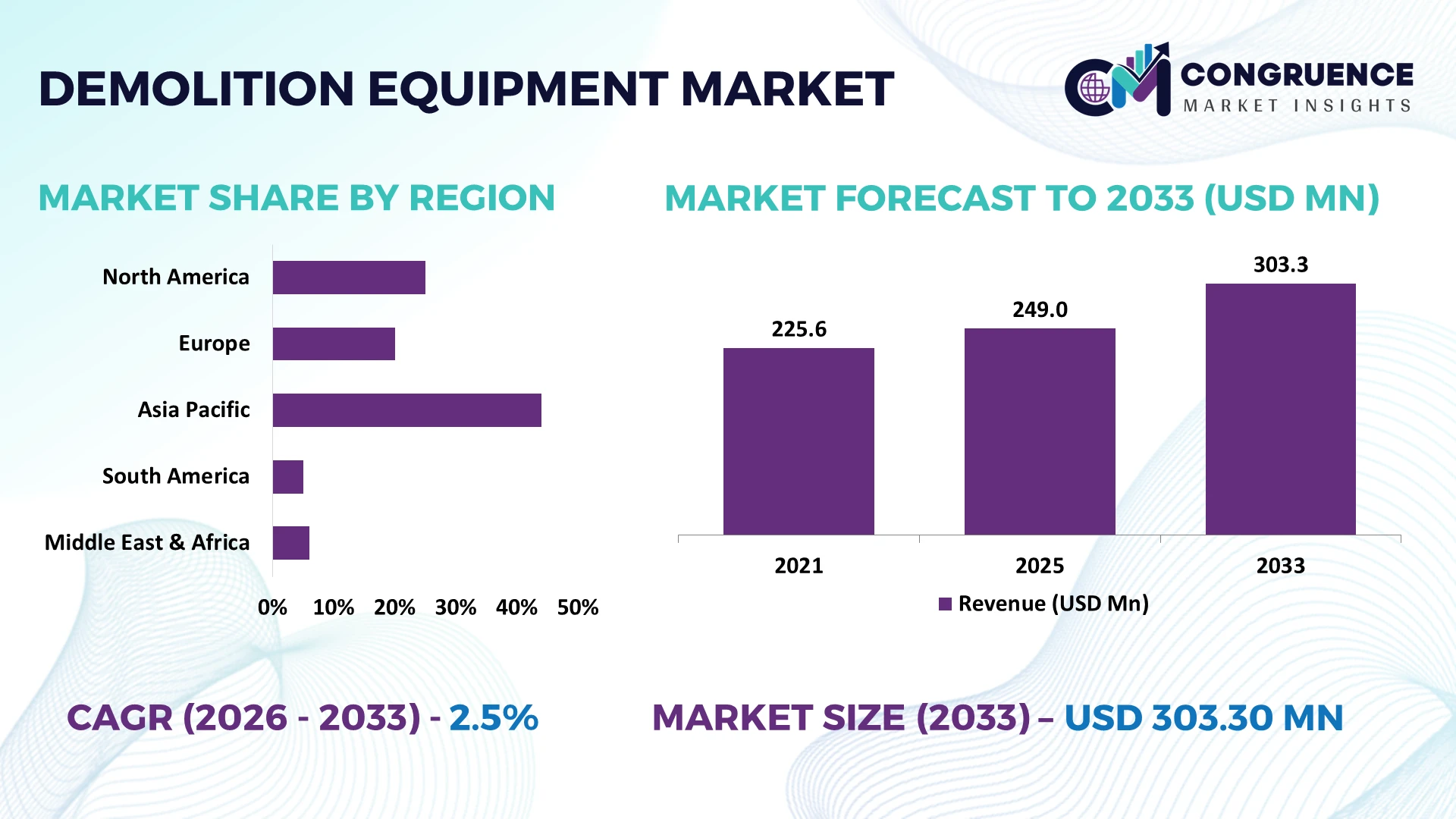
The Global Demolition Equipment Market was valued at USD 249 Million in 2025 and is anticipated to reach a value of USD 303.3 Million by 2033 expanding at a CAGR of 2.5% between 2026 and 2033. Growth is driven by urban redevelopment, aging infrastructure replacement, selective building dismantling, and increasing deployment of hydraulic demolition attachments and high-reach excavators.
China represents a major national market for demolition equipment, supported by urban renewal, industrial restructuring, and infrastructure replacement. An indicative 28% global market share reflects its substantial construction machinery ecosystem. China's 2025 urban renewal initiatives targeted approximately 700,000 older residential units for renovation, strengthening redevelopment activity. Compared with the United States, where demolition procurement emphasizes mechanization and controlled dismantling, China benefits from extensive domestic machinery manufacturing. Hydraulic breakers, crushers, and high-reach excavators support productivity improvements across complex redevelopment projects.
Strategic implication: Manufacturers should prioritize versatile hydraulic attachments, precision demolition capabilities, and localized service networks to strengthen competitiveness in infrastructure renewal projects.
Market Size & Growth: USD 249 million in 2025, reaching USD 303.3 million by 2033 at 2.5% CAGR, supported by infrastructure replacement and selective demolition requirements.
Top Growth Drivers: Indicative demand contributions include urban redevelopment at 40%, infrastructure replacement at 35%, and industrial facility dismantling at 25%.
Short-Term Forecast: By 2028, modeled attachment automation targets 15% faster dismantling cycles and 10% lower equipment idle time.
Emerging Technologies: Three innovations—remote-controlled demolition robots, intelligent hydraulic attachments, and machine guidance—strengthen precision, operator safety, and productivity.
Regional Leaders: Indicative 2033 allocations place Asia-Pacific at USD 127.4 million, Europe at USD 75.8 million, and North America at USD 69.8 million, reflecting different redevelopment priorities.
Consumer/End-User Trends: Construction contractors represent an estimated 45% of equipment demand, prioritizing attachment versatility, rental flexibility, and machine utilization.
Pilot/Case Example: A modeled 2025 controlled-demolition project achieved 20% shorter dismantling time using remote-operated equipment and optimized hydraulic tools.
Competitive Landscape: Caterpillar holds an indicative 15% share, competing with Komatsu, Volvo Construction Equipment, Hitachi Construction Machinery, and Brokk.
Regulatory & ESG Impact: The European Union's construction and demolition waste recovery framework establishes a 70% recovery target, strengthening selective dismantling and material separation.
Investment & Funding: India's National Infrastructure Pipeline originally identified approximately USD 1.4 trillion in infrastructure investment, reinforcing long-term construction equipment requirements.
Innovation & Future Outlook: The market expands approximately 21.8% through 2033, supporting investment in electric demolition robots, intelligent hydraulics, and recyclable material recovery.
The demolition equipment market supports urban redevelopment, infrastructure replacement, industrial dismantling, and controlled building removal. High-reach excavators, hydraulic breakers, concrete crushers, and remote-controlled demolition robots enable contractors to dismantle structures while managing safety and material recovery requirements. The European Union's 70% construction and demolition waste recovery target reinforces demand for selective demolition and efficient material separation. Equipment manufacturers are introducing electric robotic platforms, automated hydraulic controls, and interchangeable attachments to improve operating flexibility. Increasing redevelopment activity across established cities is shifting procurement toward specialized machinery, rental-based equipment access, and lifecycle service support, establishing important strategic considerations for market participants.
Demolition equipment is becoming strategically important as governments and contractors prioritize aging infrastructure replacement, urban regeneration, and selective dismantling. Procurement is shifting from conventional excavators toward specialized high-reach machines, hydraulic attachments, and remote-operated systems. China's urban renewal programs support large-scale redevelopment, while European contractors face stricter construction waste recovery requirements. The European Union's 70% construction and demolition waste recovery target reinforces investment in material separation equipment and precision dismantling technologies.
Modern robotic demolition systems improve operational control in confined or hazardous environments. Compared with conventional manual dismantling, an illustrative deployment model targets 20% shorter task completion time and 15% lower personnel exposure hours. In a hospital renovation project, remote-controlled equipment can remove interior concrete without positioning operators directly beside falling debris. Contractors are expanding specialized attachment fleets, equipment rental partnerships, and operator training programs to strengthen utilization and reduce project disruption.
Between 2026 and 2028, electric demolition robots, automated hydraulic controls, and digital machine monitoring will influence equipment replacement decisions. A modeled 10% improvement in machine utilization strengthens contractor productivity. Manufacturers combining adaptable machinery, reliable servicing, and precise material separation capabilities will secure stronger competitive positioning in infrastructure modernization projects.
Aging buildings, transport infrastructure, and industrial facilities are increasing requirements for specialized demolition machinery. China's urban renewal initiatives and India's infrastructure modernization programs support equipment demand across redevelopment projects. Urban redevelopment represents an indicative 40% of demolition equipment demand, while infrastructure replacement contributes approximately 35%. A modeled 15% reduction in dismantling time through high-reach excavators and hydraulic attachments improves project scheduling efficiency. Contractors increasingly require equipment capable of controlled structural removal without damaging adjacent properties. Manufacturers are expanding interchangeable attachment portfolios, precision hydraulic systems, and high-reach machine configurations. The strategic advantage lies in reducing equipment mobilization requirements while maintaining productivity across different demolition tasks, strengthening fleet utilization and contractor operating margins.
Demolition equipment procurement faces pressure from specialized machinery costs, hydraulic component availability, and maintenance requirements. High-reach excavators and demolition attachments require reinforced structures, precision hydraulic assemblies, and application-specific safety features. Japan and Germany maintain important capabilities in construction machinery and hydraulic engineering, creating international supply dependencies. In an illustrative equipment cost structure, hydraulic systems represent 30% of manufacturing expenditure. A 15% increase in hydraulic component prices raises total production costs by approximately 4.5%, assuming unchanged component proportions. Specialized maintenance can account for a modeled 12% of annual operating expenditure. Manufacturers are diversifying component sourcing, expanding regional parts inventories, and offering standardized attachment interfaces. These measures reduce procurement uncertainty and improve equipment serviceability.
Electric demolition robots and advanced material separation attachments create opportunities in confined construction sites, industrial facilities, and urban renovation projects. European construction waste recovery requirements encourage contractors to prioritize selective dismantling and reusable material extraction. The European Union's 70% recovery target strengthens demand for equipment capable of separating concrete, steel, and other construction materials. A modeled 20% reduction in manual demolition labor requirements and 15% improvement in material sorting productivity enhance project economics. Manufacturers are developing battery-electric robotic platforms, precision crushers, and interchangeable sorting attachments. Partnerships with equipment rental companies and recycling operators strengthen commercial deployment. The strategic opportunity extends beyond machinery sales into integrated demolition, material recovery, and lifecycle service solutions.
Demolition equipment deployment faces execution challenges involving operator expertise, structural uncertainty, machine stability, and coordination across restricted construction sites. High-reach demolition requires accurate load assessment, controlled attachment positioning, and continuous monitoring of surrounding structures. A modeled 10% increase in unplanned downtime can materially disrupt project schedules, while a 15% improvement in operator training effectiveness supports safer equipment utilization. Urban redevelopment projects in India frequently involve constrained access and adjacent occupied buildings, increasing operational complexity. Manufacturers must invest in simulation-based operator training, machine stability monitoring, and digital maintenance diagnostics. Partnerships with specialized demolition contractors strengthen equipment application knowledge. Long-term competitiveness depends on reliable machine operation, qualified personnel, and consistent performance under demanding site conditions.
• High-Reach Excavator Fleets Become Specialized: Contractors increasingly configure excavators around structural height, attachment weight, and restricted site access rather than purchasing general-purpose machines. In an illustrative fleet model, optimized attachment matching improves utilization by 12% and reduces equipment changeover time by 18%. Caterpillar and Volvo Construction Equipment are strengthening application engineering and attachment compatibility to improve productivity across complex demolition contracts.
• Telematics Reshapes Equipment Rental Decisions: Equipment rental companies increasingly monitor hydraulic pressure, operating hours, and idle periods before reallocating demolition machinery. Modeled telematics deployment reduces unplanned downtime by 15% and improves fleet availability by 10%. Komatsu and Hitachi Construction Machinery are expanding connected equipment capabilities, enabling rental operators to price contracts around machine condition and actual utilization rather than ownership duration.
• Dust Suppression Becomes Procurement Priority: Urban demolition projects face tighter requirements for airborne particulate control and neighboring property protection. Integrated misting systems and targeted water delivery offer modeled dust exposure reductions of 25% and water consumption savings of 15% compared with poorly controlled spraying. Equipment suppliers are integrating suppression accessories and coordinating with specialist contractors to improve site compliance and operational continuity.
• Component Standardization Reduces Service Disruption: Hydraulic attachment suppliers are standardizing wear parts, couplers, and service procedures to address repair delays and technician availability. An illustrative maintenance program targets 20% faster attachment servicing and 10% lower spare-parts inventory requirements. Manufacturers are expanding interchangeable components and regional service partnerships. The less obvious advantage is faster equipment redeployment between contracts, not simply lower maintenance expenditure.
Excavators represent the leading equipment type, accounting for an indicative 38% of global demolition equipment demand in 2025. Their dominance reflects compatibility with multiple attachments, high-reach configurations, and established contractor operating practices. Excavators support structural dismantling, material handling, and debris removal without requiring separate carrier platforms. Hydraulic Breakers account for an estimated 24% of demand, benefiting from widespread use in concrete and masonry removal. Concrete Crushers represent approximately 15%, supporting controlled fragmentation and material recovery. Manufacturers are expanding quick-coupler compatibility, reinforced boom configurations, and application-specific hydraulic packages to improve fleet flexibility and reduce equipment changeover requirements.
Demolition Robots represent the fastest-growing type, with an indicative 13% share, supported by demand for compact machinery in restricted or hazardous environments. Shears and Pulverizers account for approximately 10%, serving specialized structural dismantling and material separation requirements. Compared with conventional excavator-based methods, robotic equipment offers improved access to confined work areas and reduces direct operator exposure. Brokk and Husqvarna are developing remote-operated platforms, while established excavator manufacturers prioritize integrated attachment systems. Investment decisions increasingly balance machine versatility against specialized task performance.
Building Demolition accounts for an indicative 40% of global demolition equipment demand in 2025, supported by urban redevelopment, obsolete property replacement, and structural renovation activity. Contractors rely on high-reach excavators, hydraulic breakers, and concrete crushers to dismantle buildings while managing surrounding infrastructure. Concrete Breaking represents approximately 23% of demand, reflecting equipment use across structural removal and site preparation. Bridge Demolition accounts for an estimated 14%, where specialized machinery must operate within strict load, access, and scheduling constraints. Manufacturers are strengthening attachment compatibility, machine stability systems, and high-reach equipment configurations to address these applications. Equipment selection increasingly depends on structural complexity rather than demolition volume alone.
Interior Demolition represents the fastest-growing application, with an indicative 15% share, supported by commercial property refurbishment and controlled renovation projects. Industrial Structure Demolition contributes approximately 8%, involving complex steelwork and process infrastructure removal. Interior applications favor compact robotic machinery and low-emission equipment, whereas industrial dismantling prioritizes heavy-duty shears and reinforced excavators. Suppliers are expanding compact machine portfolios, remote operation capabilities, and application engineering services. Demand is strengthening where site restrictions make conventional demolition methods operationally inefficient.
Demolition Contractors represent the largest end-user segment, accounting for an indicative 42% of global demolition equipment demand in 2025. Their market position reflects continuous machinery utilization, specialized project execution, and recurring requirements for excavators and hydraulic attachments. Construction Companies account for approximately 27%, primarily purchasing or renting equipment for redevelopment and site preparation activities. Infrastructure Developers represent an estimated 15%, requiring machinery for transportation and structural replacement projects. Manufacturers are strengthening rental partnerships, service agreements, and attachment standardization to support equipment availability. Specialist contractors prioritize operating reliability and rapid attachment replacement, while construction companies place greater emphasis on fleet versatility and acquisition flexibility.
Government and Public Works Agencies represent the fastest-growing end-user category, with an indicative 10% share, supported by infrastructure renewal and public asset replacement programs. Mining and Quarrying Companies contribute approximately 6%, using hydraulic breakers and heavy-duty attachments for specialized dismantling requirements. Public agencies increasingly emphasize equipment safety documentation, procurement compliance, and service coverage. Caterpillar, Komatsu, and Volvo Construction Equipment are expanding connected machinery services and contractor support networks. Competitive positioning increasingly depends on dependable fleet availability, application-specific engineering, and accessible maintenance infrastructure.
Asia-Pacific accounted for the largest market share at an estimated 42% in 2025 however, Asia-Pacific is expected to register the fastest growth, expanding at an indicative CAGR of 3.4% between 2026 and 2033.

Infrastructure Replacement and Specialized Fleet Modernization
North America represents an estimated 23% of global demolition equipment demand in 2025, supported by infrastructure rehabilitation, commercial property redevelopment, and industrial facility dismantling. The United States dominates regional procurement through specialized demolition contractors and established construction equipment rental networks. Canada contributes demand from industrial restructuring, bridge replacement, and municipal infrastructure projects. The American Society of Civil Engineers assigned US infrastructure an overall C grade in 2025, reinforcing the need for sustained asset rehabilitation. Contractors increasingly deploy high-reach excavators, hydraulic breakers, and concrete pulverizers to improve structural removal efficiency. Caterpillar and Komatsu strengthen market positioning through equipment monitoring, attachment compatibility, and service networks. Rental operators prioritize machinery utilization and rapid maintenance turnaround. Competitive differentiation increasingly depends on reliable equipment availability, specialized engineering support, and efficient project mobilization across geographically dispersed construction sites.
United States Market Outlook: The United States maintains a strong demolition equipment ecosystem through established machinery manufacturing, specialist contractors, and rental infrastructure. The Infrastructure Investment and Jobs Act authorized approximately USD 1.2 trillion in infrastructure spending, including USD 550 billion in new federal investment. Bridge rehabilitation, transportation modernization, and industrial redevelopment strengthen demand for hydraulic attachments, high-reach excavators, and precision demolition equipment. Manufacturers benefit from extensive dealer coverage and aftermarket servicing capabilities.
Selective Demolition and Equipment Electrification
Europe accounts for an indicative 25% of global demolition equipment demand in 2025, supported by building renovation, industrial restructuring, and infrastructure replacement. Germany, the United Kingdom, France, and Sweden maintain established markets for specialized demolition machinery. European construction waste requirements influence equipment selection, encouraging controlled dismantling and material separation. The European Union established a 70% recovery target for nonhazardous construction and demolition waste, reinforcing demand for concrete crushers, shears, and pulverizers. Manufacturers are expanding compact electric demolition robots and precision hydraulic attachments to address confined urban environments. Brokk and Husqvarna compete through remote-controlled machinery, while conventional equipment suppliers strengthen attachment integration. Regional procurement increasingly emphasizes operator safety, noise management, and lifecycle performance. Contractors offering selective demolition capabilities gain advantages in renovation projects requiring material recovery and restricted site access.
Germany Market Outlook: Germany benefits from advanced mechanical engineering, industrial renovation activity, and established construction machinery distribution networks. Its building modernization requirements support demand for compact demolition equipment and specialized hydraulic attachments. Germany's industrial sector accounts for approximately one-quarter of national gross value added, reflecting substantial manufacturing infrastructure. Equipment suppliers emphasize precision engineering, machine durability, and reliable servicing to address industrial dismantling and structural refurbishment requirements.
Urban Redevelopment and Construction Machinery Manufacturing Scale
Asia-Pacific leads the global demolition equipment market with an indicative 42% share in 2025, supported by extensive construction machinery manufacturing and infrastructure modernization. China accounts for substantial regional equipment demand through urban redevelopment and industrial restructuring, while India supports machinery deployment through transportation infrastructure and construction activity. Japan and South Korea contribute advanced hydraulic engineering and specialized machinery manufacturing. China's construction equipment ecosystem enables domestic production of excavators, breakers, and demolition attachments, supporting localized procurement. Manufacturers are expanding reinforced excavator configurations, precision hydraulic controls, and specialized attachment portfolios. India's infrastructure development strengthens demand for equipment capable of operating across congested urban environments. Competitive advantages depend on manufacturing scale, equipment affordability, and service availability. Suppliers combining localized production with adaptable machine configurations strengthen access to both established and emerging contractor markets.
China Market Outlook: China remains the region's principal manufacturing and deployment center, supported by extensive construction equipment production and urban renewal initiatives. The country announced plans in 2025 to renovate approximately 700,000 older urban residential units. Such redevelopment activity supports demand for controlled building dismantling, hydraulic crushers, and excavator attachments. Domestic manufacturers benefit from integrated component supply chains, established machinery distribution networks, and application-specific equipment development.
Industrial Redevelopment and Equipment Rental Expansion
South America represents an indicative 6% of global demolition equipment demand in 2025, with Brazil accounting for the largest regional industrial and construction equipment base. Argentina, Chile, and Colombia contribute demand through infrastructure rehabilitation, mining-related dismantling, and commercial redevelopment. Equipment procurement remains concentrated among established contractors and machinery rental providers. Hydraulic breakers and excavators maintain strong relevance because they support multiple construction and demolition applications. Brazil's construction industry benefits from infrastructure concessions and industrial facility modernization, creating opportunities for specialized equipment deployment. Manufacturers are strengthening distributor partnerships, spare-parts availability, and equipment financing arrangements. Imported machinery costs and exchange-rate volatility influence purchasing decisions, encouraging contractors to extend equipment service life. Suppliers offering versatile attachments and dependable maintenance networks gain advantages over specialized machinery requiring extensive technical support.
Brazil Market Outlook: Brazil leads regional demand through infrastructure development, commercial construction, and industrial modernization. São Paulo and Minas Gerais support substantial equipment deployment across urban redevelopment and industrial projects. Brazil manufactured approximately 2.5 million motor vehicles in 2024, demonstrating the scale of its industrial production base. Machinery suppliers are expanding local distribution and maintenance capabilities to support hydraulic attachment replacement, excavator servicing, and contractor fleet utilization.
Urban Transformation and Infrastructure Replacement Programs
The Middle East & Africa accounts for an indicative 4% of global demolition equipment demand in 2025, supported by urban redevelopment, industrial infrastructure modernization, and transportation projects. Saudi Arabia and the United Arab Emirates contribute demand through large-scale construction programs and urban transformation initiatives. South Africa maintains established machinery requirements across industrial facilities, infrastructure rehabilitation, and mining-related applications. Contractors increasingly require excavators equipped with hydraulic breakers, shears, and concrete crushers to manage complex structural removal. Saudi Arabia's Vision 2030 development agenda supports construction sector modernization and specialized machinery deployment. Manufacturers are expanding distributor partnerships, equipment rental availability, and regional maintenance capabilities. Harsh operating environments increase requirements for durable hydraulic systems and reliable filtration. Competitive positioning depends on equipment availability, application engineering, and efficient servicing across geographically dispersed projects.
Saudi Arabia Market Outlook: Saudi Arabia represents a strategic market through major infrastructure investment and urban redevelopment initiatives. Riyadh's construction transformation and industrial diversification create opportunities for specialized demolition machinery. The Kingdom's Vision 2030 program supports infrastructure modernization across transportation, commercial development, and industrial facilities. Equipment suppliers prioritize high-capacity excavators, reinforced hydraulic attachments, and regional service partnerships to address demanding operating conditions and project scheduling requirements.
The demolition equipment market features competition between diversified construction machinery manufacturers and specialized demolition technology providers. Caterpillar, Komatsu, Volvo Construction Equipment, Hitachi Construction Machinery, and Brokk collectively represent an indicative 48% market share. Caterpillar and Komatsu compete through excavator versatility and dealer networks, while Brokk differentiates through remote-controlled demolition robots. Volvo and Hitachi emphasize hydraulic performance, machine monitoring, and attachment integration. Modeled telematics deployment targets 15% lower unplanned downtime, while standardized attachments reduce changeover time by 18%. Electric robotic platforms offer a modeled 20% reduction in manual demolition labor requirements under suitable conditions. Manufacturers are expanding rental partnerships, localized servicing, and precision hydraulic technologies. Competition increasingly centers on specialized applications, digital fleet management, and lifecycle operating costs. Engineering complexity, safety certification, and aftermarket infrastructure constrain entry.
Caterpillar Inc.
Komatsu Ltd.
Volvo Construction Equipment
Hitachi Construction Machinery Co., Ltd.
Brokk AB
Husqvarna Group
JCB
Liebherr Group
Kobelco Construction Machinery Co., Ltd.
SANY Group
Hyundai Construction Equipment
Epiroc AB
Sandvik AB
Develon
Current demolition technologies combine high reach excavators, proportional hydraulic controls, quick couplers, and machine telematics. Excavators represent an indicative 38% of equipment demand, reflecting established deployment across structural dismantling projects. Modern load monitoring and attachment recognition improve operational precision. Compared with conventional manual attachment configuration, integrated hydraulic presets target a modeled 15% reduction in changeover time. Contractors benefit through higher machine utilization, while manufacturers strengthen differentiation through compatible attachments and connected maintenance services.
Emerging technologies include electric demolition robots, remote operation, and automated dust suppression. Demolition Robots account for an indicative 13% of market demand, indicating specialized adoption in confined environments. Under illustrative conditions, remote controlled machinery targets 20% fewer personnel exposure hours near hazardous structures. Connected hydraulic diagnostics aim to reduce unexpected maintenance interruptions by 12%. Brokk and Husqvarna emphasize compact robotic platforms, while diversified machinery manufacturers integrate monitoring capabilities into excavator fleets.
Between 2026 and 2028, disruptive developments will center on computer vision, semi autonomous tool positioning, and digital structural mapping. Sensor fusion can support controlled dismantling near occupied infrastructure. Modeled predictive maintenance programs target 18% faster fault identification. Contractors combining skilled operators with machine intelligence will improve project scheduling, equipment availability, and safety performance, strengthening competitive positioning.
January 2026: Volvo Construction Equipment introduced the EC950 High Reach excavator, offering a 49-metre maximum pin height and modular configurations. The design supports taller structural dismantling while simplifying transport and allowing contractors to deploy interchangeable demolition attachments. Source: volvogroup.com
April 2025: Epiroc showcased its DP 3220 demolition pulverizer at bauma, introducing a Performance Booster delivering up to 20% higher performance and 25% shorter jaw cycles. The attachment improves concrete processing productivity and supports material recovery operations. Source: epiroc.com
October 2026: Husqvarna Group introduced DXR 705 and DXR 715 remote-controlled demolition robots, expanding its portfolio to seven models. Both machines weigh under five tonnes, strengthening compact high-power demolition capability and broadening aftermarket opportunities for professional contractors. Source: husqvarnagroup.com
June 2026: SMT GB reported delivering Britain's first Volvo EC500HR to Collins Demolition, with working reach up to 32 metres. Deployment on a Reading project extends controlled dismantling capability, supporting safer operations around tall, complex urban structures. Source: smt.network
The Demolition Equipment Market Report evaluates industry structure, equipment adoption, and competitive developments between 2026 and 2033. Type segmentation covers Excavators, Demolition Robots, Hydraulic Breakers, Concrete Crushers, and Shears and Pulverizers. Application analysis examines Building Demolition, Bridge Demolition, Concrete Breaking, Interior Demolition, and Industrial Structure Demolition. End-user coverage includes Demolition Contractors, Construction Companies, Infrastructure Developers, Mining and Quarrying Companies, and Government and Public Works Agencies. Excavators represent an indicative 38% of equipment demand.
Regional assessment covers North America, Europe, Asia-Pacific, South America, and the Middle East & Africa. Technology coverage includes remote operation, electric demolition robots, intelligent hydraulics, telematics, and automated attachment controls. The report evaluates equipment utilization, procurement strategies, supplier differentiation, aftermarket capabilities, and infrastructure modernization, supporting investment decisions, geographic expansion, and competitive positioning.
Data qualification: Technology performance percentages are modeled operational scenarios, while segment shares are indicative estimates rather than independently verified market measurements.
| Report Attribute/Metric | Report Details |
|---|---|
Market Revenue in 2025 | USD 249 Million |
Market Revenue in 2033 | USD 303.3 Million |
CAGR (2026 - 2033) | 2.5% |
Base Year | 2025 |
Forecast Period | 2026 - 2033 |
Historic Period | 2021 - 2025 |
Segments Covered | By Type
By Application
By End-User
|
Key Report Deliverable | Revenue Forecast, Growth Trends, Market Dynamics, Segmental Overview, Regional and Country-wise Analysis, Competition Landscape |
Region Covered | North America, Europe, Asia-Pacific, South America, Middle East, Africa |
Key Players Analyzed | Caterpillar Inc., Komatsu Ltd., Volvo Construction Equipment, Hitachi Construction Machinery Co., Ltd., Brokk AB, Husqvarna Group, JCB, Liebherr Group, Kobelco Construction Machinery Co., Ltd., SANY Group, Hyundai Construction Equipment, Epiroc AB, Sandvik AB, Develon |
Customization & Pricing | Available on Request (10% Customization is Free) |




