
Reports
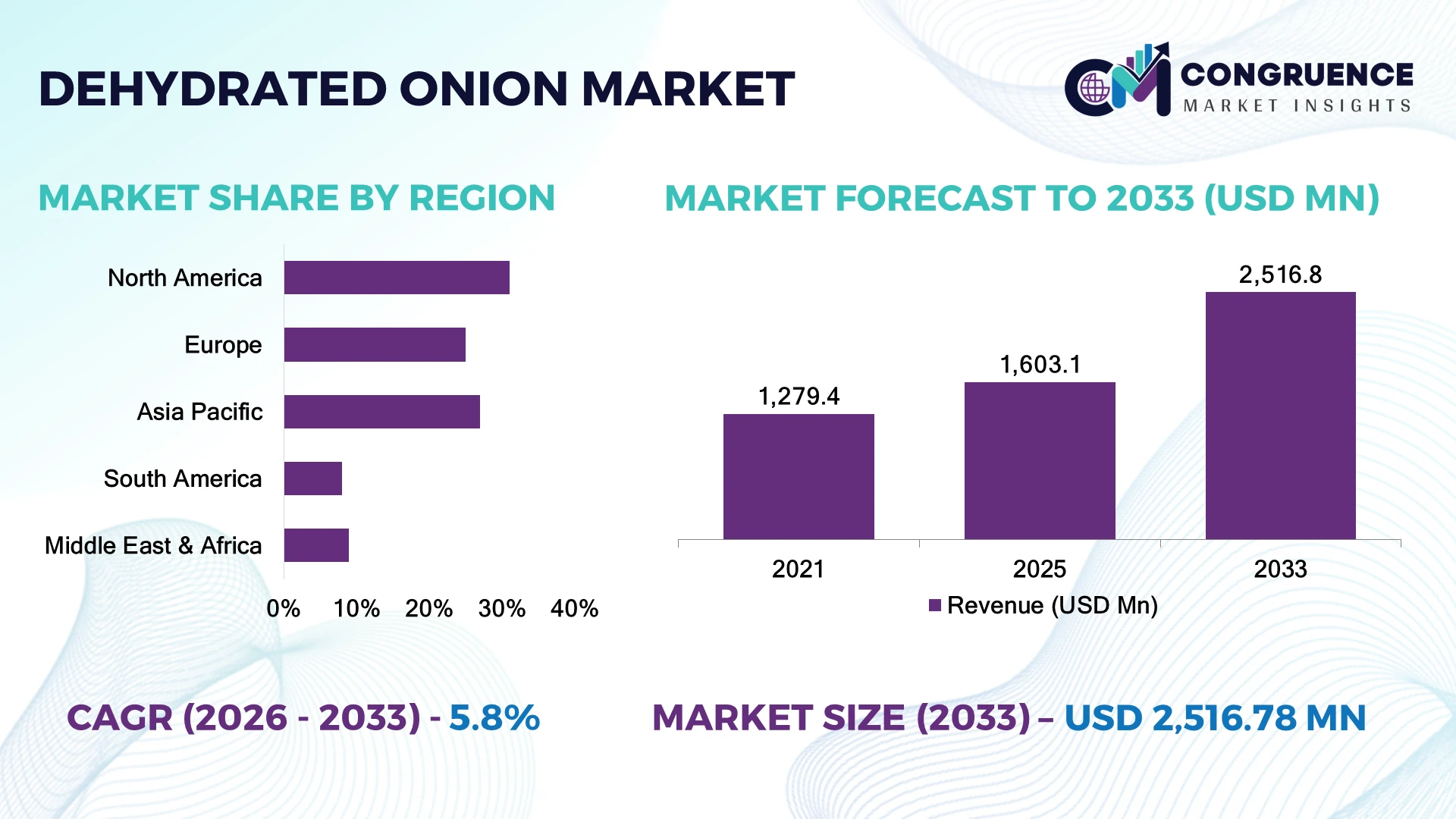
The Global Dehydrated Onion Market was valued at USD 1,603.1 Million in 2025 and is anticipated to reach a value of USD 2,516.8 Million by 2033 expanding at a CAGR of 5.8% between 2026 and 2033. Growth is being driven by food manufacturers replacing fresh onions with shelf-stable flakes, powder, and granules to reduce storage losses, processing labor, and cold-chain exposure.
India is the dominant production and export hub, with Maharashtra contributing 44.07% of national onion output in 2024–25, while Gujarat remains a major dehydration-processing cluster. India exported 1.55 million tonnes of fresh onions in FY2025–26 despite evolving export controls, reinforcing raw-material availability. China competes through scale, while India holds stronger dehydration specialization. The 2025 removal of India's onion export duty materially improved trade flexibility.
Procurement and capacity decisions should prioritize Indian processing clusters, diversified sourcing, and higher-value sterilized formats.
Market Size & Growth: USD 1,603.1 million in 2025 to USD 2,516.8 million by 2033 at a 5.8% CAGR, supported by food processors shifting toward shelf-stable ingredients.
Top Growth Drivers: Processed-food adoption 32%, foodservice procurement 24%, and convenience-meal production 19% are the strongest structural demand drivers.
Short-Term Forecast: By 2028, automated drying and sorting can reduce processing losses by 8–12% while improving batch consistency by approximately 10%.
Emerging Technologies: Vacuum-belt drying, infrared dehydration, optical sorting, and automated moisture control are improving color retention, throughput, and product uniformity.
Regional Leaders: Asia-Pacific is projected at approximately USD 1.46 billion by 2034, North America at USD 643.9 million, and Europe at USD 899.7 million, with automation and clean-label procurement strengthening adoption.
Consumer/End-User Trends: Food and beverage manufacturers account for roughly 67% of global intake, while B2B channels represent more than 43% of sales.
Pilot/Case Example: In 2025, Indian dehydration processors expanded export-oriented capacity, with automated sorting and drying systems targeting 10%–15% higher usable output.
Competitive Landscape: India-based suppliers hold strong production positioning, competing with Sensient Technologies, Van Drunen Farms, Olam, Jain Farm Fresh Foods, and specialized regional processors.
Regulatory & ESG Impact: India's removal of the 20% onion export duty in April 2025 improved export flexibility, while dehydration reduces refrigeration requirements and post-harvest handling intensity.
Investment & Funding: Processing expansion is increasingly concentrated in Gujarat, Maharashtra, and other onion-producing clusters, with investment shifting toward sterilization, automated grading, and export-grade quality systems.
Innovation & Future Outlook: Steam sterilization, precision drying, AI-assisted optical sorting, and traceable sourcing are moving the market from commodity dehydration toward higher-margin ingredient specifications.
The dehydrated onion market is increasingly concentrated around food-processing applications requiring consistent flavor, lower moisture, and predictable ingredient performance. Powder, flakes, granules, and minced formats serve seasoning blends, sauces, soups, snacks, instant foods, and prepared meals. Approximately 67% of global intake is linked to food and beverage manufacturing. In 2026, buyers are placing greater emphasis on steam-sterilized ingredients and traceable sourcing as food-safety requirements tighten and international freight patterns remain volatile.
The dehydrated onion market is becoming strategically important because it converts a highly seasonal agricultural commodity into a standardized industrial ingredient with substantially lower storage and handling requirements. For food manufacturers, this improves formulation consistency while reducing dependence on daily fresh-onion procurement. The 2025 removal of India's 20% onion export duty also altered sourcing economics, increasing flexibility for processors serving international buyers.
Technology is strengthening this advantage. Modern infrared or vacuum-assisted systems can improve drying efficiency by roughly 10–15% compared with conventional hot-air processes, while optical sorting can reduce foreign-material and quality defects by approximately 5–10%. Asia-Pacific benefits from raw-material concentration and lower processing costs; North America and Europe provide higher-value demand through seasoning, ready-meal, and foodservice applications.
A practical deployment model is emerging in Gujarat and Maharashtra, where processors combine automated sorting, controlled dehydration, steam sterilization, and export-grade packaging. Through 2026–2028, companies are prioritizing integrated procurement contracts, localized processing capacity, and higher-margin powder and sterilized formats. Competitive advantage will increasingly depend on controlling raw-material quality, energy efficiency, food safety, and international supply reliability rather than simply maximizing drying volume.
Industrial food manufacturers are increasing dehydrated onion procurement as shelf-stable ingredients reduce handling complexity and improve formulation consistency. Approximately 35% of commercial onion-processing demand is increasingly directed toward dried formats, while automated slicing and controlled-air drying can reduce processing losses by 8–12%. India remains a critical processing hub, with export-oriented facilities investing in sorting, drying, and moisture-control systems. Energy-efficient dryers and optical grading are improving batch uniformity while reducing labor dependence. Companies are responding through capacity expansion, contract farming, and integrated processing lines. The non-obvious advantage is inventory flexibility: manufacturers can maintain standardized onion inputs beyond seasonal harvest windows, strengthening supply continuity and reducing exposure to fresh-onion price swings.
Fresh onion availability remains the primary cost constraint because seasonal price movements directly affect dehydration economics. Procurement costs can fluctuate by 15–25% between supply periods, while moisture content variations of 5–10% can alter drying requirements and finished-product yield. India’s periodic export-policy changes and crop disruptions can further tighten international availability, forcing processors to rebalance domestic and export commitments. Energy-intensive dehydration also exposes plants to electricity and thermal-fuel volatility, with energy representing an estimated 10–15% of processing costs in conventional facilities. Companies are mitigating exposure through multi-region sourcing, contracted cultivation, inventory buffers, and variable-price procurement agreements. Strategic procurement discipline increasingly matters as much as plant capacity for protecting margins.
Higher-value dehydrated onion formats are creating opportunities beyond conventional flakes and granules. Fine powders, low-temperature dried products, and customized particle sizes can command stronger industrial positioning, while automated grading can improve usable output by approximately 5–8%. Demand from seasoning manufacturers, instant foods, sauces, and convenience meals is shifting toward standardized ingredients with predictable moisture and microbial specifications. In India, processors are increasingly pairing contract farming with dedicated dehydration lines to secure consistent raw material. Companies are also investing in low-energy drying, precision moisture monitoring, and application-specific formulations. The strategic opportunity lies in moving from commodity dehydration toward specification-led ingredient supply, where customized particle size, color retention, and microbiological performance strengthen customer retention and pricing power.
Scaling dehydrated onion production requires tighter control over microbial load, moisture migration, color retention, and particle uniformity across batches. Moisture deviations of only 2–4% can affect shelf stability and downstream processing performance, while inadequate foreign-material detection increases rejection risk. Labor shortages around agricultural-processing hubs also complicate manual inspection and sorting. Export-oriented facilities face increasingly stringent food-safety documentation and traceability requirements, raising compliance workloads. Companies must therefore integrate optical sorting, automated moisture measurement, hygienic conveying, and digital batch tracking rather than relying on final-stage inspection. Plants that automate 60–70% of repetitive quality-control tasks can improve consistency and reduce dependence on skilled manual inspection. Competitive sustainability increasingly depends on process standardization, not simply additional drying capacity.
Automated Sorting Gains Ground — Optical sorting and machine-vision inspection are expanding across commercial dehydration plants, with automated quality checks capable of reducing manual inspection requirements by 30–40%. Indian processors are integrating color, size, and foreign-material detection into packaging lines, improving batch consistency while redirecting labor toward maintenance and process supervision.
Low-Energy Drying Gains Priority — Energy-efficient drying configurations are becoming more important as thermal costs pressure processing margins. Heat-recovery systems and optimized airflow can lower energy consumption by roughly 10–18%, while controlled drying improves moisture uniformity by 5–8%. Producers are prioritizing equipment upgrades where energy savings directly strengthen export competitiveness.
Customized Particle Sizes Expand — Food manufacturers are increasingly specifying onion powder, minced formats, flakes, and granules according to formulation requirements rather than purchasing standardized commodity grades. Customized processing can raise value realization by approximately 8–15%, encouraging processors to add flexible milling and screening capacity and develop dedicated specifications for seasoning, snack, sauce, and instant-food customers.
Traceability Becomes Commercial Advantage — Digital batch records, supplier mapping, and QR-enabled traceability are gaining traction as international buyers demand stronger origin and quality documentation. Digitized workflows can reduce documentation time by 20–30% and accelerate recall readiness. Export-focused companies are linking farm procurement, drying batches, laboratory results, and packaging records to strengthen buyer confidence and regulatory compliance.
Flakes Lead, While Powder Gains Industrial Momentum
Dehydrated onion flakes are estimated to lead the market with approximately 34% share, supported by broad use in soups, sauces, seasoning blends, instant meals, and foodservice preparations. Their simple processing, recognizable texture, and compatibility with bulk packaging provide stronger scalability than specialized formats. Granules and minced/chopped products remain strategically relevant for seasoning and prepared-food formulations, while powder is the fastest-growing format, gaining an estimated 8–10% adoption uplift as manufacturers prioritize uniform dispersion and automated dosing.
The shift toward finer formats is increasing investment in milling, screening, and moisture-control systems. Powder demand is particularly strong where automated ingredient handling requires consistent particle characteristics, while flakes remain the mature volume segment. Companies are expanding flexible processing lines capable of switching between formats, with customized specifications accounting for an estimated 12–15% of industrial orders. This favors processors that can combine high-volume flakes with specification-driven powder and granule production, shifting capital priorities toward multi-format plants rather than single-product facilities.
APEDA’s 2026 trade marketplace lists dehydrated onion in flakes, chopped, kibbled, minced, granules, and powder formats, confirming continued commercial diversification across product forms.
Food Processing Remains the Core Demand Engine
Food processing is estimated to represent approximately 62% of dehydrated onion demand, reflecting intensive use in sauces, soups, seasoning systems, snacks, meat products, ready meals, and convenience foods. Demand concentration results from manufacturers valuing stable flavor, predictable moisture, extended storage, and reduced preparation labor. Foodservice is the fastest-growing application, with adoption estimated to increase by 9–11% as centralized kitchens and quick-service operators standardize recipes and reduce fresh-ingredient handling.
Retail and household applications remain smaller but strategically important, particularly for smaller packs of flakes, granules, and powder. Industrial processors increasingly favor automated dosing and bulk procurement, while foodservice buyers prioritize reconstitution performance and portion consistency. Approximately 15% of procurement programs are shifting toward application-specific particle sizes and packaging specifications. Companies are responding through dedicated formulations, flexible packaging, and contract supply arrangements. The business implication is clear: future demand is becoming increasingly specification-led, rewarding suppliers that integrate processing, quality control, and application support rather than competing solely on commodity pricing.
APEDA reported that Indian processed-vegetable exports reached 726,874.82 metric tons in FY2025–26, demonstrating the scale of export-oriented processing infrastructure supporting processed vegetable supply chains.
Food Manufacturers Dominate, While Foodservice Accelerates
Food manufacturers are estimated to account for approximately 68% of dehydrated onion consumption, reflecting their large-scale procurement, continuous production schedules, and dependence on standardized ingredients. Seasoning producers, instant-food manufacturers, sauce companies, snack processors, and prepared-meal manufacturers favor dehydrated onion because it reduces fresh-ingredient handling and supports repeatable formulations. Foodservice operators represent the fastest-growing end-user group, with adoption rising an estimated 10–12% as centralized kitchens and quick-service chains standardize ingredient inputs.
Retail-oriented buyers and smaller food processors remain important for specialty packs and regional formulations but operate at lower procurement volumes. Food manufacturers increasingly demand tighter microbiological, moisture, color, and particle-size specifications, whereas foodservice buyers emphasize convenience, portion control, and reconstitution consistency. Customized specifications now represent roughly 12–15% of industrial purchasing programs, encouraging suppliers to develop differentiated grades and packaging. Companies are responding with contract farming, application-specific production, and flexible pack sizes. Competitive advantage is shifting toward suppliers capable of serving both high-volume industrial contracts and faster-growing standardized foodservice channels.
APEDA’s 2025–26 export data identifies the United States, United Kingdom, Philippines, Saudi Arabia, and Indonesia among major destinations for India’s processed-vegetable shipments, reinforcing the importance of industrial and export-oriented buyers in the supply chain.
North America accounted for the largest market share at 31% in 2025 however, Asia-Pacific is expected to register the fastest growth, expanding at a CAGR of 6.8% between 2026 and 2033.
Industrial food processing shifts toward standardized dried ingredients
North America represents approximately 31% of the global dehydrated onion market, supported by extensive use across seasoning blends, sauces, soups, snacks, frozen foods, and ready-to-eat meals. The United States concentrates most regional demand, with large food manufacturers favoring dehydrated onion for consistent flavor, lower preparation labor, and extended inventory life. Approximately 65% of regional demand is linked to industrial food processing and foodservice channels. Automated ingredient dosing and tighter microbiological specifications are encouraging processors to purchase standardized particle sizes and moisture-controlled products. Canadian and U.S. buyers are also diversifying sourcing beyond individual agricultural origins to reduce exposure to crop volatility. Producers are responding through contract cultivation, multi-origin procurement, and higher-capacity drying and milling lines. The strategic priority is shifting from commodity supply toward specification-driven ingredient contracts.
United States Market Outlook: The United States remains the region's principal demand center because of its large processed-food manufacturing base, sophisticated seasoning industry, and extensive foodservice infrastructure. Approximately 70% of regional industrial consumption is concentrated in U.S.-based manufacturing and foodservice channels. Manufacturers increasingly require uniform moisture, color, particle size, and microbial specifications. Domestic processors are strengthening supplier contracts and automated quality-control systems to reduce batch variability, while importers are diversifying origins to protect continuity.
Specification-driven procurement strengthens premium ingredient positioning
Europe accounts for an estimated 25% of global dehydrated onion demand, with Germany, the United Kingdom, France, Italy, and the Netherlands serving as major food-processing and distribution centers. Manufacturers increasingly prioritize traceability, microbiological compliance, pesticide controls, and consistent particle specifications. Approximately 55% of regional demand is associated with processed foods, sauces, seasonings, and convenience products. Sustainability requirements are also influencing procurement, encouraging suppliers to improve drying efficiency, packaging utilization, and agricultural traceability. European buyers are increasingly favoring contracted suppliers capable of providing standardized batches rather than opportunistic spot purchases. Companies are responding with certified sourcing programs, energy-efficient processing, and application-specific grades. The competitive advantage is moving toward documented quality and supply reliability rather than lowest delivered cost.
Germany Market Outlook: Germany holds a strategically important position because of its large food-processing industry, sophisticated ingredient distribution network, and strong demand for standardized seasoning inputs. Approximately 60% of industrial dehydrated-onion purchases are associated with processed-food and ingredient applications. German manufacturers increasingly emphasize traceability and batch consistency, supporting demand for digitally documented supply chains. Processors serving this market are investing in laboratory testing, precision grading, and energy-efficient dehydration to satisfy stringent purchasing specifications.
Processing scale and export integration accelerate supply-chain expansion
Asia-Pacific represents approximately 27% of the global dehydrated onion market and has the strongest production and export concentration. India is the principal processing hub, supported by extensive onion cultivation, established dehydration clusters, and comparatively competitive processing costs. India accounts for an estimated 45% of global dehydrated-onion export supply, while China remains strategically important for processing capacity and regional food manufacturing. Approximately 35% of regional production is directed toward export-oriented channels. Investments in optical sorting, automated grading, controlled drying, and bulk packaging are improving consistency and throughput. Companies are expanding contract farming and integrated processing facilities to secure raw material during seasonal price fluctuations. The region's strategic advantage increasingly combines agricultural availability with scalable dehydration infrastructure.
India Market Outlook: India is the most strategically significant country in Asia-Pacific because of its large onion cultivation base, established processing clusters, export infrastructure, and comparatively low-cost manufacturing model. Gujarat and Maharashtra remain important processing centers, with industrial facilities increasingly integrating sorting, drying, milling, and packaging. Export-oriented processors are strengthening contract farming and inventory management to reduce crop-price exposure. Approximately 40% of India's dehydrated onion output is estimated to serve international markets, reinforcing its position as a major global supply source.
Local processing capacity expands as food manufacturers seek supply resilience
South America represents an estimated 8% of global dehydrated onion demand, with Brazil serving as the principal commercial center because of its large processed-food, seasoning, snack, and foodservice industries. Regional manufacturers increasingly use dehydrated onion to simplify ingredient handling and reduce dependence on seasonal fresh supply. Approximately 50% of regional demand is concentrated in Brazil's industrial food-processing sector. Argentina and Chile provide additional agricultural and food-processing capabilities, although processing infrastructure remains less extensive than in North America or Asia-Pacific. Companies are responding through regional sourcing agreements, localized packaging, and investments in drying and milling capacity. The strategic opportunity is strongest where processors can combine domestic agricultural procurement with standardized industrial-grade production.
Brazil Market Outlook: Brazil dominates South American demand because of its extensive packaged-food manufacturing base, large foodservice sector, and established seasoning and ingredient supply chains. Approximately 60% of regional industrial consumption is concentrated in Brazil. Food manufacturers increasingly require stable particle size and moisture specifications for automated formulation. Local processors and importers are strengthening supplier networks and inventory buffers to manage seasonal agricultural variability while improving responsiveness to large food manufacturers.
Import diversification and food-processing modernization reshape procurement
The Middle East & Africa region accounts for approximately 9% of global dehydrated onion demand, with the Gulf states, South Africa, Egypt, and Saudi Arabia forming important consumption and distribution centers. Demand is concentrated in food processing, seasoning, catering, and institutional foodservice, where shelf-stable onion formats reduce preparation requirements and storage pressure. Approximately 45% of regional consumption is associated with foodservice and large-scale food manufacturing. Saudi Arabia and the United Arab Emirates are strengthening food-import infrastructure and regional distribution capabilities, while African processors are gradually increasing local value addition. Companies are responding with diversified import contracts, regional warehousing, and localized packaging. The key competitive advantage is reliable year-round availability supported by efficient distribution rather than proximity to onion cultivation.
Saudi Arabia Market Outlook: Saudi Arabia is strategically significant because of its large institutional foodservice industry, expanding packaged-food manufacturing base, and substantial dependence on imported agricultural ingredients. Approximately 55% of dehydrated-onion demand is linked to industrial food processing, catering, and foodservice applications. Modern logistics infrastructure enables bulk ingredient distribution across Gulf markets. Suppliers are increasingly establishing regional inventory positions and long-term procurement contracts to provide consistent supply despite fluctuations in international onion availability.
The market pits integrated ingredient processors such as Jain Farm Fresh Foods and Oceanic Foods against specialist dehydration exporters including Nedspice, Garlico Industries, and regional Mahuva producers. The top five players are estimated to control about 28% collectively, leaving a fragmented field where scale and sourcing depth matter. Price competition influences roughly 45% of industrial purchasing decisions, while quality specifications and supply reliability influence about 35%. Customized particle size and moisture control account for another 20% of buyer differentiation. Leaders are expanding automated drying, strengthening farmer contracts, and integrating sorting, milling, testing, and packaging. Regional processors compete through lower conversion costs and faster customization, while global suppliers differentiate through traceability and sustainability. The competitive shift is moving toward supply control, energy-efficient processing, and specification-led contracts. Entry barriers include raw-material access, food-safety certification, export compliance, and capital-intensive drying infrastructure. Winning requires dependable procurement, consistent specifications, flexible formats, and competitive delivered cost.
Jain Farm Fresh Foods
Oceanic Foods Limited
Nedspice
Garlico Industries
Natural Dehydrated Vegetables
Daksh Foods
Earth Expo Company
Murtuza Foods
Pardes Quick Foods & Dehydration
Real Dehydrates
Mahuva Dehydration
Van Drunen Farms
Sensient Technologies
Euro Foods Industries
Current dehydrated onion plants are shifting from conventional hot-air drying toward controlled-temperature dryers, optical sorting, and automated moisture monitoring. Modern process control can improve batch consistency by 8–12% and reduce drying energy by 10–15%. Adoption is strongest among export-oriented processors, where automated grading and inline inspection cover 50–60% of production workflows. The advantage is tighter specifications, lower rework, and faster order fulfillment.
Emerging systems combine heat recovery, heat-pump drying, machine vision, and digital batch traceability. Low-temperature drying can improve color uniformity by 5–8%, while heat-recovery integration can reduce thermal energy requirements by 15–20%. Compared with conventional drying, advanced controlled-air systems can cut process energy consumption by 18% while improving moisture uniformity by 10%. This favors integrated processors serving multinational food manufacturers, because specification compliance becomes a commercial differentiator.
From 2026–2028, AI-assisted sorting, predictive dryer control, automated packaging, and IoT-enabled traceability will increasingly connect raw-material intake with finished-product specifications. Plants deploying these technologies can target 10–15% lower operating losses and 5–10% faster production cycles. The competitive edge will favor vertically integrated processors that combine farm sourcing, precision dehydration, and digital quality assurance. Companies delaying automation face higher labor exposure, greater batch variability, and weaker responsiveness to customized particle-size and moisture requirements.
February 2026 NK Dehydration commissioned a fully automatic Mahuva plant with 400 metric tons monthly capacity, expanding onion, garlic, and vegetable processing. The investment strengthens hygienic production and batch consistency while adding capacity to Gujarat’s dehydration cluster. Source: LinkedIn
January 2026 Nedspice reported Indian dehydrated onion exports reaching 115 KMT in 2025, up 12% year-on-year, with powder dominant. The shift strengthens India’s export position while encouraging suppliers to prioritize powder capacity, diversified sourcing, and access. Source: nedspice.com
July 2025 Nedspice highlighted its sustainable dehydration model using heat pumps and solar energy, achieving 89% lower CO2 emissions and 67% water savings. The development raises sustainability benchmarks for processors and strengthens commercial investment in low-carbon dehydration infrastructure. Source: nedspice.com
April 2025 Jain Farm Fresh Foods reported dehydrated-onion production volumes at 60–65% of planned levels during peak months because of raw-material constraints and operational disruptions. The shortfall reinforced procurement resilience, production-efficiency upgrades, and supply-chain coordination as priorities. Source: jains.com
The Dehydrated Onion Market Report covers the industry across product types including flakes, powder, granules, minced, chopped, and kibbled formats, with analysis of applications spanning food processing, foodservice, seasoning, sauces, soups, snacks, ready meals, and retail. End-user assessment distinguishes large food manufacturers, seasoning producers, foodservice operators, ingredient distributors, and household-oriented channels. The report evaluates mature volume segments alongside specification-driven niche formats.
Regional coverage includes North America, Europe, Asia-Pacific, South America, and the Middle East & Africa, with country-level assessment emphasizing India, the United States, Germany, Brazil, and Saudi Arabia. Technology analysis examines controlled drying, heat recovery, optical sorting, automated grading, moisture monitoring, and digital traceability. The report supports investment planning, sourcing strategy, capacity expansion, product customization, competitive positioning, and supply-chain resilience decisions through 2026–2033.
| Report Attribute/Metric | Report Details |
|---|---|
|
Market Revenue in 2025 |
USD 1,603.1 Million |
|
Market Revenue in 2033 |
USD 2,516.8 Million |
|
CAGR (2026 - 2033) |
5.8% |
|
Base Year |
2025 |
|
Forecast Period |
2026 - 2033 |
|
Historic Period |
2021 - 2025 |
|
Segments Covered |
By Type
By Application
By End-User
|
|
Key Report Deliverable |
Revenue Forecast, Growth Trends, Market Dynamics, Segmental Overview, Regional and Country-wise Analysis, Competition Landscape |
|
Region Covered |
North America, Europe, Asia-Pacific, South America, Middle East, Africa |
|
Key Players Analyzed |
Jain Farm Fresh Foods, Oceanic Foods Limited, Nedspice, Garlico Industries, Natural Dehydrated Vegetables, Daksh Foods, Earth Expo Company, Murtuza Foods, Pardes Quick Foods & Dehydration, Real Dehydrates, Mahuva Dehydration, Van Drunen Farms, Sensient Technologies, Euro Foods Industries |
|
Customization & Pricing |
Available on Request (10% Customization is Free) |




