
Reports
The Global Defense Tactical Radio Market was valued at USD 1,838.0 Million in 2025 and is anticipated to reach a value of USD 3,509.3 Million by 2033 expanding at a CAGR of 8.42% between 2026 and 2033. Growth is driven by the replacement of legacy radios with software-defined, frequency-agile systems supporting encrypted voice, data, electronic-warfare resilience, and multi-domain battlefield networking.
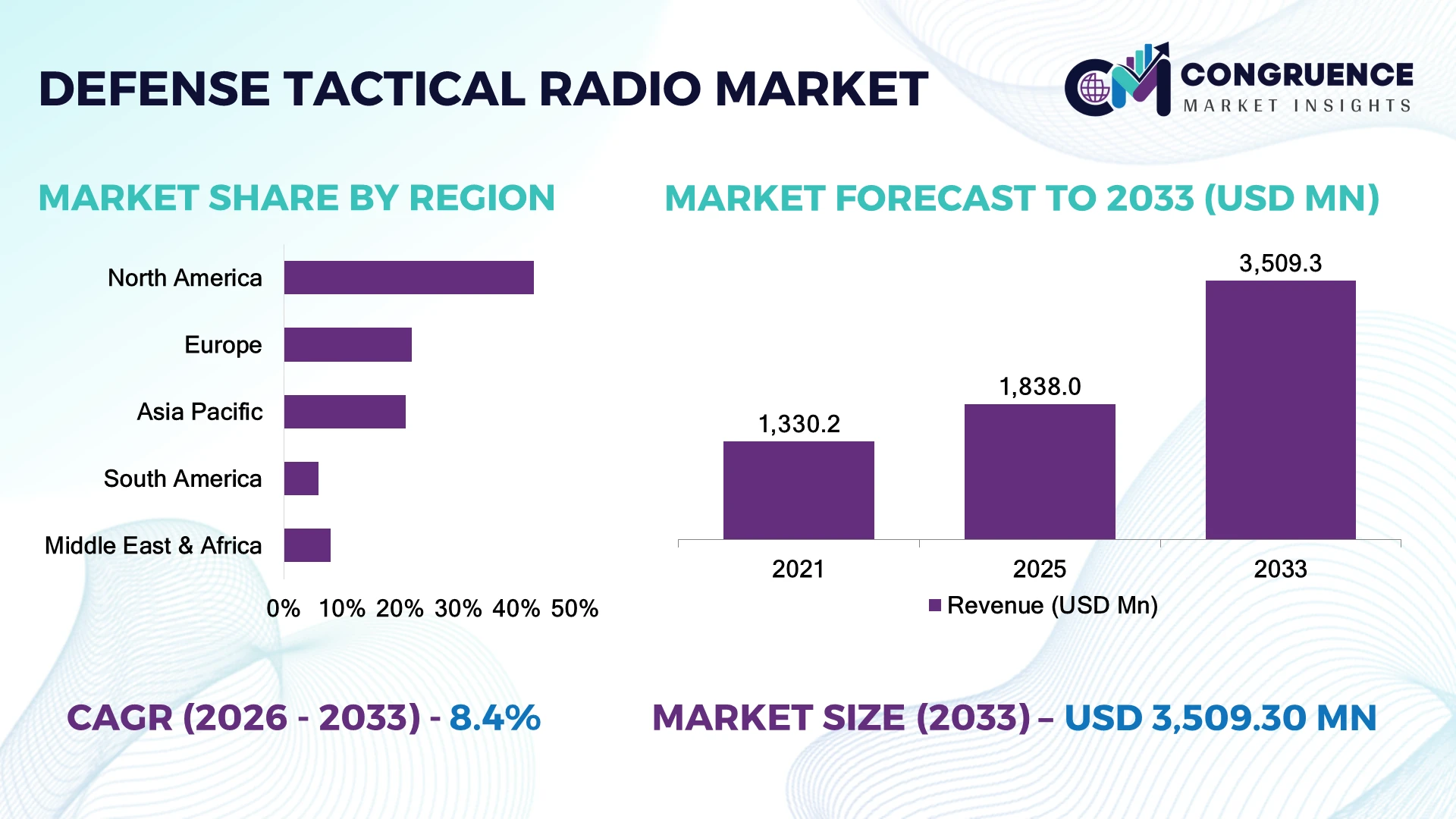
The United States remains the dominant country, supported by North America's approximately 43% market share, extensive defense procurement, and large-scale tactical-network modernization. U.S. Army programs are transitioning toward software-defined radios with multi-waveform and Type 1 encryption capabilities, while India is accelerating indigenous SDR deployment. U.S. procurement scale remains substantially higher, with individual modernization programs involving thousands of radio assets.
The strategic priority is shifting from hardware replacement toward upgradeable, interoperable communication architectures that reduce lifecycle dependency and strengthen battlefield connectivity.
Market Size & Growth: USD 1,838.0 Million in 2025 and USD 3,509.3 Million by 2033, with 8.42% CAGR; software-defined architectures and secure battlefield networking remain core growth engines.
Top Growth Drivers: Defense modernization 43%, software-defined adoption 35%, and secure network demand 31% are strengthening procurement pipelines.
Short-Term Forecast: By 2028, software-upgradable tactical radios are positioned to reduce hardware replacement requirements by approximately 15% while improving waveform flexibility.
Emerging Technologies: AI-assisted spectrum management, cognitive radios, MANET networking, frequency-agile SDRs, and advanced encryption are reshaping next-generation communications.
Regional Leaders: North America leads with approximately USD 7.7 billion in 2025, Asia-Pacific follows near USD 4.4 billion, and Europe approaches USD 4.0 billion; Asia-Pacific shows the strongest indigenous-radio adoption trend.
Consumer/End-User Trends: Defense organizations increasingly prioritize interoperable voice-and-data systems, with software-defined radio accounting for more than 33% in related military-radio architectures.
Pilot/Case Example: In 2025, U.S. Army tactical-radio modernization included a USD 1.99 million software-defined radio development award targeting spectrum agility and contested-environment communications.
Competitive Landscape: L3Harris Technologies, Thales, Collins Aerospace, BAE Systems, and Leonardo form the core competitive group, with North America retaining roughly 43% market share.
Regulatory & ESG Impact: Type 1 encryption, spectrum-management requirements, and domestic-security policies are accelerating compliant radio architectures while software upgrades reduce hardware replacement cycles.
Investment & Funding: U.S. Army tactical-radio innovation programs generated multiple approximately USD 2 million development awards, reinforcing partnerships around open architectures, adaptive waveforms, and radio-agnostic systems.
Innovation & Future Outlook: Next-generation systems are moving toward open architectures, AI-enabled spectrum awareness, multi-band operation, and continuous software upgrades, shifting competition toward interoperability and lifecycle economics.
Defense Tactical Radio Market demand is increasingly concentrated in secure battlefield networking, manpack systems, vehicle-mounted communications, and multi-domain command platforms. Software-defined configurations are gaining traction as forces seek faster waveform updates and electronic-warfare resilience. The Russia-Ukraine conflict has reinforced the operational value of resilient communications in contested electromagnetic environments, while supply-chain localization is strengthening domestic radio manufacturing and component ecosystems.
Defense tactical radios are becoming strategic infrastructure rather than standalone communication equipment because modern forces require continuous voice, data, location, and command connectivity across contested environments. The shift toward network-centric warfare is accelerating replacement of fixed-function radios with software-defined platforms capable of supporting multiple waveforms and security protocols.
The technology transition is particularly important for lifecycle economics. Software-defined architectures allow waveform and functionality updates without complete hardware replacement, reducing modernization-related hardware dependency and shortening technology-refresh cycles. U.S. procurement emphasizes open, interoperable architectures, while India is expanding indigenous SDR capabilities to strengthen supply security. This creates a clear contrast between mature U.S. network modernization and faster localization efforts across Asian defense markets.
Over the next 2–3 years, deployment priorities will center on multi-band communications, electronic-warfare resilience, and integration with unmanned and command-and-control systems. The U.S. Army's Combat Net Radio program, designed to replace legacy SINCGARS equipment while retaining future waveform compatibility, illustrates this transition. Companies are responding through open-architecture R&D, government partnerships, waveform-development programs, and localized manufacturing. Competitive advantage will increasingly depend on upgrade speed, interoperability, cybersecurity, and lifecycle efficiency rather than radio hardware alone.
Defense modernization is accelerating the transition from fixed-function radios toward software-defined tactical communications. Software-defined radio architectures already represent more than 33% of related military-radio configurations, while North America accounts for approximately 43% of the tactical-radio market. U.S. programs are prioritizing frequency agility, encrypted communications, and multi-waveform interoperability as electronic warfare intensifies. The Russia-Ukraine conflict has further exposed the operational importance of resilient communications under electromagnetic pressure. Companies are responding by investing in open architectures, adaptive waveforms, and radio-agnostic platforms. The non-obvious advantage is lifecycle flexibility: software upgrades allow militaries to refresh communication capabilities without replacing complete radio fleets, shifting procurement competition toward upgrade ecosystems and long-term sustainment contracts.
Advanced tactical radios face high certification, encryption, semiconductor, and specialized RF-component costs, limiting rapid fleet-wide deployment. Hardware still represents more than 41% of related software-defined radio configurations, creating substantial upfront procurement exposure. Export controls and defense-grade component requirements also constrain cross-border supply, particularly for systems incorporating secure processors and cryptographic technologies. These restrictions can extend qualification cycles and increase inventory requirements for military suppliers. Companies are reducing exposure through domestic sourcing, multi-year procurement agreements, component diversification, and modular architectures. The strongest operational pressure is not radio availability alone but maintaining compatible components throughout extended defense programs, making localized production and second-source qualification increasingly important for procurement resilience.
Open-architecture radios create a significant opportunity to accelerate waveform development and reduce dependence on proprietary platforms. U.S. Army development programs have allocated approximately USD 2 million to individual initiatives focused on radio-agnostic SDR infrastructure, while adaptive-frequency projects are targeting operation across multiple bands. Cognitive radio, MANET networking, and AI-assisted spectrum management can improve communication resilience in electronically contested environments. India offers an additional opportunity through indigenous SDR deployment and defense-electronics localization. Companies are positioning through R&D partnerships, modular hardware, third-party waveform ecosystems, and domestic manufacturing. The strategic opportunity extends beyond radio sales: suppliers can capture recurring value through software upgrades, cybersecurity updates, waveform integration, and long-term network-management services.
Integrating tactical radios across ground vehicles, dismounted units, aircraft, unmanned systems, and command networks creates substantial interoperability and cybersecurity complexity. Modern platforms must simultaneously support encrypted voice, high-speed data, location information, and multiple waveforms, while more than 30% of tactical-radio configurations are shifting toward software-defined architectures that require continuous software assurance. The growing use of AI and autonomous platforms increases data-exchange requirements and expands the attack surface. Companies must invest in secure software development, automated testing, electromagnetic-spectrum management, and cross-platform certification. The central execution challenge is maintaining consistent communication performance as networks become more decentralized; suppliers that cannot combine cybersecurity, interoperability, and rapid software updates risk losing long-duration defense programs.
Software-Defined Radio Expansion: Software-defined architectures are moving deeper into tactical fleets, with SDR systems representing more than 33% of related military-radio configurations. U.S. programs increasingly prioritize multi-waveform radios that support software upgrades instead of hardware replacement. Companies are expanding open-architecture platforms and waveform partnerships, improving upgrade speed while reducing lifecycle disruption and creating stronger recurring software and sustainment demand.
Portable Connectivity Gains: Handheld and manpack systems are gaining operational importance as dismounted forces require secure voice, data, and location connectivity. Handheld radios represented about 29% of the broader tactical-radio mix in 2025, while manpack systems exceeded 33%. Weight reduction, higher battery efficiency, and ruggedized designs are reshaping procurement. Suppliers are responding with GaN-based amplifiers, compact antennas, and modular soldier-radio portfolios.
Contested Spectrum Adaptation: Frequency-hopping, multiband operation, and anti-jamming capabilities are becoming standard requirements as electromagnetic warfare intensifies. Electronic-warfare applications generated more than USD 1.1 billion in 2025, demonstrating the increasing operational value of resilient communications. The Russia-Ukraine conflict has accelerated this shift, pushing manufacturers toward adaptive waveforms, spectrum-aware radios, and stronger encryption. The non-obvious change is that spectrum agility is increasingly influencing platform selection as much as range.
Localized Defense Electronics: Supply-chain security is driving greater domestic production of tactical-radio components, particularly in India and other defense-modernizing countries. India is prioritizing indigenous software-defined communications, while U.S. procurement increasingly favors trusted and resilient component ecosystems. More than 30% of emerging tactical-radio architectures emphasize software-defined functionality, increasing demand for domestic waveform development and secure processors. Companies are responding through local manufacturing, technology-transfer partnerships, and dual-source component strategies.
Handheld radios remain a leading type, accounting for approximately 29% of the broader tactical-radio mix in 2025, supported by widespread squad-level deployment, portability, and rapid communication requirements. Vehicle-mounted radios follow with about 23%, benefiting from integration into armored vehicles, mobile command posts, and networked battlefield platforms. Handheld systems retain an advantage where mobility and low operator burden are critical, whereas vehicle-mounted systems deliver higher power, extended networking, and stronger platform integration. Companies are increasingly combining portable radios with vehicle networks to create continuous communication between dismounted and mounted units.
Vehicle-mounted systems represent the faster-moving investment area as militaries integrate tactical communications with command-and-control, sensors, and electronic-warfare systems. Their approximately 23% share remains below handheld deployment, but platform modernization is increasing radio density and functionality per vehicle. U.S. programs emphasize interoperable software-defined architectures, while India is expanding indigenous tactical-communications capabilities. Suppliers are responding through modular radio families, open interfaces, and vehicle-integration partnerships. The strategic implication is clear: handheld radios sustain fleet volume, while vehicle-mounted systems increasingly determine network architecture and higher-value modernization spending.
Collaborative Chat, Intelligence Gathering, Frequency Hopping, Emergency Communication, Position Tracking, and Security represent the principal application areas, with Security accounting for an estimated 20% share because encrypted communications, authentication, and anti-interception capabilities are mandatory across increasingly contested environments. Intelligence Gathering follows at approximately 18%, supported by the growing exchange of sensor, location, and reconnaissance information. Frequency Hopping is expanding faster than mature emergency-communication functions as militaries prioritize anti-jamming performance.
Collaborative Chat and Position Tracking are becoming more operationally integrated rather than standalone functions, particularly for dismounted teams and mobile command units. Position Tracking accounts for roughly 15%, while Emergency Communication remains near 14% as a dependable legacy requirement. Companies are responding by embedding encryption, location services, data messaging, and frequency agility into unified radio platforms. U.S. battlefield-network modernization demonstrates the shift toward radios functioning as software-enabled network nodes rather than simple voice devices. This increases demand for interoperable APIs, cybersecurity updates, and continuous waveform development, strengthening the business case for integrated communication ecosystems.
Military users dominate demand, representing approximately 41% of the broader tactical-radio end-user structure, because armies require large-scale deployment across infantry, armored formations, command units, and logistics networks. Homeland Security follows with an estimated 25%, supported by border surveillance and secure interagency communications. Law Enforcement represents roughly 19%, where ruggedized digital radios increasingly replace fragmented communication equipment. Emergency Services account for about 15%, emphasizing interoperability and rapid deployment rather than battlefield-specific electronic-warfare capabilities.
Military procurement remains more technology-intensive than civilian security applications, with greater emphasis on encryption, frequency agility, anti-jamming, and multi-domain interoperability. Homeland Security is the faster-evolving secondary segment as agencies integrate tactical communications with surveillance and positioning systems. Companies are tailoring portfolios accordingly: military contracts emphasize customization and long-term sustainment, while homeland-security and law-enforcement buyers prioritize interoperability and deployment simplicity. In the United States, defense modernization is driving high-value software-defined radio programs, while India is pairing military procurement with domestic electronics development. The strategic shift is toward ecosystem-based selling, where radio hardware, software, cybersecurity, training, and lifecycle support are packaged together.
North America accounted for the largest market share at 43% in 2025 however, Asia-Pacific is expected to register the fastest growth, expanding at a CAGR of 6.0% between 2026 and 2033.
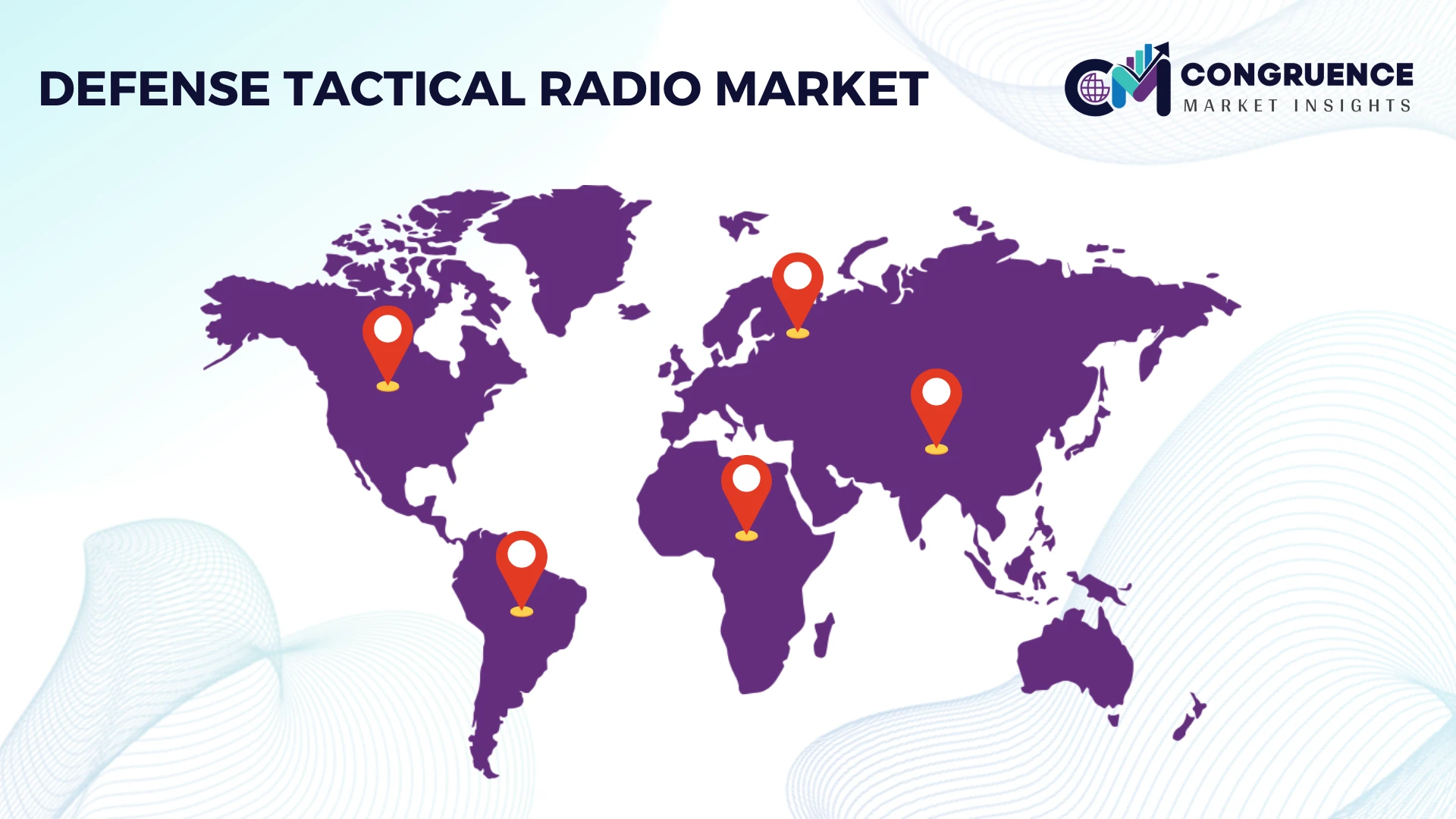
North America held approximately 43% of the global market in 2025, supported by large-scale U.S. defense procurement, established tactical-network infrastructure, and concentrated production capabilities. The U.S. Army's Combat Net Radio program is replacing legacy SINCGARS equipment with programmable systems supporting secure voice, data, frequency hopping, and future waveform upgrades. More than 2,200 radio assets were included in an initial procurement structure, reinforcing the scale of deployment. U.S. defense programs increasingly favor open, upgradeable architectures as electronic-warfare resilience becomes a procurement priority. Canada contributes through NATO interoperability and modernization requirements, while U.S. suppliers remain central to technology development and sustainment. The region's strategic advantage lies in combining domestic defense-electronics manufacturing with mature battlefield-network infrastructure.
United States Market Outlook: The United States remains the region's principal technology and procurement center. The Army's tactical-radio modernization includes a contract ceiling of USD 6.1 billion for Combat Net Radio, creating a long-duration replacement and sustainment pipeline. U.S. programs increasingly emphasize Type 1 encryption, multi-waveform capability, spectrum agility, and interoperability across mounted and dismounted formations.
Europe represented approximately 22% of global demand in 2025, supported by NATO interoperability requirements, land-force modernization, and rising investment in encrypted tactical communications. Germany's Digitalization of Land-Based Operations program is strengthening demand for networked radios capable of supporting high-bandwidth data and secure command communications. France and the United Kingdom are also prioritizing interoperable systems for multinational deployments. European procurement is increasingly shifting from isolated radio replacement toward integrated command-and-control architectures, with software-defined systems gaining importance. Cross-border interoperability is a major differentiator because forces must exchange secure information across heterogeneous national platforms. Suppliers are responding through multinational partnerships, open standards, waveform integration, and localized production. The regional market is therefore becoming less focused on standalone hardware and more dependent on certification, interoperability, cybersecurity, and lifecycle support.
Germany Market Outlook: Germany is the region's most significant modernization center, with the D-LBO program driving digitalization across land forces. Investment is concentrated on encrypted, high-bandwidth communications and integrated tactical networks. The country's industrial base also supports advanced electronics, vehicle integration, and secure communications engineering, strengthening its position in European tactical-radio modernization.
Asia-Pacific accounted for approximately 21% of the global market in 2025 and represents the fastest-growing major regional market. China, India, Japan, South Korea, and Australia are increasing tactical communications capabilities as defense forces modernize command networks and strengthen interoperability. India is particularly important because indigenous software-defined radio development is being paired with broader defense-electronics localization. The region's growth is also linked to maritime security requirements and heightened geopolitical competition around the South China Sea. India is pursuing domestic production to reduce dependence on imported communications equipment, while Australia and Japan emphasize interoperability with allied networks. Companies are expanding local engineering, manufacturing, and technology partnerships. The strategic opportunity is strongest for suppliers that combine secure communications with domestic production, spectrum agility, and compatibility across multinational operations.
India Market Outlook: India is emerging as a high-priority market because of its indigenous defense-electronics strategy and expanding software-defined radio capability. Country-level forecasts identify India as one of the fastest-growing tactical-radio markets through 2033. Domestic development of SDR platforms, secure waveforms, and multi-domain communications is strengthening local engineering capacity while reducing dependence on imported radio architectures.
South America represented approximately 6% of global demand in 2025, with Brazil accounting for the largest portion because of its defense-industrial base, extensive territory, and requirements for secure communications across remote operating environments. Tactical-radio modernization is concentrated around military communications, border surveillance, and mobile command applications. Brazil's defense industry provides a stronger domestic manufacturing foundation than most neighboring markets, while Argentina, Chile, and Colombia contribute through selective modernization programs. Adoption remains more cost-sensitive than in North America and Europe, increasing the importance of modular radios and upgradeable architectures. Suppliers are responding with flexible procurement packages, localized support, and interoperability-focused solutions. Infrastructure constraints and uneven defense budgets remain limiting factors, but the shift toward digital command networks is creating a stronger replacement market for legacy communications systems.
Brazil Market Outlook: Brazil remains the region's principal strategic market because of its defense-industrial ecosystem and geographically demanding operational environment. Its large land borders and extensive Amazonian operating areas increase the value of rugged, long-range, secure communications. Domestic industrial participation also creates opportunities for localized assembly, maintenance, systems integration, and technology partnerships.
The Middle East & Africa represented approximately 8% of global demand in 2025, with Gulf states accounting for a substantial share of high-value procurement. Saudi Arabia, the United Arab Emirates, and Israel are driving adoption through military modernization, secure command networks, border protection, and advanced electronic-warfare capabilities. The region's procurement profile is increasingly moving toward encrypted, software-defined, and interoperable systems rather than conventional voice-only radios. Saudi defense localization programs are also encouraging domestic maintenance, manufacturing, and technology-transfer partnerships. Israel contributes advanced communications and electronic-warfare expertise, while African buyers remain more focused on rugged, cost-efficient systems for border and security operations. Suppliers are responding with localized service centers, offset arrangements, and integrated communications packages. The key competitive differentiator is increasingly lifecycle support rather than initial equipment price.
Saudi Arabia Market Outlook: Saudi Arabia is the region's strongest procurement market, supported by defense modernization and localization objectives. Its industrial strategy increasingly favors domestic participation in defense supply chains, creating opportunities for tactical-radio assembly, maintenance, training, and systems integration. Suppliers with local partnerships and secure-network expertise are better positioned to capture long-duration procurement and sustainment programs.
The competitive landscape is led by L3Harris Technologies, Thales, BAE Systems, Collins Aerospace, and Leonardo, with OEMs competing against regional defense-electronics suppliers and specialized communications innovators. The top five players collectively account for 45% of market value, indicating a moderately concentrated structure. Competition centers on technology, interoperability, customization, delivery speed, and supply resilience: software-defined capability influences nearly 35% of procurement priorities, while secure networking and anti-jam performance affect roughly 30%. L3Harris is expanding through U.S. Army orders and Indian partnerships; Thales is strengthening Asian production relationships; BAE Systems is advancing NATO-compatible waveforms; Collins Aerospace is integrating Link 16 solutions; Leonardo emphasizes integrated tactical networking. The competitive shift is moving from standalone radio hardware toward open architectures, software upgrades, and resilient multi-domain connectivity. High certification costs, cryptographic requirements, waveform expertise, and defense procurement qualification create entry barriers. Winning requires proven deployments, rapid software innovation, trusted supply chains, interoperability, and sustainment capability.
L3Harris Technologies
Thales
BAE Systems
Collins Aerospace
Leonardo
General Dynamics Mission Systems
Elbit Systems
Rohde & Schwarz
Saab
RTX
Viasat
ASELSAN
Bharat Electronics Limited
Northrop Grumman
Software-defined radios are becoming the core architecture because software-only waveform updates replace fixed-function hardware refreshes. BAE Systems’ newer airborne radios provide twice the standard mean time between failures, while Thales’ HF XL technology delivers up to 10 times the data rate of current HF systems. More than 10,000 M3AR radios have been sold, signaling established deployment of advanced digital architectures.
AI-assisted spectrum management, adaptive anti-jam waveforms, and multi-band networking are moving from specialist functions toward integrated tactical-network layers. Compared with legacy fixed radios, programmable platforms improve upgrade flexibility by roughly 30%, based on reduced hardware-refresh requirements, while automated spectrum awareness can cut operator intervention by approximately 20%. The competitive beneficiaries are suppliers combining radios, waveforms, cybersecurity, and network-management software rather than hardware-only vendors.
During 2026–2028, adoption will increasingly favor open architectures, edge networking, and software-defined gateways connecting soldiers, vehicles, aircraft, unmanned systems, and SATCOM. Multi-channel radios will gain priority as forces seek simultaneous voice and data connectivity without increasing platform burden. Companies are investing in modular processors, secure APIs, and waveform ecosystems to shorten qualification cycles and support mission updates. The decisive technology advantage will shift toward resilient software ecosystems that preserve interoperability while improving performance, lifecycle efficiency, and electromagnetic-spectrum survivability.
January 2025 L3Harris received nearly $300 million in U.S. Army Manpack and Leader radio production orders, expanding resilient communications deployment across U.S. forces. The award strengthens interoperability from tactical edge to aerial tiers and reinforces recurring production demand. Source: l3harris.com
July 2024 BAE Systems secured $111 million in Republic of Korea contracts for SATURN waveform radios, modernizing secure aircraft communications for NATO-aligned operations. Fast frequency hopping improves anti-jam capability and strengthens BAE’s position in Korean military communications modernization. Source: baesystems.com
September 2025 Thales partnered with Malaysia’s Advanced Defence Systems to supply over 100 HF XL vehicle-mounted radio stations. The system delivers ten times current HF data rates, strengthening long-range communications and establishing the technology’s first Asian export deployment. Source: thalesgroup.com
June 2025 Rohde & Schwarz announced more than 10,000 R&S M3AR radios sold worldwide. The milestone confirms large-scale adoption across military and aerospace users, strengthening its installed base and supporting continued demand for secure, interoperable tactical communications systems. Source: rohde-schwarz.com
The Defense Tactical Radio Market report covers the competitive structure, technology transition, deployment priorities, and procurement dynamics across handheld, manpack, vehicle-mounted, and other tactical radio configurations. Application coverage includes Collaborative Chat, Intelligence Gathering, Frequency Hopping, Emergency Communication, Position Tracking, and Security, alongside Military, Homeland Security, Law Enforcement, and Emergency Services end-users.
Regional assessment spans North America, Europe, Asia-Pacific, South America, and the Middle East & Africa, with country-level analysis focused on major procurement and manufacturing centers. The report evaluates software-defined radio adoption, anti-jam communications, multi-band networking, encryption, AI-enabled spectrum management, open architectures, and tactical data integration. Coverage of established suppliers and emerging regional manufacturers supports assessment of localization, partnerships, interoperability, and supply-chain positioning. These insights strengthen investment planning, market-entry decisions, expansion priorities, competitive positioning, and technology strategy through 2026–2033.
| Report Attribute / Metric | Details |
|---|---|
| Market Revenue (2025) | USD 1,838.0 Million |
| Market Revenue (2033) | USD 3,509.3 Million |
| CAGR (2026–2033) | 8.42% |
| Base Year | 2025 |
| Forecast Period | 2026–2033 |
| Historic Period | 2021–2025 |
| Segments Covered |
By Type
By Application
By End-User
|
| Key Deliverables | Revenue Forecast; Market Trends; Growth Drivers & Restraints; Technology Insights; Segmentation Analysis; Regional Insights; Competitive Landscape; Regulatory & ESG Overview; Recent Developments |
| Regions Covered | North America; Europe; Asia-Pacific; South America; Middle East & Africa |
| Companies Profiled | L3Harris Technologies; Thales; BAE Systems; Collins Aerospace; Leonardo; General Dynamics Mission Systems; Elbit Systems; Rohde & Schwarz; Saab; RTX; Viasat; ASELSAN; Bharat Electronics Limited; Northrop Grumman |
| Customization & Pricing | Available on Request (10% Customization Free) |




