
Reports
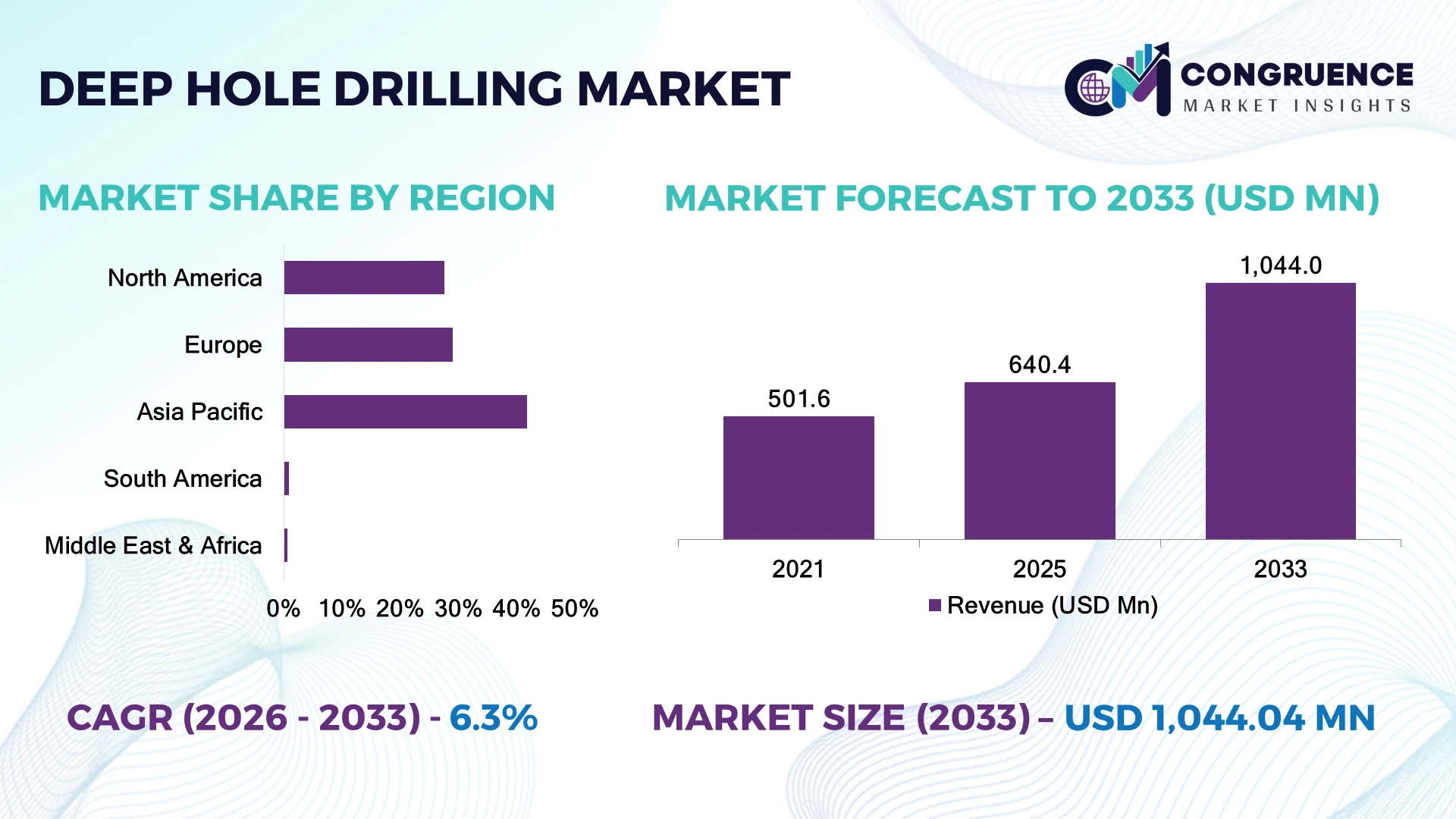
The Global Deep Hole Drilling Market was valued at USD 640.4 Million in 2025 and is anticipated to reach a value of USD 1,044.0 Million by 2033 expanding at a CAGR of 6.3% between 2026 and 2033. Growth is driven by increasing precision machining requirements in aerospace, defense, medical devices, energy equipment, and electric vehicle manufacturing requiring high-aspect-ratio drilling with micron-level accuracy.
Germany leads the Deep Hole Drilling market with approximately 22% of global precision deep-hole drilling machine production, supported by advanced machine tool manufacturing, aerospace engineering, and automotive industries. Compared with China, which dominates high-volume machining capacity, Germany maintains stronger penetration in premium CNC deep-hole drilling systems, with nearly 68% of new installations incorporating automated process monitoring and adaptive tooling. Continued defense modernization across Europe following evolving geopolitical priorities has accelerated investment in advanced precision machining technologies.
Manufacturers investing in intelligent drilling systems, automation, and application-specific machining capabilities are securing long-term competitive advantages across high-value industrial sectors.
Market Size & Growth: USD 640.4 million (2025) to USD 1,044.0 million (2033) at 6.3% CAGR, driven by aerospace, defense, and precision manufacturing expansion.
Top Growth Drivers: Aerospace machining (+27%), EV component production (+24%), defense manufacturing (+19%).
Short-Term Forecast: By 2028, machining cycle times decline 16% while drilling accuracy improves 18%.
Emerging Technologies: AI-enabled process control, digital twins, and adaptive CNC automation reshape precision drilling.
Regional Leaders: Europe, Asia-Pacific, and North America lead through advanced machine tool investment and industrial modernization.
Consumer/End-User Trends: Approximately 63% of aerospace suppliers prioritize automated deep-hole drilling for critical components.
Pilot/Case Example: A 2026 smart machining deployment improved tool life by 22% and reduced scrap by 15%.
Competitive Landscape: Leading manufacturers collectively hold approximately 44% market share through advanced engineering and customization.
Regulatory & ESG Impact: Minimum quantity lubrication systems reduce coolant consumption by nearly 28% during drilling operations.
Investment & Funding: More than USD 1.6 billion supports machine tool automation, precision manufacturing, and factory expansion.
Innovation & Future Outlook: Intelligent machining platforms and predictive maintenance are redefining next-generation deep-hole drilling operations.
The Deep Hole Drilling market is increasingly shaped by aerospace, oil and gas, medical, mold manufacturing, and precision engineering applications requiring exceptional dimensional accuracy and surface finish. Around 57% of newly installed premium drilling systems incorporate intelligent process monitoring and automated tool compensation. Ongoing supply-chain localization for strategic manufacturing sectors is accelerating investment in high-precision machining capabilities, setting the foundation for the strategic discussion below.
Deep hole drilling has become strategically important as manufacturers prioritize precision, production efficiency, and supply-chain resilience across aerospace, defense, energy, automotive, and medical industries. Increasing reshoring of advanced manufacturing and modernization of industrial infrastructure are encouraging investment in high-performance machining centers capable of producing complex components with tighter tolerances and improved operational consistency.
Modern CNC deep-hole drilling systems equipped with adaptive process monitoring improve drilling accuracy by approximately 21% while reducing machining time by nearly 18% compared with conventional manual systems. Germany continues leading premium machine innovation through advanced engineering and automation, whereas China focuses on large-scale production capacity and rapid deployment across industrial manufacturing. During the next two to three years, adoption of AI-assisted machining optimization, predictive maintenance, and digital manufacturing integration is expected to expand across precision engineering facilities.
Manufacturers are strengthening partnerships with tooling specialists, expanding intelligent machining portfolios, and investing in automated production cells supporting aerospace and medical applications. A growing number of defense component manufacturers are deploying multi-axis deep-hole drilling systems integrated with in-process measurement to reduce rework and improve production consistency. Organizations combining precision engineering, intelligent automation, and application-specific machining expertise will strengthen competitive positioning in an increasingly quality-driven manufacturing landscape.
The rapid expansion of aerospace, defense, and electric mobility manufacturing is accelerating demand for high-precision deep hole drilling systems capable of machining complex components with superior dimensional accuracy. Approximately 61% of aerospace structural components require precision deep-hole machining, while advanced CNC drilling reduces dimensional deviation by nearly 20% and improves tool utilization by approximately 17%. Germany's continued investment in defense manufacturing and precision engineering is strengthening demand for advanced drilling technologies. Machine builders are responding through multi-axis platform expansion, intelligent tooling innovation, and partnerships with automation specialists. A key strategic shift is the integration of adaptive machining software that minimizes production variability while improving throughput across high-value manufacturing operations.
Deep hole drilling equipment requires significant investment in specialized machines, cutting tools, coolant delivery systems, and precision fixturing, limiting adoption among medium-sized manufacturers. Initial equipment and tooling account for nearly 55% of total project expenditure, while carbide and coated tooling costs have increased by approximately 18% due to raw material supply volatility. Japan's dependence on high-grade precision tooling imports creates procurement challenges during supply disruptions. These cost pressures reduce production flexibility and extend investment payback periods. Manufacturers are mitigating risk through localized tooling partnerships, modular machine configurations, long-term procurement agreements, and refurbishment programs that improve equipment utilization while reducing replacement costs.
The convergence of AI, digital twins, and sensor-driven machining is creating new opportunities beyond conventional drilling performance. Intelligent process monitoring improves machining efficiency by approximately 23%, while predictive maintenance reduces unplanned machine downtime by nearly 26%. South Korea is expanding smart manufacturing initiatives that accelerate deployment of digitally connected machine tools across precision engineering facilities. Equipment manufacturers are investing in cloud-enabled analytics, adaptive control software, and collaborative technology partnerships to deliver data-driven machining solutions. A notable strategic opportunity lies in offering drilling platforms as integrated productivity systems combining automation, software, tooling, and lifecycle services rather than standalone machine sales.
Sustained growth depends on the availability of highly skilled operators capable of programming, optimizing, and maintaining increasingly sophisticated deep hole drilling systems. Approximately 34% of precision manufacturers report shortages of advanced CNC machining specialists, while digital production environments require nearly 28% more multidisciplinary technical competencies than conventional machining operations. The transition toward interconnected manufacturing systems increases implementation complexity across legacy production facilities. Companies must expand workforce training, invest in digital simulation platforms, collaborate with technical institutes, and standardize machine connectivity to maintain machining consistency, maximize equipment performance, and strengthen long-term manufacturing competitiveness.
Smart Process Monitoring Expands: Manufacturers are integrating real-time sensors and adaptive machining controls that improve drilling precision by approximately 19% while reducing scrap rates by nearly 14%. Labor shortages in advanced machining are accelerating automation deployment. Equipment suppliers are embedding intelligent diagnostics and closed-loop process control into next-generation drilling platforms.
Hybrid Machine Platforms Increase: Multi-function machining centers combining deep hole drilling, milling, and turning reduce setup time by approximately 22% and improve equipment utilization by nearly 18%. Manufacturers are consolidating production workflows to increase operational flexibility while machine builders expand modular platform offerings tailored for aerospace and medical component manufacturing.
Advanced Tool Materials Advance: New carbide grades, ceramic coatings, and optimized coolant delivery systems extend tool life by approximately 27% while reducing heat generation by nearly 16%. The non-obvious shift is the growing use of digital tooling databases that optimize cutting parameters before production begins. Companies are strengthening tooling partnerships and expanding application engineering services.
Localized Manufacturing Strengthens: Supply-chain restructuring is encouraging regional production of precision machine tools and critical tooling components, reducing procurement lead times by approximately 20% and logistics costs by nearly 12%. Manufacturers are increasing localized assembly, expanding service networks, and investing in regional engineering centers to improve responsiveness and production continuity.
BTA (Boring and Trepanning Association) drilling systems account for approximately 43% of the global Deep Hole Drilling market due to their superior productivity in large-diameter, high-depth industrial applications. Their ability to achieve high material removal rates, excellent hole straightness, and stable coolant delivery makes them the preferred solution for aerospace, energy, defense, and heavy engineering manufacturers. Gun drilling remains a mature segment supporting high-precision, small-diameter applications, while ejector drilling continues serving medium-volume production where machine adaptability is prioritized over maximum throughput.
Gun drilling represents the fastest-growing type as medical devices, electric vehicle components, and precision engineering increasingly require micron-level accuracy in small-diameter holes. Advanced gun drilling systems improve dimensional accuracy by approximately 18% while extending tool life by nearly 22% through optimized coolant management and coated tooling technologies. Machine builders are expanding CNC-integrated product portfolios, investing in automation, and collaborating with tooling specialists to deliver application-specific machining solutions. Investment priorities are shifting toward flexible drilling platforms capable of handling diverse production requirements without sacrificing precision or productivity.
According to a 2026 manufacturing assessment by the Association for Manufacturing Technology (AMT), precision gun drilling systems continue gaining adoption across aerospace and medical component manufacturing due to increasing demand for automated, high-accuracy machining operations.
Aerospace manufacturing represents approximately 36% of global Deep Hole Drilling demand because turbine shafts, landing gear components, hydraulic systems, and structural assemblies require deep, high-precision holes with strict dimensional tolerances. Defense manufacturing and oil & gas equipment remain mature application segments where process reliability and material integrity are operational priorities. Mold manufacturing and medical device production continue expanding their use of precision drilling technologies for specialized, high-value components requiring repeatable machining performance.
Medical device manufacturing is the fastest-growing application as minimally invasive surgical instruments, orthopedic implants, and precision tubular components demand increasingly sophisticated drilling capabilities. Automated drilling systems improve production efficiency by approximately 21% while reducing component rejection rates by nearly 17%. Equipment manufacturers are integrating adaptive process monitoring, robotic material handling, and digital quality verification into production workflows. Demand is increasingly concentrated in applications requiring consistent micron-level precision, shorter production cycles, and validated manufacturing processes supporting highly regulated industries.
A 2025 enterprise manufacturing survey published by the International Federation of Robotics (IFR) indicated increasing deployment of automated precision machining technologies within aerospace and medical manufacturing to improve production consistency and operational efficiency.
The aerospace and defense sector accounts for approximately 39% of global Deep Hole Drilling equipment demand due to stringent machining tolerances, complex alloy processing requirements, and continuous investment in aircraft, propulsion systems, and military equipment. Automotive manufacturers remain a significant customer group focused on engine components, transmission systems, and electric drivetrain applications, while industrial machinery producers sustain steady demand for heavy-duty precision machining. Energy equipment manufacturers continue adopting advanced drilling technologies for critical pressure-bearing and rotating components.
Medical device manufacturers represent the fastest-growing end-user segment as demand rises for precision implants, surgical tools, and minimally invasive medical technologies. Automated machining platforms improve manufacturing throughput by approximately 19% while reducing dimensional variation by nearly 15%. Equipment suppliers are responding through customized machine configurations, application engineering partnerships, flexible automation packages, and digital service offerings. Future demand is shifting toward manufacturers requiring intelligent machining platforms capable of combining productivity, traceability, and precision within highly regulated production environments.
According to a 2026 enterprise study released by the European Association of the Machine Tool Industries (CECIMO), manufacturers increasingly prioritize digitally integrated deep-hole drilling systems to improve precision, process repeatability, and production flexibility across aerospace, medical, and advanced industrial applications.
Asia-Pacific accounted for the largest market share at 41.8% in 2025 however, Middle East & Africa is expected to register the fastest growth, expanding at a CAGR of 7.1% between 2026 and 2033.

High-Precision Aerospace Manufacturing Drives Equipment Modernization
North America accounts for approximately 27.6% of the global Deep Hole Drilling market, supported by advanced aerospace production, defense manufacturing, precision medical engineering, and high-value energy equipment fabrication. Manufacturers are accelerating replacement of conventional machining systems with CNC-controlled deep-hole drilling platforms integrated with process monitoring and automated tool management. Nearly 62% of newly commissioned aerospace machining cells now incorporate intelligent drilling technologies that improve dimensional consistency and reduce production downtime. Ongoing investment in reshoring strategic manufacturing capabilities and expanding defense production capacity continues strengthening demand for high-precision drilling equipment. Machine tool suppliers are expanding engineering support, automation integration, and customized machining solutions to improve operational flexibility across complex manufacturing environments.
United States Market Outlook: The United States dominates the regional market through its extensive aerospace, defense, medical device, and industrial machinery manufacturing ecosystem. Large OEMs continue investing in multi-axis machining centers capable of producing critical aircraft, energy, and defense components with extremely tight tolerances. More than 70% of advanced aerospace component manufacturers have adopted digitally connected machining systems supporting automated quality verification, predictive maintenance, and precision deep-hole drilling operations.
Engineering Excellence Sustains Premium Machine Tool Demand
Europe remains a leading market through its strong precision engineering capabilities, advanced machine tool manufacturing, and high-value automotive and aerospace industries. Approximately 29% of premium deep-hole drilling systems supplied globally originate from European manufacturing facilities emphasizing automation, machining accuracy, and application-specific customization. Manufacturers continue modernizing production lines with digital process control and energy-efficient machining technologies while strengthening collaboration between equipment builders and industrial customers to improve production productivity and machining reliability.
Germany Market Outlook: Germany leads European demand through its globally competitive machine tool industry, aerospace engineering expertise, and industrial automation capabilities. Precision manufacturing companies continue expanding investment in intelligent machining technologies supporting high-value mechanical components and defense equipment. Around 66% of newly installed premium deep-hole drilling machines incorporate adaptive process monitoring and advanced CNC integration, reinforcing Germany's technological leadership in precision machining.
Large-Scale Industrial Manufacturing Strengthens Market Leadership
Asia-Pacific leads the global Deep Hole Drilling market with approximately 41.8% share, supported by large-scale automotive manufacturing, industrial machinery production, electronics, and expanding aerospace supply chains. Strong investment in advanced manufacturing infrastructure and automated machining facilities continues driving equipment deployment across high-volume production environments. Nearly 64% of newly established precision machining facilities within major industrial hubs utilize CNC-controlled deep-hole drilling systems to improve productivity, machining quality, and export competitiveness. Manufacturers are increasing automation investment while strengthening domestic machine tool production capabilities.
China Market Outlook: China remains the region's largest market due to its extensive industrial manufacturing ecosystem, growing aerospace production, and expanding domestic machine tool industry. Precision machining companies continue investing in intelligent manufacturing systems and advanced drilling technologies supporting electric vehicles, industrial equipment, and defense production. Approximately 35% of global precision machining capacity for large-scale industrial components is concentrated within China's manufacturing network, strengthening long-term equipment demand.
Industrial Diversification Supports Precision Machining Investment
South America is steadily expanding deep-hole drilling adoption through modernization of mining equipment manufacturing, oil and gas machinery production, agricultural equipment, and automotive component industries. Brazil and Argentina continue investing in precision machining capabilities to improve domestic manufacturing competitiveness and reduce dependence on imported industrial components. Approximately 42% of newly upgraded machining facilities now integrate advanced CNC drilling technologies that improve production accuracy and operational efficiency. Although imported machine tools remain important, localized engineering services and industrial partnerships are improving deployment capability across the region.
Brazil Market Outlook: Brazil leads the regional market through its diversified industrial base, established automotive manufacturing sector, and growing energy equipment production. Manufacturers continue upgrading machining infrastructure to support domestic production of precision mechanical components for transportation, mining, and industrial applications. Investment in automated machining systems is improving productivity while strengthening local manufacturing capability for complex engineering products.
Industrial Diversification Expands Precision Manufacturing Capability
The Middle East & Africa market is gaining momentum through industrial diversification initiatives, energy infrastructure expansion, and investment in advanced manufacturing capabilities. Demand for precision drilling equipment is increasing across oil and gas equipment manufacturing, defense production, and industrial fabrication. Approximately 38% of newly commissioned precision machining facilities now include digitally controlled deep-hole drilling systems to improve machining quality and operational consistency. Governments and industrial investors continue supporting localized manufacturing through infrastructure expansion, technical partnerships, and industrial modernization programs.
Saudi Arabia Market Outlook: Saudi Arabia represents the region's most strategically significant market due to its industrial diversification strategy, expanding defense manufacturing, and continued investment in downstream energy equipment production. Precision machining capability is becoming increasingly important for domestic manufacturing localization. Large industrial projects continue incorporating advanced CNC machining technologies to strengthen engineering capability, reduce import dependence, and support long-term development of high-value industrial manufacturing.
Deep-hole drilling specialists including TBT Tiefbohrtechnik, UNISIG, Mollart Engineering, IMSA, and Botek compete on precision engineering, while CNC machine builders and regional manufacturers compete through cost-efficient customization and localized service. The top five suppliers collectively account for approximately 48% of the global market. Competition is driven by drilling accuracy, automation capability, tooling integration, and delivery speed rather than equipment price alone. Intelligent process monitoring improves machining accuracy by approximately 20%, automated tool management increases productivity by nearly 18%, and modular machine platforms shorten customer lead times by around 25%. Market leaders are expanding application engineering centers, strengthening tooling partnerships, integrating robotics, and increasing vertical manufacturing capabilities. Competition is shifting toward digitally connected machining ecosystems that combine software, tooling, automation, and lifecycle services. High engineering expertise, precision manufacturing capability, and application-specific process knowledge remain significant entry barriers. Winning requires automation leadership, superior machining performance, responsive technical support, and integrated manufacturing solutions.
TBT Tiefbohrtechnik GmbH + Co.
UNISIG
Mollart Engineering Ltd.
IMSA S.r.l.
Botek Präzisionsbohrtechnik GmbH
Entrust Manufacturing Technologies
Precihole Machine Tools Pvt. Ltd.
Cheto Corporation S.A.
HTE Technologies
Mollificio Varesino S.r.l.
Hochmuth Maschinenbau GmbH
Kays Engineering, Inc.
Deep hole drilling technology is rapidly advancing through adaptive CNC controls, intelligent coolant management, and sensor-enabled process monitoring. Modern BTA and gun drilling systems improve hole straightness by approximately 21% while reducing machining cycle time by nearly 18%. Around 64% of newly installed premium machines incorporate real-time monitoring, automated tool compensation, and digital diagnostics, enabling manufacturers to achieve higher precision, lower scrap rates, and greater production consistency in aerospace, medical, and energy applications.
Emerging technologies include AI-assisted machining optimization, digital twins, robotic workpiece handling, and predictive maintenance platforms. Compared with conventional CNC drilling systems, digitally integrated machining cells improve tool utilization by approximately 24% while reducing setup time by nearly 19%. Aerospace manufacturers and precision medical suppliers benefit most through tighter tolerances, automated quality verification, and faster qualification cycles, while machine builders strengthen competitiveness by delivering integrated machining, tooling, and software ecosystems instead of standalone equipment.
Between 2026 and 2028, autonomous machining optimization, cloud-connected production analytics, and closed-loop process control will become defining competitive differentiators. Companies investing in intelligent machining software, advanced tooling technologies, and digitally connected manufacturing cells will improve operational resilience, reduce downtime, accelerate product validation, and strengthen long-term competitiveness as precision manufacturing requirements continue becoming increasingly demanding.
August 2024 – UNISIG introduced a next-generation operating system for its UNE Series gundrilling machines, significantly improving the human-robot interface and reducing programming time, strengthening automation capabilities for precision manufacturing. Source: Unisig
March 2025 – UNISIG launched its assemble-to-order program for UNE gundrilling machines, reducing customer lead times by up to 50% through modular manufacturing and synchronized production planning, improving delivery flexibility and machine customization. Source: Unisig
June 2026 – UNISIG expanded its Wisconsin Tech Center with more than US$1 million in new research and development equipment, accelerating deep-hole drilling process validation, application engineering, and machine innovation for industrial customers. Source: Machinery Market - UK Manufacturing News
2025 – Mollart Engineering expanded its subcontract deep-hole drilling services while increasing support for advanced semiconductor and precision manufacturing applications, strengthening specialized machining capacity and improving customer access to high-accuracy drilling solutions. Source: Mollart Engineering corporate updates.
This report provides comprehensive analysis of the global Deep Hole Drilling market across drilling technologies, industrial applications, end-user industries, and major geographic markets. It evaluates BTA drilling, gun drilling, ejector drilling, and related precision machining technologies used across aerospace, defense, automotive, medical devices, energy, mold manufacturing, and industrial machinery. The assessment covers manufacturing capabilities, machine deployment trends, automation adoption, tooling innovations, and evolving customer requirements across established and emerging industrial markets.
The report further examines AI-enabled machining, adaptive process monitoring, robotic automation, digital twins, predictive maintenance, and advanced coolant management systems shaping next-generation precision manufacturing. Approximately 64% of premium machine installations now incorporate intelligent process monitoring and digitally connected machining capabilities. Strategic insights support investment planning, manufacturing expansion, technology selection, competitive benchmarking, product portfolio development, and regional market prioritization by identifying operational trends, technology shifts, customer purchasing priorities, and high-value growth opportunities expected to influence the market between 2026 and 2033.
| Report Attribute/Metric | Report Details |
|---|---|
|
Market Revenue in 2025 |
USD 640.4 Million |
|
Market Revenue in 2033 |
USD 1,044.0 Million |
|
CAGR (2026 - 2033) |
6.3% |
|
Base Year |
2025 |
|
Forecast Period |
2026 - 2033 |
|
Historic Period |
2021 - 2025 |
|
Segments Covered |
By Type
By Application
By End-User
|
|
Key Report Deliverable |
Revenue Forecast, Growth Trends, Market Dynamics, Segmental Overview, Regional and Country-wise Analysis, Competition Landscape |
|
Region Covered |
North America, Europe, Asia-Pacific, South America, Middle East, Africa |
|
Key Players Analyzed |
TBT Tiefbohrtechnik GmbH + Co., UNISIG, Mollart Engineering Ltd., IMSA S.r.l., Botek Präzisionsbohrtechnik GmbH, Entrust Manufacturing Technologies, Precihole Machine Tools Pvt. Ltd., Cheto Corporation S.A., HTE Technologies, Mollificio Varesino S.r.l., Hochmuth Maschinenbau GmbH, Kays Engineering, Inc. |
|
Customization & Pricing |
Available on Request (10% Customization is Free) |




