
Reports
The Global Decorative Laminates Market was valued at USD 6415.7 Million in 2025 and is anticipated to reach a value of USD 8190.5 Million by 2033 expanding at a CAGR of 3.1% between 2026 and 2033. Growth is driven by modular furniture manufacturing, high-pressure laminate adoption in commercial interiors, and the replacement of conventional wood veneers with scratch-resistant, low-emission decorative surfaces.
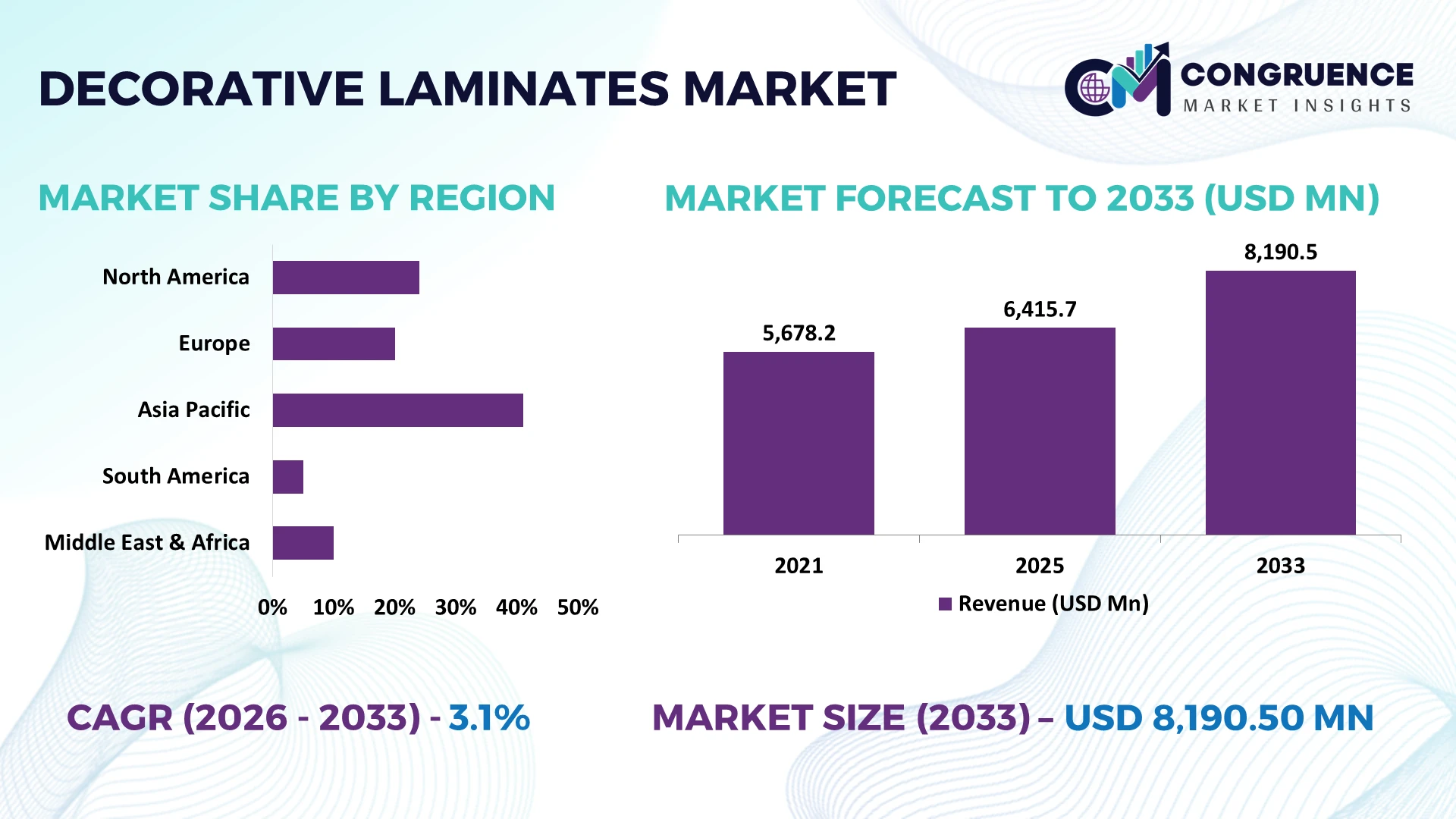
China maintains a dominant position in the global decorative laminates manufacturing landscape, supported by its extensive wood-based panel processing infrastructure, furniture production clusters in Guangdong and Zhejiang, and vertically integrated resin supply chains. China's furniture industry operates alongside a construction materials ecosystem serving domestic property refurbishment and international exports. India presents a contrasting growth opportunity, with its 2025–2026 infrastructure and housing investment cycle supporting organized laminate production. European manufacturers increasingly prioritize low-formaldehyde materials, while Chinese producers emphasize automated pressing, digital surface printing, and high-volume manufacturing efficiency.
Strategic implication: Manufacturers investing in automated surface finishing, certified low-emission substrates, and localized distribution gain stronger positioning across commercial renovation and modular furniture supply chains.
Market Size & Growth: USD 6,415.7 million in 2025, reaching USD 8,190.5 million by 2033 at 3.1% CAGR, supported by modular furniture manufacturing and engineered surface adoption.
Top Growth Drivers: Greenlam's FY2025–26 laminate production increased 5.1%, international business contributed 43.8% of consolidated revenue, and laminate capacity reached 24.52 million sheets annually.
Short-Term Forecast: By FY2026–27, Greenlam targets 2 million additional laminate sheets annually through brownfield expansion, increasing Naidupeta capacity approximately 57%.
Emerging Technologies: German continuous pressing systems, digital decorative printing, and automated resin impregnation support advanced high-pressure laminate manufacturing across 3 major production stages.
Regional Leaders: Asia Pacific leads manufacturing expansion, North America emphasizes commercial HPL applications, and Europe prioritizes low-emission surfaces; verified regional USD forecasts remain unavailable.
Consumer/End-User Trends: Greenlam's 19.85 million laminate sheets sold in FY2024–25 demonstrate established demand across residential furniture, commercial interiors, and institutional applications.
Pilot/Case Example: In 2025, Greenlam's Naidupeta expansion demonstrated a planned 7-million-sheet annual high-pressure laminate production capacity, strengthening integrated manufacturing.
Competitive Landscape: Greenlam holds an estimated 17%+ share of India's organized laminate segment, competing with Wilsonart, Formica, Merino Industries, and Stylam Industries.
Regulatory & ESG Impact: FSC chain-of-custody certification, GREENGUARD compliance, and ISO 14001 environmental management strengthen eligibility for certified institutional procurement.
Investment & Funding: Greenlam announced ₹1,147 crore in Andhra Pradesh manufacturing investment during 2025, supported by approximately ₹329 crore in state incentives.
Innovation & Future Outlook: Next-generation fingerprint-resistant surfaces, low-emission resin formulations, and digitally textured laminates strengthen differentiation across 2 major product categories: HPL and LPL.
The Decorative Laminates Market is increasingly shaped by demand for durable kitchen cabinetry, modular wardrobes, healthcare furniture, and commercial wall panels. Manufacturers are integrating digitally synchronized woodgrain textures, antimicrobial finishes, and low-formaldehyde resin technologies to improve surface functionality and environmental compliance. Greenlam's FY2025–26 production increase of 5.1% highlights the operational importance of manufacturing scale and product availability. India's expanding furniture manufacturing ecosystem and European indoor-air-quality requirements are encouraging suppliers to develop certified, application-specific decorative surfaces. These developments establish manufacturing integration, material performance, and distribution efficiency as central priorities for strategic market positioning.
Decorative laminates are becoming strategically important as furniture manufacturers, interior contractors, and building material suppliers shift toward engineered surfaces with predictable quality, faster installation, and standardized performance. India's organized furniture manufacturing ecosystem is accelerating the transition from conventional wood veneers to high-pressure laminates and prelaminated boards. Greenlam's 24.52 million-sheet annual laminate manufacturing capacity illustrates the scale required to serve institutional procurement and export markets. Supply-chain localization is becoming a competitive priority as manufacturers integrate resin impregnation, decorative printing, and substrate processing.
Technology investment increasingly determines production economics. Continuous-pressure lamination offers more consistent thickness, surface adhesion, and production throughput than conventional batch pressing, while automated inspection reduces manual handling and rejects. Germany and Italy emphasize digitally synchronized textures and specialized surface finishes, whereas China prioritizes industrial-scale production and export competitiveness. India's manufacturing expansion combines automated equipment with domestic distribution development. During 2026–2028, investment priorities will increasingly focus on production utilization, surface defect reduction, and certified low-emission product portfolios.
Greenlam's Naidupeta manufacturing development demonstrates integrated production deployment, combining laminate manufacturing with supporting wood-panel infrastructure. Companies are strengthening equipment partnerships, developing application-specific decorative surfaces, and expanding distribution into organized furniture manufacturing clusters. Competitive advantage will depend on maintaining reliable production quality, controlling conversion costs, and supplying differentiated surfaces without extending customer delivery cycles.
India's expanding modular furniture ecosystem is increasing industrial demand for decorative laminates used in kitchen cabinets, wardrobes, office workstations, and commercial fixtures. Greenlam's reported 5.1% increase in laminate production during FY2025–26 illustrates manufacturing activity supporting organized interior applications. Its 43.8% international business contribution also demonstrates the importance of export-oriented production networks. Meanwhile, India's urban population represents approximately 36% of its population, supporting concentrated demand for space-efficient residential interiors. Manufacturers are responding through automated pressing equipment, expanded decorative collections, and distribution partnerships with furniture fabricators. The strategic advantage lies in supplying standardized surface dimensions and consistent finishing quality that reduce fabrication complexity for high-volume modular furniture producers.
Decorative laminate production remains sensitive to phenol, methanol, formaldehyde, kraft paper, and decorative paper procurement costs. Petroleum-linked chemical feedstocks expose manufacturers to pricing fluctuations, while resin-intensive high-pressure laminate production limits immediate substitution flexibility. Resin and impregnated paper materials can represent substantial portions of manufacturing input costs, making even a 5% increase in material expenditure commercially significant. India's dependence on imported specialty decorative papers and selected chemical intermediates adds currency and logistics exposure. Manufacturers are responding through domestic sourcing, supplier diversification, inventory optimization, and longer-term procurement agreements. A 10% increase in imported input costs can materially compress conversion margins when contractual selling prices remain fixed, making procurement discipline central to operational profitability.
Advanced decorative laminates present opportunities in digitally textured finishes, synchronized woodgrain patterns, fingerprint-resistant coatings, and integrated furniture panels. Greenlam's planned Naidupeta expansion will increase annual laminate capacity from 3.5 million to 5.5 million sheets, representing approximately 57% additional production capability. Its existing 292,380-cubic-meter chipboard facility creates opportunities to supply coordinated substrate and surface solutions. During 2026–2028, digital print-on-demand technology will enable shorter decorative design runs without requiring equivalent increases in printed paper inventory. Manufacturers targeting 10–15% reductions in decorative paper wastage through optimized print scheduling can improve product customization economics. India's organized furniture sector offers an attractive entry point for integrated laminate-and-board supply partnerships, particularly among modular kitchen and commercial furniture manufacturers.
Maintaining consistent decorative appearance across industrial-scale production remains challenging as manufacturers introduce embossed textures, synchronized printing, and increasingly complex laminate specifications. Greenlam's FY2025–26 production of 21.01 million sheets against 24.52 million sheets of installed capacity represents approximately 85.7% utilization, emphasizing the importance of throughput optimization. Its earlier reported 88% utilization benchmark illustrates how production performance changes with manufacturing conditions. Digital surface registration requires precise alignment between printed designs and embossing cylinders; even 1–2% defective output can create substantial reprocessing requirements across multimillion-sheet operations. Manufacturers must strengthen automated optical inspection, operator training, and process-control integration. Sustained competitiveness increasingly depends on minimizing quality variation while expanding product complexity, rather than relying exclusively on additional manufacturing capacity.
Shift Toward Certified Low-Emission Surfaces: European furniture suppliers are adjusting decorative laminate specifications to comply with tighter indoor air quality requirements. The EU's revised formaldehyde restriction establishes a 0.062 mg/m³ emission limit for furniture and wood-based articles, with implementation beginning in August 2026. This represents a 50% reduction against the conventional 0.124 mg/m³ E1 reference threshold. Manufacturers are reformulating resin systems, expanding emissions testing, and strengthening certification procedures. The operational shift favors suppliers capable of documenting emissions performance across finished furniture assemblies rather than individual laminate sheets.
Digital Inventory and Specification Integration: Decorative laminate distributors are transitioning toward digital catalogues, standardized product codes, and integrated order management. Greenlam's 24.52 million-sheet installed capacity and 21.01 million-sheet annual production illustrate the scale at which inventory coordination becomes commercially important. Its approximately 85.7% utilization also highlights the need for accurate production scheduling. Manufacturers are connecting design libraries with dealer ordering platforms, reducing specification mismatches and improving replenishment decisions for high-variation decorative collections.
Growing Preference for Repairable Surfaces: Furniture manufacturers are evaluating laminate finishes that reduce visible scratches, fingerprints, and routine maintenance requirements. Self-healing surface technologies, including FENIX thermal repair systems, allow superficial micro-scratches to be treated without replacing entire panels. Typical laminate thicknesses of approximately 0.7–1.2 mm support compatibility with established furniture fabrication equipment. Producers are expanding premium matte collections and training fabricators in surface care, shifting differentiation toward lifecycle maintenance performance.
Localized Distribution and Export Rebalancing: Indian laminate producers are adjusting sales networks to balance domestic project deliveries with overseas orders. Greenlam's international business contribution of 43.8% demonstrates significant exposure to cross-border markets. Its planned 2-million-sheet manufacturing expansion creates additional supply flexibility. Companies are strengthening regional warehousing, dealer partnerships, and order consolidation to manage freight volatility. The strategic advantage comes from serving smaller, specification-sensitive orders without disrupting larger production batches.
High-Pressure Laminates (HPL) accounted for approximately 56.4% of the global decorative laminates market in 2025, supported by superior impact resistance, dimensional stability, and suitability for high-traffic commercial interiors. Their multilayer construction provides dependable surface durability across furniture, partitions, and architectural fixtures. Manufacturers including Formica and Wilsonart maintain competitive advantages through extensive decorative collections, standardized fabrication specifications, and established distribution networks. HPL remains particularly important in institutional projects where surface longevity and maintenance requirements influence material selection. Its established manufacturing ecosystem supports consistent quality across large-volume contracts.
Low-Pressure Laminates (LPL) represent the fastest-expanding type, benefiting from direct integration with MDF and particleboard production. Compact Laminates serve moisture-intensive installations, while Postforming Laminates support seamless curved edges and furniture profiles. Fire-Retardant Laminates address specialized building safety requirements. India's LPL segment accounts for approximately 63% of its domestic decorative laminates market, demonstrating the influence of cost-efficient panel manufacturing. Investment priorities increasingly favor integrated substrate processing, specialized surface treatments, and application-specific product certification.
Furniture and Cabinetry represented approximately 49.4% of global decorative laminate applications in 2025, reflecting extensive consumption across modular kitchens, wardrobes, office furniture, and storage systems. Standardized cabinet dimensions, CNC cutting equipment, and automated edge-banding processes support high-volume laminate integration. Indian manufacturers increasingly coordinate decorative surface specifications with engineered wood panels, enabling consistent finishing across modular furniture collections. The segment benefits from established fabrication networks and repeat procurement from organized furniture manufacturers. Suppliers are prioritizing coordinated color ranges, matching edge bands, and dependable inventory availability to strengthen long-term relationships with cabinet producers.
Wall Paneling represents the fastest-growing application as commercial developers adopt decorative surfaces for interior refurbishment, partitions, and architectural feature walls. Flooring remains important where abrasion resistance and decorative consistency influence product selection. Countertops and Tabletops require enhanced stain and heat resistance, while Doors and Interior Fixtures benefit from coordinated interior specifications. India's furniture applications account for approximately 55.8% of domestic decorative laminate demand, highlighting concentrated purchasing requirements. Manufacturers are developing application-specific finishes and strengthening contractor distribution networks to capture higher-value installation projects.
Residential Construction represented approximately 57.4% of global decorative laminate end-use demand in 2025, supported by kitchen modernization, built-in wardrobes, interior refurbishment, and apartment furnishing. Standardized housing layouts enable repetitive surface specifications, improving material procurement and installation efficiency. India and China remain important residential consumption centers, with manufacturers aligning laminate collections to modular furniture dimensions and local interior preferences. Suppliers are expanding retail distribution, introducing coordinated decorative finishes, and developing product ranges suitable for residential renovation budgets. Furniture Manufacturers also represent a significant purchasing group, particularly where automated panel processing enables consistent laminate consumption across multiple product categories.
Commercial Construction is emerging as the fastest-expanding end-user category, supported by office refurbishment, retail interiors, and institutional infrastructure modernization. Hospitality Facilities prioritize stain-resistant decorative finishes, while Healthcare Facilities require cleanable surfaces and specialized hygiene performance. India's projected urban population share of 38% by 2030 provides an important indicator of future residential infrastructure concentration. Manufacturers are responding through specification partnerships, architect engagement, and differentiated product portfolios. Competitive positioning increasingly depends on balancing standardized residential volumes with technically demanding commercial and institutional procurement.
Asia-Pacific accounted for the largest market share at approximately 43.5% in 2025 however, Asia-Pacific is expected to register the fastest growth, expanding at a CAGR of 4.2% between 2026 and 2033.

Commercial Interior Renovation and Performance-Based Surface Specifications
North America accounted for an estimated 24.2% of global decorative laminates demand in 2025, supported by established furniture manufacturing, commercial refurbishment, and institutional interior applications. The United States dominates regional consumption, while Canada contributes through residential renovation and architectural panel manufacturing. High-pressure laminates retain strong positioning in healthcare, education, hospitality, and workplace interiors, where abrasion resistance and standardized surface performance influence procurement. Wilsonart and Formica compete through extensive architectural specification networks, while regional fabricators emphasize customized panel conversion and delivery reliability. Commercial projects increasingly incorporate low-emission substrates and certified surface materials to satisfy indoor environmental quality requirements. The region's approximately 158 million square feet of office construction underway in early 2025 illustrates continuing commercial development activity. Suppliers are strengthening specification services, distributor inventory systems, and fabrication partnerships to secure repeat institutional contracts.
United States Market Outlook: The United States benefits from established decorative surface manufacturing infrastructure, advanced woodworking equipment, and strong architectural specification channels. Wilsonart's domestic production and distribution capabilities support commercial furniture and countertop applications. The Environmental Protection Agency's TSCA Title VI framework establishes formaldehyde emission limits of 0.05 ppm for hardwood plywood, encouraging compliant substrate procurement and documented material traceability throughout furniture manufacturing.
Low-Emission Materials and Advanced Surface Engineering
Europe represented approximately 22.8% of global decorative laminates consumption in 2025, supported by sophisticated furniture manufacturing, architectural panel processing, and established interior renovation activity. Germany, Italy, Poland, and France form important manufacturing and consumption centers, with producers emphasizing precision finishing, decorative realism, and environmental compliance. European suppliers increasingly integrate synchronized embossing, fingerprint-resistant coatings, and digitally coordinated surface collections into premium furniture applications. The European Union's formaldehyde restriction introduces a 0.062 mg/m³ emission threshold for furniture and wood-based articles beginning in August 2026, creating measurable requirements for material qualification. Manufacturers are adjusting resin formulations, strengthening emissions testing, and expanding certified product portfolios. European panel manufacturing also supports localized substrate availability, reducing dependence on finished decorative board imports. Competitive differentiation increasingly centers on surface functionality, emissions documentation, and efficient production of customized architectural specifications.
Germany Market Outlook: Germany combines advanced panel-processing machinery, engineered wood manufacturing, and established furniture production clusters. Companies including EGGER and Pfleiderer maintain integrated capabilities across decorative boards and surface technologies. Germany's industrial automation ecosystem supports precision coating, automated quality inspection, and high-volume panel finishing. Manufacturers increasingly align decorative surface specifications with European environmental requirements, strengthening their position in premium commercial interiors and export-oriented furniture production.
Integrated Manufacturing Scale and Furniture Production Localization
Asia-Pacific leads decorative laminate manufacturing and consumption, supported by concentrated furniture production, engineered wood processing, and expanding residential interior development. China maintains extensive decorative paper, resin, and panel manufacturing infrastructure, while India is strengthening domestic laminate production through integrated industrial investments. Japan and South Korea emphasize advanced surface finishes, precision manufacturing, and specialized architectural applications. India's organized laminate manufacturing sector demonstrates significant industrial scale, with Greenlam reporting 24.52 million sheets of annual installed capacity. Production localization supports shorter procurement cycles and closer coordination between substrate suppliers and furniture fabricators. Chinese manufacturers benefit from vertically integrated chemical and paper supply chains, enabling competitive export pricing. Across the region, manufacturers are investing in automated pressing, integrated panel production, and broader decorative collections to serve differentiated domestic and international specifications.
China Market Outlook: China maintains a substantial competitive advantage through Guangdong's furniture manufacturing ecosystem, Zhejiang's decorative materials processing clusters, and extensive engineered wood production capabilities. Its industrial infrastructure supports integrated sourcing of decorative papers, resins, and panel substrates. Automated manufacturing and established export logistics enable suppliers to serve high-volume furniture producers while accommodating diverse decorative specifications. China's manufacturing scale also supports competitive procurement of specialized production equipment and finishing materials.
Furniture Manufacturing Integration and Domestic Surface Supply
South America accounted for approximately 5.6% of global decorative laminates demand in 2025, with Brazil representing the principal manufacturing and consumption center. Regional demand is concentrated in residential cabinetry, commercial furniture, retail interiors, and architectural panel applications. Brazil's established MDF and particleboard manufacturing infrastructure supports integrated low-pressure laminate production, while specialized high-pressure laminates serve performance-oriented commercial installations. Manufacturers including Duratex and Arauco compete through engineered wood processing, decorative panel collections, and regional distribution capabilities. The region's furniture industry benefits from access to plantation-based wood resources, although imported specialty chemicals and decorative papers introduce procurement exposure. Producers are strengthening domestic substrate integration, developing localized surface designs, and expanding furniture manufacturer partnerships. Operational competitiveness depends on balancing decorative product variety with production efficiency and regional logistics costs.
Brazil Market Outlook: Brazil combines large-scale plantation forestry, engineered wood processing, and furniture manufacturing clusters in Rio Grande do Sul, Santa Catarina, and São Paulo. Domestic producers benefit from established MDF and particleboard infrastructure and access to industrial timber resources. Brazilian furniture manufacturers increasingly incorporate decorative panels into standardized cabinetry and commercial furniture, creating opportunities for suppliers offering coordinated finishes, reliable substrate availability, and localized technical support.
Hospitality Infrastructure and Premium Interior Material Adoption
The Middle East & Africa represented approximately 3.9% of global decorative laminates consumption in 2025, with demand concentrated in hospitality developments, commercial interiors, residential construction, and institutional infrastructure. Saudi Arabia and the United Arab Emirates lead specification-intensive projects, while South Africa supports established furniture manufacturing and interior refurbishment activity. Decorative laminate suppliers increasingly target hotel furniture, commercial partitions, retail fixtures, and moisture-resistant interior applications. Saudi Arabia's Vision 2030 infrastructure transformation supports extensive hospitality and mixed-use construction pipelines, creating procurement opportunities for high-performance decorative surfaces. Regional distributors remain important because specialty laminate manufacturing capacity is less developed than in major Asian production centers. Suppliers are strengthening import partnerships, maintaining project-specific inventories, and expanding technical specification support. Fire-performance documentation and installation compatibility increasingly influence procurement decisions across large commercial developments.
Saudi Arabia Market Outlook: Saudi Arabia benefits from substantial investment in tourism infrastructure, hospitality facilities, and mixed-use urban development. The Kingdom targets 150 million annual visitors by 2030, supporting long-term hospitality infrastructure requirements. Projects associated with NEOM, Red Sea Global, and major urban developments create opportunities for durable decorative surfaces. Suppliers offering certified fire-performance products, coordinated architectural finishes, and dependable project delivery are positioned to compete for large interior fit-out contracts.
The decorative laminates market features competition between Wilsonart, Formica, Greenlam Industries, EGGER, and Merino Industries, alongside integrated regional panel manufacturers. The five leading suppliers collectively command an estimated 25–30% of global demand, reflecting fragmented manufacturing and geographically differentiated distribution networks. Wilsonart and Formica compete through premium surface technologies and architectural specifications, while Greenlam and Merino emphasize manufacturing scale, product diversity, and export distribution. EGGER leverages integrated wood panel processing to strengthen substrate availability and production efficiency. Greenlam's approximately 85.7% capacity utilization highlights the importance of throughput management, while its planned 57% Naidupeta capacity expansion strengthens manufacturing flexibility. India's organized laminate segment increasingly favors branded suppliers offering consistent specifications and dependable delivery. Competition is shifting toward certified low-emission surfaces, advanced decorative textures, and integrated manufacturing capabilities. Successful suppliers must combine differentiated product engineering, efficient procurement, reliable distribution, and disciplined manufacturing investment to defend margins and customer relationships.
Wilsonart LLC
Formica Group
Greenlam Industries Limited
Merino Industries Limited
Stylam Industries Limited
EGGER Group
Pfleiderer Group
AICA Kogyo Co., Ltd.
Fundermax GmbH
Abet Laminati S.p.A.
Panolam Industries International, Inc.
Lamitech S.A.S.
Royale Touche
CenturyPly Limited
Continuous pressing, automated resin impregnation, and digitally controlled surface finishing are improving decorative laminate manufacturing consistency. Modern production lines integrate temperature monitoring, pressure regulation, and automated sheet handling to minimize thickness variation and surface defects. Compared with conventional batch pressing, continuous systems can target 15–20% higher throughput under optimized operating conditions. Optical inspection and computerized process controls support faster defect identification, allowing manufacturers to improve material utilization while maintaining consistent high-pressure laminate specifications.
Emerging technologies include synchronized digital embossing, electron-beam curing, and advanced fingerprint-resistant coatings. Digital texture registration aligns printed decorative patterns with embossed surface structures, improving woodgrain realism without natural veneer processing. Low-emission resin formulations support compliance with Europe's 2026 formaldehyde requirements. Automated decorative printing also enables smaller production batches, reducing inventory exposure for specialized designs. Manufacturers combining substrate production with surface finishing gain greater control over material compatibility and processing schedules.
During 2026–2028, artificial intelligence-assisted inspection, predictive maintenance, and digitally integrated production planning will become important investment priorities. Manufacturers targeting 10–15% reductions in unplanned equipment downtime can strengthen capacity utilization without proportionate infrastructure expansion. Greenlam, Wilsonart, and EGGER are positioned to benefit from manufacturing integration and specialized surface engineering. Competitive differentiation will increasingly depend on process stability, certified material performance, and faster commercialization of customized decorative finishes.
September 2026: Stylam Industries commenced commercial production at its Manak Tabra-2 laminate facility in Haryana, adding 5.25 crore square meters of annual manufacturing capacity. The expansion strengthens export-oriented production capabilities and improves supply availability for domestic furniture manufacturers. Source: business-standard.com
June 2026: Formica Corporation introduced FENIX NTX decorative surfaces featuring up to 90% bio-based material content. The innovation expands sustainable laminate specifications across cabinetry, furniture, and architectural interiors, strengthening procurement opportunities where material composition and environmental performance influence purchasing decisions. Source: formica.com
November 2025: Greenlam Industries approved brownfield laminate manufacturing expansion at Naidupeta, Andhra Pradesh, adding 2 million sheets annually. The investment strengthens production flexibility and supports domestic and international order fulfillment, with commissioning targeted for the fourth quarter of FY2027. Source: greenlamindustries.com
February 2024: EGGER introduced its Decorative Collection 24+, featuring over 300 international decor and texture combinations. The rolling collection model replaces fixed product cycles, improving design availability and supporting coordinated laminate, panel, and edging specifications for furniture manufacturers worldwide. Source: euwid-holz.de
The Decorative Laminates Market Report evaluates industry structure, production capabilities, competitive dynamics, and material technology developments between 2026 and 2033. Segmentation covers High-Pressure Laminates, Low-Pressure Laminates, Compact Laminates, Postforming Laminates, and Fire-Retardant Laminates. Application analysis examines Furniture and Cabinetry, Wall Paneling, Flooring, Countertops and Tabletops, and Doors and Interior Fixtures. End-user coverage includes Residential Construction, Commercial Construction, Furniture Manufacturers, Hospitality Facilities, and Healthcare Facilities, identifying differences in procurement requirements and surface performance specifications.
Geographical coverage includes North America, Europe, Asia-Pacific, South America, and Middle East & Africa, with country-level manufacturing and deployment analysis. The report examines automated pressing, digital embossing, low-emission resin systems, and integrated panel manufacturing. Competitive benchmarking assesses 14 manufacturers, production expansion strategies, distribution capabilities, and product innovation priorities, supporting investment planning, geographic expansion, and differentiated market positioning.
| Report Attribute/Metric | Report Details |
|---|---|
Market Revenue in 2025 | USD 6415.7 Million |
Market Revenue in 2033 | USD 8190.5 Million |
CAGR (2026 - 2033) | 3.1% |
Base Year | 2025 |
Forecast Period | 2026 - 2033 |
Historic Period | 2021 - 2025 |
Segments Covered | By Type
By Application
By End-User
|
Key Report Deliverable | Revenue Forecast, Growth Trends, Market Dynamics, Segmental Overview, Regional and Country-wise Analysis, Competition Landscape |
Region Covered | North America, Europe, Asia-Pacific, South America, Middle East, Africa |
Key Players Analyzed | Wilsonart LLC, Formica Group, Greenlam Industries Limited, Merino Industries Limited, Stylam Industries Limited, EGGER Group, Pfleiderer Group, AICA Kogyo Co., Ltd., Fundermax GmbH, Abet Laminati S.p.A., Panolam Industries International, Inc., Lamitech S.A.S., Royale Touche, CenturyPly Limited |
Customization & Pricing | Available on Request (10% Customization is Free) |




