
Reports
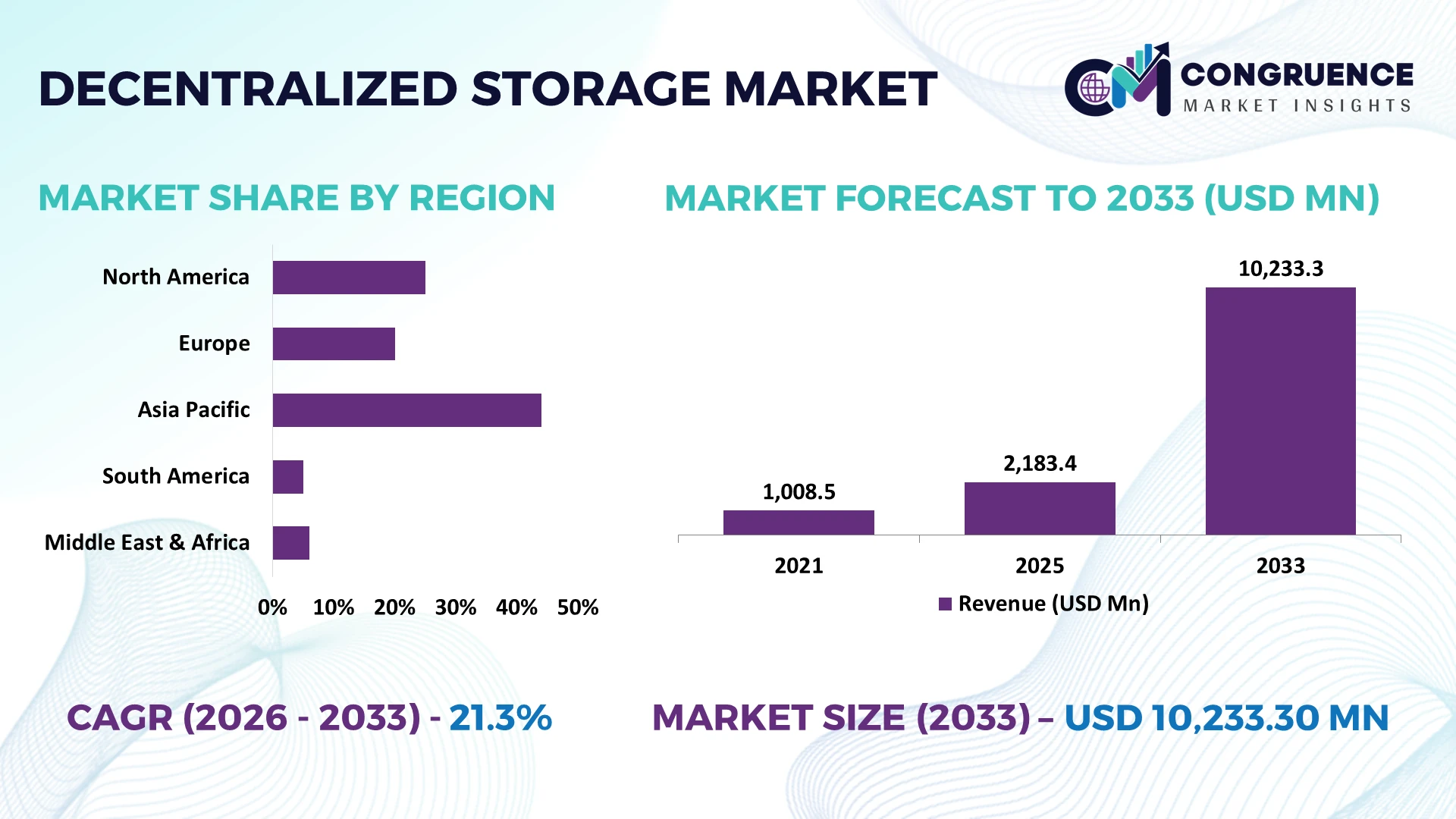
The Global Decentralized Storage Market was valued at USD 2183.4 Million in 2025 and is anticipated to reach a value of USD 10233.3 Million by 2033 expanding at a CAGR of 21.3% between 2026 and 2033. Growth is driven by distributed AI data storage, blockchain-based content addressing, enterprise backup diversification, and increasing adoption of cryptographically verifiable storage infrastructure.
The United States represents a leading innovation hub for decentralized storage, supported by Protocol Labs, Filecoin ecosystem development, and enterprise cloud infrastructure investment. Filecoin's network has historically provided storage capacity measured in multiple exbibytes, while Storj distributes encrypted data fragments across independent storage nodes. Compared with China, where cross-border data controls influence deployment, U.S. developers benefit from established venture capital networks and Web3 infrastructure partnerships. Storj's 80% erasure coding redundancy overhead provides a measurable architecture benchmark for distributed storage efficiency.
Strategically, infrastructure providers should prioritize verifiable storage, 80% redundancy overhead optimization, and enterprise-compatible data residency controls to capture demand from AI workloads and regulated industries.
Market Size & Growth: USD 2,183.4 million in 2025, reaching USD 10,233.3 million by 2033 at 21.3% CAGR, driven by verifiable cloud storage adoption.
Top Growth Drivers: Filecoin utilization reached 32%, following a 13% capacity contraction, while Storj's erasure coding reduces storage overhead approximately 8% versus triple replication.
Short-Term Forecast: By 2027, network operators target higher paid storage utilization, building on Filecoin's 2-percentage-point improvement during Q2 2025.
Emerging Technologies: Three innovations dominate: zero-knowledge proofs, AI-driven retrieval optimization, and programmable decentralized storage contracts.
Regional Leaders: Illustrative 2033 allocations include North America USD 3,889 million, Asia-Pacific USD 3,377 million, and Europe USD 2,661 million, reflecting enterprise, Web3, and compliance-focused adoption.
Consumer/End-User Trends: Filecoin's 32% network utilization in Q2 2025 highlights increasing emphasis on productive capacity rather than unused storage commitments.
Pilot/Case Example: Filecoin Onchain Cloud launched in November 2025, attracting over 100 early builders and integrations for programmable storage services.
Competitive Landscape: Filecoin leads in decentralized storage capacity alongside Storj, Sia, Arweave, and Crust Network; verified market shares remain unavailable.
Regulatory & ESG Impact: The EU Data Act became applicable in September 2025, introducing cloud switching requirements and strengthening data portability expectations.
Investment & Funding: Filecoin's 2025 ProPGF program allocated USD 3.68 million to 14 development teams, supporting infrastructure and ecosystem innovation.
Innovation & Future Outlook: Storj's 80-piece erasure coding reconstructs data using 29 pieces, enabling resilient distributed storage and advanced enterprise backup architectures.
The Global Decentralized Storage Market is transitioning from capacity-driven blockchain infrastructure toward commercially verifiable storage, enterprise data protection, and programmable cloud services. Demand is strengthening across AI dataset preservation, decentralized application hosting, media archives, and geographically distributed backup. Filecoin's storage utilization increased from 30% to 32% between the first and second quarters of 2025, demonstrating improved capacity efficiency despite infrastructure consolidation. Innovations in cryptographic storage proofs, S3-compatible interfaces, and automated data retrieval are reducing enterprise integration barriers. The emerging priority is converting distributed capacity into dependable, contract-backed services with measurable performance and compliance guarantees.
Decentralized storage is becoming strategically important as enterprises diversify cloud infrastructure, reduce platform dependency, and demand verifiable data integrity. The European Union's Data Act, applicable since September 2025, strengthens cloud switching and portability requirements, accelerating interest in interoperable storage architectures. Filecoin's network utilization reached approximately 32% during the second quarter of 2025, highlighting the transition from speculative infrastructure provisioning toward commercially productive capacity. Infrastructure providers are increasingly prioritizing enterprise compatibility, predictable retrieval performance, and cryptographically verified storage commitments.
Compared with conventional triple replication, which requires 200% storage overhead, Storj's 80-of-29 erasure coding configuration requires approximately 176% overhead, representing a 12% reduction in total physical storage requirements. The United States leads protocol development and enterprise integration, while Europe emphasizes data sovereignty and regulatory compliance. China maintains stricter cross-border data governance, influencing storage node placement and deployment architectures. These differences create distinct opportunities for geographically controlled decentralized storage services.
Between 2026 and 2028, competitive priorities will shift toward higher paid utilization, automated retrieval orchestration, and enterprise-grade service guarantees. Filecoin Onchain Cloud demonstrates practical integration of programmable storage with decentralized application infrastructure. Providers are strengthening S3-compatible gateways, developing verifiable storage services, and partnering with enterprise software platforms. Competitive leadership increasingly depends on converting distributed capacity into dependable, auditable, and commercially sustainable storage services.
Enterprise demand for cloud portability and cryptographically verifiable storage is strengthening decentralized infrastructure adoption. Filecoin's network utilization reached approximately 32% in the second quarter of 2025, increasing from 30% in the preceding quarter despite a reported 13% contraction in committed capacity. This demonstrates improving productive utilization rather than simple infrastructure expansion. The European Union's Data Act, applicable from September 2025, reinforces cloud switching and interoperability requirements, encouraging alternative storage architectures. Providers such as Filecoin ecosystem developers and Storj are expanding S3-compatible access, automated storage verification, and enterprise integration capabilities. The strategic advantage lies in reducing dependence on centralized storage vendors while providing independently verifiable data persistence and diversified infrastructure resilience.
Decentralized storage networks face structural limitations from underutilized capacity, variable provider incentives, and inconsistent commercial demand. Filecoin's approximately 32% utilization during the second quarter of 2025 indicates that roughly 68% of committed capacity remained outside reported utilized storage. Network capacity contracted approximately 13% during the quarter, highlighting infrastructure consolidation pressures. Storj's erasure coding configuration introduces approximately 176% storage overhead, requiring careful management of storage node economics despite resilience advantages. These conditions complicate predictable pricing and infrastructure investment decisions. In the United States, enterprise procurement teams additionally require contractual service guarantees and consistent retrieval performance. Providers are responding through capacity optimization, commercially backed storage contracts, geographic diversification, and improved storage provider incentive structures.
AI training datasets, distributed inference infrastructure, and verifiable digital archives create opportunities for programmable decentralized storage. Filecoin's utilization increased from 30% to 32% during the first half of 2025, demonstrating progress toward more productive network capacity. Storj's 29-of-80 reconstruction architecture allows recovery from approximately 36% of distributed fragments, supporting resilience against individual node failures. Emerging programmable storage contracts enable automated verification, payment settlement, and data retention enforcement. U.S. AI infrastructure developers increasingly require geographically distributed dataset preservation and independent integrity verification. Providers are investing in S3-compatible gateways, retrieval acceleration, and application programming interfaces. The strategic opportunity is combining cryptographic verification with conventional enterprise workflows rather than competing exclusively through storage capacity.
Delivering consistent enterprise-grade performance across independently operated storage nodes remains a significant execution challenge. Storj's 29-of-80 erasure coding design requires approximately 36% of fragments for reconstruction, but retrieval performance still depends on node availability, geographic distribution, and network conditions. Filecoin's 32% reported utilization demonstrates commercial adoption progress without establishing uniform service quality across providers. Europe's Data Act adds interoperability expectations, while GDPR obligations require careful management of personal data, encryption keys, and geographic processing arrangements. Operators must coordinate decentralized identity, access management, monitoring, and incident response across distributed infrastructure. Companies are investing in automated node selection, retrieval optimization, independent security audits, and contractual service frameworks. Long-term competitiveness depends on delivering predictable performance without compromising decentralization or regulatory accountability.
Enterprise Gateways Simplify Storage Integration: Decentralized storage providers are expanding S3-compatible interfaces to connect distributed networks with existing enterprise applications. Storj's 80-fragment erasure coding architecture reconstructs files from 29 fragments, requiring approximately 36% fragment availability. This enables resilient data access without maintaining three complete replicas. Providers are strengthening gateway automation, access controls, and application compatibility, reducing migration complexity for American enterprises while supporting hybrid infrastructure deployment.
Storage Provider Consolidation Improves Utilization: Filecoin's reported network utilization increased from approximately 30% in the first quarter of 2025 to 32% in the second quarter, while committed capacity contracted around 13%. These shifts reflect growing emphasis on productive storage rather than unused infrastructure commitments. Network operators are adjusting collateral management, optimizing hardware allocation, and prioritizing verified storage agreements. The operational benefit is stronger capacity discipline and improved alignment between infrastructure expenditure and customer workloads.
Data Portability Reshapes Procurement Requirements: The European Union's Data Act became applicable on September 12, 2025, strengthening cloud switching and interoperability obligations. Its framework includes a transition toward removing switching charges by January 2027, creating measurable procurement milestones. Decentralized storage companies are improving export interfaces, metadata portability, and standardized authentication workflows. European enterprises increasingly evaluate contractual portability alongside encryption and availability, encouraging suppliers to demonstrate practical migration capabilities rather than relying exclusively on decentralization claims.
Permanent Archiving Gains Commercial Focus: Arweave's permanent storage model and content-addressed retrieval are supporting long-duration digital preservation. Arweave uses a one-time storage payment structure, while Filecoin supports time-bounded storage agreements requiring renewal. These two distinct models influence lifecycle cost planning and retention policies. Providers are expanding archival integrations, retrieval indexing, and automated integrity checks. Media organizations and digital preservation operators benefit from clearer retention economics and reduced dependence on manually renewed storage contracts.
Blockchain-Based Storage Leads Verifiable Infrastructure Adoption
Blockchain-Based Storage represents the leading category within the defined segmentation framework, supported by cryptographic storage verification, programmable agreements, and distributed infrastructure participation. An indicative 35–40% market share represents an analytical estimate rather than independently verified segmentation data. Filecoin demonstrates the commercial importance of storage proofs and decentralized provider coordination. Its network utilization reached approximately 32% during the second quarter of 2025, indicating increasing emphasis on productive infrastructure. Manufacturers and protocol developers are prioritizing automated verification, enterprise access interfaces, and stronger storage provider economics.
Distributed Cloud Storage represents a potentially faster-growing category as enterprise customers prioritize application compatibility and geographically diversified infrastructure. Peer-to-Peer Storage maintains relevance for direct node communication and decentralized data exchange. Content-Addressable Storage supports immutable content identification, while Decentralized File Storage Networks enable distributed file persistence and retrieval. Storj's 29-of-80 reconstruction architecture demonstrates resilience through fragment distribution. Providers are expanding enterprise gateways, optimizing retrieval coordination, and strengthening commercial service guarantees. Investment priorities increasingly favor architectures combining cryptographic verification with dependable operational performance.
Data Backup and Recovery Anchors Enterprise Demand
Data Backup and Recovery represents the leading application category, supported by enterprise requirements for resilient storage, ransomware recovery, and geographically distributed data protection. An indicative 30–35% market share reflects an analytical allocation rather than independently verified application data. Decentralized storage architectures distribute encrypted fragments across independent infrastructure, reducing dependence on individual storage locations. Storj's erasure coding design reconstructs data using 29 of 80 fragments, supporting recovery despite substantial node unavailability. Providers are integrating automated backup workflows, S3-compatible access, and configurable retention policies to strengthen enterprise adoption.
Application and Web Hosting represents a potentially faster-growing application as decentralized services integrate programmable storage and distributed application infrastructure. Enterprise Data Storage emphasizes access control, performance consistency, and integration with existing systems. Content Delivery requires optimized retrieval latency and geographic distribution, while Archival Storage prioritizes integrity verification and predictable retention. Filecoin's reported utilization reached approximately 32% during the second quarter of 2025, highlighting improving infrastructure productivity. Suppliers are developing retrieval acceleration, application interfaces, and commercial service agreements. Competitive differentiation increasingly depends on matching decentralized architecture capabilities with specific enterprise workload requirements.
IT and Telecommunications Companies Lead Infrastructure Deployment
IT and Telecommunications Companies represent the leading end-user category, supported by distributed infrastructure operations, extensive data management requirements, and established technical integration capabilities. An indicative 30–35% market share reflects an analytical estimate rather than verified purchasing data. These organizations prioritize storage availability, network performance, and integration with existing infrastructure management systems. Filecoin's approximately 32% network utilization during the second quarter of 2025 illustrates the importance of commercially productive distributed capacity. Providers are strengthening application programming interfaces, automated monitoring, and enterprise service agreements to address technical procurement requirements.
Cloud Service Providers represent a potentially faster-growing end-user category as decentralized infrastructure becomes integrated into hybrid storage offerings. Banking and Financial Institutions prioritize encryption, auditability, and regulatory compliance. Media and Entertainment Companies require scalable content preservation and retrieval, while Healthcare Organizations emphasize sensitive data protection and controlled access. Government Agencies evaluate sovereignty, continuity, and long-term information integrity. Storj's 29-of-80 reconstruction model demonstrates resilience advantages for distributed infrastructure. Suppliers are developing sector-specific security controls, geographic placement policies, and enterprise partnerships to improve adoption across regulated and data-intensive organizations.
North America accounted for the largest estimated market share at 38% in 2025 however, Asia-Pacific is expected to register the fastest growth, expanding at an estimated CAGR of 24.5% between 2026 and 2033.
Enterprise Storage Integration Strengthens Distributed Infrastructure Leadership
North America represented an estimated 38% of the global decentralized storage market in 2025, supported by established cloud infrastructure, blockchain development, and enterprise software ecosystems. The United States concentrates major protocol development activities involving Filecoin, Storj, and Arweave, while Canada contributes cloud engineering expertise and distributed infrastructure participation. Enterprise adoption increasingly emphasizes S3-compatible access, encrypted storage fragmentation, and verifiable data retention. Filecoin's network utilization reached approximately 32% during the second quarter of 2025, highlighting improving productive infrastructure deployment. Storj's erasure coding architecture reconstructs data from 29 of 80 fragments, supporting resilience against individual node failures. Providers are expanding application integrations, automated storage verification, and commercial service agreements. Competitive differentiation increasingly depends on predictable retrieval performance, enterprise security controls, and compatibility with established cloud management systems.
United States Market Outlook: The United States benefits from established venture capital networks, advanced cloud engineering capabilities, and concentrated blockchain infrastructure development. Protocol Labs has supported Filecoin ecosystem innovation, while Storj focuses on enterprise-compatible distributed cloud storage. The United States accounted for approximately 40% of global private AI investment activity in 2024 by deal count estimates, supporting infrastructure demand. Providers prioritize developer tools, enterprise partnerships, and commercially dependable storage services.
Data Sovereignty Requirements Accelerate Interoperable Storage Deployment
Europe represented an estimated 26% of the global decentralized storage market in 2025, supported by data protection regulations, cloud modernization, and enterprise interest in infrastructure independence. Germany, France, the Netherlands, and the United Kingdom maintain established cloud engineering and distributed systems development capabilities. The European Union's Data Act became applicable on September 12, 2025, strengthening requirements for switching between data processing services. The regulation also establishes a transition toward eliminating switching charges from January 2027, influencing enterprise procurement and provider interoperability strategies. Decentralized storage developers are strengthening encryption management, geographic data placement, and standardized access interfaces. European enterprises increasingly evaluate storage portability alongside contractual transparency and operational resilience. Competitive opportunities concentrate on regulated workloads, auditable data persistence, and infrastructure architectures compatible with European data governance requirements.
Germany Market Outlook: Germany combines advanced industrial digitalization with strong data protection expectations and enterprise cloud modernization. The Federal Office for Information Security supports cybersecurity standards relevant to distributed infrastructure procurement. Germany's population exceeds 80 million, supporting substantial enterprise digital service demand. Storage developers are targeting manufacturing data archives, encrypted backup, and interoperable cloud infrastructure, emphasizing GDPR compliance, access governance, and verifiable data integrity.
Digital Infrastructure Expansion Strengthens Distributed Storage Adoption
Asia-Pacific accounted for an estimated 28% of the global decentralized storage market in 2025, supported by expanding cloud infrastructure, blockchain development, and growing digital content volumes. China, India, Japan, Singapore, and South Korea represent distinct deployment environments shaped by data localization requirements, enterprise modernization, and domestic technology ecosystems. China maintains substantial distributed computing capabilities, although cryptocurrency restrictions and cross-border data regulations influence blockchain infrastructure commercialization. India benefits from expanding digital services, software engineering capabilities, and cloud infrastructure investment. Singapore supports blockchain enterprise development through established financial technology and digital infrastructure ecosystems. India's Digital Personal Data Protection Act, enacted in 2023, strengthens the policy framework influencing enterprise data governance. Providers are developing geographically controlled storage architectures, developer integrations, and partnerships with regional technology firms. Competitive positioning increasingly depends on regulatory compatibility, infrastructure efficiency, and localized enterprise support.
China Market Outlook: China maintains extensive data center infrastructure, advanced telecommunications networks, and domestic distributed computing development capabilities. The country's Personal Information Protection Law and Data Security Law shape enterprise storage deployment and cross-border information management. China operates more than 3 million 5G base stations, supporting distributed digital infrastructure requirements. Domestic technology providers emphasize compliant data placement, enterprise storage management, and integration with established cloud platforms.
Cloud Modernization Creates Demand for Resilient Data Infrastructure
South America represented an estimated 5% of the global decentralized storage market in 2025, with Brazil, Argentina, Chile, and Colombia supporting emerging deployment opportunities. Brazil concentrates enterprise cloud investment, digital financial services, and data center development, creating opportunities for distributed backup and encrypted storage solutions. The Brazilian General Data Protection Law establishes requirements influencing personal data processing and storage governance. Chile benefits from established telecommunications infrastructure and increasing cloud service investment, while Colombia supports digital transformation across financial and enterprise services. Brazil's population exceeds 200 million, providing substantial digital service demand. However, uneven connectivity, infrastructure concentration, and enterprise integration costs constrain deployment economics. Providers are prioritizing regional storage partnerships, simplified application interfaces, and geographically diversified backup configurations to improve operational reliability.
Brazil Market Outlook: Brazil offers established financial technology activity, enterprise software development, and expanding data center infrastructure. Its Central Bank's Pix payment system processed more than 60 billion transactions during 2024, illustrating the scale of digital infrastructure activity. Decentralized storage providers can target encrypted backup, transaction record preservation, and resilient enterprise data management. Competitive adoption depends on local technical support, predictable pricing, and compliance with national data protection requirements.
Digital Sovereignty Investment Supports Distributed Infrastructure Modernization
Middle East & Africa represented an estimated 3% of the global decentralized storage market in 2025, supported by digital infrastructure investment in the United Arab Emirates, Saudi Arabia, South Africa, and selected technology hubs. Saudi Arabia's Vision 2030 encourages cloud infrastructure development and digital transformation, while the UAE supports blockchain innovation and advanced enterprise technology deployment. South Africa maintains established telecommunications networks and enterprise data center infrastructure. Regional adoption focuses on encrypted backup, digital asset preservation, and geographically controlled data management. The UAE's government blockchain initiatives have encouraged experimentation with distributed ledger applications, although blockchain adoption does not directly establish decentralized storage deployment. Providers are strengthening regional cloud partnerships, enterprise security capabilities, and local infrastructure integration. Competitive differentiation depends on regulatory alignment, data residency assurance, and dependable technical support.
United Arab Emirates Market Outlook: The UAE benefits from advanced telecommunications infrastructure, digital government initiatives, and established technology investment ecosystems. Dubai's blockchain strategy has supported distributed ledger experimentation across government and enterprise services. The UAE's internet penetration exceeds 95%, creating favorable conditions for digital infrastructure integration. Decentralized storage providers are targeting enterprise backup, digital content preservation, and verifiable records management, emphasizing security, interoperability, and local regulatory compliance.
Filecoin, Storj, Arweave, Sia, and Crust Network compete across verifiable storage, enterprise cloud integration, permanent archiving, and decentralized infrastructure economics. Their combined global market share remains unverified; an indicative 60–70% concentration would require transaction-level validation. Filecoin emphasizes cryptographic storage proofs and programmable infrastructure, while Storj competes through enterprise-compatible interfaces and erasure coding. Storj's 29-of-80 reconstruction architecture requires approximately 36% fragment availability, differentiating resilience economics. Filecoin's reported utilization reached 32% during the second quarter of 2025, highlighting commercial capacity optimization. Arweave targets permanent data preservation, whereas Sia emphasizes decentralized storage contracts. Providers are expanding developer ecosystems, enterprise partnerships, retrieval optimization, and automated storage management. Competition is shifting from committed capacity toward measurable service reliability and workload integration. Entry barriers include network liquidity, storage provider coordination, security assurance, and enterprise procurement requirements. Winning requires dependable retrieval, transparent economics, interoperability, and verifiable data integrity across demanding commercial workloads.
Protocol Labs
Storj Labs Inc.
Arweave
Sia Foundation
Crust Network
MaidSafe
Holo Limited
Akash Network
Bluzelle Networks
Pinata Technologies Inc.
Lighthouse Storage
Fleek Network
CESS Network
4EVERLAND
Current decentralized storage technologies combine cryptographic storage proofs, erasure coding, and distributed node orchestration to improve resilience and data integrity. Filecoin reported approximately 32% network utilization during the second quarter of 2025, indicating increasing productive capacity. Storj reconstructs files using 29 of 80 fragments, tolerating approximately 64% fragment unavailability. Compared with conventional triple replication, its configuration reduces physical storage requirements by approximately 8%, although network transfer costs and retrieval performance remain workload-dependent. Enterprise providers benefit through improved redundancy economics and flexible infrastructure sourcing.
Emerging technologies include programmable storage contracts, zero-knowledge verification, and automated retrieval optimization. Smart contracts coordinate storage commitments, payments, and verification without centralized settlement administration. Zero-knowledge techniques support selective disclosure of storage-related information, strengthening privacy-sensitive workflows. S3-compatible gateways connect decentralized networks with existing applications, reducing migration complexity. Adoption is progressing through production integrations, developer platforms, and geographically distributed storage services. Companies investing in automation and standardized interfaces gain advantages in enterprise procurement and service delivery.
Disruptive innovation increasingly connects decentralized storage with AI dataset provenance, permanent archives, and autonomous infrastructure management. Content-addressed retrieval verifies file identity independently of storage location, supporting trustworthy data distribution. Between 2026 and 2028, providers will prioritize predictable retrieval latency, automated integrity monitoring, and policy-controlled geographic placement. Competitive differentiation will depend on converting distributed capacity into measurable service reliability, contractual performance, and commercially sustainable infrastructure operations.
November 2025: Filecoin Foundation launched Filecoin Onchain Cloud, introducing programmable storage, retrieval, and verifiable payments. More than 100 early builders and integrations participated, strengthening developer access to decentralized infrastructure and supporting the transition toward commercially usable cloud services. Source: fil.org
February 2026: Storj announced a strategic partnership with TenrecX to distribute enterprise storage and compute solutions. The companies highlighted potential storage cost reductions of up to 80%, strengthening procurement access and positioning decentralized infrastructure against conventional hyperscale cloud providers. Source: storj.io
February 2025:AR.IO launched its permanent cloud mainnet on Arweave infrastructure, reporting over 1 million monthly active gateway users. The deployment expanded permanent data retrieval and application hosting capabilities, supporting commercial adoption of immutable storage and decentralized content services. Source: globenewswire.com
September 2025: Messari reported Filecoin network utilization reaching 32%, while daily new storage deals increased 25% during the second quarter. The findings documented improving infrastructure productivity despite capacity consolidation, highlighting stronger commercial demand for distributed storage workloads. Source: app.blockworks.com
The Decentralized Storage Market Report evaluates infrastructure commercialization, distributed storage technologies, enterprise adoption, and competitive development between 2026 and 2033. Coverage includes five storage types, five application categories, and six end-user groups. Analysis examines blockchain-based storage, peer-to-peer networks, distributed cloud infrastructure, content-addressable systems, and decentralized file storage networks. Application coverage spans backup, enterprise storage, content delivery, archival services, and application hosting across North America, Europe, Asia-Pacific, South America, and Middle East & Africa.
Technology assessment examines erasure coding, cryptographic verification, programmable storage contracts, and automated retrieval. Filecoin's 32% utilization benchmark supports analysis of infrastructure productivity and commercial adoption. Competitive evaluation addresses ecosystem partnerships, enterprise integration, regulatory compatibility, and emerging permanent storage services, supporting investment planning, geographic expansion, technology selection, and long-term positioning.
| Report Attribute/Metric | Report Details |
|---|---|
Market Revenue in 2025 | USD 2183.4 Million |
Market Revenue in 2033 | USD 10233.3 Million |
CAGR (2026 - 2033) | 21.3% |
Base Year | 2025 |
Forecast Period | 2026 - 2033 |
Historic Period | 2021 - 2025 |
Segments Covered | By Type
By Application
By End-User
|
Key Report Deliverable | Revenue Forecast, Growth Trends, Market Dynamics, Segmental Overview, Regional and Country-wise Analysis, Competition Landscape |
Region Covered | North America, Europe, Asia-Pacific, South America, Middle East, Africa |
Key Players Analyzed | Protocol Labs, Storj Labs Inc., Arweave, Sia Foundation, Crust Network, MaidSafe, Holo Limited, Akash Network, Bluzelle Networks, Pinata Technologies Inc., Lighthouse Storage, Fleek Network, CESS Network, 4EVERLAND |
Customization & Pricing | Available on Request (10% Customization is Free) |




