
Reports
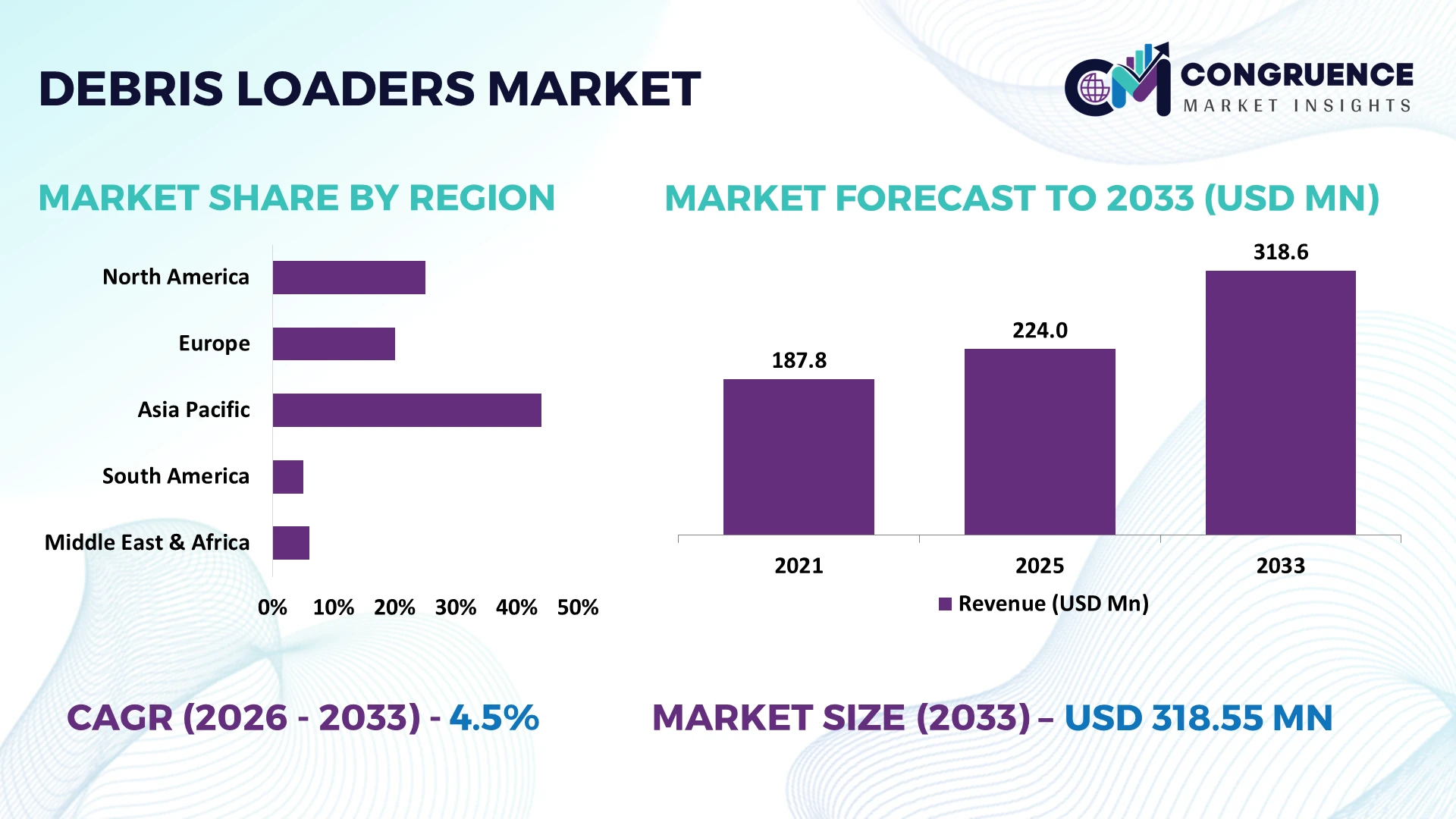
The Global Debris Loaders Market was valued at USD 224 Million in 2025 and is anticipated to reach a value of USD 318.55 Million by 2033 expanding at a CAGR of 4.5% between 2026 and 2033. Growth is driven by municipal leaf collection mechanization, landscaping labor constraints, storm debris clearance, and adoption of high suction loaders with larger impellers and hydraulic boom controls.
The United States commands approximately 45% of global demand, supported by more than 19,000 incorporated municipalities, extensive landscaping services, and recurring autumn leaf collection across northeastern and midwestern states. Commercial units increasingly use 18 to 35 horsepower engines and 12 to 16 inch intake hoses to accelerate curbside loading. Canada operates a smaller installed base but maintains strong municipal adoption in Ontario and Quebec. Post hurricane cleanup requirements and expanding wildfire vegetation management reinforce North American equipment utilization.
Manufacturers should prioritize United States municipal replacement cycles while developing quieter, lower emission platforms for increasingly regulated urban landscaping operations.
Market Size & Growth: USD 224 million in 2025 reaches USD 318.55 million by 2033 at 4.5% CAGR as municipalities mechanize seasonal debris collection.
Top Growth Drivers: Municipal mechanization contributes approximately 40%, landscaping labor optimization 35%, and storm cleanup requirements 25% of major purchasing momentum.
Short Term Forecast: By 2028, improved impeller geometry and hydraulic controls are positioned to increase collection productivity by approximately 12% while reducing manual handling.
Emerging Technologies: Electronic fuel injection, telematics, and advanced impeller designs are entering 20 plus horsepower commercial loaders, strengthening fuel management and equipment visibility.
Regional Leaders: By 2033, North America approaches USD 155 million, Europe USD 75 million, and Asia Pacific USD 55 million as mechanized landscaping expands.
Consumer/End User Trends: Municipal and professional landscaping buyers represent approximately 70% of demand, favoring tow behind and truck mounted equipment for intensive collection routes.
Pilot/Case Example: Modern 2025 commercial loaders using 14 inch intake hoses can process materially larger debris volumes than traditional 10 inch configurations, reducing collection passes.
Competitive Landscape: Billy Goat holds an estimated 15% position, competing with Scag, Little Wonder, XtremeVac, and Trac Vac across professional and municipal applications.
Regulatory & ESG Impact: California's small engine transition targets 100% zero emission new equipment where feasible, accelerating battery development across commercial landscaping equipment portfolios.
Investment & Funding: US infrastructure programs exceeding USD 1 trillion continue supporting municipal modernization, indirectly strengthening fleet replacement and public works equipment procurement.
Innovation & Future Outlook: Next generation debris loaders combine 2 to 3 digital functions including telematics, maintenance alerts, and operating hour tracking, shifting procurement toward lifecycle productivity.
The Debris Loaders Market is increasingly shaped by municipal sanitation fleets, professional landscaping contractors, campuses, parks, and storm cleanup operations requiring faster collection of leaves, grass, litter, and lightweight vegetation. Commercial equipment is moving toward larger 12 to 16 inch suction hoses, improved impeller geometry, hydraulic boom positioning, and connected maintenance monitoring. Municipal and professional users account for an estimated 70% of equipment demand. California's tightening small engine emissions framework is simultaneously pushing manufacturers toward lower emission and electrified platforms, establishing technology compliance and collection productivity as central strategic considerations.
Debris loaders are becoming strategically important as municipalities and landscaping contractors replace labor intensive collection with mechanized curbside workflows. Seasonal labor constraints, storm cleanup requirements, and tighter small engine regulation are changing equipment procurement. California’s transition away from newly manufactured small off road engines is particularly significant, pushing suppliers toward cleaner powertrains while fleet operators reassess replacement schedules and lifecycle costs.
Modern high capacity loaders using 14 to 16 inch intake hoses can deliver roughly 20% to 30% greater material throughput than legacy 10 to 12 inch configurations under comparable debris conditions. The United States leads deployment through established municipal leaf collection programs, while European demand emphasizes lower noise and emissions. Through 2028, electronic fuel injection, hydraulic boom control, telematics, and improved impeller geometry will increasingly influence fleet specifications.
A municipal crew pairing a truck mounted loader with automated hose positioning can consolidate curbside leaves directly into high capacity bodies, reducing manual handling and collection passes. Manufacturers are responding with larger impellers, replaceable wear liners, dealer service expansion, and lower emission platforms. Competitive positioning will increasingly depend on throughput per crew hour, regulatory compatibility, durability, and dependable aftermarket support.
Municipal leaf and vegetation collection is shifting toward mechanized loading as public works departments confront seasonal labor availability and tighter collection windows. High capacity debris loaders can reduce manual handling requirements by approximately 25% to 35%, while 14 to 16 inch intake hoses provide roughly 20% greater material handling capacity than smaller legacy configurations under suitable conditions. In the United States, more than 19,000 incorporated municipalities create a broad equipment replacement base, particularly across northeastern and midwestern leaf collection corridors. Storm cleanup following hurricanes and severe wind events further raises utilization beyond autumn collection. Manufacturers are responding with truck mounted configurations, hydraulic hose booms, replaceable wear liners, and dealer fleet programs. The strategic advantage is higher annual utilization from equipment capable of serving routine collection and emergency cleanup.
Powertrain regulation and equipment acquisition costs are reshaping purchasing economics for gasoline powered debris loaders. California’s small off road engine rules restrict newly manufactured spark ignition equipment subject to the regulation, forcing manufacturers and contractors to reconsider conventional engine portfolios. Commercial debris loaders commonly require engines above 18 horsepower, while battery alternatives must address sustained suction loads that can consume substantially more energy than handheld landscaping equipment. Electrified configurations can also carry equipment cost premiums exceeding 20% where high capacity batteries and charging infrastructure are required. This creates a difficult transition for smaller contractors operating narrow replacement budgets. Manufacturers are mitigating exposure through electronic fuel injection, engine supplier diversification, compliant product configurations, and electrification development. The critical constraint is achieving regulatory compliance without sacrificing continuous high airflow performance or extending fleet payback periods.
Electrification offers a differentiated opportunity where municipalities operate predictable routes, centralized depots, and defined daily collection windows. Electric drivetrains can eliminate direct tailpipe emissions and reduce powertrain maintenance requirements by approximately 20% because oil changes, fuel systems, and several combustion related service components disappear. Connected battery management can simultaneously track state of charge, operating temperature, and energy consumption across 100% of equipment cycles. California provides an early commercialization environment as landscaping fleets transition toward zero emission equipment and charging infrastructure expands. Suppliers are developing battery platforms, telematics, modular power systems, and depot charging partnerships rather than treating electrification as an isolated machine redesign. A non obvious opportunity lies in fleet energy management: manufacturers that integrate loaders with charging software can capture recurring digital services alongside equipment sales.
Maintaining commercial suction performance while electrifying debris loaders presents a different engineering challenge from converting handheld landscaping tools. Large impellers require sustained power for collection shifts lasting 6 to 8 hours, while wet leaves and compacted vegetation can increase airflow resistance and energy consumption by more than 15% under difficult operating conditions. Battery packs also add substantial mass, affecting trailer payload, axle configuration, and vehicle integration. California’s regulatory transition creates immediate pressure to solve these issues before zero emission alternatives achieve equivalent operating endurance. Manufacturers must invest in higher energy density batteries, rapid charging, efficient impellers, thermal management, and standardized fleet charging architecture. The decisive challenge is operational continuity: contractors will resist platforms requiring additional machines or extended charging interruptions to complete routes previously handled by one combustion powered loader.
Higher Capacity Collection Configurations: Contractors are shifting toward tow behind and truck mounted loaders using 14 to 16 inch intake hoses and engines exceeding 20 horsepower. Larger airflow systems can increase material handling capacity by roughly 15% to 25% versus smaller commercial configurations. Manufacturers are enlarging impellers, reinforcing housings, and improving hose support systems to shorten collection cycles without proportionally increasing crew size.
Wear Management Gains Procurement Weight: Replaceable liners, abrasion resistant impellers, and service access are becoming more influential as machines process leaves mixed with gravel, twigs, and roadside material. Modular wear components can reduce major housing replacement requirements by approximately 15% to 20%, while faster service access cuts maintenance interruption. Suppliers are redesigning intake paths and replaceable components around lifecycle economics rather than initial machine price.
Fleet Visibility Enters Equipment Workflows: Commercial operators increasingly combine hour meters, GPS fleet platforms, and digital maintenance records with debris collection equipment. Landscaping businesses already use inventory software at approximately 25% penetration and time tracking tools at 19%, supporting broader equipment digitization. Manufacturers and dealers are responding with maintenance alerts, fleet tracking compatibility, and service programs that improve utilization visibility across seasonal equipment portfolios.
Route Productivity Drives Buying Decisions: Staffing pressure is shifting procurement toward output per crew hour. In 2025, 55% of landscaping companies identified qualified employee availability as their leading concern, while equipment costs remained a major profitability consideration. Contractors are consequently standardizing higher throughput loaders and optimizing route allocation. Vendors are strengthening demonstrations, productivity benchmarking, financing, and dealer support to prove operating savings before fleet replacement decisions.
Tow Behind loaders account for approximately 38% of market demand, supported by flexible integration with dump trucks, collection boxes, and existing municipal fleet assets. Their detachable architecture reduces the need for dedicated vehicles while allowing commercial engines, larger impellers, and 12 to 16 inch intake hoses. Truck Mounted systems represent the fastest advancing type, particularly among municipalities and large contractors seeking consolidated collection workflows. Integrated configurations can reduce equipment repositioning and improve route productivity by approximately 15% compared with workflows requiring separate loading equipment.
Walk Behind loaders remain relevant for campuses, confined properties, and smaller landscaping operations where maneuverability outweighs maximum throughput. Self Propelled equipment occupies an emerging position between compact manual machines and vehicle based systems, supporting operators managing larger sites without dedicated trucks. Manufacturers are concentrating product development on reinforced impellers, hydraulic hose positioning, simplified mounting, and higher capacity collection bodies. Investment priorities are therefore moving toward configurations that maximize existing vehicle utilization while reducing labor movements between collection points.
Leaf Collection represents approximately 43% of debris loader demand because seasonal curbside accumulation creates concentrated requirements for high airflow collection and rapid truck loading. Municipal routes and commercial properties generate predictable autumn workloads where mechanized suction delivers greater throughput than manual bagging. Municipal Cleanup accounts for another significant application because equipment can support street, park, and public property maintenance beyond seasonal leaves. Lawn Cleanup remains established among landscaping contractors managing recurring maintenance accounts.
Storm Debris is the fastest advancing application as hurricanes, wind events, and severe storms increase requirements for rapid removal of leaves, small branches, and lightweight vegetation. Suitable high capacity systems can reduce collection time by approximately 20% to 30% compared with labor intensive handling under comparable conditions. Yard Waste provides broader seasonal utilization where communities separately collect organic material for processing or composting. Manufacturers are responding with stronger impellers, larger hoses, towable configurations, and truck integration, allowing one machine to cover routine landscaping and event driven cleanup workloads.
Municipalities represent approximately 35% of debris loader demand because scheduled leaf collection, street maintenance, park cleanup, and storm response create recurring equipment utilization across multiple departments. Their procurement favors tow behind and truck mounted systems capable of operating with existing dump bodies and public works vehicles. Landscaping Contractors follow closely and increasingly prioritize equipment productivity because direct labor remains their largest operating cost. Higher capacity loaders can reduce manual material handling by approximately 20% to 30% on suitable collection routes.
Landscaping Contractors represent the fastest advancing buyer group as workforce constraints push businesses toward mechanized workflows and standardized fleet productivity. Property Managers favor compact equipment for campuses and multifamily properties, while Parks Departments require maneuverable systems for extensive public grounds. Golf Courses emphasize controlled collection around maintained turf and restricted access areas. Manufacturers are targeting these differences through multiple hose diameters, mounting packages, dealer financing, demonstration programs, and application specific accessories, making configuration flexibility increasingly important to competitive positioning.
North America accounted for the largest market share at 46% in 2025 however, Asia Pacific is expected to register the fastest growth, expanding at a CAGR of 6.1% between 2026 and 2033.

Municipal Fleet Replacement Favors Higher Capacity Systems
North America represented approximately 46% of global debris loader demand in 2025, supported by mature municipal collection infrastructure, professional landscaping fleets, and recurring seasonal vegetation removal. United States municipalities increasingly specify tow behind and truck mounted units with 14 to 16 inch hoses, hydraulic boom assistance, and engines above 20 horsepower for curbside collection. Mechanized loading can reduce manual material handling by approximately 25% on suitable routes while enabling crews to consolidate leaves directly into high capacity bodies. Storm recovery following hurricanes and severe wind events extends equipment utilization beyond autumn collection. California’s small engine regulations are simultaneously changing procurement specifications, encouraging lower emission equipment development. Manufacturers are strengthening municipal dealer networks, replacement parts availability, financing, and demonstration programs focused on productivity per crew hour.
United States Market Outlook: The United States provides the strongest commercial base through more than 19,000 incorporated municipalities alongside extensive professional landscaping activity. Northeastern and Midwestern cities operate concentrated seasonal leaf collection programs, while southeastern states generate additional storm cleanup requirements. Equipment suppliers benefit from recurring fleet replacement, established truck infrastructure, and demand for high capacity machines capable of supporting multiple municipal functions.
Emission Compliance Reshapes Professional Equipment Procurement
Europe accounted for approximately 24% of global demand in 2025, with Germany, the United Kingdom, France, and the Netherlands supporting established professional landscaping and municipal maintenance activity. Equipment procurement increasingly emphasizes noise reduction, engine efficiency, operator ergonomics, and compatibility with urban environmental standards. EU Stage V requirements for non road mobile machinery have accelerated cleaner engine integration across applicable professional equipment categories, influencing powertrain selection and lifecycle fleet planning. Contractors operating in dense urban environments increasingly favor compact towable systems capable of navigating restricted streets while maintaining commercial suction performance. Organic waste separation policies also strengthen structured collection of leaves and vegetation for composting and processing. Manufacturers are responding with quieter engines, reinforced impellers, compact chassis designs, and dealer service partnerships that address increasingly demanding municipal procurement specifications.
Germany Market Outlook: Germany combines extensive municipal green space management with mature landscaping, composting, and organic waste infrastructure. The country separately collected approximately 12 million tonnes of biodegradable waste in recent years, demonstrating substantial material handling requirements. Professional equipment vendors can differentiate through low noise operation, efficient engines, durable wear components, and integration with established municipal vehicle fleets.
Urban Landscaping Mechanization Expands Equipment Addressability
Asia Pacific represented approximately 18% of global debris loader demand in 2025, led by Japan, Australia, China, and South Korea. Adoption is shifting from labor intensive grounds maintenance toward mechanized collection across municipal parks, commercial properties, campuses, and professionally managed landscapes. Japan’s aging workforce strengthens demand for equipment that reduces repetitive lifting and manual loading, while Australia requires rugged systems capable of processing leaves, vegetation, and lightweight storm material across extensive properties. China’s urban greening programs create substantial landscaping workloads, although equipment adoption remains fragmented across municipal contractors. Compact self propelled and tow behind platforms are gaining relevance where maneuverability is more important than maximum truck capacity. Manufacturers are expanding distributor relationships, adapting engines to local requirements, and offering modular collection systems suited to varying vehicle and labor structures.
Japan Market Outlook: Japan presents a strong automation case because approximately 29% of its population is aged 65 or above, intensifying workforce pressure across physical maintenance occupations. Compact mechanized debris collection reduces lifting and loading requirements in parks, institutional properties, and urban landscapes. Suppliers emphasizing maneuverability, low noise, reliability, and simplified controls are positioned strongly for professional fleet modernization.
Professional Landscaping Drives Selective Fleet Modernization
South America accounted for approximately 7% of global debris loader demand in 2025, with Brazil, Argentina, Chile, and Colombia providing the principal commercial opportunities. Deployment remains concentrated among municipal contractors, landscaping companies, parks, gated developments, and large institutional properties rather than broad residential use. Brazil offers the greatest operating scale because extensive urban green spaces and year round vegetation management create recurring cleanup requirements. Tow behind systems provide attractive economics where operators can integrate loaders with existing utility vehicles instead of purchasing dedicated collection trucks. Currency volatility, imported engine costs, and uneven dealer coverage constrain replacement cycles outside major metropolitan markets. Suppliers are therefore prioritizing durable mechanical designs, distributor inventories, interchangeable wear components, and equipment configurations that reduce dependence on specialized service infrastructure.
Brazil Market Outlook: Brazil combines large metropolitan maintenance requirements with extensive commercial landscaping and municipal park infrastructure. São Paulo alone maintains thousands of public green areas and street tree assets, generating continuous vegetation collection workloads. Local dealer capability, parts availability, engine serviceability, and equipment suited to high moisture organic debris remain decisive factors for converting manual cleanup into mechanized collection.
Managed Landscapes Create Concentrated Equipment Demand
Middle East and Africa represented approximately 5% of global demand in 2025, with deployment concentrated in the United Arab Emirates, Saudi Arabia, South Africa, and selected high investment urban centers. Unlike leaf intensive temperate markets, demand centers on landscaped developments, resorts, golf courses, municipal parks, and roadside vegetation maintenance. Saudi Arabia’s large urban greening programs are expanding professionally maintained landscape assets, creating demand for mechanized cleanup equipment capable of operating in dusty, high temperature conditions. Dubai and Abu Dhabi provide additional opportunities through intensive property management and tourism infrastructure. Equipment durability, filtration, cooling, and service accessibility carry greater procurement weight than seasonal throughput alone. Suppliers are adapting air filtration, engine protection, collection accessories, and distributor support for harsh operating environments and geographically concentrated professional fleets.
Saudi Arabia Market Outlook: Saudi Arabia offers a distinctive infrastructure led opportunity as Riyadh’s Green Riyadh program targets planting more than 7.5 million trees. Expanding parks, streetscape vegetation, and managed public spaces increase recurring organic debris handling requirements. Vendors offering heat tolerant engines, effective dust filtration, mobile servicing, and integration with municipal utility vehicles gain a stronger operational proposition.
Billy Goat, Scag, Little Wonder, XtremeVac, and Trac Vac compete across professional landscaping and municipal debris collection, while specialized equipment manufacturers challenge through application focused customization. The top five suppliers represent approximately 58% of market demand, reflecting established dealer networks and durable installed bases. Premium manufacturers differentiate through airflow performance, with larger intake configurations delivering roughly 20% higher throughput, while cost focused suppliers compete through simpler drivetrains and equipment prices approximately 10% to 15% lower. Companies are expanding truck mounted systems, hydraulic hose controls, reinforced impellers, dealer inventories, and municipal demonstration programs. Competition is shifting from engine horsepower toward collection productivity, wear resistance, regulatory compatibility, and lifecycle service. California engine regulation intensifies pressure for cleaner powertrains, while component availability remains critical during seasonal demand peaks. Entry barriers include specialized airflow engineering, commercial engine integration, dealer coverage, and replacement parts support. Winning requires measurable crew productivity, durable equipment, regulatory readiness, and dependable aftermarket service capabilities.
Billy Goat Industries
Scag Power Equipment
Little Wonder
XtremeVac
Trac Vac
Harper Industries
Giant Vac
Cyclone Rake
Agri Fab
DR Power Equipment
Woodland Power Products
Walinga
Pequea Machine
Echo Incorporated
Current debris loader technology centers on high airflow impellers, electronic fuel injection, reinforced wear liners, and truck mounting. Commercial systems now deliver roughly 2,100 to 6,900 CFM, while EFI can cut fuel consumption by up to 25% versus carbureted engines. Shredding reaches 12:1 to 15:1 volume reduction, allowing contractors to extend collection routes, reduce disposal trips, and improve truck utilization.
Emerging designs combine larger serrated impellers, anti clog discharge geometry, hydraulic hose handling, and modular self contained collection bodies. Compared with conventional 10 inch intake systems, 14 to 16 inch hoses increase intake area by more than 90%, improving bulky leaf handling where engine capacity supports airflow. Professional deployment increasingly favors 33 to 49 horsepower platforms for municipal workloads, giving fleet operators higher throughput and fewer interruptions during seasonal collection windows.
Disruptive development through 2026 to 2028 will center on electrified powertrains, connected diagnostics, engine management, and telemetry. Predictive service tools can target 10% to 15% lower unplanned downtime by identifying wear before failure. Municipalities benefit from emissions compliance, while contractors gain from route visibility and maintenance control. Suppliers integrating durable airflow hardware with digital fleet management will hold the strongest competitive advantage as procurement shifts toward lifecycle productivity overall.
May 2024 Billy Goat demonstrated its Leaf Dragon debris loader with the Hurricane P2000 blower as a cleanup workflow. The Leaf Dragon delivers 6,900 CFM, pairing high volume suction with mechanized pile movement to accelerate contractor and municipal collection productivity.
September 2025 Landscape Management highlighted Billy Goat’s Leaf Dragon with a 37 horsepower EFI engine delivering 6,900 CFM. Its 45 square foot operating coverage doubles typical reach, while EFI improves fuel efficiency by up to 25%, directly strengthening crew productivity.
March 2026 Foresteel introduced its Generation 2 debris loader range after thousands of hours of field feedback, adding Vanguard engines and replaceable Hardox wear liners. The redesign targets longer service life and lower ownership costs for intensive professional cleanup operations.
May 2024 Burlington, Massachusetts budgeted USD 20,000 to replace a leaf vacuum more than 10 years old with a Little Wonder truck loader. The replacement addressed repeated repairs and undersized capacity, demonstrating municipal movement toward higher productivity modern collection equipment.
The Debris Loaders Market Report evaluates Walk Behind, Tow Behind, Self Propelled, and Truck Mounted equipment across Leaf Collection, Lawn Cleanup, Yard Waste, Storm Debris, and Municipal Cleanup applications. End user coverage includes Landscaping Contractors, Municipalities, Property Managers, Parks Departments, and Golf Courses. Technology assessment examines high airflow impellers, EFI engines, 12:1 to 15:1 debris reduction, wear resistant liners, hydraulic hose handling, electrification, and connected fleet monitoring.
Regional analysis covers North America, Europe, Asia Pacific, South America, and Middle East and Africa, including country specific procurement and deployment patterns. Commercial platforms spanning approximately 2,100 to 6,900 CFM provide measurable performance benchmarks. The 2026 to 2033 framework evaluates fleet replacement, municipal mechanization, regulatory transitions, dealer infrastructure, product positioning, and technology priorities to support investment planning, geographic expansion, competitive benchmarking, and long term portfolio decisions.
| Report Attribute/Metric | Report Details |
|---|---|
Market Revenue in 2025 | USD 224 Million |
Market Revenue in 2033 | USD 318.55 Million |
CAGR (2026 - 2033) | 4.5% |
Base Year | 2025 |
Forecast Period | 2026 - 2033 |
Historic Period | 2021 - 2025 |
Segments Covered | By Type
By Application
By End-User
|
Key Report Deliverable | Revenue Forecast, Growth Trends, Market Dynamics, Segmental Overview, Regional and Country-wise Analysis, Competition Landscape |
Region Covered | North America, Europe, Asia-Pacific, South America, Middle East, Africa |
Key Players Analyzed | Billy Goat Industries, Scag Power Equipment, Little Wonder, XtremeVac, Trac Vac, Harper Industries, Giant Vac, Cyclone Rake, Agri Fab, DR Power Equipment, Woodland Power Products, Walinga, Pequea Machine, Echo Incorporated |
Customization & Pricing | Available on Request (10% Customization is Free) |




